Deledda International School


  Language loss and
cultural consequences


                                     Alessandra Giglio
                          TOK Seminar, 25 January 2013
Deledda International School


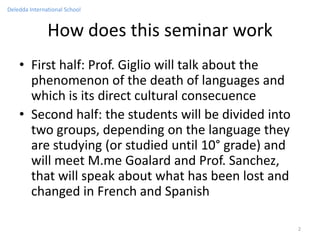
               How does this seminar work
    • First half: Prof. Giglio will talk about the
      phenomenon of the death of languages and
      which is its direct cultural consecuence
    • Second half: the students will be divided into
      two groups, depending on the language they
      are studying (or studied until 10° grade) and
      will meet M.me Goalard and Prof. Sanchez,
      that will speak about what has been lost and
      changed in French and Spanish

                                                       2
Deledda International School


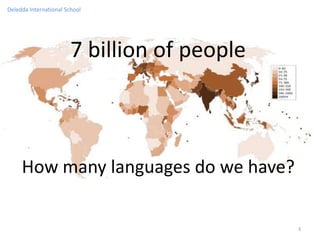
                        7 billion of people


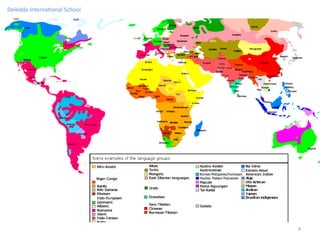
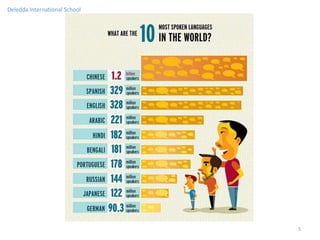
     How many languages do we have?

                                              3
Deledda International School


                               4
Deledda International School


                               5
Deledda International School


                               6
Deledda International School


                               Why?

     Because of the supremacy of Lingua Franca.


           (English, in this particular moment; French, in
                        the past; Spanish, even before, …)

                                                         7
Deledda International School


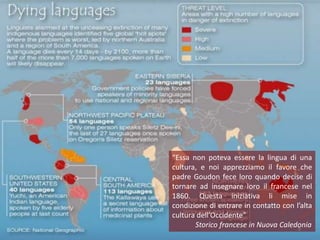
                               “Essa non poteva essere la lingua di una
                               cultura, e noi apprezziamo il favore che
                               padre Goudon fece loro quando decise di
                               tornare ad insegnare loro il francese nel
                               1860. Questa iniziativa li mise in
                               condizione di entrare in contatto con l’alta
                               cultura dell’Occidente”
                                      Storico francese in Nuova Caledonia
                                                                      8
Deledda International School


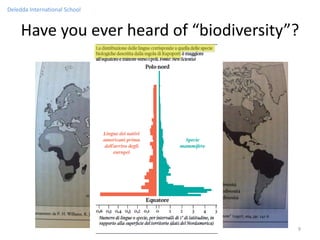
     Have you ever heard of “biodiversity”?


                                          9
Deledda International School


                   So, what’s the point here??!


       Not a big deal if we loose languages:
           we will communicate better
              in the future, that’s it.


                               No, it’s not.
                                                  10
Deledda International School


             “Rose is a rose is a rose is a rose”
                      …100% sure?!?
                                    G. Stein on Shakespeare’s inspiration


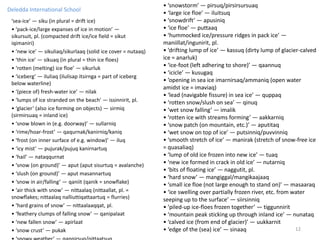
    • Inuit people have a lot of words to express all
      the concepts related to “snow”/”ice”


                                                                  11
• ‘snowstorm’ — pirsuq/pirsirsursuaq
Deledda International School
                                                               • ‘large ice floe’ — iluitsuq
 ‘sea-ice’ — siku (in plural = drift ice)                      • ‘snowdrift’ — apusiniq
 • ‘pack-ice/large expanses of ice in motion’ —                • ‘ice floe’ — puttaaq
 sikursuit, pl. (compacted drift ice/ice field = sikut         • ‘hummocked ice/pressure ridges in pack ice’ —
 iqimaniri)                                                    maniillat/ingunirit, pl.
 • ‘new ice’ — sikuliaq/sikurlaaq (solid ice cover = nutaaq)   • ‘drifting lump of ice’ — kassuq (dirty lump of glacier-calved
 • ‘thin ice’ — sikuaq (in plural = thin ice floes)            ice = anarluk)
 • ‘rotten (melting) ice floe’ — sikurluk                      • ‘ice-foot (left adhering to shore)’ — qaannuq
                                                               • ‘icicle’ — kusugaq
 • ‘iceberg’ — iluliaq (ilulisap itsirnga = part of iceberg
                                                               • ‘opening in sea ice imarnirsaq/ammaniq (open water
 below waterline)
                                                               amidst ice = imaviaq)
 • ‘(piece of) fresh-water ice’ — nilak
                                                               • ‘lead (navigable fissure) in sea ice’ — quppaq
 • ‘lumps of ice stranded on the beach' — issinnirit, pl.      • ‘rotten snow/slush on sea’ — qinuq
 • ‘glacier’ (also ice forming on objects) — sirmiq            • ‘wet snow falling’ — imalik
 (sirmirsuaq = inland ice)                                     • ‘rotten ice with streams forming’ — aakkarniq
 • ‘snow blown in (e.g. doorway)’ — sullarniq                  • ‘snow patch (on mountain, etc.)’ — aputitaq
 • ‘rime/hoar-frost’ — qaqurnak/kanirniq/kaniq                 • ‘wet snow on top of ice’ — putsinniq/puvvinniq
 • ‘frost (on inner surface of e.g. window)’ — iluq            • ‘smooth stretch of ice’ — manirak (stretch of snow-free ice
 • ‘icy mist’ — pujurak/pujuq kanirnartuq                      = quasaliaq)
 • ‘hail’ — nataqqurnat                                        • ‘lump of old ice frozen into new ice’ — tuaq
 • ‘snow (on ground)’ — aput (aput sisurtuq = avalanche)       • ‘new ice formed in crack in old ice’ — nutarniq
                                                               • ‘bits of floating ice’ — naggutit, pl.
 • ‘slush (on ground)’ — aput masannartuq
                                                               • ‘hard snow’ — mangiggal/mangikaajaaq
 • ‘snow in air/falling’ — qaniit (qanik = snowflake)
                                                               • ‘small ice floe (not large enough to stand on)’ — masaaraq
 • ‘air thick with snow’ — nittaalaq (nittaallat, pl. =        • ‘ice swelling over partially frozen river, etc. from water
 snowflakes; nittaalaq nalliuttiqattaartuq = flurries)         seeping up to the surface’ — siirsinniq
 • ‘hard grains of snow’ — nittaalaaqqat, pl.                  • ‘piled-up ice-floes frozen together’ — tiggunnirit
 • ‘feathery clumps of falling snow’ — qanipalaat              • ‘mountain peak sticking up through inland ice’ — nunataq
 • ‘new fallen snow’ — apirlaat                                • ‘calved ice (from end of glacier)’ — uukkarnit
 • ‘snow crust’ — pukak                                        • ‘edge of the (sea) ice’ — sinaaq                      12
Deledda International School

       Even if Stephen Pinker says this is not
                    really true…


                       But this is not the point: “you
                       invent the words to express [the
                       world around you]” S. Pinker


                        http://www.youtube.com/watch?v=K5ljEBkCeMQ


                                                                     13/23
Deledda International School


             “Rose is a rose is a rose is a rose”
                      …100% sure?!?

    • “C’è una tribù dell'Amazzonia che usa 16
      parole distinte per dire 'verde', mostrando
      grande attenzione per la realtà circostante: la
      nostra società occidentale invece guarda più
      allo specchio che alla finestra.”
                                        Niccolò Fabi


                                                    14
Deledda International School


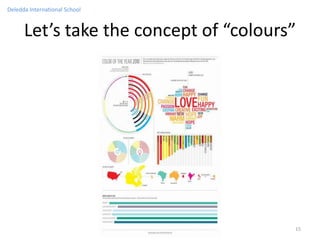
      Let’s take the concept of “colours”


                                        15
Deledda International School


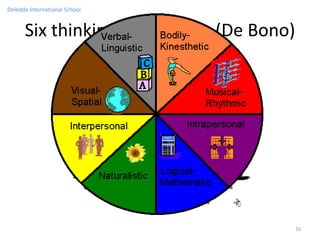
      Six thinking hats theory (De Bono)


                                           16
Deledda International School


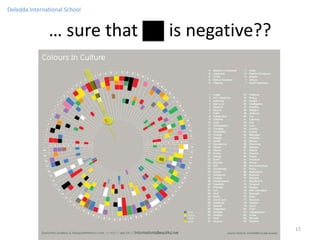
               … sure that     is negative??


                                               17
http://www.internazionale.it/opinioni/lee-marshall/2012/08/21/nel-blu-dipinto-di-azzurro/
Deledda International School


                   How to translate colours?

     […] andate a cercare l’icona di Twitter che sta laggiù da qualche parte. L’uccellino di che colore è? Non
     pensateci troppo: vi chiedo di nominare il colore non come adulti che hanno studiato la gamma pantone, ma
     come dei bambini, usando una delle dodici parole base per i colori che esistono in italiano.

     Per me, sia il colore di sfondo della testata [della rivista Internazionale, nda] sia l’uccellino di Twitter sono blue.
     Il primo è sicuramente un dark blue, con un tocco di cobalt o indigo. Il secondo, l’uccellino, si avvicina a un
     light blue, pur essendo un light blue piuttosto dark: in realtà, quasi un medium blue. Non so se vi ricordate (la
     nostra memoria informatica è notoriamente corta), ma fino a giugno di quest’anno l’uccellino Twitter era ben
     più light, e aveva anche un ciuffo in testa. Comunque, il concetto è questo: per un inglese come me, light blue,
     medium blue e dark blue sono gradazioni di un solo colore.

     In italiano ci sono due modi di tradurre l’inglese blue non qualificato da altro aggettivo: blu e azzurro. Lasciamo
     da parte il celeste, che sarebbe sempre tradotto in inglese con un blue accompagnato da qualche notazione:
     light blue, sky blue, eccetera. Potrei sbagliarmi, ma scommetto che per voi il colore dello sfondo della testata
     Internazionale è blu, mentre l’uccellino di Twitter è azzurro. Ditemi se sbaglio.


                                                                                                                                  18
Deledda International School


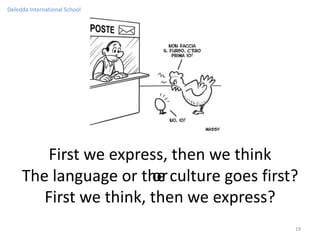
         First we express, then we think
                        or
     The language or the culture goes first?
        First we think, then we express?
                                           19
Deledda International School


                        Is a rose a rose a rose?
     Does all of this mean that language influences
     world’s perception? Or viceversa?


      “The limits of my language mean the limits of my world.”
                                                   L. Wittgenstein


                                                                20
Deledda International School


                               LAD
    • Noam Chomsky (1960) claims that we have a
      Language Acquisition Device in define
               Therefore, we don’t our brain. It is a
      cognitive, innate instinct that allow us to learn a
                         anything.
      language.The world (and the
    • A child basically has all the potential structures of
               language!) is already set
      all the languages incannot interfere he selects
               and we his brain; however,
      and uses only the structures that he hears.
               with that.
    • In this way, we learn the only language we are
      exposed to.
                                                         21/23
Deledda International School


    • Do different languages give us a different
      knowledge of the world?
    • Do you know differently in the different
      language you know?
    • Do we need to understand a culture, in order
      to understand a language?
    • Why do we have some concepts that seem
      universal?

                                                     22
Deledda International School


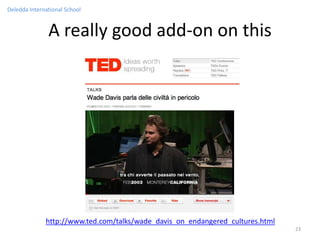
               A really good add-on on this


              http://www.ted.com/talks/wade_davis_on_endangered_cultures.html
                                                                                23
Deledda International School


                               Further materials
    • http://www.ted.com/talks/patricia_ryan_idea
      s_in_all_languages_not_just_english.html
    • http://www.youtube.com/watch?v=K5ljEBkCe
      MQ
    • D. Nettle, S. Romaine, Voci nel silenzio,
      Carocci, 2000, Roma


                                                   24
Deledda International School


                                   References
    •    http://infographiclabs.com/wp-content/uploads/2010/10/complex_world_langua
         ge_families-600x2480.jpg
    •    http://www.transparent.com/language-resources/infographic-speaking-of-languag
         es.jpg
    •    http://webmarketing.toweb.co/significato-colori-infografica/
    •    http://blog.focus.it/graphic-news/2012/02/21/il-significato-dei-colori-nel-mondo/
    •    http://affreschidigitali.blogosfere.it/galleria/2010/10/i-colori-piu-popolari-del-201
         0-e-il-loro-significato-quando-il-colore-rappresenta-il-mondo.html/2
    •    http://lizneale.files.wordpress.com/2011/10/32_large.jpg
    •    http://www.docstoc.com/docs/123680090/Linking-TOK-to-Language-B
    •    http://www.wikipedia.com
    •    http://www.dr-fdtc.com/cultural-differences/cd/ch3-03a.html
    •    http://johncarlosbaez.wordpress.com/2011/11/15/eskimo-words-for-snow/
    •    http://www.internazionale.it/opinioni/lee-marshall/2012/08/21/nel-blu-dipinto-di
         -azzurro/

    •    D. Nettle, S. Romaine, Voci nel silenzio, Carocci, 2000, Roma
    •    M. Pagel, “Un mondo di parole”, Internazionale, n. 983 anno 20
    •    D. McCandless, Information Is Beautiful, Rizzoli, 2011, Milano                     25
Language Loss and Cultural Consequences

  • 1.
    Deledda International School Language loss and cultural consequences Alessandra Giglio TOK Seminar, 25 January 2013
  • 2.
    Deledda International School How does this seminar work • First half: Prof. Giglio will talk about the phenomenon of the death of languages and which is its direct cultural consecuence • Second half: the students will be divided into two groups, depending on the language they are studying (or studied until 10° grade) and will meet M.me Goalard and Prof. Sanchez, that will speak about what has been lost and changed in French and Spanish 2
  • 3.
    Deledda International School 7 billion of people How many languages do we have? 3
  • 4.
  • 5.
  • 6.
  • 7.
    Deledda International School Why? Because of the supremacy of Lingua Franca. (English, in this particular moment; French, in the past; Spanish, even before, …) 7
  • 8.
    Deledda International School “Essa non poteva essere la lingua di una cultura, e noi apprezziamo il favore che padre Goudon fece loro quando decise di tornare ad insegnare loro il francese nel 1860. Questa iniziativa li mise in condizione di entrare in contatto con l’alta cultura dell’Occidente” Storico francese in Nuova Caledonia 8
  • 9.
    Deledda International School Have you ever heard of “biodiversity”? 9
  • 10.
    Deledda International School So, what’s the point here??! Not a big deal if we loose languages: we will communicate better in the future, that’s it. No, it’s not. 10
  • 11.
    Deledda International School “Rose is a rose is a rose is a rose” …100% sure?!? G. Stein on Shakespeare’s inspiration • Inuit people have a lot of words to express all the concepts related to “snow”/”ice” 11
  • 12.
    • ‘snowstorm’ —pirsuq/pirsirsursuaq Deledda International School • ‘large ice floe’ — iluitsuq ‘sea-ice’ — siku (in plural = drift ice) • ‘snowdrift’ — apusiniq • ‘pack-ice/large expanses of ice in motion’ — • ‘ice floe’ — puttaaq sikursuit, pl. (compacted drift ice/ice field = sikut • ‘hummocked ice/pressure ridges in pack ice’ — iqimaniri) maniillat/ingunirit, pl. • ‘new ice’ — sikuliaq/sikurlaaq (solid ice cover = nutaaq) • ‘drifting lump of ice’ — kassuq (dirty lump of glacier-calved • ‘thin ice’ — sikuaq (in plural = thin ice floes) ice = anarluk) • ‘rotten (melting) ice floe’ — sikurluk • ‘ice-foot (left adhering to shore)’ — qaannuq • ‘icicle’ — kusugaq • ‘iceberg’ — iluliaq (ilulisap itsirnga = part of iceberg • ‘opening in sea ice imarnirsaq/ammaniq (open water below waterline) amidst ice = imaviaq) • ‘(piece of) fresh-water ice’ — nilak • ‘lead (navigable fissure) in sea ice’ — quppaq • ‘lumps of ice stranded on the beach' — issinnirit, pl. • ‘rotten snow/slush on sea’ — qinuq • ‘glacier’ (also ice forming on objects) — sirmiq • ‘wet snow falling’ — imalik (sirmirsuaq = inland ice) • ‘rotten ice with streams forming’ — aakkarniq • ‘snow blown in (e.g. doorway)’ — sullarniq • ‘snow patch (on mountain, etc.)’ — aputitaq • ‘rime/hoar-frost’ — qaqurnak/kanirniq/kaniq • ‘wet snow on top of ice’ — putsinniq/puvvinniq • ‘frost (on inner surface of e.g. window)’ — iluq • ‘smooth stretch of ice’ — manirak (stretch of snow-free ice • ‘icy mist’ — pujurak/pujuq kanirnartuq = quasaliaq) • ‘hail’ — nataqqurnat • ‘lump of old ice frozen into new ice’ — tuaq • ‘snow (on ground)’ — aput (aput sisurtuq = avalanche) • ‘new ice formed in crack in old ice’ — nutarniq • ‘bits of floating ice’ — naggutit, pl. • ‘slush (on ground)’ — aput masannartuq • ‘hard snow’ — mangiggal/mangikaajaaq • ‘snow in air/falling’ — qaniit (qanik = snowflake) • ‘small ice floe (not large enough to stand on)’ — masaaraq • ‘air thick with snow’ — nittaalaq (nittaallat, pl. = • ‘ice swelling over partially frozen river, etc. from water snowflakes; nittaalaq nalliuttiqattaartuq = flurries) seeping up to the surface’ — siirsinniq • ‘hard grains of snow’ — nittaalaaqqat, pl. • ‘piled-up ice-floes frozen together’ — tiggunnirit • ‘feathery clumps of falling snow’ — qanipalaat • ‘mountain peak sticking up through inland ice’ — nunataq • ‘new fallen snow’ — apirlaat • ‘calved ice (from end of glacier)’ — uukkarnit • ‘snow crust’ — pukak • ‘edge of the (sea) ice’ — sinaaq 12
  • 13.
    Deledda International School Even if Stephen Pinker says this is not really true… But this is not the point: “you invent the words to express [the world around you]” S. Pinker http://www.youtube.com/watch?v=K5ljEBkCeMQ 13/23
  • 14.
    Deledda International School “Rose is a rose is a rose is a rose” …100% sure?!? • “C’è una tribù dell'Amazzonia che usa 16 parole distinte per dire 'verde', mostrando grande attenzione per la realtà circostante: la nostra società occidentale invece guarda più allo specchio che alla finestra.” Niccolò Fabi 14
  • 15.
    Deledda International School Let’s take the concept of “colours” 15
  • 16.
    Deledda International School Six thinking hats theory (De Bono) 16
  • 17.
    Deledda International School … sure that is negative?? 17
  • 18.
    http://www.internazionale.it/opinioni/lee-marshall/2012/08/21/nel-blu-dipinto-di-azzurro/ Deledda International School How to translate colours? […] andate a cercare l’icona di Twitter che sta laggiù da qualche parte. L’uccellino di che colore è? Non pensateci troppo: vi chiedo di nominare il colore non come adulti che hanno studiato la gamma pantone, ma come dei bambini, usando una delle dodici parole base per i colori che esistono in italiano. Per me, sia il colore di sfondo della testata [della rivista Internazionale, nda] sia l’uccellino di Twitter sono blue. Il primo è sicuramente un dark blue, con un tocco di cobalt o indigo. Il secondo, l’uccellino, si avvicina a un light blue, pur essendo un light blue piuttosto dark: in realtà, quasi un medium blue. Non so se vi ricordate (la nostra memoria informatica è notoriamente corta), ma fino a giugno di quest’anno l’uccellino Twitter era ben più light, e aveva anche un ciuffo in testa. Comunque, il concetto è questo: per un inglese come me, light blue, medium blue e dark blue sono gradazioni di un solo colore. In italiano ci sono due modi di tradurre l’inglese blue non qualificato da altro aggettivo: blu e azzurro. Lasciamo da parte il celeste, che sarebbe sempre tradotto in inglese con un blue accompagnato da qualche notazione: light blue, sky blue, eccetera. Potrei sbagliarmi, ma scommetto che per voi il colore dello sfondo della testata Internazionale è blu, mentre l’uccellino di Twitter è azzurro. Ditemi se sbaglio. 18
  • 19.
    Deledda International School First we express, then we think or The language or the culture goes first? First we think, then we express? 19
  • 20.
    Deledda International School Is a rose a rose a rose? Does all of this mean that language influences world’s perception? Or viceversa? “The limits of my language mean the limits of my world.” L. Wittgenstein 20
  • 21.
    Deledda International School LAD • Noam Chomsky (1960) claims that we have a Language Acquisition Device in define Therefore, we don’t our brain. It is a cognitive, innate instinct that allow us to learn a anything. language.The world (and the • A child basically has all the potential structures of language!) is already set all the languages incannot interfere he selects and we his brain; however, and uses only the structures that he hears. with that. • In this way, we learn the only language we are exposed to. 21/23
  • 22.
    Deledda International School • Do different languages give us a different knowledge of the world? • Do you know differently in the different language you know? • Do we need to understand a culture, in order to understand a language? • Why do we have some concepts that seem universal? 22
  • 23.
    Deledda International School A really good add-on on this http://www.ted.com/talks/wade_davis_on_endangered_cultures.html 23
  • 24.
    Deledda International School Further materials • http://www.ted.com/talks/patricia_ryan_idea s_in_all_languages_not_just_english.html • http://www.youtube.com/watch?v=K5ljEBkCe MQ • D. Nettle, S. Romaine, Voci nel silenzio, Carocci, 2000, Roma 24
  • 25.
    Deledda International School References • http://infographiclabs.com/wp-content/uploads/2010/10/complex_world_langua ge_families-600x2480.jpg • http://www.transparent.com/language-resources/infographic-speaking-of-languag es.jpg • http://webmarketing.toweb.co/significato-colori-infografica/ • http://blog.focus.it/graphic-news/2012/02/21/il-significato-dei-colori-nel-mondo/ • http://affreschidigitali.blogosfere.it/galleria/2010/10/i-colori-piu-popolari-del-201 0-e-il-loro-significato-quando-il-colore-rappresenta-il-mondo.html/2 • http://lizneale.files.wordpress.com/2011/10/32_large.jpg • http://www.docstoc.com/docs/123680090/Linking-TOK-to-Language-B • http://www.wikipedia.com • http://www.dr-fdtc.com/cultural-differences/cd/ch3-03a.html • http://johncarlosbaez.wordpress.com/2011/11/15/eskimo-words-for-snow/ • http://www.internazionale.it/opinioni/lee-marshall/2012/08/21/nel-blu-dipinto-di -azzurro/ • D. Nettle, S. Romaine, Voci nel silenzio, Carocci, 2000, Roma • M. Pagel, “Un mondo di parole”, Internazionale, n. 983 anno 20 • D. McCandless, Information Is Beautiful, Rizzoli, 2011, Milano 25