ENGLISH 540 SEMINAR IN
LINGUISTICS AND LANGUAGE STUDY:
   Intercultural Rhetoric and Discourse:
         Issues and Perspectives
AGENDA


1.  Welcome Back!
2.  Who are we? Six Word Memoir
3.  Goal of the class: Rationale, course materials
4.  Introduction of Modules
5.  Description of Course Projects
6.  Key concepts : Standard English, Standard English Ideology and World
    Englishes
7. In-class reading and discussion:
Pennycook, A. (2008). Translingual English. Australian Review of Applied
Linguistics, 31/2.
SIX WORD MEMOIR


             For Sale: Baby shoes. Never worn.—Hemingway
                        Lost voice. Gone to find it.
               Suddenly everyone seems younger than me.
                  Mother, teacher, writer. In this order.
                 My resolutions melted faster than snow.
                       Well, I am still here, are you?


Source: http://www.smithmag.net/sixwords/
COURSE RATIONALE


 This course provides an introduction to cross-cultural approaches to rhetoric,
language and literacy. Examining the effects of globalization on the use of
English, we will discuss various questions such as: How do people construct
written and spoken texts across linguistic, cultural and disciplinary boundaries?
How do our literacy practices (both first and second language) shape, and are
shaped by the discourse communities in which we participate? What are some
of the complex politics surrounding contrastive rhetoric? Understanding
language and rhetoric in terms of performativity and transculturation, the
main goal of this course is to construct a strong understanding of cross-
language and cross-cultural relations and promote more equitable discourses
and access to knowledge and knowledge construction. The approaches
covered in this course are grounded in the works of scholars in the areas of
critical applied linguistics (e.g., Canagarajah, Kachru, Matsuda, McKay,
Pennycook,), intercultural rhetoric (e.g., Atkinson, Connor, Kubota, Yu)
educational ethnography (e.g, Heath, Street, Bloome), and theories of critical
literacy as social justice (e.g., Street, Gee, Labov, Smitherman).
INTRODUCTION OF MODULES


       MODULE # 1: Translingualism and global Englishes.
                           Week 1-4
  MODULE # 2: From contrastive rhetoric to intercultural rhetoric.
                           Week 4-9
MODULE # 3: Ethnographic approaches to cross-cultural literacy practices.
                          Week 11-15
MODULE # 1: TRANSLINGUALISM
                       AND GLOBAL ENGLISHES


1.   Diversity among language varieties: English versus Englishes How do
     certain discourses denigrate vernacular varieties? How are the “acts of
     identities” (LaPage, 1985) affirmed or marginalized? What are the
     educational implications of privileging Standard American English over
     other vernacular varieties (even languages)?
2.   Language as performance: how do postcolonial speakers of English
     shuttle between communities? What’s the politics of English as a global
     language? What’s the role of popular culture in language change?
MODULE # 2: FROM CONTRASTIVE TO
                       INTERCULTURAL RHETORIC


1.   Cross-cultural issues in second language writing: How does culture matter
     in writing? How can we balance the complexity of vernacular culture with
     the expectations of the target audience (e.g. Standard Academic Writing)
     What are the implications of world Englishes on writing? How can we see
     language difference as a resource rather than a deficit?
2.   Methods in cross-cultural analysis: Text analysis, genre
     analysis, ethnographic approaches to text and context analysis.
MODULE # 3: ETHNOGRAPHIC
                    APPROACHES TO CROSS-CULTURAL
                         LITERACY PRACTICES.


1.   Literacy, discourse and politics: Debunking the myth that literacy as a
           mental phenomenon: What does the word literacy mean?
2. Discourse Analysis and Ethnography: how do we make sense of social
     languages and literacy practices in cross-cultural settings? How does
   ethnography help researchers understand complex issues around literacy
   and language? What are the difficulties of conducting ethnographic and
                         discourse analytic approaches?
COURSE PROJECTS


                Discussion Facilitation
                  Reading Responses
                  Book Club Activity
Intercultural analysis of spoken or written discourse
                    Final Project
KEY CONCEPTS FOR MODULE # 1
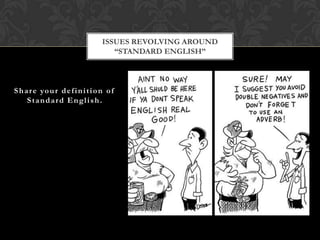
ISSUES REVOLVING AROUND
                                      “STANDARD ENGLISH”


S h a r e yo u r d e f i n i t i o n o f
     Standard English.
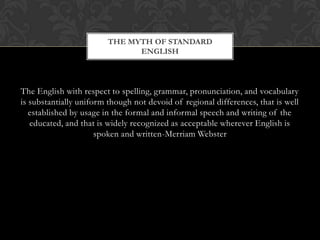
THE MYTH OF STANDARD
                               ENGLISH


The English with respect to spelling, grammar, pronunciation, and vocabulary
is substantially uniform though not devoid of regional differences, that is well
   established by usage in the formal and informal speech and writing of the
   educated, and that is widely recognized as acceptable wherever English is
                      spoken and written-Merriam Webster
DEFINITIONS BEAR
                        SIMILARITIES…


                     Carries the most prestige
                    The dialect of the educated
     Variety of English that is employed in written discourse
Grammar and lexical forms typically used by educated Native Speakers
LIPPI GREEN SAYS…


 “ a picture begins to emerge, Standard US English is the language spoken and
                               written by persons:
                         • With no regional accents;
                           • Who reside in Midwest
               • With more than average or superior education;
• Who pay attention to speech; and are not sloppy in terms of pronunciation or
                                      grammar
           • Who are easily understood by all.” (p. Green, 1997. 58)

•   “Standard and non-standard dichotomy is firmly entrenched both in literature
        and in the minds of the speakers, it is not possible to simply replace it.
     Mainstream English, as it is defined here, is an abstraction. It is an attempt to
    isolate from the full set of all varieties of US English those varieties which are
                             not overtly stigmatized.” (p. 62)
STANDARD LANGUAGE IDEOLOGY


A bias toward an abstracted, idealized, homogenous spoken language which is
             imposed and maintained by dominant institutions.

   Day-to-day devaluation of non-standard Englishes as “illogical”, “ugly”,
                       “unacceptable”, “incoherent”

              How is this ideology maintained and promoted?
     See the handout for Lippie Green’s language subordination process
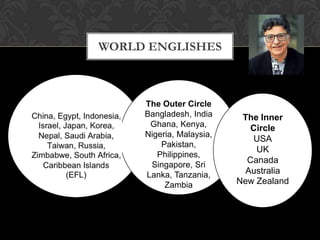
WORLD ENGLISHES

 Different varieties of Englishes around the globe--Linguistic diversity in
                           present-day English use.
   There are 350 million native English speakers living in the inner circle
                                    countries
There are 700 million non-native English speakers in the expanding and outer
                                circle countries.
 More non-native speakers than native speakers: About 80% of the English
        speakers of the world are non-native speakers (Braine, 2006)
  The concept of WE allows for varieties in English usage. It allows us to
                        pluralize English--Englishes
WORLD ENGLISHES


  The Expanding Circl e


          Chin
China, Egypt, Indonesia,
                                The Outer Circle
  Israel, Japan, Korea,
  Nepal, Saudi Arabia,          Bangladesh, India     The Inner
China, Egypt, Indonesia,
  Israel, Japan, Korea,
                                 Ghana, Kenya,          Circle
  Nepal, Saudi Arabia,
                                Nigeria, Malaysia,
    Taiwan, Russia,
Zimbabwe, South Africa,                                 USA
   Caribbean Islands                Pakistan,
         (EFL)
                                                         UK
    Taiwan, Russia,
                                   Philippines,
Zimbabwe, South Africa,
                                                       Canada
   Caribbean Islands
         (EFL)                   Singapore, Sri
  a, Egypt, Indonesia,
  Israel, Japan, Korea,
                                Lanka, Tanzania,      Australia
  Nepal, Saudi Arabia,
    Taiwan, Russia,
                                     Zambia          New Zealand
Zimbabwe, South Africa,
   Caribbean Islands
         (EFL)
KACHRU (1986). THE ALCHEMY OF
                          ENGLISH


“ Knowing English is like possessing the Aladdin’s lamp, which
     permits one to open, as it were, the linguistic gates to
international business, technology, service, science and travel”
                      (Kachru, 1986; p.1)
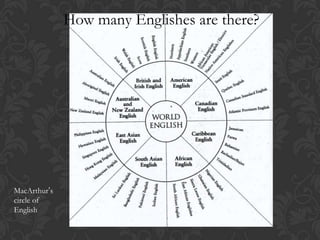
How many Englishes are there?


MacArthur’s
circle of
English
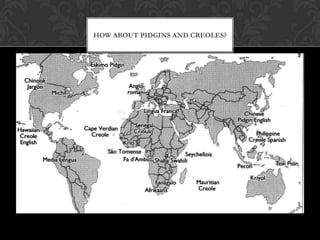
HOW ABOUT PIDGINS AND CREOLES?
EXAMPLE FROM HAWAIIAN
                           PIDGIN (A PRAYER)


God, you our Fadda. You stay inside da sky. We like all da peopo know fo shua
    how you stay, An dat you stay good an spesho, An we like dem give you
 plenny respeck. We like you come King fo everybody now. We like everybody
make jalike you like, Ova hea inside da world, Jalike da angel guys up inside da
    sky make jalike you like. Give us da food we need fo today an every day.
 Hemmo our shame, an let us go Fo all da kine bad stuff we do to you, Jalike
 us guys let da odda guys go awready, And we no stay huhu wit dem Fo all da
kine bad stuff dey do to us. No let us get chance fo do bad kine stuff, But take
us outa dea, so da Bad Guy no can hurt us. Cuz you our King. You get da real
                  power, An you stay awesome foeva. Dass it!”
                          Check out the speech archive:
                      http://accent.gmu.edu/browse.php
PENNYCOOK ARTICLE ON
                    TRANSLINGUALISM


       Read & Discuss Pennycook’s Translingualism article
(American Tongues—if time allows… if the majority did not see the
                   documentary before…)

540 week 1

  • 1.
    ENGLISH 540 SEMINARIN LINGUISTICS AND LANGUAGE STUDY: Intercultural Rhetoric and Discourse: Issues and Perspectives
  • 2.
    AGENDA 1. WelcomeBack! 2. Who are we? Six Word Memoir 3. Goal of the class: Rationale, course materials 4. Introduction of Modules 5. Description of Course Projects 6. Key concepts : Standard English, Standard English Ideology and World Englishes 7. In-class reading and discussion: Pennycook, A. (2008). Translingual English. Australian Review of Applied Linguistics, 31/2.
  • 3.
    SIX WORD MEMOIR For Sale: Baby shoes. Never worn.—Hemingway Lost voice. Gone to find it. Suddenly everyone seems younger than me. Mother, teacher, writer. In this order. My resolutions melted faster than snow. Well, I am still here, are you? Source: http://www.smithmag.net/sixwords/
  • 4.
    COURSE RATIONALE Thiscourse provides an introduction to cross-cultural approaches to rhetoric, language and literacy. Examining the effects of globalization on the use of English, we will discuss various questions such as: How do people construct written and spoken texts across linguistic, cultural and disciplinary boundaries? How do our literacy practices (both first and second language) shape, and are shaped by the discourse communities in which we participate? What are some of the complex politics surrounding contrastive rhetoric? Understanding language and rhetoric in terms of performativity and transculturation, the main goal of this course is to construct a strong understanding of cross- language and cross-cultural relations and promote more equitable discourses and access to knowledge and knowledge construction. The approaches covered in this course are grounded in the works of scholars in the areas of critical applied linguistics (e.g., Canagarajah, Kachru, Matsuda, McKay, Pennycook,), intercultural rhetoric (e.g., Atkinson, Connor, Kubota, Yu) educational ethnography (e.g, Heath, Street, Bloome), and theories of critical literacy as social justice (e.g., Street, Gee, Labov, Smitherman).
  • 5.
    INTRODUCTION OF MODULES MODULE # 1: Translingualism and global Englishes. Week 1-4 MODULE # 2: From contrastive rhetoric to intercultural rhetoric. Week 4-9 MODULE # 3: Ethnographic approaches to cross-cultural literacy practices. Week 11-15
  • 6.
    MODULE # 1:TRANSLINGUALISM AND GLOBAL ENGLISHES 1. Diversity among language varieties: English versus Englishes How do certain discourses denigrate vernacular varieties? How are the “acts of identities” (LaPage, 1985) affirmed or marginalized? What are the educational implications of privileging Standard American English over other vernacular varieties (even languages)? 2. Language as performance: how do postcolonial speakers of English shuttle between communities? What’s the politics of English as a global language? What’s the role of popular culture in language change?
  • 7.
    MODULE # 2:FROM CONTRASTIVE TO INTERCULTURAL RHETORIC 1. Cross-cultural issues in second language writing: How does culture matter in writing? How can we balance the complexity of vernacular culture with the expectations of the target audience (e.g. Standard Academic Writing) What are the implications of world Englishes on writing? How can we see language difference as a resource rather than a deficit? 2. Methods in cross-cultural analysis: Text analysis, genre analysis, ethnographic approaches to text and context analysis.
  • 8.
    MODULE # 3:ETHNOGRAPHIC APPROACHES TO CROSS-CULTURAL LITERACY PRACTICES. 1. Literacy, discourse and politics: Debunking the myth that literacy as a mental phenomenon: What does the word literacy mean? 2. Discourse Analysis and Ethnography: how do we make sense of social languages and literacy practices in cross-cultural settings? How does ethnography help researchers understand complex issues around literacy and language? What are the difficulties of conducting ethnographic and discourse analytic approaches?
  • 9.
    COURSE PROJECTS Discussion Facilitation Reading Responses Book Club Activity Intercultural analysis of spoken or written discourse Final Project
  • 10.
    KEY CONCEPTS FORMODULE # 1
  • 11.
    ISSUES REVOLVING AROUND “STANDARD ENGLISH” S h a r e yo u r d e f i n i t i o n o f Standard English.
  • 12.
    THE MYTH OFSTANDARD ENGLISH The English with respect to spelling, grammar, pronunciation, and vocabulary is substantially uniform though not devoid of regional differences, that is well established by usage in the formal and informal speech and writing of the educated, and that is widely recognized as acceptable wherever English is spoken and written-Merriam Webster
  • 13.
    DEFINITIONS BEAR SIMILARITIES… Carries the most prestige The dialect of the educated Variety of English that is employed in written discourse Grammar and lexical forms typically used by educated Native Speakers
  • 14.
    LIPPI GREEN SAYS… “ a picture begins to emerge, Standard US English is the language spoken and written by persons: • With no regional accents; • Who reside in Midwest • With more than average or superior education; • Who pay attention to speech; and are not sloppy in terms of pronunciation or grammar • Who are easily understood by all.” (p. Green, 1997. 58) • “Standard and non-standard dichotomy is firmly entrenched both in literature and in the minds of the speakers, it is not possible to simply replace it. Mainstream English, as it is defined here, is an abstraction. It is an attempt to isolate from the full set of all varieties of US English those varieties which are not overtly stigmatized.” (p. 62)
  • 15.
    STANDARD LANGUAGE IDEOLOGY Abias toward an abstracted, idealized, homogenous spoken language which is imposed and maintained by dominant institutions. Day-to-day devaluation of non-standard Englishes as “illogical”, “ugly”, “unacceptable”, “incoherent” How is this ideology maintained and promoted? See the handout for Lippie Green’s language subordination process
  • 16.
    WORLD ENGLISHES Differentvarieties of Englishes around the globe--Linguistic diversity in present-day English use. There are 350 million native English speakers living in the inner circle countries There are 700 million non-native English speakers in the expanding and outer circle countries. More non-native speakers than native speakers: About 80% of the English speakers of the world are non-native speakers (Braine, 2006) The concept of WE allows for varieties in English usage. It allows us to pluralize English--Englishes
  • 17.
    WORLD ENGLISHES The Expanding Circl e Chin China, Egypt, Indonesia, The Outer Circle Israel, Japan, Korea, Nepal, Saudi Arabia, Bangladesh, India The Inner China, Egypt, Indonesia, Israel, Japan, Korea, Ghana, Kenya, Circle Nepal, Saudi Arabia, Nigeria, Malaysia, Taiwan, Russia, Zimbabwe, South Africa, USA Caribbean Islands Pakistan, (EFL) UK Taiwan, Russia, Philippines, Zimbabwe, South Africa, Canada Caribbean Islands (EFL) Singapore, Sri a, Egypt, Indonesia, Israel, Japan, Korea, Lanka, Tanzania, Australia Nepal, Saudi Arabia, Taiwan, Russia, Zambia New Zealand Zimbabwe, South Africa, Caribbean Islands (EFL)
  • 18.
    KACHRU (1986). THEALCHEMY OF ENGLISH “ Knowing English is like possessing the Aladdin’s lamp, which permits one to open, as it were, the linguistic gates to international business, technology, service, science and travel” (Kachru, 1986; p.1)
  • 19.
    How many Englishesare there? MacArthur’s circle of English
  • 20.
    HOW ABOUT PIDGINSAND CREOLES?
  • 21.
    EXAMPLE FROM HAWAIIAN PIDGIN (A PRAYER) God, you our Fadda. You stay inside da sky. We like all da peopo know fo shua how you stay, An dat you stay good an spesho, An we like dem give you plenny respeck. We like you come King fo everybody now. We like everybody make jalike you like, Ova hea inside da world, Jalike da angel guys up inside da sky make jalike you like. Give us da food we need fo today an every day. Hemmo our shame, an let us go Fo all da kine bad stuff we do to you, Jalike us guys let da odda guys go awready, And we no stay huhu wit dem Fo all da kine bad stuff dey do to us. No let us get chance fo do bad kine stuff, But take us outa dea, so da Bad Guy no can hurt us. Cuz you our King. You get da real power, An you stay awesome foeva. Dass it!” Check out the speech archive: http://accent.gmu.edu/browse.php
  • 22.
    PENNYCOOK ARTICLE ON TRANSLINGUALISM Read & Discuss Pennycook’s Translingualism article (American Tongues—if time allows… if the majority did not see the documentary before…)

Editor's Notes

  • #6 I am hoping that by focusing on these modules, we will transcend the disciplinary boundaries that are oftenimposed to us and help us see new ways of looking at language, culture and discourse.
  • #7 This module will revolve around the unidirectional spread of English language worldwide. We will specifically discuss proliferation of English use from the historical, political, socio-cultural perspective and discuss how the emergence of new varieties create hybrid discourses, new linguistic identities where many non-standard users of English find themselves in an asymmetrical power relationships. The readings we will address the dilemmas posed by language and globalizationWe will continue to explore different ways of looking at language…we will collectively think about is the definition of language as a social activity, as a performance…Drawing from Judith Butler’s definition of gender as a performance, Pennycook defines “Languages are no more pregiven entities that pre-exist our linguistic performances than are gendered or ethnic identities. Rather they are sedimented products of repeated acts of identity (p. 73) Looking at language from this perspective avoids essentialist and pregiven categories of identities.
  • #8 The second module is closely intersects with the first in that we will look at how culture impacts writing of individuals who use Standard English as their second language or additional variation in their language repertoire. James Gee says that any time we speak or write we make sure of two things: 1) We must make clear who we are and we must make clear what we are doing? But in the context of English use as a global language we have multiple whos and multiple, and we often time have to negotiate who we are as scholars, mothers, writers in order to be perceived as legitimate participant of a community of practice. In this module, the act of writing is also seen as a representation of identity. So we will discuss how binary distinctions on student writing is created.
  • #15 So in this picture Green says that accent and non-standard English usage fall into the domain of uneducated, or sloppy users of English—The judgmental tone is evident in these definitions. It is carefully propagated by institutions by limiting the use of nonstandard varieties. This ideology empowers certain individuals and institutions.
  • #16 Pervasive belief about the superiority of an abstracted and idealized form of language, based on the spoken language of the upper middle classes—This ideology is maintained by the dominant groups. Those who believe in this ideology work to promote their own interests at the expense of marginalized AND ,noNdominant groups.
  • #17 The spread of English since 18th century led to emergence of world Englishes.