Supporting Self-regulated Learning
through Digital Badges: a Case Study
S. Cucchiara, A. Giglio, D. Persico, J. Raffaghelli
National Research Council of Italy – Institute for Educational Technologies (ITALY)
Who are we?
http://images.cdn.fotopedia.com/flickr-2879644822-original.jpg
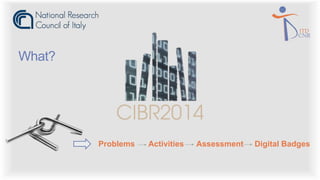
Problems Activities Assessment Digital Badges
What?
How? (1)
How? (2)
How? (3)
When?
VS
VS
For questions, doubts, more information, you can e-mail us to:
{cucchiara, giglio, persico, raffaghelli} @ itd.cnr.it

OBIE2014 - Supporting Self-regulated Learning Through Digital Badges: a Case Study

Editor's Notes

  • #4 BASIC ASSUMPTIONS ON SRL Self-regulated learning (SRL) takes place when individuals plan, monitor and evaluate their own learning experiences. Learning assessment plays a crucial role in this process because it provides an excellent basis for the above three phases of SRL; however, the identification, design and implementation of meaningful assessment activities is not easy and some technological affordances for an SRL-sensitive assessment design still need to be explored. Although Digital Badges are already considered an instrument that could provide good answers to the complex problem of assessment for learning, their potential for SRL support is rather under-explored. This paper puts forward a proposal on the role that Digital Badges can play in supporting SRL.
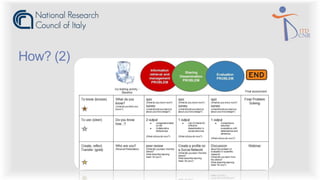
  • #5 The proposal consists in a “badge ecosystem”, developed for a course on “Scientific Information for Biomedical Research”, aimed at differentiating among different levels of competence to facilitate learners in making better informed decisions on how to go about in their learning process. Each course module has been designed following a Problem-based-learning. For each of the problems tackled in the three modules described in §2, a specific assessment activity is provided. Each assessment activity leads to the achievement of a Digital Badge.
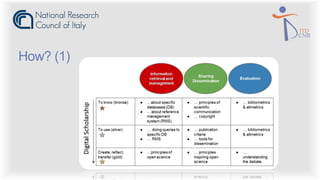
  • #6 Therefore, we designed a “structure” where course contents, activities and expected learning outcomes are clearly aligned and explicit to learners. Such a “structure” is composed of: a) a Competence Map, with three levels of competence
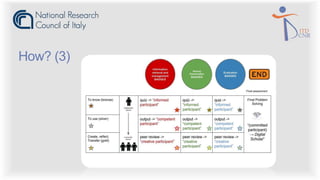
  • #7 b) the assessment activities, aligning with the Knowledge and the Competence Map, where for every competence and level there is a specific type of assessment activity
  • #8 c) the badge ecosystem, consisting on one badge per type of competence