What do Sociolinguistics
study?
Chapter one
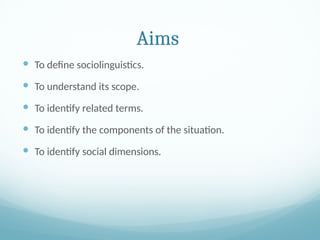
Aims
 To define sociolinguistics.
 To understand its scope.
 To identify related terms.
 To identify the components of the situation.
 To identify social dimensions.
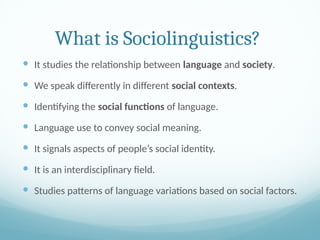
What is Sociolinguistics?
 It studies the relationship between language and society.
 We speak differently in different social contexts.
 Identifying the social functions of language.
 Language use to convey social meaning.
 It signals aspects of people’s social identity.
 It is an interdisciplinary field.
 Studies patterns of language variations based on social factors.
People
Examples
 Address forms: provides non-linguistic information about
relations that govern the situation.
Mrs. Walker
Margaret Meg Mum
Sweetie madam
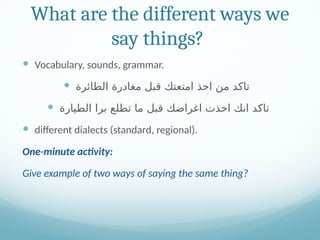
What are the different ways we
say things?
 Vocabulary, sounds, grammar.
 ‫الطائرة‬ ‫مغادرة‬ ‫قبل‬ ‫امتعتك‬ ‫اخذ‬ ‫من‬ ‫تاكد‬
 ‫الطيارة‬ ‫برا‬ ‫تطلع‬ ‫ما‬ ‫قبل‬ ‫اغراضك‬ ‫اخذت‬ ‫انك‬ ‫تاكد‬
 different dialects (standard, regional).
One-minute activity:
Give example of two ways of saying the same thing?
Terms
 Variety (code): any set of linguistic forms that patterns
according to social factors (p.6). It refers to language in social
context. It includes accents, style, dialects and languages.
 Linguistic (verbal) repertoire: the range of varieties from
which people select according to the context in which they
are communicating. It is acquired as part of our knowledge.
(P.8)
 In monolingual communities dialects.
 In multilingual communities languages.
Linguistic variation
 Reflects social factors:
1- Vocabulary or word choice
2- Pronunciation
3- Grammar
4- Conversational practices.
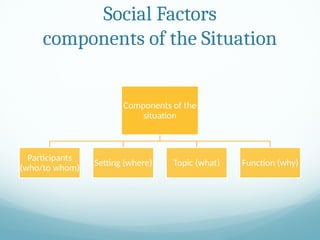
Social Factors
components of the Situation
Components of the
situation
Participants
(who/to whom)
Setting (where) Topic (what) Function (why)
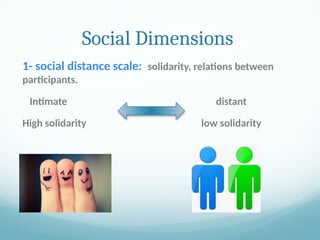
Social Dimensions
1- social distance scale: solidarity, relations between
participants.
Intimate distant
High solidarity low solidarity
2- The Status Scale
 Relations between participants.
Superior high status
Subordinate low status
3- The Formality Scale
 Related to the setting
formal high formality
Informal low formality
4- Two-Functional Scales
 Related to purpose of interaction.
High information referential low information
content content
Low affective affective high affective
content content
How to investigate it?
 We identify the linguistic variety involved (language).
 We identify different social or non-linguistic factors (society).
Sociolinguistics aims at developing a theory of how language is
used in a community.
The end
 The definition of sociolinguistics.
 Its importance and scope.
 Social factors (the components of the situation).
 Social dimensions.
H.W. draw a mind map summarizing chapter one.

3014949_sociolinguistics chapter one.pptx

  • 1.
  • 2.
    Aims  To definesociolinguistics.  To understand its scope.  To identify related terms.  To identify the components of the situation.  To identify social dimensions.
  • 3.
    What is Sociolinguistics? It studies the relationship between language and society.  We speak differently in different social contexts.  Identifying the social functions of language.  Language use to convey social meaning.  It signals aspects of people’s social identity.  It is an interdisciplinary field.  Studies patterns of language variations based on social factors.
  • 4.
  • 5.
    Examples  Address forms:provides non-linguistic information about relations that govern the situation. Mrs. Walker Margaret Meg Mum Sweetie madam
  • 6.
    What are thedifferent ways we say things?  Vocabulary, sounds, grammar.  ‫الطائرة‬ ‫مغادرة‬ ‫قبل‬ ‫امتعتك‬ ‫اخذ‬ ‫من‬ ‫تاكد‬  ‫الطيارة‬ ‫برا‬ ‫تطلع‬ ‫ما‬ ‫قبل‬ ‫اغراضك‬ ‫اخذت‬ ‫انك‬ ‫تاكد‬  different dialects (standard, regional). One-minute activity: Give example of two ways of saying the same thing?
  • 7.
    Terms  Variety (code):any set of linguistic forms that patterns according to social factors (p.6). It refers to language in social context. It includes accents, style, dialects and languages.  Linguistic (verbal) repertoire: the range of varieties from which people select according to the context in which they are communicating. It is acquired as part of our knowledge. (P.8)  In monolingual communities dialects.  In multilingual communities languages.
  • 8.
    Linguistic variation  Reflectssocial factors: 1- Vocabulary or word choice 2- Pronunciation 3- Grammar 4- Conversational practices.
  • 9.
    Social Factors components ofthe Situation Components of the situation Participants (who/to whom) Setting (where) Topic (what) Function (why)
  • 10.
    Social Dimensions 1- socialdistance scale: solidarity, relations between participants. Intimate distant High solidarity low solidarity
  • 11.
    2- The StatusScale  Relations between participants. Superior high status Subordinate low status
  • 12.
    3- The FormalityScale  Related to the setting formal high formality Informal low formality
  • 13.
    4- Two-Functional Scales Related to purpose of interaction. High information referential low information content content Low affective affective high affective content content
  • 14.
    How to investigateit?  We identify the linguistic variety involved (language).  We identify different social or non-linguistic factors (society). Sociolinguistics aims at developing a theory of how language is used in a community.
  • 15.
    The end  Thedefinition of sociolinguistics.  Its importance and scope.  Social factors (the components of the situation).  Social dimensions. H.W. draw a mind map summarizing chapter one.