Dialects and sociolects
Approaches to Language
Birkbeck, University of London
4 July 2013
Dr Simone Bacchini
simobac@gmail.com
Aims:
① To introduce and describe the notion of “language
variation” and related technical terminology
② To explore two constructs: “dialect” and “sociolect”
③ To outline some of the implications of the above
Dr Simone Bacchini-Approaches to
Language
04/07/2013
Language:
1. “The phenomenon of
vocal and written [and
signed] communication
among human beings
generally” (Matthews,
2007: 215)
2. A form of communication;
a system of “signs”. A
communicative
behaviour.
1. In the ordinary sense, a
particular language,
identified by a name:
English, French, Swahili.
lengua; lingua – as in 1
lenguaje; linguaggio as in 2
Dr Simone Bacchini-Approaches to
Language
04/07/2013
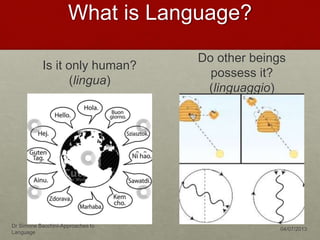
What is Language?
Is it only human?
(lingua)
Do other beings
possess it?
(linguaggio)
Dr Simone Bacchini-Approaches to
Language
04/07/2013
(A) Human language is a
complex system
But is it uniform and unchanging?
A language is inherently variant; it varies across time
(diachronically)
and across both geographical and social space
(synchronically)
Dr Simone Bacchini-Approaches to
Language
04/07/2013
Synchronic variation
Across geographical space
Dialect: “Any distinct variety of a
language, especially one spoken in a
specific part of a country or other
geographical area” (Matthews, 2007:
103)
Dialectal variation can occur at the
levels of:
① Phonology (the sound system)
② Syntax (sentence structure)
③ Lexicon/morphology (the
words)
PHONOLOGY of modern English dialects.
(Trudgill, 1999a: 52)
• but pronounced as /bʊt/ or /bʌt/
• arm pronounced as /a:rm/ or /a:m/
• path pronounced /pɑθ/ or /pæθ/
SYNTAX :North of England: lack of
inversion/auxilaries in wh-questions: e.g.
What Ø you doing? (Beal, 2010: 26)
LEXICON: US lift/UK elevator;
Dr Simone Bacchini-Approaches to
Language
04/07/2013
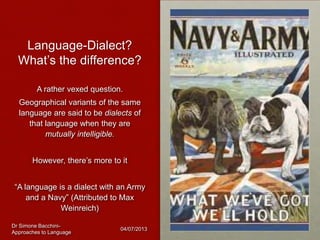
Language-Dialect?
What’s the difference?
A rather vexed question.
Geographical variants of the same
language are said to be dialects of
that language when they are
mutually intelligible.
However, there’s more to it
“A language is a dialect with an Army
and a Navy” (Attributed to Max
Weinreich)
Dr Simone Bacchini-
Approaches to Language
04/07/2013
Variation across
social groups
Sociolect: differences in speech
associated with a social group or
class (Wardhaugh, 2010: 46).
A problem:
Social group or class hard to define
Social dialectology = the study of
variation along social lines.
Dr Simone Bacchini-
Approaches to Language
04/07/2013
(a) Language is inherently
varied
At any one time
(synchronically) various
linguistic forms coexist, within
speakers and social groups
Both dialects and sociolects
are porous; there is
“exchange”
Local variants may be
adopted as social variants
Speakers and groups may
adopt own or “foreign” to
‘perform’ identity
“It is impossible for an
Englishman to open his
mouth without making
some other Englishman
despise him” George
Bernard Shaw
Dr Simone Bacchini-Approaches to
Language
04/07/2013
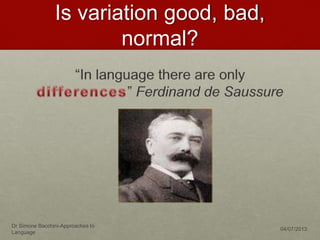
Is variation good, bad,
normal?
04/07/2013
Dr Simone Bacchini-Approaches to
Language
Any questions?
Dr Simone Bacchini-Approaches to
Language
04/07/2013
References:
• Beal, C. J. (2010). An Introduction to Regional
Englishes. Edinburg: Edinburgh University
Press.
• Matthews, P. H. (2007). Oxford Concise
Dictionary of Linguistics, 2nd ed. Oxford: Oxford
University Press.
• Wardhaugh, R. (2010). An Introduction to
Sociolinguistics, 6th ed. Oxford: Wiley-Blackwell.

DialectsAndSociolects

  • 1.
    Dialects and sociolects Approachesto Language Birkbeck, University of London 4 July 2013 Dr Simone Bacchini simobac@gmail.com
  • 2.
    Aims: ① To introduceand describe the notion of “language variation” and related technical terminology ② To explore two constructs: “dialect” and “sociolect” ③ To outline some of the implications of the above Dr Simone Bacchini-Approaches to Language 04/07/2013
  • 3.
    Language: 1. “The phenomenonof vocal and written [and signed] communication among human beings generally” (Matthews, 2007: 215) 2. A form of communication; a system of “signs”. A communicative behaviour. 1. In the ordinary sense, a particular language, identified by a name: English, French, Swahili. lengua; lingua – as in 1 lenguaje; linguaggio as in 2 Dr Simone Bacchini-Approaches to Language 04/07/2013
  • 4.
    What is Language? Isit only human? (lingua) Do other beings possess it? (linguaggio) Dr Simone Bacchini-Approaches to Language 04/07/2013
  • 5.
    (A) Human languageis a complex system But is it uniform and unchanging? A language is inherently variant; it varies across time (diachronically) and across both geographical and social space (synchronically) Dr Simone Bacchini-Approaches to Language 04/07/2013
  • 6.
    Synchronic variation Across geographicalspace Dialect: “Any distinct variety of a language, especially one spoken in a specific part of a country or other geographical area” (Matthews, 2007: 103) Dialectal variation can occur at the levels of: ① Phonology (the sound system) ② Syntax (sentence structure) ③ Lexicon/morphology (the words) PHONOLOGY of modern English dialects. (Trudgill, 1999a: 52) • but pronounced as /bʊt/ or /bʌt/ • arm pronounced as /a:rm/ or /a:m/ • path pronounced /pɑθ/ or /pæθ/ SYNTAX :North of England: lack of inversion/auxilaries in wh-questions: e.g. What Ø you doing? (Beal, 2010: 26) LEXICON: US lift/UK elevator; Dr Simone Bacchini-Approaches to Language 04/07/2013
  • 7.
    Language-Dialect? What’s the difference? Arather vexed question. Geographical variants of the same language are said to be dialects of that language when they are mutually intelligible. However, there’s more to it “A language is a dialect with an Army and a Navy” (Attributed to Max Weinreich) Dr Simone Bacchini- Approaches to Language 04/07/2013
  • 8.
    Variation across social groups Sociolect:differences in speech associated with a social group or class (Wardhaugh, 2010: 46). A problem: Social group or class hard to define Social dialectology = the study of variation along social lines. Dr Simone Bacchini- Approaches to Language 04/07/2013
  • 9.
    (a) Language isinherently varied At any one time (synchronically) various linguistic forms coexist, within speakers and social groups Both dialects and sociolects are porous; there is “exchange” Local variants may be adopted as social variants Speakers and groups may adopt own or “foreign” to ‘perform’ identity “It is impossible for an Englishman to open his mouth without making some other Englishman despise him” George Bernard Shaw Dr Simone Bacchini-Approaches to Language 04/07/2013
  • 10.
    Is variation good,bad, normal? 04/07/2013 Dr Simone Bacchini-Approaches to Language
  • 11.
    Any questions? Dr SimoneBacchini-Approaches to Language 04/07/2013 References: • Beal, C. J. (2010). An Introduction to Regional Englishes. Edinburg: Edinburgh University Press. • Matthews, P. H. (2007). Oxford Concise Dictionary of Linguistics, 2nd ed. Oxford: Oxford University Press. • Wardhaugh, R. (2010). An Introduction to Sociolinguistics, 6th ed. Oxford: Wiley-Blackwell.