Download to read offline






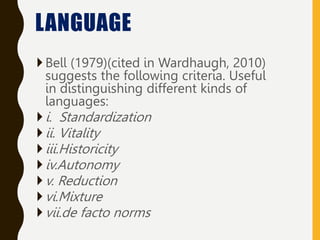
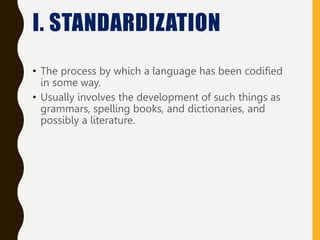







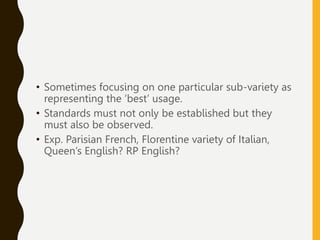

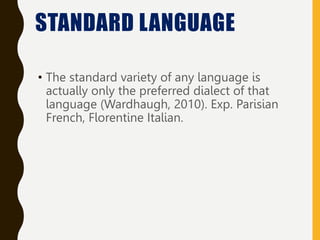





This document discusses the differences between languages and dialects. It explains that a dialect is a subordinate variety of a language, while the standard variety of a language is the preferred dialect that has been chosen for political, social or economic reasons to serve as the model or norm. The document also discusses criteria for distinguishing languages from dialects, such as standardization, vitality, historicity, autonomy, and de facto norms. Regional dialects are defined as geographical variations in how a language is spoken, while accent refers to differences in pronunciation but not grammar or vocabulary.


