Language assistance
through design
Taapsi Ramchandani
Center for Civic Design
civicdesign.org
EAC Language Summit, 2017
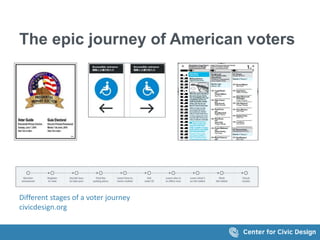
The epic journey of American voters
Different stages of a voter journey
civicdesign.org
Inviting LEP voters to participate in
our elections
A pleasurable voting experience is when an LEP voter can:
 Find the information she needs
 Find the information in her own
language
 Mark her ballots as she intends
“Can I fit five
languages?”
Language support requires space
on paper
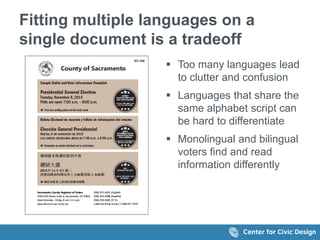
Fitting multiple languages on a
single document is a tradeoff
 Too many languages lead
to clutter and confusion
 Languages that share the
same alphabet script can
be hard to differentiate
 Monolingual and bilingual
voters find and read
information differently
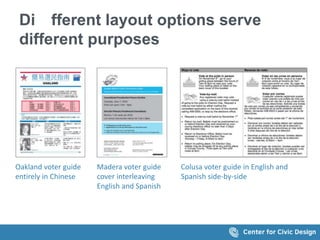
Di fferent layout options serve
different purposes
Oakland voter guide
entirely in Chinese
Madera voter guide
cover interleaving
English and Spanish
Colusa voter guide in English and
Spanish side-by-side
“How do I present
each language?”
Information must be clearly
visible, in all languages
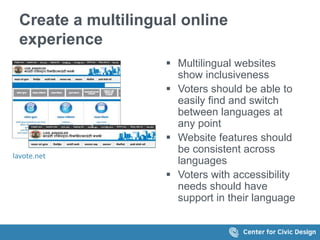
Create a multilingual online
experience
lavote.net
 Multilingual websites
show inclusiveness
 Voters should be able to
easily find and switch
between languages at
any point
 Website features should
be consistent across
languages
 Voters with accessibility
needs should have
support in their language
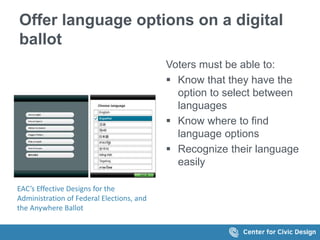
Offer language options on a digital
ballot
EAC’s Effective Designs for the
Administration of Federal Elections, and
the Anywhere Ballot
Voters must be able to:
 Know that they have the
option to select between
languages
 Know where to find
language options
 Recognize their language
easily
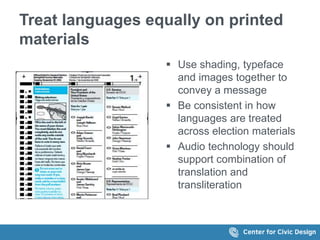
Treat languages equally on printed
materials
 Use shading, typeface
and images together to
convey a message
 Be consistent in how
languages are treated
across election materials
 Audio technology should
support combination of
translation and
transliteration
”Can my election
department handle
it?”
Voting systems should be able to
support language assistance
today and in the future
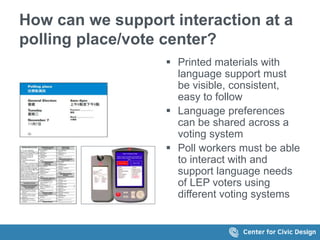
How can we support interaction at a
polling place/vote center?
 Printed materials with
language support must
be visible, consistent,
easy to follow
 Language preferences
can be shared across a
voting system
 Poll workers must be able
to interact with and
support language needs
of LEP voters using
different voting systems
Get in touch!
Taapsi Ramchandani
taapsi@civicdesign.org
@digitaldidi
@civicdesign
Field Guides to Ensuring Voter
Intent have general guidelines
for voter education and ballot
design best practices
http://civicdesign.org/fieldguides

Language assistance through design

  • 1.
    Language assistance through design TaapsiRamchandani Center for Civic Design civicdesign.org EAC Language Summit, 2017
  • 2.
    The epic journeyof American voters Different stages of a voter journey civicdesign.org
  • 3.
    Inviting LEP votersto participate in our elections A pleasurable voting experience is when an LEP voter can:  Find the information she needs  Find the information in her own language  Mark her ballots as she intends
  • 4.
    “Can I fitfive languages?” Language support requires space on paper
  • 5.
    Fitting multiple languageson a single document is a tradeoff  Too many languages lead to clutter and confusion  Languages that share the same alphabet script can be hard to differentiate  Monolingual and bilingual voters find and read information differently
  • 6.
    Di fferent layoutoptions serve different purposes Oakland voter guide entirely in Chinese Madera voter guide cover interleaving English and Spanish Colusa voter guide in English and Spanish side-by-side
  • 7.
    “How do Ipresent each language?” Information must be clearly visible, in all languages
  • 8.
    Create a multilingualonline experience lavote.net  Multilingual websites show inclusiveness  Voters should be able to easily find and switch between languages at any point  Website features should be consistent across languages  Voters with accessibility needs should have support in their language
  • 9.
    Offer language optionson a digital ballot EAC’s Effective Designs for the Administration of Federal Elections, and the Anywhere Ballot Voters must be able to:  Know that they have the option to select between languages  Know where to find language options  Recognize their language easily
  • 10.
    Treat languages equallyon printed materials  Use shading, typeface and images together to convey a message  Be consistent in how languages are treated across election materials  Audio technology should support combination of translation and transliteration
  • 11.
    ”Can my election departmenthandle it?” Voting systems should be able to support language assistance today and in the future
  • 12.
    How can wesupport interaction at a polling place/vote center?  Printed materials with language support must be visible, consistent, easy to follow  Language preferences can be shared across a voting system  Poll workers must be able to interact with and support language needs of LEP voters using different voting systems
  • 13.
    Get in touch! TaapsiRamchandani taapsi@civicdesign.org @digitaldidi @civicdesign Field Guides to Ensuring Voter Intent have general guidelines for voter education and ballot design best practices http://civicdesign.org/fieldguides

Editor's Notes

  • #2 Language support is about two things really - coverage (making sure the people who need the most assistance are identified) and implementation (making sure they can vote as they intend). This is where this presentation comes in –it comes out of a more extensive paper that examines the gaps in how election materials support language needs and requirements, and especially how smaller jurisdictions can make incremental changes to how LEP voters interact with their election materials.
  • #3 The journey from deciding to vote to actually voting doesn’t necessarily follow a linear path. In fact, it possibly rarely does. At any of these touchpoints in the voter journey, language access is critical. For election officials, language access is crucial to how a good voting system should function – everything from the ballot display to marking, reviewing, and casting paper or digital ballots, and also tracking those ballots, including vote-by-mail or provisional ballots.
  • #4 Your job as an election official is a tough one! You have to incorporate legal obligations, design requirements, election deadlines, policy changes, printing costs, recruitment and also language needs of your community into the voting experience. We at CCD are interested in supporting the work you do by looking at how LEP voters interact with your election materials and perhaps offering suggestions on how that interaction can be improved. We are focusing on the presentation of election materials – How can we present clear, consistent information every time, no matter where that voter is in her journey – it could be a voter guide, could be a sample or real ballot, it could be an election website. How can we do a better job in how we invite LEP voters to participate in our elections?
  • #5 In this presentation, I focus on three big hurdles election officials face when offering language support, in printed and digital form. The first one is about real estate.
  • #6 A Los Angeles County study showed that voters had a tougher time differentiating between languages that shared a similar script (like English and Spanish) compared to languages in non-similar scripts.
  • #7 Different layout options - different documents, sections, side-by-side, interleaving, or split top and bottom CCD’s study on voter guides in California showed bilingual voters preferred side-by-side layouts while monolingual voters preferred organization by language rather than topic (separate English and non-English sections). (Also issue of trust with side-by-side layout) CCD also recommends that certain pages of election materials like the cover sheet, inside front cover, pamphlets and some form layouts are best supported by interleaving – you don’t want to flip through two cover pages or two table of contents for example.
  • #8 The next big issue is about equality of presentation. How can we serve the needs of both English and non-English speakers in the same materials?
  • #9 Let’s start with the easiest – a unique language experience online. If your site is accessible (as is required by law) and it supports multiple languages, then you are, in effect, supporting people with disabilities in all languages. You are doing a good job!
  • #10 Digital ballots have similar language considerations as multilingual websites. LEP voters may also have low digital literacy. A good digital experience is one that supports plain interaction.
  • #12 The third issue is about scalability and changes to the voting system in the future.
  • #13 Sharing across voting system - We can already start to think about synergies between different aspects of a voting system – can an LEP voter’s language preference be shared between an electronic poll book and voting machines or ballot marking devices? Poll workers – Can they correctly identify a paper ballot in a different language? Can they identify a language on a ballot printed on demand or using a ballot marking device?
  • #14 These are just a handful of issues that we’re researching about language assistance. Let me leave you with this - offering consistent language support in a way that is useful and usable by LEP voters is critical to how they stay engaged in the election process. The goal of election administration is fundamentally to invite LEP voters into elections, into civic life, into civic engagement. We know this is your (election admin) goal. Our goal is to see how can we (CCD) help you reflect that in your materials. One way we started doing this is by creating field guides – if you want one, we can send them to you. Now we’re trying to expand that to language support.