Presented by:
ADDOU Adel
Tlemcen university, Algeria
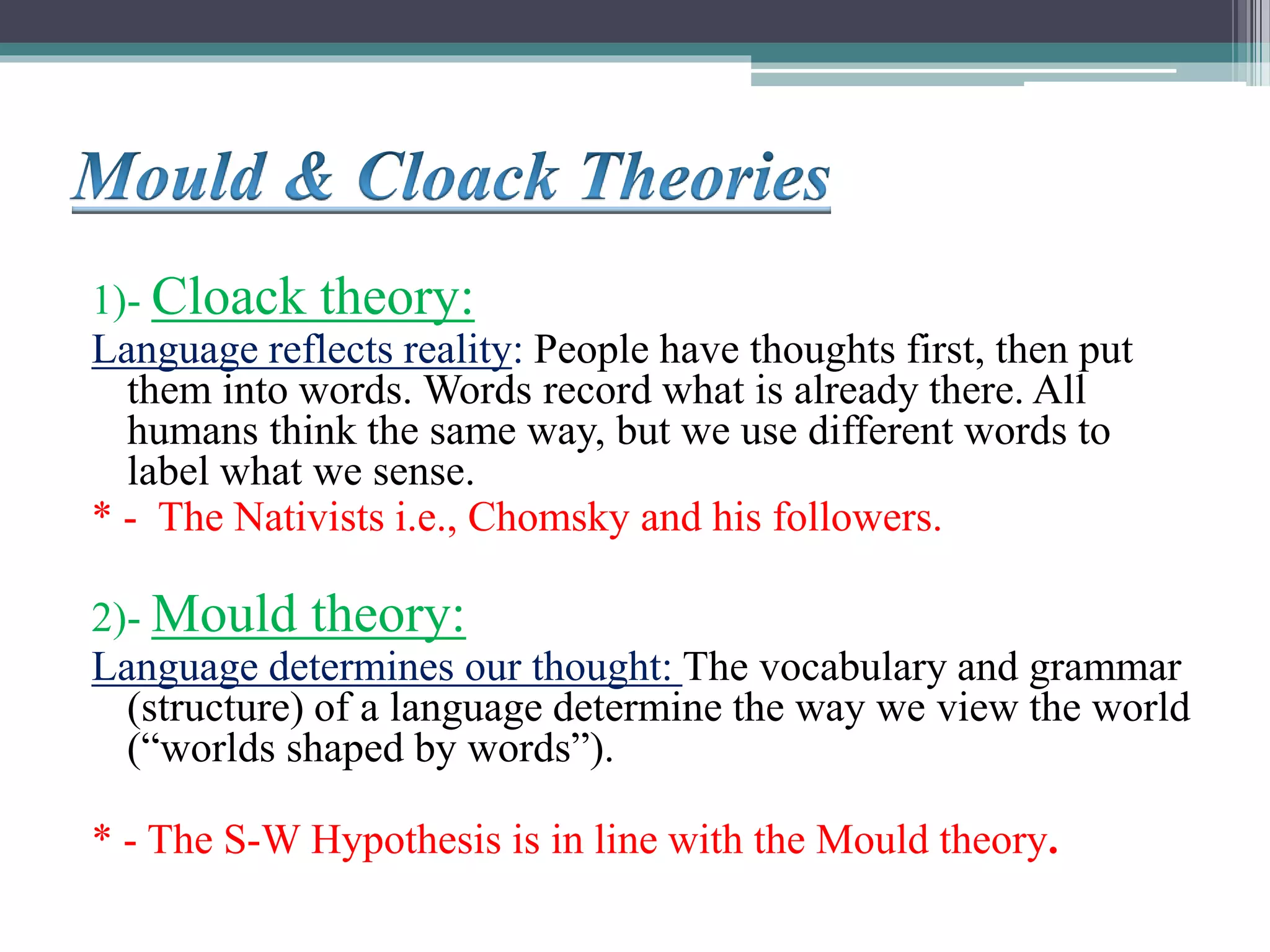
1)- Cloack theory:
Language reflects reality: People have thoughts first, then put
them into words. Words record what is already there. All
humans think the same way, but we use different words to
label what we sense.
* - The Nativists i.e., Chomsky and his followers.
2)- Mould theory:
Language determines our thought: The vocabulary and grammar
(structure) of a language determine the way we view the world
(“worlds shaped by words”).
* - The S-W Hypothesis is in line with the Mould theory.
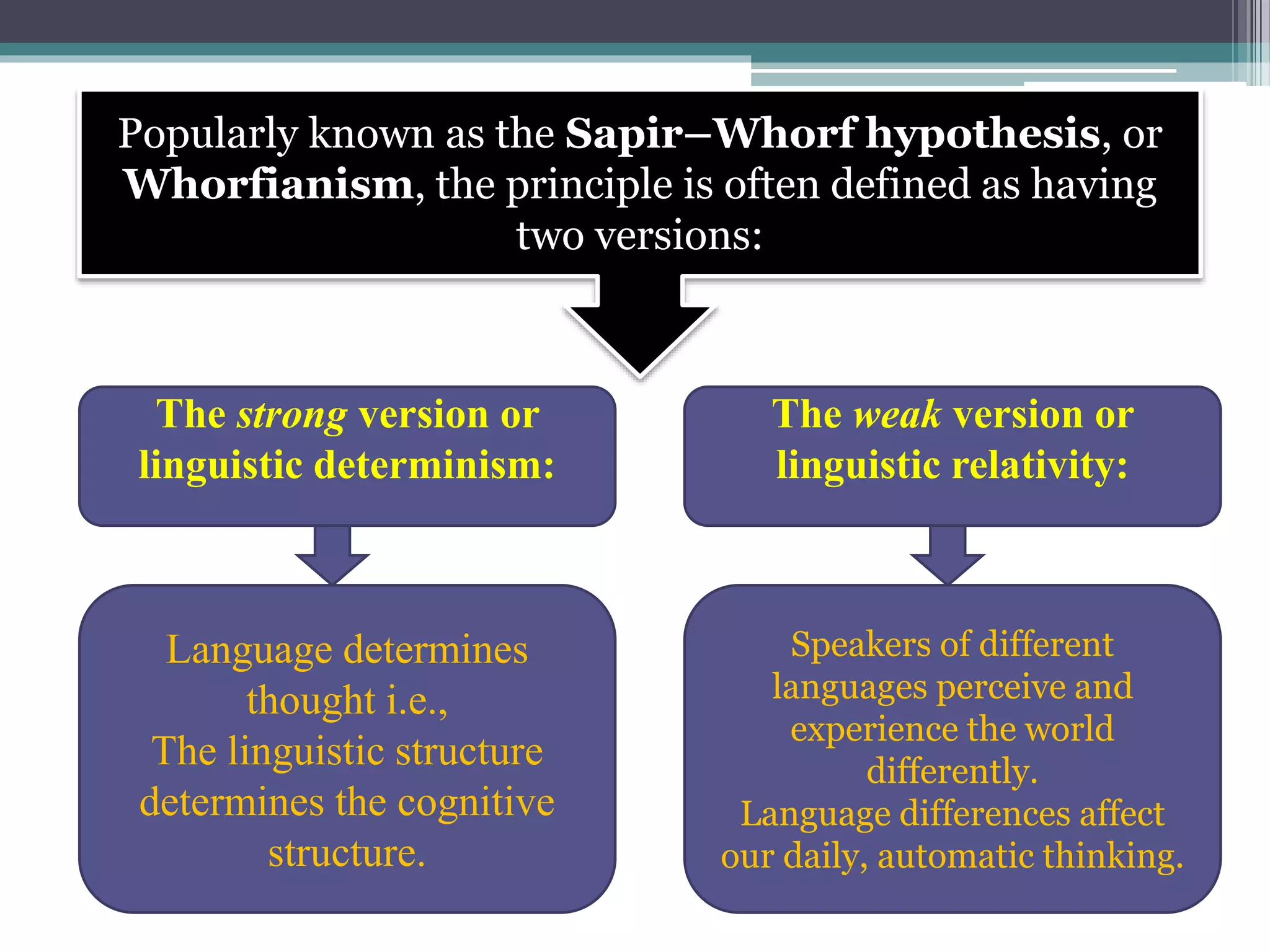
Popularly known as the Sapir–Whorf hypothesis, or
Whorfianism, the principle is often defined as having
two versions:
The strong version or
linguistic determinism:
The weak version or
linguistic relativity:
Language determines
thought i.e.,
The linguistic structure
determines the cognitive
structure.
Speakers of different
languages perceive and
experience the world
differently.
Language differences affect
our daily, automatic thinking.
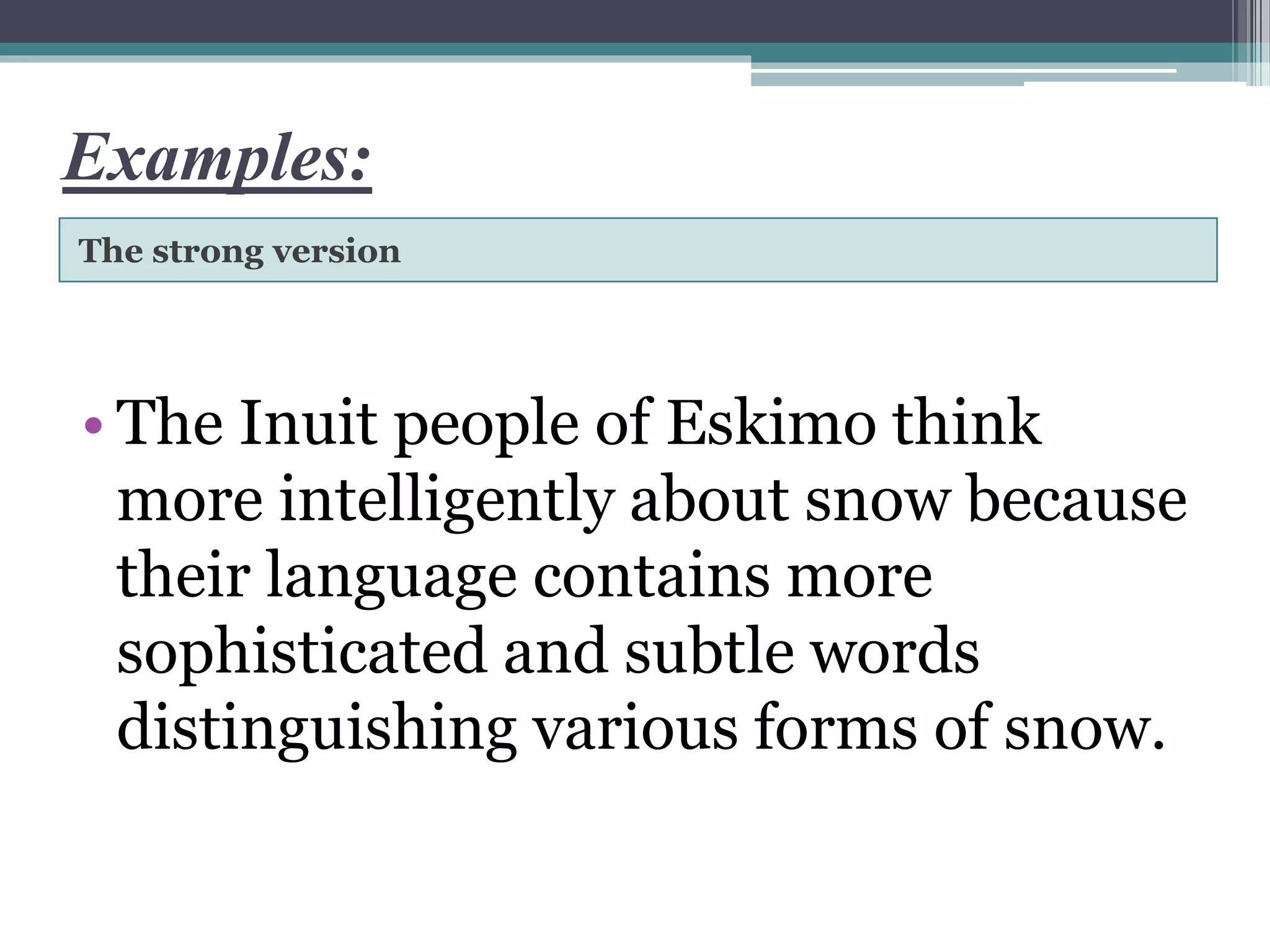
Examples:
The strong version
• The Inuit people of Eskimo think
more intelligently about snow because
their language contains more
sophisticated and subtle words
distinguishing various forms of snow.
Steven pinker, “language instinct”,
criticized Whorf’s claim that the Hopi
language is a timeless language.
He included the study of the
Anthropologist ‘Malokti Ekkehart (1983)’ to
prove that the Hopi language is not a
timeless language:
“then indeed, the following day, quite
early in the morning, at the hour when
people pray to the sun, around that time
when he woke up the girl again.”
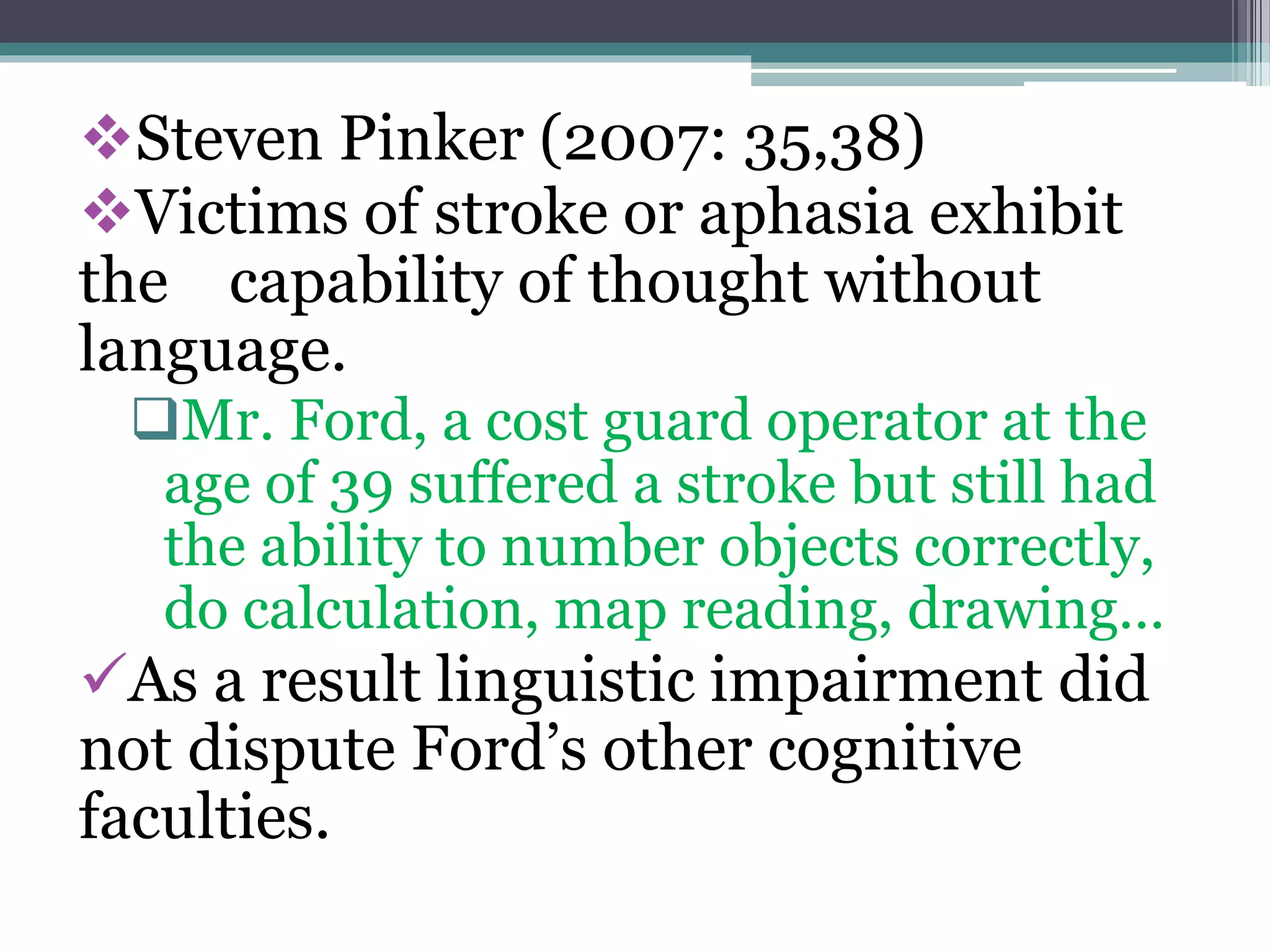
Steven Pinker (2007: 35,38)
Victims of stroke or aphasia exhibit
the capability of thought without
language.
Mr. Ford, a cost guard operator at the
age of 39 suffered a stroke but still had
the ability to number objects correctly,
do calculation, map reading, drawing…
As a result linguistic impairment did
not dispute Ford’s other cognitive
faculties.
Steven Pinker (p58) also mentioned the
case of people who are raised without
language.
Schaller (1991)
Ildefonso, 27 years old deaf and
mute Mexican immigrant was taught sign
language, after that he started
communicating with ‘Schaller’ and told
her events from the past.
As a result, if language determines
thought, Ildfonso would not have been
able to think
Other studies have shown that ‘babies’
use pointing to get things they want,
before they can speak.
As a result, thought exists before
language.
 Peter Gordon (2004) Columbia University
Language of Piraha tribe contains only three
counting words , one, two and many.
He shows through a series of experiments that
people of Piraha tribe have difficulty recounting
numbers higher than three.
The people of Piraha cannot accurately tell the
difference between ‘four’ and ‘five’ objects.
As a result the tribe’s language determines its
people thought.
 Mooney et al (2011:32)
Since there is a connection between language
and thought, language must influence thought.
 A boy wants to use the toilet, he then noticed a
sign on the public toilet door “out of use”.
This sign will influence his decision, so he will
not open that door.
 As a result, the sign language on the toilet door
( the language) influences the boy’s decision
(his thought).
The weak version
• The number and the type of the basic
color words of a language determine
how a person sees the rainbow.
Lenneberg and Roberts (1953)
They conducted a cross-linguistic comparison of
color recognition between speakers of ‘Zuni Tribe’ and
English speakers.
In Zuni:
one word is used to refer to yellow-orange
spectrum.
For English:
two words are used to refer to each color
independently.
As a result differences in codability lead to differences
in color perception.
Lila Gleitman (2004:636-673)
People do not think in language.
According to her language rather affects hints
to learners to make influences from them by
adding up information of common sense.
The word ‘uncle’ does not show whether this
person comes from the father’s side or from the
mother’s side.
As a result when saying ‘my uncle’ the person
has the relevant information.
The extreme version of this idea, that all
thought is constrained by language, has
been disproved. The opposite extreme –
that language does not influence thought
at all or influences it partially– is also
widely considered to be false

Language and Thought

  • 1.
  • 3.
    1)- Cloack theory: Languagereflects reality: People have thoughts first, then put them into words. Words record what is already there. All humans think the same way, but we use different words to label what we sense. * - The Nativists i.e., Chomsky and his followers. 2)- Mould theory: Language determines our thought: The vocabulary and grammar (structure) of a language determine the way we view the world (“worlds shaped by words”). * - The S-W Hypothesis is in line with the Mould theory.
  • 4.
    Popularly known asthe Sapir–Whorf hypothesis, or Whorfianism, the principle is often defined as having two versions: The strong version or linguistic determinism: The weak version or linguistic relativity: Language determines thought i.e., The linguistic structure determines the cognitive structure. Speakers of different languages perceive and experience the world differently. Language differences affect our daily, automatic thinking.
  • 5.
    Examples: The strong version •The Inuit people of Eskimo think more intelligently about snow because their language contains more sophisticated and subtle words distinguishing various forms of snow.
  • 6.
    Steven pinker, “languageinstinct”, criticized Whorf’s claim that the Hopi language is a timeless language. He included the study of the Anthropologist ‘Malokti Ekkehart (1983)’ to prove that the Hopi language is not a timeless language: “then indeed, the following day, quite early in the morning, at the hour when people pray to the sun, around that time when he woke up the girl again.”
  • 7.
    Steven Pinker (2007:35,38) Victims of stroke or aphasia exhibit the capability of thought without language. Mr. Ford, a cost guard operator at the age of 39 suffered a stroke but still had the ability to number objects correctly, do calculation, map reading, drawing… As a result linguistic impairment did not dispute Ford’s other cognitive faculties.
  • 8.
    Steven Pinker (p58)also mentioned the case of people who are raised without language. Schaller (1991) Ildefonso, 27 years old deaf and mute Mexican immigrant was taught sign language, after that he started communicating with ‘Schaller’ and told her events from the past. As a result, if language determines thought, Ildfonso would not have been able to think
  • 9.
    Other studies haveshown that ‘babies’ use pointing to get things they want, before they can speak. As a result, thought exists before language.
  • 10.
     Peter Gordon(2004) Columbia University Language of Piraha tribe contains only three counting words , one, two and many. He shows through a series of experiments that people of Piraha tribe have difficulty recounting numbers higher than three. The people of Piraha cannot accurately tell the difference between ‘four’ and ‘five’ objects. As a result the tribe’s language determines its people thought.
  • 11.
     Mooney etal (2011:32) Since there is a connection between language and thought, language must influence thought.  A boy wants to use the toilet, he then noticed a sign on the public toilet door “out of use”. This sign will influence his decision, so he will not open that door.  As a result, the sign language on the toilet door ( the language) influences the boy’s decision (his thought).
  • 12.
    The weak version •The number and the type of the basic color words of a language determine how a person sees the rainbow.
  • 13.
    Lenneberg and Roberts(1953) They conducted a cross-linguistic comparison of color recognition between speakers of ‘Zuni Tribe’ and English speakers. In Zuni: one word is used to refer to yellow-orange spectrum. For English: two words are used to refer to each color independently. As a result differences in codability lead to differences in color perception.
  • 14.
    Lila Gleitman (2004:636-673) Peopledo not think in language. According to her language rather affects hints to learners to make influences from them by adding up information of common sense. The word ‘uncle’ does not show whether this person comes from the father’s side or from the mother’s side. As a result when saying ‘my uncle’ the person has the relevant information.
  • 15.
    The extreme versionof this idea, that all thought is constrained by language, has been disproved. The opposite extreme – that language does not influence thought at all or influences it partially– is also widely considered to be false