ِ‫م‬ْ‫ي‬ ِ‫ح‬َّ‫الر‬ ِ‫ن‬ ٰ‫م‬ْ‫ح‬َّ‫الر‬ ِ‫هللا‬ ِ‫م‬ْ‫س‬ِ‫ب‬
E-LEARNING IS NOT THE NEXT BIG THING— IT IS THE NOW BIG
THING
National University of Modern Languages
(Peshawar Campus)
Read,
Learn,
Explore &
Lead
Language, Thought & Culture
By
Sulaiman Ahmad
Lecturer in English
NUML Peshawar.
2
Subject: Sociolinguistics
???
1. Does Language Determine Thought?
2. To what extant & in what ways does language determine
thought?
3. Are thoughts totally determined by language?
4. Can thoughts stand independent of language?
5. What are the other factors which may influence thought?
3
An Experiment by Susan Ervin-Tripp
 Research Participants: Japanese women
 Early life in Japan but immigrated to the US after WWII
 Sentence Completion Task: “I like to read__________.”
 In Japanese: “…bout sociology.”
 In English: “…comics because they relax my mind”.
 Conclusion: Linguistic determinism.
4
THE SAPIR-WHORF HYPOTHESIS
Edward Sapir and Benjamin Lee Whorf:
Two Versions of the Hypothesis:
1. Linguistic Determinism (Strong Version):
2. Linguistic Relativity (Weak Version)
5
Linguistic Determinism (Strong Version)
Linguistic Determinism (Strong Version):
 Language determines thoughts.
 One is incapable of understanding a concept for which the
language has no name.
 There is no thought without language
6
Linguistic Determinism
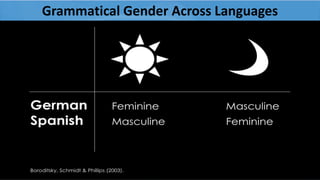
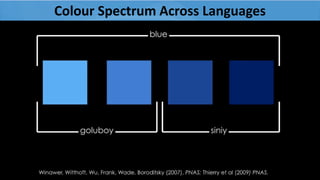
The language we speak limits or determines the concepts we can
understand and express. For example, proponents of linguistic
determinism argue that speakers of languages without a specific
colour term, such as "blue," would have difficulty perceiving or
conceptualizing that colour.
7
Grammatical Gender Across Languages
8
Colour Spectrum Across Languages
9
Linguistic Relativity (Weak Version)
language influences our thoughts and perception but does not
entirely determine them.
Language can shape our thinking to some extent, but it does not
entirely constrain or limit it.
Experimental Project by Caroll and Casagrande (1950s).
10
The Verb of Handling Technique Experiment
 Two Speech Communities:
i. English Speaking Community.
ii. Navajo Speaking Community.
1.String:----------------------Flexible-----------------------Long
2. Stick---------------------Rigid--------------------------Long
3. Cloth--------------------Flexible-----------------------Flat
Result: Navajo speakers preferred to Shape.
11
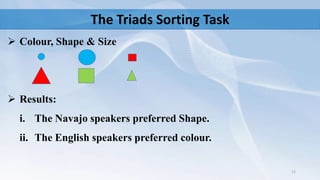
The Triads Sorting Task
12
 Colour, Shape & Size
 Results:
i. The Navajo speakers preferred Shape.
ii. The English speakers preferred colour.
Experiment No.03
 Two English Speaking Communities:
1. Boston English Speaking Middle Class.
2. Harlem English Speaking Lower Class.
Finding/Conclusion: Socialization/Social Class.
13
Result:
Shape
Colour

LESSON 12; LANGUAGE, THOUGH & CULTURE.pptx

  • 1.
    ِ‫م‬ْ‫ي‬ ِ‫ح‬َّ‫الر‬ ِ‫ن‬ٰ‫م‬ْ‫ح‬َّ‫الر‬ ِ‫هللا‬ ِ‫م‬ْ‫س‬ِ‫ب‬ E-LEARNING IS NOT THE NEXT BIG THING— IT IS THE NOW BIG THING National University of Modern Languages (Peshawar Campus) Read, Learn, Explore & Lead
  • 2.
    Language, Thought &Culture By Sulaiman Ahmad Lecturer in English NUML Peshawar. 2 Subject: Sociolinguistics
  • 3.
    ??? 1. Does LanguageDetermine Thought? 2. To what extant & in what ways does language determine thought? 3. Are thoughts totally determined by language? 4. Can thoughts stand independent of language? 5. What are the other factors which may influence thought? 3
  • 4.
    An Experiment bySusan Ervin-Tripp  Research Participants: Japanese women  Early life in Japan but immigrated to the US after WWII  Sentence Completion Task: “I like to read__________.”  In Japanese: “…bout sociology.”  In English: “…comics because they relax my mind”.  Conclusion: Linguistic determinism. 4
  • 5.
    THE SAPIR-WHORF HYPOTHESIS EdwardSapir and Benjamin Lee Whorf: Two Versions of the Hypothesis: 1. Linguistic Determinism (Strong Version): 2. Linguistic Relativity (Weak Version) 5
  • 6.
    Linguistic Determinism (StrongVersion) Linguistic Determinism (Strong Version):  Language determines thoughts.  One is incapable of understanding a concept for which the language has no name.  There is no thought without language 6
  • 7.
    Linguistic Determinism The languagewe speak limits or determines the concepts we can understand and express. For example, proponents of linguistic determinism argue that speakers of languages without a specific colour term, such as "blue," would have difficulty perceiving or conceptualizing that colour. 7
  • 8.
  • 9.
  • 10.
    Linguistic Relativity (WeakVersion) language influences our thoughts and perception but does not entirely determine them. Language can shape our thinking to some extent, but it does not entirely constrain or limit it. Experimental Project by Caroll and Casagrande (1950s). 10
  • 11.
    The Verb ofHandling Technique Experiment  Two Speech Communities: i. English Speaking Community. ii. Navajo Speaking Community. 1.String:----------------------Flexible-----------------------Long 2. Stick---------------------Rigid--------------------------Long 3. Cloth--------------------Flexible-----------------------Flat Result: Navajo speakers preferred to Shape. 11
  • 12.
    The Triads SortingTask 12  Colour, Shape & Size  Results: i. The Navajo speakers preferred Shape. ii. The English speakers preferred colour.
  • 13.
    Experiment No.03  TwoEnglish Speaking Communities: 1. Boston English Speaking Middle Class. 2. Harlem English Speaking Lower Class. Finding/Conclusion: Socialization/Social Class. 13 Result: Shape Colour