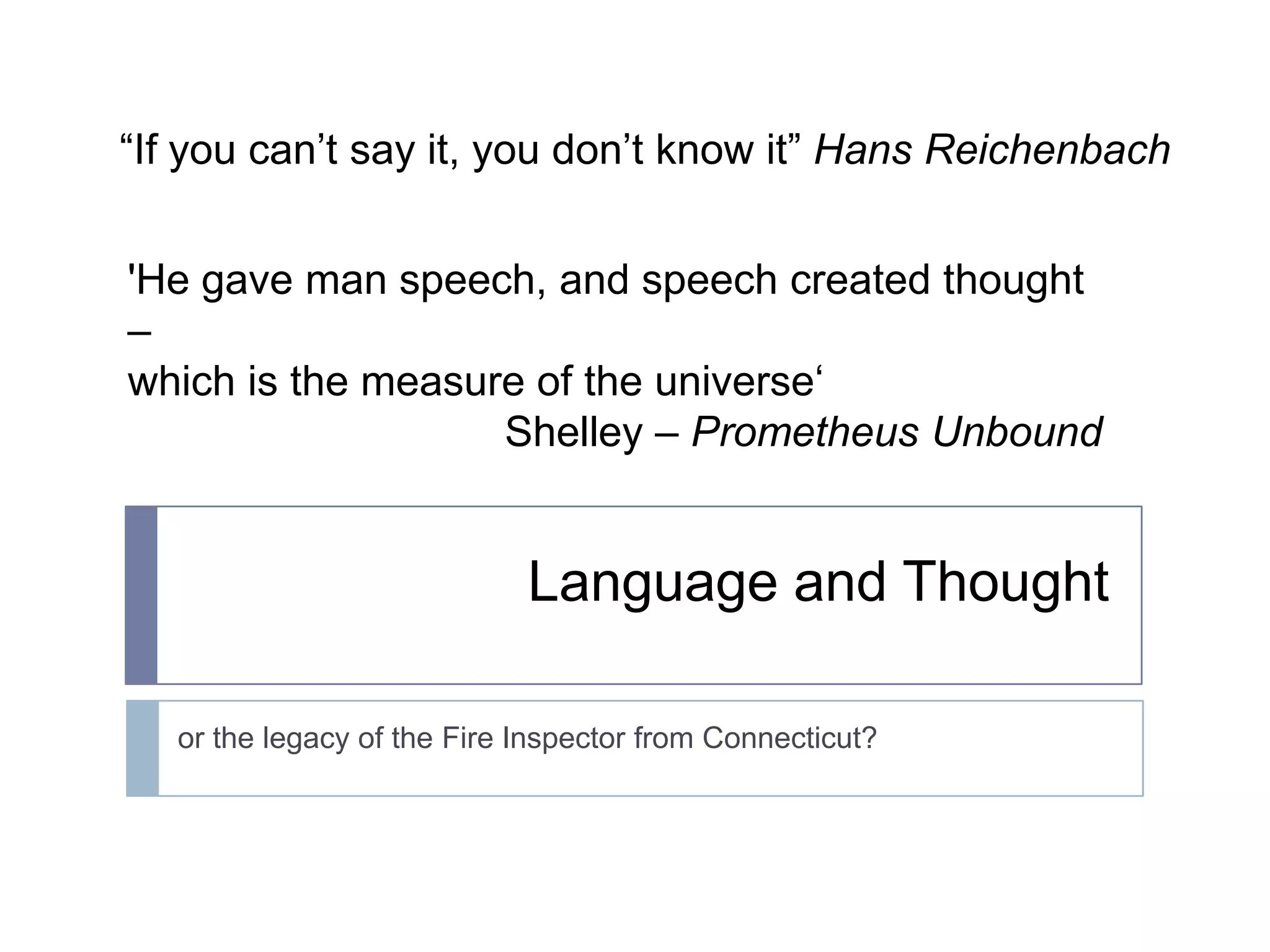
Language and Thought“Ifyou can’t sayit, you don’t knowit” Hans Reichenbach'He gave man speech, and speech created thought – which is the measure of the universe‘Shelley – Prometheus Unboundor the legacyof the FireInspectorfrom Connecticut?
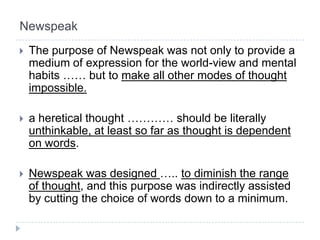
NewspeakThe purpose of Newspeak was not only to provide a medium of expression for the world-view and mental habits …… but to make all other modes of thought impossible.a heretical thought ………… should be literally unthinkable, at least so far as thought is dependent on words.Newspeak was designed ….. to diminish the range of thought, and this purpose was indirectly assisted by cutting the choice of words down to a minimum.
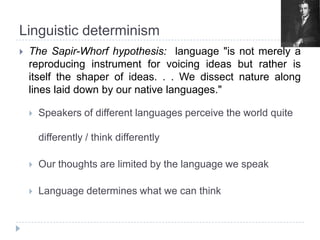
LinguisticdeterminismThe Sapir-Whorfhypothesis:  language "is not merely a reproducing instrument for voicing ideas but rather is itself the shaper of ideas. . . We dissect nature along lines laid down by our native languages." Speakersofdifferentlanguagesperceive the world quitedifferently / thinkdifferentlyOurthoughts are limitedby the languagewespeakLanguagedetermineswhatwe can think
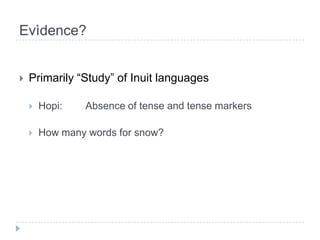
Evìdence?Primarily “Study” of Inuit languagesHopi:	 Absence of tense and tense markersHow many words for snow?
Currrentviewsof the hypothesisGuyDeutscher[the hypothesis]hassunkintodisreputeamongrespectablelinguists.If language is to serve as an effective means of communication, then the private systems of knowledge in speakers’ minds must closely correspond with the public system of linguistic conventions. Stephen Pinkerthe more you examine Whorf's arguments, the less sense they makewrong, all wrongthe idea that thought is the same thing as language is ... a conventional absurdityWords are not the same as thought and much of human wisdom consists of not mistaking one for the other.
More detailedstudiesPirahaAbsenceofnumberwordsAbsenceofcolourwordsAbsenceofrecursionMatsesHighlycomplextensestructuresdepending not only on distance from the here and now but as to how the speaker came to know the fact and when.GuuguYimithirr, no words such as left or right, behind or in front of,  that can describe egocentric spacial positioning.
So….?Is the way they live (culture) reflected in featuresoftheirlanguage? Doestheirlanguagedetermine the way theythink?
Babies………Can babiesthink and knowbeforetheyacquire / learnlanguage?Piaget – from birth to the development of language, the child actively and autonomously  acquires knowledge through the body. The development of language introduces a second ‘representational’ phaseVygotsky - The child's knowledge is socially constructed in interaction with adults, so “Child logic develops only along with the growth of the child's social speech …..”.Pinker – “mentalese”
Speechless adultsIdlefonsoan adult completely without language, who was still intelligent, numerate, and once shown sign language was able to fully recount experiences and converse. For more seePinker, The LanguageInstinct
Language in the IB programmeFrom the ToK Guide – Nature of KnowingIn English there is one word “know”, while French and Spanish, for example, each has two (savoir/connaîtreand saber/conocer). In what ways do various languages classify the concepts associated with “to know”?
Problems in L2 acquisition (1)French “depuis” clauses and tenseJe suisicidepuis 15 minutesI’ve been here for 15 minutesOther tense usageLanguages with no tenses (Chinese)Difference tense structure (English v romance langs)
Problems in L2 acquisition (2)GenderProfessions with no feminine form in FrenchDoes gender matter? Does it affect perception of the signified? Formal and informal styles of addressWord and sentence orderChinese addresses
Professional or technicallanguageWhat is the role of specialist vocabulary in different subjects?Is it possible to learn in a subject without having the vocabulary?To what extent are skills / understanding dependent on language?When you are trying to solve a problem, to what extent is it useful to think in words?
Further readingArticlesDoes Language Shape What We Think? Joshua Hartstone in Scientific American.How does our language shape the way we think? LeraBoroditsky on edge.org “Language is central to our experience of being human, and the languages we speak profoundly shape the way we think, the way we see the world, the way we live our lives.”BooksThe LanguageInstinctStephen Pinker (especiallychapter 3 calledMentalese)Through the Language Glass  GuyDeutscher
Next written task“To what extent is knowledge dependant on language?”(400 words)
And ifthereistime…….Stephen Fry on Language	– if not, then find it through the blog:www.nlcstok.edublogs .org

Language and thought pml

  • 1.
    Language and Thought“Ifyoucan’t sayit, you don’t knowit” Hans Reichenbach'He gave man speech, and speech created thought – which is the measure of the universe‘Shelley – Prometheus Unboundor the legacyof the FireInspectorfrom Connecticut?
  • 2.
    NewspeakThe purpose ofNewspeak was not only to provide a medium of expression for the world-view and mental habits …… but to make all other modes of thought impossible.a heretical thought ………… should be literally unthinkable, at least so far as thought is dependent on words.Newspeak was designed ….. to diminish the range of thought, and this purpose was indirectly assisted by cutting the choice of words down to a minimum.
  • 3.
    LinguisticdeterminismThe Sapir-Whorfhypothesis: language "is not merely a reproducing instrument for voicing ideas but rather is itself the shaper of ideas. . . We dissect nature along lines laid down by our native languages." Speakersofdifferentlanguagesperceive the world quitedifferently / thinkdifferentlyOurthoughts are limitedby the languagewespeakLanguagedetermineswhatwe can think
  • 4.
    Evìdence?Primarily “Study” ofInuit languagesHopi: Absence of tense and tense markersHow many words for snow?
  • 5.
    Currrentviewsof the hypothesisGuyDeutscher[thehypothesis]hassunkintodisreputeamongrespectablelinguists.If language is to serve as an effective means of communication, then the private systems of knowledge in speakers’ minds must closely correspond with the public system of linguistic conventions. Stephen Pinkerthe more you examine Whorf's arguments, the less sense they makewrong, all wrongthe idea that thought is the same thing as language is ... a conventional absurdityWords are not the same as thought and much of human wisdom consists of not mistaking one for the other.
  • 6.
    More detailedstudiesPirahaAbsenceofnumberwordsAbsenceofcolourwordsAbsenceofrecursionMatsesHighlycomplextensestructuresdepending notonly on distance from the here and now but as to how the speaker came to know the fact and when.GuuguYimithirr, no words such as left or right, behind or in front of,  that can describe egocentric spacial positioning.
  • 7.
    So….?Is the waythey live (culture) reflected in featuresoftheirlanguage? Doestheirlanguagedetermine the way theythink?
  • 8.
    Babies………Can babiesthink andknowbeforetheyacquire / learnlanguage?Piaget – from birth to the development of language, the child actively and autonomously acquires knowledge through the body. The development of language introduces a second ‘representational’ phaseVygotsky - The child's knowledge is socially constructed in interaction with adults, so “Child logic develops only along with the growth of the child's social speech …..”.Pinker – “mentalese”
  • 9.
    Speechless adultsIdlefonsoan adultcompletely without language, who was still intelligent, numerate, and once shown sign language was able to fully recount experiences and converse. For more seePinker, The LanguageInstinct
  • 10.
    Language in theIB programmeFrom the ToK Guide – Nature of KnowingIn English there is one word “know”, while French and Spanish, for example, each has two (savoir/connaîtreand saber/conocer). In what ways do various languages classify the concepts associated with “to know”?
  • 11.
    Problems in L2acquisition (1)French “depuis” clauses and tenseJe suisicidepuis 15 minutesI’ve been here for 15 minutesOther tense usageLanguages with no tenses (Chinese)Difference tense structure (English v romance langs)
  • 12.
    Problems in L2acquisition (2)GenderProfessions with no feminine form in FrenchDoes gender matter? Does it affect perception of the signified? Formal and informal styles of addressWord and sentence orderChinese addresses
  • 13.
    Professional or technicallanguageWhatis the role of specialist vocabulary in different subjects?Is it possible to learn in a subject without having the vocabulary?To what extent are skills / understanding dependent on language?When you are trying to solve a problem, to what extent is it useful to think in words?
  • 14.
    Further readingArticlesDoes LanguageShape What We Think? Joshua Hartstone in Scientific American.How does our language shape the way we think? LeraBoroditsky on edge.org “Language is central to our experience of being human, and the languages we speak profoundly shape the way we think, the way we see the world, the way we live our lives.”BooksThe LanguageInstinctStephen Pinker (especiallychapter 3 calledMentalese)Through the Language Glass GuyDeutscher
  • 15.
    Next written task“Towhat extent is knowledge dependant on language?”(400 words)
  • 16.
    And ifthereistime…….Stephen Fryon Language – if not, then find it through the blog:www.nlcstok.edublogs .org