Language Acquisition
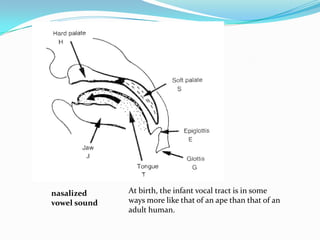
Vocalizations in the first year of lifeAt birth, the infant vocal tract is in some ways more like that of an ape than that of an adult human. Compare the diagram of the infant vocal tract shown next slide . diagrams of adult human and ape.In particular, the tip of the velum reaches or overlaps with the tip of the epiglottis. As the infant grows, the tract gradually reshapes itself in the adult pattern.During the first two months
At birth, the infant vocal tract is in some ways more like that of an ape than that of an adult human. nasalizedvowelsound
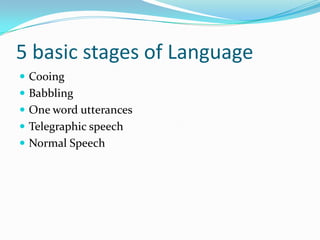
5 basic stages of LanguageCooingBabblingOne word utterancesTelegraphic speechNormal Speech
Cooing and vocal playCooing: Appears at about 4-8 months.All infants coo using all the phonemes from every language. Even congenitally deaf children coo. Repetitive CV patternsDuring the period from, infants typically engage in "vocal play", manipulating pitch (to produce "squeals" and "growls"), loudness (producing "yells"), and also manipulating tract closures to produce friction noises, nasal murmurs, "raspberries" and "snorts
BabblingBabbling: Appears at around 9 months. Infants selectively use the phonemes ( smallest unit of sound) from their native language. 7 months,- "canonical babbling" appears: infants start to make extended sounds that are chopped up rhythmically by oral articulations into syllable-like sequences, opening and closing their jaws, lips and tongue.. The range of sounds produced are heard as stop-like and glide-like. Vowels tend to be low and open, at least in the beginning.No other animal does anything like babbling. It has often been hypothesized that vocal play and babbling have the function of "practicing" speech-like gestures, helping the infant to gain control of the motor systems involved, and to learn the acoustical consequences of different gestures
One-word utterances: At around 12-18 months, children start using words. Telegraphic speech: Children start making multi-word utterances that lack function words. (about 2 years old) Normal speech: By about 5-6 years of age, children have almost normal speech
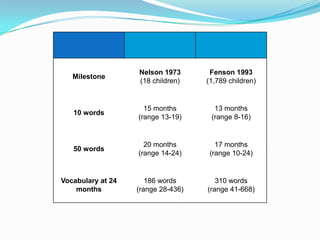
There is often a spurt of vocabulary acquisition during the second year. Early words are acquired at a rate of 1-3 per week (as measured by production diaries); in many cases the rate may suddenly increase to 8-10 new words per week, after 40 or so words have been learned.
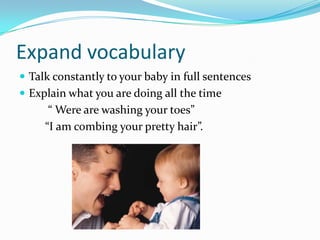
Expand vocabularyTalk constantly to your baby in full sentencesExplain what you are doing all the time          “ Were are washing your toes”         “I am combing your pretty hair”.
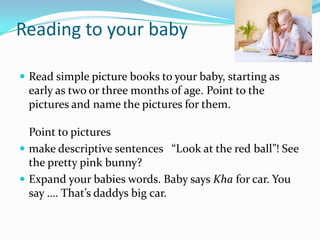
Reading to your babyRead simple picture books to your baby, starting as early as two or three months of age. Point to the pictures and name the pictures for them.Point to pictures make descriptive sentences   “Look at the red ball”! See the pretty pink bunny?Expand your babies words. Baby says Kha for car. You say …. That’s daddys big car.
Imitation: Pretty self-explanatory. Modeling: Children sound like the adults around them, such as by sharing accents and idioms. Adults use child-directed speech to make themselves easier for children to understand.
Motivation for learningHis learning of the new language coincides with his discovery of the world. the curiosity that he has toward the world becomes a powerful force in his language learning.And every time he uses a piece of language successfully, it is reinforced in his mind and his confidence grows
Good Language EnvironmentNo pressure should be put upon the child as he learns the environment does contain within itself the ability to tell the child where to begin and how to proceed.There is all the time that the child needs to learn the language
Sourceshttp://www.ling.upenn.edu/courses/Fall_2003/ling001/acquisition.htmlhttp://iteslj.org/Articles/McGlothlin-ChildLearn.html

Language aquisition full pres

  • 1.
  • 2.
    Vocalizations in thefirst year of lifeAt birth, the infant vocal tract is in some ways more like that of an ape than that of an adult human. Compare the diagram of the infant vocal tract shown next slide . diagrams of adult human and ape.In particular, the tip of the velum reaches or overlaps with the tip of the epiglottis. As the infant grows, the tract gradually reshapes itself in the adult pattern.During the first two months
  • 3.
    At birth, theinfant vocal tract is in some ways more like that of an ape than that of an adult human. nasalizedvowelsound
  • 4.
    5 basic stagesof LanguageCooingBabblingOne word utterancesTelegraphic speechNormal Speech
  • 5.
    Cooing and vocalplayCooing: Appears at about 4-8 months.All infants coo using all the phonemes from every language. Even congenitally deaf children coo. Repetitive CV patternsDuring the period from, infants typically engage in "vocal play", manipulating pitch (to produce "squeals" and "growls"), loudness (producing "yells"), and also manipulating tract closures to produce friction noises, nasal murmurs, "raspberries" and "snorts
  • 6.
    BabblingBabbling: Appears ataround 9 months. Infants selectively use the phonemes ( smallest unit of sound) from their native language. 7 months,- "canonical babbling" appears: infants start to make extended sounds that are chopped up rhythmically by oral articulations into syllable-like sequences, opening and closing their jaws, lips and tongue.. The range of sounds produced are heard as stop-like and glide-like. Vowels tend to be low and open, at least in the beginning.No other animal does anything like babbling. It has often been hypothesized that vocal play and babbling have the function of "practicing" speech-like gestures, helping the infant to gain control of the motor systems involved, and to learn the acoustical consequences of different gestures
  • 7.
    One-word utterances: Ataround 12-18 months, children start using words. Telegraphic speech: Children start making multi-word utterances that lack function words. (about 2 years old) Normal speech: By about 5-6 years of age, children have almost normal speech
  • 9.
    There is oftena spurt of vocabulary acquisition during the second year. Early words are acquired at a rate of 1-3 per week (as measured by production diaries); in many cases the rate may suddenly increase to 8-10 new words per week, after 40 or so words have been learned.
  • 10.
    Expand vocabularyTalk constantlyto your baby in full sentencesExplain what you are doing all the time “ Were are washing your toes” “I am combing your pretty hair”.
  • 11.
    Reading to yourbabyRead simple picture books to your baby, starting as early as two or three months of age. Point to the pictures and name the pictures for them.Point to pictures make descriptive sentences “Look at the red ball”! See the pretty pink bunny?Expand your babies words. Baby says Kha for car. You say …. That’s daddys big car.
  • 13.
    Imitation: Pretty self-explanatory.Modeling: Children sound like the adults around them, such as by sharing accents and idioms. Adults use child-directed speech to make themselves easier for children to understand.
  • 14.
    Motivation for learningHislearning of the new language coincides with his discovery of the world. the curiosity that he has toward the world becomes a powerful force in his language learning.And every time he uses a piece of language successfully, it is reinforced in his mind and his confidence grows
  • 15.
    Good Language EnvironmentNopressure should be put upon the child as he learns the environment does contain within itself the ability to tell the child where to begin and how to proceed.There is all the time that the child needs to learn the language
  • 16.