Language and Politics
What do we mean by ‘politics’?

 Any social relationship which deals with
 power, governing and authority.

 What does politics mean to you? Think of your
 everyday life – what situations do you engage in that
 can be described as dealing with power, governing
 and authority relations?
Rhetoric

 The art of persuasion
   Invention

   Arrangement

   Style

   Memory

   delivery
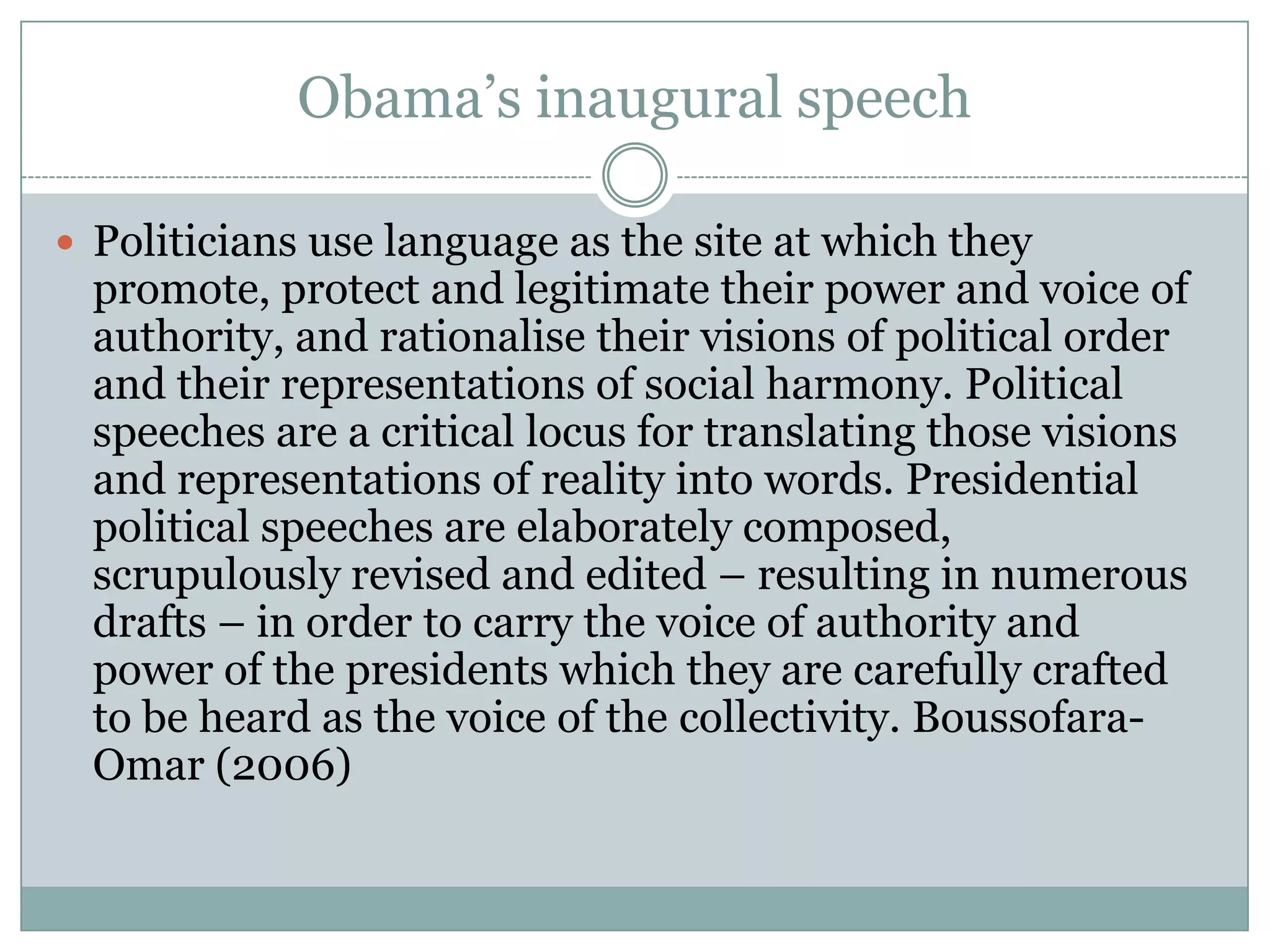
Obama’s inaugural speech

 Politicians use language as the site at which they
  promote, protect and legitimate their power and voice of
  authority, and rationalise their visions of political order
  and their representations of social harmony. Political
  speeches are a critical locus for translating those visions
  and representations of reality into words. Presidential
  political speeches are elaborately composed,
  scrupulously revised and edited – resulting in numerous
  drafts – in order to carry the voice of authority and
  power of the presidents which they are carefully crafted
  to be heard as the voice of the collectivity. Boussofara-
  Omar (2006)
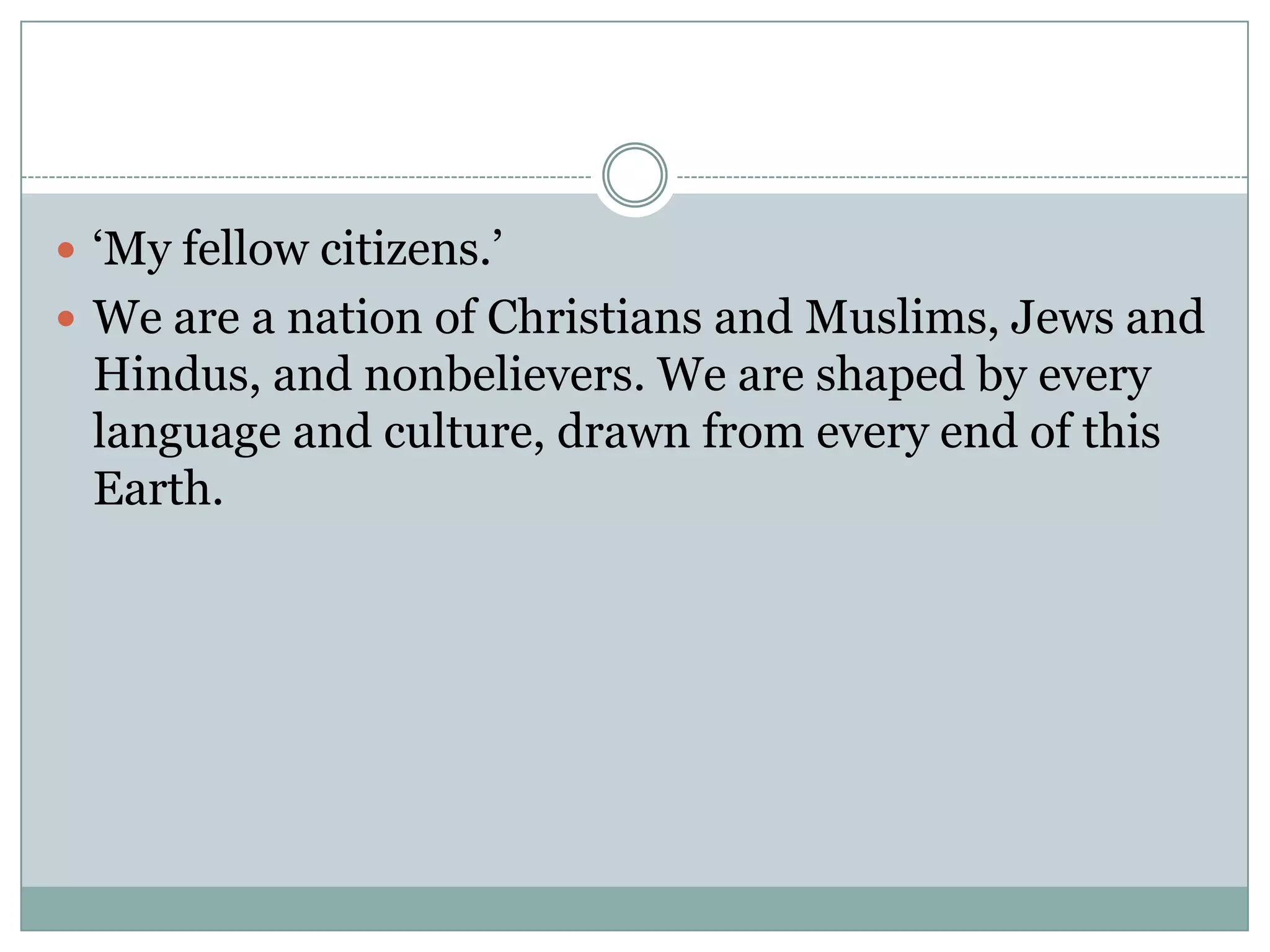
 ‘My fellow citizens.’
 We are a nation of Christians and Muslims, Jews and
 Hindus, and nonbelievers. We are shaped by every
 language and culture, drawn from every end of this
 Earth.
Metaphor

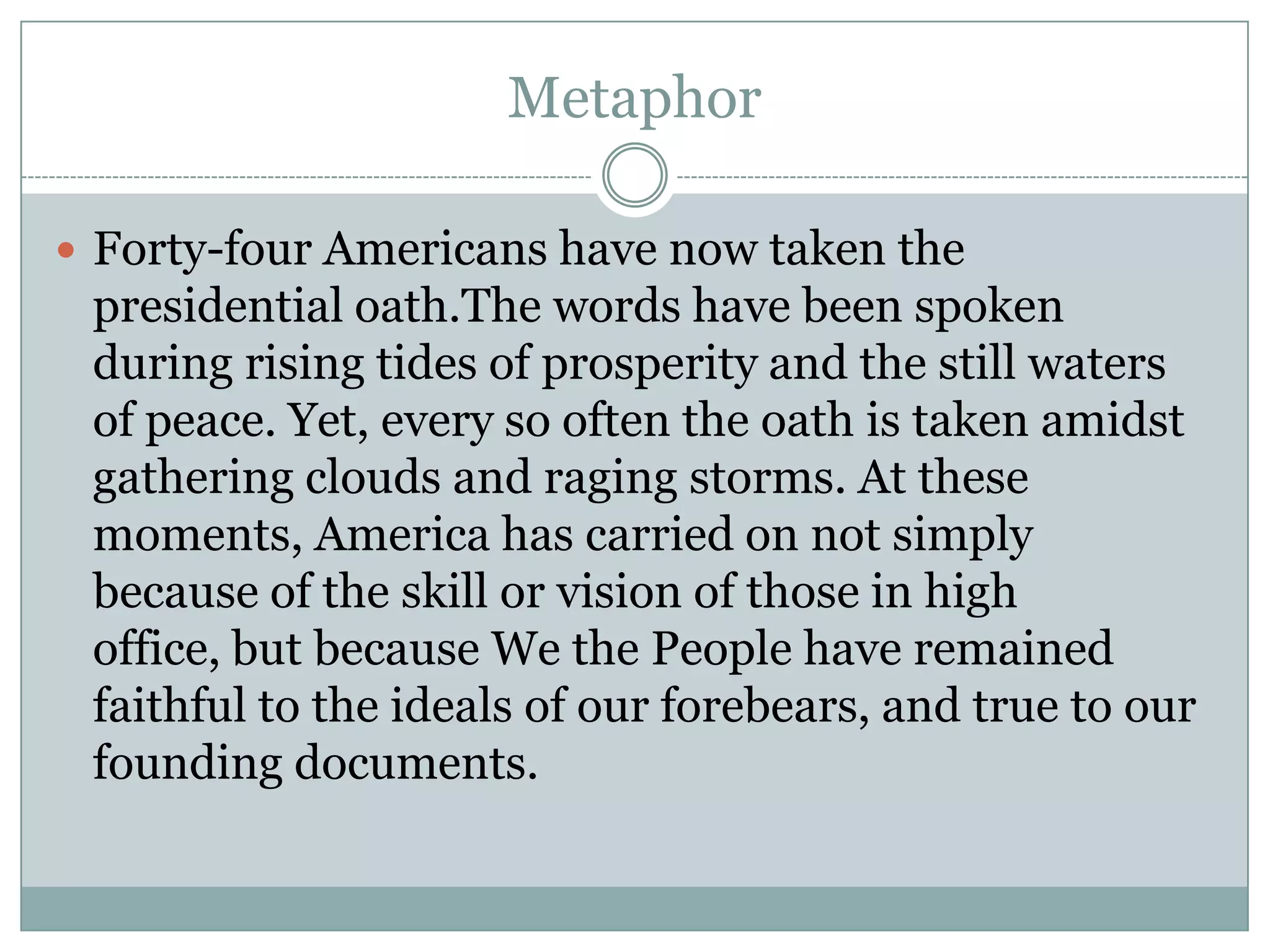
 Forty-four Americans have now taken the
 presidential oath.The words have been spoken
 during rising tides of prosperity and the still waters
 of peace. Yet, every so often the oath is taken amidst
 gathering clouds and raging storms. At these
 moments, America has carried on not simply
 because of the skill or vision of those in high
 office, but because We the People have remained
 faithful to the ideals of our forebears, and true to our
 founding documents.
Metaphor

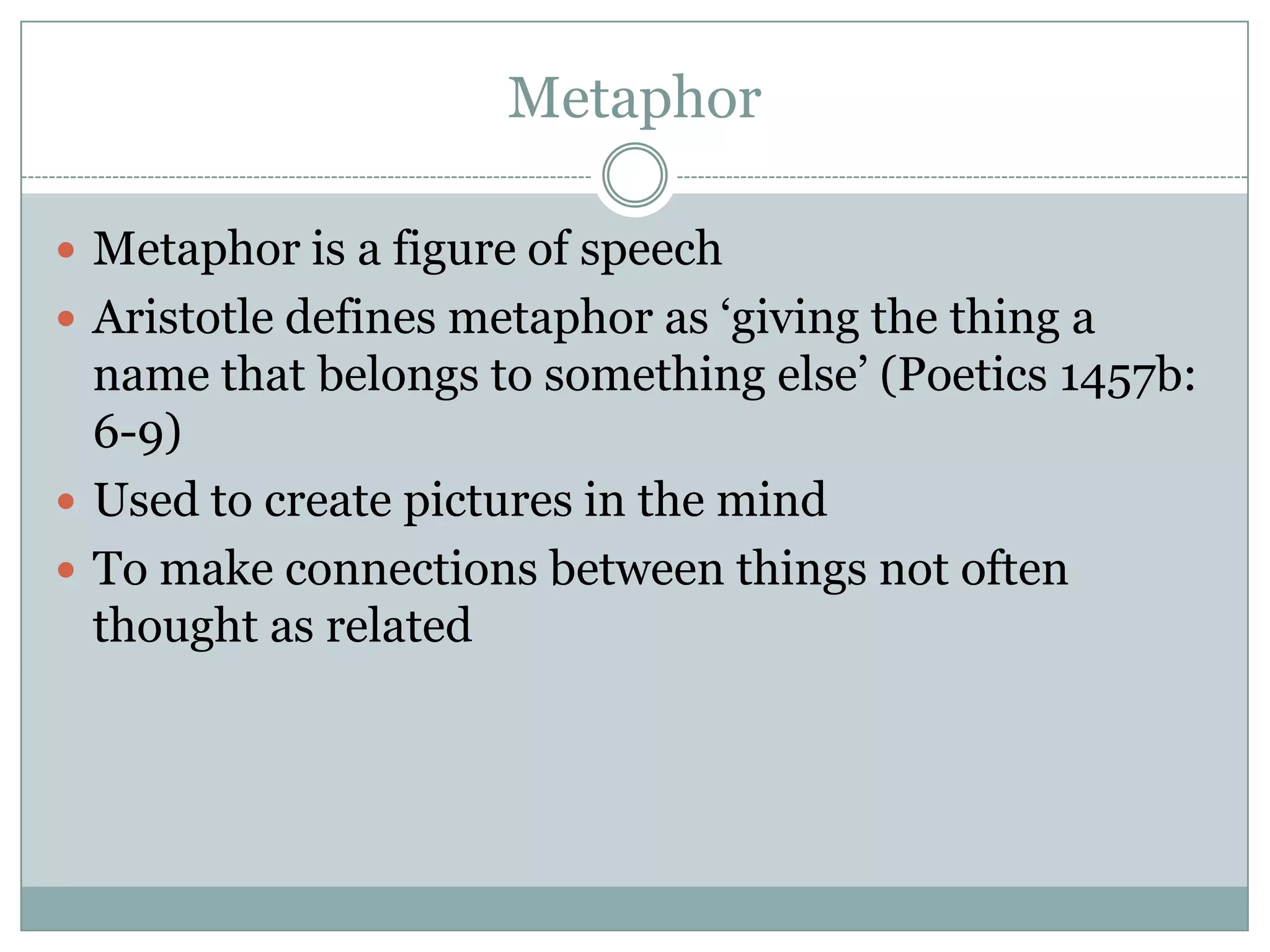
 Metaphor is a figure of speech
 Aristotle defines metaphor as ‘giving the thing a
  name that belongs to something else’ (Poetics 1457b:
  6-9)
 Used to create pictures in the mind
 To make connections between things not often
  thought as related
Metaphor

 Forty-four Americans have now taken the
 presidential oath.The words have been spoken
 during rising tides of prosperity and the still waters
 of peace. Yet, every so often the oath is taken amidst
 gathering clouds and raging storms. At these
 moments, America has carried on not simply
 because of the skill or vision of those in high
 office, but because We the People have remained
 faithful to the ideals of our forebears, and true to our
 founding documents.
Metaphors

 ‘Metaphor is the omnipresent principle of thought.’
  (I.A. Richards 1936: 92)
 Talking about things in metaphorical form influences
  the way we think and behave (Lakoff and Johnson
  1980)
 Metaphors can be used as tools to understand new
  and complex ideas using familiar language.
Simile

 A simile establishes an association between things by
  saying that something is ‘like’ something else. ‘She
  smells like a rose.’ ‘She’s a good boss because she
  acts like a man.’
 Simile’s and metaphors are used to connect concepts
  in a way that is beneficial for the speaker.
The rule of three

 That we are in the midst of crisis is now well
 understood. Our nation is at war against a far-
 reaching network of violence and hatred. Our
 economy is badly weakened, a consequence of greed
 and irresponsibility on the part of some but also our
 collective failure to make hard choices and prepare
 the nation for a new age. Homes have been lost, jobs
 shed, businesses shuttered. Our health care is too
 costly, our schools fail too many, and each day brings
 further evidence that the ways we use energy
 strengthen our adversaries and threaten our planet.
Parallelism

 On this day, we gather because we have chosen hope
 over fear, unity of purpose over conflict and discord.
 On this day, we come to proclaim an end to the petty
 grievances and false promises, the recriminations
 and worn-out dogmas that for far too long have
 strangled our politics.
Euphemism and dyseuphemism

 Euphemism is used when there is a constraint on
  being explicit for fear of causing offence or distress –
  often related to taboos (death and bodily functions).
  They highlight the positive and background the
  negative
 Dyseuphemisms do the opposite – they highlight the
  negative and background the positive.
Euphemism and dyseuphemism

 On September the 11th, the enemies of freedom
 committed an act of war against our country. Fellow
 citizens, we’ll meet violence with patient justice –
 assured of the rightness of our cause, and confident
 of the victories to come (George W. Bush: 22 Sept.
 2001)
Euphemism and dyseuphemism

 Today is the day that Harry Reid has scheduled a
 vote to try and cram the ‘financial reform’ bill down
 our throats. This bill is a terrible bill. It needs to be
 killed.

 By which they mean bring it up for debate using a
 majority vote. That’s cramming it down your throat
 in tea party speak.
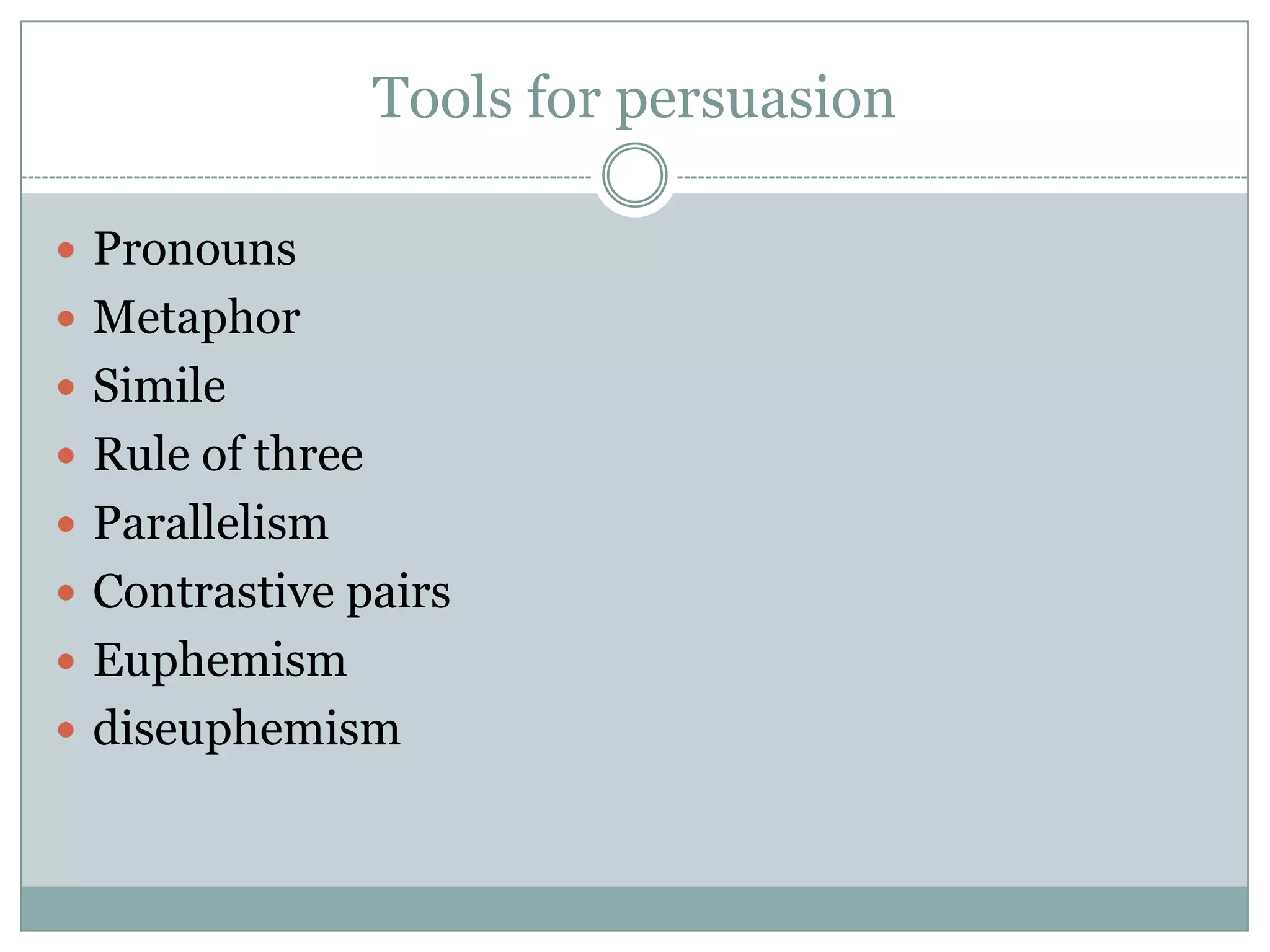
Tools for persuasion

 Pronouns
 Metaphor
 Simile
 Rule of three
 Parallelism
 Contrastive pairs
 Euphemism
 diseuphemism
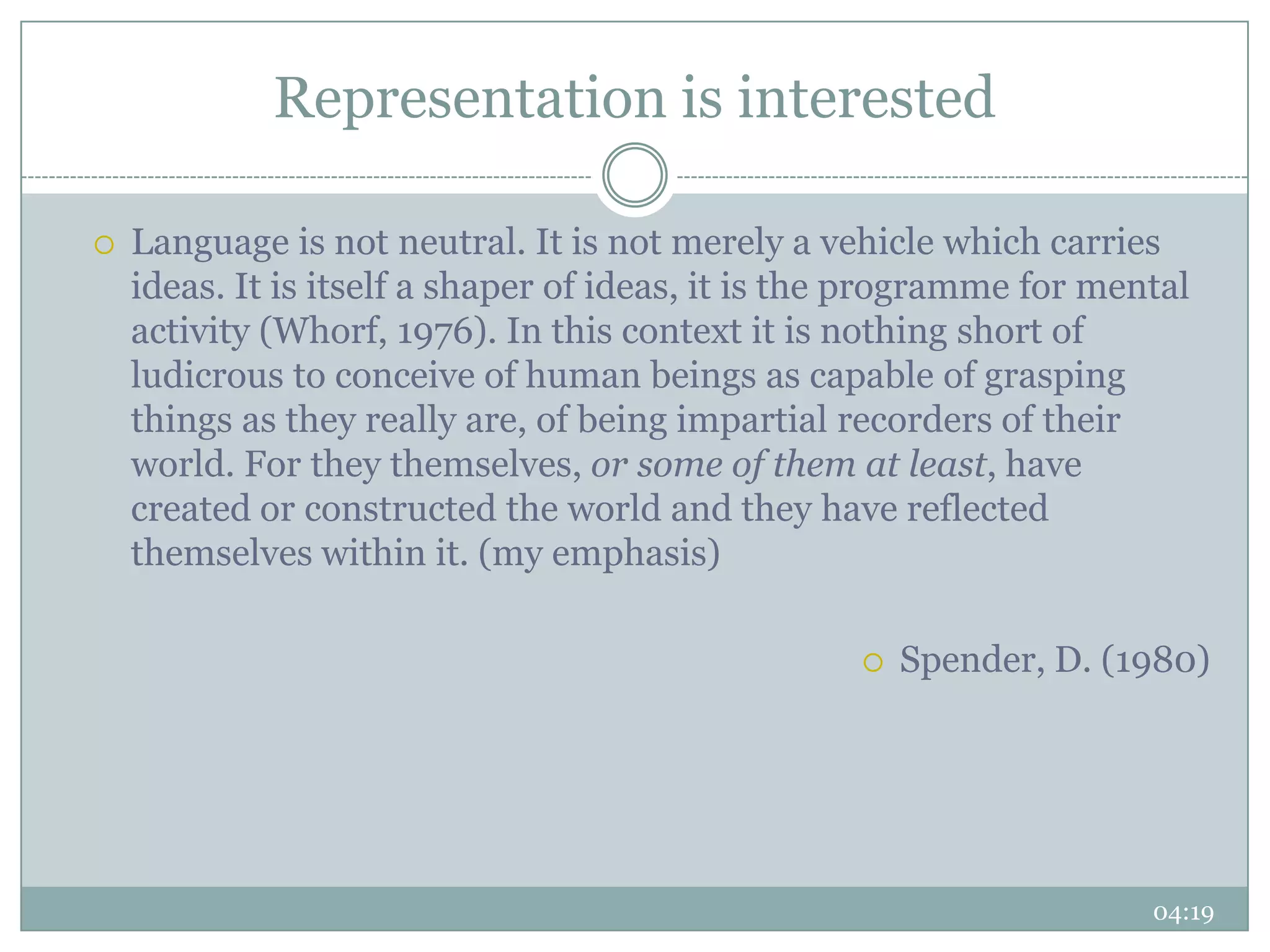
Representation is interested

   Language is not neutral. It is not merely a vehicle which carries
    ideas. It is itself a shaper of ideas, it is the programme for mental
    activity (Whorf, 1976). In this context it is nothing short of
    ludicrous to conceive of human beings as capable of grasping
    things as they really are, of being impartial recorders of their
    world. For they themselves, or some of them at least, have
    created or constructed the world and they have reflected
    themselves within it. (my emphasis)

                                                      Spender, D. (1980)


                                                                      04:19
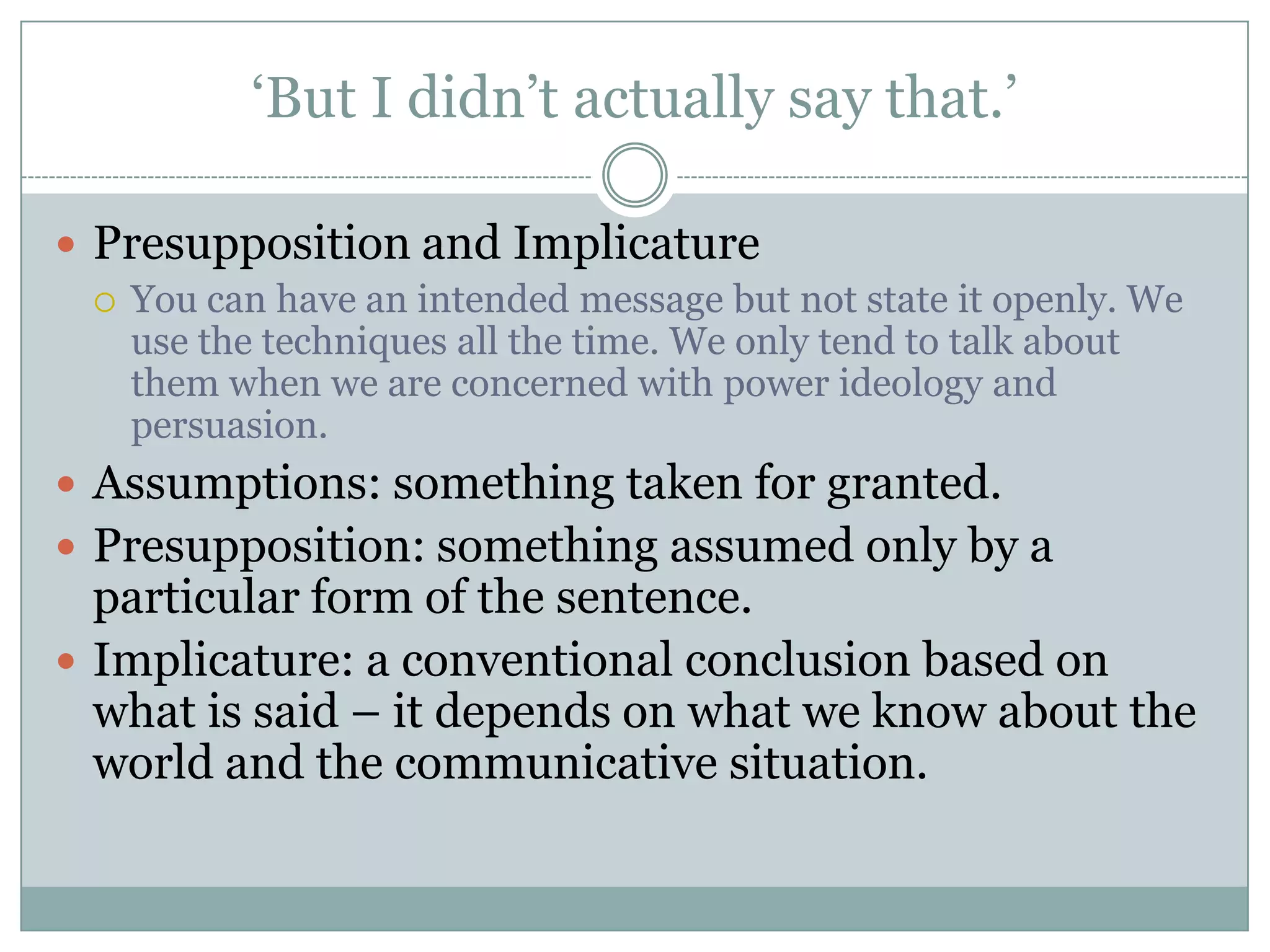
‘But I didn’t actually say that.’

 Presupposition and Implicature
   You can have an intended message but not state it openly. We
    use the techniques all the time. We only tend to talk about
    them when we are concerned with power ideology and
    persuasion.
 Assumptions: something taken for granted.
 Presupposition: something assumed only by a
  particular form of the sentence.
 Implicature: a conventional conclusion based on
  what is said – it depends on what we know about the
  world and the communicative situation.
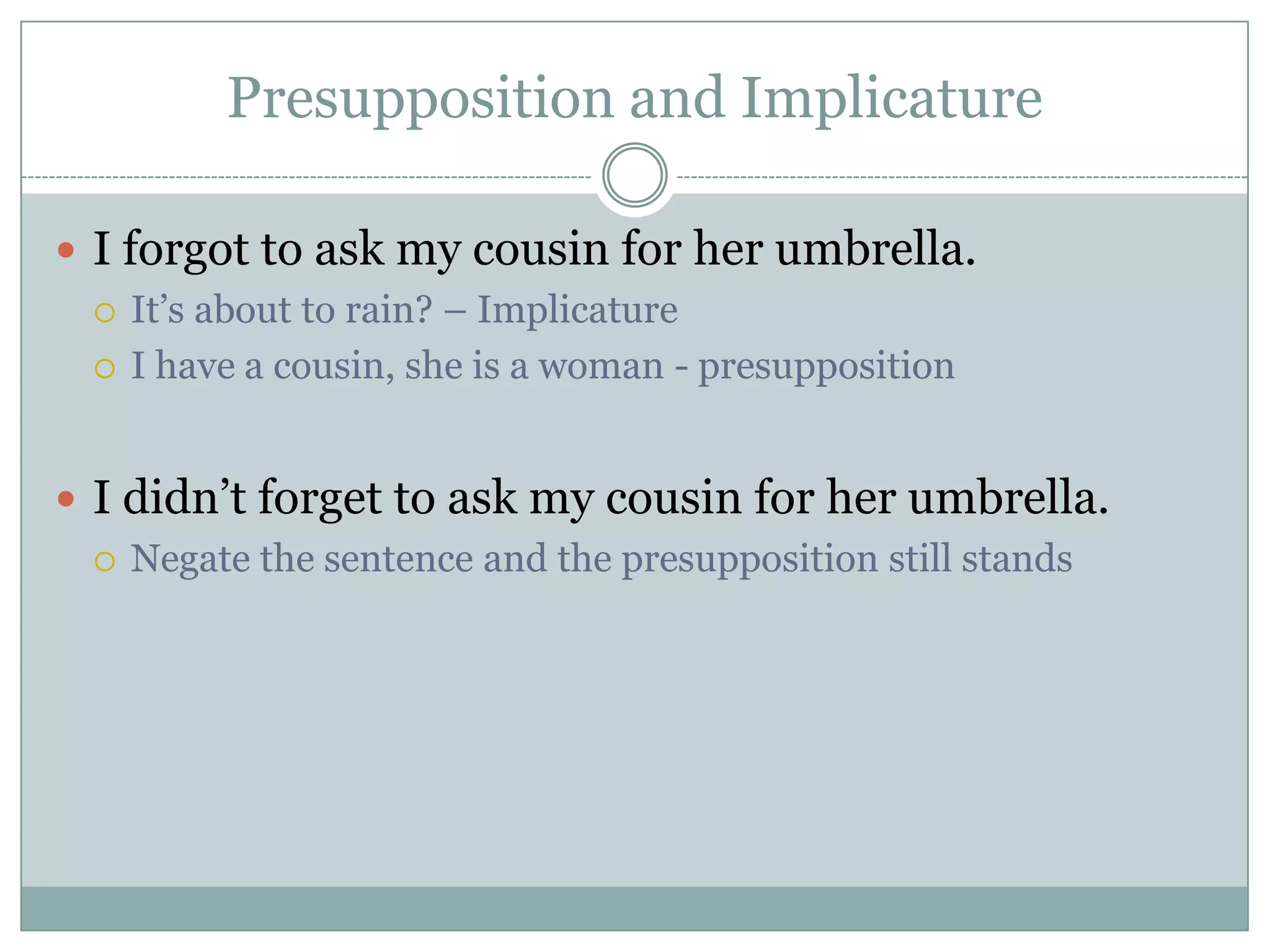
Presupposition and Implicature

 I forgot to ask my cousin for her umbrella.
   It’s about to rain? – Implicature

   I have a cousin, she is a woman - presupposition


 I didn’t forget to ask my cousin for her umbrella.
   Negate the sentence and the presupposition still stands
Presupposition and Implicature

 Examples:


    We will save the NHS
    Put country before party this election
    Invest in a future we can all enjoy
    Make the difference
    The green alternative to a better life
    We will transform our schools and colleges to meet the demands
     of a new age.
    Doesn’t each day bring further evidence that the ways we use
     energy strengthen our adversaries and threaten our planet?


                                                                 04:19
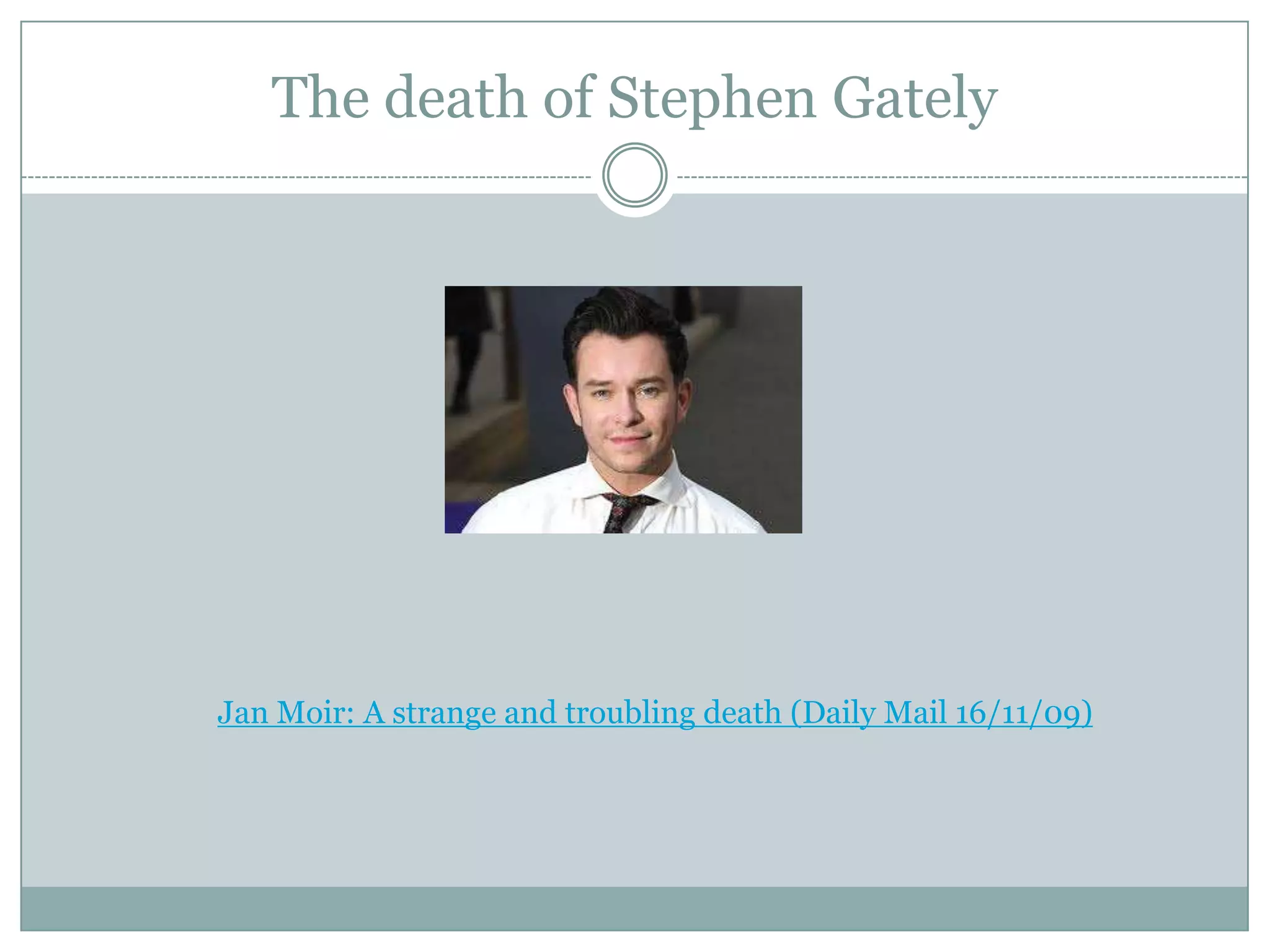
The death of Stephen Gately


Jan Moir: A strange and troubling death (Daily Mail 16/11/09)

Language and politics 2012

  • 1.
  • 2.
    What do wemean by ‘politics’?  Any social relationship which deals with power, governing and authority.  What does politics mean to you? Think of your everyday life – what situations do you engage in that can be described as dealing with power, governing and authority relations?
  • 4.
    Rhetoric  The artof persuasion  Invention  Arrangement  Style  Memory  delivery
  • 5.
    Obama’s inaugural speech Politicians use language as the site at which they promote, protect and legitimate their power and voice of authority, and rationalise their visions of political order and their representations of social harmony. Political speeches are a critical locus for translating those visions and representations of reality into words. Presidential political speeches are elaborately composed, scrupulously revised and edited – resulting in numerous drafts – in order to carry the voice of authority and power of the presidents which they are carefully crafted to be heard as the voice of the collectivity. Boussofara- Omar (2006)
  • 6.
     ‘My fellowcitizens.’  We are a nation of Christians and Muslims, Jews and Hindus, and nonbelievers. We are shaped by every language and culture, drawn from every end of this Earth.
  • 7.
    Metaphor  Forty-four Americanshave now taken the presidential oath.The words have been spoken during rising tides of prosperity and the still waters of peace. Yet, every so often the oath is taken amidst gathering clouds and raging storms. At these moments, America has carried on not simply because of the skill or vision of those in high office, but because We the People have remained faithful to the ideals of our forebears, and true to our founding documents.
  • 8.
    Metaphor  Metaphor isa figure of speech  Aristotle defines metaphor as ‘giving the thing a name that belongs to something else’ (Poetics 1457b: 6-9)  Used to create pictures in the mind  To make connections between things not often thought as related
  • 9.
    Metaphor  Forty-four Americanshave now taken the presidential oath.The words have been spoken during rising tides of prosperity and the still waters of peace. Yet, every so often the oath is taken amidst gathering clouds and raging storms. At these moments, America has carried on not simply because of the skill or vision of those in high office, but because We the People have remained faithful to the ideals of our forebears, and true to our founding documents.
  • 10.
    Metaphors  ‘Metaphor isthe omnipresent principle of thought.’ (I.A. Richards 1936: 92)  Talking about things in metaphorical form influences the way we think and behave (Lakoff and Johnson 1980)  Metaphors can be used as tools to understand new and complex ideas using familiar language.
  • 11.
    Simile  A simileestablishes an association between things by saying that something is ‘like’ something else. ‘She smells like a rose.’ ‘She’s a good boss because she acts like a man.’  Simile’s and metaphors are used to connect concepts in a way that is beneficial for the speaker.
  • 12.
    The rule ofthree  That we are in the midst of crisis is now well understood. Our nation is at war against a far- reaching network of violence and hatred. Our economy is badly weakened, a consequence of greed and irresponsibility on the part of some but also our collective failure to make hard choices and prepare the nation for a new age. Homes have been lost, jobs shed, businesses shuttered. Our health care is too costly, our schools fail too many, and each day brings further evidence that the ways we use energy strengthen our adversaries and threaten our planet.
  • 13.
    Parallelism  On thisday, we gather because we have chosen hope over fear, unity of purpose over conflict and discord. On this day, we come to proclaim an end to the petty grievances and false promises, the recriminations and worn-out dogmas that for far too long have strangled our politics.
  • 14.
    Euphemism and dyseuphemism Euphemism is used when there is a constraint on being explicit for fear of causing offence or distress – often related to taboos (death and bodily functions). They highlight the positive and background the negative  Dyseuphemisms do the opposite – they highlight the negative and background the positive.
  • 15.
    Euphemism and dyseuphemism On September the 11th, the enemies of freedom committed an act of war against our country. Fellow citizens, we’ll meet violence with patient justice – assured of the rightness of our cause, and confident of the victories to come (George W. Bush: 22 Sept. 2001)
  • 16.
    Euphemism and dyseuphemism Today is the day that Harry Reid has scheduled a vote to try and cram the ‘financial reform’ bill down our throats. This bill is a terrible bill. It needs to be killed.  By which they mean bring it up for debate using a majority vote. That’s cramming it down your throat in tea party speak.
  • 17.
    Tools for persuasion Pronouns  Metaphor  Simile  Rule of three  Parallelism  Contrastive pairs  Euphemism  diseuphemism
  • 18.
    Representation is interested  Language is not neutral. It is not merely a vehicle which carries ideas. It is itself a shaper of ideas, it is the programme for mental activity (Whorf, 1976). In this context it is nothing short of ludicrous to conceive of human beings as capable of grasping things as they really are, of being impartial recorders of their world. For they themselves, or some of them at least, have created or constructed the world and they have reflected themselves within it. (my emphasis)  Spender, D. (1980) 04:19
  • 19.
    ‘But I didn’tactually say that.’  Presupposition and Implicature  You can have an intended message but not state it openly. We use the techniques all the time. We only tend to talk about them when we are concerned with power ideology and persuasion.  Assumptions: something taken for granted.  Presupposition: something assumed only by a particular form of the sentence.  Implicature: a conventional conclusion based on what is said – it depends on what we know about the world and the communicative situation.
  • 20.
    Presupposition and Implicature I forgot to ask my cousin for her umbrella.  It’s about to rain? – Implicature  I have a cousin, she is a woman - presupposition  I didn’t forget to ask my cousin for her umbrella.  Negate the sentence and the presupposition still stands
  • 21.
    Presupposition and Implicature Examples:  We will save the NHS  Put country before party this election  Invest in a future we can all enjoy  Make the difference  The green alternative to a better life  We will transform our schools and colleges to meet the demands of a new age.  Doesn’t each day bring further evidence that the ways we use energy strengthen our adversaries and threaten our planet? 04:19
  • 22.
    The death ofStephen Gately Jan Moir: A strange and troubling death (Daily Mail 16/11/09)