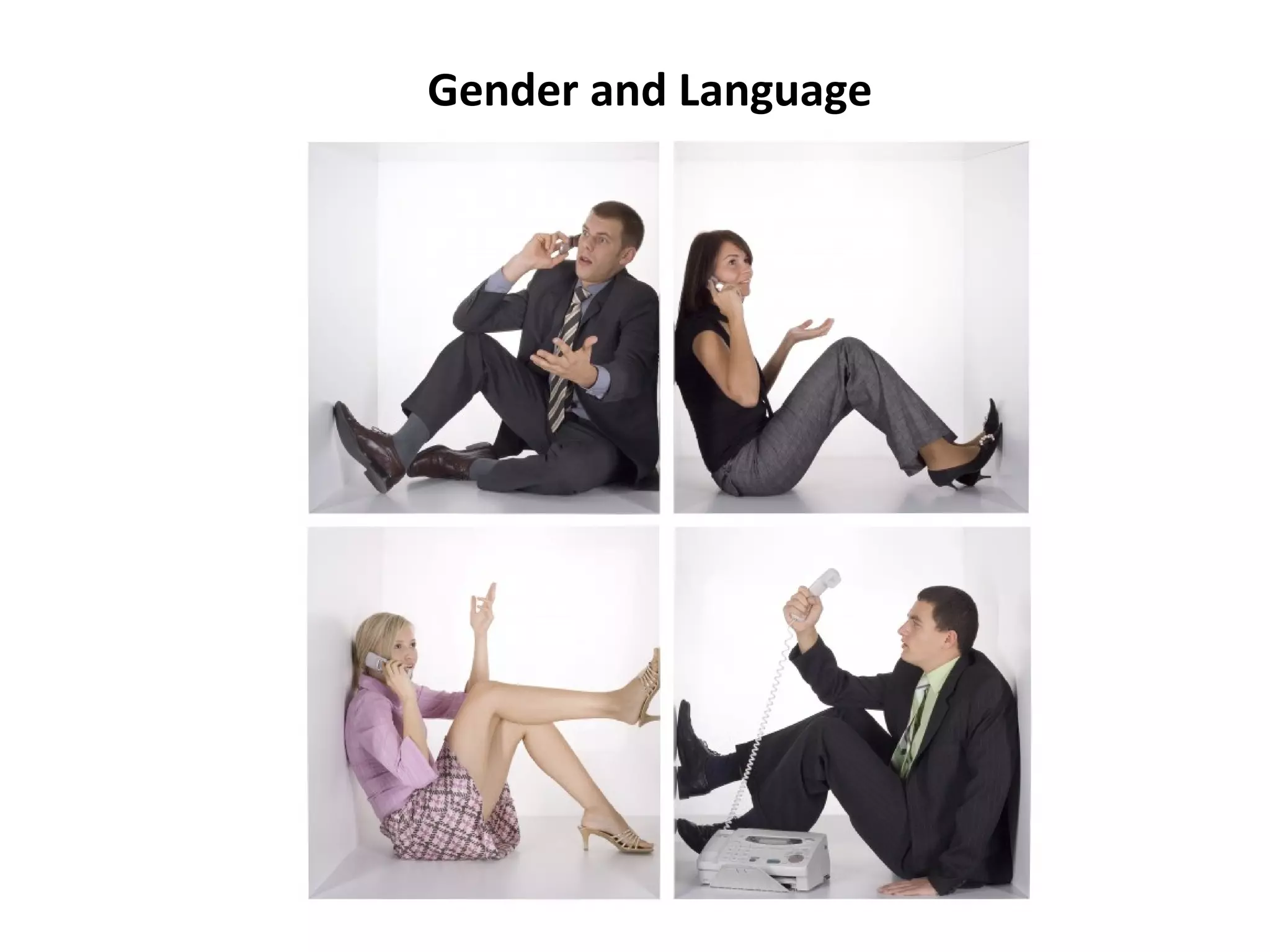
Gender and Language
Sex Versus Gender
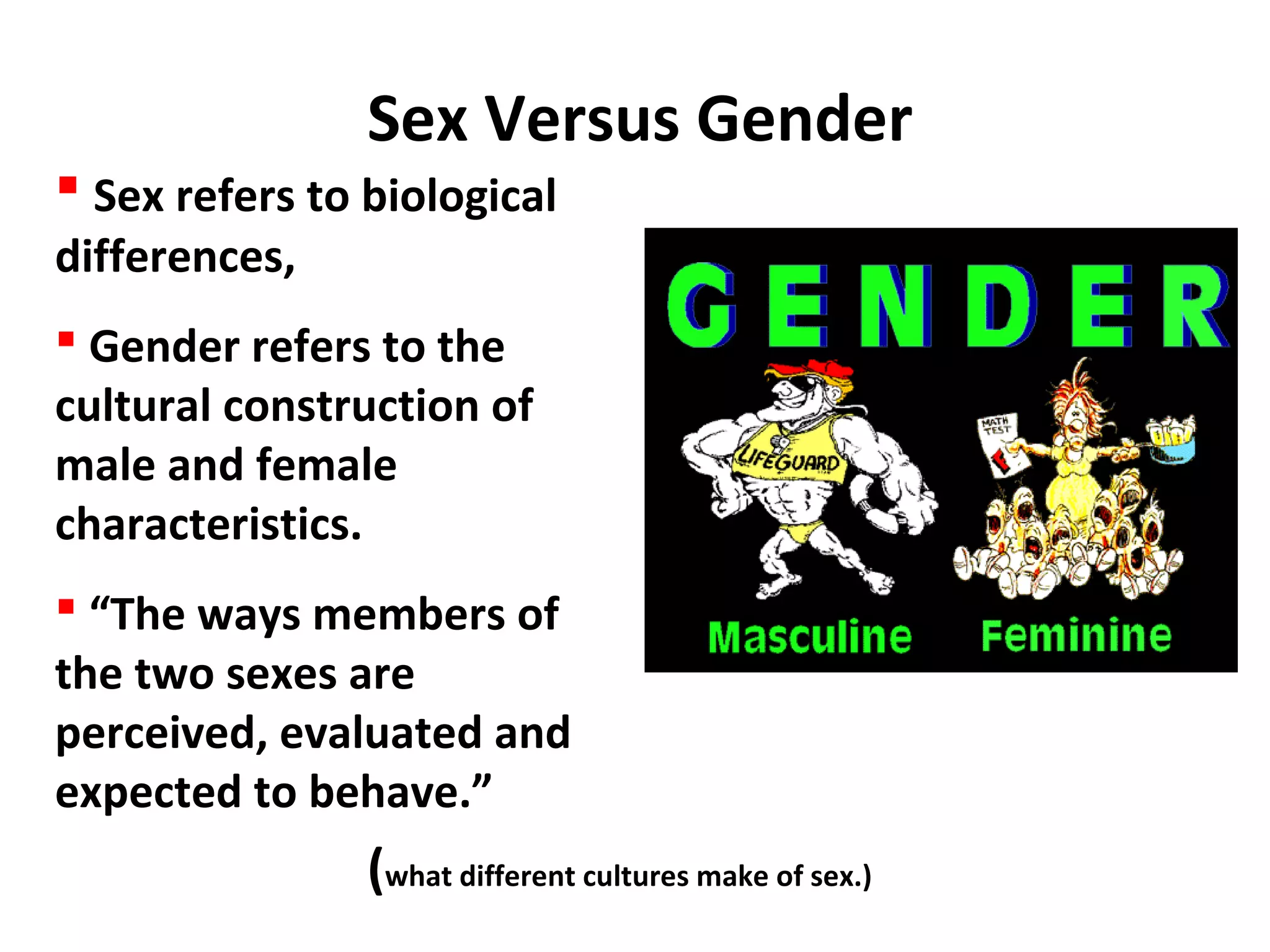
 Sex refers to biological
differences,
 Gender refers to the
cultural construction of
male and female
characteristics.
 “The ways members of
the two sexes are
perceived, evaluated and
expected to behave.”
(what different cultures make of sex.)
Gender Boundaries
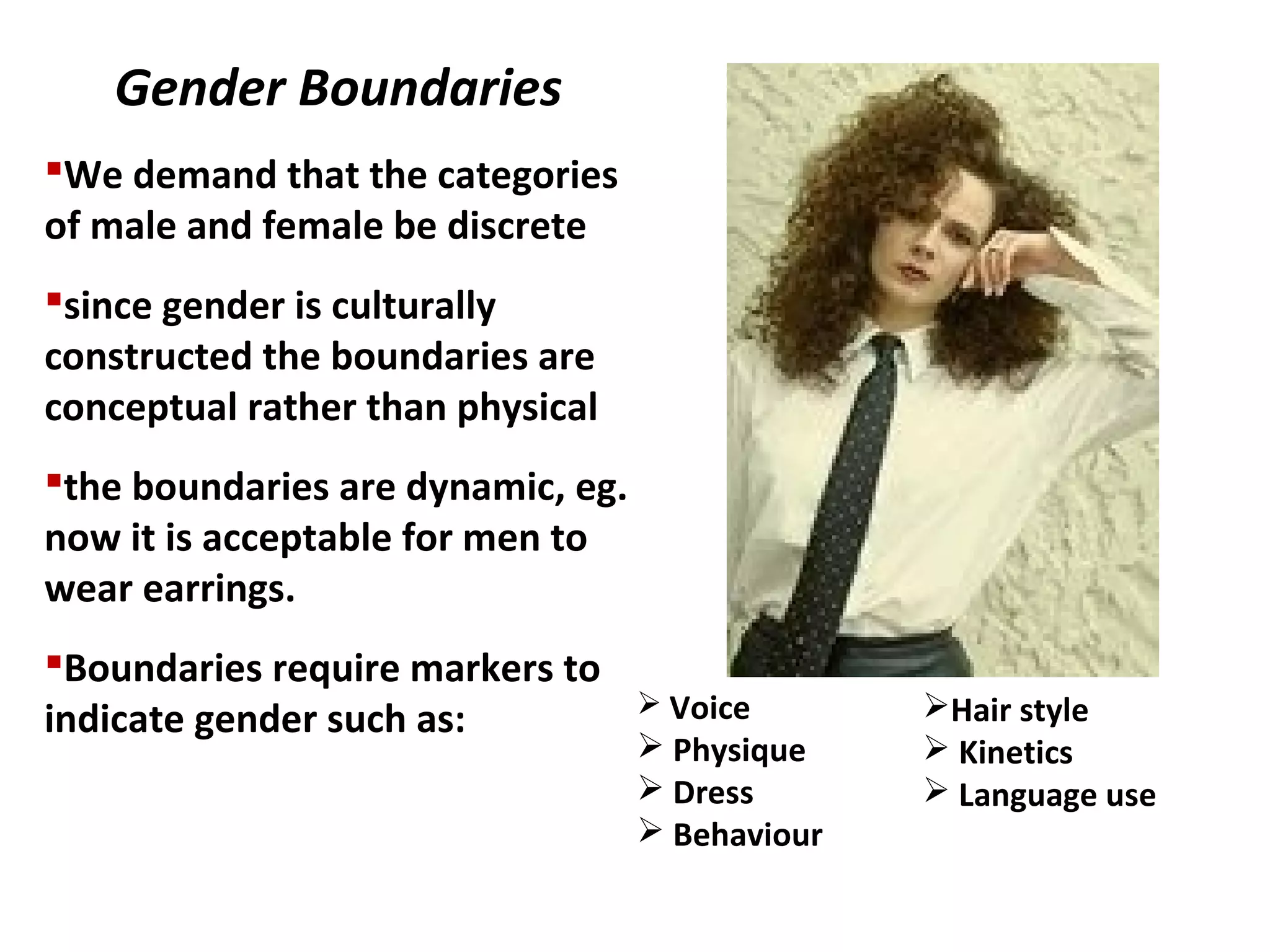
We demand that the categories
of male and female be discrete
since gender is culturally
constructed the boundaries are
conceptual rather than physical
the boundaries are dynamic, eg.
now it is acceptable for men to
wear earrings.
Boundaries require markers to
indicate gender such as:  Voice
 Physique
 Dress
 Behaviour
Hair style
 Kinetics
 Language use
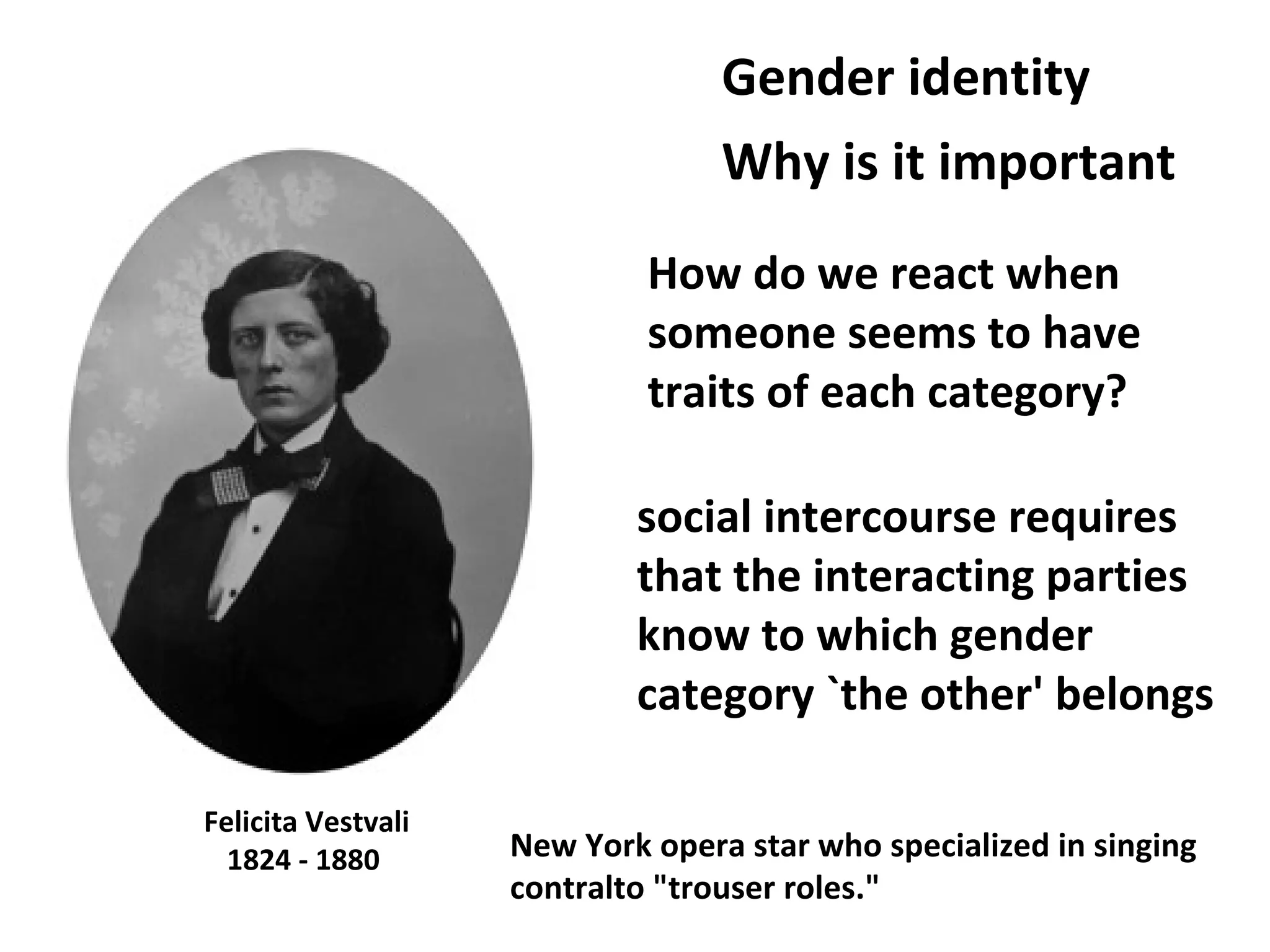
Felicita Vestvali
1824 - 1880
How do we react when
someone seems to have
traits of each category?
Gender identity
New York opera star who specialized in singing
contralto "trouser roles."
Why is it important
social intercourse requires
that the interacting parties
know to which gender
category `the other' belongs
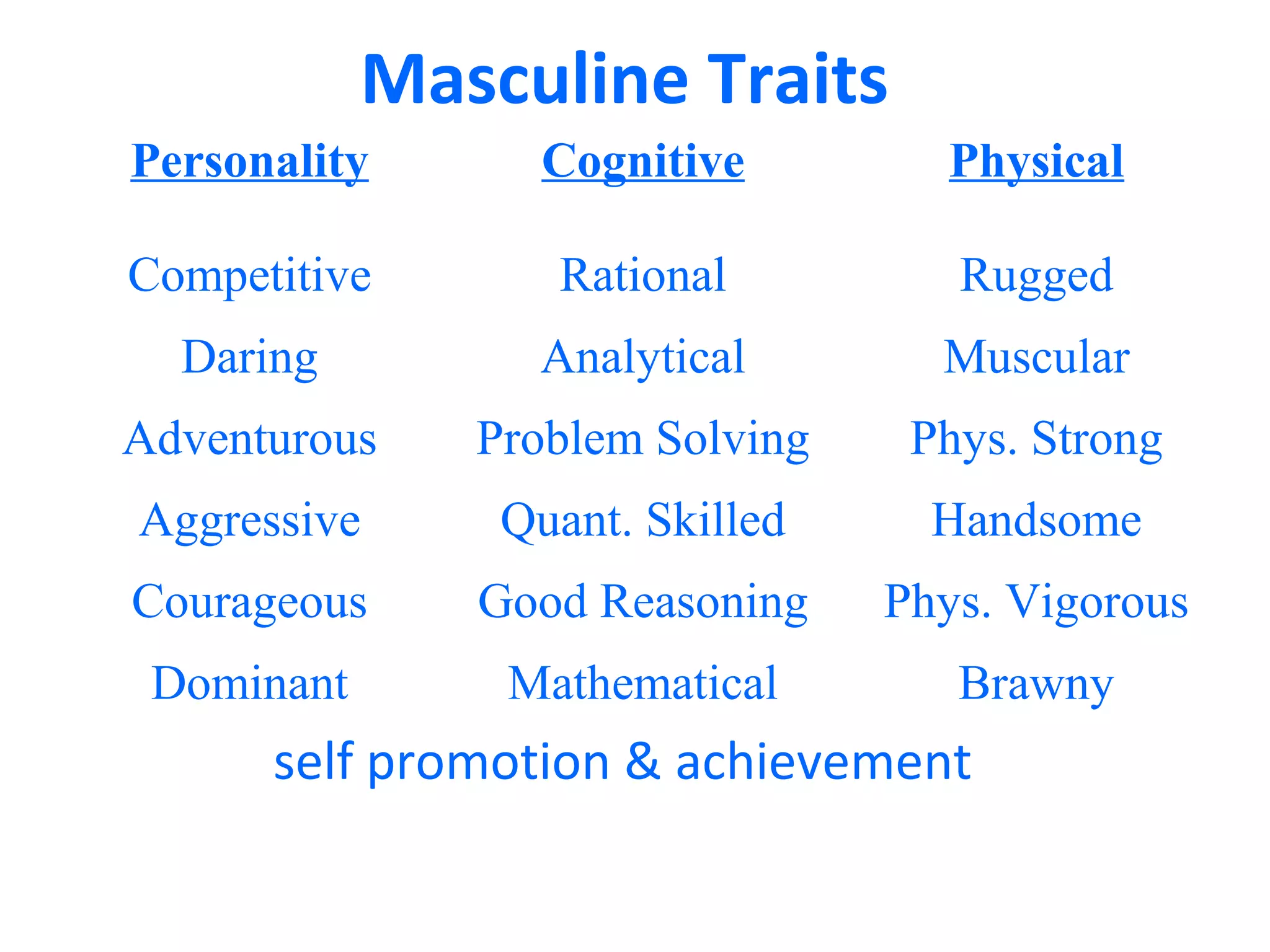
Masculine Traits
Personality Cognitive Physical
Competitive Rational Rugged
Daring Analytical Muscular
Adventurous Problem Solving Phys. Strong
Aggressive Quant. Skilled Handsome
Courageous Good Reasoning Phys. Vigorous
Dominant Mathematical Brawny
self promotion & achievement
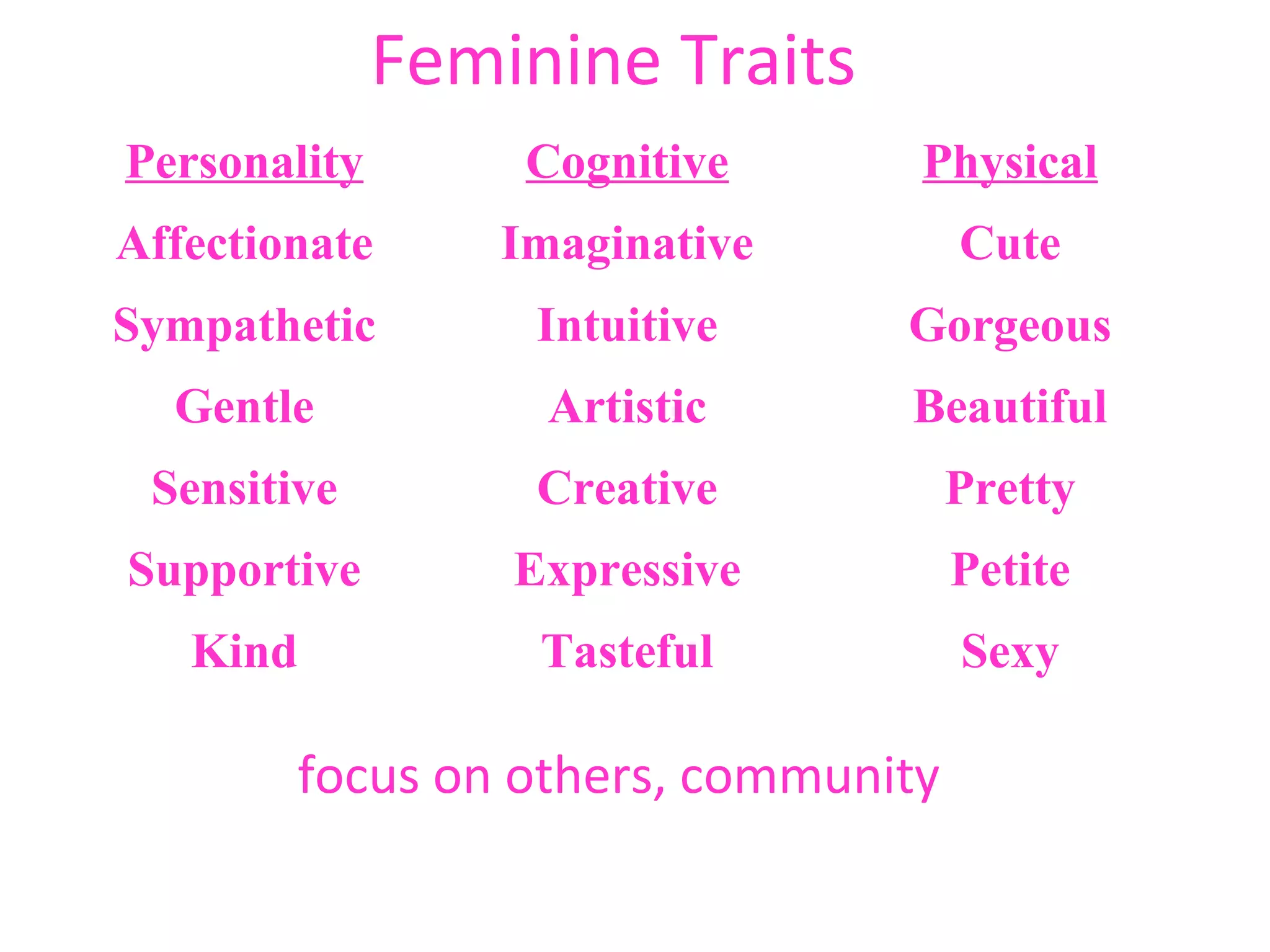
Personality Cognitive Physical
Affectionate Imaginative Cute
Sympathetic Intuitive Gorgeous
Gentle Artistic Beautiful
Sensitive Creative Pretty
Supportive Expressive Petite
Kind Tasteful Sexy
focus on others, community
Feminine Traits
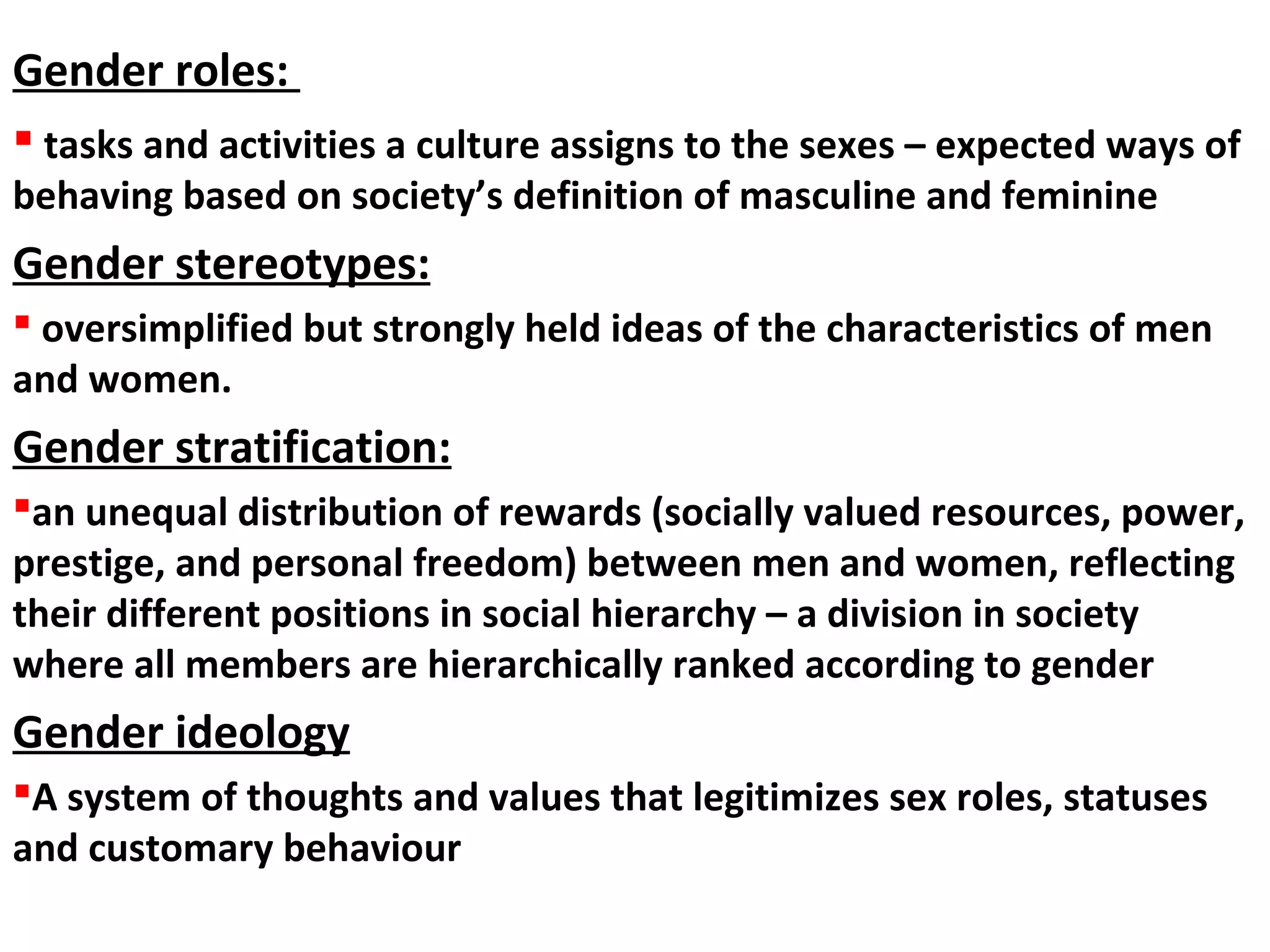
 tasks and activities a culture assigns to the sexes – expected ways of
behaving based on society’s definition of masculine and feminine
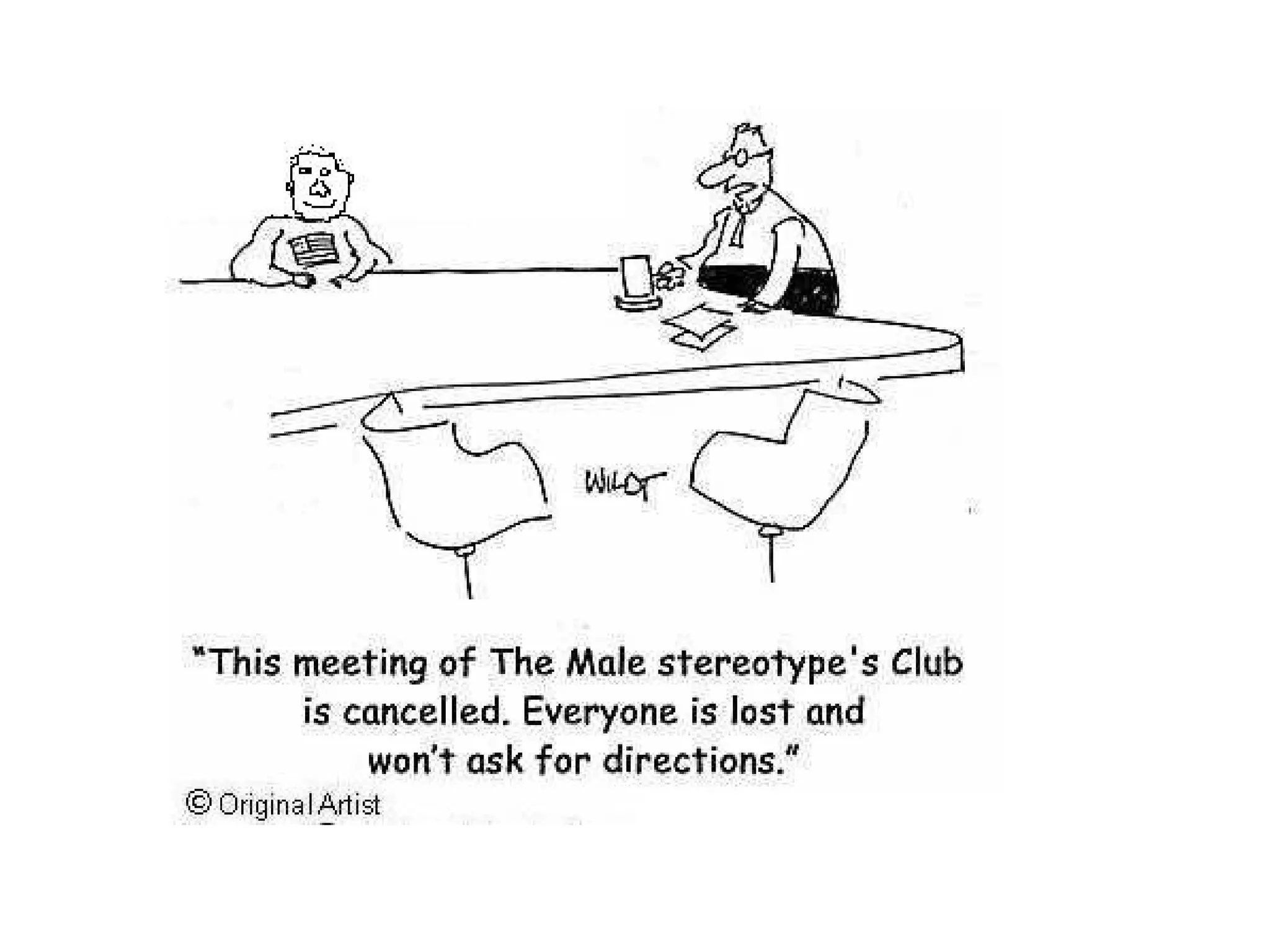
Gender stereotypes:
 oversimplified but strongly held ideas of the characteristics of men
and women.
Gender stratification:
an unequal distribution of rewards (socially valued resources, power,
prestige, and personal freedom) between men and women, reflecting
their different positions in social hierarchy – a division in society
where all members are hierarchically ranked according to gender
Gender ideology
A system of thoughts and values that legitimizes sex roles, statuses
and customary behaviour
Gender roles:
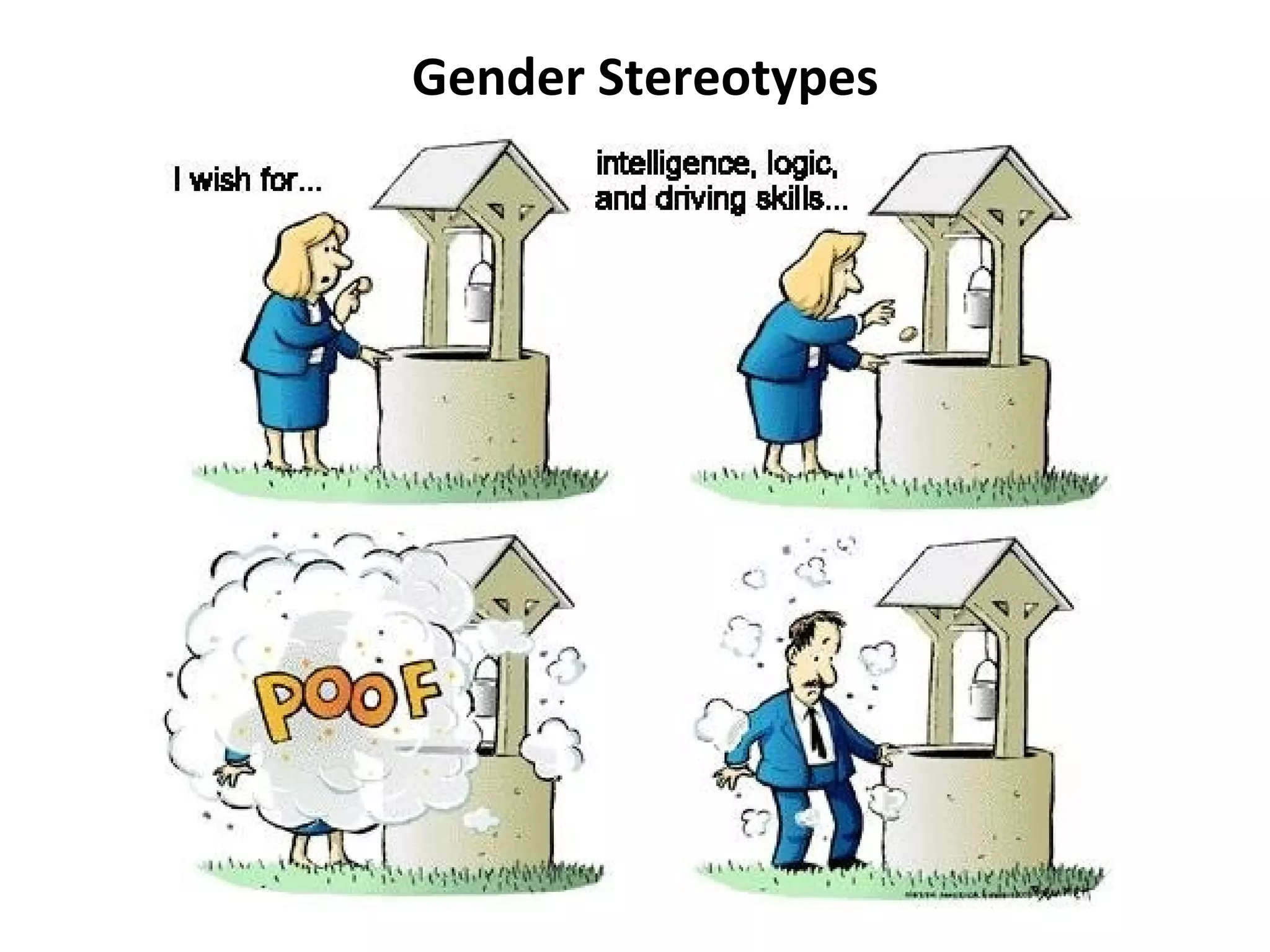
Gender Stereotypes
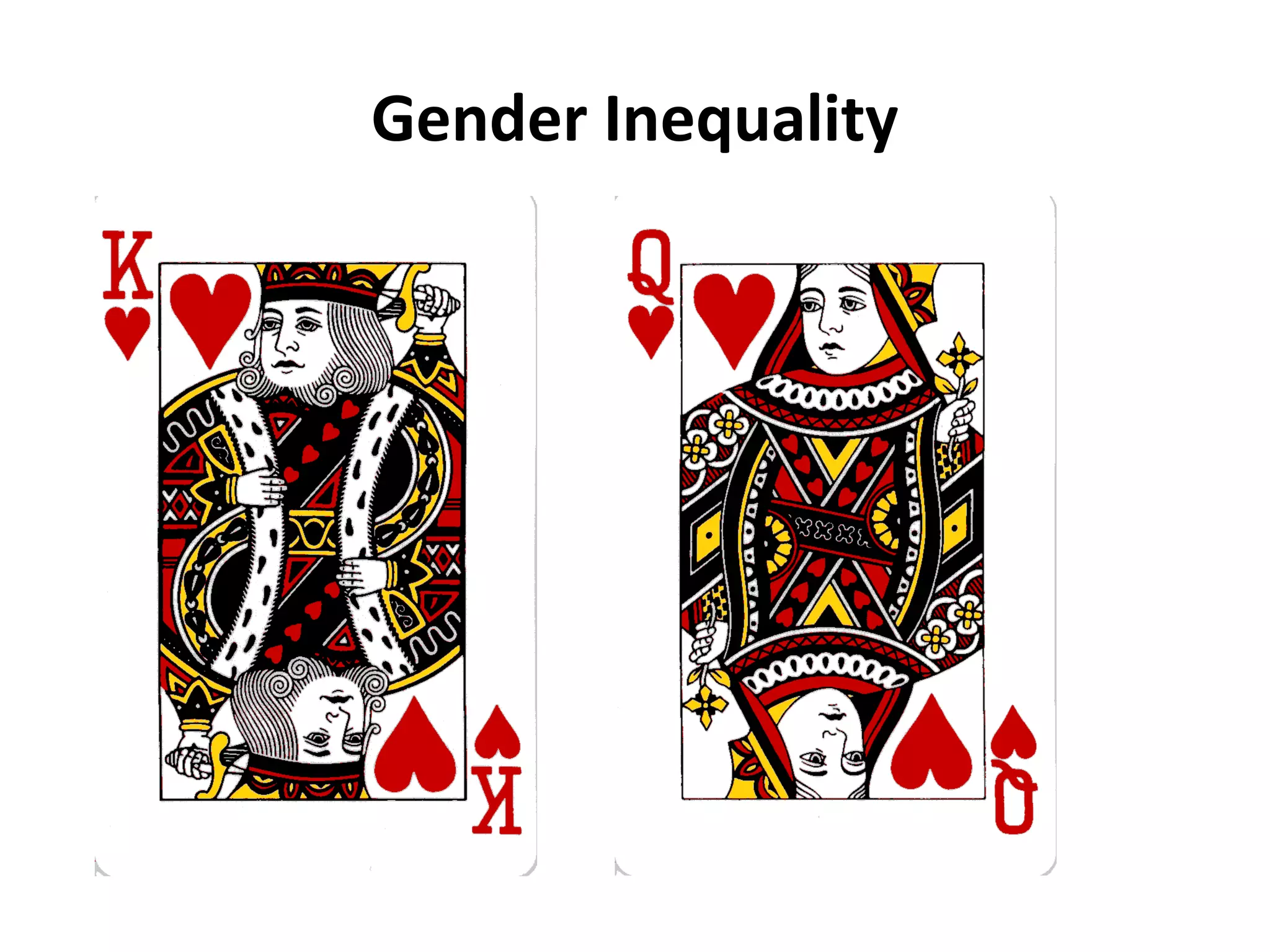
Gender Inequality
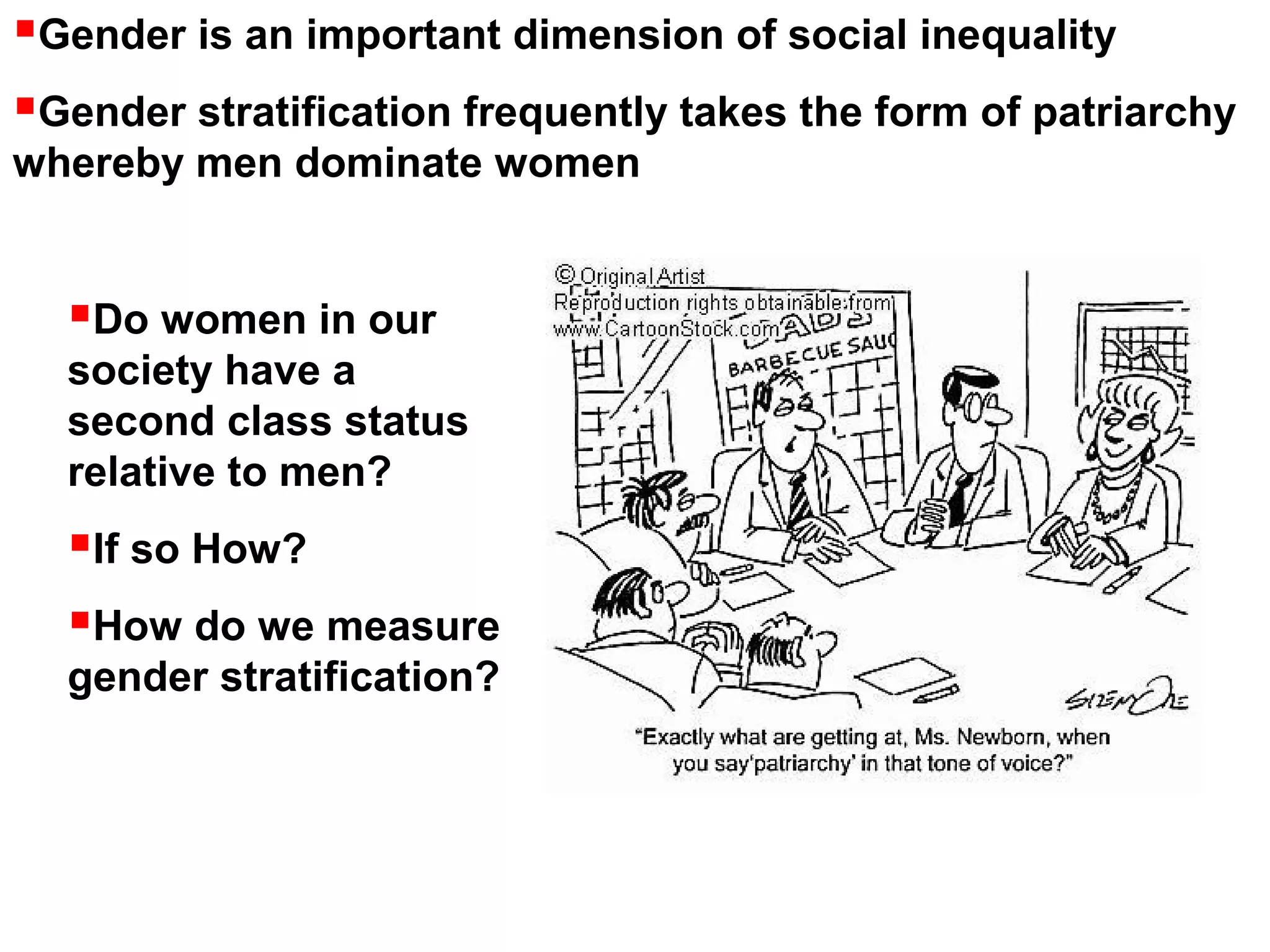
Gender is an important dimension of social inequality
Gender stratification frequently takes the form of patriarchy
whereby men dominate women
Do women in our
society have a
second class status
relative to men?
If so How?
How do we measure
gender stratification?
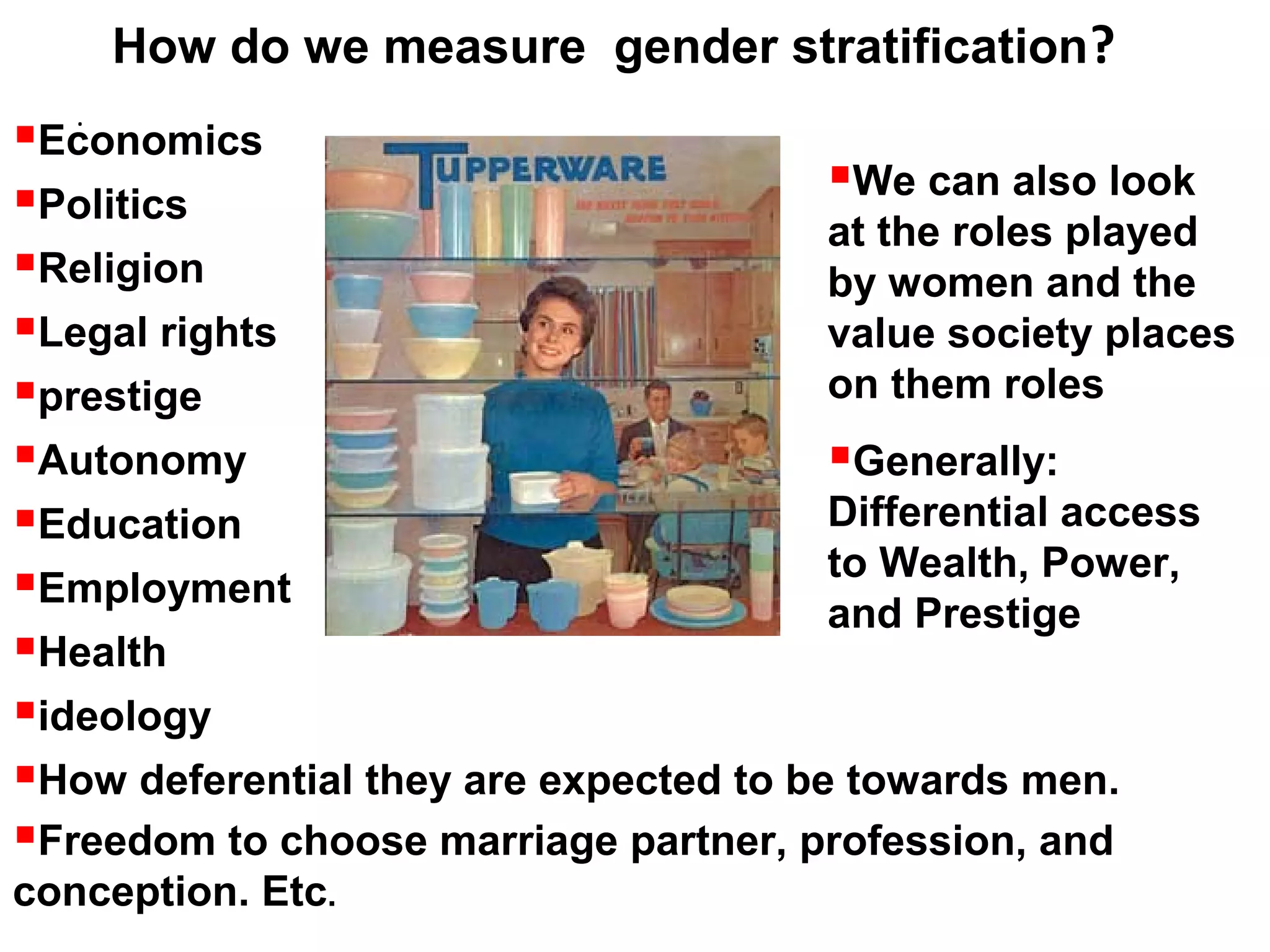
How do we measure gender stratification?
.
Economics
Politics
Religion
Legal rights
prestige
Autonomy
Education
Employment
Health
ideology
How deferential they are expected to be towards men.
Freedom to choose marriage partner, profession, and
conception. Etc.
We can also look
at the roles played
by women and the
value society places
on them roles
Generally:
Differential access
to Wealth, Power,
and Prestige
Language and gender
Three issues:
1. Do women and men speak a different language
- genderlect? – Do they speak differently
2. Do women and men behave differently in
conversations? – Use language differently
3. Gender bias in English
Men and women are socialized to express themselves in different
ways in accordance with cultural norms that teach and reinforce
differentiated gender roles
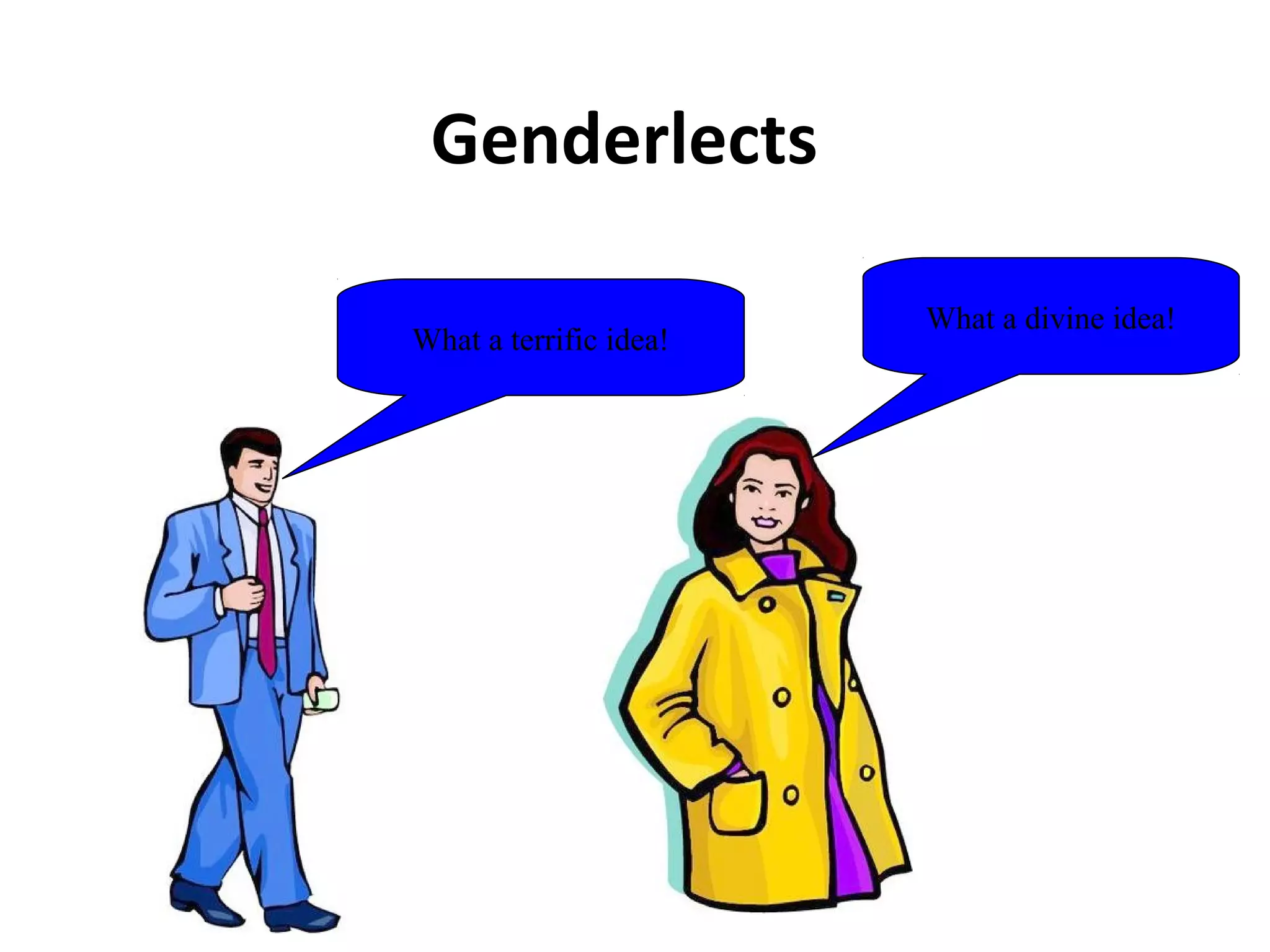
Genderlects
What a divine idea!
What a terrific idea!
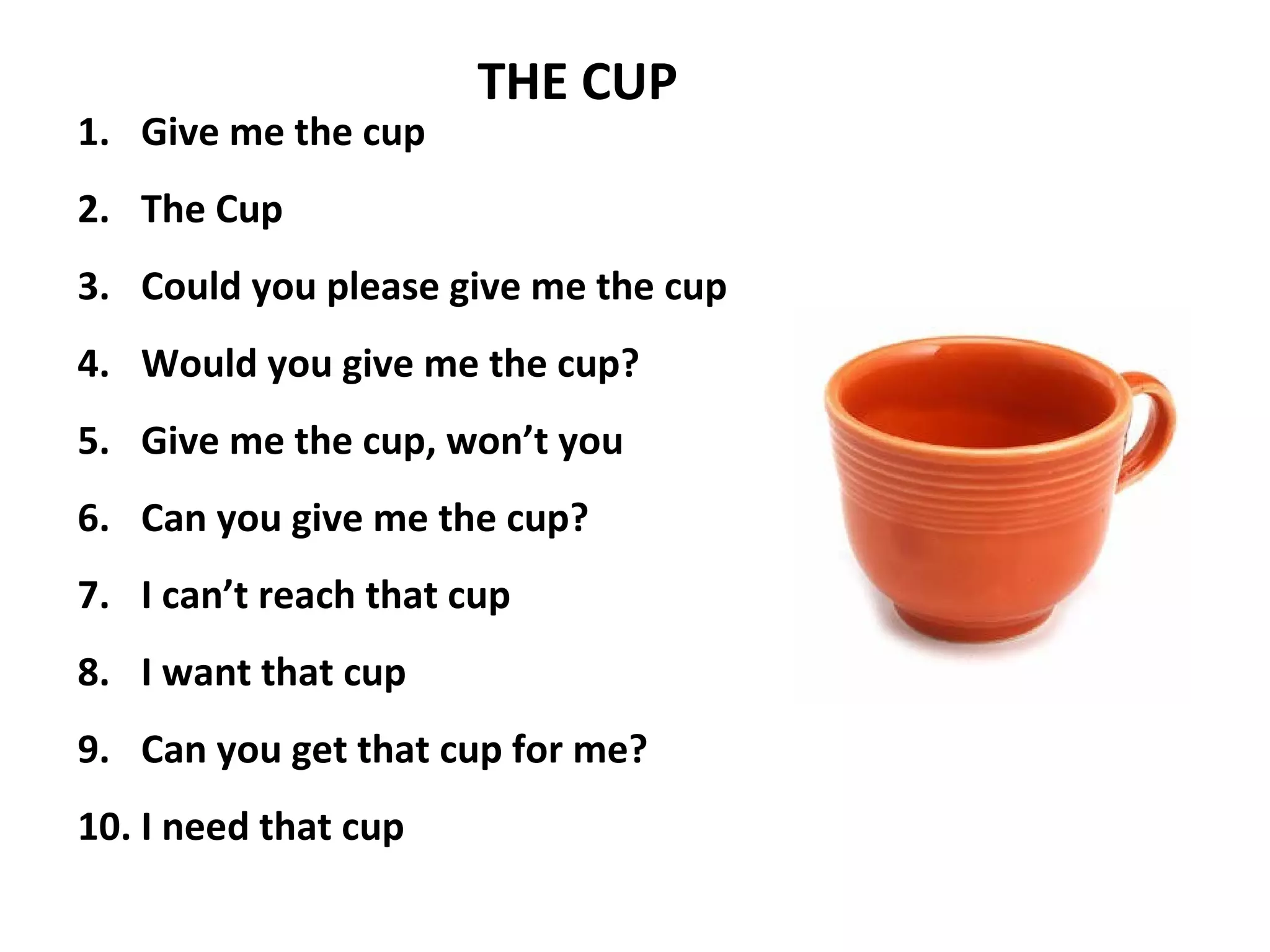
1. Give me the cup
2. The Cup
3. Could you please give me the cup
4. Would you give me the cup?
5. Give me the cup, won’t you
6. Can you give me the cup?
7. I can’t reach that cup
8. I want that cup
9. Can you get that cup for me?
10. I need that cup
THE CUP
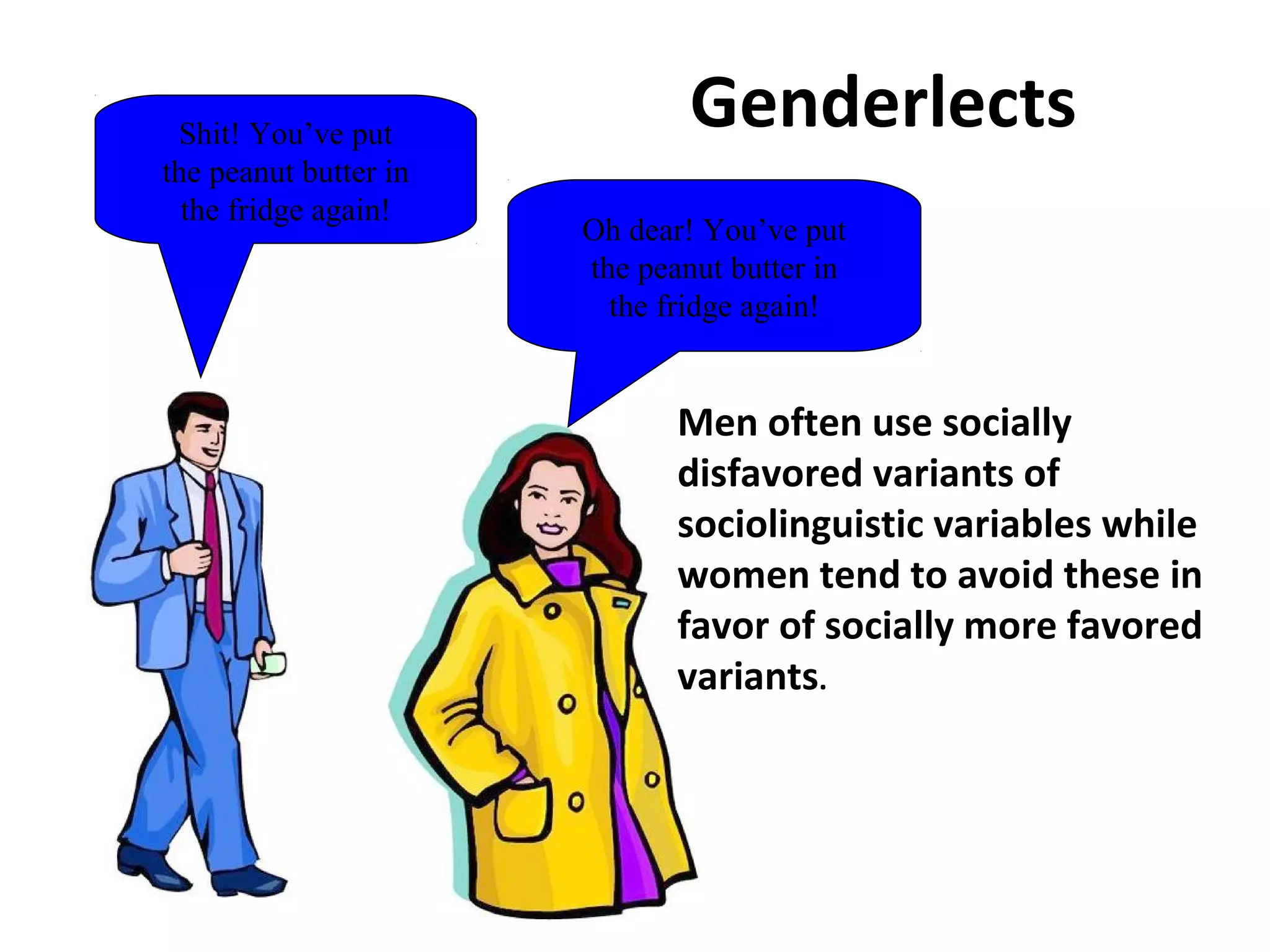
Shit! You’ve put
the peanut butter in
the fridge again!
Oh dear! You’ve put
the peanut butter in
the fridge again!
Men often use socially
disfavored variants of
sociolinguistic variables while
women tend to avoid these in
favor of socially more favored
variants.
Genderlects
-ing symbolizes female
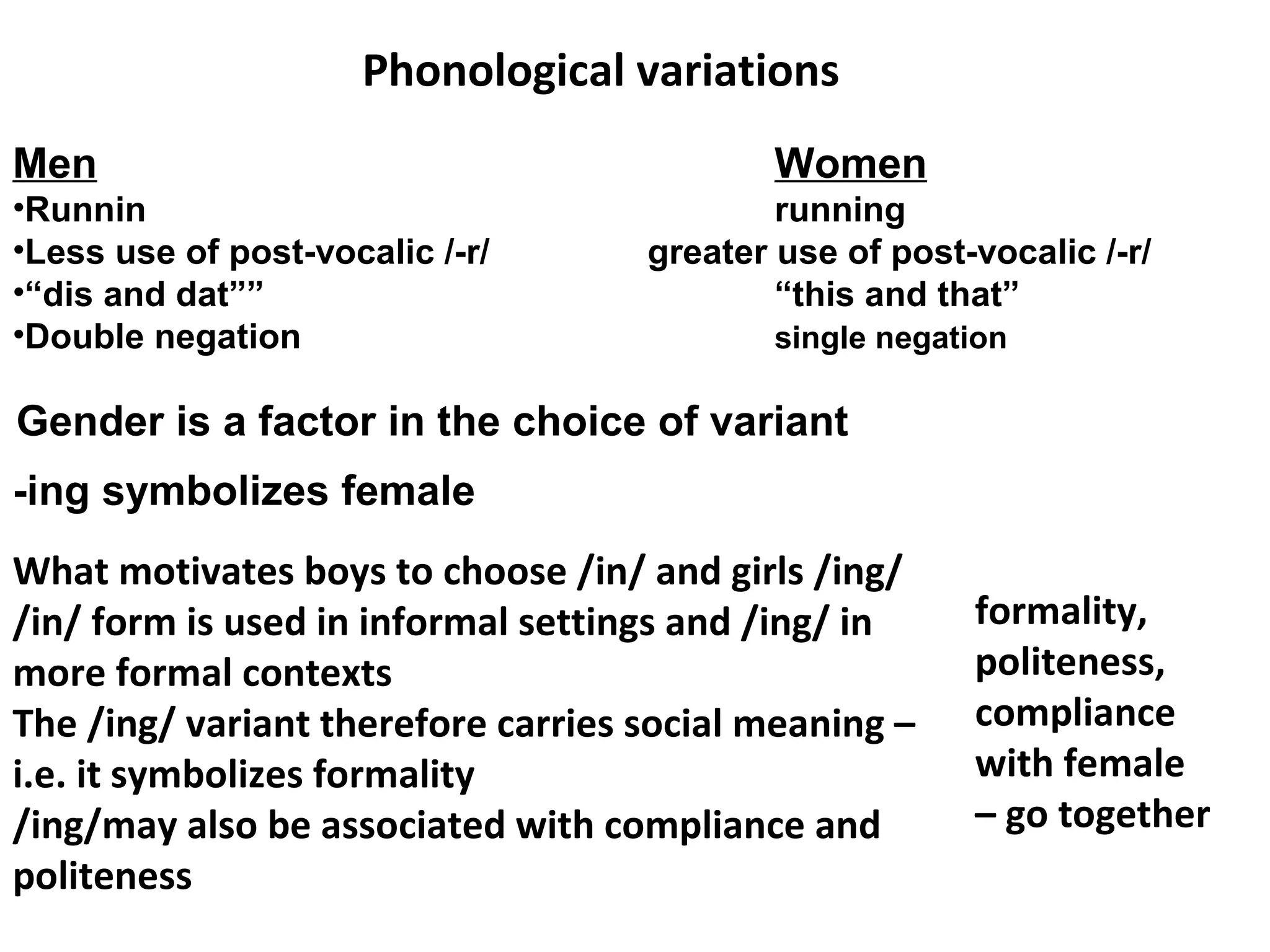
Phonological variations
Men Women
•Runnin running
•Less use of post-vocalic /-r/ greater use of post-vocalic /-r/
•“dis and dat”” “this and that”
•Double negation single negation
Gender is a factor in the choice of variant
What motivates boys to choose /in/ and girls /ing/
/in/ form is used in informal settings and /ing/ in
more formal contexts
The /ing/ variant therefore carries social meaning –
i.e. it symbolizes formality
/ing/may also be associated with compliance and
politeness
formality,
politeness,
compliance
with female
– go together
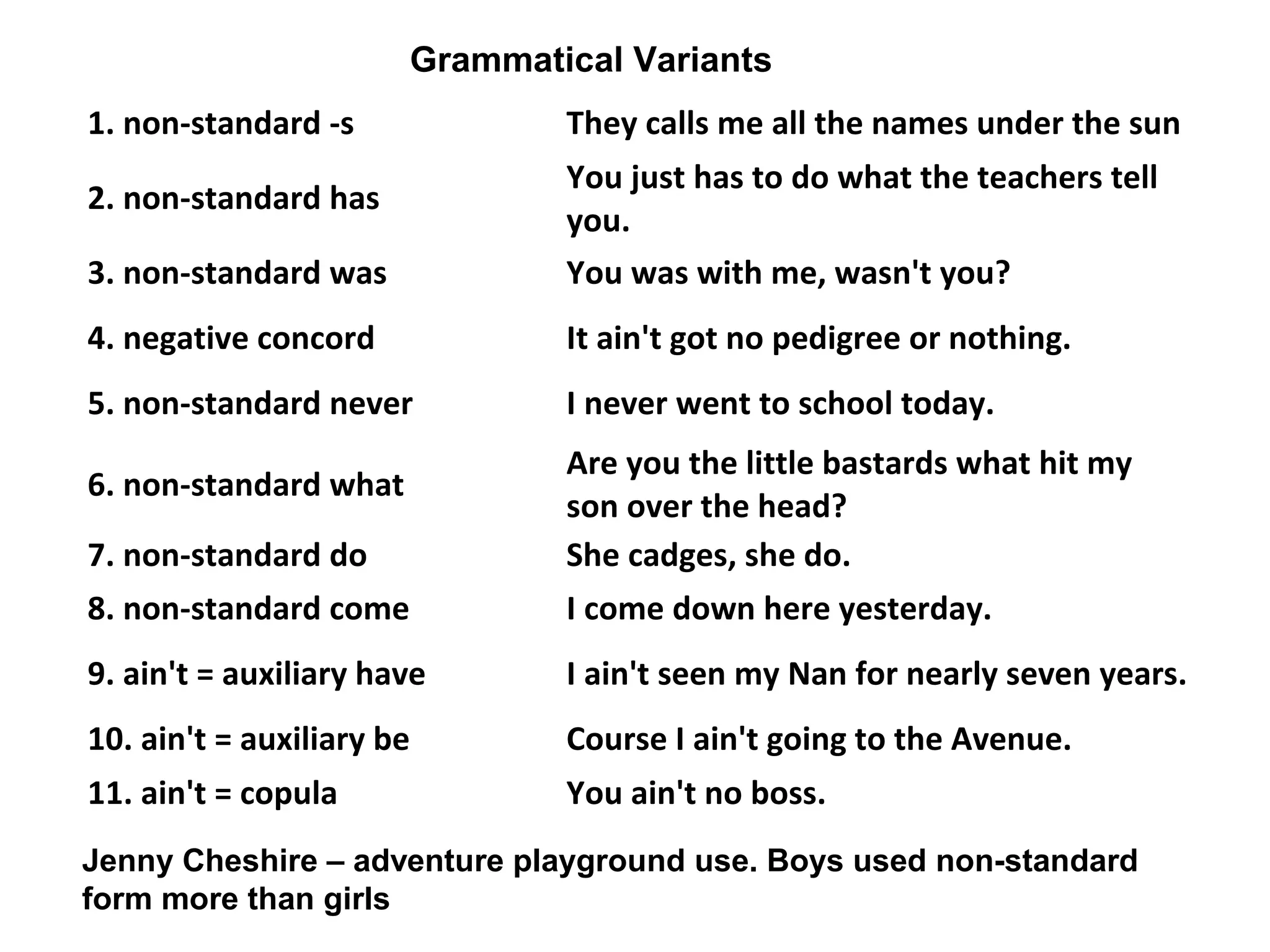
Grammatical Variants
1. non-standard -s They calls me all the names under the sun
2. non-standard has
You just has to do what the teachers tell
you.
3. non-standard was You was with me, wasn't you?
4. negative concord It ain't got no pedigree or nothing.
5. non-standard never I never went to school today.
6. non-standard what
Are you the little bastards what hit my
son over the head?
7. non-standard do She cadges, she do.
8. non-standard come I come down here yesterday.
9. ain't = auxiliary have I ain't seen my Nan for nearly seven years.
10. ain't = auxiliary be Course I ain't going to the Avenue.
11. ain't = copula You ain't no boss.
Jenny Cheshire – adventure playground use. Boys used non-standard
form more than girls
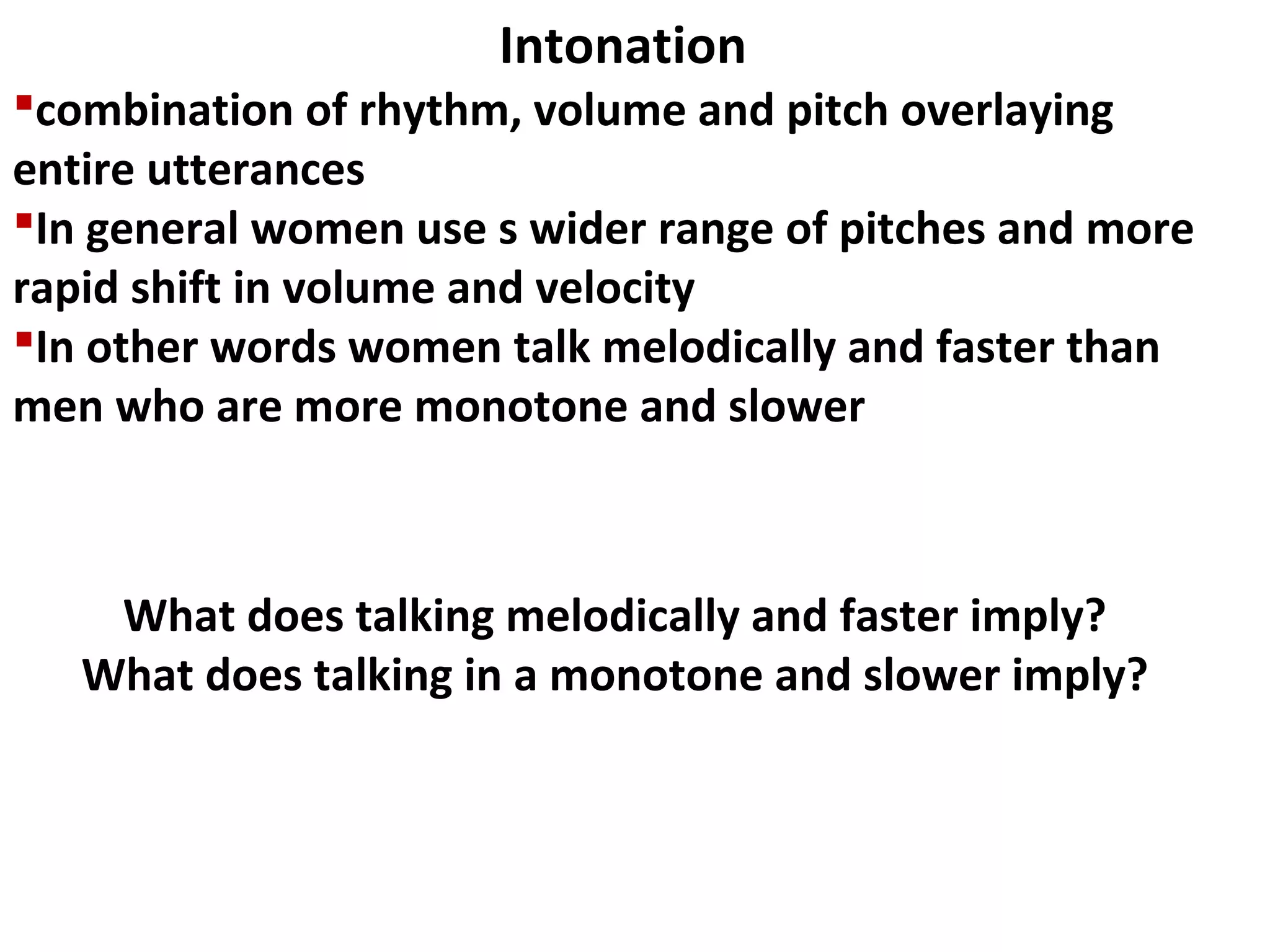
combination of rhythm, volume and pitch overlaying
entire utterances
In general women use s wider range of pitches and more
rapid shift in volume and velocity
In other words women talk melodically and faster than
men who are more monotone and slower
Intonation
What does talking melodically and faster imply?
What does talking in a monotone and slower imply?
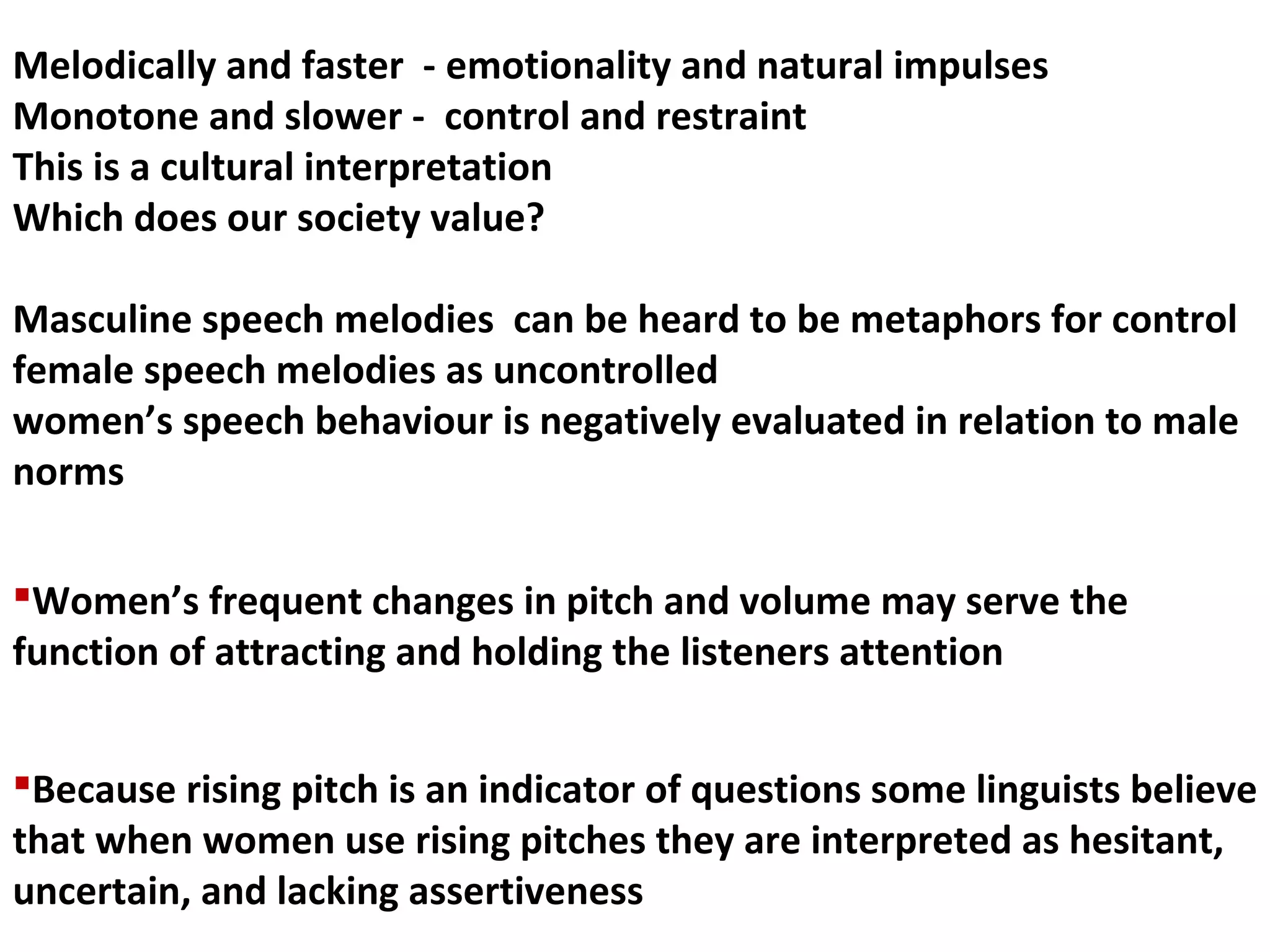
Because rising pitch is an indicator of questions some linguists believe
that when women use rising pitches they are interpreted as hesitant,
uncertain, and lacking assertiveness
Melodically and faster - emotionality and natural impulses
Monotone and slower - control and restraint
This is a cultural interpretation
Which does our society value?
Masculine speech melodies can be heard to be metaphors for control
female speech melodies as uncontrolled
women’s speech behaviour is negatively evaluated in relation to male
norms
Women’s frequent changes in pitch and volume may serve the
function of attracting and holding the listeners attention
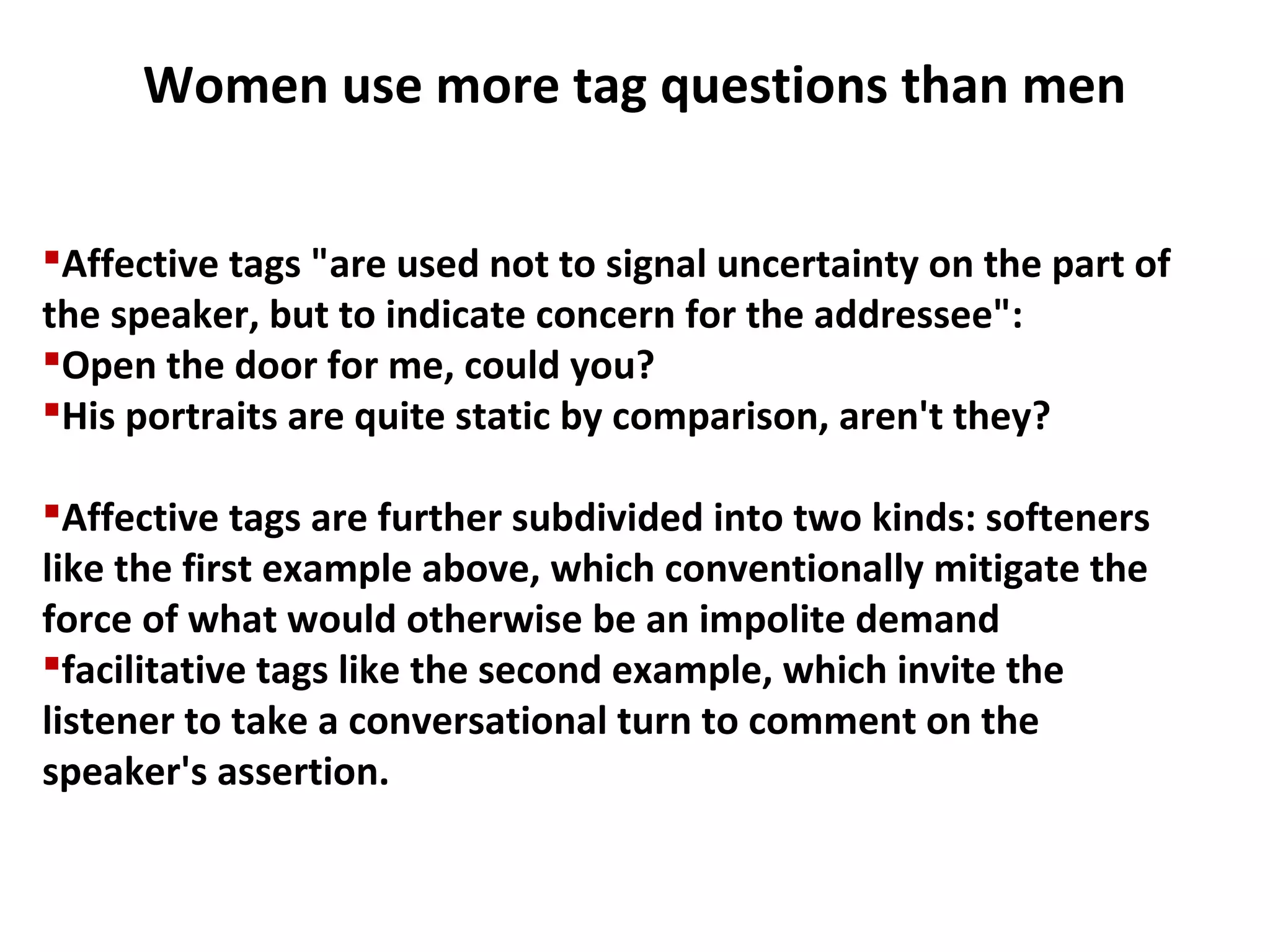
Affective tags "are used not to signal uncertainty on the part of
the speaker, but to indicate concern for the addressee":
Open the door for me, could you?
His portraits are quite static by comparison, aren't they?
Affective tags are further subdivided into two kinds: softeners
like the first example above, which conventionally mitigate the
force of what would otherwise be an impolite demand
facilitative tags like the second example, which invite the
listener to take a conversational turn to comment on the
speaker's assertion.
Women use more tag questions than men
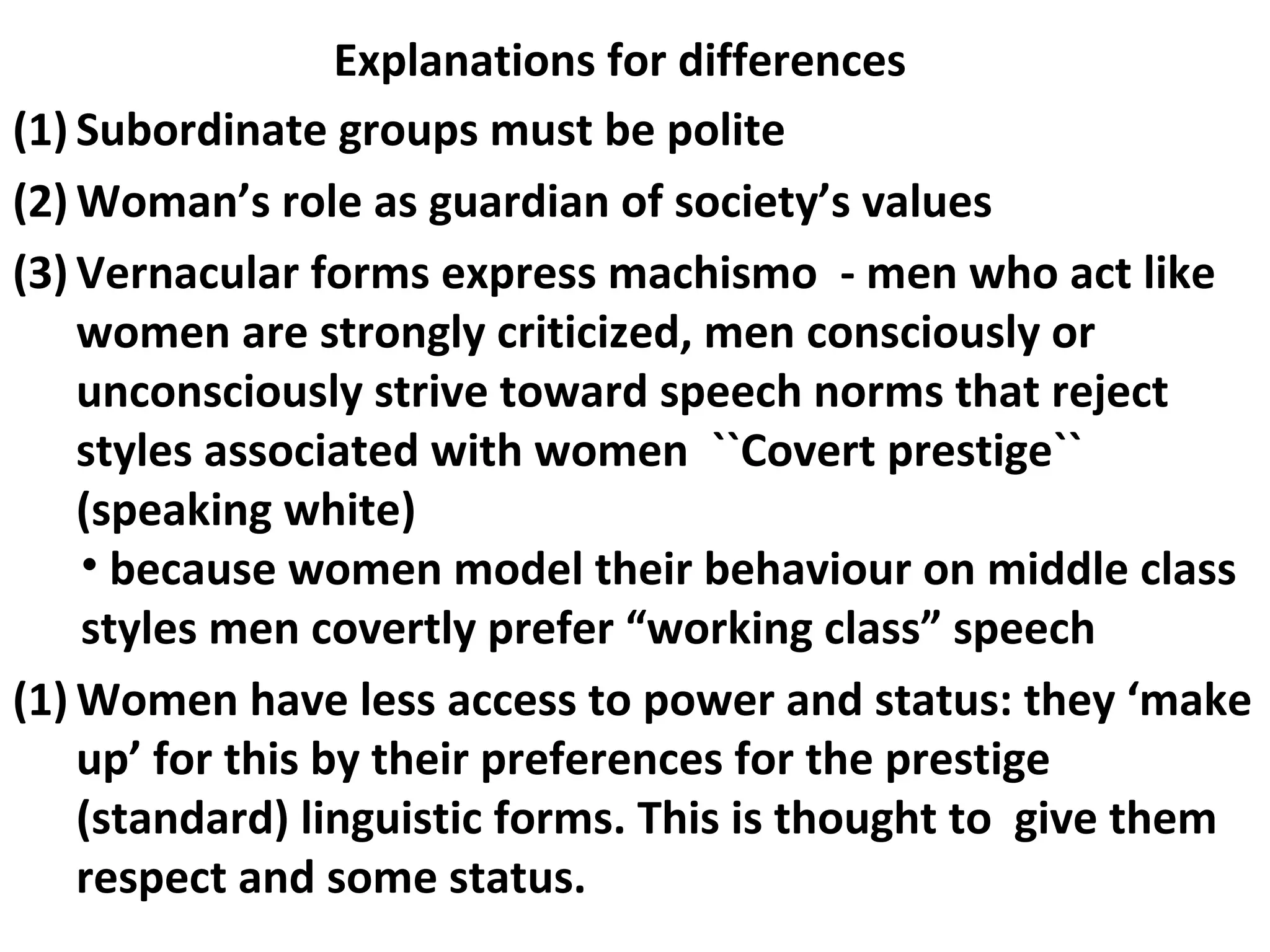
(1) Subordinate groups must be polite
(2) Woman’s role as guardian of society’s values
(3) Vernacular forms express machismo - men who act like
women are strongly criticized, men consciously or
unconsciously strive toward speech norms that reject
styles associated with women ``Covert prestige``
(speaking white)
• because women model their behaviour on middle class
styles men covertly prefer “working class” speech
(1) Women have less access to power and status: they ‘make
up’ for this by their preferences for the prestige
(standard) linguistic forms. This is thought to give them
respect and some status.
Explanations for differences
(5) women are more conscious of prestige norms and strive to use
them because they are judged by their social self-presentation and
are aware of strong social sanction if they do not conform –
linguistic insecurity
(6) Women and men are socialized in different ways which is reflected
in their language use patterns.
(7) women may be more status conscious than men because:
– society sets more standards for women and
– Women’s typical activities do not confer status itself.
– Women don`t want to use lower class language because of the
associations made with lower class people
(8) Women and men have different networks which lead to women
and men using different ways of speaking.
(9) many of the jobs available to women require standard form
Explanations for differences
Women use more hedge words
Use mitigation to blunt direct statement
More tag questions
Men and women vary in frequencies with which they use –
particular sounds (pronunciation), prosodic features (intonation,
velocity) grammar and choices of vocabulary. i.e. women and men
use have different styles of speaking (although for the most part we
speak the same)
Linguistic and stylistic variations arise from, reflect and reinforce
existing gender differences
Gender is an aspect of identity that is enacted through speech
practices
careful speech by women reflects their position in a hierarchical
system of gender in which they are culturally relegated to second
place
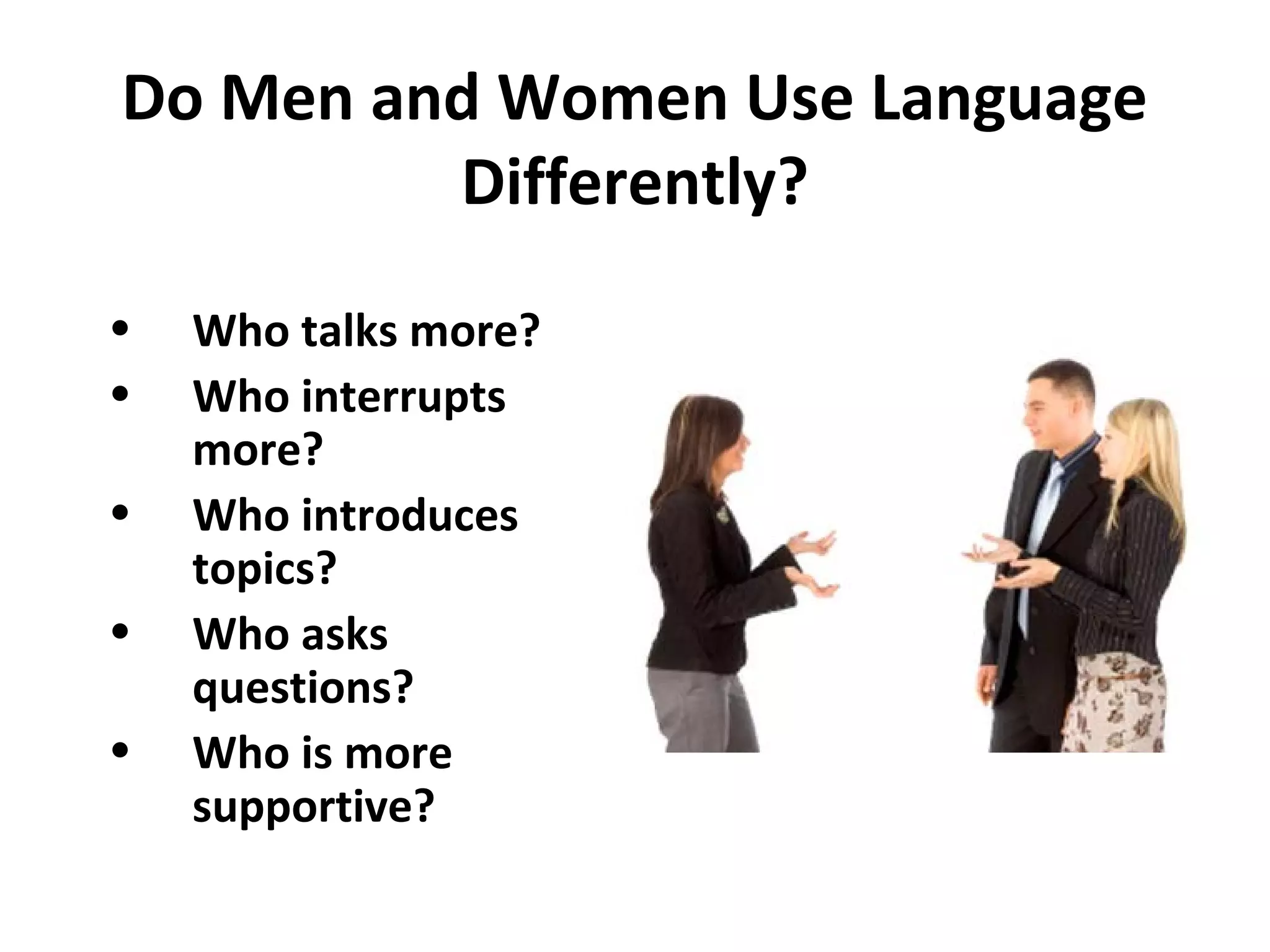
• Who talks more?
• Who interrupts
more?
• Who introduces
topics?
• Who asks
questions?
• Who is more
supportive?
Do Men and Women Use Language
Differently?
Men and women in conversation
Who talks more?
• Stereotype says that women talk more
than men
• Proverbs:
– A woman's tongue wags like a lamb's tail.
– Foxes are all tail and women are all tongue.
– The North Sea will sooner be found wanting in
water than a woman be at a loss for a word.
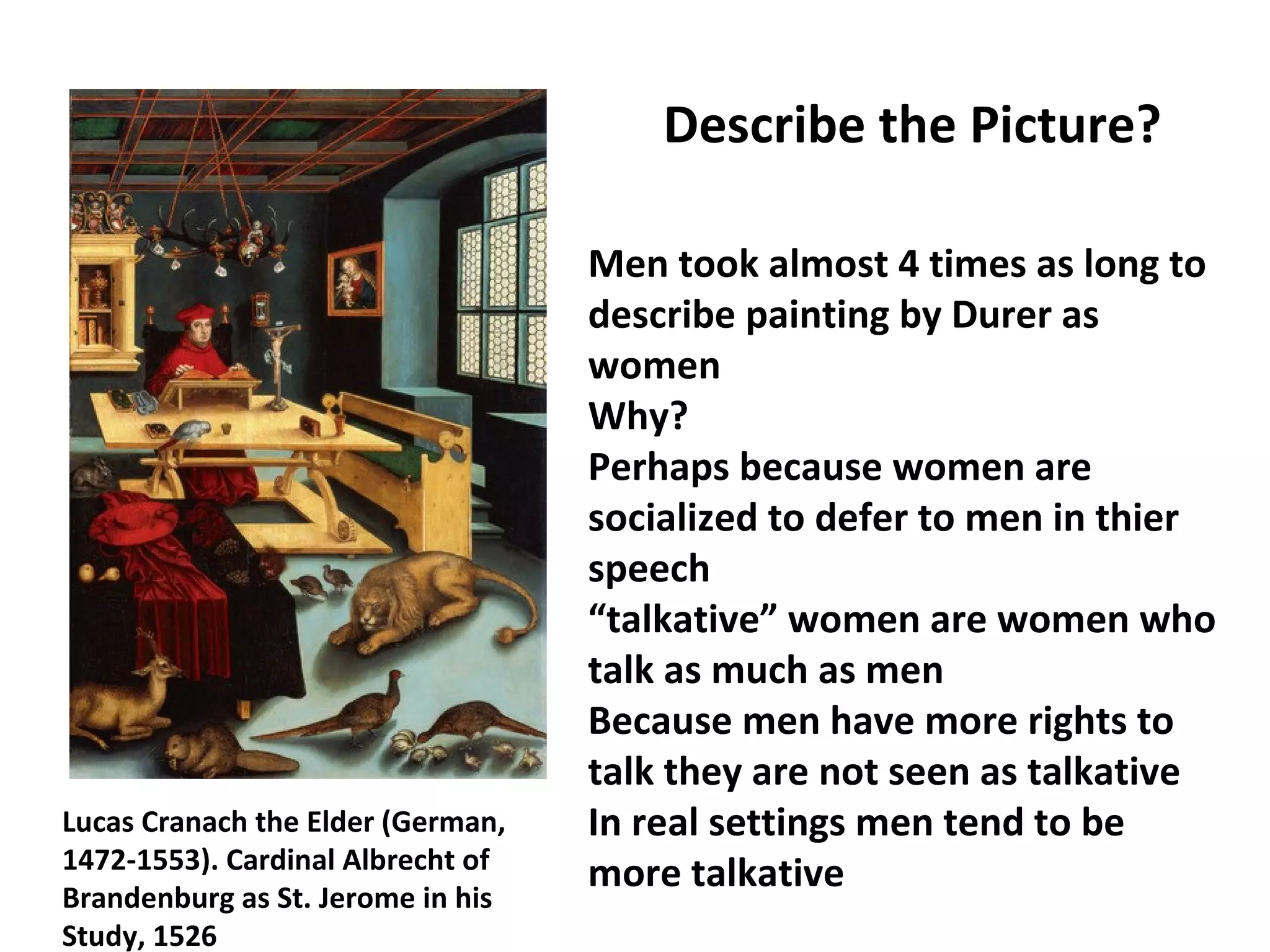
Lucas Cranach the Elder (German,
1472-1553). Cardinal Albrecht of
Brandenburg as St. Jerome in his
Study, 1526
Describe the Picture?
Men took almost 4 times as long to
describe painting by Durer as
women
Why?
Perhaps because women are
socialized to defer to men in thier
speech
“talkative” women are women who
talk as much as men
Because men have more rights to
talk they are not seen as talkative
In real settings men tend to be
more talkative
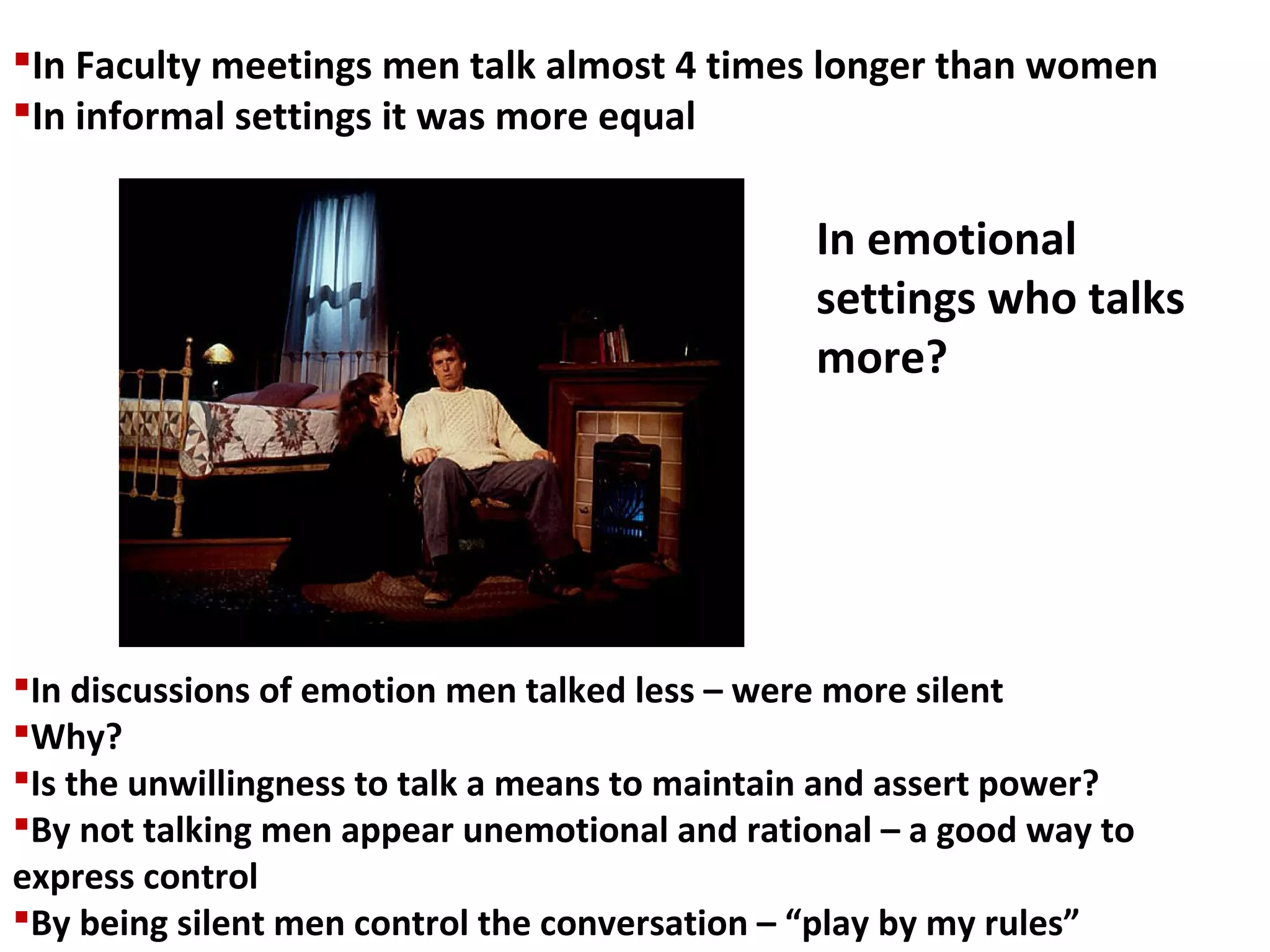
In Faculty meetings men talk almost 4 times longer than women
In informal settings it was more equal
In discussions of emotion men talked less – were more silent
Why?
Is the unwillingness to talk a means to maintain and assert power?
By not talking men appear unemotional and rational – a good way to
express control
By being silent men control the conversation – “play by my rules”
In emotional
settings who talks
more?
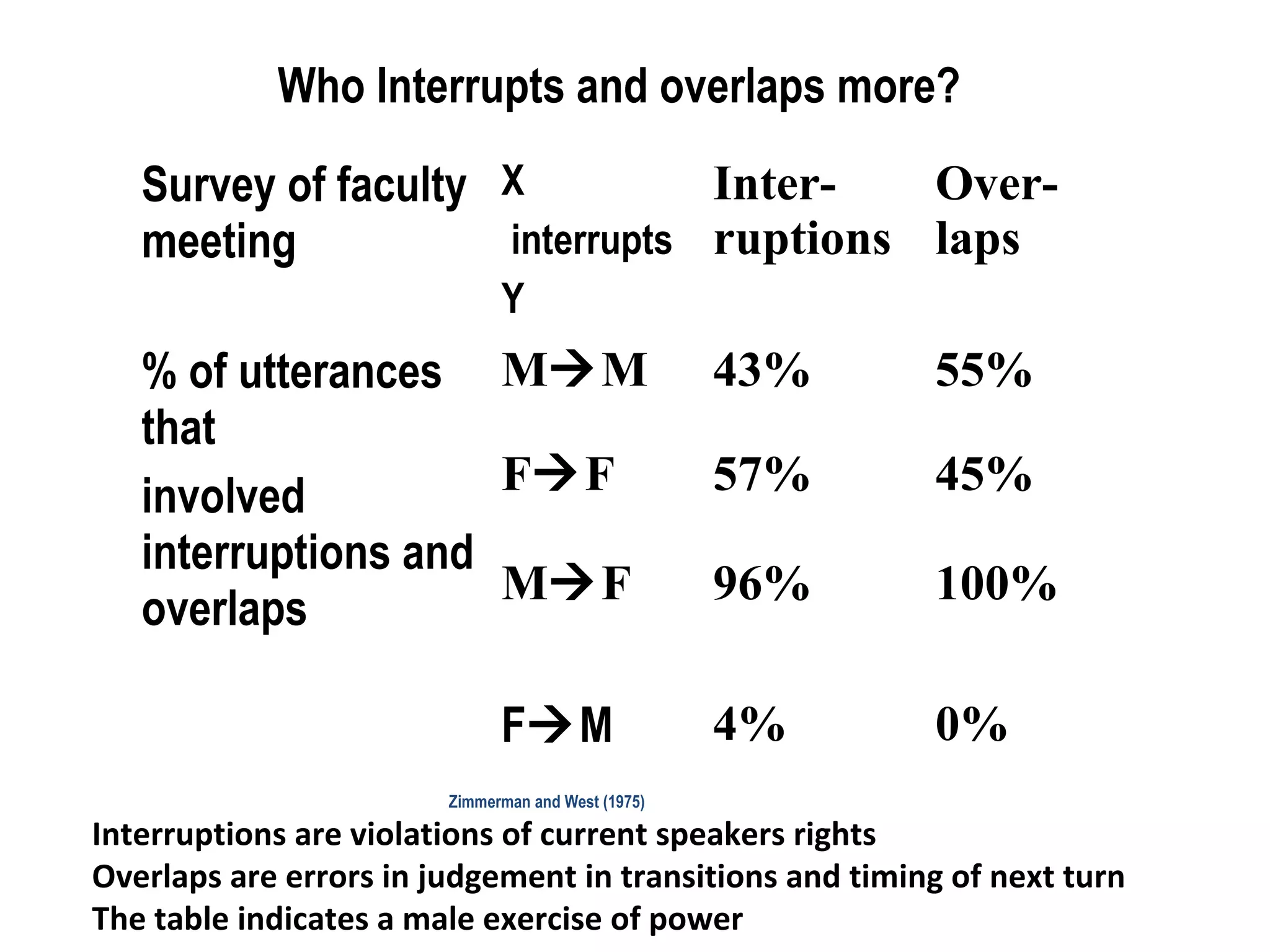
Who Interrupts and overlaps more?
Survey of faculty
meeting
X
interrupts
Y
Inter-
ruptions
Over-
laps
% of utterances
that
involved
interruptions and
overlaps
MM 43% 55%
FF 57% 45%
MF 96% 100%
FM 4% 0%
Zimmerman and West (1975)
Interruptions are violations of current speakers rights
Overlaps are errors in judgement in transitions and timing of next turn
The table indicates a male exercise of power
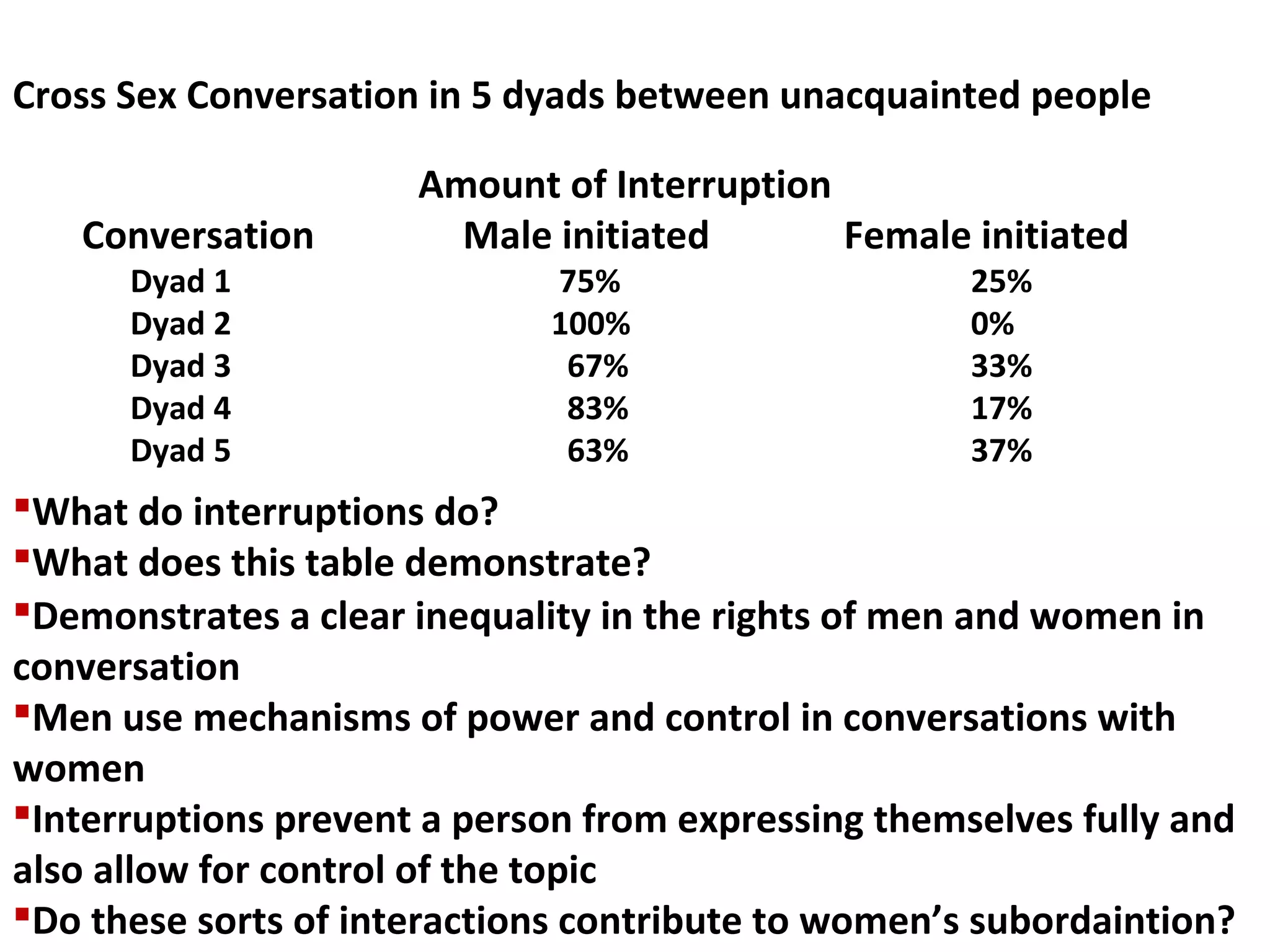
Cross Sex Conversation in 5 dyads between unacquainted people
Amount of Interruption
Conversation Male initiated Female initiated
Dyad 1 75% 25%
Dyad 2 100% 0%
Dyad 3 67% 33%
Dyad 4 83% 17%
Dyad 5 63% 37%
Demonstrates a clear inequality in the rights of men and women in
conversation
Men use mechanisms of power and control in conversations with
women
Interruptions prevent a person from expressing themselves fully and
also allow for control of the topic
Do these sorts of interactions contribute to women’s subordaintion?
What do interruptions do?
What does this table demonstrate?
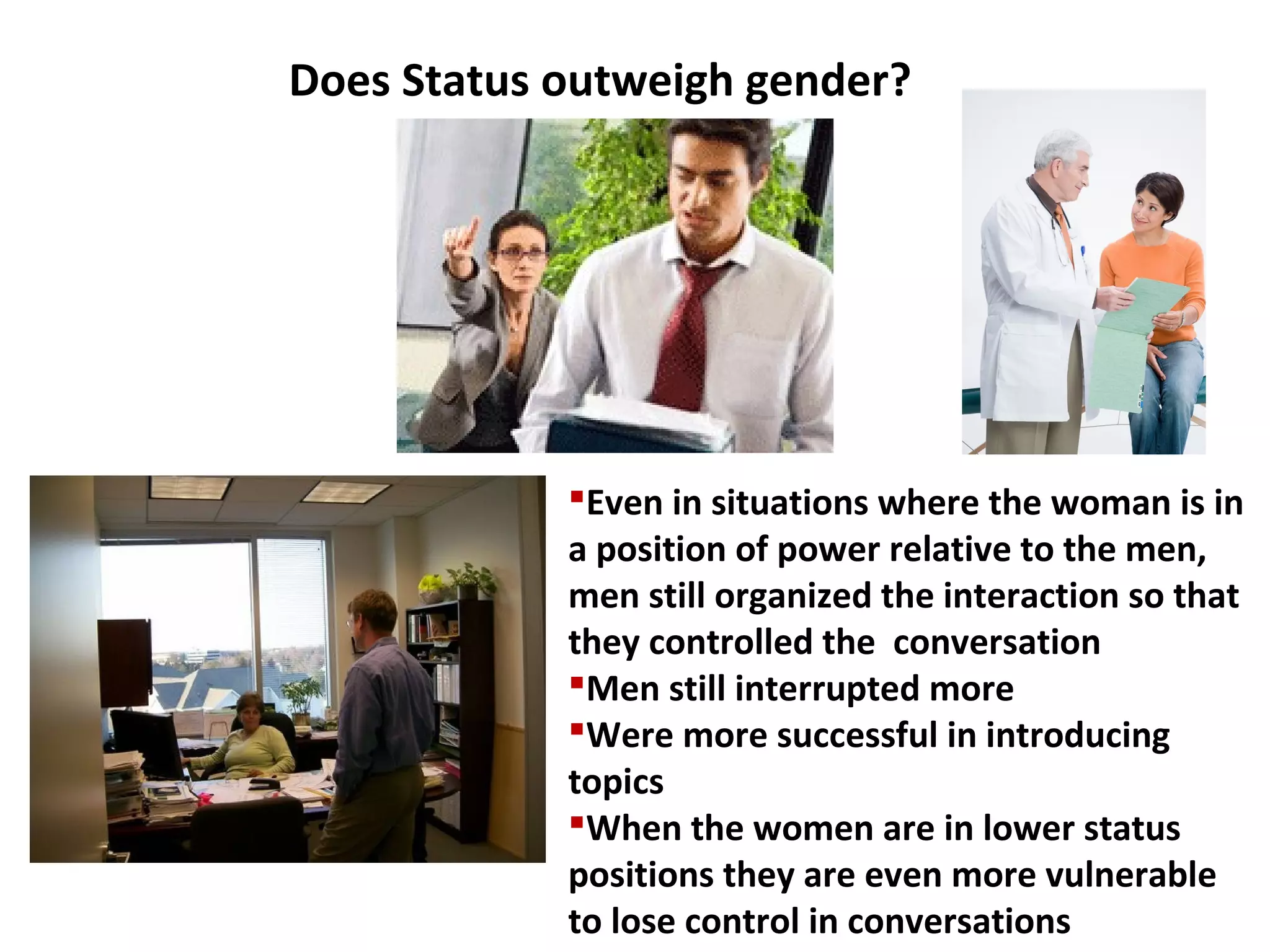
Even in situations where the woman is in
a position of power relative to the men,
men still organized the interaction so that
they controlled the conversation
Men still interrupted more
Were more successful in introducing
topics
When the women are in lower status
positions they are even more vulnerable
to lose control in conversations
Does Status outweigh gender?
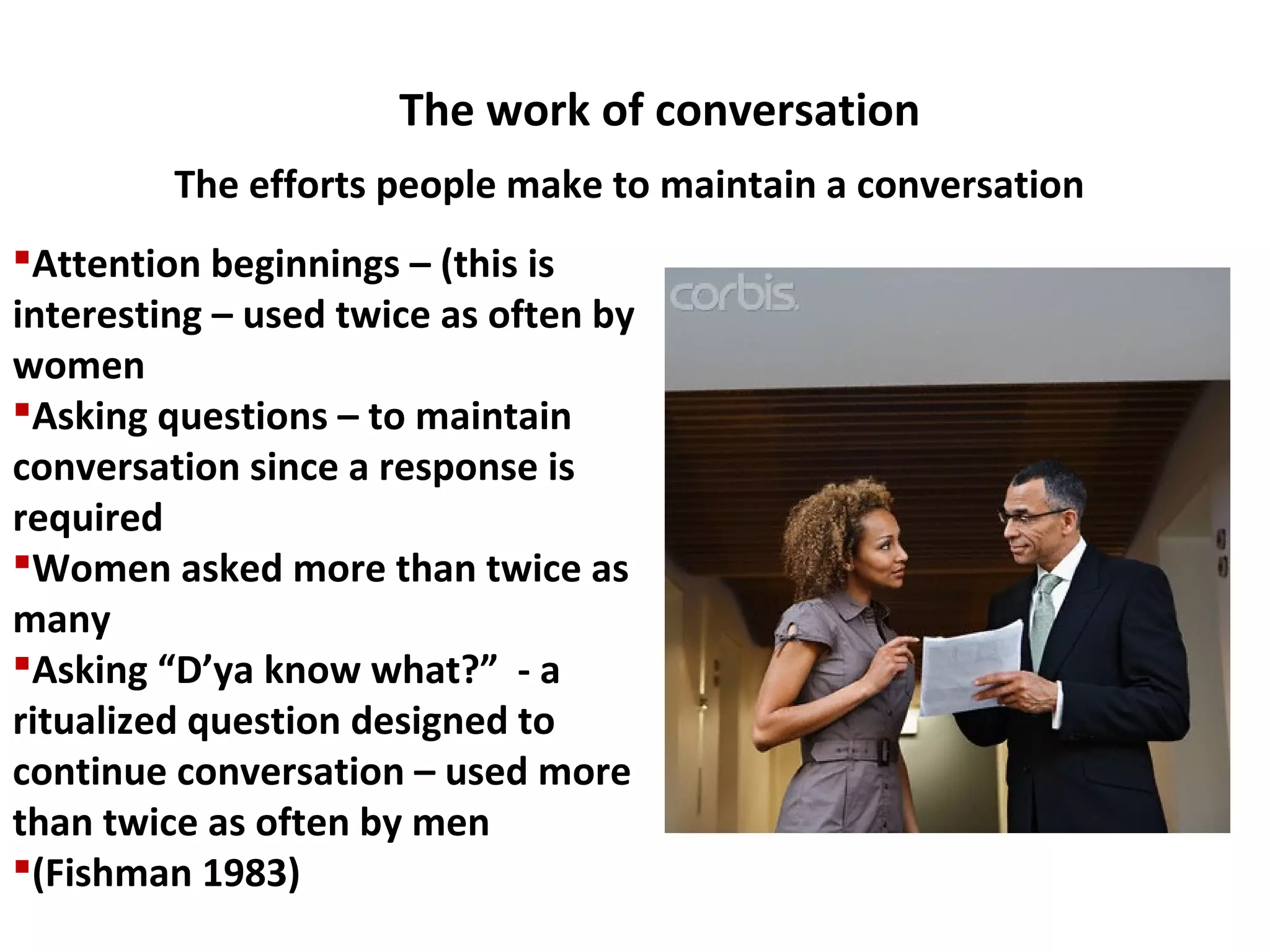
The work of conversation
Attention beginnings – (this is
interesting – used twice as often by
women
Asking questions – to maintain
conversation since a response is
required
Women asked more than twice as
many
Asking “D’ya know what?” - a
ritualized question designed to
continue conversation – used more
than twice as often by men
(Fishman 1983)
The efforts people make to maintain a conversation
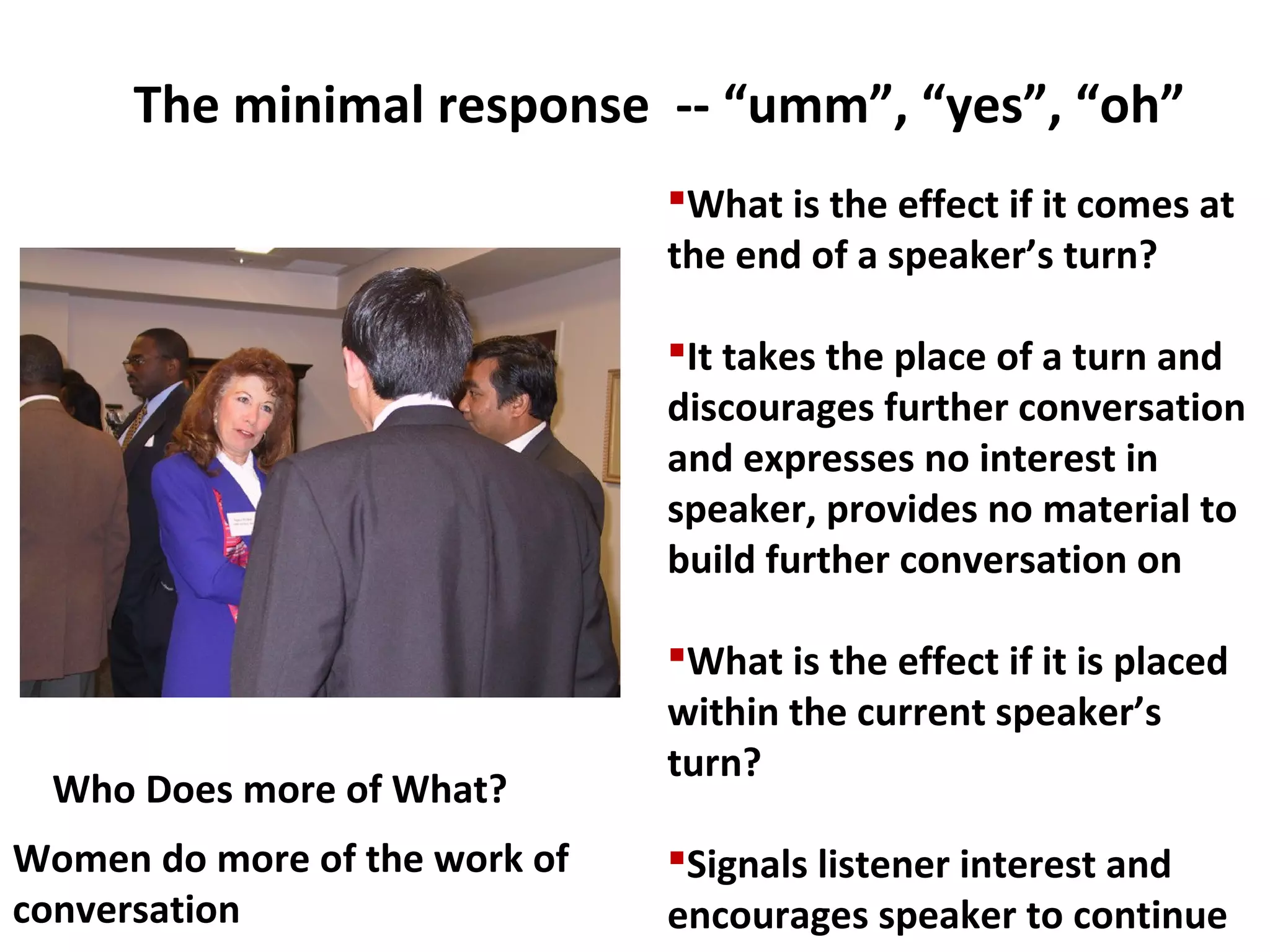
The minimal response -- “umm”, “yes”, “oh”
What is the effect if it comes at
the end of a speaker’s turn?
It takes the place of a turn and
discourages further conversation
and expresses no interest in
speaker, provides no material to
build further conversation on
What is the effect if it is placed
within the current speaker’s
turn?
Signals listener interest and
encourages speaker to continue
Who Does more of What?
Women do more of the work of
conversation
Turn taking behaviour in mixed
sex conversations
• Turn-length: men take more and longer turns
• interruptions: mainly by men
• Silence (after speaker’s turn before addressee continues):
women's silence far longer
• back-channels: (e.g. um hmm, oh really?) women use more
(supportive behaviour)
• questions: 70 per cent by women, e.g. as a means for topic
introduction ("D’ya know what?")
• topics: men tried 29 times and succeed 28 times; women tried 47
times and succeeded 17 times
• women talk to other women about family and interpersonal
matters; while men talk to male friends about cars, sports, work,
motorcycles, carpentry, and politics
• women are more sensitive to social connotations of speech
(Tannen 1992: 75)
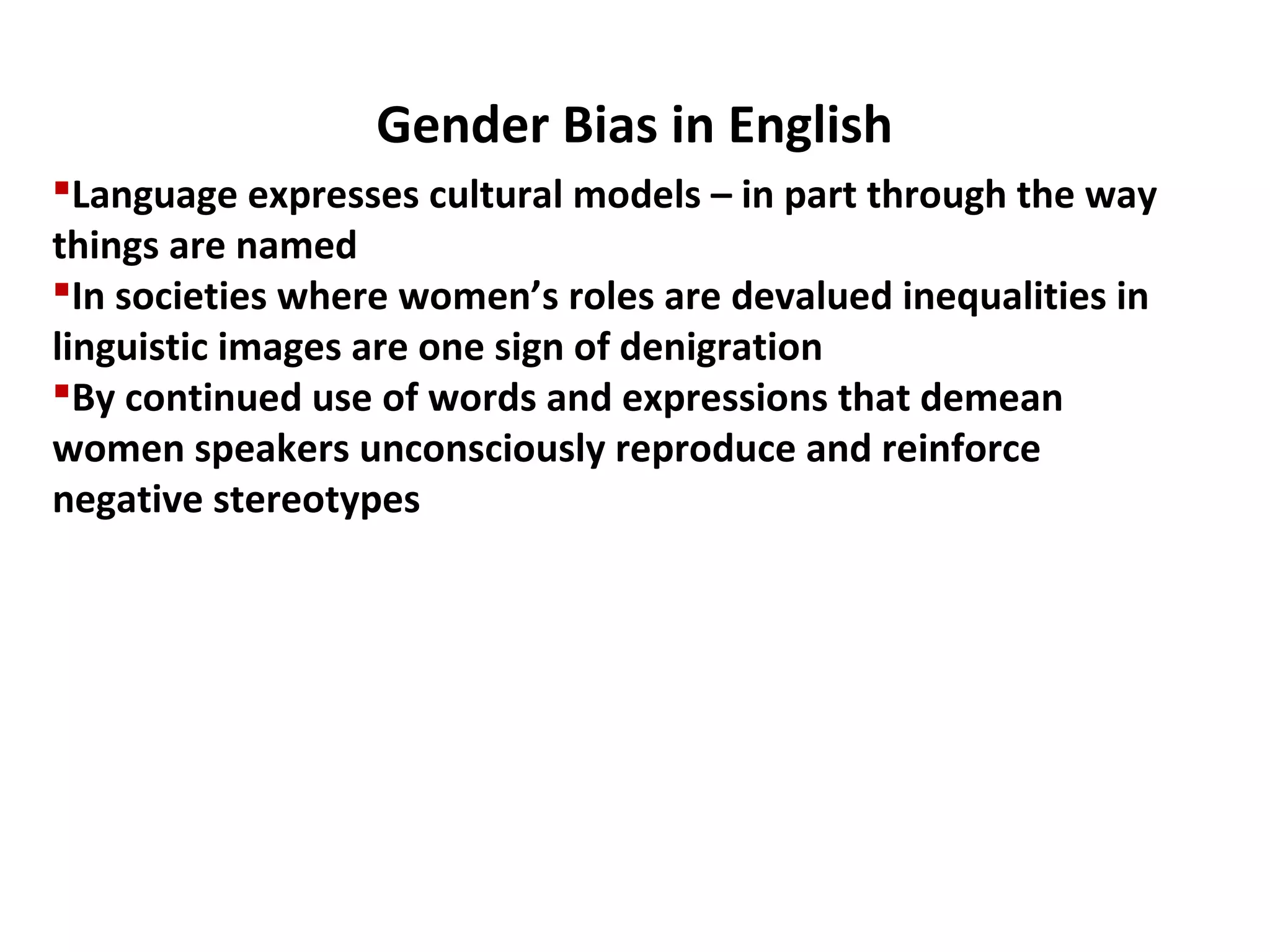
Gender Bias in English
Language expresses cultural models – in part through the way
things are named
In societies where women’s roles are devalued inequalities in
linguistic images are one sign of denigration
By continued use of words and expressions that demean
women speakers unconsciously reproduce and reinforce
negative stereotypes
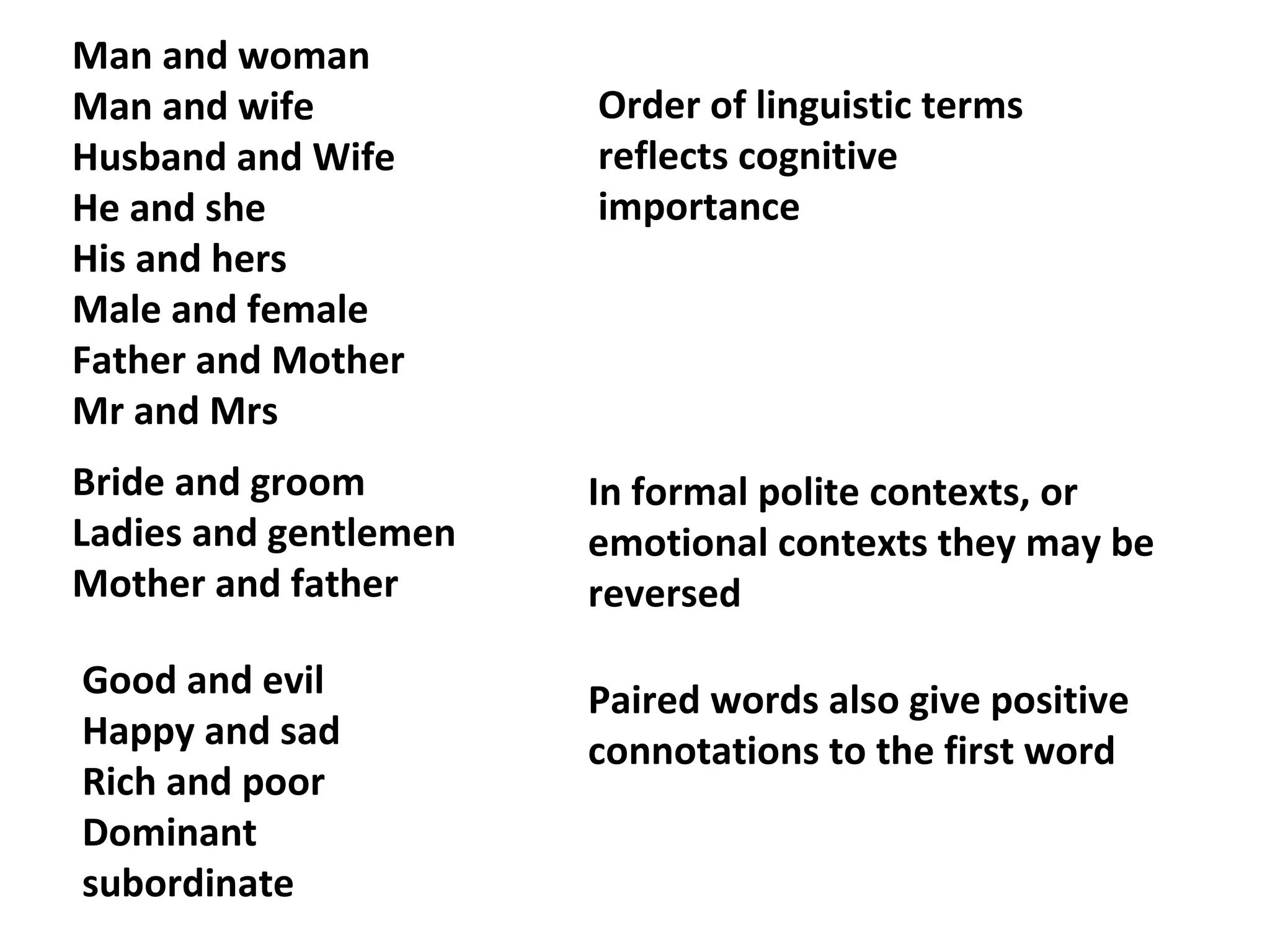
Man and woman
Man and wife
Husband and Wife
He and she
His and hers
Male and female
Father and Mother
Mr and Mrs
Order of linguistic terms
reflects cognitive
importance
Good and evil
Happy and sad
Rich and poor
Dominant
subordinate
Bride and groom
Ladies and gentlemen
Mother and father
In formal polite contexts, or
emotional contexts they may be
reversed
Paired words also give positive
connotations to the first word
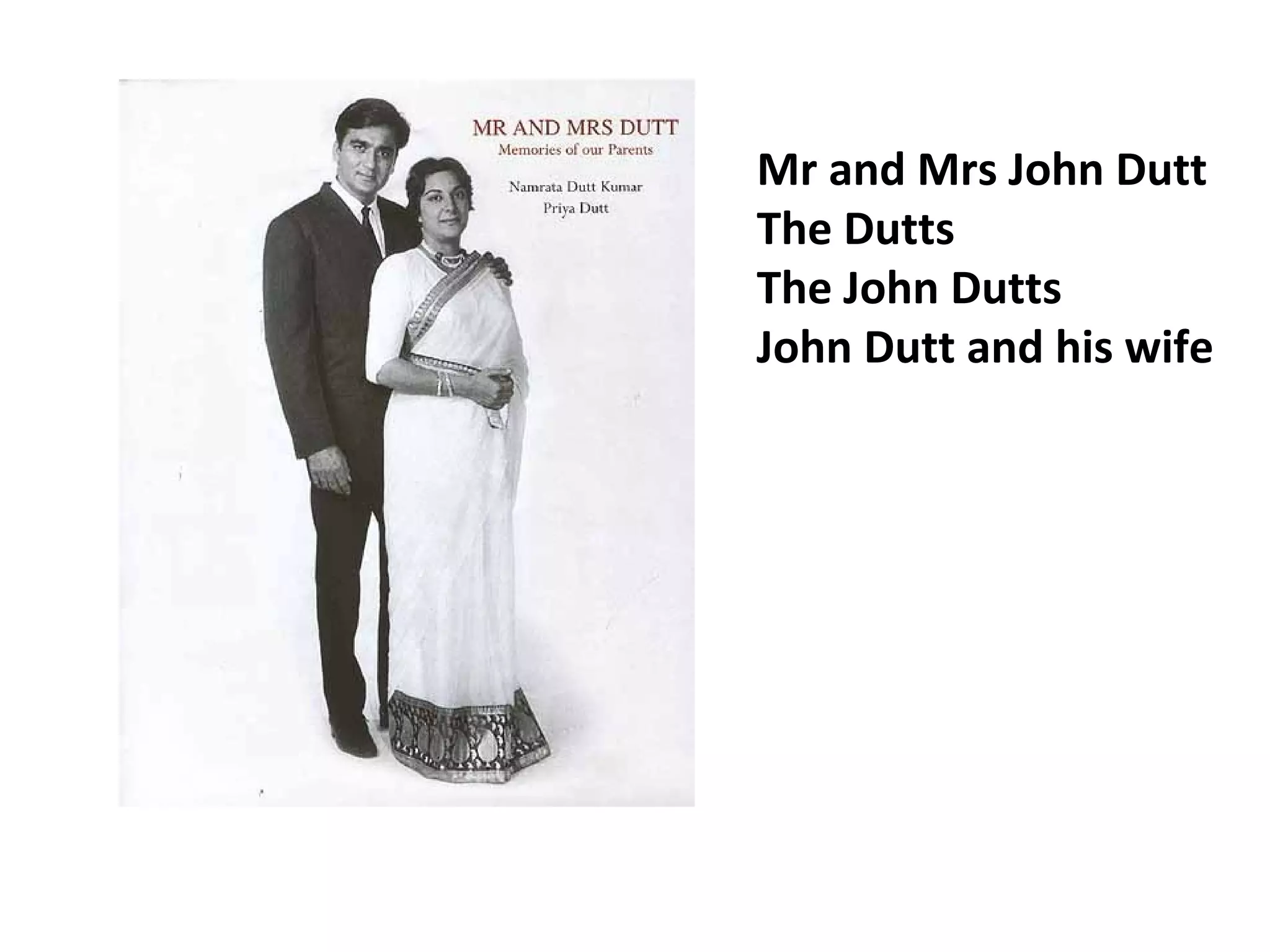
Mr and Mrs John Dutt
The Dutts
The John Dutts
John Dutt and his wife
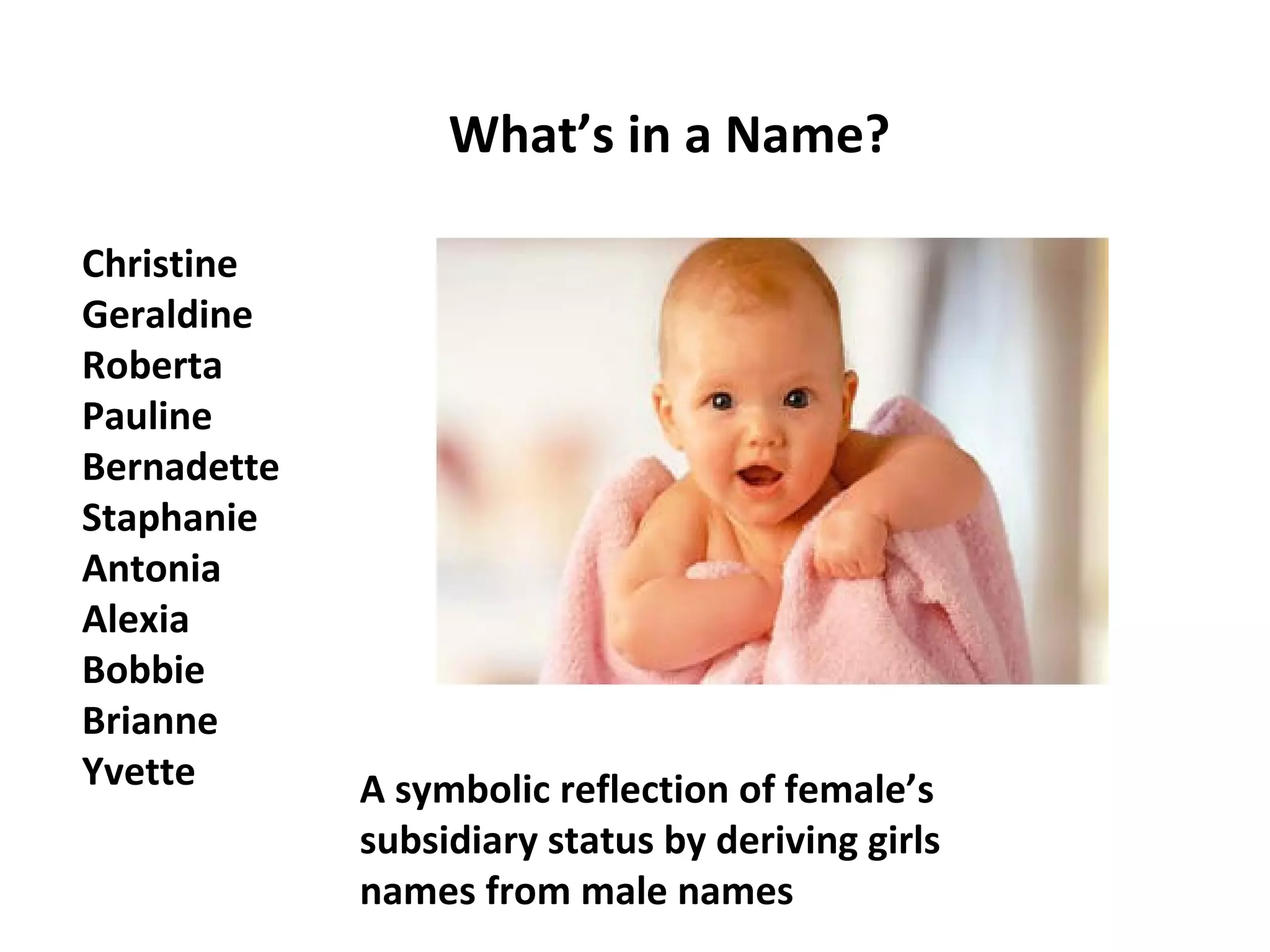
What’s in a Name?
Christine
Geraldine
Roberta
Pauline
Bernadette
Staphanie
Antonia
Alexia
Bobbie
Brianne
Yvette A symbolic reflection of female’s
subsidiary status by deriving girls
names from male names
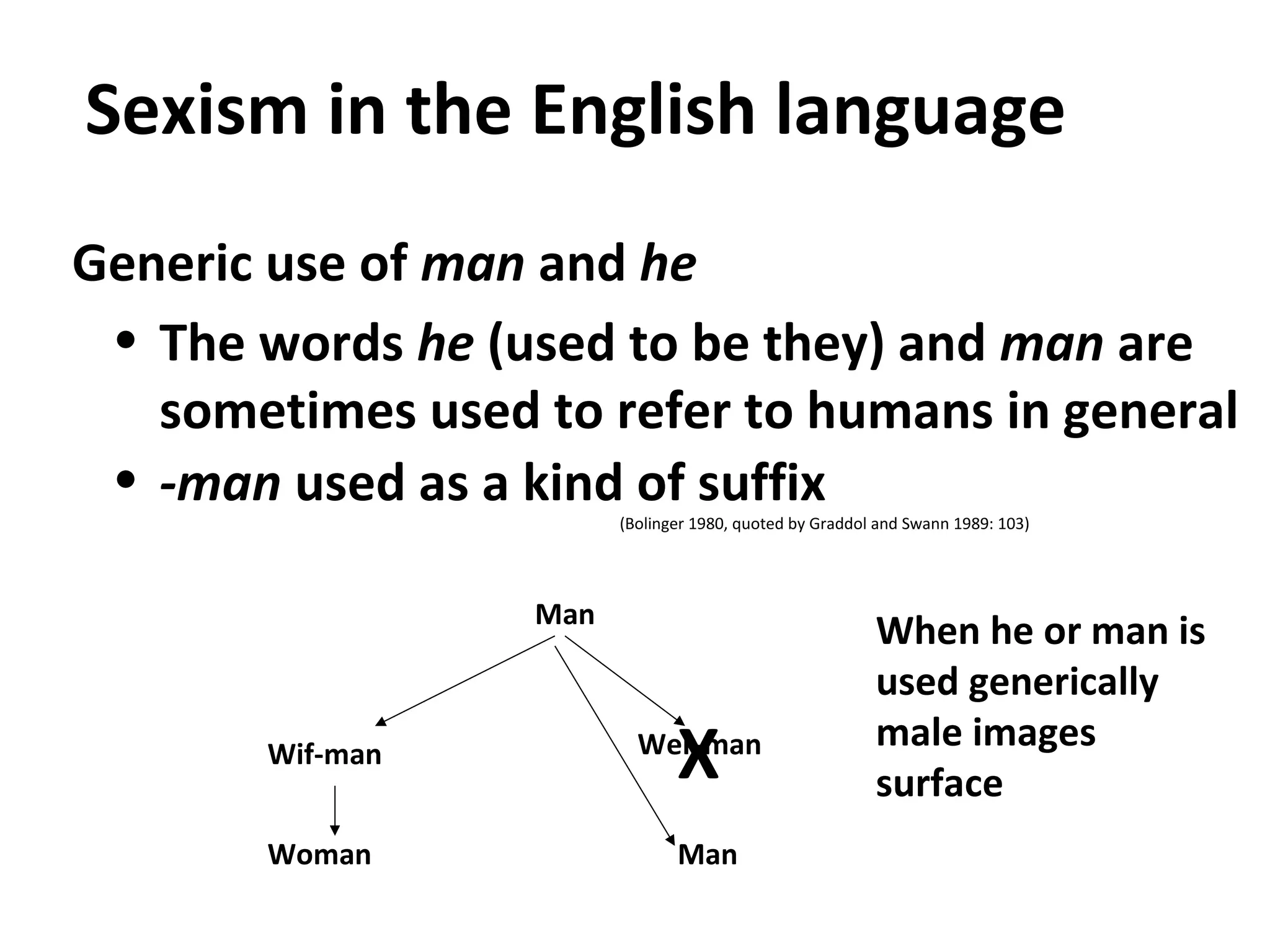
Generic use of man and he
• The words he (used to be they) and man are
sometimes used to refer to humans in general
• -man used as a kind of suffix
(Bolinger 1980, quoted by Graddol and Swann 1989: 103)
Sexism in the English language
Man
Wif-man Wer-man
Woman Man
X
When he or man is
used generically
male images
surface
Sexism in the English language
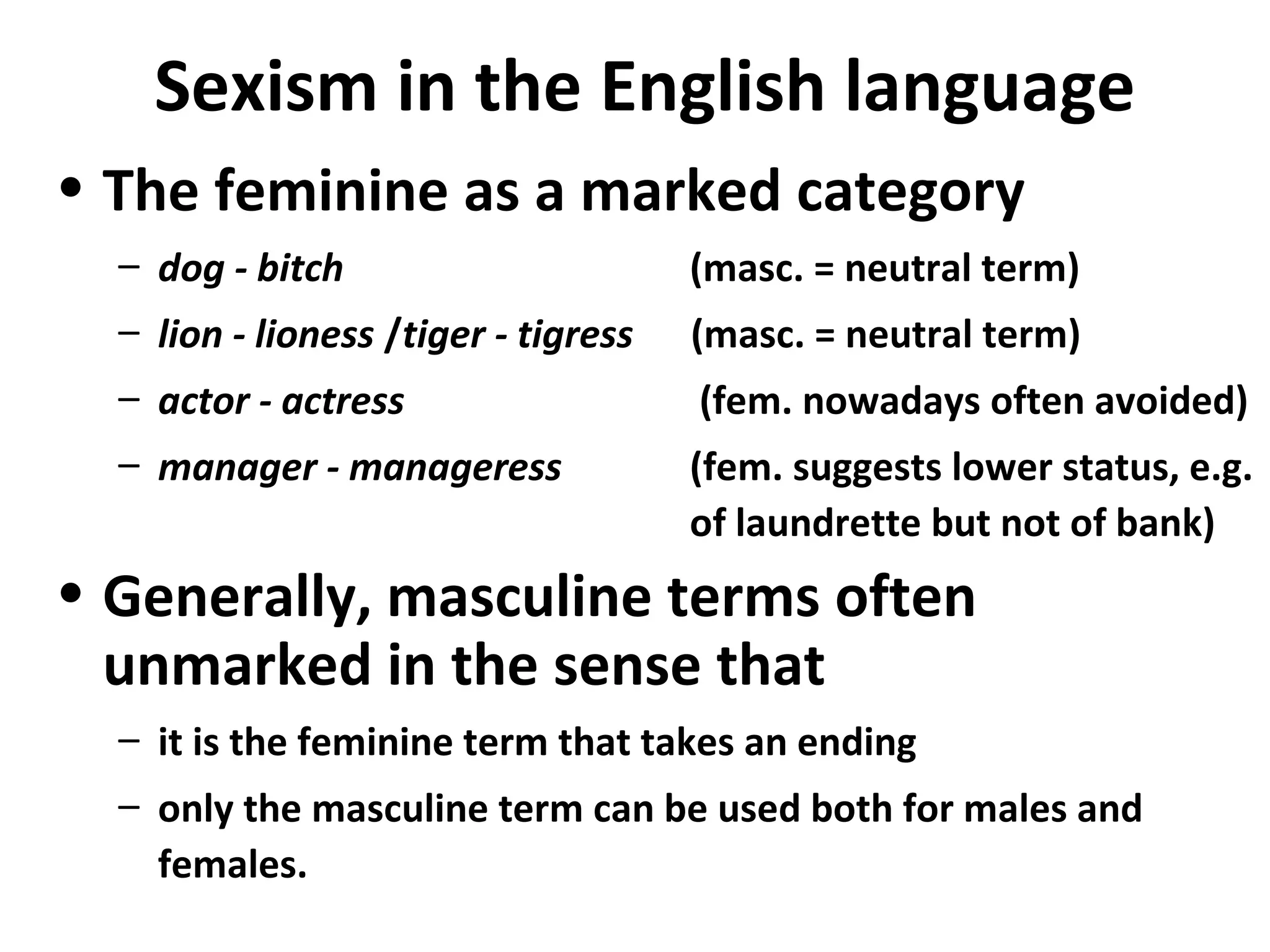
• The feminine as a marked category
– dog - bitch (masc. = neutral term)
– lion - lioness /tiger - tigress (masc. = neutral term)
– actor - actress (fem. nowadays often avoided)
– manager - manageress (fem. suggests lower status, e.g.
of laundrette but not of bank)
• Generally, masculine terms often
unmarked in the sense that
– it is the feminine term that takes an ending
– only the masculine term can be used both for males and
females.
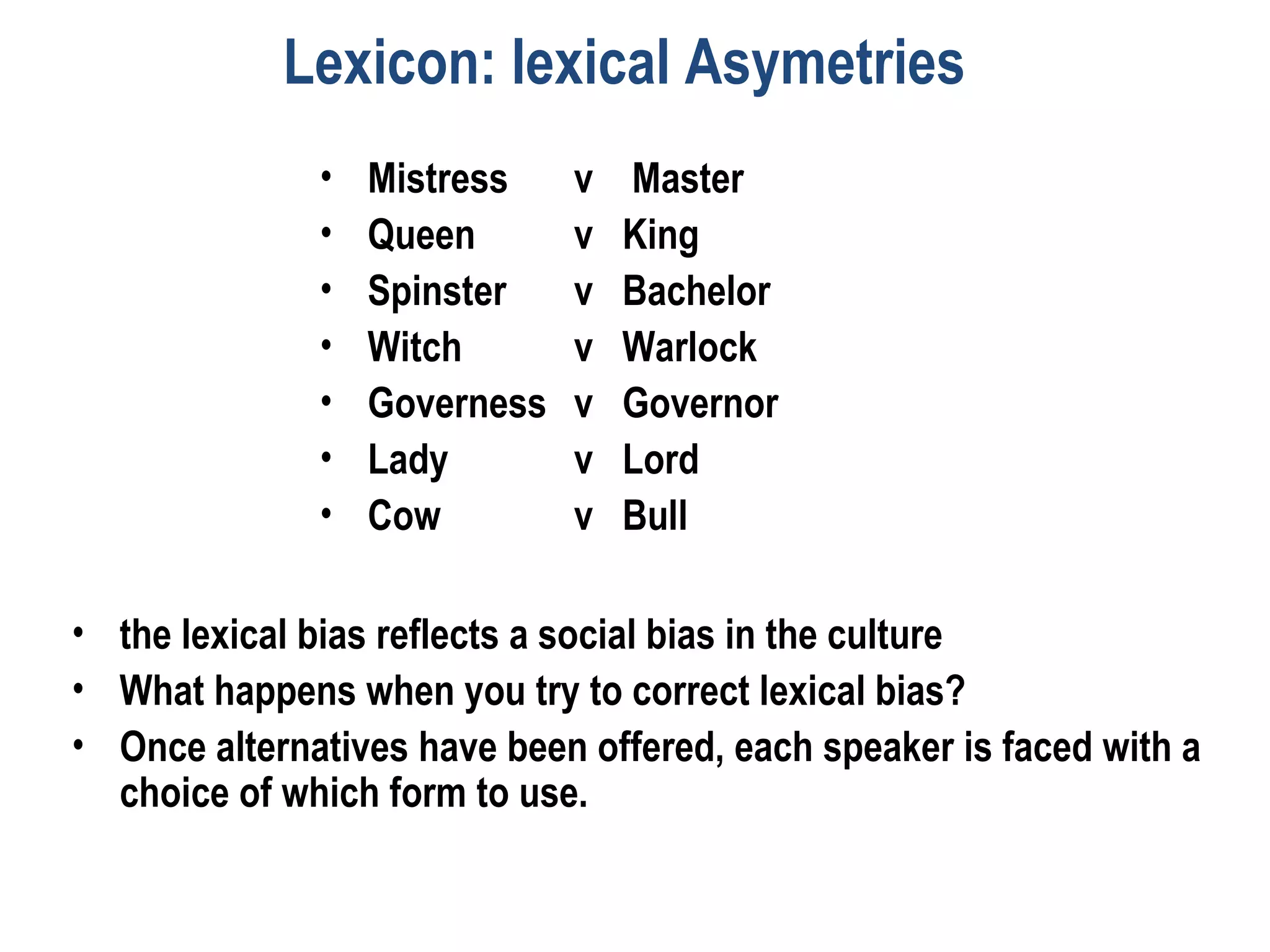
Lexicon: lexical Asymetries
• Mistress v Master
• Queen v King
• Spinster v Bachelor
• Witch v Warlock
• Governess v Governor
• Lady v Lord
• Cow v Bull
• the lexical bias reflects a social bias in the culture
• What happens when you try to correct lexical bias?
• Once alternatives have been offered, each speaker is faced with a
choice of which form to use.
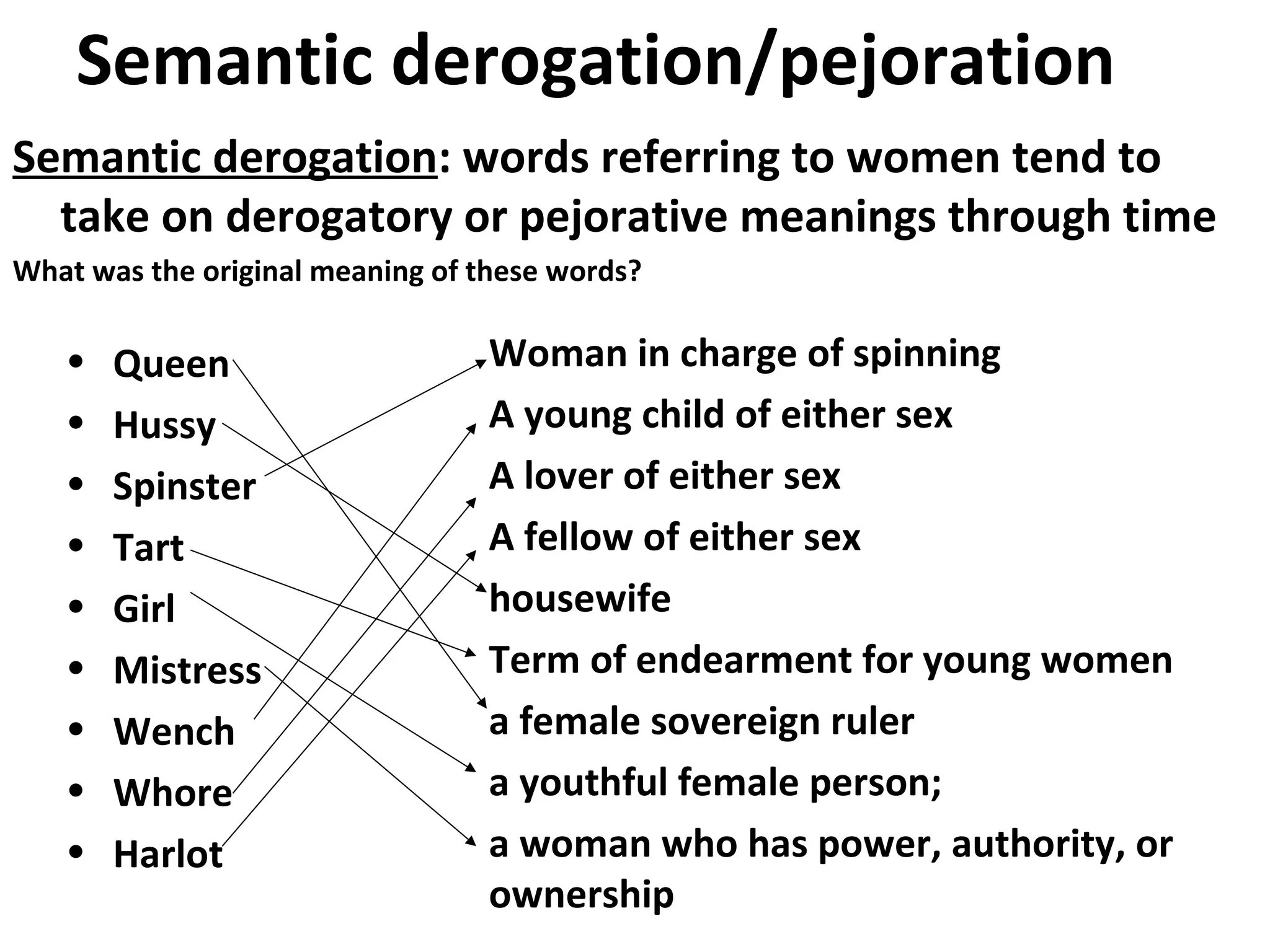
Semantic derogation: words referring to women tend to
take on derogatory or pejorative meanings through time
What was the original meaning of these words?
• Queen
• Hussy
• Spinster
• Tart
• Girl
• Mistress
• Wench
• Whore
• Harlot
Woman in charge of spinning
A young child of either sex
A lover of either sex
A fellow of either sex
housewife
Term of endearment for young women
a female sovereign ruler
a youthful female person;
a woman who has power, authority, or
ownership
Semantic derogation/pejoration
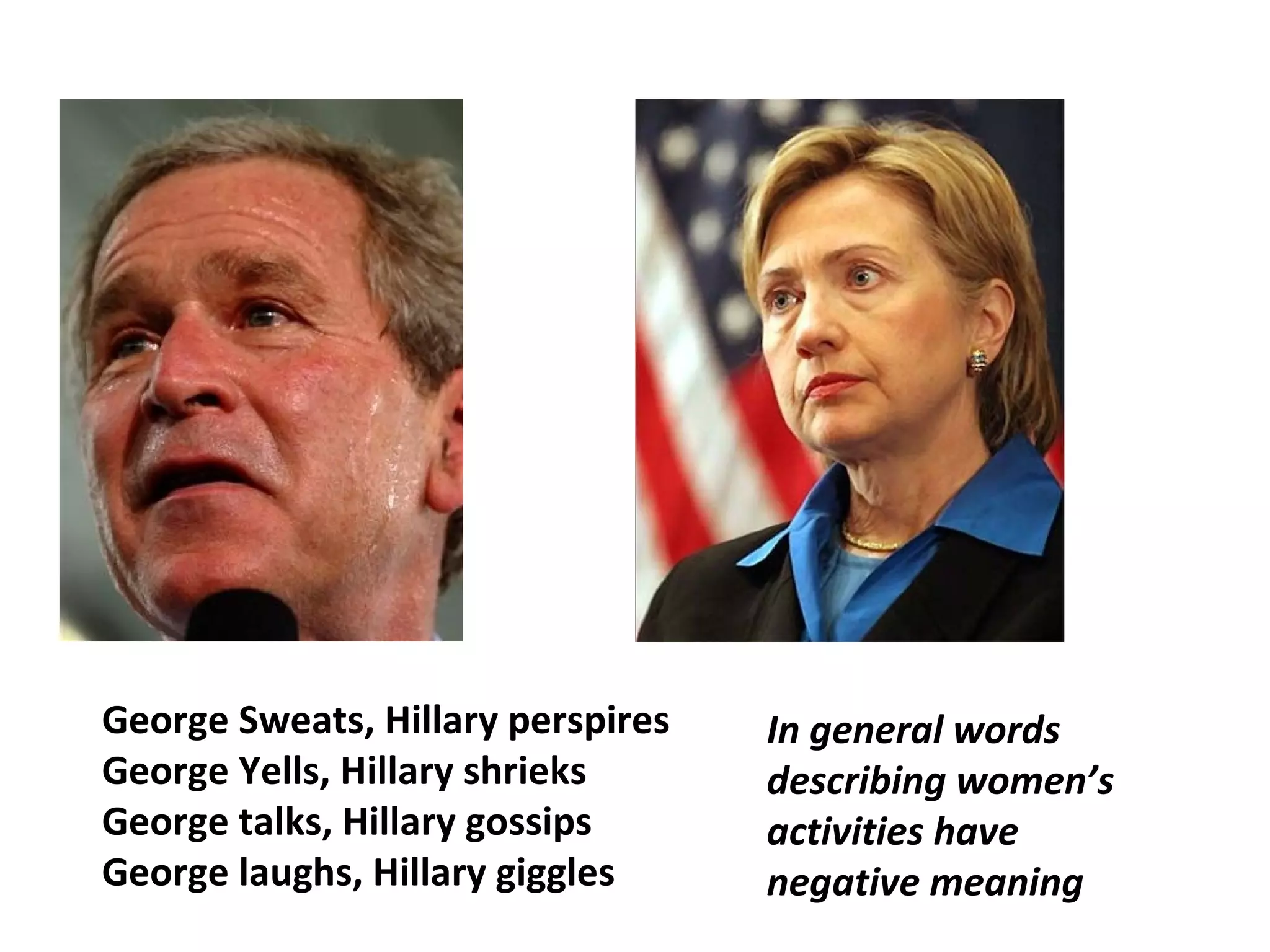
George Sweats, Hillary perspires
George Yells, Hillary shrieks
George talks, Hillary gossips
George laughs, Hillary giggles
In general words
describing women’s
activities have
negative meaning
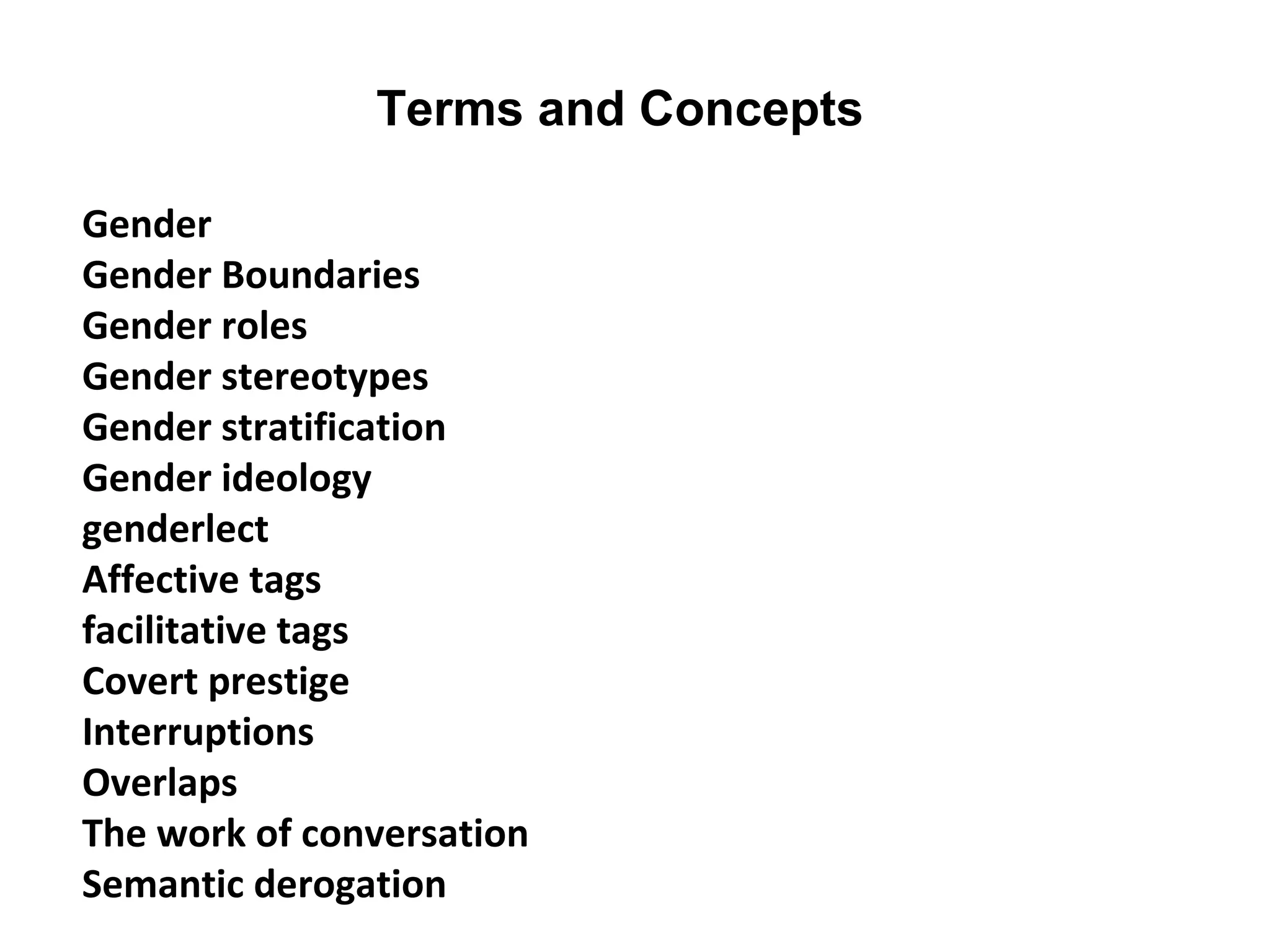
Terms and Concepts
Gender
Gender Boundaries
Gender roles
Gender stereotypes
Gender stratification
Gender ideology
genderlect
Affective tags
facilitative tags
Covert prestige
Interruptions
Overlaps
The work of conversation
Semantic derogation

Gender and language

  • 1.
  • 2.
    Sex Versus Gender Sex refers to biological differences,  Gender refers to the cultural construction of male and female characteristics.  “The ways members of the two sexes are perceived, evaluated and expected to behave.” (what different cultures make of sex.)
  • 3.
    Gender Boundaries We demandthat the categories of male and female be discrete since gender is culturally constructed the boundaries are conceptual rather than physical the boundaries are dynamic, eg. now it is acceptable for men to wear earrings. Boundaries require markers to indicate gender such as:  Voice  Physique  Dress  Behaviour Hair style  Kinetics  Language use
  • 4.
    Felicita Vestvali 1824 -1880 How do we react when someone seems to have traits of each category? Gender identity New York opera star who specialized in singing contralto "trouser roles." Why is it important social intercourse requires that the interacting parties know to which gender category `the other' belongs
  • 5.
    Masculine Traits Personality CognitivePhysical Competitive Rational Rugged Daring Analytical Muscular Adventurous Problem Solving Phys. Strong Aggressive Quant. Skilled Handsome Courageous Good Reasoning Phys. Vigorous Dominant Mathematical Brawny self promotion & achievement
  • 6.
    Personality Cognitive Physical AffectionateImaginative Cute Sympathetic Intuitive Gorgeous Gentle Artistic Beautiful Sensitive Creative Pretty Supportive Expressive Petite Kind Tasteful Sexy focus on others, community Feminine Traits
  • 7.
     tasks andactivities a culture assigns to the sexes – expected ways of behaving based on society’s definition of masculine and feminine Gender stereotypes:  oversimplified but strongly held ideas of the characteristics of men and women. Gender stratification: an unequal distribution of rewards (socially valued resources, power, prestige, and personal freedom) between men and women, reflecting their different positions in social hierarchy – a division in society where all members are hierarchically ranked according to gender Gender ideology A system of thoughts and values that legitimizes sex roles, statuses and customary behaviour Gender roles:
  • 8.
  • 12.
  • 13.
    Gender is animportant dimension of social inequality Gender stratification frequently takes the form of patriarchy whereby men dominate women Do women in our society have a second class status relative to men? If so How? How do we measure gender stratification?
  • 14.
    How do wemeasure gender stratification? . Economics Politics Religion Legal rights prestige Autonomy Education Employment Health ideology How deferential they are expected to be towards men. Freedom to choose marriage partner, profession, and conception. Etc. We can also look at the roles played by women and the value society places on them roles Generally: Differential access to Wealth, Power, and Prestige
  • 15.
    Language and gender Threeissues: 1. Do women and men speak a different language - genderlect? – Do they speak differently 2. Do women and men behave differently in conversations? – Use language differently 3. Gender bias in English Men and women are socialized to express themselves in different ways in accordance with cultural norms that teach and reinforce differentiated gender roles
  • 16.
    Genderlects What a divineidea! What a terrific idea!
  • 17.
    1. Give methe cup 2. The Cup 3. Could you please give me the cup 4. Would you give me the cup? 5. Give me the cup, won’t you 6. Can you give me the cup? 7. I can’t reach that cup 8. I want that cup 9. Can you get that cup for me? 10. I need that cup THE CUP
  • 18.
    Shit! You’ve put thepeanut butter in the fridge again! Oh dear! You’ve put the peanut butter in the fridge again! Men often use socially disfavored variants of sociolinguistic variables while women tend to avoid these in favor of socially more favored variants. Genderlects
  • 19.
    -ing symbolizes female Phonologicalvariations Men Women •Runnin running •Less use of post-vocalic /-r/ greater use of post-vocalic /-r/ •“dis and dat”” “this and that” •Double negation single negation Gender is a factor in the choice of variant What motivates boys to choose /in/ and girls /ing/ /in/ form is used in informal settings and /ing/ in more formal contexts The /ing/ variant therefore carries social meaning – i.e. it symbolizes formality /ing/may also be associated with compliance and politeness formality, politeness, compliance with female – go together
  • 20.
    Grammatical Variants 1. non-standard-s They calls me all the names under the sun 2. non-standard has You just has to do what the teachers tell you. 3. non-standard was You was with me, wasn't you? 4. negative concord It ain't got no pedigree or nothing. 5. non-standard never I never went to school today. 6. non-standard what Are you the little bastards what hit my son over the head? 7. non-standard do She cadges, she do. 8. non-standard come I come down here yesterday. 9. ain't = auxiliary have I ain't seen my Nan for nearly seven years. 10. ain't = auxiliary be Course I ain't going to the Avenue. 11. ain't = copula You ain't no boss. Jenny Cheshire – adventure playground use. Boys used non-standard form more than girls
  • 21.
    combination of rhythm,volume and pitch overlaying entire utterances In general women use s wider range of pitches and more rapid shift in volume and velocity In other words women talk melodically and faster than men who are more monotone and slower Intonation What does talking melodically and faster imply? What does talking in a monotone and slower imply?
  • 22.
    Because rising pitchis an indicator of questions some linguists believe that when women use rising pitches they are interpreted as hesitant, uncertain, and lacking assertiveness Melodically and faster - emotionality and natural impulses Monotone and slower - control and restraint This is a cultural interpretation Which does our society value? Masculine speech melodies can be heard to be metaphors for control female speech melodies as uncontrolled women’s speech behaviour is negatively evaluated in relation to male norms Women’s frequent changes in pitch and volume may serve the function of attracting and holding the listeners attention
  • 23.
    Affective tags "areused not to signal uncertainty on the part of the speaker, but to indicate concern for the addressee": Open the door for me, could you? His portraits are quite static by comparison, aren't they? Affective tags are further subdivided into two kinds: softeners like the first example above, which conventionally mitigate the force of what would otherwise be an impolite demand facilitative tags like the second example, which invite the listener to take a conversational turn to comment on the speaker's assertion. Women use more tag questions than men
  • 24.
    (1) Subordinate groupsmust be polite (2) Woman’s role as guardian of society’s values (3) Vernacular forms express machismo - men who act like women are strongly criticized, men consciously or unconsciously strive toward speech norms that reject styles associated with women ``Covert prestige`` (speaking white) • because women model their behaviour on middle class styles men covertly prefer “working class” speech (1) Women have less access to power and status: they ‘make up’ for this by their preferences for the prestige (standard) linguistic forms. This is thought to give them respect and some status. Explanations for differences
  • 25.
    (5) women aremore conscious of prestige norms and strive to use them because they are judged by their social self-presentation and are aware of strong social sanction if they do not conform – linguistic insecurity (6) Women and men are socialized in different ways which is reflected in their language use patterns. (7) women may be more status conscious than men because: – society sets more standards for women and – Women’s typical activities do not confer status itself. – Women don`t want to use lower class language because of the associations made with lower class people (8) Women and men have different networks which lead to women and men using different ways of speaking. (9) many of the jobs available to women require standard form Explanations for differences
  • 26.
    Women use morehedge words Use mitigation to blunt direct statement More tag questions Men and women vary in frequencies with which they use – particular sounds (pronunciation), prosodic features (intonation, velocity) grammar and choices of vocabulary. i.e. women and men use have different styles of speaking (although for the most part we speak the same) Linguistic and stylistic variations arise from, reflect and reinforce existing gender differences Gender is an aspect of identity that is enacted through speech practices careful speech by women reflects their position in a hierarchical system of gender in which they are culturally relegated to second place
  • 27.
    • Who talksmore? • Who interrupts more? • Who introduces topics? • Who asks questions? • Who is more supportive? Do Men and Women Use Language Differently?
  • 28.
    Men and womenin conversation Who talks more? • Stereotype says that women talk more than men • Proverbs: – A woman's tongue wags like a lamb's tail. – Foxes are all tail and women are all tongue. – The North Sea will sooner be found wanting in water than a woman be at a loss for a word.
  • 29.
    Lucas Cranach theElder (German, 1472-1553). Cardinal Albrecht of Brandenburg as St. Jerome in his Study, 1526 Describe the Picture? Men took almost 4 times as long to describe painting by Durer as women Why? Perhaps because women are socialized to defer to men in thier speech “talkative” women are women who talk as much as men Because men have more rights to talk they are not seen as talkative In real settings men tend to be more talkative
  • 30.
    In Faculty meetingsmen talk almost 4 times longer than women In informal settings it was more equal In discussions of emotion men talked less – were more silent Why? Is the unwillingness to talk a means to maintain and assert power? By not talking men appear unemotional and rational – a good way to express control By being silent men control the conversation – “play by my rules” In emotional settings who talks more?
  • 31.
    Who Interrupts andoverlaps more? Survey of faculty meeting X interrupts Y Inter- ruptions Over- laps % of utterances that involved interruptions and overlaps MM 43% 55% FF 57% 45% MF 96% 100% FM 4% 0% Zimmerman and West (1975) Interruptions are violations of current speakers rights Overlaps are errors in judgement in transitions and timing of next turn The table indicates a male exercise of power
  • 32.
    Cross Sex Conversationin 5 dyads between unacquainted people Amount of Interruption Conversation Male initiated Female initiated Dyad 1 75% 25% Dyad 2 100% 0% Dyad 3 67% 33% Dyad 4 83% 17% Dyad 5 63% 37% Demonstrates a clear inequality in the rights of men and women in conversation Men use mechanisms of power and control in conversations with women Interruptions prevent a person from expressing themselves fully and also allow for control of the topic Do these sorts of interactions contribute to women’s subordaintion? What do interruptions do? What does this table demonstrate?
  • 33.
    Even in situationswhere the woman is in a position of power relative to the men, men still organized the interaction so that they controlled the conversation Men still interrupted more Were more successful in introducing topics When the women are in lower status positions they are even more vulnerable to lose control in conversations Does Status outweigh gender?
  • 34.
    The work ofconversation Attention beginnings – (this is interesting – used twice as often by women Asking questions – to maintain conversation since a response is required Women asked more than twice as many Asking “D’ya know what?” - a ritualized question designed to continue conversation – used more than twice as often by men (Fishman 1983) The efforts people make to maintain a conversation
  • 35.
    The minimal response-- “umm”, “yes”, “oh” What is the effect if it comes at the end of a speaker’s turn? It takes the place of a turn and discourages further conversation and expresses no interest in speaker, provides no material to build further conversation on What is the effect if it is placed within the current speaker’s turn? Signals listener interest and encourages speaker to continue Who Does more of What? Women do more of the work of conversation
  • 37.
    Turn taking behaviourin mixed sex conversations • Turn-length: men take more and longer turns • interruptions: mainly by men • Silence (after speaker’s turn before addressee continues): women's silence far longer • back-channels: (e.g. um hmm, oh really?) women use more (supportive behaviour) • questions: 70 per cent by women, e.g. as a means for topic introduction ("D’ya know what?") • topics: men tried 29 times and succeed 28 times; women tried 47 times and succeeded 17 times • women talk to other women about family and interpersonal matters; while men talk to male friends about cars, sports, work, motorcycles, carpentry, and politics • women are more sensitive to social connotations of speech (Tannen 1992: 75)
  • 38.
    Gender Bias inEnglish Language expresses cultural models – in part through the way things are named In societies where women’s roles are devalued inequalities in linguistic images are one sign of denigration By continued use of words and expressions that demean women speakers unconsciously reproduce and reinforce negative stereotypes
  • 39.
    Man and woman Manand wife Husband and Wife He and she His and hers Male and female Father and Mother Mr and Mrs Order of linguistic terms reflects cognitive importance Good and evil Happy and sad Rich and poor Dominant subordinate Bride and groom Ladies and gentlemen Mother and father In formal polite contexts, or emotional contexts they may be reversed Paired words also give positive connotations to the first word
  • 40.
    Mr and MrsJohn Dutt The Dutts The John Dutts John Dutt and his wife
  • 41.
    What’s in aName? Christine Geraldine Roberta Pauline Bernadette Staphanie Antonia Alexia Bobbie Brianne Yvette A symbolic reflection of female’s subsidiary status by deriving girls names from male names
  • 42.
    Generic use ofman and he • The words he (used to be they) and man are sometimes used to refer to humans in general • -man used as a kind of suffix (Bolinger 1980, quoted by Graddol and Swann 1989: 103) Sexism in the English language Man Wif-man Wer-man Woman Man X When he or man is used generically male images surface
  • 43.
    Sexism in theEnglish language • The feminine as a marked category – dog - bitch (masc. = neutral term) – lion - lioness /tiger - tigress (masc. = neutral term) – actor - actress (fem. nowadays often avoided) – manager - manageress (fem. suggests lower status, e.g. of laundrette but not of bank) • Generally, masculine terms often unmarked in the sense that – it is the feminine term that takes an ending – only the masculine term can be used both for males and females.
  • 44.
    Lexicon: lexical Asymetries •Mistress v Master • Queen v King • Spinster v Bachelor • Witch v Warlock • Governess v Governor • Lady v Lord • Cow v Bull • the lexical bias reflects a social bias in the culture • What happens when you try to correct lexical bias? • Once alternatives have been offered, each speaker is faced with a choice of which form to use.
  • 45.
    Semantic derogation: wordsreferring to women tend to take on derogatory or pejorative meanings through time What was the original meaning of these words? • Queen • Hussy • Spinster • Tart • Girl • Mistress • Wench • Whore • Harlot Woman in charge of spinning A young child of either sex A lover of either sex A fellow of either sex housewife Term of endearment for young women a female sovereign ruler a youthful female person; a woman who has power, authority, or ownership Semantic derogation/pejoration
  • 46.
    George Sweats, Hillaryperspires George Yells, Hillary shrieks George talks, Hillary gossips George laughs, Hillary giggles In general words describing women’s activities have negative meaning
  • 47.
    Terms and Concepts Gender GenderBoundaries Gender roles Gender stereotypes Gender stratification Gender ideology genderlect Affective tags facilitative tags Covert prestige Interruptions Overlaps The work of conversation Semantic derogation