
Language & Context
By :
Zahra Aamir Kamil.
 Everything is interpreted through some context. It is impossible to
communicate without context because context is the conditions in which
something exists or occurs.
 Linguistically, Context is the part of a discourse that surrounds a language
unit and helps to determine its interpretation. People will know how to
interpret what someone says from the situation they are in. The context of
situation of what someone says is vital to understanding and interpreting
the meaning of what is being said which also includes the physical context,
the social context and the mental words and roles of the people involved
in an interaction.
Context
A term that is referring to the features of non-linguistic world in relation to
which linguistic unit are systematically used .it is the broadest sense, situational
context include the total non linguistic back ground to a text or utterances.
According to Yule ( 2010 ) is the physical environment in which a word is used.
Linguistic context has direct relation to language .It can be divided in to two
parts :
 Visual .
 Verbal.
C ,sea , see
Richard &Schmidt (2010) define context as that which occurs before and/or
after a word, a phrase or even a longer UTTERANCE or a TEXT. The context
often helps in understanding the particular meaning of the word, phrase, etc.
According to Yule (1996) Context refers to three aspects:
1. Physical and social world.
2. Knowledge of time and place.
3. Features that affect the context
Context is “an essential factor in the interpretation of utterances and
expressions and the most important aspects of context are:
(1) preceding and following utterances and/or expressions (‘co-text’),
(2) the immediate physical situation,
(3) the wider situation, including social and power relations,
(4) knowledge presumed shared between speaker and hearer”
 Types of context
There are three main types of contextual information:-
1. Physical Context: This encompasses what is physically present around the speakers/ hearers
at the time of communication. What objects are visible, where the communication is taking
place, what is going on around, etc. such as(I want that book (accompanying by pointing)).
2. Linguistic Context: (also called co-text): This refers to what has been said before in the
conversation, or the ‘history’ of things said so far. For example:(I can’t believe you said that!).
3. Social context: This refers to the social relationship of the people involved in
communication.
For instance:(Mr. President, stop bugging me and go home).
Addressee’s Context
One important feature of social context which may well have an effect on the
formality of the language used is the ‘context’ of the person spoken to, and in
particular the role relationship and relative statuses of the participants in a
discourse.
In other most non-European and European linguistic communities further
complications arise, since it is not only names or address pronouns (such as
French tu – vous;, Spanish tu- Lei ) that are involved. In both Japanese and
Korean,the context of the person addressed can, in addition to particular
address-forms, produce rather considerable grammatical and lexical variation as
well, depending on the relationship between, and the relative statuses of the
two people involved.
Cultural Context
Cultural context refers to the culture, customs and background of the communities in
which the speakers participate. Language is a social phenomenon, and it is closely tied
up with the social structure and value system of society.
e.g. The word garden is used in Britain while in America they use the word backyard.
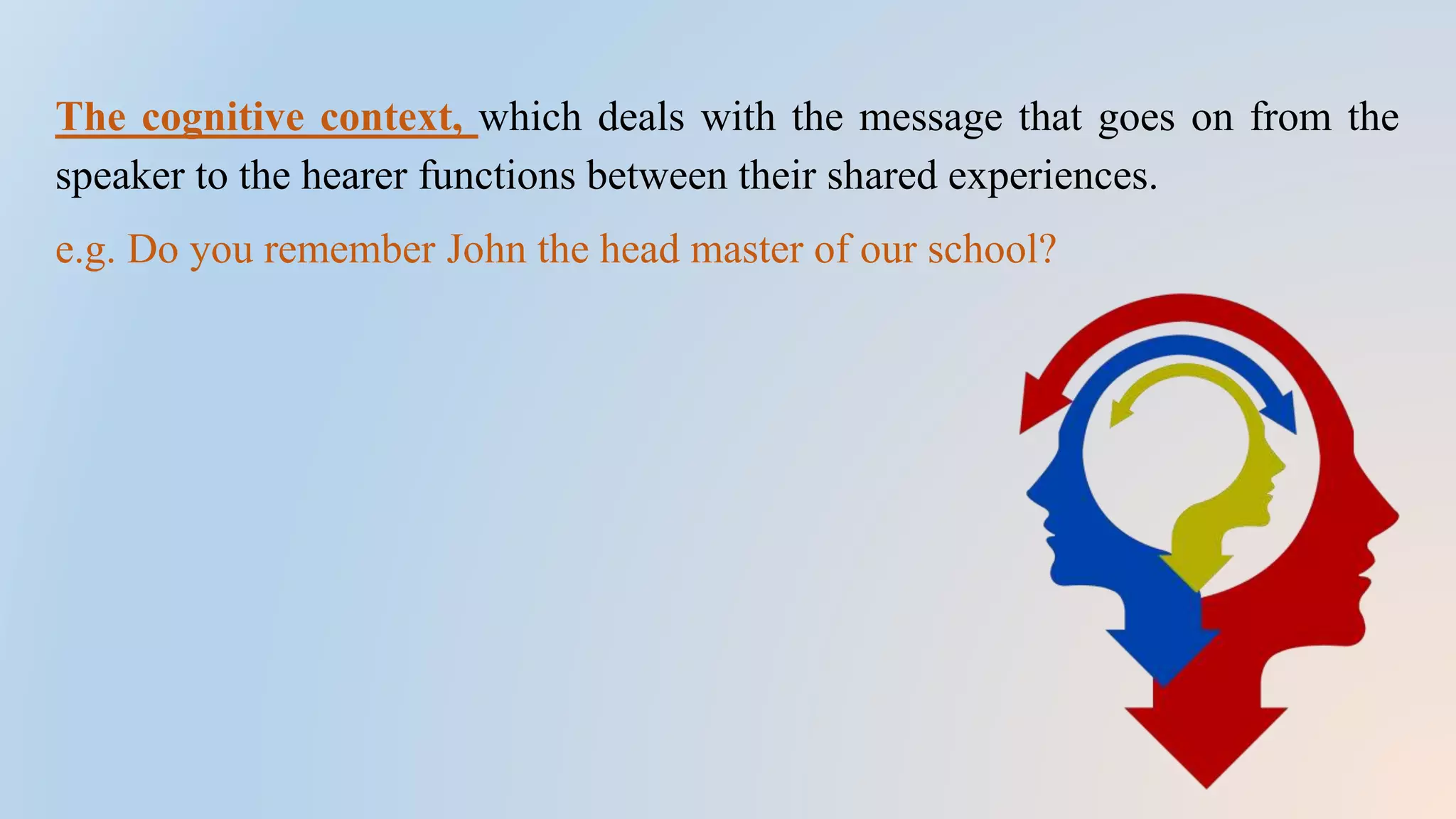
The cognitive context, which deals with the message that goes on from the
speaker to the hearer functions between their shared experiences.
e.g. Do you remember John the head master of our school?
 The negative effect of context
According to Thomas (1983) The total dependence on context might cause
misunderstanding causing pragmatic failure: "the inability to understand
'what's meant by what's said“
Speaker 1: It's very hot In here.
Speaker 2: Yes, I know.
A : we must have lunch some time.
B : when?
Language & Context.pptx

Language & Context.pptx

  • 1.
    Language & Context By: Zahra Aamir Kamil.
  • 2.
     Everything isinterpreted through some context. It is impossible to communicate without context because context is the conditions in which something exists or occurs.  Linguistically, Context is the part of a discourse that surrounds a language unit and helps to determine its interpretation. People will know how to interpret what someone says from the situation they are in. The context of situation of what someone says is vital to understanding and interpreting the meaning of what is being said which also includes the physical context, the social context and the mental words and roles of the people involved in an interaction.
  • 3.
    Context A term thatis referring to the features of non-linguistic world in relation to which linguistic unit are systematically used .it is the broadest sense, situational context include the total non linguistic back ground to a text or utterances. According to Yule ( 2010 ) is the physical environment in which a word is used.
  • 4.
    Linguistic context hasdirect relation to language .It can be divided in to two parts :  Visual .  Verbal. C ,sea , see
  • 5.
    Richard &Schmidt (2010)define context as that which occurs before and/or after a word, a phrase or even a longer UTTERANCE or a TEXT. The context often helps in understanding the particular meaning of the word, phrase, etc. According to Yule (1996) Context refers to three aspects: 1. Physical and social world. 2. Knowledge of time and place. 3. Features that affect the context
  • 6.
    Context is “anessential factor in the interpretation of utterances and expressions and the most important aspects of context are: (1) preceding and following utterances and/or expressions (‘co-text’), (2) the immediate physical situation, (3) the wider situation, including social and power relations, (4) knowledge presumed shared between speaker and hearer”
  • 7.
     Types ofcontext There are three main types of contextual information:- 1. Physical Context: This encompasses what is physically present around the speakers/ hearers at the time of communication. What objects are visible, where the communication is taking place, what is going on around, etc. such as(I want that book (accompanying by pointing)). 2. Linguistic Context: (also called co-text): This refers to what has been said before in the conversation, or the ‘history’ of things said so far. For example:(I can’t believe you said that!). 3. Social context: This refers to the social relationship of the people involved in communication. For instance:(Mr. President, stop bugging me and go home).
  • 8.
    Addressee’s Context One importantfeature of social context which may well have an effect on the formality of the language used is the ‘context’ of the person spoken to, and in particular the role relationship and relative statuses of the participants in a discourse. In other most non-European and European linguistic communities further complications arise, since it is not only names or address pronouns (such as French tu – vous;, Spanish tu- Lei ) that are involved. In both Japanese and Korean,the context of the person addressed can, in addition to particular address-forms, produce rather considerable grammatical and lexical variation as well, depending on the relationship between, and the relative statuses of the two people involved.
  • 9.
    Cultural Context Cultural contextrefers to the culture, customs and background of the communities in which the speakers participate. Language is a social phenomenon, and it is closely tied up with the social structure and value system of society. e.g. The word garden is used in Britain while in America they use the word backyard.
  • 10.
    The cognitive context,which deals with the message that goes on from the speaker to the hearer functions between their shared experiences. e.g. Do you remember John the head master of our school?
  • 11.
     The negativeeffect of context According to Thomas (1983) The total dependence on context might cause misunderstanding causing pragmatic failure: "the inability to understand 'what's meant by what's said“ Speaker 1: It's very hot In here. Speaker 2: Yes, I know. A : we must have lunch some time. B : when?