GENDE
R
According to Maciones (2002), gender refers
to the personal traits and social positions that
members of a society attach to being male and
female.
For him, it is a dimension of social
organization, shaping how we interact with
others and how we think about ourselves.
INFLUENCE OF GENDER
Biological Influences
It involves pubertal change, sexuality and
an examination of Freud’s and Erikson’s
notions on anatomy and destiny.
PUBERTAL CHANGE AND
SEXUALITY
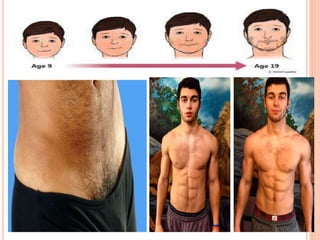
Pubertal Changes for boys
 Testicular size, function and fertility
 Public hair
 Body and Facial hair
 Voice Change
 Male musculature and body shape
 Body odor and acne
Pubertal Change for Girls
 Breast Development
 Public hair
 Vagina, uterus, ovaries
 Menstruation and fertility
 Body shape, fat distribution, and body
composition
 Body odor and acne
ANATOMY IS DESTINY: FREUD AND
ERIKSON
Sigmund Freud and Erik Erikson’s
“anatomy is destiny” theories that gender
behavior is influenced by a person’s sex
organ. According to Freud, human behavior
and history are directly related to
reproductive processes. Erikson agreed
with Freud and further stressed that
anatomical differences affect psychological
differences. He noted that male individual
are aggressive while females are passive.
SOCIAL INFLUENCES
Parents are the most critical and
influential development agents of
socialization. Other social influences are
culture, school, peers and the media.
PARENTAL INFLUENCES
Boys are given more independent while girls’
sexual vulnerability causes parent to monitor
them closely.
Severe restrictions on adolescent boys disrupt
their development.
SOCIAL LEARNING THEORY OF
GENDER
It states that gender development of children
and adolescents occur through observation
of gender behavior, which are appropriate
and inappropriate, through the system of
rewards and punishments.
PEERS
Peers also play a vital role in modeling and
responding to gender behavior. In adolescence,
peer approval or disapproval is a powerful influence
on gender attitudes and behavior.
SCHOOLS
The pressure to achieve and to excel in
academic is more likely to be heaped on boys
than on girls because they will grow up to be
the breadwinners.
THE MEDIA
Social researchers assumed that mass
media carry sexist messages. Exposure to
mass media by the sexes would inculcate
stereotyped messages in them.
COGNITIVE INFLUENCES
Cognitive influences on gender stress that
children organize their world on the basis of
gender after identifying themselves as
either male or female.
GENDER
STEREOTYPES
AND
SIMILARITIES
GENDER STEREOTYPES
Gender stereotypes pertain to images,
impressions and beliefs about males and
females. These vary in culture and
socioeconomic status. These are largely
negative in nature and may be prejudices
and discriminatory.
SEXISM
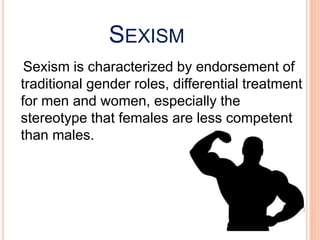
Sexism is characterized by endorsement of
traditional gender roles, differential treatment
for men and women, especially the
stereotype that females are less competent
than males.
GENDER SIMILARITIES AND
DIFFERENCES
 Most women have the capacity to bear children,
whereas men do not.
 Males are more active and aggressive than
females.
 Both sexes use the same facial expressions, adopt
the same language and describe their emotional
experiences similarly.
 Both sexes are physically capable of learning to
cook and sew, yet Western societies assigned
these tasks to women.
 Both sexes are capable of learning how to weld
metal and fly airplanes but these are assigned
traditionally to men.
 Davis Buss (1995) stressed that men and women
differ psychologically in domains where they have
encountered different problems.
ANDROGYNY
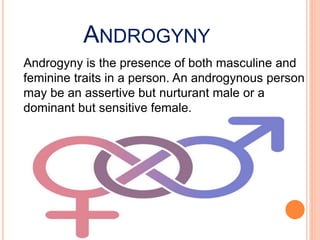
Androgyny is the presence of both masculine and
feminine traits in a person. An androgynous person
may be an assertive but nurturant male or a
dominant but sensitive female.
GENDER ROLES
Gender roles or sex roles are aspects of gender
that refer to a set of expectations prescribing how
males or females should act, think and feel
(Santrock, 1998). They are the attitudes and
activities that a society links to each gender.
WOMEN BEFORE …
 When slavery was legal in most parts of the US in 1848,
women were subordinate to men.
 Women could not own property or keep their salaries if
they were married.
 They would not draft a will and were barred from filing
lawsuits in court including suits seeking custody of their
children.
 Women could not study in college and their husbands
would beat them up using a stick no thicker than a thumb.
 Women also could not exercise the right to vote
because people think they naturally lacked the
required intelligence and political will.
 They were seen as mere decorations in homes
and were fitted for household chores.
 The roles that women played were those that
portrayed them to be dependent, nurturant and
incapable of holding power.
WOMEN NOW …
 Women complements men in terms of
capability in running the affairs of the home,
politics, career development or any chosen
professional field.
 In Olympic competitions worldwide, women
excel in various fields just like their male
counterparts.
 In politics, particularly in the Philippines,
women hold high political positions and are
emulated as models of the youth and held in
high esteem by the elders.
 Women have entered traditionally male
domains like the military, the police and
other occupations requiring physical
strength and assertiveness.
 The women of modern times display a
positive and highly secure gender
identity.
 They feel very comfortable in being
feminine while performing their duties
and responsibilities, even those
perceived to be dominated by men.
Women are no longer
typecast in roles that paint
them soft, submissive and
emotional.
They are now
empowered, independent
and principled.
MEN
 Today’s male has stepped into the role of nurturer
to his family.
 He is now actively involved in his children’s
upbringing, spends quality time with his family and
is more positive and highly secure of his gender
identity.
He confidently does
household works and other
tasks previously relegated
to women without feeling
ashamed or insecure of his
masculinity.
Men are anchored in
occupations outside the
home.
GENDER
ISSUES
WOMEN’S ISSUES
 Sexual Harassment
Sexual harassment occurs when an
individual is unable to perform a task due to
unwelcome and unwanted sexual advances by
either the same or opposite sex
Forms of sexual harassment include
sexist remarks, vulgar sexual language, covert
physical contact (deliberate and improper
touching of private and sensitive body parts,
patting) specially in the workplace.
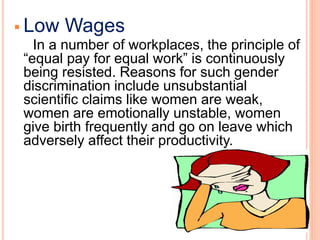
 Low Wages
In a number of workplaces, the principle of
“equal pay for equal work” is continuously
being resisted. Reasons for such gender
discrimination include unsubstantial
scientific claims like women are weak,
women are emotionally unstable, women
give birth frequently and go on leave which
adversely affect their productivity.
 Equal Work Opportunities and Promotions
Women oftentimes encounter attitudinal or
organizational biases that prevent them
from reaching their full potentials in the
workplace. They are often blocked from top
management positions in business and
industries.
 Sexist Advertising
and Music
The media has often been
criticized for the stereotyping
of women and exploiting
them via sexy
advertisement. They have
been portrayed either as
sexy vamps out to seduce
the male population in liquor,
cigarette and personal care
products advertisements.
They are viewed as sex
objects.
A number of popular music of today
have lyrics of sexual overtones most
of which pertain to women. These
lyrics in some ways are shaping the
minds of the listeners, particularly the
youth in the areas of sex, violence,
drugs and Satanism.
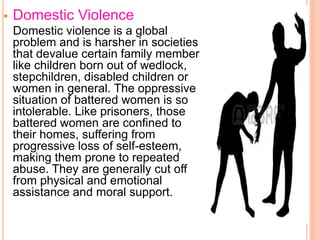
 Domestic Violence
Domestic violence is a global
problem and is harsher in societies
that devalue certain family member
like children born out of wedlock,
stepchildren, disabled children or
women in general. The oppressive
situation of battered women is so
intolerable. Like prisoners, those
battered women are confined to
their homes, suffering from
progressive loss of self-esteem,
making them prone to repeated
abuse. They are generally cut off
from physical and emotional
assistance and moral support.
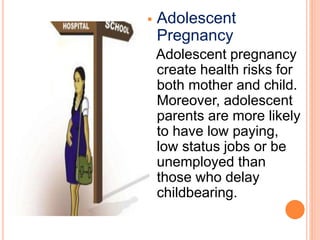
 Adolescent
Pregnancy
Adolescent pregnancy
create health risks for
both mother and child.
Moreover, adolescent
parents are more likely
to have low paying,
low status jobs or be
unemployed than
those who delay
childbearing.
A sound sex education, family planning
and access to contraceptive methods
alone will not remedy an adolescent’s
unwanted pregnancy. They have to have
opportunities to improve their academic
and career-related skill, job opportunities,
lifelong consultations and extensive mental
health services.
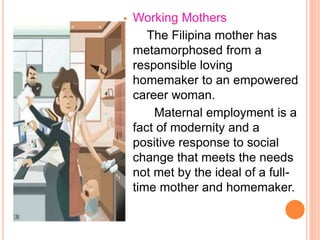
 Working Mothers
The Filipina mother has
metamorphosed from a
responsible loving
homemaker to an empowered
career woman.
Maternal employment is a
fact of modernity and a
positive response to social
change that meets the needs
not met by the ideal of a full-
time mother and homemaker.
MEN’S ISSUES
A certain Herbert Goldberg stressed that men
cannot sense and articulate their problems and
feelings. His important message to men is to
become more attuned to their inner self and
emotions and work on developing more positive
close relationships.
In 1990’s, Robert Bly, stated that today’s
males are “soft” as a result of absentee fathers
and strong attachment to their mothers.
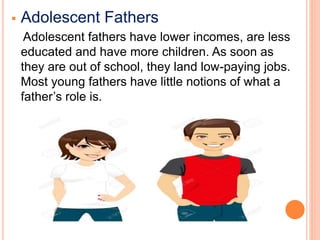
 Adolescent Fathers
Adolescent fathers have lower incomes, are less
educated and have more children. As soon as
they are out of school, they land low-paying jobs.
Most young fathers have little notions of what a
father’s role is.
 Sexual Harassment
Prisons are vulnerable
settings for sexual
harassment. The absence
of heterosexual partners in
prison cells make men turn
to the same gender for
sexual favors and release.
In workplaces, men like
women are also unwilling or
willing victims of sexual
harassment in exchange of
work promotions and
others.
DISCRIMINATION AGAINST GAYS AND
LESBIANS
People harbor many
misconceptions against gays and
lesbians, otherwise known as the
“third sex”. They not only suffer
harassment and discrimination but
have minimal rights under the law.
They are discriminated on when
seeking employment. They are
victims of such unwarranted
emotions are disgust, fear or
hatred.
Gays and lesbians suffer not
only sexual harassment but also
verbal harassment.
AGE DISCRIMINATION
In a lot of businesses,
there are instances when
workers are laid off and
replaced by younger
workers, ignoring the
capability and experience
of aged workers still able
to perform efficiently. Even
some elders are still
capable of working, they
are no longer hired in
companies.
GENDER ROLE DEVELOPMENT
In the Philippines, human
resources is considered one
of the most important assets
of an organization. Both
males and females
constitute the workforce.
To achieve excellence
and high productivity, as an
organization has to exert
effort in empowering its
workforce.
GENDER EMPOWERMENT
Republic Act 7192 which was approved in November
18,1992 is an act promoting the role of women in national
development. Women are regarded as full and equal
partners of men in development, hence the law mandates
that all government agencies in the national level – state
colleges included – must allot 5% of their budget to
Gender and Development (GAD) which refers to the
activities or programs designed to empower the human
resource including women.

Gender soc sci4

  • 1.
  • 2.
    According to Maciones(2002), gender refers to the personal traits and social positions that members of a society attach to being male and female. For him, it is a dimension of social organization, shaping how we interact with others and how we think about ourselves.
  • 3.
    INFLUENCE OF GENDER BiologicalInfluences It involves pubertal change, sexuality and an examination of Freud’s and Erikson’s notions on anatomy and destiny.
  • 4.
    PUBERTAL CHANGE AND SEXUALITY PubertalChanges for boys  Testicular size, function and fertility  Public hair  Body and Facial hair  Voice Change  Male musculature and body shape  Body odor and acne
  • 6.
    Pubertal Change forGirls  Breast Development  Public hair  Vagina, uterus, ovaries  Menstruation and fertility  Body shape, fat distribution, and body composition  Body odor and acne
  • 10.
    ANATOMY IS DESTINY:FREUD AND ERIKSON Sigmund Freud and Erik Erikson’s “anatomy is destiny” theories that gender behavior is influenced by a person’s sex organ. According to Freud, human behavior and history are directly related to reproductive processes. Erikson agreed with Freud and further stressed that anatomical differences affect psychological differences. He noted that male individual are aggressive while females are passive.
  • 11.
    SOCIAL INFLUENCES Parents arethe most critical and influential development agents of socialization. Other social influences are culture, school, peers and the media.
  • 12.
    PARENTAL INFLUENCES Boys aregiven more independent while girls’ sexual vulnerability causes parent to monitor them closely. Severe restrictions on adolescent boys disrupt their development.
  • 13.
    SOCIAL LEARNING THEORYOF GENDER It states that gender development of children and adolescents occur through observation of gender behavior, which are appropriate and inappropriate, through the system of rewards and punishments.
  • 14.
    PEERS Peers also playa vital role in modeling and responding to gender behavior. In adolescence, peer approval or disapproval is a powerful influence on gender attitudes and behavior.
  • 15.
    SCHOOLS The pressure toachieve and to excel in academic is more likely to be heaped on boys than on girls because they will grow up to be the breadwinners.
  • 16.
    THE MEDIA Social researchersassumed that mass media carry sexist messages. Exposure to mass media by the sexes would inculcate stereotyped messages in them.
  • 17.
    COGNITIVE INFLUENCES Cognitive influenceson gender stress that children organize their world on the basis of gender after identifying themselves as either male or female.
  • 18.
  • 19.
    GENDER STEREOTYPES Gender stereotypespertain to images, impressions and beliefs about males and females. These vary in culture and socioeconomic status. These are largely negative in nature and may be prejudices and discriminatory.
  • 20.
    SEXISM Sexism is characterizedby endorsement of traditional gender roles, differential treatment for men and women, especially the stereotype that females are less competent than males.
  • 21.
    GENDER SIMILARITIES AND DIFFERENCES Most women have the capacity to bear children, whereas men do not.  Males are more active and aggressive than females.  Both sexes use the same facial expressions, adopt the same language and describe their emotional experiences similarly.
  • 22.
     Both sexesare physically capable of learning to cook and sew, yet Western societies assigned these tasks to women.  Both sexes are capable of learning how to weld metal and fly airplanes but these are assigned traditionally to men.  Davis Buss (1995) stressed that men and women differ psychologically in domains where they have encountered different problems.
  • 23.
    ANDROGYNY Androgyny is thepresence of both masculine and feminine traits in a person. An androgynous person may be an assertive but nurturant male or a dominant but sensitive female.
  • 24.
    GENDER ROLES Gender rolesor sex roles are aspects of gender that refer to a set of expectations prescribing how males or females should act, think and feel (Santrock, 1998). They are the attitudes and activities that a society links to each gender.
  • 25.
    WOMEN BEFORE … When slavery was legal in most parts of the US in 1848, women were subordinate to men.  Women could not own property or keep their salaries if they were married.  They would not draft a will and were barred from filing lawsuits in court including suits seeking custody of their children.  Women could not study in college and their husbands would beat them up using a stick no thicker than a thumb.
  • 26.
     Women alsocould not exercise the right to vote because people think they naturally lacked the required intelligence and political will.  They were seen as mere decorations in homes and were fitted for household chores.  The roles that women played were those that portrayed them to be dependent, nurturant and incapable of holding power.
  • 27.
    WOMEN NOW … Women complements men in terms of capability in running the affairs of the home, politics, career development or any chosen professional field.  In Olympic competitions worldwide, women excel in various fields just like their male counterparts.  In politics, particularly in the Philippines, women hold high political positions and are emulated as models of the youth and held in high esteem by the elders.
  • 28.
     Women haveentered traditionally male domains like the military, the police and other occupations requiring physical strength and assertiveness.  The women of modern times display a positive and highly secure gender identity.  They feel very comfortable in being feminine while performing their duties and responsibilities, even those perceived to be dominated by men.
  • 29.
    Women are nolonger typecast in roles that paint them soft, submissive and emotional. They are now empowered, independent and principled.
  • 30.
    MEN  Today’s malehas stepped into the role of nurturer to his family.  He is now actively involved in his children’s upbringing, spends quality time with his family and is more positive and highly secure of his gender identity.
  • 31.
    He confidently does householdworks and other tasks previously relegated to women without feeling ashamed or insecure of his masculinity. Men are anchored in occupations outside the home.
  • 32.
  • 33.
    WOMEN’S ISSUES  SexualHarassment Sexual harassment occurs when an individual is unable to perform a task due to unwelcome and unwanted sexual advances by either the same or opposite sex Forms of sexual harassment include sexist remarks, vulgar sexual language, covert physical contact (deliberate and improper touching of private and sensitive body parts, patting) specially in the workplace.
  • 34.
     Low Wages Ina number of workplaces, the principle of “equal pay for equal work” is continuously being resisted. Reasons for such gender discrimination include unsubstantial scientific claims like women are weak, women are emotionally unstable, women give birth frequently and go on leave which adversely affect their productivity.
  • 35.
     Equal WorkOpportunities and Promotions Women oftentimes encounter attitudinal or organizational biases that prevent them from reaching their full potentials in the workplace. They are often blocked from top management positions in business and industries.
  • 36.
     Sexist Advertising andMusic The media has often been criticized for the stereotyping of women and exploiting them via sexy advertisement. They have been portrayed either as sexy vamps out to seduce the male population in liquor, cigarette and personal care products advertisements. They are viewed as sex objects.
  • 37.
    A number ofpopular music of today have lyrics of sexual overtones most of which pertain to women. These lyrics in some ways are shaping the minds of the listeners, particularly the youth in the areas of sex, violence, drugs and Satanism.
  • 38.
     Domestic Violence Domesticviolence is a global problem and is harsher in societies that devalue certain family member like children born out of wedlock, stepchildren, disabled children or women in general. The oppressive situation of battered women is so intolerable. Like prisoners, those battered women are confined to their homes, suffering from progressive loss of self-esteem, making them prone to repeated abuse. They are generally cut off from physical and emotional assistance and moral support.
  • 39.
     Adolescent Pregnancy Adolescent pregnancy createhealth risks for both mother and child. Moreover, adolescent parents are more likely to have low paying, low status jobs or be unemployed than those who delay childbearing.
  • 40.
    A sound sexeducation, family planning and access to contraceptive methods alone will not remedy an adolescent’s unwanted pregnancy. They have to have opportunities to improve their academic and career-related skill, job opportunities, lifelong consultations and extensive mental health services.
  • 41.
     Working Mothers TheFilipina mother has metamorphosed from a responsible loving homemaker to an empowered career woman. Maternal employment is a fact of modernity and a positive response to social change that meets the needs not met by the ideal of a full- time mother and homemaker.
  • 42.
    MEN’S ISSUES A certainHerbert Goldberg stressed that men cannot sense and articulate their problems and feelings. His important message to men is to become more attuned to their inner self and emotions and work on developing more positive close relationships. In 1990’s, Robert Bly, stated that today’s males are “soft” as a result of absentee fathers and strong attachment to their mothers.
  • 43.
     Adolescent Fathers Adolescentfathers have lower incomes, are less educated and have more children. As soon as they are out of school, they land low-paying jobs. Most young fathers have little notions of what a father’s role is.
  • 44.
     Sexual Harassment Prisonsare vulnerable settings for sexual harassment. The absence of heterosexual partners in prison cells make men turn to the same gender for sexual favors and release. In workplaces, men like women are also unwilling or willing victims of sexual harassment in exchange of work promotions and others.
  • 45.
    DISCRIMINATION AGAINST GAYSAND LESBIANS People harbor many misconceptions against gays and lesbians, otherwise known as the “third sex”. They not only suffer harassment and discrimination but have minimal rights under the law. They are discriminated on when seeking employment. They are victims of such unwarranted emotions are disgust, fear or hatred. Gays and lesbians suffer not only sexual harassment but also verbal harassment.
  • 46.
    AGE DISCRIMINATION In alot of businesses, there are instances when workers are laid off and replaced by younger workers, ignoring the capability and experience of aged workers still able to perform efficiently. Even some elders are still capable of working, they are no longer hired in companies.
  • 47.
    GENDER ROLE DEVELOPMENT Inthe Philippines, human resources is considered one of the most important assets of an organization. Both males and females constitute the workforce. To achieve excellence and high productivity, as an organization has to exert effort in empowering its workforce.
  • 48.
    GENDER EMPOWERMENT Republic Act7192 which was approved in November 18,1992 is an act promoting the role of women in national development. Women are regarded as full and equal partners of men in development, hence the law mandates that all government agencies in the national level – state colleges included – must allot 5% of their budget to Gender and Development (GAD) which refers to the activities or programs designed to empower the human resource including women.