Gender
Definition of Gender
- A range of characteristic used to distinguish between
male and female, particularly in the cases of men
and women, and the masculine and feminine
attributes assigned to them
- Social construct involving with the whole gamut of
genetic, psychological, social, and cultural
differences (Sex is biologically determined)
- Not a pool of attributes possessed by a person, but
something a person does (Wodak, 1997)
- Change from one generation to the next (Wodak,
1997)
Language and Gender
An area of study within sociolinguistics, applied
linguistics, and related fields that investigates
varieties of speech associated with a particular
gender, or social norms for such gendered
language use
- Do the men and women speaking a same
language use it in different ways?
- Do these differences arise from their
language structure or social relationship?
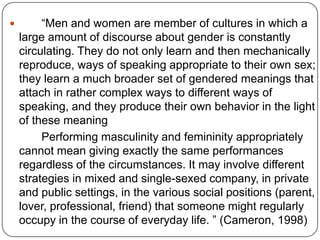
 “Men and women are member of cultures in which a
large amount of discourse about gender is constantly
circulating. They do not only learn and then mechanically
reproduce, ways of speaking appropriate to their own sex;
they learn a much broader set of gendered meanings that
attach in rather complex ways to different ways of
speaking, and they produce their own behavior in the light
of these meaning
Performing masculinity and femininity appropriately
cannot mean giving exactly the same performances
regardless of the circumstances. It may involve different
strategies in mixed and single-sexed company, in private
and public settings, in the various social positions (parent,
lover, professional, friend) that someone might regularly
occupy in the course of everyday life. ” (Cameron, 1998)
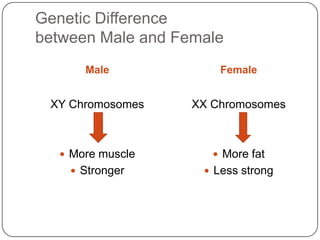
Genetic Difference
between Male and Female
Male Female
XY Chromosomes
 More muscle
 Stronger
XX Chromosomes
 More fat
 Less strong
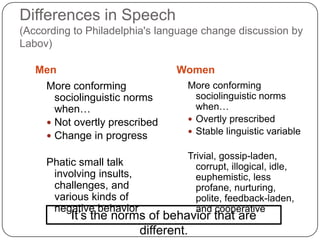
Differences in Speech
(According to Philadelphia's language change discussion by
Labov)
Men Women
More conforming
sociolinguistic norms
when…
 Not overtly prescribed
 Change in progress
Phatic small talk
involving insults,
challenges, and
various kinds of
negative behavior
More conforming
sociolinguistic norms
when…
 Overtly prescribed
 Stable linguistic variable
Trivial, gossip-laden,
corrupt, illogical, idle,
euphemistic, less
profane, nurturing,
polite, feedback-laden,
and cooperative
It’s the norms of behavior that are
different.
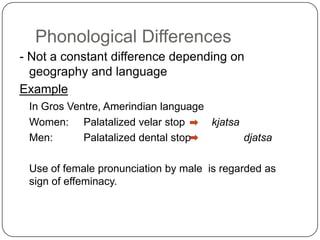
Phonological Differences
- Not a constant difference depending on
geography and language
Example
In Gros Ventre, Amerindian language
Women: Palatalized velar stop kjatsa
Men: Palatalized dental stop djatsa
Use of female pronunciation by male is regarded as
sign of effeminacy.
Phonological Differences
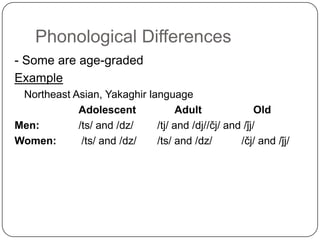
- Some are age-graded
Example
Northeast Asian, Yakaghir language
Adolescent Adult Old
Men: /ts/ and /dz/ /tj/ and /dj//čj/ and /ĵj/
Women: /ts/ and /dz/ /ts/ and /dz/ /čj/ and /ĵj/
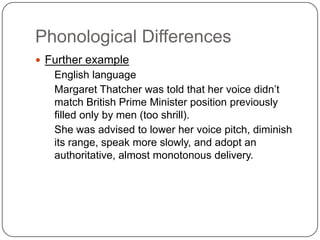
Phonological Differences
 Further example
English language
Margaret Thatcher was told that her voice didn’t
match British Prime Minister position previously
filled only by men (too shrill).
She was advised to lower her voice pitch, diminish
its range, speak more slowly, and adopt an
authoritative, almost monotonous delivery.
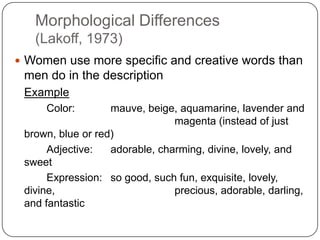
Morphological Differences
(Lakoff, 1973)
 Women use more specific and creative words than
men do in the description
Example
Color: mauve, beige, aquamarine, lavender and
magenta (instead of just
brown, blue or red)
Adjective: adorable, charming, divine, lovely, and
sweet
Expression: so good, such fun, exquisite, lovely,
divine, precious, adorable, darling,
and fantastic
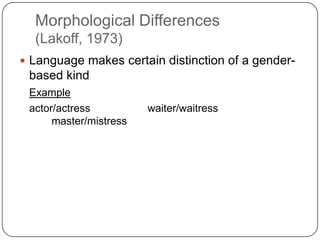
Morphological Differences
(Lakoff, 1973)
 Language makes certain distinction of a gender-
based kind
Example
actor/actress waiter/waitress
master/mistress

Genderlect

  • 1.
  • 2.
    Definition of Gender -A range of characteristic used to distinguish between male and female, particularly in the cases of men and women, and the masculine and feminine attributes assigned to them - Social construct involving with the whole gamut of genetic, psychological, social, and cultural differences (Sex is biologically determined) - Not a pool of attributes possessed by a person, but something a person does (Wodak, 1997) - Change from one generation to the next (Wodak, 1997)
  • 3.
    Language and Gender Anarea of study within sociolinguistics, applied linguistics, and related fields that investigates varieties of speech associated with a particular gender, or social norms for such gendered language use - Do the men and women speaking a same language use it in different ways? - Do these differences arise from their language structure or social relationship?
  • 4.
     “Men andwomen are member of cultures in which a large amount of discourse about gender is constantly circulating. They do not only learn and then mechanically reproduce, ways of speaking appropriate to their own sex; they learn a much broader set of gendered meanings that attach in rather complex ways to different ways of speaking, and they produce their own behavior in the light of these meaning Performing masculinity and femininity appropriately cannot mean giving exactly the same performances regardless of the circumstances. It may involve different strategies in mixed and single-sexed company, in private and public settings, in the various social positions (parent, lover, professional, friend) that someone might regularly occupy in the course of everyday life. ” (Cameron, 1998)
  • 5.
    Genetic Difference between Maleand Female Male Female XY Chromosomes  More muscle  Stronger XX Chromosomes  More fat  Less strong
  • 6.
    Differences in Speech (Accordingto Philadelphia's language change discussion by Labov) Men Women More conforming sociolinguistic norms when…  Not overtly prescribed  Change in progress Phatic small talk involving insults, challenges, and various kinds of negative behavior More conforming sociolinguistic norms when…  Overtly prescribed  Stable linguistic variable Trivial, gossip-laden, corrupt, illogical, idle, euphemistic, less profane, nurturing, polite, feedback-laden, and cooperative It’s the norms of behavior that are different.
  • 7.
    Phonological Differences - Nota constant difference depending on geography and language Example In Gros Ventre, Amerindian language Women: Palatalized velar stop kjatsa Men: Palatalized dental stop djatsa Use of female pronunciation by male is regarded as sign of effeminacy.
  • 8.
    Phonological Differences - Someare age-graded Example Northeast Asian, Yakaghir language Adolescent Adult Old Men: /ts/ and /dz/ /tj/ and /dj//čj/ and /ĵj/ Women: /ts/ and /dz/ /ts/ and /dz/ /čj/ and /ĵj/
  • 9.
    Phonological Differences  Furtherexample English language Margaret Thatcher was told that her voice didn’t match British Prime Minister position previously filled only by men (too shrill). She was advised to lower her voice pitch, diminish its range, speak more slowly, and adopt an authoritative, almost monotonous delivery.
  • 10.
    Morphological Differences (Lakoff, 1973) Women use more specific and creative words than men do in the description Example Color: mauve, beige, aquamarine, lavender and magenta (instead of just brown, blue or red) Adjective: adorable, charming, divine, lovely, and sweet Expression: so good, such fun, exquisite, lovely, divine, precious, adorable, darling, and fantastic
  • 11.
    Morphological Differences (Lakoff, 1973) Language makes certain distinction of a gender- based kind Example actor/actress waiter/waitress master/mistress