!
!
20th Century Drama II Eng4214
DISCLAIMER: I don’t own any of the included essays.
I have accumulated them for the purpose of studying. 

DRAMA FILE
Pirandello 1
The Context of Six Characters in Search of an Author 2
Character Analysis  3
Play-within- a- play; theatre about theatre  5
Theatricality 6
raison d’etre 8
Improvisation 9
Death of the author 11
Commedia dell’arte 13
Brecht 14
The Context of Mother Courage and her Children 15
Character Analysis 15
Themes 17
Epic Theatre 19
Alienation Effect 21
Brecht as a revolutionist in stage technique: Gestus 22
Brecht’s Political Theatre 23
Beckett 25
The Context of Waiting for Godot 26
Character analysis 28
Theatre of the Absurd 37
Theory of Semiotics 45
Time 47
Existentialism 53
Nihilism 55
Habituation 55
Structure of the play (Repetitiveness, Circular development) 57
Vaudeville 60
Visual effect 60
TOPICS
!
“All my work has always been
a challenge to the opinions of the public.”
LUIGI PIRANDELLO
Born: 28 June 1867
Died: 10 December 1936 (aged 69)
!
!
!
! Luigi Pirandello was born in Girgenti (now Agrigento) on the island of Sicily. Luigi's father was a
fairly prosperous sulphur dealer and intended that his son should follow in his footsteps, but the boy
demonstrated a studious bent early on, and as a result, he was provided with a literary schooling. He entered
the University of Rome in 1887, but later transferred to Bonn University where he completed his doctoral
thesis, a study of his native Sicilian dialect.
!
Pirandello's first creative efforts were in the realm of verse--he translated Goethe's Roman elegies--
but after falling under the influence of Sicilian novelist Capuana who became his friend and advisor,
Pirandello turned his attention to naturalistic fiction. His first novel, The Outcast (1893), contains the seeds
that would blossom in his later writing.
!
Pirandello's sense of disillusionment was burned into his psyche early on by a very personal tragedy.
In 1894, at the age of 27, he married a young woman whom he had never met. The marriage had been
arranged by his parents according to custom. His young bride, Antonietta Portulano, was the daughter of his
father's business partner. For a time, the young couple found happiness, but after the birth of their third child
and the loss of the family fortune in a flood, Antonietta suffered a mental breakdown. She became so violent
that she should have been institutionalized, but Pirandello chose instead to keep her at home for seventeen
years while she spat her venom at the young writer and his three children. Their daughter was so disturbed by
her mother's illness that she tried to take her own life. Fortunately, her instrument of choice, a revolver, was so
old as to be of no use. The illness had a profound effect on Pirandello's writing as well, leading him to
explorations of madness, illusion, and isolation. It was not until his plays finally began to prove profitable
around 1919 that he was able to send Antonietta to a private sanitarium.
!
Pirandello first published two other novels and numerous short stories. It was not until 1916, however,
that he turned his attention to the theatre. He quickly became enthralled by this new medium, and became
quite prolific, turning out as many as nine plays in one year. His first three plays, Better Think Twice About It!,
Liolà, and It is So!, If You Think So, were each written in less than a week. His first notable critical success
came in 1920 with As Before, Better than Before. Then, within a five week period in 1921, he wrote two
masterpieces: Six Characters in Search of an Author, and Henry IV. Six Characters had a successful but
!1
SIX CHARACTERS IN SEARCH OF AN AUTHOR
scandalous opening in Rome and, soon after, another successful--but less scandalous--opening in Milan.
Almost overnight, the play was being directed by Komisarjevsky in London, Brock Pemberton in New York,
and Max Reinhardt in Germany. 1922 saw the successful opening of two more plays, Henry IV and Naked.
!
Between 1922 and 1924, Pirandello became a major public figure. In Paris, he received the Legion of
Honor, and in 1925, with the help of Mussolini who had publicly announced his admiration for the
playwright, Pirandello opened his own Art Theatre in Rome. Pirandello's relationship with Mussolini has been
the subject of much debate. Some scholars have suggested that the playwright's enthusiastic adoption of
fascism was simply a matter of practicality, a strategic ploy to advance his career. Had he opposed the fascist
regime, it would have meant serious difficulties for him and for his art. Acceptance, on the other hand, meant
subsidies and publicity. His statement that "I am a Fascist because I am an Italian." has often been called on to
support this theory, and one of his later plays, The Giants of the Mountain, has often been interpreted as
showing the author's growing realization that the fascist giants were hostile to culture. And yet, during his last
appearance in New York, Pirandello voluntarily distributed a statement announcing his support of Italy's
annexation of Abyssinia. He even gave his Nobel medal over to the Italian government to be melted down for
the Abyssinian campaign. However, Pirandello was a complex creature, and all that can be certain is that
nothing is certain. At any rate, Mussolini's support quickly brought the Italian playwright international fame,
and a worldwide tour ensued, introducing London, Paris, Vienna, Prague, Budapest, and several cities in
Germany, Argentina, and Brazil to the intriguing intellectual contortions of "Pirandellian" theatre.
!
The most popular of Pirandello's comedies, his masterpiece, is Six Characters in Search of an Author.
The premise of the play is that these six characters have taken on a life of their own because their author has
failed to complete the story. They invade a rehearsal of another Pirandellian play and insist on playing out the
life that is rightfully theirs. Suggesting that life defies all simple interpretations, Pirandello's characters rebel
against their creator. They attack the foundation of the play, refusing to follow stage directions and interfering
with the structure of the play until it breaks down into a series of alternately comic and tragic fragments.
!
Pirandello was clearly the greatest Italian playwright of his time, and he has left a lasting mark on all
the playwrights that have followed him. In his agony over the illusory nature of existence and the isolation of
man, he anticipates such writers as Samuel Beckett, Harold Pinter and Eugene Ionesco. Perhaps Pirandello
best summed up his art himself when he said, "I have tried to tell something to other men, without any
ambition, except perhaps that of avenging myself for having been born.” (Imagi-nation website)
!
THE CONTEXT OF THE PLAY
!
Six Characters in Search of an Author was first performed in 1921 and was absolutely revolutionary
for it's time. Pirandello (a Nobel Prize winning author) focused on the symbolic and dream-like, shying away
!2
from realist drama. Pirandello was completely disillusioned with Italy's unified government and his work
arose from this disappointment. His plays were all concerned with the search of identity. It is my belief that he
was deeply affected by Italy's lack of identity, and therefore was very preoccupied with the concept.
!
The play centers around six characters who are simultaneously real and not real. They exist in a sort
of limbo, as they are characters in a play, who have yet to fulfill their roles and whose script remains
unfinished. One part of the play that was so pioneering was the fact that it was a play within a play. At the
time of it's maiden performance, this was unheard of. Audience's were dumbfounded as the play began while
people were still wandering about. The play began with (what appeared to be) stage hands and actors running
around, seemingly preparing for the performance. What shocked the audience was that this was the
performance. And it was Pirandello who spearheaded this entirely new concept. (Penn State University blog)
“Exactly, perfectly…living beings more alive than
those who breathe and wear clothes: beings less
real perhaps, but truer! I agree with you entirely.”
!
The Father
!
The Father is a "fattish" man in his fifties with thin, reddish hair, a thick moustache, and piercing, blue
oval eyes. He is "alternatively mellifluous and violent." Along with the Step-Daughter, he is the Character
who most fervently insists on the staging of the Characters' drama. In some sense, he figures as the drama's
progenitor, having produced the situation of the step- household, a situation that culminates in an inadvertent
sexual encounter with his Step-Daughter. Though the Father ostensibly seeks remorse, Pirandello intimates a
number of times that a "deal" has perhaps been struck between the Father and Manager, the play's two
authorial figures. Thus the Son and Step- Daughter warn against reading the play according to his word alone.
As the Manager laments, the Father is the play's philosopher, continually stepping out of his role to sermonize
about ideas of the inner workings of the Characters' drama and the relations between the Characters and
Actors. His excessive tendency for preaching would mark him as a roughly drawn character and as a double
for the author. In particular, the Father insists on the "reality" of the Characters, a reality he poses over and
!3
CHARACTER ANALYSIS
against that of the company. Unlike the "nobody" Actors, the Characters are "real somebodies" because their
reality—the reality of both their drama and role—remains fixed and independent of the vagaries of time. This
reality has little to do with the plausibility nor the codes of the "actable." Thus, both he and the Step-Daughter
relate the sense of estrangement in seeing their reality rendered by the Actors.
The Step-Daughter
!
Dashing, impudent, and beautiful, the Step-Daughter also seeks the realization of the Characters'
drama. Her "reality" as a Character is a fixed, grimacing mask of vengeance. She seeks stage-life to revenge
herself on the Father and she appears in two principle forms that define a certain fantasy of woman. As noted
above, she and the Father are the major players in their drama's traumatic scene: the inadvertent sexual
encounter that precipitates the encounter between the original and surrogate families in the back of Madame
Pace's shop. Exploited despite her mourning for her father, the Step-Daughter appears here as victim. At the
same time, on-stage she appears seductive, exhibitionistic, and dangerously cruel.
As she tells the Manager, the Father's perversity is responsible for hers. Her perversity emerges in particular
with her obsession with the spectacle of the Characters' drama. Whereas the Father offers their play as a more
"cerebral drama," tracing its players' motivations, its overarching structures, and its narrative trajectories, she
will conjure its scenes in speech, calling for its trappings forth on the stage. Many of these props concern the
visual: the mirror, the window, and the screen. The Step-Daughter also functions as object of this spectacle.
Though dressed, like the other members of her immediate family, in mourning for their own father, she wears
her clothes with "great elegance." For example, she brashly erupts into a cabaret-style performance of "Prenez
garde à Tchou-Tchin-Tchou": her display would lure the company into their drama's realization. More
explicitly does the Step-Daughter reveal her obsession with her self-image in her memory of the author. As
she tells the company, she strove most to seduce him from the shadows about his writing table. In her vision
of this seduction, she progressively exiles the other Characters from the room, ultimately leaving her alone to
illuminate the darkness. With the Characters' drama, the Step-Daughter would become a star. For her, the
drama's stage-life would realize her self-image above all.
The Mother
!
Dressed in modest black and a thick widow's veil, the Mother appears crushed by an "intolerable
weight of shame and abasement." Her face is "wax-like," and her eyes always downcast. She bears the
anguish of the Characters' drama, serving as its horrified spectator. She is the consummate figure of grief,
mourning the Characters' inexorable fate. As Pirandello notes in his preface to the play, the Mother would
incarnate nature without mind in her suffering—she suffers the torture of what has befallen the family without
cognizing it as the Father does. In this respect, she is not even a woman, she first and foremost a mother in
anguish. Caught, like the other Characters, in the unchanging and inexorable reality of both her drama and
role. She laments that she suffers her torture at every moment; her lot as mourner is fixed for eternity. The two
!4
mute children, accessories of sorts, underline her function as an image of grief. Particularly agonizing to her is
the aloofness of her estranged Son, whom she will approach to no avail throughout the play.
The Son
!
A tall, severe man of twenty-two, the Son appears contemptuous, supercilious, and humiliated by his
fellow Characters. Having been grown up in the country, he is estranged from his family and, in his aloofness,
will cause the elimination of the stepchildren within the Characters' drama. Ironically then will he ultimately
appear as witness to the two younger children's demise. His role as a character lies in his ashamed refusal to
participate in the household and the Characters' spectacle, a spectacle to which he nevertheless remains bound.
More specifically, he appears to be structurally tied within the Character's drama to the Step-Daughter, whose
look of scorn and exhibitionism fixes him in his guilt, shame, and reserve. In his aversion to spectacle, he in
particular attacks the Actors who would imitate them. For him, the Actor-as-mirror, in its necessary inability
to reflect the Character as he sees himself, freezes the Character's self-image and renders it grotesque. The
Son also protests to the Manager that he remains an unrealized character, perhaps one that even stands for the
will of the author in objecting to their drama's staging. As the Father counters, however, his unrealized nature
is his own situation in both the Characters' drama and its attempted rehearsal on-stage; his aloofness within
the drama makes him the drama's very hinge. The Son's position as an unrealized character appears most
clearly in the scene he would refuse to play with his Mother in Act III, a scene that is actually a non-scene.
The Mother enters his bedroom, and the Son, in his aversion to scenes, flees to the garden to witness his step-
siblings' deaths. (Sparknotes website)
!
!
PLAY-WITHIN-PLAY; THEATRE ABOUT THEATRE
!
The most obvious device that Pirandello uses to convey his themes is to portray the action as a play
within a play. The initial play within a play is relatively easy for the audience to handle - Pirandello’s own
Rules of the Game is being performed in rehearsal by a troupe of actors. Then the “characters” enter and they
seem to embody a completely different play within the play. Furthermore, they insist on acting out the story
that have brought to the rehearsal, which is done twice, once by themselves and again by the actors. And once
the audience has more or less assimilated all of this, a seventh character, Madame Pace, is created on the spot,
as if out of thin air. The effect is similar to that presented with nesting boxes, one inside another and another
inside that until the audience gets so far away from their easy faith in their ability to distinguish between
reality and illusion that they might throw up their hands like the Producer and simply say, “Make believe?!
Reality?! Oh, go to hell the lot of you! Lights! Lights! Lights!” Throughout the production of Six Characters
in Search of an Author the audience in fact experiences the difficulty of distinguishing between reality and
illusion that constitutes Pirandello’s main theme. And the Producer’s company of actors in many ways speaks
for the audience throughout - from the initial, derisive incredulity at the entrance of the “characters” to the
!5
ambivalent response at the end of the play. And a crucial moment in this process comes early in Act I, after the
derisive laughter of the actors has died down somewhat, and the Father explains that “we want to live, sir . . .
only for a few moments - in you.” In response, a young actor says, pointing to the Stepdaughter, “I don’t
mind. . . so long as I get her.” This comically libidinous response is ignored by everyone on stage, but it
represents an important turning point in the minds of the actors in the company and in the minds of the
audience as well. It embodies a playful, tentative acceptance of the illusion, a making do with what’s
available, an abandonment to the situation as it presents itself. In short, it represents the response to the
mystery of life to which human beings obsessed with absolute certainty are ultimately reduced. One must
simply get on with life and make the best of it, accepting the hopelessness of trying to draw fine distinctions
between what is real and what is not. (Pirandello web website)
!
THEATRICALITY
!
Pirandello was part of a movement in the early 20th century called theatricalism or anti-illusionism.
The theatricalists rejected realist drama and substituted the dreamlike, the expressive, and the symbolic. The
theatricalists disapproved of realism because it had abandoned the defining tools of drama, such as poetry,
interaction between actors and audience, soliloquies, asides and bare stages. They thought realism could not
depict the inner life of human beings. (Bench Theatre website)
!
Pirandello had in fact invented and then abandoned these characters, unable to see how to reconcile
their conflicting demands. Each character has in some way gone beyond the capacity of art to resolve his or
her predicament. The theatre cannot handle private and inarticulate grief (the mother), the painful shyness and
dumb suffering of the boy, the aloof silence of the older son, the excessively vocal, verbalized self-lacerations
and self-justifications of the father, or the shrill maliciousness of the daughter without injustice to one or other
of them, and without degrading their suffering by translating it into the melodramatic clichés the audience
would be familiar with. The impossibility of making their story into a coherent and meaningful play is an
image of the impossibility of communication and understanding between people in life. The living man has no
fixed identity in his own eyes. What he does today he can forget or repudiate tomorrow. He has a degree of
existential freedom to choose and change. But the ordinary man is likely to experience this freedom as nausea.
The Father says to the director:
!
Don't you feel the ground sink beneath your feet as you reflect that this 'you' which you feel today, all
this present reality of yours, is destined to seem mere Illusion to you tomorrow?
!
To be saved from that flux, he wishes to be a character in a play, with a fixed role and identity and
significance. But once the author has accepted responsibility to set down this fixed role in a text, the character
loses all freedom to change or protest. The living man has no role or purpose, but a character in a play is
!6
locked for ever in a role which, since it has to be defined not in terms of self-justification, but in terms of the
requirements of the play as a whole and of the other characters, all of whom have different, but equally
selective and unjust, definitions of him. The father says:
!
My drama lies entirely in this one thing. . . . In my being conscious that each one of us believes
himself to be a single person. But it’s not true. . . . Each one of us is many persons. . . . according to
all the possibilities of being that there are within us. . . . And we see this very clearly when by some
tragic chance we are, as it were, caught up whilst in the middle of doing something and find ourselves
suspended in mid-air. And then we perceive that all of us was not in what we were doing, and that it
would, therefore, be an atrocious injustice to us to judge us by that action alone.
!
Drama here for Pirandello performs the same function as death in Sartre’s In Camera, it suspends
existential freedom. The dead man and the character in play are both fixed in the opinion of others with no
possibility of redemption. The director tells the characters:
!
All the characters must be contained within one harmonious picture, and presenting only what is
proper to present. … Ah, it would be all very pleasant if each character could have a nice little
monologue … Or without making any bones about it, give a lecture, in which he could tell his
audience what’s bubbling and boiling away inside him.
You might get something like justice if you happen to be Hamlet, but what if you happen to be Rozencrantz or
Guildenstern, who get the worst of both worlds, neither the freedom of real life, nor the justification of art.
!
In his preface to the 1925 edition of the play, Pirandello acknowledges the close parallel between
being a dramatist and being God. He gives his characters being without a reason for being. He rejects them.
And if his role were to be explained to them, they would not believe him:
!
It is not possible to believe that the sole reason for our living should lie in a torment that seems to us
unjust and inexplicable.
!
Anything which is ‘unjust and inexplicable’, without meaning, is absurd. Absurdism is not simply a
label for certain plays written in the fifties and sixties. It was a major component in Greek thought and Greek
tragedy. Shakespeare’s Troilus and Cressida is pure absurdism, where neither Troilus nor Cressida get to tell
their stories, and the Trojan War itself is drained of meaning. Chehov’s plays were all, as we have seen,
absurdist; and The Seagull even has an ultra-absurdist play-within-a-play. The definitive expression of
absurdism is within a play, but also uses theatre as its primary image:
!
Life’s but a walking shadow, a poor player
That struts and frets his hour upon the stage
!7
And then is heard no more. It is a tale
Told by an idiot, full of sound and fury
Signifying nothing.
!
In 1903 Bertrand Russell also used dramatic imagery to express his sense of an absurd universe:
!
And Man saw that all is passing in this mad, monstrous world, that all is struggling to snatch, at any
cost, a few brief moments of life before Death’s inexorable decree. And Man said: ‘There is a hidden
purpose, could we but fathom it, and the purpose is good; for we must reverence something, and in
the visible world there is nothing worthy of reverence’. And man stood aside from the struggle,
resolving that God intended harmony to come out of chaos by human efforts. And when he followed
the instincts which God had transmitted to him from his ancestry of beasts of prey, he called it Sin,
and asked God to forgive him. But he doubted whether he could be justly forgiven, until he inverted a
divine Plan by which God’s wrath was to have been appeased. And seeing the present was bad, he
made it still worse, that thereby the future might be better. And he gave God thanks for the strength
that enabled him to forgo even the joys that were possible. And God smiled; and when he saw that
Man had become perfect in renunciation and worship, he sent another sun through the sky, which
crashed into Man’s sun; and all returned again to nebula. ‘Yes’, he murmured, ‘it was a good play; I
will have it performed again’. [A Free Man’s Worship]
!
Pirandello also indicts God for creating sentient beings and denying them a purpose in his image, in
the final paragraph of his preface, of the playwright as deus absconditus:
Though the audience eventually understands that one does not create life by artifice and that the
drama of the six characters cannot be presented without an author to give them value with his spirit,
the Manager remains vulgarly anxious to know how the thing turned out, and the ‘ending’ is
remembered by the son in its sequence of actual moments, but without any sense and therefore not
needing a human voice for its expression. It happens stupidly, uselessly, with the going-off of a
mechanical weapon on stage. It breaks up and disperses the sterile experiment of the characters and
the actors, which has apparently been made without the assistance of the poet. The poet, unknown to
them, as if looking on at a distance during the whole period of the experiment, was at the same time
busy creating – with it and of it – his own play. (Keith Sagar)
!
RAISON D’ÊTRE
!
Raison d’être is a french phrase meaning reason or justification of existence. And according to Oxford
Dictionary of Literary Terms, existentialism is a current in European philosophy distinguished by its emphasis
!8
on lived human existence. Sartrean existentialism, which is derived from Juan-Paul Sartre, is the most
influential in the literary field.
Existence Precedes Essence
!
It is an atheist philosophy of human freedom conceived in terms of individual responsibility and
authenticity. Its fundamental premiss is that ‘existence precedes essence,’ implies that we as human beings
have no given essence or nature but must forge our own values and meanings in an inherently meaningless or
absurd world of existence. Obliged to make our own choices, we can either confront the anguish of this
responsibility, or evade it by claiming obedience to some determining convention or duty, thus acting in ‘bad
faith.’ Paradoxically, we are ‘condemned to be free.’
!
IMPROVISATION

!
“A fact is like a sack - it won't stand up if it's empty. To make it stand up, first you have to
put in it all the reasons and feelings that caused it in the first place.”
!
In the trilogy improvisation also functions as a conceit for Pirandello's approach to theater.
Demolishing conventional attitudes toward the stage, the playwright proposes a universe of the unforeseen,
the sudden, the inconclusive, and the unknowable where imagination and illusion rule. But the theater plays
themselves are far from spontaneous “happenings,” where action is left to chance. Pirandello offers a highly
structured set of works in which details are carefully pondered and stage directions abound. Indeed, Tonight
We Improvise becomes a statement against haphazard impro-visational art in favor of a rigorously constructed
text by an author who is not a director but a playwright.
!
The theater plays also demonstrate the intricate interpretive layers that develop between the original
creative work and its performance. Authorial intention is easily lost, for the dramatic text is open ended,
subject to a multiplicity of readings, none of which necessarily coincides with the writer’s initial vision. This
fact gives poignancy to the consternation of the Six Characters when they see themselves falsified by the
actors: a metaphor for the experience of the writer once his creation has entered the world beyond his
imagination.
!
In the trilogy the dramatic form is repeatedly dissolved in the exchange of reality and illusion, inner
and outer plays, dramatic action and critical reflection. Levels of meaning shift and move about, accompanied
by continuous analysis and discussion. In this atmosphere the inner plays are not meant to stand alone as
naturalist artifacts with a beginning, middle, and end. Rather they operate as dramatizations of ideas or
expanded conceits for the creation and construction of the theatrical experience, which is the focus of the
!9
framing action. Thus Six Characters in Search of an Author concerns a play in the making which is never
finished. Each in His Own Way provides a partial but incomplete text, a work purposely left unendcd. In
Tonight We Improvise the play reaches resolution but not according to the original intent of the director-
playwright: the text literally becomes the actors. All the theater plays, however, dramatize a dialectic of
conflict. In Six Characters this dialectic is played out between the characters and the actors, between art and
life. In Each in His Own Way spectators and actors collide as “real” and “fictional" characters encounter each
other, representing fluidity and fixity, reality and illusion. In Tonight We Improvise the struggle for control of
the dramatic material is played out between the director, his actors, and the “truth" contained in the story and
its characters. In all three plays theatrical form is subjected to Pirandellian concepts of relativity and
multiplicity, for the plays tear down conventions, spatial barriers, and the walls separating action and
audience, characters and people.
!
A representative figure, the Father of Six Characters is quintessential Pirandellian in his struggle to
control passion through reason. The Father is equally a cerebral and an emotive creation who expresses a
gamut of feelings including self-confidence, torment, wit, anger, and condescension. He also personifies the
mask of remorse imposed upon him by the playwright as his defining passion. Criticized, like many of the
dramatist’s raisonneurs, for excessive philosophizing, the Father reacts by declaring the “reasons of [his]
suffering." His emphasis on the rational places him squarely in a Pirandellian universe but outside the
traditions of melodrama, where emotions are not given an intellectual structure. As commonly occurs in
Pirandellian drama, thought and emotion are fused, not divided, in the character. The act of passionate
reflection is a fundamental quality of the dramatist’s protagonists. Propelling the action of Six Characters, the
Father is the story’s prime mover, mouthpiece, advocate, and challenger. In recent years, however, literary
criticism of this play has focused more and more on the subterranean, unconscious motivations underlying the
dramatic action. Proceeding in such a psychoanalytical line, Eric Bentley remarks that the Father is the source
of the Characters’ catastrophes and the “base of that Oedipal triangle on which the family story rests.”18 The
family story, the critic notes, begins and ends with the Oedipal image of father, mother, and son, the second
family having literally or figuratively been killed off. Bentley sees the inner melodrama as a “great play of
dead or agonized fatherhood,” including the absence of the greatest father of all, God. In this vein the search
for a welcoming author can be interpreted as a metaphor for humanity’s need for the Author of our being, for
the safety and protection of absolute fatherhood. Moreover some critics employ psychoanalytic instruments
not only to explore issues of character development and plot, but also to understand the creative genesis of
Pirandello’s works in his own psychological makeup. For example, in his article “The Play as Replay,”
Rudolph Binion attributes the tragic situations of Six Characters and Henry IV to the mechanism of “traumatic
reliving” of life-shattering dramas, in an existence termed “a chronicle of psychic gashes” (149). Binion states
that a personal Pirandellian trauma is at the core of Six Characters: Antonietta Portulano’s accusations of
incest against her husband and daughter. These, Binion offers, are transformed into dramatic action in the
scenes depicting the maternally interrupted sexual encounter of the Father and Stepdaughter.
!
!10
In his depiction of the Father, Pirandello is also expressing the failure of the individual’s chosen
masks, which is concealed beneath his self-justifying rational discourse. For all his aspirations toward “a
certain moral sanity,” the Father is stripped of his masks and exposed as a bad husband, a bad parent, an
egotist, and a sensualist. Having been incapable of sustaining a satisfactory marriage, the Father becomes his
wife’s procurer when he sends her off with the Secretary. By this action he foreshadows the seventh Character,
Madama Pace, who procures the Stepdaughter for him, with intimations of an incestuous bond. It is not
coincidental that the play being rehearsed at the opening of Six Characters is Pirandello’s own The Rules of
the Game. Besides forming a comic self-referential aside, the mention and brief discussion of this earlier piece
presage themes of the new text. Like The Rules of the Game, Six Characters is also about roles. On stage,
these roles often clash: father versus child; actor versus character; husband versus wife. The Father is urgent
about his personal tragedy; he has been caught in the compromising role of the middle-aged client of the
disreputable Madama Pace and fixed in it. Madama Pace’s own “nature” is visualized in her grotesque
appearance. The corruption of her character is rendered by the monstrousness of her physique: a hideous old
harridan wearing an orange wig, red silk gown, and a rose behind her car, she is enormously fat.
!
Theoretically, dramatically, and emotionally Pirandello’s theater plays reflect the playwright’s vital
imagination and creativity. Their innovative use of the total theater, their exploration of the creative process in
action, and their invention of novel ways to express human experience make them unique in Pirandello’s
dramatic output and revolutionary within the framework of the European theater of his day. By exposing the
illusion of theater and opening it to public view, Pirandello, fulfilling his goal of capturing the instability of
life and fixing it in dramatic form, redefined the nature of the dramatic work and broke the conventions of
naturalism. In so doing, he made the audience an active, as well as reactive, participant in the construction of
drama. As the playwright declares in the introduction to Six Characters in Search of an Author, “I have set
before them [the audience], not the stage now, but my own imagination in the guise of that stage, caught in the
act of creation” (xxiii). (Understanding Luigi Pirandello By Fiora A. Bassanese)
!
DEATH OF THE AUTHOR
!
“Nature uses human imagination to lift her work of creation to even higher levels.”
!
“Death of the Author” (1967) is an essay by the French literary critic
Roland Barthes that was first published in the American journal Aspen. The
essay later appeared in an anthology of his essays, Image-Music-Text (1977), a
book that also included “From Work To Text”. It argues against incorporating
the intentions and biographical context of an author in an interpretation of text;
writing and creator are unrelated.
!
!11
In his essay, Barthes criticizes the reader’s tendency to consider aspects of the author’s identity-his
political views, historical context, religion, ethnicity, psychology, or other biographical or personal attributes-
to distill meaning from his work. In this critical schematic, the experiences and biases of the author serve as
its definitive “explanation.” For Barthes, this is a tidy, convenient method of reading and is sloppy and flawed:
"To give a text an Author” and assign a single, corresponding interpretation to it “is to impose a limit on that
text.” Readers must separate a literary work from its creator in order to liberate it from interpretive tyranny (a
notion similar to Erich Auerbach’s discussion of narrative tyranny in Biblical parables), for each piece of
writing contains multiple layers and meanings. In a famous quotation, Barthes draws an analogy between text
and textiles, declaring that a “text is a tissue [or fabric] of quotations,” drawn from “innumerable centers of
culture,” rather than from one, individual experience. The essential meaning of a work depends on the
impressions of the reader, rather than the “passions” or “tastes” of the writer; “a text's unity lies not in its
origins,” or its creator, “but in its destination,” or its audience.
!
No longer the locus of creative influence, the author is merely a “scriptor” (a word Barthes uses
expressly to disrupt the traditional continuity of power between the terms “author” and “authority”). The
scriptor exists to produce but not to explain the work and “is bom simultaneously with the text, is in no way
equipped with a being preceding or exceeding the writing, [and] is not the subject with the book as predicate.”
Every work is "eternally written here and now,” with each re-reading, because the “origin” of meaning lies
exclusively in “language itself” and its impressions on the reader.
!
Barthes notes that the traditional critical approach to literature raises a thorny problem: how can we
detect precisely what the writer intended? His answer is that we cannot. He introduces this notion in the
epigraph to the essay, taken from Honore de Balzac’s story Sarrasine (a text that receives a more rigorous
close-reading treatment in his influential post-structuralist book S/Z), in which a male protagonist mistakes a
castrato for a woman and falls in love with her. When, in the passage, the character dotes over her perceived
womanliness, Barthes challenges his own readers to determine who is speaking-and about what. "Is it Balzac
the author professing ‘literary’ ideas on femininity? Is it universal wisdom? Romantic psychology?... We can
never know.” Writing, “the destruction of every voice,” defies adherence to a single interpretation or
perspective.
!
Acknowledging the presence of this idea (or variations of it) in the works of previous writers, Barthes
cites in his essay the poet Stephane Mallarme, who said that “it is language which speaks.” He also recognizes
Marcel Proust as being “concerned with the task of inexorably blurring...the relation between the writer and
his characters”; the Surrealist movement for their employment the practice of “automatic writing” to express
“what the head itself is unaware of”; and the field of linguistics as a discipline for “showing that the whole of
enunciation is an empty process.” Barthes’s articulation of the death of the author is, however, the most
radical and most drastic recognition of this severing of authority and authorship. Instead of discovering a
“single ‘theological’ meaning (the ‘message’ of the Author-God)," readers of text discover that writing, in
!12
reality, constitutes “a multi-dimensional space,” which cannot be “deciphered,” only “disentangled.”
“Refusing to assign a ‘secret,’ ultimate meaning” to text “liberates what may be called an anti-theological
activity, an activity that is truly revolutionary since to refuse meaning is, in the end, to refuse God and his
hypostases-reason, science, law.” The implications of Barthes’s radical vision of critical reading are indicative
of the inherently political nature of this vision, which reverses the balance of authority and power between
author and reader. Like the dethroning of a monarchy, the “death of the author” clears political space for the
multivoiced populace at large, ushering in the long-awaited “birth of the reader.” (Literarism, the Republic of
Letters website)
!
COMMEDIA DELL’ARTE
!
Commedia dell’arte translates as “comedy of skills”: an improvisational style of theater which began
in sixteenth-century Italy and flourished in Europe for 200 years.
Traveling companies of professional actors performed outdoors in public squares, using simple
backdrops and props. Each member of the company played a particular stock character – the tricky servant,
the greedy old man, the young heroine – wearing masks and costumes that defined the character’s personality.
The actors worked from a basic outline, improvising the dialogue and incorporating jokes and
physical comedy “bits” as they went. The performers always played the same characters, changing only their
situ- ations (for example, in one scenario the greedy old man might be the young heroine’s father, keeping her
away from her sweetheart; in another, he might be her elderly husband.)
The translation “comedy of skills” refers to the skills that the profes- sional comic actors developed:
they each had a repertoire of jokes, funny speeches, comic insults, and physical stunts to draw from in their
per- formances.
The great silent movie comedians Charlie Chaplin, Buster Keaton, and Harold Lloyd drew on the
acrobatic physical comedy of commedia in their films. The energetic, improvisatory humor of the commedia
troupes is similar to the work done by contemporay improv comedy groups such as Second City, the
Groundlings, and the Upright Citizens Brigade.
The stock characters of commedia dell’arte live on in modern sitcom characters (such as the lovable
but dumb husband, the know-it-all next door neighbor, the wisecracking best friend) who deal with changing
situations each week. (Commedia dell’arte: A Study Guide for Students for the Improvisational Theatre Style
“Comedy of Skills”)
!
!13
“For art to be ‘unpolitical’ means only
to alley itself with the ‘ruling group’.”
BERTOLT BRECHT
Born: 10 February 1898
Died: 14 August 1956 (aged 58)
!
!
!
A poet first and foremost, Bertolt Brecht's genius was for language. However, because this language is
built upon a certain bold and direct simplicity, his plays often lose something in the translation from his native
German. Nevertheless, they contain a rare poetic vision, a voice that has rarely been paralleled in the 20th
century.
!
Brecht was influenced by a wide variety of sources including Chinese, Japanese, and Indian theatre,
the Elizabethans (especially Shakespeare), Greek tragedy, Büchner, Wedekind, fair-ground entertainments, the
Bavarian folk play, and many more. Such a wide variety of sources might have proven overwhelming for a
lesser artist, but Brecht had the uncanny ability to take elements from seemingly incompatible sources,
combine them, and make them his own.
!
In his early plays, Brecht experimented with dada and expressionism, but in his later work, he
developed a style more suited his own unique vision. He detested the "Aristotelian" drama and its attempts to
lure the spectator into a kind of trance-like state, a total identification with the hero to the point of complete
self-oblivion, resulting in feelings of terror and pity and, ultimately, an emotional catharsis. He didn't want his
audience to feel emotions--he wanted them to think--and towards this end, he determined to destroy the
theatrical illusion, and, thus, that dull trance-like state he so despised.
!
The result of Brecht's research was a technique known as "verfremdungseffekt" or the "alienation
effect". It was designed to encourage the audience to retain their critical detachment. His theories resulted in a
number of "epic" dramas, among them Mother Courage and Her Children which tells the story of a travelling
merchant who earns her living by following the Swedish and Imperial armies with her covered wagon and
selling them supplies: clothing, food, brandy, etc... As the war grows heated, Mother Courage finds that this
profession has put her and her children in danger, but the old woman doggedly refuses to give up her wagon.
Mother Courage and Her Children was both a triumph and a failure for Brecht. Although the play was a great
success, he never managed to achieve in his audience the unemotional, analytical response he desired.
Audiences never fail to be moved by the plight of the stubborn old woman.
!
Brecht would go on to write a number of modern masterpieces including The Good Person of
Szechwan and The Caucasian Chalk Circle. In the end, Brecht's audience stubbornly went on being moved to
!14
MOTHER COURAGE AND HER CHILDREN
terror and pity. However, his experiments were not a failure. His dramatic theories have spread across the
globe, and he left behind a group of dedicated disciples known today as "Brechtians" who continue to
propagate his teachings. At the time of his death, Brecht was planning a play in response to Samuel Becket's
Waiting for Godot. (Imagi-nation website)
!
THE CONTEXT OF THE PLAY
!
Playwright Bertolt Brecht wrote Mother Courage and Her Children in direct response to Hitler's
invasion of Poland in 1939. Because of his leftist leanings, Brecht had fled Nazi Germany and gone into self-
imposed exile in Scandinavia in 1933. Mother Courage was first produced in 1941 in Switzerland and then
with Brecht himself directing it in Berlin in 1949 with his second wife, Helene Weigel, playing the title role.
Since then it has been seen around the world in numerous productions and film versions. It is considered by
some as the greatest play of the 20th century and perhaps the greatest anti-war play of all time. The action of
the play takes place over the course of 12 years (1624 to 1636), represented in 12 scenes. The scenes give a
sense of Courage's career but without developing sentimental feelings and empathizing with any of the
characters. Mother Courage is not
!
depicted as a noble character. Brecht's style of "epic theatre" contrasts with the ancient Greek
tragedies in which the heroes are far above the normal person. With the alienating effect of Brecht's style, the
ending of his play does not inspire us to imitate the main character, Mother Courage, but rather reflect on her
folly. Actors who have portrayed Mother Courage include Judi Dench and Meryl Streep.
!
CHARACTER ANALYSIS
!
Mother Courage -The protagonist is an entrepreneur who follows armies with her canteen wagon of food and
goods and whose real name is Anna Fierling. She earned her nickname of Mother Courage when she ran
through a bombardment in order to sell her loaves of bread before they went moldy. She has three children -
by different lovers - named Eilif, Swiss Cheese and Kattrin. Although her passion seems to be to protect and
take care of them, she loses them throughout the play, each time while pursuing her own self-interested goals.
Drawn as a deeply unsympathetic character, we see at the end of the play that war has ruined her but failed to
teach her anything.
!
Eilif- Mother Courage's eldest and favourite son is something of a thug. His thirst for violence in slaughtering
peasants and stealing livestock is praised in wartime but gets him executed during a temporary peace.
!
!15
Swiss Cheese-The younger son is rather stupid but completely honest. When he becomes paymaster for a
Finnish division, he tries to save the cashbox from the invading army but is executed for his trouble.
!
Kattrin - She is Mother Courage's teenage mute daughter who hopes to be married and have her own children,
but dies trying to warn villagers of an impending attack.
!
Recruiting Officer and Sergeant - The Officer recruits Eilif into the army with promises of beer and women
while the Sergeant distracts Mother Courage with the possibility of a sale.
!
Cook - He prepares the food for the Swedish general but quickly leaves when the food runs out. He is very
cynical and out for what he can get from the war. He later offers Mother Courage a chance to settle down and
operate an inn.
Commander - He is the General of the Swedish Regiment in which Eilif is fighting. He praises Eilif for killing
the peasants because they had attempted to hide their cattle from the army.
!
Chaplain - He is the religious leader for the army but personifies Brecht's view that religion is of no use when
it comes to war. He is a total coward and hypocrite who switches allegiances freely yet complains that no one
appreciates him.
!
Armourer - He sells Mother Courage the Protestant army's bullets so he can buy brandy.
!
Yvette Pottier - She is a prostitute who follows the army. She ends up marrying a rich colonel's brother and is
rewarded with wealth but loses her looks. She is the only character that gains from the war in some way.
!
The Man with the Eye Patch, a Captain and a Sergeant - These three roles comprise a spy and two
members of the Catholic army who arrest Swiss Cheese for hiding the Protestant army's cashbox and later
execute him.
!
Old Colonel - This is a ridiculous, elderly commander whom Yvette "picks up" and who acts as her "financial
advisor" for favours.
!
Scrivener - The clerk in charge of recording the complaints made to his Captain advises Mother Courage not
to complain about how her wagon has been damaged.
!
Young Soldier - He complains to the scrivener about the injustice of an officer who kept reward money owed
to him. An Old Soldier attempts to restrain him because complaining is pointless.
!
!16
Peasant Man and Woman - They are victims of an attack on their farm. He has lost an arm and she warns that
her baby is still in the collapsing house. Kattrin rushes in to save the baby against Mother Courage's warnings.
!
Old Woman and her Son - They are trying to sell bedding to Mother Courage when news comes that peace has
finally been declared.
!
Various voices - They tell us of passing time, invite Mother Courage to come inside the parsonage for soup,
and sing of the joys of a comfortable home.
!
An Old Peasant, his Wife and Son - They are forced by Catholic soldiers to help in their attack on the
protestant village of Halle. Kattrin is killed when she climbs onto a roof to warn the villagers of the attack.
!
THEMES
!
Capitalism in war. - War, as the play portrays it, is a capitalist system designed to make profit for just a few,
and is perpetuated for that purpose. Therefore, despite the fact that she is constantly trying to make a profit,
Mother Courage is destined to lose by trading during the war; only the fat cats at the top have a real chance of
benefitting from the system. People in this play are always looking to get their cut, large or small. In the
original German text the verb kriegen is often repeated; it means both "to wage war" and "to get".
!
Lower classes lose in war-The play focuses on the "little people", from the nameless Sergeant and
Recruiting Officer freezing in a field at the start the play, to the peasants burying Mother Courage's daughter
at the end. Important figures such as General Tilly or the Kaiser are only mentioned. The war brings pain,
poverty, hunger and destruction to everyone. Mother Courage profits temporarily when the war is at its
fiercest but has lost everything by the end. Yvette, the army whore, is the only one whose life has improved
financially by marrying into the upper class, but she has lost her humanity.
!
Virtue in wartime - War makes human virtues fatal to their possessors. Early in the play. Mother
Courage tells her children their fortunes and in so doing, realizes they will all die because of their respective
virtues: Eilif for his bravery, Swiss Cheese for his honesty, and Kattrin for her kindness. Later, the Cook sings
the "Song of Solomon" in which four Great Souls of the Earth die because of their virtues: Solomon for his
wisdom, Julius Caesar for his bravery, Socrates for his honesty, and St. Martin for his kindness. These four
souls could be compared to Mother Courage and her three children respectively. The qualities that save you in
time of war are cowardice, stupidity, dishonesty and cruelty, Brecht seems to say.
!
Religion - Religion is of little help during a war. Religion is portrayed in the play by the sniveling,
hypocritical, lecherous Chaplain who changes his allegiances at the drop of a hat. When peace is declared he
!17
dusts off his vestments and is prepared to go back to work, but soon changes his mind when war breaks out
again. At the end of the play when the Catholic army is preparing to attack a sleeping town, the peasants begin
to pray fervently for God to intervene. However, it is through the efforts of Kattrin when she climbs onto the
rooftop to sound the alarm by beating her drum that the townspeople are saved.
!
Silence and dumbness.: Real virtue and goodness are silenced during war. Kattrin's dumbness is
highly symbolic in the play. She is psychologically mute because soldiers abused her when she was small.
There are several other significant silences in the play: Mother Courage's refusal to complain after the "Song
of the Great Capitulation", the Chaplain's denial of his own faith when the Catholic army arrives, and Mother
Courage's denial of her own son when his body is brought to her for identification. On the other hand, Kattrin
becomes the most eloquent character in the end by creating the noise to wake the townspeople, her goodness
overcoming the impending massacre of the children. Her reward is to be shot, and then buried anonymously
while her mother trudges on.
!
Motherhood.-There is a clear conflict between Mother Courage's role of "mother" and her
professional role of "canteen woman". Although she claims she is working to support her children, her neglect
causes their deaths. In each case, she is involved in business transactions when her children are lost to her. She
has had multiple sexual partners, the children being byproducts of those encounters, but never seems to have
loved anyone. By contrast, we watch Kattrin's sexual awakening and desire for a husband and children. These
desires are thwarted by her handicap and disfigurement, and her mother's actions. Her maternal instincts are
strong however, as she risks her life to save a baby from a collapsing house, and gives her life to save the
endangered children of the town.
!
War's hunger is insatiable. - Hunger is a recurring theme in the play. The Cook tries to "feed the war"
but there is never enough food, and he must escape when food runs out altogether. Soldiers pillage peasant
farms, killing the owners in the process, to feed the marauding armies. The play opens with a conversation
about how difficult it is to recruit enough soldiers to fill the quota - the war's appetite for men exceeds the
supply. The Cook and the whole army feed society's appetite for war. By the end, starvation has left a bleak
landscape over the county side and Mother Courage's wagon is empty.
!
!18
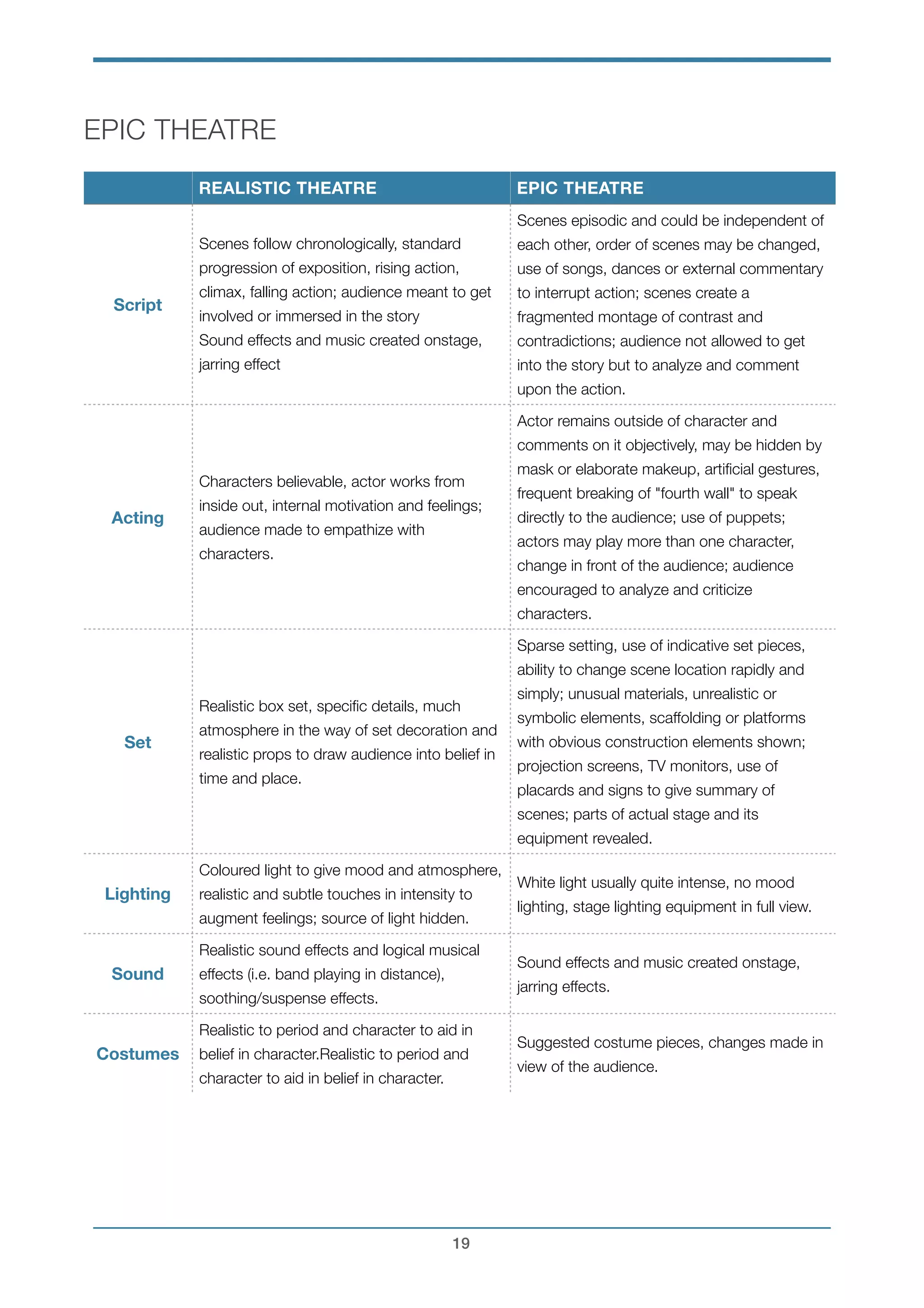
EPIC THEATRE
!
!!!
REALISTIC THEATRE EPIC THEATRE
Script
Scenes follow chronologically, standard
progression of exposition, rising action,
climax, falling action; audience meant to get
involved or immersed in the story
Sound effects and music created onstage,
jarring effect
Scenes episodic and could be independent of
each other, order of scenes may be changed,
use of songs, dances or external commentary
to interrupt action; scenes create a
fragmented montage of contrast and
contradictions; audience not allowed to get
into the story but to analyze and comment
upon the action.
Acting
Characters believable, actor works from
inside out, internal motivation and feelings;
audience made to empathize with
characters.
Actor remains outside of character and
comments on it objectively, may be hidden by
mask or elaborate makeup, artificial gestures,
frequent breaking of "fourth wall" to speak
directly to the audience; use of puppets;
actors may play more than one character,
change in front of the audience; audience
encouraged to analyze and criticize
characters.
Set
Realistic box set, specific details, much
atmosphere in the way of set decoration and
realistic props to draw audience into belief in
time and place.
Sparse setting, use of indicative set pieces,
ability to change scene location rapidly and
simply; unusual materials, unrealistic or
symbolic elements, scaffolding or platforms
with obvious construction elements shown;
projection screens, TV monitors, use of
placards and signs to give summary of
scenes; parts of actual stage and its
equipment revealed.
Lighting
Coloured light to give mood and atmosphere,
realistic and subtle touches in intensity to
augment feelings; source of light hidden.
White light usually quite intense, no mood
lighting, stage lighting equipment in full view.
Sound
Realistic sound effects and logical musical
effects (i.e. band playing in distance),
soothing/suspense effects.
Sound effects and music created onstage,
jarring effects.
Costumes
Realistic to period and character to aid in
belief in character.Realistic to period and
character to aid in belief in character.
Suggested costume pieces, changes made in
view of the audience.
!19
Brecht had a strong reaction to the generally apolitical nature of the theatre around which he grew up,
particularly the realistic drama of Konstantin Stanislavski. Both Brecht and Stanislavski were reacting to the
shallow spectacle, manipulative plots and exaggerated emotions of the 19th century's melodramas. The two
theatre practitioners, however, went in opposite directions. When Brecht began working as a writer and a
director, the Second World War was a large threat, and he believed that theatre should engage more directly
with the political climate of its day. Whereas Stanislavski hoped to so immerse the audience in the world of
his plays that they too experienced what the characters experienced, Brecht took a didactic approach hoping to
jar his audience into learning his message.
!
"Epic Theatre" was Brecht's term for the form of theatre he hoped would achieve this goal. Its basic
aim was to educate its audience by forcing them to view the action of the play critically, from a detached,
"alienated", point of view, rather than allowing them to become emotionally involved. The famous "willing
suspension of disbelief", where the audience switched off its critical faculties in order to believe in the world
of the play, was the polar opposite to Brecht's epic theatre. Whereas realistic theatre or a "good movie" make
us forget we are in a theatre, Brecht reminds his audience constantly that what is before them is artificial and
presentational. Brecht in his book Brecht on Theatre says: "It is most important that one of the main features
of the ordinary theatre should be excluded from [epic theatre]: the engendering of illusion."
!
Brecht saw Stanislavski's method of absorbing the audience completely into the fiction of the play as
escapism. Brecht's social and political focus departed also from other theatre movements of the early 20th
century such as surrealism and the Theatre of Cruelty as developed in the writings and dramaturgy of Antonin
Artaud, who sought to affect audiences psychologically, physically, and irrationally. Epic theatre also differed
from Theatre of the Absurd, whose principal exponents were Beckett, Ionesco and Genet. These authors did
not set out to present a thesis or tell a story but to present images of a disintegrating world that has lost its
meaning or purpose. They place audiences in a dramatic situation in which man's fears, shames, obsessions,
and hopes are acted out in an atmosphere like a dream, carnival or altered mental state.
!
Brecht rejected the standard Aristotelian dramatic construction for a play and its adherence to the plot
pyramid - exposition, rising action, climax, falling action, resolution - for one in which each element or scene
of the play could be considered independent of the rest, much like a music hall act which can stand on its own.
His plays would not be considered comedies or tragedies but dialectical comments on society.
!
Brecht devised an acting technique for his epic theatre which he called gestus involving physical
gestures or attitudes. The physicality shown to the audience reveals the intent or the personality of the
character. Another activity suggested by Brecht to his actors was that at an early rehearsal the actor should:
first, change the dialogue from first to third person; second, change the dialogue from present to past tense;
and third, read all stage directions aloud. In later rehearsals, the actor should keep these feelings of
!20
detachment as he or she begins to use the lines as written in the script. Brecht wanted the actor to observe the
character, demonstrate the character's actions, but not identify with the role.
!
ALIENATION EFFECT
!
Bertolt Brecht, German leftist playwright and director, had nothing but disdain for the conventional,
commercial “bourgeois” theater of his time. He considered it a “branch of the narcotics business.” Why? The
theater of his time, like most Hollywood movies now, relied on emotional manipulation to bring about a
suspension of disbelief for the audience, along with an emotional identification with the main character.
Audience members were taken on an uncritical emotional roller coaster ride, crying when the main character
cried, laughing when s/he laughed — identifying with him/her even when the character had nothing in
common with them or their interests (working-class audiences swooningly identifying with a Prince of
Denmark, for example).
!
Brecht saw that these audiences were manipulated by theater technology — beautiful, realistic sets,
cleverly naturalistic lighting, the imaginary fourth wall, and most importantly, emotionally effusive acting
techniques. He soon watched with horror as the Nazi movement gained popular support in his country with its
racist, xenophobic demagoguery, relying on similar emotional manipulation. Emotional manipulation was, to
him, Enemy Number One of human decency.
!
It was in this context that Brecht developed his theory of Verfremdungseffekt, also known as V-effekt,
alienation effect, or distantiation effect. (Important disclaimer: there is compelling evidence that many of
Brecht’s greatest ideas were developed in uncredited cooperation with his artistic partners).
!
The alienation effect attempts to combat emotional manipulation in the theater, replacing it with an
entertaining or surprising jolt. For instance, rather than investing in or “becoming” their characters, they might
emotionally step away and demonstrate them with cool, witty, and skillful self-critique. The director could
“break the fourth wall” and expose the technology of the theater to the audience in amusing ways. Or a
technique known as the social gest could be used to expose unjust social power relationships so the audience
sees these relationships in a new way. The social gest is an exaggerated gesture or action that is not to be taken
literally but which critically demonstrates a social relationship or power imbalance. For example, workers in a
corporate office may suddenly and quickly drop to the floor and kowtow to the CEO, or the women in a
household may suddenly start to move in fast-motion, cleaning the house, while the men slowly yawn and loaf
around.
!
By showing the instruments of theater and how they can be manipulative — for example, the actor
calling out “Cue the angry red spotlight!” before he shrieks with rage, or “Time for the gleeful violin” before
!21
dancing happily as the violinist joins him on stage, or visibly dabbing water on his eyes when he is supposed
to cry . . . the audience can be entertained without being manipulated. Many of Brecht’s techniques have been
co-opted and incorporated into contemporary bourgeois theater and film, though his challenge remains
relevant: how to confront the problem of emotional manipulation while creating a stimulating, surprising,
entertaining, radically critical, popularly appealing and accessible social art practice. (L.M. Bogad, Beautiful
Trouble Website)
!
!
BRECHT AS A REVOLUTIONIST IN STAGE TECHNIQUE
!
Gestus
An acting technique developed by the German theatre practitioner Bertolt Brecht. It carries the sense
of a combination of physical gesture and "gist" or attitude. It is a means by which "an attitude or single aspect
of an attitude" is revealed, insofar as it is "expressible in words or actions.” This is Brecht’s term for that
which expresses basic human attitudes – not merely “gesture” but all signs of social relations: department,
intonation, facial expression. The Stanislavskian actor is to work at identifying with the character he or she
portrays. The Brechtian actor is to work at expressing social attitudes in clear and stylized ways. So, when
Shen-Te becomes Shui-Ta, she moves in a different manner. Brecht wished to embody the “Gestus” in the
dialogue – as if to compel the right stance, movement and intonation. By subtle use of rhythm pause,
parallelism and counterpointing, Brecht creates a “gestic” language. The songs are yet more clearly “gestic”.
As street singers make clear their attitudes with overt, grand but simple gestures, so, in delivering songs, the
Brechtian actor aims to produce clarity in expressing a basic attitude, such as despair, defiance or submission.
!
Instead of the seamless continuity of the naturalistic theatre, the illusion of natural disorder, Brecht
wishes to break up the story into distinct episodes, each of which presents, in a clear and ordered manner, a
central basic action. All that appears in the scene is designed to show the significance of the basic “Gestus”.
We see how this works in Mother Courage. Each scene is prefaced by a caption telling the audience what is to
be the important event, in such a way as to suggest the proper attitude for the audience to adopt to it.
!
Spass
“Fun” / Satire…Grotesque Stereotypes. The audience is being invited to laugh at these characters and
ultimately condemn what they stand for. Two Acting Styles co-existing: grotesque contrasted with
Sympathetic down-to-earth characters (both are making political statements to the audience and one shows up
the other)
!
!22
Montage
Montage is a technique Brecht used in which a series of short shots is edited into a sequence to condense
space, time, and information
!
BRECHT’S POLITICAL THEATRE
!
Brecht's choice of setting his anti-war play in the midst of the Thirty Years' War was made for several
reasons. Firstly, the monumental destruction and loss of life was inflicted mostly on the poor civilian
populations of Europe. His point was that the little man is the one to lose in wartime; rulers and big business
will always win. He hoped that the lesson of the folly of war would be learned by the masses which had
everything to lose. Secondly, by placing the drama in a distant time (300 years earlier) people would have
fewer tendencies to relate emotionally to it and be more likely to listen objectively to the message. Germany,
however, was the setting in which he wrote, and Germany in 1938 was heading inexorably toward war under
the leadership of the Nazi party - a war which was to surpass the misery of the Thirty Years War.
!
World War II was a global conflict which involved a majority of the world's nations, including all
great powers, organized into two opposing military alliances: the Allies and the Axis. The war involved the
mobilization of over 100 million military personnel, making it the most widespread war in history. In a state
of "total war," the major participants placed their entire economic, industrial, and scientific capabilities at the
service of the war effort, erasing the distinction between civilian and military resources. Over 70 million
people, the majority civilians, were killed, making it the deadliest conflict in human history.
!
The war began on September 1,1939, with the German invasion of Poland and the subsequent
declarations of war on Germany by Britain, Canada, most of the countries in the British Commonwealth and
France. This was followed by the invasion of Poland from the east side by the Soviet Union to halt the
advance of the Germans. Hitler had already allied himself with the Fascist regime in Italy and with Japan. A
number of other countries were already at war with each other, such as Ethiopia and Italy and Japan and
China. Other countries were drawn into the war by the Japanese invasion of British colonies and attack on the
US naval base in Pearl Harbour.
!
The war ended in 1945 with a victory for the Allies. The Soviet Union and the United States emerged
as superpowers, setting the stage for the Cold War which lasted for the next 46 years. The United Nations was
formed in the hope of preventing another global conflict. Decolonization movements began in Asia and Africa
as a result of the more popular concept of national self-determination. Western Europe began moving toward
integration, a movement accelerated by the disintegration of the USSR in 1991.
!
!23
Recent Wars include the Civil War in Lebanon, the Israeli wars with the surrounding Arab states, the
Shia-Sunni dispute, the Iraq-Turkey-Kurd dispute, the Iran-lraq War, the US and USSR's involvement in Iraq
and Afghanistan. Some have compared the Thirty Years' War with the situation in the Middle East today
which likewise has its religious roots and old animosities, and in which the control of great natural resources
and the balance of power are at stake.
!
!24
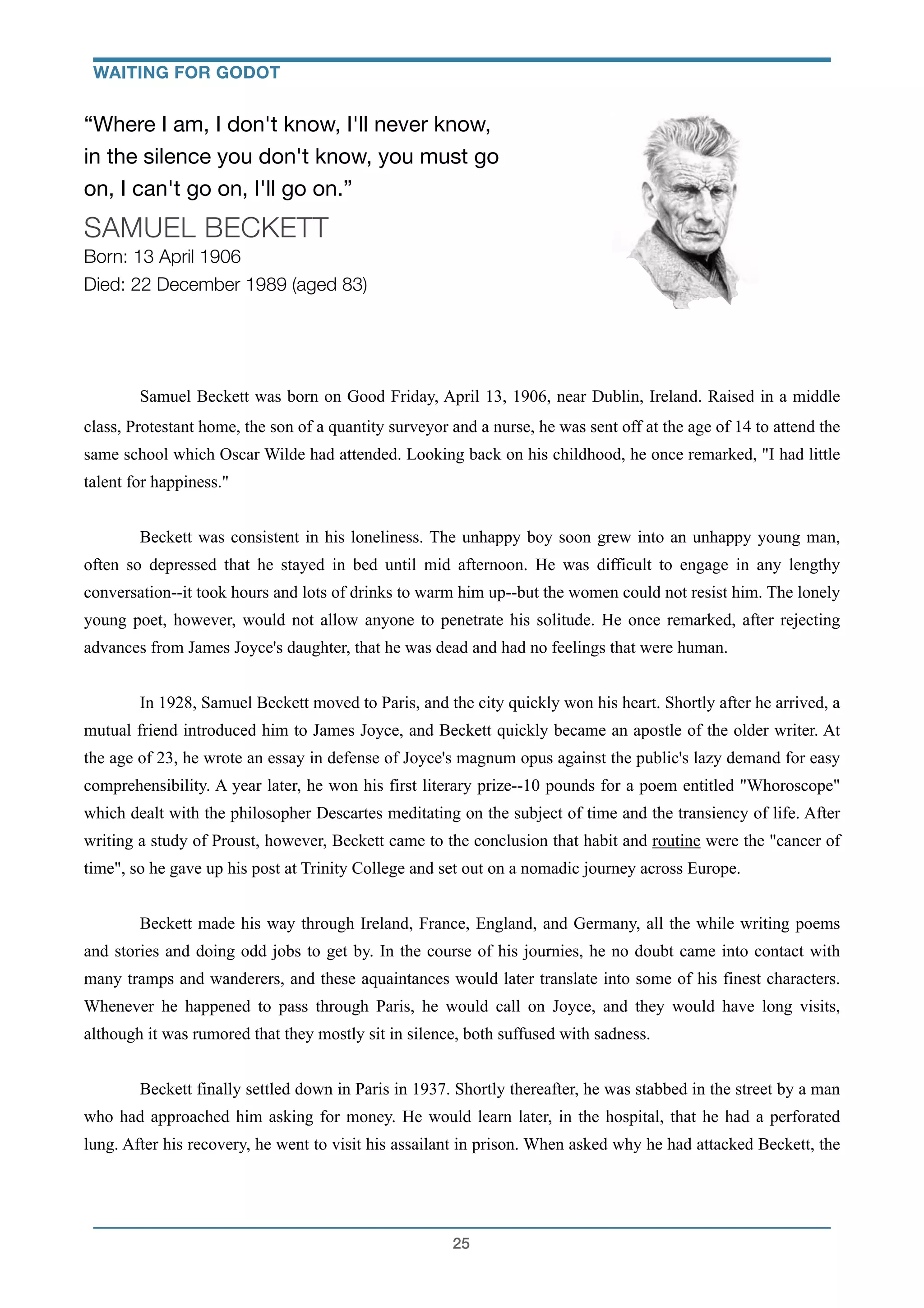
“Where I am, I don't know, I'll never know,

in the silence you don't know, you must go

on, I can't go on, I'll go on.”

SAMUEL BECKETT
Born: 13 April 1906
Died: 22 December 1989 (aged 83)
!
!
!
Samuel Beckett was born on Good Friday, April 13, 1906, near Dublin, Ireland. Raised in a middle
class, Protestant home, the son of a quantity surveyor and a nurse, he was sent off at the age of 14 to attend the
same school which Oscar Wilde had attended. Looking back on his childhood, he once remarked, "I had little
talent for happiness."
!
Beckett was consistent in his loneliness. The unhappy boy soon grew into an unhappy young man,
often so depressed that he stayed in bed until mid afternoon. He was difficult to engage in any lengthy
conversation--it took hours and lots of drinks to warm him up--but the women could not resist him. The lonely
young poet, however, would not allow anyone to penetrate his solitude. He once remarked, after rejecting
advances from James Joyce's daughter, that he was dead and had no feelings that were human.
!
In 1928, Samuel Beckett moved to Paris, and the city quickly won his heart. Shortly after he arrived, a
mutual friend introduced him to James Joyce, and Beckett quickly became an apostle of the older writer. At
the age of 23, he wrote an essay in defense of Joyce's magnum opus against the public's lazy demand for easy
comprehensibility. A year later, he won his first literary prize--10 pounds for a poem entitled "Whoroscope"
which dealt with the philosopher Descartes meditating on the subject of time and the transiency of life. After
writing a study of Proust, however, Beckett came to the conclusion that habit and routine were the "cancer of
time", so he gave up his post at Trinity College and set out on a nomadic journey across Europe.
!
Beckett made his way through Ireland, France, England, and Germany, all the while writing poems
and stories and doing odd jobs to get by. In the course of his journies, he no doubt came into contact with
many tramps and wanderers, and these aquaintances would later translate into some of his finest characters.
Whenever he happened to pass through Paris, he would call on Joyce, and they would have long visits,
although it was rumored that they mostly sit in silence, both suffused with sadness.
!
Beckett finally settled down in Paris in 1937. Shortly thereafter, he was stabbed in the street by a man
who had approached him asking for money. He would learn later, in the hospital, that he had a perforated
lung. After his recovery, he went to visit his assailant in prison. When asked why he had attacked Beckett, the
!25
WAITING FOR GODOT
prisoner replied "Je ne sais pas, Monsieur", a phrase hauntingly reminiscent of some of the lost and confused
souls that would populate the writer's later works.
!
During World War II, Beckett stayed in Paris even after it had become occupied by the Germans. He
joined the underground movement and fought for the resistance until 1942 when several members of his group
were arrested and he was forced to flee with his French-born wife to the unoccupied zone. In 1945, after it had
been liberated from the Germans, he returned to Paris and began his most prolific period as a writer. In the
five years that followed, he wrote Eleutheria, Waiting for Godot, Endgame, the novels Malloy, Malone Dies,
The Unnamable, and Mercier et Camier, two books of short stories, and a book of criticism.
!
Beckett secured his position as a master dramatist on April 3, 1957 when his second masterpiece,
Endgame, premiered (in French) at the Royal Court Theatre in London. Although English was his native
language, all of Beckett's major works were originally written in French--a curious phenomenon since
Beckett's mother tongue was the accepted international language of the twentieth century. Apparently,
however, he wanted the discipline and economy of expression that an acquired language would force upon on
him.
!
Beckett's dramatic works do not rely on the traditional elements of drama. He trades in plot,
characterization, and final solution, which had hitherto been the hallmarks of drama, for a series of concrete
stage images. Language is useless, for he creates a mythical universe peopled by lonely creatures who struggle
vainly to express the unexpressable. His characters exist in a terrible dreamlike vacuum, overcome by an
overwhelming sense of bewilderment and grief, grotesquely attempting some form of communication, then
crawling on, endlessly.
!
Beckett was the first of the absurdists to win international fame. His works have been translated into
over twenty languages. In 1969 he was awarded the Nobel Prize for Literature. He continued to write until his
death in 1989, but the task grew more and more difficult with each work until, in the end, he said that each
word seemed to him "an unnecessary stain on silence and nothingness.” (Imagi-nation website)
!
THE CONTEXT OF THE PLAY
!
“Do not despair; one of the thieves was saved. 

Do not presume; one of the thieves was damned.”

!
Beckett’s play captures the uncertainty of the post World War II/ Cold War era; this uncertainty is
explained through the philosophical questioning and ambiguous dialogue between Beckett’s characters.
Through their conversation, they capture societal anxiety of Beckett’s context. Paradigms of the period were
!26
no longer considered to be true, there was reconsideration, particularly of philosophical, and religious ideals.
The foundations of society had shifted and artists and playwrights explored profound ideological conflict in
their responses. Post World War II society was new, the world had changed, and could never be the same
again after the millions of deaths and the dropping of the bomb.
!
Waiting for Godot, questions and confronts its contextual paradigms, incorporating both existentialism
and nihilism. There was an upheaval of the foundations of religion due to the aftermath of World War II. The
existentialist idea of waiting for God, and yet God never comes, was very controversial and confronting for
the audience of the time. When the play was first performed in 1955, audience members were recorded
walking out of the theatre because of the absurdity and confronting nature of the play. Philosophical questions
about existence are raised, discussed, and then juxtaposed with a sight gag, vaudeville humor, or the mundane,
such as the fussing over the boots and bowler hats. The satiric humor undertaken by the characters subverts
what should be tragically nihilistic, into a blackly comedic romp, enjoyable for the audience, and creating
relief from the perpetual philosophical questions. Beckett himself stated 'If I could have expressed the subject
of my work in philosophical terms, I wouldn’t have had any reason to write it.' This outlines how
philosophically important the play was at the time of its release. During to the context of the play, the
1940-50s, existentialist thinking was persuasive, a work about the individual’s quest for purpose included
current controversies about the questioning of existence and religion. Past atrocities such as the holocaust, and
the atomic attacks on Japan caused a change in people’s thinking, religion was indeed questioned and
existentialism was starting to be popularly embraced, for what kind of God could allow the horrors of war
which are still affecting the current generation? This uncertainty, cultural ruin and the physical devastation of
post World War Europe and its accompanying disappointment and angst is captured by Beckett through both
the post apocalyptic setting of the play and the issues explored through his construction of character.
!
“[Waiting for Godot] will make it easier for me and everyone else to write freely
in the theatre.”
William Saroyan
By challenging religious and philosophical paradigms through the dialogue of his characters, Beckett
questions the humanity and beliefs typical of his context. As 'nothing happens, twice', the audience is being
presented with the idea of 'nothing to be done'. Mistakes and major events are repeated by the characters
representing all of humanity. Life and time, World War grief, Cold war uncertainty and the pointlessness of
religion, is being mirrored by Waiting for Godot through Beckett's use of the repetitive structure of absurd
theatre. The philosophical, questioning dialogue of Beckett's characters captures the challenging of prevailing
paradigms and the personal ramifications of the political and philosophical shifts in thinking of the era.
(Monotony Strange, Waiting For Godot, how it mirrors cold war anxiety)
!
!27
CHARACTER ANALYSIS
!
Vladimir
In any comic or burlesque act, there are two characters, traditionally known as the "straight man" and
the "fall guy." Vladimir would be the equivalent of the straight man. He is also the intellectual who is
concerned with a variety of ideas. Of the two, Vladimir makes the decisions and remembers significant
aspects of their past. He is the one who constantly reminds Estragon that they must wait for Godot. Even
though it is left indefinite, all implications suggest that Vladimir knows more about Godot than does Estragon,
who tells us that he has never even seen Godot and thus has no idea what Godot looks like.
!
Vladimir is the one who often sees religious or philosophical implications in their discussions of
events, and he interprets their actions in religious terms; for example, he is concerned about the religious
implications in such stories as the two thieves (two tramps) who were crucified on either side of Jesus. He is
troubled about the fate of the thief who wasn't saved and is concerned that "only one of the four evangelists"
speaks of a thief being saved.
!
Vladimir correlates some of their actions to the general concerns of mankind. In Act II, when Pozzo
and Lucky fall down and cry for help, Vladimir interprets their cries for help as his and Estragon's chance to
be in a unique position of' helping humanity. After all, Vladimir maintains, "It is not everyday that we are
needed . . . but at this place, at this moment in time," they are needed and should respond to the cries for help.
Similarly, it is Vladimir who questions Pozzo and Lucky and the Boy Messenger(s), while Estragon remains,
for the most part, the silent listener. Essentially, Vladimir must constantly remind Estragon of their destiny —
that is, they must wait for Godot.
!
In addition to the larger needs, Vladimir also looks after their physical needs. He helps Estragon with
his boots, and, moreover, had he been with Estragon at night, he would not have allowed his friend to be
beaten; also, he looks after and rations their meager meals of turnips, carrots, and radishes, and, in general, he
tends to be the manager of the two.
!
Estragon
In contrast, Estragon is concerned mainly with more mundane matters: He prefers a carrot to a radish
or turnip, his feet hurt, and he blames his boots; he constantly wants to leave, and it must be drilled into him
that he must wait for Godot. He remembers that he was beaten, but he sees no philosophical significance in
the beating. He is willing to beg for money from a stranger (Pozzo), and he eats Pozzo's discarded chicken
bones with no shame.
!
!28
Estragon, then, is the more basic of the two. He is not concerned with either religious or philosophical
matters. First of all, he has never even heard of the two thieves who were crucified with Christ, and if the
Gospels do disagree, then "that's all there is to it," and any further discussion is futile and absurd.
!
Estragon's basic nature is illustrated in Act II when he shows so little interest in Pozzo and Lucky that
he falls asleep; also, he sleeps through the entire scene between Vladimir and the Boy Messenger. He is
simply not concerned with such issues.
!
Estragon, however, is dependent upon Vladimir, and essentially he performs what Vladimir tells him
to do. For example, Vladimir looks after Estragon's boots, he rations out the carrots, turnips, and radishes, he
comforts Estragon's pain, and he reminds Estragon of their need to wait for Godot. Estragon does sometimes
suggest that it would be better if they parted, but he never leaves Vladimir for long. Essentially, Estragon is
the less intelligent one; he has to have everything explained to him, and he is essentially so bewildered by life
that he has to have someone to look after him.
!
Vladimir and Estragon
In spite of the existential concept that man cannot take the essence of his existence from someone
else, in viewing this play, we have to view Vladimir and Estragon in their relationship to each other. In fact,
the novice viewing this play for the first time often fails to note any significant difference between the two
characters. In hearing the play read, even the most experienced theater person will often confuse one of the
characters for the other. Therefore, the similarities are as important as the differences between them.
!
Both are tramps dressed in costumes which could be interchanged. They both wear big boots which
don't necessarily fit, and both have big bowler hats. Their suits are baggy and ill-fitting. (In Act II, when
Estragon removes the cord he uses for a belt, his trousers are so baggy that they fall about his feet.) Their
costumes recall the type found in burlesque or vaudeville houses, the type often associated with the character
of the "Little Tramp," portrayed by Charlie Chaplin.
!
The Chaplinesque-type costume prepares us for many of the comic routines that Vladimir and
Estragon perform. The opening scene with Estragon struggling with his boots and Vladimir doffing and
donning his hat to inspect it for lice could be a part of a burlesque routine. The resemblance of their costumes
to Chaplin's supports the view that these tramps are outcasts from society, but have the same plucky defiance
to continue to exist as Chaplin's "Little Tramp" did.
!
Another action which could come directly from the burlesque theater occurs when Vladimir finds a
hat on the ground which he tries on, giving his own to Estragon, who tries it on while giving his hat to
Vladimir, who tries it on while giving the new-found hat to Estragon, who tries it on, etc. This comic episode
!29
continues until the characters — and the audience — are bored with it. Other burlesque-like scenes involve
Vladimir's struggles to help Estragon with his boots while Estragon is hopping awkwardly about the stage on
one foot to keep from falling; another scene involves the loss of Estragon's pants, while other scenes involve
the two tramps' grotesque efforts to help Pozzo and Lucky get up off the ground and their inept attempts to
hang themselves. Thus, the two characters are tied together partly by being two parts of a burlesque act.
!
Pozzo
Pozzo appears on stage after the appearance of Lucky. They are tied together by a long rope; thus,
their destinies are fixed together in the same way that Pozzo might be a mother figure, with the rope being the
umbilical cord which ties the two together.
!
Everything about Pozzo resembles our image of the circus ringmaster. If the ringmaster is the chief
person of the circus, then it is no wonder that Vladimir and Estragon first mistook him for Godot or God. Like
a ringmaster, he arrives brandishing a whip, which is the trademark of the professional. In fact, we hear the
cracking of Pozzo's whip before we actually see him. Also, a stool is often associated with an animal trainer,
and Pozzo constantly calls Lucky by animal terms or names. Basically, Pozzo commands and Lucky obeys.
!
In the first act, Pozzo is immediately seen in terms of this authoritarian figure. He lords over the
others, and he is decisive, powerful, and confident. He gives the illusion that he knows exactly where he is
going and exactly how to get there. He seems "on top" of every situation.
!
When he arrives on the scene and sees Vladimir and Estragon, he recognizes them as human, but as
inferior beings; then he condescendingly acknowledges that there is a human likeness, even though the
"likeness is an imperfect one." This image reinforces his authoritarian god-like stance: we are made in God's
image but imperfectly so. Pozzo's superiority is also seen in the manner in which he eats the chicken, then
casts the bones to Lucky with an air of complete omnipotence.
!
In contrast to the towering presence exhibited by Pozzo in Act I, a significant change occurs between
the two acts. The rope is shortened, drawing Pozzo much closer to his antithesis, Lucky. Pozzo is now blind;
he cannot find his way alone. He stumbles and falls. He cannot get along without help; he is pathetic. He can
no longer command. Rather than driving Lucky as he did earlier, he is now pathetically dragged along by
Lucky. From a position of omnipotence and strength and confidence, he has fallen and has become the
complete fallen man who maintains that time is irrelevant and that man's existence is meaningless. Unlike the
great blind prophets of' yore who could see everything, for Pozzo "the things of time are hidden from the
blind." Ultimately, for Pozzo, man's existence is discomforting and futile, depressing, and gloomy and, most
of all, brief and to no purpose. The gravedigger is the midwife of mankind: "They give birth astride the grave,
the light gleams an instant, then it's night once more.”
!30
!
Lucky
As noted above, Lucky is the obvious antithesis of Pozzo. At one point, Pozzo maintains that Lucky's
entire existence is based upon pleasing him; that is, Lucky's enslavement is his meaning, and if he is ever
freed, his life would cease to have any significance. Given Lucky's state of existence, his very name "Lucky"
is ironic, especially since Vladimir observes that even "old dogs have more dignity."
!
All of Lucky's actions seem unpredictable. In Act I, when Estragon attempts to help him, Lucky
becomes violent and kicks him on the leg. When he is later expected to dance, his movements are as
ungraceful and alien to the concept of dance as one can possibly conceive. We have seldom encountered such
ignorance; consequently, when he is expected to give a coherent speech, we are still surprised by his almost
total incoherence. Lucky seems to be more animal than human, and his very existence in the drama is a
parody of human existence. In Act II, when he arrives completely dumb, it is only a fitting extension of his
condition in Act I, where his speech was virtually incomprehensible. Now he makes no attempt to utter any
sound at all. Whatever part of man that Lucky represents, we can make the general observation that he, as
man, is reduced to leading the blind, not by intellect, but by blind instinct.
!
Pozzo and Lucky
Together they represent the antithesis of each other. Yet they are strongly and irrevocably tied together
— both physically and metaphysically. Any number of polarities could be used to apply to them. If Pozzo is
the master (and father figure), then Lucky is the slave (or child). If Pozzo is the circus ringmaster, then Lucky
is the trained or performing animal. If Pozzo is the sadist, Lucky is the masochist. Or Pozzo can be seen as the
Ego and Lucky as the Id. An inexhaustible number of polarities can be suggested. (Cliffsnotes website)
!
Godot
!
[Another] story has Beckett rejecting the advances of a prostitute on the rue Godot de Mauroy only to
have the prostitute ask if he was saving himself for Godot. Beckett’s longtime friend and English publisher
John Calder summarises Beckett’s position on the play thus: "He wanted any number of stories circulated, the
more there are, the better he likes it.” (S E Gontarski "Dealing with a Given Space”)
!
Without either accepting or rejecting the widespread view that Waiting for Godot is a religious
allegory, let us consider what problems confront a dramatist who wishes to write a play about waiting—a play
which virtually nothing is to happen and yet the audience are to be cajoled into themselves waiting to the
bittersweet end. Obviously those who wait on stage must wait for something that they and the audience
consider extremely important.
!31
!
We are explicitly told that when Godot arrives, so Vladimir and Estragon believe, they will be
"saved". An audience possessing even a tenuous acquaintance with Christianity need no further hint: an
analogy , they deduce, is being drawn with Christ’s Second Coming . They do not have to identify Godot with
God; they do, however, need to see the analogy if the play is not to seem hopelessly trivial. In secular terms,
salvation can mean the coming of the classless society, that of the Thousand-Year Reich, or any other
millennial solution. Ultimately, though, the concept of the Millennium is itself religious in origin, being
present in the Old Testament as well as the New; a Jewish audience would remember that they are still
awaiting the Messiah.
!
In other words, a play like Waiting for Godot could hardly "work" artistically if it did not invoke the
Judaeo-Christian Messianic tradition and its political derivatives (Having grown up in Ireland at the time of
the struggle for independence, Beckett was doubtless aware of the millennial salvationist hope implicit in all
nationalist as well as socialist movements.) It is a measure of Beckett’s art that he invokes this tradition (this
stereotype, almost) stealthily rather than blatantly.
!
Any critic who accepts the religious analogy sees the boy messenger as equivalent to an angel
("angel" is in any case derived from the Greek word for "Messenger"), but Pozzo seems to be a stumbling-
block for most of them. He need not be: although Pozzo denies that he is Godot, he tells Vladimir and
Estragon that they are "on my land". Other hints suggest that he may be the very person they are waiting for,
but, like the Jews confronted with Jesus, they are expecting someone so different that they fail to recognise
him. On the other hand, one must admit that Pozzo’s treatment of Lucky in Act I resembles the behaviour of
the God of the Old Testament ; it is in Act II that Pozzo himself begins to seem a victim, "a man of sorrows
and acquainted with grief." There are moments in the Old Testament when the Jews—or some of them—failed
to recognise their God, so we could perhaps argue that Act I represents the Old Testament and Act II the New.
But if Vladimir and Estragon represent Christianity rather than Judaism, there are several texts in the New
Testament which warn that the Second Coming of Christ will resemble in its stealth that of "a thief in the
night” (Beckett/Beckett By: Vivian Mercier 1919-1989)
The two thieves are Didi and Gogo; the two thieves are Pozzo and Lucky; the two thieves are you and
me. And the play is shaped to reflect that fearful symmetry. (Back to Beckett by: Ruby Cohn)
!
Carnevale Annunciation At the end of Act I, when the boy arrives to say that Mr Godot " won’t come
this evening but surely tomorrow " and Vladimir proceeds to question him about his "credentials", the boy
reveals that he minds the goats and his brother minds the sheep. Placing these two words together is enough to
suggest one of Jesus’s best-known parables, frequently used in art and sermon, the parable of the sheep and
the goats:
!
!32
When the Son of man shall come in his glory, and all the holy angels with him, then shall he sit upon
the throne of his glory: And before him shall be gathered all nations; and he shall separate them one
from another, as a shepherd divideth his sheep from the goats: And he shall set the sheep on his right
hand, but the goats on the left. Then shall the King say unto them on his right hand, Come, ye
blessed of my Father, inherit the kingdom prepared for you from the foundation of the world. . . .
Then shall he say also unto them on the left hand, Depart from me, ye cursed, into everlasting fire,
prepared for the devil and his angels. . . . And these shall go away into everlasting punishment: but
the righteous into life eternal. (Matthew 25:31-46)
This parable is, of course, a narrative about salvation and damnation; the sheep are the saved, the goats the
damned. It is significant that the messenger who attends Vladimir and Estragon is the goatherd. Previous
ironies about the nature of the God parodied in this play are intensified by his perverse beating of the boy who
tends the sheep, not the one who tends the goats (the damned are damned and the saved get beaten). Act II
ends after the appearance of a similar messenger (apparently not the same one, but not necessarily his
shepherd brother either). This boy, in response to questions, provides the information that Godot has a white
beard, frightening Vladimir into pleas for mercy and expectations of punishment. (Biblical Allusions in
Waiting for Godot by Kristin Morrison)
!
From all this we may gather the Godot has several traits in common with the image of God as we
know it from the Old and New Testament. . . . The discrimination between goatherd [Satanic] and shepherd
[priestly—agnus dei] is reminiscent of the Son of God as the ultimate judge [judicare vivos et mortuos] . . .
while his doing nothing might be an equally cynical reflection concerning man’s forlorn state. This feature,
together with Beckett’s statement about something being believed to be " in store for us, not in store in us ,"
seems to show clearly that Beckett points to the sterility of a consciousness that expects and waits for the old
activity of God or gods.
!
Whereas Matthew (25,33) says: "And he shall seat the sheep on his right hand, but the goats on the
left" in the play it is the shepherd who is beaten and the goatherd who is favoured. What Vladimir and
Estragon expect from Godot is food and shelter, and goats are motherly, milk-providing animals. In antiquity,
even the male goats among the deities , like Pan and Dionysos, have their origin in the cult of the great mother
and the matriarchal mysteries , later to become devils.
!
Today religion altogether is based on indistinct desires in which spiritual and material needs remain
mixed. Godot is explicitly vague, merely an empty promise, corresponding to the lukewarm piety and absence
of suffering in the tramps. Waiting for him has become a habit which Beckett calls a "guarantee of dull
inviolability", an adaptation to the meaningless of life. " The periods of transition ," he continued, "that
separate consecutive adaptations . . . represent the perilous zones in the life of the individual, dangerous,
precarious, mysterious and fertile, when for a moment the boredom of living is replaced by the suffering of
being. (Reflections on Samuel Beckett's Plays by Eva Metman)
!33
!
The question of Godot’s identity does more than tantalise spectators of Beckett’s play: it is a paradigm
of textual tantalisation itself. Its answer appears to lie outside the play, encouraging criticism to return to that
realm it once called home: the author’s intentions. However, this ancient ground of textual meaning now
seems abandoned, most explicitly in Beckett’s work, where its vacancy is announced, paradoxically, in the
form of a text strongly marked with intentionality: the direct nonfictional statement of authorial intent. I am
referring, of course, to Beckett’s notorious riposte to the question of Godot’s identity. "If I knew," Beckett
said, "I would have said so in the play."
!
If indeed Beckett is not deliberately withholding the identity of Godot but really does not know it (a
supposition implying that there is something to be known), then he is displacing the traditional notion of
textual meaningfulness . . . For if we take Beckett’s remark at face value, we are confronted with the
incredible spectacle of a work of art based on expressive deficiency, a work of art that lacks the one necessary
condition of art: mastery. It is surely significant that critics have generally been unable to accept this feature in
Beckett’s work and have preferred to characterise Godot’s nonarrival as an effect of Beckett’s authorial power
rather than of the impotence and ignorance he himself insists on.
!
Origin is gone, nonexistent. For, on closer inspection, the original audience we have posited is not the
integrated, stable starting point of a process that will continue beyond its encounter with the play: rather, it is
an audience already in process, divided against itself. The play’s repetitious structure is such that it reverses
the usual rôle-playing of audiences: instead of requiring later audiences to play the rôle of a first audience,
Godot requires its first audience to play the rôle of a subsequent audience.
!
The tree in Godot functions, first, as a link between the Friedrich—Oak Tree in Snow audience and
an organic "other world", a world that includes, among (very few) other things, material nature. . . . the tree is
a relational sign, mediating the relation between the stage and the road in such a way as to render that relation
asymmetrical (the stage may be the road, but not, thanks to the tree, vice versa)
!
As one of the very few signs of the play’s setting system, . . . the tree raises the question of material
realisation, which could be formulated simply as "Should the tree be realistic?" However, the normative cast
of this question is disturbing, implying, as it does, that there is a "right" way to "do the tree". The play itself
indicates otherwise. The episode in which Didi and Gogo attempt to enact the tree is an instructive example of
the dialectic of representation and reference. The episode sets up a relay of signification (actors playing
characters play a stage tree that is playing a real tree) in which what is dramatised is one of the thorniest and
most crucial aspects of dramatic significant: the transformability of signs. . . . Their failure is especially
remarkable in the context of their otherwise ample theatrical skill and resourcefulness, which has led critics to
read them as carriers of the entire tradition of popular entertainment. . . . Not only are the tramps unsure that
this is the "right" tree, they are even uncertain about what kind of tree it is, even whether it is a tree at all.
!34
Paradoxically, this persistent verbal ambiguating of the tree has the effect of asserting its stage its stage
identity, . . . Once so established, . . . the tree functions as a sign of a tree and the question of its materiality
becomes irrelevant. . . . The stage tree refers to a real tree not because it looks like one (though it may) but
because it creates the stage as a road (in a world) and the actors as characters (rather than, as metatheatrical
readings insist, as performers).
!
Thus the function of the tree goes beyond its world-creating capacity. The tree becomes one of the
principal mechanisms of the characters’ self-constitution, the sign of the area within which their existence
might ultimately make sense. It is not so much a question of their "doing" the tree: the tree "does" them. While
the theatrically absent road tends to theatricalise the characters, to unravel their characterological existence by
placing them on a "mere" stage, the tree (despite its impoverished aspect) richly bestows dramatic identity on
the tramps. In this regard, it does not recall the Christian images with which it has been associated as much as
it does the sacred post of the voodoo séance, down which the Mystères descend to earth. Here, it is not
divinity that the tree attracts like a lightning rod but fictionality: another absent world that constitutes the
actors as characters. Within the world thus created, Godot is not merely an absence but a character, however
stubbornly diegetic. His literal absence, colliding with the others’ literal presence, partakes of their
referentiality. The question of his identity, while it can never be answered, cannot be wished away either. (A
Semiotic Approach to Beckett's Play by June Schlueter and Enoch Brater)
!
In ancient Egyptian art, the Tree is depicted as bringing forth the Sun itself. This Cosmic Tree, the
living Source of radiant energy/be-ing, is the deep Background of the christian cross, the dead wood rack to
which a dying body is fastened with nails. As [Helen] Diner succinctly states: "In Christianity, the tree
becomes the torture cross of the world".
!
Thus the Tree of Life became converted into the symbol of the necrophilic S and M Society. This grim
reversal is not peculiar to Christianity. It was a theme of patriarchal myth which made christianity palatable to
an already death-loving society. Thus Odin,worshiped by the Germans, was known as "Hanging God", "the
Dangling One", and "Lord of the Gallows". [Jungian Erich] Neumann remarks that "scarcely any aspect of
their religion so facilitated the conversion of the Germans to Christianity as the apparent similarity of their
hanged god to the crucified Christ." In the cheerful German version, the tree of life, cross and gallows tree are
all forms of the "maternal" tree.
!
The christian culmination of the Tree of Life is analysed by Neumann in the following manner:
!
Christ, hanging from the tree of death, is the fruit of suffering and hence the pledge of the promised
land , the beatitude to come; and at the same time He is the tree of life as the god of the grape. Like
Dionysis, he is endendros, the life at work in the tree, and fulfills the mysterious twofold and
contradictory nature of the tree.
!35
We are told that the Cross is a bed. It is not only Christ's "marriage bed" , but also it is "crib, cradle and nest".
It is the "bed of birth and . . . it is the deathbed”. (Mary Daly, Gyn/Ecology)
[quoting Beckett]:
!
If life and death did not both present themselves to us, there would be no inscrutability. If there were
only darkness, all would be clear. It is because there is not only darkness but also light that our
situation becomes inexplicable. Take Augustine’s doctrine of grace given and grace withheld: have
you pondered the dramatic qualities of this theology? Two thieves are crucified with Christ, one
saved and the other damned. How can we make sense of this division? In classical drama, such
problems do not arise. The destiny of Racine’s Phedre is sealed from the beginning: she will proceed
into the dark. As she goes, she herself will be illuminated. At the beginning of the play she has
partial illumination and at the end she has complete illumination, but there has been no question but
that she moves toward the dark. That is the play. Within this notion clarity is possible, but for us who
are neither Greek nor Jansenist there is not such clarity. The question would also be removed if we
believed in the contrary—total salvation. But where we have both dark and light we have also the
inexplicable. The key word in my plays is "perhaps".
I would gloss his commentary as follows: Vladimir and Estragon stand for the "we", two moderns
befogged in the inexplicable greyness of "perhaps". Pozzo is Phedre: a relic, an anachronism, an erstwhile
truth—but even so the logical historical argument to the contrary. That is, if one were posing a contrast that
would illustrate how far we have come from an accountable universe, it might be the dark world of tragedy
which has, at least, the comfort of being designed and instructive. Pozzo’s destiny, like Phedre’s is sealed from
the beginning; he proceeds into the dark, and though we do not see the scene, we presume that "as he goes" he
is illuminated. I am assuming that what Beckett means by "illumination" is the process by which the tragic
hero is made aware . . . of what the journey into the dark means. In other words, tragedy is "a complex act of
clarification". In Pozzo this act is condensed into one speech in which he stands outside time in a brief space
of temporal integration. What he says is that all crises, from the coming hither to the going hence, take place
in the same second. The light gleams an instant, then it is night once more.
!
Actually, Pozzo might have answered Vladimir’s question (" Since when ?") even more
philosophically by quoting one of Beckett’s favourite secular thinkers: "Our own past," Schopenhauer says,
"even the most recent, even the previous day, is only an empty dream of the imagination. . . . What was?
What is? . . . Future and past are only in the concept. . . . No man has lived in the past, and none will ever live
in the future; the present alone is the form of all life. . . . “ (Bert O States The Shape of Paradox: An Essay on
Waiting for Godot)
(http://www.samuel-beckett.net/Penelope/Godot.html)
!
!
!
!
!36
THEATRE OF THE ABSURD
!
With the appearance of Godot (Waiting for Godot) at the Théâtre de Babylone in Paris in 1953, the
literary world was shocked by the appearance of a drama so different and yet so intriguing that it virtually
created the term "Theater of the Absurd," and the entire group of dramas which developed out of this type of
theater is always associated with the name of Samuel Beckett. His contribution to this particular genre allows
us to refer to him as the grand master, or father, of the genre. While other dramatists have also contributed
significantly to this genre, Beckett remains its single, most towering figure.
!
This movement known as the Theater of the Absurd was not a consciously conceived movement, and
it has never had any clear-cut philosophical doctrines, no organized attempt to win converts, and no meetings.
Each of the main playwrights of the movement seems to have developed independently of' each other. The
playwrights most often associated with the movement are Samuel Beckett, Eugene Ionesco, Jean Genet, and
Arthur Adamov. The early plays of Edward Albee and Harold Pinter fit into this classification, but these
dramatists have also written plays that move far away from the Theater of the Absurd's basic elements.
!
In viewing the plays that comprise this movement, we must forsake the theater of coherently
developed situations, we must forsake characterizations that are rooted in the logic of motivation and reaction,
we must sometimes forget settings that bear an intrinsic, realistic, or obvious relationship to the drama as a
whole, we must forget the use of language as a tool of logical communication, and we must forget cause-and-
effect relationships found in traditional dramas. By their use of a number of puzzling devices, these
playwrights have gradually accustomed audiences to a new kind of relationship between theme and
presentation. In these seemingly queer and fantastic plays, the external world is often depicted as menacing,
devouring, and unknown; the settings and situations often make us vaguely uncomfortable; the world itself
seems incoherent and frightening and strange, but at the same time, it seems hauntingly poetic and familiar.
!
These are some of the reasons which prompt the critic to classify them under the heading "Theater of
the Absurd" — a title which comes not from a dictionary definition of the word "absurd," but rather from
Martin Esslin's book The Theatre of the Absurd, in which he maintains that these dramatists write from a
"sense of metaphysical anguish at the absurdity of the human condition." But other writers such as Kafka,
Camus, and Sartre have also argued from the same philosophical position. The essential difference is that
critics like Camus have presented their arguments in a highly formal discourse with logical and precise views
which prove their theses within the framework of traditional forms. On the contrary, the Theater of the Absurd
seeks to wed form and content into an indissoluble whole in order to gain a further unity of meaning and
impact. This theater, as Esslin has pointed out, "has renounced arguing about the absurdity of the human
condition; it merely presents it in being — that is, in terms of concrete stage images of the absurdity of
existence."
!
!37
Too often, however, the viewer notes only these basic similarities and fails to note the distinctive
differences in each dramatist. Since these writers do not belong to any deliberate or conscious movement, they
should be evaluated for their individual concerns, as well as for their contributions to the total concept of the
Theater of the Absurd. In fact, most of these playwrights consider themselves to be lonely rebels and
outsiders, isolated in their own private worlds. As noted above, there have been no manifestoes, no theses, no
conferences, and no collaborations. Each has developed along his own unique lines; each in his own way is
individually and distinctly different. Therefore, it is important to see how Beckett both belongs to the Theater
of the Absurd and, equally important, how he differs from the other writers associated with this movement.
First, let us note a few of the basic differences.
!
Differences
!
One of Samuel Beckett's main concerns is the polarity of existence. In Waiting for Godot, Endgame,
and Krapp's Last Tape, we have such characteristic polarities as sight versus blindness, life–death, time
present–time past, body–intellect, waiting–not waiting, going–not going, and dozens more. One of Beckett's
main concerns, then, seems to be characterizing man's existence in terms of these polarities. To do this,
Beckett groups his characters in pairs; for example, we have Vladimir and Estragon, or Didi and Gogo, Hamm
and Clov, Pozzo and Lucky, Nagg and Nell, and Krapp's present voice and past voice. Essentially, however,
Beckett's characters remain a puzzle which each individual viewer must solve.
!
In contrast to Beckett, Eugene Ionesco's characters are seen in terms of singularity. Whereas Beckett's
characters stand in pairs outside of society, but converse with each other, Ionesco's characters are placed in the
midst of society — but they stand alone in an alien world with no personal identity and no one with whom
they can communicate. For example, the characters in The Bald Soprano are in society, but they scream
meaningless phrases at each other, and there is no communication. And whereas Beckett's plays take place on
strange and alien landscapes (some of the settings of his plays remind one of a world transformed by some
holocaust or created by some surrealist), Ionesco's plays are set against the most traditional elements in our
society — the standard English drawing room in The Bald Soprano, a typical street scene in Rhinoceros, and
an average academic study in The Lesson, etc.
!
The language of the two playwrights also differs greatly. Beckett's dialogue recalls the disjointed
phantasmagoria of a dream world; Ionesco's language is rooted in the banalities, clichés, and platitudes of
everyday speech; Beckett uses language to show man isolated in the world and unable to communicate
because language is a barrier to communication. Ionesco, on the other hand, uses language to show the failure
of communication because there is nothing to say; in The Bald Soprano, and other plays, the dialogue is filled
with clichés and platitudes.
!
!38
In contrast to the basic sympathy we feel for both Beckett's and Ionesco's characters, Jean Genet's
characters almost revile the audience from the moment that they appear on the stage. His theme is stated more
openly. He is concerned with the hatred which exists in the world. In The Maids, for example, each maid hates
not just her employer and not just her own sister, but also her own self. Therefore, she plays the other roles so
as to exhaust her own hatred of herself against herself. Basically, then, there is a great sense of repugnance in
Genet's characters. This revulsion derives partially from the fact that Genet's dramatic interest, so different
from Beckett's and Ionesco's, is in the psychological exploration of man's predilection to being trapped in his
own egocentric world, rather than facing the realities of existence. Man, for Genet, is trapped by his own
fantastic illusions; man's absurdity results partially from the fact that he prefers his own disjointed images to
those of reality. In Genet's directions for the production of The Blacks, he writes that the play should never be
played before a totally black audience. If there are no white people present, then one of the blacks in the
audience must wear a white mask; if the black refuses, then a white mannequin must be used, and the actors
must play the drama for this mannequin. There must at least be a symbol of a white audience, someone for the
black actors to revile.
!
In contrast to Beckett, Arthur Adamov, in his themes, is more closely aligned to the Kafkaesque,
existentialistic school, but his technique is that of the Theater of the Absurd. His interest is in establishing
some proof that the individual does exist, and he shows how man becomes more alienated from his fellow
man as he attempts to establish his own personal identity. For example, in Professor Taranne, the central
character, hoping to prove his innocence of a certain accusation, actually convicts himself through his own
defense. For Adamov, man attempting to prove his own existence actually proves, ironically, that he does not
exist. Therefore language, for Adamov, serves as an inadequate system of communication and, actually, in
some cases serves to the detriment of man, since by language and man's use of language, man often finds
himself trapped in the very circumstances he previously hoped to avoid. Ultimately, Adarnov's characters fail
to communicate because each is interested only in his own egocentric self. Each character propounds his own
troubles and his own achievements, but the words reverberate, as against a stone wall. They are heard only by
the audience. Adamov's plays are often grounded in a dream-world atmosphere, and while they are presenting
a series of outwardly confusing scenes of almost hallucinative quality, they, at the same time, attack or
denounce the confusion present in modem man.
!
Characteristic of all these writers is a notable absence of any excess concern with sex. Edward Albee,
an American, differs significantly in his emphasis and concern with the sexual substructure of society. The
overtones of homosexuality in The Zoo Story are carried further until the young man in The American Dream
becomes the physical incarnation of a muscular and ideally handsome, young sexual specimen who, since he
has no inner feelings, passively allows anyone "to take pleasure from my groin." In The Sandbox, the angel of
death is again seen as the muscle-bound young sexual specimen who spends his time scantily dressed and
performing calisthenics on a beach while preparing for a career in Hollywood.
!
!39
Similarities
!
Since all of the writers have varying concerns, they also have much in common because their works
reflect a moral and philosophical climate in which most of our civilization finds itself today. Again, as noted
above, even though there are no manifestoes, nor any organized movements, there are still certain concerns
that are basic to all of the writers, and Beckett's works are concerned with these basic ideas.
!
Beyond the technical and strange illusionary techniques which prompt the critic to group these plays
into a category, there are larger and, ultimately, more significant concerns by which each dramatist, in spite of
his artistic differences, is akin to the others. Aside from such similarities as violation of traditional beginning,
middle, and end structure (exposition, complication, and denouement) or the refusal to tell a straightforward,
connected story with a proper plot, or the disappearance of traditional dramatic forms and techniques, these
dramatists are all concerned with the failure of communication in modern society which leaves man alienated;
moreover, they are all concerned with the lack of individuality and the overemphasis on conformity in our
society, and they use the dramatic elements of time and place to imply important ideas; finally, they reject
traditional logic for a type of non-logic which ultimately implies something about the nature of the universe.
Implicit in many of these concerns is an attack on a society or a world which possesses no set standards of
values or behavior.
!
Foremost, all of these dramatists of the absurd are concerned with the lack of communication. In
Edward Albee's plays, each character is existing within the bounds of his own private ego. Each makes a futile
attempt to get another character to understand him, but as the attempt is heightened, there is more alienation.
Thus, finally, because of a lack of communication, Peter, the conformist in The Zoo Story, is provoked into
killing Jerry, the individualist; and in The Sandbox, a continuation of The American Dream, Mommy and
Daddy bury Grandma because she talks incessantly but says nothing significant. The irony is that Grandma is
the only character who does say anything significant, but Mommy and Daddy, the people who discard her, are
incapable of understanding her.
!
In Ionesco's plays, this failure of communication often leads to even more drastic results. Akin to the
violence in Albee's Zoo Story, the professor in The Lesson must kill his student partly because she doesn't
understand his communication. Berenger, in The Killers, has uttered so many clichés that by the end of the
play, he has convinced even himself that the killers should kill him. In The Chairs, the old people, needing to
express their thoughts, address themselves to a mass of empty chairs which, as the play progresses, crowd all
else off the stage. In Maid to Marry, communication is so bad that the maid, when she appears on the stage,
turns out to be a rather homely man. And ultimately in Rhinoceros, the inability to communicate causes an
entire race of so-called rational human beings to be metamorphosed into a herd of rhinoceroses, thereby
abandoning all hopes of language as a means of communication.
!
!40
In Adamov's Professor Taranne, the professor, in spite of all his desperate attempts, is unable to get
people to acknowledge his identity because there is no communication. Likewise, Pinter's plays show
individuals grouped on the stage, but each person fails to achieve any degree of effective communication. This
concern with communication is finally carried to its illogical extreme in two works: in Genet's The Blacks,
one character says, "We shall even have the decency — a decency learned from you — to make
communication impossible." And in another, Beckett's Act Without Words I, we have our first play in this
movement that uses absolutely no dialogue. And even without dialogue, all the action on the stage suggests
the inability of man to communicate.
!
Beckett's characters are tied together by a fear of being left entirely alone, and they therefore cling to
one last hope of establishing some kind of communication. His plays give the impression that man is totally
lost in a disintegrating society, or, as in Endgame, that man is left alone after society has disintegrated. In
Waiting for Godot, two derelicts are seen conversing in a repetitive, strangely fragmented dialogue that
possesses an illusory, haunting effect, while they are waiting for Godot, a vague, never-defined being who will
bring them some communication about — what? Salvation? Death? An impetus for living? A reason for
dying? No one knows, and the safest thing to say is that the two are probably waiting for someone or
something which will give them an impetus to continue living or, at least, something which will give meaning
and direction to their lives. As Beckett clearly demonstrates, those who rush hither and yon in search of
meaning find it no quicker than those who sit and wait. The "meaning" about life that these tramps hope for is
never stated precisely. But Beckett never meant his play to be a "message play," in which one character would
deliver a "message." The message here is conveyed through the interaction of the characters and primarily
through the interaction of the two tramps. Everyone leaves the theater with the knowledge that these tramps
are strangely tied to one another; even though they bicker and fight, and even though they have exhausted all
conversation notice that the second act is repetitive and almost identical — the loneliness and weakness in
each calls out to the other, and they are held by a mystical bond of interdependence. In spite of this strange
dependency, however, neither is able to communicate with the other. The other two characters, Pozzo and
Lucky, are on a journey without any apparent goal and are symbolically tied together. One talks, the other says
nothing. The waiting of Vladimir and Estragon and the journeying of Pozzo and Lucky offer themselves as
contrasts of various activities in the modem world — all of which lead to no fruitful end; therefore, each pair
is hopelessly alienated from the other pair. For example, when Pozzo falls and yells for help, Vladimir and
Estragon continue talking, although nothing is communicated in their dialogue; all is hopeless, or as Vladimir
aphoristically replies to one of Estragon's long discourses, "We are all born mad. Some remain so." In their
attempts at conversation and communication, these two tramps have a fastidious correctness and a grave
propriety that suggest that they could be socially accepted; but their fastidiousness and propriety are
inordinately comic when contrasted with their ragged appearance.
!
Their fumbling ineffectuality in their attempts at conversation seems to represent the ineptness of all
mankind in its attempt at communication. And it rapidly becomes apparent that Vladimir and Estragon, as
!41
representatives of modern man, cannot formulate any cogent or useful resolution or action; and what is more
pathetic, they cannot communicate their helpless longings to one another. While failing to possess enough
individualism to go their separate ways, they nevertheless are different enough to embrace most of our society.
In the final analysis, their one positive gesture is their strength to wait. But man is, ultimately, terribly alone in
his waiting. Ionesco shows the same idea at the end of Rhinoceros when we see Berenger totally alone as a
result, partly, of a failure in communication.
!
Each dramatist, therefore, presents a critique of modern society by showing the total collapse of
communication. The technique used is that of evolving a theme about communication by presenting a series
of seemingly disjointed speeches. The accumulative effect of these speeches is a devastating commentary on
the failure of communication in modem society.
!
In conjunction with the general attack on communication, the second aspect common to these
dramatists is the lack of individuality encountered in modern civilization. Generally, the point seems to be that
man does not know himself He has lost all sense of individualism and either functions isolated and alienated,
or else finds himself lost amid repetition and conformity.
!
Jean Genet's play The Maids opens with the maid Claire playing the role of her employer while her
sister Solange plays the role of Claire. Therefore, we have Claire referring to Solange as Claire. By the time
the audience realizes that the two sisters are imitating someone else, each character has lost her individualism;
therefore, when Claire later portrays Solange, who portrays the employer, and vice versa, we gradually realize
that part of Genet's intent is to illustrate the total lack of individuality and, furthermore, to show that each
character becomes vibrantly alive only when functioning in the image of another personality.
!
Other dramatists present their attack on society's destruction of individualism by different means, but
the attack still has the same thematic intent. In Albee's The American Dream, Mommy and Daddy are
obviously generic names for any mommy and daddy. Albee is not concerned with individualizing his
characters. They remain types and, as types, are seen at times in terms of extreme burlesque. So, unlike
Beckett's tramps, and more like Ionesco's characters, Albee's people are seen as Babbitt-like caricatures and
satires on the "American Dream" type; the characters remain mannequins with no delineations. Likewise in
Ionesco's The Bald Soprano, the Martins assume the roles of the Smiths and begin the play over because there
is no distinction between the two sets of characters.
!
Perhaps more than any of the other dramatists of the absurd, Ionesco has concerned himself almost
exclusively with the failure of individualism, especially in his most famous play, Rhinoceros. To repeat, in this
play, our society today has emphasized conformity to such an extent and has rejected individualism so
completely that Ionesco demonstrates with inverse logic how stupid it is not to conform with all society and
be metamorphosed into a rhinoceros. This play aptly illustrates how two concerns of the absurdists — lack of
!42
communication and the lack of individualism — are combined, each to support the other. Much of Ionesco's
dialogue in this play seems to be the distilled essence of the commonplace. One cliché follows another, and
yet, in contrast, this dialogue is spoken within the framework of a wildly improbable situation. In a typically
common street scene, with typically common clichés about weather and work being uttered, the morning calm
is shattered by a rhinoceros charging through the streets. Then two rhinoceroses, then more. Ridiculous
arguments then develop as to whether they are African or Asiatic rhinoceroses. We soon learn that there is an
epidemic of metamorphoses; everyone is changing into rhinoceroses. Soon only three individuals are left.
Then in the face of this absurd situation, we have the equally appalling justifications and reasons in favor of
being metamorphosed advocated in such clichés as "We must join the crowd," "We must move with the
times," and "We've got to build our life on new foundations," etc. Suddenly it seems almost foolish not to
become a rhinoceros. In the end, Berenger's sweetheart, Daisy, succumbs to the pressures of society,
relinquishes her individualism, and joins the society of rhinoceroses — not because she wants to, but rather
because she is afraid not to. She cannot revolt against society and remain a human being. Berenger is left
alone, totally isolated with his individualism. And what good is his humanity in a world of rhinoceroses?
!
At first glance, it would seem obvious that Ionesco wishes to indicate the triumph of the individual,
who, although caught in a society that has gone mad, refuses to surrender his sense of identity. But if we look
more closely, we see that Ionesco has no intention of leaving us on this hopeful and comforting note.
!
In his last speech, Berenger makes it clear that his stand is rendered absurd. What does his humanity
avail him in a world of beasts? Finally, he wishes that he also had changed; now it is too late. All he can do is
feebly reassert his joy in being human. His statement carries little conviction. This is how Ionesco deals with
the haunting theme of the basic meaning and value of personal identity in relationship to society. If one
depends entirely upon the society in which one lives for a sense of reality and identity, it is impossible to take
a stand against that society without reducing oneself to nothingness in the process. Berenger instinctively felt
repelled by the tyranny that had sprung up around him, but he had no sense of identity that would have
enabled him to combat this evil with anything resembling a positive force. Probably any action he could have
taken would have led to eventual defeat, but defeat would have been infinitely preferable to the limbo in
which he is finally consigned. Ionesco has masterfully joined two themes: the lack of individualism and the
failure of communication. But unlike Beckett, who handles the same themes by presenting his characters as
derelicts and outcasts from society, Ionesco's treatment seems even more devastating because he places them
in the very middle of the society from which they are estranged.
!
Ultimately, the absurdity of man's condition is partially a result of his being compelled to exist
without his individualism in a society which does not possess any degree of effective communication.
Essentially, therefore, the Theater of the Absurd is not a positive drama. It does not try to prove that man can
exist in a meaningless world, as did Camus and Sartre, nor does it offer any solution; instead, it demonstrates
the absurdity and illogicality of the world we live in. Nothing is ever settled; there are no positive statements;
!43
no conclusions are ever reached, and what few actions there are have no meaning, particularly in relation to
the action. That is, one action carries no more significance than does its opposite action. For example, the
man's tying his shoe in The Bald Soprano — a common occurrence — is magnified into a momentous act,
while the appearance of rhinoceroses in the middle of a calm afternoon seems to be not at all consequential
and evokes only the most trite and insignificant remarks. Also, Pozzo and Lucky's frantic running and
searching are no more important than Vladimir and Estragon's sitting and waiting. And Genet presents his
blacks as outcasts and misfits from society, but refrains from making any positive statement regarding the
black person's role in our society. The question of whether society is to be integrated or segregated is, to
Genet, a matter of absolute indifference. It would still be society, and the individual would still be outside it.
!
No conclusions or resolutions can ever be offered, therefore, because these plays are essentially
circular and repetitive in nature. The Bald Soprano begins over again with a new set of characters, and other
plays end at the same point at which they began, thus obviating any possible conclusions or positive
statements. The American Dream ends with the coming of a second child, this time one who is fully grown
and the twin to the other child who had years before entered the family as a baby and upset the static
condition; thematically, the play ends as it began. In all of these playwrights' dramas, the sense of repetition,
the circular structure, the static quality, the lack of cause and effect, and the lack of apparent progression all
suggest the sterility and lack of values in the modem world.
!
Early critics referred to the Theater of the Absurd as a theater in transition, meaning that it was to lead
to something different. So far this has not happened, but the Theater of the Absurd is rapidly becoming
accepted as a distinct genre in its own right. The themes utilized by the dramatists of this movement are not
new; thus, the success of the plays must often depend upon the effectiveness of the techniques and the new
ways by which the dramatists illustrate their themes. The techniques are still so new, however, that many
people are confused by a production of one of these plays. Yet if the technique serves to emphasize the
absurdity of man's position in the universe, then to present this concept by a series of ridiculous situations is
only to render man's position even more absurd; and in actuality, the techniques then reinforce that very
condition which the dramatists bewail. In other words, to present the failure of communication by a series of
disjointed and seemingly incoherent utterances lends itself to the accusation that functionalism is carried to a
ridiculous extreme. But this is exactly what the absurdist wants to do. He is tired of logical discourses pointing
out step-by-step the absurdity of the universe: he begins with the philosophical premise that the universe is
absurd, and then creates plays which illustrate conclusively that the universe is indeed absurd and that perhaps
this play is another additional absurdity.
!
In conclusion, if the public can accept these unusual uses of technique to support thematic concerns,
then we have plays which dramatically present powerful and vivid views on the absurdity of the human
condition — an absurdity which is the result of the destruction of individualism and the failure of
communication, of man's being forced to conform to a world of mediocrity where no action is meaningful. As
!44
the tragic outcasts of these plays are presented in terms of burlesque, man is reminded that his position and
that of human existence in general is essentially absurd. Every play in the Theater of the Absurd movement
mirrors the chaos and basic disorientation of modern man. Each play laughs in anguish at the confusion that
exists in contemporary society; hence, all share a basic point of view, while varying widely in scope and
structure. (Cliffsnotes website)
!
!
THEORY OF SEMIOTICS
!
Semiotics includes the study of signification and communication, how meaning is constructed
and understood, and how signification changes in different contexts.
“It is possible to conceive of a science which studies the role of signs as part of social life. It would
form part of social psychology, and hence of general psychology. We shall call it semiology (from the
Greek semeîon, 'sign'). It would investigate the nature of signs and the laws governing
them.” (Ferdinand de Saussure
!
By the first decades of the twentieth century, a reaction against realism erupted in the world
of theater. Paralleling contemporaneous radical visual art and musical movements, a movement known as
absurdist theater emerged. The emphasis of this new form of theater was on the absurdity of theater and of the
human condition it glorified. The subtext in all absurdist drama was that of humanity as lost in an unknown
and unknowable world, where all human actions are senseless and absurd. Absurdism reached its peak in the
1950s. but continues to influence drama to this day. Take, as a well-known case in point, the play Waiting for
Godot, published in 1952 by the Irish-born playwright and novelist. Samuel Beckett (1906-1989). Godot is a
powerful indictment of the wretchedness of the human condition. It continues to have great appeal because,
like the two tramps in the play, many people today seem to have become cynical about the meaning of human
existence. The play perseveres in challenging the ingrained belief system that there is a meaning to life,
insinuating that language, religion, and philosophy are no more than illusory screens we have set up to avoid
the truth—that life is an absurd moment of consciousness on its way to extinction.
!
The play revolves around the actions of two tramps, Vladimir and Rstragon, stranded in an
empty landscape, who are attempting to pass the time away with a series of banal activities reminiscent of
those of slapstick comedians or circus clowns. The two tramps seem doomed to repeating their senseless
actions and words forever. They call each other names; they ponder whether or not to commit suicide; they
reminisce about their insignificant past lives; they threaten to leave each other but cannot quite do it; they
perform silly exercises; and they are constantly waiting for a mysterious character named Godot, who never
!45
comes. A strange pair, named Lucky and Pozzo, appear, disappear, reappear, and finally vanish in the second
act, which is virtually a duplicate of the first. Pozzo whips Lucky, as if he were a cart horse. Lucky kicks
Estragon. The tw o tramps tackle Lucky to the ground to stop him from shrieking out a deranged parody of a
philosophical lecture. Vladimir and Rstragon go back to talking about nothing in particular, and wait with
mindless exasperation for Godot, engaging in mindless discourse replete w'ith tired cliches. Allusions to the
Bible narrative and scenery are sardonic—there is a bare tree on stage suggesting the Biblical tree of life, and
the tramps constantly engage in senseless theological discourse. The play ends with the two tramps still
waiting. There is no meaning to life, nor will there ever be. Life is meaningless, a veritable circus farce!
!
But despite the play's nihilism, people seem paradoxically to discover meaning in it. The
tramps are perpetually waiting for Godot—a name coined as an obvious allusion to God. Godot never comes
in the play. But deep inside us, as audience members, we yearningly hope that Beckett is wrong, and that on
some other stage, in some other play, the design of things will become known to us—that God will indeed
come.
!
Waiting for Godot questions traditional assumptions about certainty and truth. It satirizes
language, portraying it as a collection of senseless words that can refer only to other words. It also
deconstructs classic theater, which drew its stories and characters from myth or ancient history. The objective
of the ancient dramas was to consider humanity’s place in the world and the consequences of individual
actions. The classical actors wore costumes of everyday dress and large masks. Movement and gesture were
stately and formal. The plots emphasized supernatural elements, portraying how humans and the gods
struggled, interacted, and ultimately derived meaning from each other. Similarly, medieval morality plays put
on display principles of human conduct that informed the populace about what was meaningful to existence.
Shakespeare's great tragedies continued in this vein. Waiting for Godot is a critique of this kind of theater. The
ancient dramas portrayed a world full of metaphysical meanings; Godot portrays a world in which there is
only a void. In the ancient dramas, human life was portrayed as having great meaning. In Godot, human
beings fulfill no particular purpose in being alive—life is a meaningless collage of actions on a relentless
course leading to death and to a return to nothingness. But Beckett’s bleak portrait of the human condition
somehow forces us to think about that very condition, paradoxically stimulating in us a profound reevaluation
of the meaning of life.
Absurdist theater was deconstuctionist, taking apart common beliefs and forcing people to
reevaluate them. It continues to inform contemporary theatrical trends. In a play such as American Buffalo
(1976) by David Mamet (1947- ). for instance, little action occurs and the focus is on mundane characters and
events. The language is fragmentary, as it is in everyday conversation. And the settings are indistinguishable
from reality. The intense focus on seemingly meaningless fragments of reality creates a nightmarish effect on
the audience.
!46
!
Today, the functions of the theater have been largely replaced by cinema, although theater
continues to attract a fairly large following. Musical theater has also emerged as a popular entertainment art
form. Already in the 1920s musicals were transformed from a loosely connected series of songs, dances, and
comic sketches to a story, sometimes serious, told through dialogue, song, and dance. The form was extended
in the 1940s by the team of Richard Rodgers (1902-1979) and Oscar Hammerstein II (1895-1960) and in the
1980s by Andrew Lloyd Webber (1948- ) with such extravagantly popular works as Cats (1982) and Phantom
of the Opera (1988).
!
It should be mentioned, as a final word on theater, that theatrical practices in Asia—in India.
China. Japan, and Southeast Asia—have started to attract great interest from the West. The central idea in
Asian performance art is a blend of literature, dance, music, and spectacle. The theater is largely participatory
—the audience does not actually take part in the performance, but participation unfolds like a shared
experience. The performances are often long, and the spectators come and go, eating, talking, and watching
only their favorite moments. The West discovered Asian theater in the late nineteenth century, a discovery that
has gradually influenced many contemporary forms of acting, writing, and staging.
!
TIME
!
“the play doesn’t tell a story, it’s an exploration if a static situation.”
Martin Esslin

!
Apart from young people, there is one other social group whose lack of ingrained theatrical
expectations left them wide open to the impact of a Beckett play: long-term convicts. . . . [Consider] the
reaction of fourteen hundred convicts in San Quentin penitentiary when they saw Godot in 1957. They wrote a
series of articles in their prison newspaper showing how the play had expressed their own situation by virtue
of the fact that its author expected each spectator to draw his own conclusions. . . . The following year some
prisoners put on their own production of Waiting for Godot, and from that a Drama Society flourished in the
prison. It was so successful that in 1970 they had written a play and had been paroled in order to tour the
United States with it.
!
A common factor in all of Beckett’s dramas is that the figures portrayed are all imprisoned. Some can move
away for a short time, in a restricted area, but they are all quite incapable of extended mobility; which forces
our attention upon the extent to which we normally depend on mobility—both in life and in literature.
Mobility offers the chance of escape from an undesirable situation , and the possibility of communication with
!47
other beings outside our immediate vicinity. Without mobility we are reduced to a vegetative, passive
existence. But we are mobile, are we not? . . . On the other hand, our area of choice is strictly limited by time
and space . Man is limited by his achievement, he will never reach infinity. Perhaps to within one step of
infinity, but never there. Man is imprisoned within his life-span, but for Beckett it is not so simple as it is for
those who believe there is an end to it. Most of us cling to the idea of continuation or resurrection of identity,
but supposing this means going on for ever? Will not the end be increasingly desired as it draws near? Shall
we not long to be freed into a state of blessed nothingness? This depends on the quality of the existence in
store for us, and about this we are mercifully ignorant, although we may entertain private hopes.
!
Beckett represents for us , in many varied images and forms, the imprisonment of the human
consciousness within the bounds of infinity and eternity —not very promising ground, on the face of it, for
fiction and drama. He has faced the challenge of the intransigent nature of the subject by scaling down the
dimensions of the problem without changing its fundamental elements. He shows us human destiny in an
accelerated, concentrated form, and he manages to remain amusing and compassionate while he is doing it.
The vision is dark, but laughter lends wings. (Angels of Darkness by Colin Duckworth)
!
An important tendency in Beckett—to merge all the tenses in to a continuous present. The immediate
experience is shown to be the same as past experiences, and memories of the past are constantly recurring in
the present.
!
There is no development in Beckett’s plays because, according to him, development is impossible.
Any indications of it are illusory. This is why the total action of his plays goes not farther than the basic
situation. Both action and situation can be summed up in the same present participle: two tramps waiting for a
Messiah; a master and his servant waiting for the end; . . . The preoccupation with time is constant—it would
be hard to count the number of times that the word "time" is mentioned in Waiting for Godot. . . . In fact that
is exactly what Waiting for Godot is, a humorous lament for the failure of the finite self to make contact with
the Other, the witness that is outside space and time.
!
One commentator has suggested that it is through meeting Vladimir and Estragon that Pozzo loses his
contact with time. Certainly his attitude to it changes during the course of the action. The three constant,
contradictory complaints in Beckett’s work are that time doesn’t pass at all but stays around us, like a
continuum, that it passes to slowly, and that too much of it passes. (Samuel Beckett by Ronald Hayman)
!
In Waiting for Godot . . . silences are an undercurrent of every dramatic situation, but they become a
pattern of gaps almost visible to the audience when the messenger from Godot arrives for the second time. . . .
The words are an echo poised uncomfortably on the silence which may contain either the truth or the threat.
!
!48
The relevance of Jung to Waiting for Godot is brought out by the story he tells of an uncle of his who
stopped him in the street one day and asked him, "do you know how the devil tortures the souls in hell? . . .
He keeps them waiting.” ( Angels of Darkness by Colin Duckworth)
!
Purgatory seems to be another theological concept that Beckett has found extremely useful for
structural purposes. It formed no part of the Protestant tradition in which he grew up; he may have heard of it
first as a doctrine disputed by Protestants, but clearly it was when he came to read Dante that it captured his
imagination.
!
According to Christian theologians, a place of eternal torment is properly called Hell. In Beckett’s
Purgatory , however, . . . we face something worse than pain or penalty: the meaninglessness of a kitten
chasing its tail. Hell is at least part of God’s plan and He knows what goes on there, . . . my own severest
criticism of Beckett’s oeuvre is based not on its pessimism but on its proneness to self-pity, even though that
self-pity is of a very special kind, expressed by his characters on behalf of the human race. It is more than a
joke when Didi and Gogo insist that their sufferings are greater than Christ’s because "where he lived it was
warm, it was dry! . . . Yes. And they crucified quick.” (Beckett/Beckett by Vivian Mercier)
!
The presence and the immanence of the most fugitive character in modern theatre must be felt on the
stage throughout the play; he is as real and present as the void he inhabits. Lamentations 3:26 may outline the
fundamental dramatic situation of Godot: "It is good that a man should both hope and quietly wait for the
salvation of the Lord" ; but in Romans 8:24-25 we learn the function of absence: "For we are saved by hope:
but hope that is seen is not hope: for what a man seeth, why doth he yet hope for? But if we hope for that we
see not, then do we with patience wait for it."
!
The tramps’ suffering is spiritual and physical. Psalm 40 begins, "I waited patiently for the Lord; and
he inclined unto me, and heard my cry. He drew me up from the desolate pit, out of the miry bog and set my
feet upon a rock, making my steps secure." The fulfillment of that prophecy in the New Testament was the
rock, Simon Peter, the foundation of the Christian church and the first in line of the apostolic succession.
Beckett parodies this imagery in the iconography of the stage and in the imagery of Lucky’s speech where the
labours of two rocks, Steinweg ("stone road" in German) and Peterman (Rockman) are lost. The rock on
which the hope of the world was to be built has become a wasteland. In the third section of Lucky’s speech,
the theme "earth abode of stones" is repeated four times and alluded to at least twice more. The phenomenal
stone we see onstage is the one on which Estragon rests to relieve the suffering not of his soul but of his feet,
of which, like the two thieves, one is damned, the other saved. The play is built around such simultaneity of
echoes and opposites, such dialectical tensions, . . . The very physically present Vladimir and Estragon may be
the issue of a dreaming mind. The very absent Godot must be as present as the tree. (Dealing with a Given
Space by S E Gontarski)
!49
The passing of time for Beckett’s clowns is the passing of time for the audience as well. A friend who
had directed Godot once speculated that in coming to the play as audience, we only do what Vladimir and
Estragon do without knowing it; we also participate in a process, and if Godot fails to come for the pathetic
specimens of humanity represented onstage, he also fails for the specimens offstage as well. Our own search
in life (or in attending the play) for meaning or, barring that, at least for entertainment, is identical with that of
the unworthies before us—and around us and behind us, I might add. Like the clowns onstage, we are
surrounded by " all humanity "; yet perhaps in our single rôle as spectator each of us might be all humanity as
well. Each struggles alone or with others to find an acceptable allegory for the nontime, nonplace, nonaction
of Godot.
!
We assist in this creation, this present, by coming to the theatre. Like the clowns, we work, even if it
be waiting in our seats; even the audience members at the Coconut Grove premiere who stalked out in disgust
contributed to the waiting by enacting the alternative to those staying in their place. The actors do likewise
onstage, held there by convictions as characters (they have been told to wait) or as actors (it is their rôle). In
this dual partnership of actor and audience, both depending on the other for their present existence, we
collectively establish an artifice against an imposed Godot-ruled world, against the difficult, at times
incomprehensible reality that for them is "A country road. A tree. Evening." and for us all that lies outside as
well as inside the theatre.
!
By Act II, the dark questions of who is Godot and will he come give way to the human instinct for
survival, to that creative urge which will fashion something out of nothing, which will snatch from impending
defeat (such as the nonappearance of the divinity) a modest victory (passing the time with dialogue, putting
the events of Act I in some sort of order, albeit minimal). If we are chained to waiting, we will still find a little
leverage, a little breathing and creative space in our chains. Godot is not a romantic play, but it isrealistic. It is
not about death, not about suicide. To wait or to go on—these are actions, not nonactions; and waiting and
going on are the two alternatives to death. Vladimir and Estragon wait; they do not go on. Pozzo and Lucky
go on, and they disappear, accordingly and appropriately, from the present play. The clowns stay with us, both
to and at the end: "They do not move". We are also the clowns, for in our seats we have done no more, nor no
less, than Vladimir and Estragon. Like us, they speculate about the meaning of the play. For them, as for us,
the play, even in the absence of meaning, is a way of passing time, though time would have passed anyway, as
Estragon observes.
!
We share the same anxieties, though however aware they may be of the audience the tramps cannot
know this. If there is no Godot to witness and ratify their actions, we are there, the "Godot" for whom they
have waited. Without us their audience shrinks to one, Estragon for Vladimir, Vladimir for Estragon. The two
other spectators are a sorry lot, mute and egotistical. Again, they are not there at the end as we are. Vladimir is
right, albeit a bit melodramatic, when he raises the idea that all one can say of his life is "that with Estragon
my friend, at this place, until the fall of night, I waited for Godot". "Waited"—he uses the word as a slur, as if
!50
the time spent were nothing but a bag of actor’s tricks; and it is, it is. In the absence of anything else—and
Vladimir cannot imagine that we as audience both ratify and interpret his stage "life"—to have waited is to
have lived.
!
If one goal is not realised, that meeting with Godot, then another is, namely, the creative powers of the
human imagination that will draw the image of a rose from a dunghill, that, in the absence of roses or of
dunghills, will pass the time and avoid the abyss by dialogue.
!
Again, nature signals its approval of this creation with its own scrawny leaves in Act II. Vladimir and
Estragon, I maintain, are not the same in the second act; nor are we. We will not let ourselves not grow. Time
passes and with time there is change, be it progressive or cyclical or inevitable. At its roots "growth" implies
only change, not necessarily quality. As long as words are imposed on the chronology of seconds and minutes
and hours, time is not an abstraction but only a measuring stick for a civilisation marked by language. We
cling to life; we avoid the abyss by talking. Every syllable uttered is a second gained. The frustration of the
unending wait is, from another perspective, a sign for limited joy; death is kept at arm’s length, as is silence,
as is loneliness.
!
As audience, we are asked to consider the meaning of our existence on life’s stage. There are
revolutionaries galore for whom the theatre is a mere trifle or an example of decadent entertainment. For
"everyone knows" we must accomplish something in life, or do things, or—acting as if any human motives
could be pure—help our comrades whether they want that help or not. In the presence of such challenges to
the meaning of our existence, we can only say—and say only—that on any given night of a performance of
Godot we acted not alone put in concert, not with an excessive trust in physical life, nor, given the physical
nature of the stage, with a pseudo-intellectual, let alone spiritual dismissal of physical reality. Together, actors
and audience, we waited for Godot. (Beckett's Theatres: Interpretations for Performance by Sidney Homan)
!
What Gogo and Didi do is not what they are thinking; nor can we understand their characters by
adding and relating events to thoughts. And the action of the play—waiting—is not what they are after but
what they want most to avoid. What, after all, are their games for? They wish to "fill time" in such a way that
the vessel "containing" their activities is unnoticed amid the activities themselves. Whenever there is nothing
"to do" they remember why they are here: To wait for Godot. That memory, that direct confrontation with
Time, is painful. They play, invent, move, sing to avoid the sense of waiting. Their activities are therefore
keeping them from a consciousness of the action of the play. Although there is a real change in Vladimir’s
understanding of his experience (he learns precisely what "nothing to be done" means) and in Pozzo’s life,
these changes and insights do not emerge from the plot, but stand outside of what’s happened. Vladimir has
his epiphany while Estragon sleeps—in a real way his perception is a function of the sleeping Gogo. Pozzo’s
understanding, like the man himself, is blind.
!
!51
Structurally as well as thematically, Godot is an "incomplete" play; and its openness is not at the end
but in many places throughout: it is a play of gaps and pauses, of broken-off dialogue, of speech and action
turning into time-avoiding games and routines. . . . Waiting for Godot is designed off-balance. It is the very
opposite of Oedipus. In Godot we do not have the meshed ironies of experience, but that special anxiety
associated with question marks preceded and followed by nothing.
!
[When Vladimir says to the boy " tell him you saw me "] the "us" of the first act is the "me" of the
second. Habits break old friends are abandoned, Gogo—for the moment—is cast into the pit. When Gogo
awakens, Didi is standing with his head bowed. Didi does not tell his friend of his conversation with the Boy
nor of his insight or sadness. Gogo asks, "What’s wrong with you," and Didi answers, "Nothing." Didi tells
Estragon that they must return the following evening to keep their appointment once again. But for him the
routine is meaningless: Godot will not come. There is something more than irony in his reply to Gogo’s
question, "And if we dropped him?" "He’d punish us," Didi says. But the punishment is already apparent to
Didi: the pointless execution of orders without hope of fulfillment. Never coming; for Didi, Godot has
come . . . and gone.
!
In the first act, Gogo/Didi suspect that Pozzo may be Godot. Discovering that he is not, they are
curious about him and Lucky. They circle around their new acquaintances, listen to Pozzo’s speeches, taunt
Lucky, and so on. Partly afraid, somewhat uncertainly, they integrate Pozzo/Lucky into their world of waiting:
they make out of the visitors a way of passing time. And they exploit the persons of Pozzo/Lucky, taking food
and playing games. ( In the Free Southern Theatre production, Gogo and Didi pick-pocket Pozzo, stealing his
watch, pipe and atomiser—no doubt to hock them for necessary food. This interpretation has advantages: it
grounds the play in an acceptable reality; it establishes a first act relationship of doubt exploitation‚ Pozzo
uses them as audience and they use him as income. ) In the second act this exploitation process is even clearer.
. . . Gogo/Didi try to detain Pozzo/Lucky as long as possible. They play rather cruel games with them,
postponing assistance. It would be intolerable to Gogo/Didi for this "diversion" to pass quickly, just as it is
intolerable for an audience to watch it go on so long. . . . When they are gone, Estragon goes to sleep.
Vladimir shakes him awake. " I was lonely ." And speaking of Pozzo/Lucky, "That passed the time." For
them, perhaps; but for the audience? It is an ironic scene—the entire cast sprawled on the floor, hard to see,
not much action. It makes an audience aware that the time is not passing fast enough.
!
If waiting is the play’s action, Time is its subject. Godot is not Time, but he is associated with it—the
one who makes but does not keep appointments. (An impish thought occurs: Perhaps Godot passes time with
Gogo/Didi just as they pass it with him. Within this scheme, Godot has nothing to do [as the Boy tells Didi in
Act Two] and uses the whole play as a diversion in his day. Thus the "big game" is a strict analogy of the
many "small games" that make the play.) The basic rhythm of the play is habit interrupted by memory,
memory obliterated by games. Why do Gogo/Didi play? In order to deaden their sense of waiting. Waiting is a
"waiting for" and it is precisely this that they wish to forget. One may say that "waiting" is the larger connect
!52
within which "passing time" by playing games is a sub-system, protecting them from the sense that they are
waiting. They confront Time (i.e.., are conscious of Godot) only when there is a break in the game and they
"know" and "feel" that they are waiting.
!
To wait and not know how to wait is to experience Time. To be freed from waiting (as Gogo/Didi are
at the end of each act) is to permit the moon to rise more rapidly than it can (as it does on Godot’s stage),
almost as if nature were illegally celebrating its release from its own clock. Let loose from Time, night comes
all of a sudden. After intermission, there is the next day—and tomorrow, another performance.
!
There are two time rhythms in Godot, one of the play and one of the stage. Theatrically, the exit of the Boy
and the sudden night are strong cues for the act (and the play) to end. We, the audience, are relieved—it’s
almost over for us. They, the actors, do not move—even when the Godot-game is over, the theatre-game keeps
them in their place: tomorrow they must return to enact identical routines. Underlying the play (all of it, not
just the final scene of each act) is the theatre, and this is exactly what the script insinuates—a nightly
appointment performed for people the characters will never meet. Waiting for Godot powerfully injects the
mechanics of the theatre into the mysteries of the play. ( Godotology: There's lots of time in Godot by
Richard Schechner)
!
EXISTENTIALISM
!
! Existentialism is a philosophy that repudiates the idea of religion bringing meaning to life, and
advocates the idea that individuals are instrumental in creating meaning in their lives. Waiting for Godot
shows that the individual must take action instead of just sitting around waiting for a God that may or may not
bring salvation.
!
Existentialism: All of humanity is wasting their lives due to in inaction and waiting for the salvation of
a deity, when that divine being may or may not even exist. The existentialist argument is that humans must
break the habit of expecting salvation, and take matters into their own hands in order to bring meaning into
their lives and live as free men.
Vladimir says “Habit is a great deadener”
!
Inaction:
The very first words of the play are Estragon’s “Nothing to be done”. This is repeated several more
times. “There’s nothing we can do.”
Estragon says “Nothing happens, nobody comes, nobody goes, it's awful."
!53
!
Many times Estragon says “Lets go”, but Vladimir always reminds him that they can’t as they are
“waiting for Godot”. This inability to act renders Vladimir and Estragon unable to determine their own fates.
Instead of acting, they can only wait for someone or something to act upon them.
!
In the entire play Estragon and Vladimir never refer to each other as Estragon and Vladimir, but rather
Gogo and Didi. Vladimir is also referred to as Albert, perhaps a reference to Albert Einstein? Despite Vladimir
and Estragon being two distinct characters on the stage, they constantly finish off each other’s sentences. In
this sense Estragon and Vladimir are indistinguishable, and represent all of humanity, as Vladimir later says
“all mankind is us”. In the second act, Pozzo becomes all of humanity as Estragon tells us.
!
Interestingly the viewer is supposed to watch the play from a distance. But if taken to the next level, all
of life seems inactive when seen from a distance. Becket depicts humanity as bums seen from the distance of
the stage and shows just how small the achievements of mankind are when seen from a distance.
!
"habit is a great deadener.” Vladimir.
!
Whenever Estragon and Vladimir make a decision, the stage directions dictate that "They do not move,”
Estragon is the more mundane character of the two, while Vladimir is the more intellectual character. For the
carrot: the more Estragon eats, the worse it gets, whereas for Vladimir, the more he eats the better it tastes.
This distinguishes the two, and there is “Nothing you can do about it” and there is “No use struggling”, as
“One is what one is”, since the “essential doesn’t change”. The struggle of life is shown in an existential way,
as it is useless fight in the struggle of life, because the outcome of life will always remain the same – death.
!
When talking about suicide, Vladimir and Estragon decide no to “do anything. It’s safer” Inability to act
when Pozzo, Estragon, and Vladimir exchange adieus, but the stage directions state that “No one moves” (40).
Page 50: “They do not move” stage directions.
!
Human relationships are existential: Pozzo and Lucky are literally tethered by a cord in a master-slave
relationship. Pozzo who seeks friendship from Estragon and Vladimir ends up forming a meaningless
friendship with them, much like his meaningless relationship with Lucky, which dehumanizes both of them.
!
The friendship between Vladimir and Estragon seemingly overcomes the existential whenVladimir
wakes up Estragon because he “felt lonely” (9). Estragon and Vladimir are tethered by an invisible bond in a
relationship that can best be characterized as friendship. While at times they hate each other, they cannot live
without one another or they would die of boredom.
!
!
!54
!
NIHILISM
!
! As Beckett's title indicates, the central act of the play is waiting, and one of the most salient aspects of
the play is that nothing really seems to happen. Vladimir and Estragon spend the entire play waiting for
Godot, who never comes. Estragon repeatedly wants to leave, but Vladimir insists that they stay, in case
Godot actually shows up. As a result of this endless waiting, both Vladimir and Estragon are "bored to death,"
as Vladimir himself puts it. Both Vladimir and Estragon repeat throughout the play that there is "nothing to be
done" and "nothing to do." They struggle to find ways to pass the time, so they end up conversing back and
forth about nothing at all—including talking about how they don't know what to talk about—simply to occupy
themselves while waiting. The boredom of the characters on-stage mirrors the boredom of the audience.
Beckett has deliberately constructed a play where not only his characters, but also his audience wait for
something that never happens. Just like Estragon and Vladimir, the audience waits during the play for some
major event or climax that never occurs. Audience members might at times feel uncomfortable and want, like
Estragon, to leave, but are bound to stay, in case Godot should actually arrive later in the play.
!
All of this waiting for nothing, talking about nothing, and doing nothing contributes to a pervasive
atmosphere of nihilism in the play. Broadly defined, nihilism is a denial of any significance or meaning in the
world. Deriving from the Latin word for "nothing" (nihil), it is a worldview centered around negation,
claiming that there is no truth, morality, value, or—in an extreme form—even reality. This seems to describe
the world of the play, largely emptied out of meaning, emotion, and substance, leading to characters who
blather on endlessly in insignificant conversation. Given the play's deep exploration of the absurd humor and
feelings of alienation that arise from this nihilistic understanding of the world, one could say that Waiting for
Godot is, at its core, about nothing. (Lit Charts website)
!
!
HABITUATION
!
Habits, of course, are acquired, so Estragon and Vladimir deliberately choose to be in the habit of
waiting for Godot regardless of what they will gain out of this meeting since they are not sure of the purpose
of the meeting. Martin Esslin explains in The Theatre of the Absurd:
!
The hope, the habit of hoping, that Godot might come after all is the last illusion that keeps Vladimir
and Estragon from facing the human condition and themselves in the harsh light of fully conscious awareness.
As Dr Metman observes, it is at the very moment, toward the end of the play, when Vladimir is about to
!55
realize he has been dreaming, and must wake up and face the world as it is, that Godot’s messenger arrives,
rekindles his hopes, and plunges him back into the passivity of illusion.
!
For a brief moment, Vladimir is aware of the full horror of the human condition: ‘The air is full of our
cries…But habit is a great deadener.’ He looks at Estragon, who is asleep, and reflects, ‘At me too someone is
looking, of me too someone is saying, he is sleeping, he knows nothing, let him sleep on. . .. I can’t go on!’a
The routine of waiting for Godot stands for habit, which prevents us from reaching the painful but fruitful
awareness of the full reality of being.
!
Again we find Beckett’s own commentary on this aspect of Waiting for Godot in his essay on Proust:
‘ Habit is the ballast that chains the dog to his vomit. Breathing is habit. Life is habit. Or rather life is a
succession of habits, since the individual is a succession of individuals Habit then is the generic term for the
countless treaties concluded between the countless subjects that constitute the individual and their countless
correlative objects. The periods of transition that separate consecutive adaptations ... represent the perilous
zones in the life of the individual, dangerous, precarious, painful, mysterious, and fertile, when for a moment
the boredom of living is replaced by the suffering of being.’ ‘The suffering of being: that is the free play of
every faculty. Because the pernicious devotion of habit paralyses our attention, drugs those handmaidens of
perception whose cooperation is not absolutely essential.
!
Vladimir’s and Estragon’s pastimes are, as they repeatedly indicate, designed to stop them from
thinking. ‘We’re in no danger of thinking any more.... Thinking is not the worst.... What is terrible is to have
thought.
Vladimir and Estragon talk incessandy. Why? They hint at it in what is probably the most lyrical, the
most perfectly phrased passage of the play:
Vladimir: You are right, we’re inexhaustible.
estragon: It’s so we won’t think.
vladimir: We have that excuse.
estragon: It’s so we won't hear.
vladimir: We have our reasons.
estragon: All the dead voices.
vladimir: They make a noise like wing.
estragon: Like leaves.
vladimir: Like sand.
estragon: Like leaves.*
[Silence.]
vladimir: They all speak together.
estragon: Each one to itself.
[Silence.]
vladimir: Rather they whisper.
estragon: They rusde.
vladimir: They murmur
estragon: They rusde.
[Silence.]
vladimir: What do they say?
estragon: They talk about their lives.
!56
vladimir: To have lived is not enough for them.
estragon: They have to talk about it.
vladimir: To be dead is not enough for them.
estragon: It is not sufficient.
[Silence.]
Vladimir: They make a noise like feathers.
estragon: Like leaves.
vladimir: Like ashes.
estragon: Like leaves.
[Long silence.]
!
This passage, in which the cross-talk of Irish music-ha comedians is miraculously transmuted into
poetry, contains th key to much of Beckett’s work. Surely these rustling, murmui ing voices of the past are the
voices we hear in the three novc of his trilogy; they are the voices that explore the mysteries c being and the
self to the limits of anguish and suffering Vladimir and Estragon are trying to escape hearing them. Th long
silence that follows their evocation is broken by Vladimi 'in anguish with the cry ‘Say anything at all!* after
which th two relapse into their wait for Godot.
!
The hope of salvation may be merely an evasion of th suffering and anguish that spring from facing
the reality of th human condition. There is here a truly astonishing paralh between the Existentialist
philosophy of Jean-Paul Sartre an the creative intuition of Beckett, who has never consciousl expressed
Existentialist views. If, for Beckett as for Sartre, ma has the duty of facing the human condition as a rccognitio
that at the root of our being there is nothingness, liberty, an the need of constantly creating ourselves in a
succession c choices, then Godot might well become an image of whj Sartre calls ‘bad faith’ - ‘The first act of
bad faith consists i evading what one cannot evade, in evading what one is.
!
STRUCTURE OF THE PLAY
(REPETITIVENESS,
CIRCULAR DEVELOPMENT)
!
!
Even though the drama is divided into two
acts, there are other natural divisions. For the sake
of discussion, the following, rather obvious, scene
divisions will be referred to:
!
ACT I:
(1) Vladimir and Estragon Alone
(2) Arrival of Pozzo and Lucky: Lucky's Speech
!57
(3) Departure of Pozzo and Lucky: Vladimir and Estragon Alone
(4) Arrival of Boy Messenger
(5) Departure of Boy Messenger: Vladimir and Estragon Alone
!ACT II:
(1) Vladimir and Estragon Alone
(2) Arrival of Pozzo and Lucky
(3) Departure of Pozzo and Lucky: Vladimir and Estragon Alone
(4) Arrival of Boy Messenger
(5) Departure of Boy Messenger: Vladimir and Estragon Alone
!
The above divisions of the play are Beckett's way of making a statement about the nature of the play
— that is, the play is circular in structure, and a third act (or even a fourth or fifth act, etc.) could be added,
having the exact same structure. For further discussion, see the section on Circular Structure.
!
"But what does it all mean?" is the most frequent statement heard after one has seen or finished
reading a play from the Theater of the Absurd movement. Beckett's plays were among the earliest and,
therefore, created a great deal of confusion among the early critics.
!
No definite conclusion or resolution can ever be offered to Waiting for Godot because the play is
essentially circular and repetitive in nature. Once again, turn to the Dramatic Divisions section in these Notes
and observe that the structure of each act is exactly alike. A traditional play, in contrast, has an introduction of'
the characters and the exposition; then, there is a statement of the problem of the play in relationship to its
settings and characters. (In Waiting for Godot, we never know where the play takes place, except that it is set
on "a country road.") Furthermore, in a traditional play, the characters are developed, and gradually we come
to see the dramatist's world view; the play then rises to a climax, and there is a conclusion. This type of
development is called a linear development. In the plays of the Theater of the Absurd, the structure is often
exactly the opposite. We have, instead, a circular structure, and most aspects of this drama support this
circular structure in one way or another.
!
The setting is the same, and the time is the same in both acts. Each act begins early in the morning,
just as the tramps are awakening, and both acts close with the moon having risen. The action takes place in
exactly the same landscape — a lonely, isolated road with one single tree. (In the second act, there are some
leaves on the tree, but from the viewpoint of the audience, the setting is exactly the same.) We are never told
where this road is located; all we know is that the action of the play unfolds on this lonely road. Thus, from
Act I to Act II, there is no difference in either the setting or in the time and, thus, instead of a progression of
time within an identifiable setting, we have a repetition in the second act of the same things that we saw and
heard in the first act.
!
More important than the repetition of setting and time, however, is the repetition of the actions. To
repeat, in addition to the basic structure of actions indicated earlier — that is:
!58
Vladimir and Estragon Alone
Arrival of Pozzo and Lucky
Vladimir and Estragon Alone
Arrival of Boy Messenger
Vladimir and Estragon Alone
!
there are many lesser actions that are repeated in both acts. At the beginning of each act, for example, several
identical concerns should be noted. Among these is the emphasis on Estragon's boots. Also, too, Vladimir,
when first noticing Estragon, uses virtually the same words: "So there you are again" in Act I and "There you
are again" in Act II. At the beginning of both acts, the first discussion concerns a beating that Estragon
received just prior to their meeting. At the beginning of both acts, Vladimir and Estragon emphasize
repeatedly that they are there to wait for Godot. In the endings of both acts, Vladimir and Estragon discuss the
possibility of hanging themselves, and in both endings they decide to bring some good strong rope with them
the next day so that they can indeed hang themselves. In addition, both acts end with the same words, voiced
differently:
ACT 1:
ESTRAGON: Well, shall we go?
VLADIMIR: Yes, let's go.
ACT II:
VLADIMIR: Well? Shall we go?
ESTRAGON: Yes, let's go.
!
And the stage directions following these lines are exactly the same in each case: "They do not move.”
With the arrival of Pozzo and Lucky in each act, we notice that even though their physical appearance
has theoretically changed, outwardly they seem the same; they are still tied together on an endless journey to
an unknown place to rendezvous with a nameless person.
!
Likewise, the Boy Messenger, while theoretically different, brings the exact same message: Mr. Godot
will not come today, but he will surely come tomorrow.
!
Vladimir's difficulties with urination and his suffering are discussed in each act as a contrast to the
suffering of Estragon because of' his boots. In addition, the subject of eating, involving carrots, radishes, and
turnips, becomes a central image in each act, and the tramps' involvement with hats, their multiple insults, and
their reconciling embraces — these and many more lesser matters are found repeatedly in both acts.
!
Finally, and most important, there are the larger concepts: first, the suffering of the tramps; second,
their attempts, however futile, to pass time; third, their attempts to part, and, ultimately, their incessant waiting
for Godot — all these make the two acts clearly repetitive, circular in structure, and the fact that these
repetitions are so obvious in the play is Beckett's manner of breaking away from the traditional play and of
asserting the uniqueness of his own circular structure. (Cliffsnotes website)
!
!59
VAUDEVILLE
The most important trick in the style and structure of Waiting for Godot is the old
music-hall trick of protracted delay. No question can be answered and no action can be
taken without a maximum of interlocution, incomprehension, and argument. You never go
straight to a point if you can possibly miss it, evade it, or start a long discussion about a
shortcut.
!
There is also a great deal of vaudeville business with hats and boots and pratfalls.
The bowler hats that all four characters wear belong to the tradition of Chaplin and Laurel
and Hardy. Vladimir has a comic walk and a comic disability that makes him rush off to pee
in the wings each time he is made to laugh, and Lucky has elaborate comic business with all
the things he has to carry, dropping them, picking them up and putting them down.
!
Another important trick is the way Beckett uses interruption. Almost everything in the play gets
interrupted‚ Lucky’s big speech, Estragon’s story about the Englishman in the brothel, and Vladimir interrupts
his own song about dogs digging a dog a tomb. But it is a song that circles back on itself, so, as with Lucky’s
speech, we welcome the interruption because we feel that otherwise it would have gone on forever. (Samuel
Beckett by Ronald Hayman) (http://www.samuel-beckett.net/Penelope/Godot.html)
!
VISUAL EFFECT
!
A scene in Act I illustrates how Beckett builds into his plays the impossibility of satisfactory
explanation of actions and the reliance on visual images instead of words. Estragon repeatedly tries to ask
about the pair’s connection with Godot, about whether they are " tied to Godot". The questioning is
interrupted by the appearance of Lucky, who enters with a rope around his neck. He covers half the distance
of the stage before the audience and the pair see who is holding the rope. A man held by an invisible power,
tied to an unseen element, is a visual concretisation of the very question Estragon has been trying to ask.
"Tied" in the person of Lucky becomes palpable: Estragon tied to Vladimir, the pair tied to Godot, Lucky tied
to Pozzo, and this second pair tied to the force that keeps them walking. Here Beckett uses physical presence
to circumvent words and to offer up whatever meaning is possible. . . . Lucky tied to an unseen wielder of the
rope provides a visual image that cannot finally be reduced to simple declaratory statements. (Teaching Godot
from Life by June Schlueter and Enoch Brater)
!
!
!
!60
!
!
!
- Luigi Pirandello, Six Characters in Search of an Author
- Berlot Brecht, Mother Courage and her Children
- Samuel Beckett, Waiting for Godot
- Oxford Dictionary of Literary Terms
- Fiora A. Bassanese, Understanding Luigi Pirandello
- Roland Barthes, Death of the Author
- Commedia dell’arte: A Study Guide for Students for the Improvisational Theatre Style “Comedy of Skills”
- Richard Schechner, Godotology: There's lots of time in Godot.
- Colin Duckworth, Angels of Darkness.
- Ronald Hayman, Samuel Beckett.
- Vivian Mercier, Beckett/Beckett.
- S E Gontarski, Dealing with a Given Space.
- Sidney Homan, Beckett's Theatres: Interpretations for Performance.
- Martin Esslin, The Theatre of the Absurd.
- (http://www.imagi-nation.com/moonstruck/clsc30.html)
- ELISSA JOANNE LYNCH (http://www.personal.psu.edu/ejl5108/blogs/it130_fa2010/2010/11/historical-
context-of-pirandellos-satirical-tragicomedy.html)
- (http://www.sparknotes.com/drama/sixcharacters/canalysis.html)
- (http://www.pirandelloweb.com/english/1921_Six_characters_in_search_of_an_author/
Six_Characters_cover.htm)
- (http://www.benchtheatre.org.uk/plays70s/6characters.php)
- Keith Sagar, 2008. Luigi Pirandello: Six Characters in Search of an Author and Henry IV (http://
www.keithsagar.co.uk/moderndrama/pirandello.pdf)
- http://literarism.blogspot.com/2011/12/roland-barthes-death-of-author.html
- http://www.imagi-nation.com/moonstruck/clsc15.htm
- M. Bogad, Tactical Performance: On the Theory and Practice of Serious Play. (forthcoming from NYU
Press 2012) http://beautifultrouble.org/theory/alienation-effect/
- http://www.imagi-nation.com/moonstruck/clsc7.htm
- Monotony Strange, Waiting For Godot, how it mirrors cold war anxiety http://www.booksie.com/all/all/
monotony_strange_/waiting-for-godot-how-it-mirrors-cold-war-anxiety/nohead/pdf/ver/8
- http://www.cliffsnotes.com/literature/w/waiting-for-godot/character-analysis/vladimir-and-estragon
- http://www.samuel-beckett.net/Penelope/Godot.html
- http://www.cliffsnotes.com/literature/w/waiting-for-godot/critical-essays/samuel-beckett-and-the-theater-
of-the-absurd
- http://www.litcharts.com/lit/waiting-for-godot/themes#waiting-boredom-and-nihilism
- http://www.cliffsnotes.com/literature/w/waiting-for-godot/critical-essays/the-circular-structure-of-waiting-
for-godot
!61
REFERENCES

Drama File

  • 1.
    ! ! 20th Century DramaII Eng4214 DISCLAIMER: I don’t own any of the included essays. I have accumulated them for the purpose of studying. 
 DRAMA FILE
  • 2.
    Pirandello 1 The Context ofSix Characters in Search of an Author 2 Character Analysis  3 Play-within- a- play; theatre about theatre  5 Theatricality 6 raison d’etre 8 Improvisation 9 Death of the author 11 Commedia dell’arte 13 Brecht 14 The Context of Mother Courage and her Children 15 Character Analysis 15 Themes 17 Epic Theatre 19 Alienation Effect 21 Brecht as a revolutionist in stage technique: Gestus 22 Brecht’s Political Theatre 23 Beckett 25 The Context of Waiting for Godot 26 Character analysis 28 Theatre of the Absurd 37 Theory of Semiotics 45 Time 47 Existentialism 53 Nihilism 55 Habituation 55 Structure of the play (Repetitiveness, Circular development) 57 Vaudeville 60 Visual effect 60 TOPICS
  • 3.
    ! “All my workhas always been a challenge to the opinions of the public.” LUIGI PIRANDELLO Born: 28 June 1867 Died: 10 December 1936 (aged 69) ! ! ! ! Luigi Pirandello was born in Girgenti (now Agrigento) on the island of Sicily. Luigi's father was a fairly prosperous sulphur dealer and intended that his son should follow in his footsteps, but the boy demonstrated a studious bent early on, and as a result, he was provided with a literary schooling. He entered the University of Rome in 1887, but later transferred to Bonn University where he completed his doctoral thesis, a study of his native Sicilian dialect. ! Pirandello's first creative efforts were in the realm of verse--he translated Goethe's Roman elegies-- but after falling under the influence of Sicilian novelist Capuana who became his friend and advisor, Pirandello turned his attention to naturalistic fiction. His first novel, The Outcast (1893), contains the seeds that would blossom in his later writing. ! Pirandello's sense of disillusionment was burned into his psyche early on by a very personal tragedy. In 1894, at the age of 27, he married a young woman whom he had never met. The marriage had been arranged by his parents according to custom. His young bride, Antonietta Portulano, was the daughter of his father's business partner. For a time, the young couple found happiness, but after the birth of their third child and the loss of the family fortune in a flood, Antonietta suffered a mental breakdown. She became so violent that she should have been institutionalized, but Pirandello chose instead to keep her at home for seventeen years while she spat her venom at the young writer and his three children. Their daughter was so disturbed by her mother's illness that she tried to take her own life. Fortunately, her instrument of choice, a revolver, was so old as to be of no use. The illness had a profound effect on Pirandello's writing as well, leading him to explorations of madness, illusion, and isolation. It was not until his plays finally began to prove profitable around 1919 that he was able to send Antonietta to a private sanitarium. ! Pirandello first published two other novels and numerous short stories. It was not until 1916, however, that he turned his attention to the theatre. He quickly became enthralled by this new medium, and became quite prolific, turning out as many as nine plays in one year. His first three plays, Better Think Twice About It!, Liolà, and It is So!, If You Think So, were each written in less than a week. His first notable critical success came in 1920 with As Before, Better than Before. Then, within a five week period in 1921, he wrote two masterpieces: Six Characters in Search of an Author, and Henry IV. Six Characters had a successful but !1 SIX CHARACTERS IN SEARCH OF AN AUTHOR
  • 4.
    scandalous opening inRome and, soon after, another successful--but less scandalous--opening in Milan. Almost overnight, the play was being directed by Komisarjevsky in London, Brock Pemberton in New York, and Max Reinhardt in Germany. 1922 saw the successful opening of two more plays, Henry IV and Naked. ! Between 1922 and 1924, Pirandello became a major public figure. In Paris, he received the Legion of Honor, and in 1925, with the help of Mussolini who had publicly announced his admiration for the playwright, Pirandello opened his own Art Theatre in Rome. Pirandello's relationship with Mussolini has been the subject of much debate. Some scholars have suggested that the playwright's enthusiastic adoption of fascism was simply a matter of practicality, a strategic ploy to advance his career. Had he opposed the fascist regime, it would have meant serious difficulties for him and for his art. Acceptance, on the other hand, meant subsidies and publicity. His statement that "I am a Fascist because I am an Italian." has often been called on to support this theory, and one of his later plays, The Giants of the Mountain, has often been interpreted as showing the author's growing realization that the fascist giants were hostile to culture. And yet, during his last appearance in New York, Pirandello voluntarily distributed a statement announcing his support of Italy's annexation of Abyssinia. He even gave his Nobel medal over to the Italian government to be melted down for the Abyssinian campaign. However, Pirandello was a complex creature, and all that can be certain is that nothing is certain. At any rate, Mussolini's support quickly brought the Italian playwright international fame, and a worldwide tour ensued, introducing London, Paris, Vienna, Prague, Budapest, and several cities in Germany, Argentina, and Brazil to the intriguing intellectual contortions of "Pirandellian" theatre. ! The most popular of Pirandello's comedies, his masterpiece, is Six Characters in Search of an Author. The premise of the play is that these six characters have taken on a life of their own because their author has failed to complete the story. They invade a rehearsal of another Pirandellian play and insist on playing out the life that is rightfully theirs. Suggesting that life defies all simple interpretations, Pirandello's characters rebel against their creator. They attack the foundation of the play, refusing to follow stage directions and interfering with the structure of the play until it breaks down into a series of alternately comic and tragic fragments. ! Pirandello was clearly the greatest Italian playwright of his time, and he has left a lasting mark on all the playwrights that have followed him. In his agony over the illusory nature of existence and the isolation of man, he anticipates such writers as Samuel Beckett, Harold Pinter and Eugene Ionesco. Perhaps Pirandello best summed up his art himself when he said, "I have tried to tell something to other men, without any ambition, except perhaps that of avenging myself for having been born.” (Imagi-nation website) ! THE CONTEXT OF THE PLAY ! Six Characters in Search of an Author was first performed in 1921 and was absolutely revolutionary for it's time. Pirandello (a Nobel Prize winning author) focused on the symbolic and dream-like, shying away !2
  • 5.
    from realist drama.Pirandello was completely disillusioned with Italy's unified government and his work arose from this disappointment. His plays were all concerned with the search of identity. It is my belief that he was deeply affected by Italy's lack of identity, and therefore was very preoccupied with the concept. ! The play centers around six characters who are simultaneously real and not real. They exist in a sort of limbo, as they are characters in a play, who have yet to fulfill their roles and whose script remains unfinished. One part of the play that was so pioneering was the fact that it was a play within a play. At the time of it's maiden performance, this was unheard of. Audience's were dumbfounded as the play began while people were still wandering about. The play began with (what appeared to be) stage hands and actors running around, seemingly preparing for the performance. What shocked the audience was that this was the performance. And it was Pirandello who spearheaded this entirely new concept. (Penn State University blog) “Exactly, perfectly…living beings more alive than those who breathe and wear clothes: beings less real perhaps, but truer! I agree with you entirely.” ! The Father ! The Father is a "fattish" man in his fifties with thin, reddish hair, a thick moustache, and piercing, blue oval eyes. He is "alternatively mellifluous and violent." Along with the Step-Daughter, he is the Character who most fervently insists on the staging of the Characters' drama. In some sense, he figures as the drama's progenitor, having produced the situation of the step- household, a situation that culminates in an inadvertent sexual encounter with his Step-Daughter. Though the Father ostensibly seeks remorse, Pirandello intimates a number of times that a "deal" has perhaps been struck between the Father and Manager, the play's two authorial figures. Thus the Son and Step- Daughter warn against reading the play according to his word alone. As the Manager laments, the Father is the play's philosopher, continually stepping out of his role to sermonize about ideas of the inner workings of the Characters' drama and the relations between the Characters and Actors. His excessive tendency for preaching would mark him as a roughly drawn character and as a double for the author. In particular, the Father insists on the "reality" of the Characters, a reality he poses over and !3 CHARACTER ANALYSIS
  • 6.
    against that ofthe company. Unlike the "nobody" Actors, the Characters are "real somebodies" because their reality—the reality of both their drama and role—remains fixed and independent of the vagaries of time. This reality has little to do with the plausibility nor the codes of the "actable." Thus, both he and the Step-Daughter relate the sense of estrangement in seeing their reality rendered by the Actors. The Step-Daughter ! Dashing, impudent, and beautiful, the Step-Daughter also seeks the realization of the Characters' drama. Her "reality" as a Character is a fixed, grimacing mask of vengeance. She seeks stage-life to revenge herself on the Father and she appears in two principle forms that define a certain fantasy of woman. As noted above, she and the Father are the major players in their drama's traumatic scene: the inadvertent sexual encounter that precipitates the encounter between the original and surrogate families in the back of Madame Pace's shop. Exploited despite her mourning for her father, the Step-Daughter appears here as victim. At the same time, on-stage she appears seductive, exhibitionistic, and dangerously cruel. As she tells the Manager, the Father's perversity is responsible for hers. Her perversity emerges in particular with her obsession with the spectacle of the Characters' drama. Whereas the Father offers their play as a more "cerebral drama," tracing its players' motivations, its overarching structures, and its narrative trajectories, she will conjure its scenes in speech, calling for its trappings forth on the stage. Many of these props concern the visual: the mirror, the window, and the screen. The Step-Daughter also functions as object of this spectacle. Though dressed, like the other members of her immediate family, in mourning for their own father, she wears her clothes with "great elegance." For example, she brashly erupts into a cabaret-style performance of "Prenez garde à Tchou-Tchin-Tchou": her display would lure the company into their drama's realization. More explicitly does the Step-Daughter reveal her obsession with her self-image in her memory of the author. As she tells the company, she strove most to seduce him from the shadows about his writing table. In her vision of this seduction, she progressively exiles the other Characters from the room, ultimately leaving her alone to illuminate the darkness. With the Characters' drama, the Step-Daughter would become a star. For her, the drama's stage-life would realize her self-image above all. The Mother ! Dressed in modest black and a thick widow's veil, the Mother appears crushed by an "intolerable weight of shame and abasement." Her face is "wax-like," and her eyes always downcast. She bears the anguish of the Characters' drama, serving as its horrified spectator. She is the consummate figure of grief, mourning the Characters' inexorable fate. As Pirandello notes in his preface to the play, the Mother would incarnate nature without mind in her suffering—she suffers the torture of what has befallen the family without cognizing it as the Father does. In this respect, she is not even a woman, she first and foremost a mother in anguish. Caught, like the other Characters, in the unchanging and inexorable reality of both her drama and role. She laments that she suffers her torture at every moment; her lot as mourner is fixed for eternity. The two !4
  • 7.
    mute children, accessoriesof sorts, underline her function as an image of grief. Particularly agonizing to her is the aloofness of her estranged Son, whom she will approach to no avail throughout the play. The Son ! A tall, severe man of twenty-two, the Son appears contemptuous, supercilious, and humiliated by his fellow Characters. Having been grown up in the country, he is estranged from his family and, in his aloofness, will cause the elimination of the stepchildren within the Characters' drama. Ironically then will he ultimately appear as witness to the two younger children's demise. His role as a character lies in his ashamed refusal to participate in the household and the Characters' spectacle, a spectacle to which he nevertheless remains bound. More specifically, he appears to be structurally tied within the Character's drama to the Step-Daughter, whose look of scorn and exhibitionism fixes him in his guilt, shame, and reserve. In his aversion to spectacle, he in particular attacks the Actors who would imitate them. For him, the Actor-as-mirror, in its necessary inability to reflect the Character as he sees himself, freezes the Character's self-image and renders it grotesque. The Son also protests to the Manager that he remains an unrealized character, perhaps one that even stands for the will of the author in objecting to their drama's staging. As the Father counters, however, his unrealized nature is his own situation in both the Characters' drama and its attempted rehearsal on-stage; his aloofness within the drama makes him the drama's very hinge. The Son's position as an unrealized character appears most clearly in the scene he would refuse to play with his Mother in Act III, a scene that is actually a non-scene. The Mother enters his bedroom, and the Son, in his aversion to scenes, flees to the garden to witness his step- siblings' deaths. (Sparknotes website) ! ! PLAY-WITHIN-PLAY; THEATRE ABOUT THEATRE ! The most obvious device that Pirandello uses to convey his themes is to portray the action as a play within a play. The initial play within a play is relatively easy for the audience to handle - Pirandello’s own Rules of the Game is being performed in rehearsal by a troupe of actors. Then the “characters” enter and they seem to embody a completely different play within the play. Furthermore, they insist on acting out the story that have brought to the rehearsal, which is done twice, once by themselves and again by the actors. And once the audience has more or less assimilated all of this, a seventh character, Madame Pace, is created on the spot, as if out of thin air. The effect is similar to that presented with nesting boxes, one inside another and another inside that until the audience gets so far away from their easy faith in their ability to distinguish between reality and illusion that they might throw up their hands like the Producer and simply say, “Make believe?! Reality?! Oh, go to hell the lot of you! Lights! Lights! Lights!” Throughout the production of Six Characters in Search of an Author the audience in fact experiences the difficulty of distinguishing between reality and illusion that constitutes Pirandello’s main theme. And the Producer’s company of actors in many ways speaks for the audience throughout - from the initial, derisive incredulity at the entrance of the “characters” to the !5
  • 8.
    ambivalent response atthe end of the play. And a crucial moment in this process comes early in Act I, after the derisive laughter of the actors has died down somewhat, and the Father explains that “we want to live, sir . . . only for a few moments - in you.” In response, a young actor says, pointing to the Stepdaughter, “I don’t mind. . . so long as I get her.” This comically libidinous response is ignored by everyone on stage, but it represents an important turning point in the minds of the actors in the company and in the minds of the audience as well. It embodies a playful, tentative acceptance of the illusion, a making do with what’s available, an abandonment to the situation as it presents itself. In short, it represents the response to the mystery of life to which human beings obsessed with absolute certainty are ultimately reduced. One must simply get on with life and make the best of it, accepting the hopelessness of trying to draw fine distinctions between what is real and what is not. (Pirandello web website) ! THEATRICALITY ! Pirandello was part of a movement in the early 20th century called theatricalism or anti-illusionism. The theatricalists rejected realist drama and substituted the dreamlike, the expressive, and the symbolic. The theatricalists disapproved of realism because it had abandoned the defining tools of drama, such as poetry, interaction between actors and audience, soliloquies, asides and bare stages. They thought realism could not depict the inner life of human beings. (Bench Theatre website) ! Pirandello had in fact invented and then abandoned these characters, unable to see how to reconcile their conflicting demands. Each character has in some way gone beyond the capacity of art to resolve his or her predicament. The theatre cannot handle private and inarticulate grief (the mother), the painful shyness and dumb suffering of the boy, the aloof silence of the older son, the excessively vocal, verbalized self-lacerations and self-justifications of the father, or the shrill maliciousness of the daughter without injustice to one or other of them, and without degrading their suffering by translating it into the melodramatic clichés the audience would be familiar with. The impossibility of making their story into a coherent and meaningful play is an image of the impossibility of communication and understanding between people in life. The living man has no fixed identity in his own eyes. What he does today he can forget or repudiate tomorrow. He has a degree of existential freedom to choose and change. But the ordinary man is likely to experience this freedom as nausea. The Father says to the director: ! Don't you feel the ground sink beneath your feet as you reflect that this 'you' which you feel today, all this present reality of yours, is destined to seem mere Illusion to you tomorrow? ! To be saved from that flux, he wishes to be a character in a play, with a fixed role and identity and significance. But once the author has accepted responsibility to set down this fixed role in a text, the character loses all freedom to change or protest. The living man has no role or purpose, but a character in a play is !6
  • 9.
    locked for everin a role which, since it has to be defined not in terms of self-justification, but in terms of the requirements of the play as a whole and of the other characters, all of whom have different, but equally selective and unjust, definitions of him. The father says: ! My drama lies entirely in this one thing. . . . In my being conscious that each one of us believes himself to be a single person. But it’s not true. . . . Each one of us is many persons. . . . according to all the possibilities of being that there are within us. . . . And we see this very clearly when by some tragic chance we are, as it were, caught up whilst in the middle of doing something and find ourselves suspended in mid-air. And then we perceive that all of us was not in what we were doing, and that it would, therefore, be an atrocious injustice to us to judge us by that action alone. ! Drama here for Pirandello performs the same function as death in Sartre’s In Camera, it suspends existential freedom. The dead man and the character in play are both fixed in the opinion of others with no possibility of redemption. The director tells the characters: ! All the characters must be contained within one harmonious picture, and presenting only what is proper to present. … Ah, it would be all very pleasant if each character could have a nice little monologue … Or without making any bones about it, give a lecture, in which he could tell his audience what’s bubbling and boiling away inside him. You might get something like justice if you happen to be Hamlet, but what if you happen to be Rozencrantz or Guildenstern, who get the worst of both worlds, neither the freedom of real life, nor the justification of art. ! In his preface to the 1925 edition of the play, Pirandello acknowledges the close parallel between being a dramatist and being God. He gives his characters being without a reason for being. He rejects them. And if his role were to be explained to them, they would not believe him: ! It is not possible to believe that the sole reason for our living should lie in a torment that seems to us unjust and inexplicable. ! Anything which is ‘unjust and inexplicable’, without meaning, is absurd. Absurdism is not simply a label for certain plays written in the fifties and sixties. It was a major component in Greek thought and Greek tragedy. Shakespeare’s Troilus and Cressida is pure absurdism, where neither Troilus nor Cressida get to tell their stories, and the Trojan War itself is drained of meaning. Chehov’s plays were all, as we have seen, absurdist; and The Seagull even has an ultra-absurdist play-within-a-play. The definitive expression of absurdism is within a play, but also uses theatre as its primary image: ! Life’s but a walking shadow, a poor player That struts and frets his hour upon the stage !7
  • 10.
    And then isheard no more. It is a tale Told by an idiot, full of sound and fury Signifying nothing. ! In 1903 Bertrand Russell also used dramatic imagery to express his sense of an absurd universe: ! And Man saw that all is passing in this mad, monstrous world, that all is struggling to snatch, at any cost, a few brief moments of life before Death’s inexorable decree. And Man said: ‘There is a hidden purpose, could we but fathom it, and the purpose is good; for we must reverence something, and in the visible world there is nothing worthy of reverence’. And man stood aside from the struggle, resolving that God intended harmony to come out of chaos by human efforts. And when he followed the instincts which God had transmitted to him from his ancestry of beasts of prey, he called it Sin, and asked God to forgive him. But he doubted whether he could be justly forgiven, until he inverted a divine Plan by which God’s wrath was to have been appeased. And seeing the present was bad, he made it still worse, that thereby the future might be better. And he gave God thanks for the strength that enabled him to forgo even the joys that were possible. And God smiled; and when he saw that Man had become perfect in renunciation and worship, he sent another sun through the sky, which crashed into Man’s sun; and all returned again to nebula. ‘Yes’, he murmured, ‘it was a good play; I will have it performed again’. [A Free Man’s Worship] ! Pirandello also indicts God for creating sentient beings and denying them a purpose in his image, in the final paragraph of his preface, of the playwright as deus absconditus: Though the audience eventually understands that one does not create life by artifice and that the drama of the six characters cannot be presented without an author to give them value with his spirit, the Manager remains vulgarly anxious to know how the thing turned out, and the ‘ending’ is remembered by the son in its sequence of actual moments, but without any sense and therefore not needing a human voice for its expression. It happens stupidly, uselessly, with the going-off of a mechanical weapon on stage. It breaks up and disperses the sterile experiment of the characters and the actors, which has apparently been made without the assistance of the poet. The poet, unknown to them, as if looking on at a distance during the whole period of the experiment, was at the same time busy creating – with it and of it – his own play. (Keith Sagar) ! RAISON D’ÊTRE ! Raison d’être is a french phrase meaning reason or justification of existence. And according to Oxford Dictionary of Literary Terms, existentialism is a current in European philosophy distinguished by its emphasis !8
  • 11.
    on lived humanexistence. Sartrean existentialism, which is derived from Juan-Paul Sartre, is the most influential in the literary field. Existence Precedes Essence ! It is an atheist philosophy of human freedom conceived in terms of individual responsibility and authenticity. Its fundamental premiss is that ‘existence precedes essence,’ implies that we as human beings have no given essence or nature but must forge our own values and meanings in an inherently meaningless or absurd world of existence. Obliged to make our own choices, we can either confront the anguish of this responsibility, or evade it by claiming obedience to some determining convention or duty, thus acting in ‘bad faith.’ Paradoxically, we are ‘condemned to be free.’ ! IMPROVISATION ! “A fact is like a sack - it won't stand up if it's empty. To make it stand up, first you have to put in it all the reasons and feelings that caused it in the first place.” ! In the trilogy improvisation also functions as a conceit for Pirandello's approach to theater. Demolishing conventional attitudes toward the stage, the playwright proposes a universe of the unforeseen, the sudden, the inconclusive, and the unknowable where imagination and illusion rule. But the theater plays themselves are far from spontaneous “happenings,” where action is left to chance. Pirandello offers a highly structured set of works in which details are carefully pondered and stage directions abound. Indeed, Tonight We Improvise becomes a statement against haphazard impro-visational art in favor of a rigorously constructed text by an author who is not a director but a playwright. ! The theater plays also demonstrate the intricate interpretive layers that develop between the original creative work and its performance. Authorial intention is easily lost, for the dramatic text is open ended, subject to a multiplicity of readings, none of which necessarily coincides with the writer’s initial vision. This fact gives poignancy to the consternation of the Six Characters when they see themselves falsified by the actors: a metaphor for the experience of the writer once his creation has entered the world beyond his imagination. ! In the trilogy the dramatic form is repeatedly dissolved in the exchange of reality and illusion, inner and outer plays, dramatic action and critical reflection. Levels of meaning shift and move about, accompanied by continuous analysis and discussion. In this atmosphere the inner plays are not meant to stand alone as naturalist artifacts with a beginning, middle, and end. Rather they operate as dramatizations of ideas or expanded conceits for the creation and construction of the theatrical experience, which is the focus of the !9
  • 12.
    framing action. ThusSix Characters in Search of an Author concerns a play in the making which is never finished. Each in His Own Way provides a partial but incomplete text, a work purposely left unendcd. In Tonight We Improvise the play reaches resolution but not according to the original intent of the director- playwright: the text literally becomes the actors. All the theater plays, however, dramatize a dialectic of conflict. In Six Characters this dialectic is played out between the characters and the actors, between art and life. In Each in His Own Way spectators and actors collide as “real” and “fictional" characters encounter each other, representing fluidity and fixity, reality and illusion. In Tonight We Improvise the struggle for control of the dramatic material is played out between the director, his actors, and the “truth" contained in the story and its characters. In all three plays theatrical form is subjected to Pirandellian concepts of relativity and multiplicity, for the plays tear down conventions, spatial barriers, and the walls separating action and audience, characters and people. ! A representative figure, the Father of Six Characters is quintessential Pirandellian in his struggle to control passion through reason. The Father is equally a cerebral and an emotive creation who expresses a gamut of feelings including self-confidence, torment, wit, anger, and condescension. He also personifies the mask of remorse imposed upon him by the playwright as his defining passion. Criticized, like many of the dramatist’s raisonneurs, for excessive philosophizing, the Father reacts by declaring the “reasons of [his] suffering." His emphasis on the rational places him squarely in a Pirandellian universe but outside the traditions of melodrama, where emotions are not given an intellectual structure. As commonly occurs in Pirandellian drama, thought and emotion are fused, not divided, in the character. The act of passionate reflection is a fundamental quality of the dramatist’s protagonists. Propelling the action of Six Characters, the Father is the story’s prime mover, mouthpiece, advocate, and challenger. In recent years, however, literary criticism of this play has focused more and more on the subterranean, unconscious motivations underlying the dramatic action. Proceeding in such a psychoanalytical line, Eric Bentley remarks that the Father is the source of the Characters’ catastrophes and the “base of that Oedipal triangle on which the family story rests.”18 The family story, the critic notes, begins and ends with the Oedipal image of father, mother, and son, the second family having literally or figuratively been killed off. Bentley sees the inner melodrama as a “great play of dead or agonized fatherhood,” including the absence of the greatest father of all, God. In this vein the search for a welcoming author can be interpreted as a metaphor for humanity’s need for the Author of our being, for the safety and protection of absolute fatherhood. Moreover some critics employ psychoanalytic instruments not only to explore issues of character development and plot, but also to understand the creative genesis of Pirandello’s works in his own psychological makeup. For example, in his article “The Play as Replay,” Rudolph Binion attributes the tragic situations of Six Characters and Henry IV to the mechanism of “traumatic reliving” of life-shattering dramas, in an existence termed “a chronicle of psychic gashes” (149). Binion states that a personal Pirandellian trauma is at the core of Six Characters: Antonietta Portulano’s accusations of incest against her husband and daughter. These, Binion offers, are transformed into dramatic action in the scenes depicting the maternally interrupted sexual encounter of the Father and Stepdaughter. ! !10
  • 13.
    In his depictionof the Father, Pirandello is also expressing the failure of the individual’s chosen masks, which is concealed beneath his self-justifying rational discourse. For all his aspirations toward “a certain moral sanity,” the Father is stripped of his masks and exposed as a bad husband, a bad parent, an egotist, and a sensualist. Having been incapable of sustaining a satisfactory marriage, the Father becomes his wife’s procurer when he sends her off with the Secretary. By this action he foreshadows the seventh Character, Madama Pace, who procures the Stepdaughter for him, with intimations of an incestuous bond. It is not coincidental that the play being rehearsed at the opening of Six Characters is Pirandello’s own The Rules of the Game. Besides forming a comic self-referential aside, the mention and brief discussion of this earlier piece presage themes of the new text. Like The Rules of the Game, Six Characters is also about roles. On stage, these roles often clash: father versus child; actor versus character; husband versus wife. The Father is urgent about his personal tragedy; he has been caught in the compromising role of the middle-aged client of the disreputable Madama Pace and fixed in it. Madama Pace’s own “nature” is visualized in her grotesque appearance. The corruption of her character is rendered by the monstrousness of her physique: a hideous old harridan wearing an orange wig, red silk gown, and a rose behind her car, she is enormously fat. ! Theoretically, dramatically, and emotionally Pirandello’s theater plays reflect the playwright’s vital imagination and creativity. Their innovative use of the total theater, their exploration of the creative process in action, and their invention of novel ways to express human experience make them unique in Pirandello’s dramatic output and revolutionary within the framework of the European theater of his day. By exposing the illusion of theater and opening it to public view, Pirandello, fulfilling his goal of capturing the instability of life and fixing it in dramatic form, redefined the nature of the dramatic work and broke the conventions of naturalism. In so doing, he made the audience an active, as well as reactive, participant in the construction of drama. As the playwright declares in the introduction to Six Characters in Search of an Author, “I have set before them [the audience], not the stage now, but my own imagination in the guise of that stage, caught in the act of creation” (xxiii). (Understanding Luigi Pirandello By Fiora A. Bassanese) ! DEATH OF THE AUTHOR ! “Nature uses human imagination to lift her work of creation to even higher levels.” ! “Death of the Author” (1967) is an essay by the French literary critic Roland Barthes that was first published in the American journal Aspen. The essay later appeared in an anthology of his essays, Image-Music-Text (1977), a book that also included “From Work To Text”. It argues against incorporating the intentions and biographical context of an author in an interpretation of text; writing and creator are unrelated. ! !11
  • 14.
    In his essay,Barthes criticizes the reader’s tendency to consider aspects of the author’s identity-his political views, historical context, religion, ethnicity, psychology, or other biographical or personal attributes- to distill meaning from his work. In this critical schematic, the experiences and biases of the author serve as its definitive “explanation.” For Barthes, this is a tidy, convenient method of reading and is sloppy and flawed: "To give a text an Author” and assign a single, corresponding interpretation to it “is to impose a limit on that text.” Readers must separate a literary work from its creator in order to liberate it from interpretive tyranny (a notion similar to Erich Auerbach’s discussion of narrative tyranny in Biblical parables), for each piece of writing contains multiple layers and meanings. In a famous quotation, Barthes draws an analogy between text and textiles, declaring that a “text is a tissue [or fabric] of quotations,” drawn from “innumerable centers of culture,” rather than from one, individual experience. The essential meaning of a work depends on the impressions of the reader, rather than the “passions” or “tastes” of the writer; “a text's unity lies not in its origins,” or its creator, “but in its destination,” or its audience. ! No longer the locus of creative influence, the author is merely a “scriptor” (a word Barthes uses expressly to disrupt the traditional continuity of power between the terms “author” and “authority”). The scriptor exists to produce but not to explain the work and “is bom simultaneously with the text, is in no way equipped with a being preceding or exceeding the writing, [and] is not the subject with the book as predicate.” Every work is "eternally written here and now,” with each re-reading, because the “origin” of meaning lies exclusively in “language itself” and its impressions on the reader. ! Barthes notes that the traditional critical approach to literature raises a thorny problem: how can we detect precisely what the writer intended? His answer is that we cannot. He introduces this notion in the epigraph to the essay, taken from Honore de Balzac’s story Sarrasine (a text that receives a more rigorous close-reading treatment in his influential post-structuralist book S/Z), in which a male protagonist mistakes a castrato for a woman and falls in love with her. When, in the passage, the character dotes over her perceived womanliness, Barthes challenges his own readers to determine who is speaking-and about what. "Is it Balzac the author professing ‘literary’ ideas on femininity? Is it universal wisdom? Romantic psychology?... We can never know.” Writing, “the destruction of every voice,” defies adherence to a single interpretation or perspective. ! Acknowledging the presence of this idea (or variations of it) in the works of previous writers, Barthes cites in his essay the poet Stephane Mallarme, who said that “it is language which speaks.” He also recognizes Marcel Proust as being “concerned with the task of inexorably blurring...the relation between the writer and his characters”; the Surrealist movement for their employment the practice of “automatic writing” to express “what the head itself is unaware of”; and the field of linguistics as a discipline for “showing that the whole of enunciation is an empty process.” Barthes’s articulation of the death of the author is, however, the most radical and most drastic recognition of this severing of authority and authorship. Instead of discovering a “single ‘theological’ meaning (the ‘message’ of the Author-God)," readers of text discover that writing, in !12
  • 15.
    reality, constitutes “amulti-dimensional space,” which cannot be “deciphered,” only “disentangled.” “Refusing to assign a ‘secret,’ ultimate meaning” to text “liberates what may be called an anti-theological activity, an activity that is truly revolutionary since to refuse meaning is, in the end, to refuse God and his hypostases-reason, science, law.” The implications of Barthes’s radical vision of critical reading are indicative of the inherently political nature of this vision, which reverses the balance of authority and power between author and reader. Like the dethroning of a monarchy, the “death of the author” clears political space for the multivoiced populace at large, ushering in the long-awaited “birth of the reader.” (Literarism, the Republic of Letters website) ! COMMEDIA DELL’ARTE ! Commedia dell’arte translates as “comedy of skills”: an improvisational style of theater which began in sixteenth-century Italy and flourished in Europe for 200 years. Traveling companies of professional actors performed outdoors in public squares, using simple backdrops and props. Each member of the company played a particular stock character – the tricky servant, the greedy old man, the young heroine – wearing masks and costumes that defined the character’s personality. The actors worked from a basic outline, improvising the dialogue and incorporating jokes and physical comedy “bits” as they went. The performers always played the same characters, changing only their situ- ations (for example, in one scenario the greedy old man might be the young heroine’s father, keeping her away from her sweetheart; in another, he might be her elderly husband.) The translation “comedy of skills” refers to the skills that the profes- sional comic actors developed: they each had a repertoire of jokes, funny speeches, comic insults, and physical stunts to draw from in their per- formances. The great silent movie comedians Charlie Chaplin, Buster Keaton, and Harold Lloyd drew on the acrobatic physical comedy of commedia in their films. The energetic, improvisatory humor of the commedia troupes is similar to the work done by contemporay improv comedy groups such as Second City, the Groundlings, and the Upright Citizens Brigade. The stock characters of commedia dell’arte live on in modern sitcom characters (such as the lovable but dumb husband, the know-it-all next door neighbor, the wisecracking best friend) who deal with changing situations each week. (Commedia dell’arte: A Study Guide for Students for the Improvisational Theatre Style “Comedy of Skills”) ! !13
  • 16.
    “For art tobe ‘unpolitical’ means only to alley itself with the ‘ruling group’.” BERTOLT BRECHT Born: 10 February 1898 Died: 14 August 1956 (aged 58) ! ! ! A poet first and foremost, Bertolt Brecht's genius was for language. However, because this language is built upon a certain bold and direct simplicity, his plays often lose something in the translation from his native German. Nevertheless, they contain a rare poetic vision, a voice that has rarely been paralleled in the 20th century. ! Brecht was influenced by a wide variety of sources including Chinese, Japanese, and Indian theatre, the Elizabethans (especially Shakespeare), Greek tragedy, Büchner, Wedekind, fair-ground entertainments, the Bavarian folk play, and many more. Such a wide variety of sources might have proven overwhelming for a lesser artist, but Brecht had the uncanny ability to take elements from seemingly incompatible sources, combine them, and make them his own. ! In his early plays, Brecht experimented with dada and expressionism, but in his later work, he developed a style more suited his own unique vision. He detested the "Aristotelian" drama and its attempts to lure the spectator into a kind of trance-like state, a total identification with the hero to the point of complete self-oblivion, resulting in feelings of terror and pity and, ultimately, an emotional catharsis. He didn't want his audience to feel emotions--he wanted them to think--and towards this end, he determined to destroy the theatrical illusion, and, thus, that dull trance-like state he so despised. ! The result of Brecht's research was a technique known as "verfremdungseffekt" or the "alienation effect". It was designed to encourage the audience to retain their critical detachment. His theories resulted in a number of "epic" dramas, among them Mother Courage and Her Children which tells the story of a travelling merchant who earns her living by following the Swedish and Imperial armies with her covered wagon and selling them supplies: clothing, food, brandy, etc... As the war grows heated, Mother Courage finds that this profession has put her and her children in danger, but the old woman doggedly refuses to give up her wagon. Mother Courage and Her Children was both a triumph and a failure for Brecht. Although the play was a great success, he never managed to achieve in his audience the unemotional, analytical response he desired. Audiences never fail to be moved by the plight of the stubborn old woman. ! Brecht would go on to write a number of modern masterpieces including The Good Person of Szechwan and The Caucasian Chalk Circle. In the end, Brecht's audience stubbornly went on being moved to !14 MOTHER COURAGE AND HER CHILDREN
  • 17.
    terror and pity.However, his experiments were not a failure. His dramatic theories have spread across the globe, and he left behind a group of dedicated disciples known today as "Brechtians" who continue to propagate his teachings. At the time of his death, Brecht was planning a play in response to Samuel Becket's Waiting for Godot. (Imagi-nation website) ! THE CONTEXT OF THE PLAY ! Playwright Bertolt Brecht wrote Mother Courage and Her Children in direct response to Hitler's invasion of Poland in 1939. Because of his leftist leanings, Brecht had fled Nazi Germany and gone into self- imposed exile in Scandinavia in 1933. Mother Courage was first produced in 1941 in Switzerland and then with Brecht himself directing it in Berlin in 1949 with his second wife, Helene Weigel, playing the title role. Since then it has been seen around the world in numerous productions and film versions. It is considered by some as the greatest play of the 20th century and perhaps the greatest anti-war play of all time. The action of the play takes place over the course of 12 years (1624 to 1636), represented in 12 scenes. The scenes give a sense of Courage's career but without developing sentimental feelings and empathizing with any of the characters. Mother Courage is not ! depicted as a noble character. Brecht's style of "epic theatre" contrasts with the ancient Greek tragedies in which the heroes are far above the normal person. With the alienating effect of Brecht's style, the ending of his play does not inspire us to imitate the main character, Mother Courage, but rather reflect on her folly. Actors who have portrayed Mother Courage include Judi Dench and Meryl Streep. ! CHARACTER ANALYSIS ! Mother Courage -The protagonist is an entrepreneur who follows armies with her canteen wagon of food and goods and whose real name is Anna Fierling. She earned her nickname of Mother Courage when she ran through a bombardment in order to sell her loaves of bread before they went moldy. She has three children - by different lovers - named Eilif, Swiss Cheese and Kattrin. Although her passion seems to be to protect and take care of them, she loses them throughout the play, each time while pursuing her own self-interested goals. Drawn as a deeply unsympathetic character, we see at the end of the play that war has ruined her but failed to teach her anything. ! Eilif- Mother Courage's eldest and favourite son is something of a thug. His thirst for violence in slaughtering peasants and stealing livestock is praised in wartime but gets him executed during a temporary peace. ! !15
  • 18.
    Swiss Cheese-The youngerson is rather stupid but completely honest. When he becomes paymaster for a Finnish division, he tries to save the cashbox from the invading army but is executed for his trouble. ! Kattrin - She is Mother Courage's teenage mute daughter who hopes to be married and have her own children, but dies trying to warn villagers of an impending attack. ! Recruiting Officer and Sergeant - The Officer recruits Eilif into the army with promises of beer and women while the Sergeant distracts Mother Courage with the possibility of a sale. ! Cook - He prepares the food for the Swedish general but quickly leaves when the food runs out. He is very cynical and out for what he can get from the war. He later offers Mother Courage a chance to settle down and operate an inn. Commander - He is the General of the Swedish Regiment in which Eilif is fighting. He praises Eilif for killing the peasants because they had attempted to hide their cattle from the army. ! Chaplain - He is the religious leader for the army but personifies Brecht's view that religion is of no use when it comes to war. He is a total coward and hypocrite who switches allegiances freely yet complains that no one appreciates him. ! Armourer - He sells Mother Courage the Protestant army's bullets so he can buy brandy. ! Yvette Pottier - She is a prostitute who follows the army. She ends up marrying a rich colonel's brother and is rewarded with wealth but loses her looks. She is the only character that gains from the war in some way. ! The Man with the Eye Patch, a Captain and a Sergeant - These three roles comprise a spy and two members of the Catholic army who arrest Swiss Cheese for hiding the Protestant army's cashbox and later execute him. ! Old Colonel - This is a ridiculous, elderly commander whom Yvette "picks up" and who acts as her "financial advisor" for favours. ! Scrivener - The clerk in charge of recording the complaints made to his Captain advises Mother Courage not to complain about how her wagon has been damaged. ! Young Soldier - He complains to the scrivener about the injustice of an officer who kept reward money owed to him. An Old Soldier attempts to restrain him because complaining is pointless. ! !16
  • 19.
    Peasant Man andWoman - They are victims of an attack on their farm. He has lost an arm and she warns that her baby is still in the collapsing house. Kattrin rushes in to save the baby against Mother Courage's warnings. ! Old Woman and her Son - They are trying to sell bedding to Mother Courage when news comes that peace has finally been declared. ! Various voices - They tell us of passing time, invite Mother Courage to come inside the parsonage for soup, and sing of the joys of a comfortable home. ! An Old Peasant, his Wife and Son - They are forced by Catholic soldiers to help in their attack on the protestant village of Halle. Kattrin is killed when she climbs onto a roof to warn the villagers of the attack. ! THEMES ! Capitalism in war. - War, as the play portrays it, is a capitalist system designed to make profit for just a few, and is perpetuated for that purpose. Therefore, despite the fact that she is constantly trying to make a profit, Mother Courage is destined to lose by trading during the war; only the fat cats at the top have a real chance of benefitting from the system. People in this play are always looking to get their cut, large or small. In the original German text the verb kriegen is often repeated; it means both "to wage war" and "to get". ! Lower classes lose in war-The play focuses on the "little people", from the nameless Sergeant and Recruiting Officer freezing in a field at the start the play, to the peasants burying Mother Courage's daughter at the end. Important figures such as General Tilly or the Kaiser are only mentioned. The war brings pain, poverty, hunger and destruction to everyone. Mother Courage profits temporarily when the war is at its fiercest but has lost everything by the end. Yvette, the army whore, is the only one whose life has improved financially by marrying into the upper class, but she has lost her humanity. ! Virtue in wartime - War makes human virtues fatal to their possessors. Early in the play. Mother Courage tells her children their fortunes and in so doing, realizes they will all die because of their respective virtues: Eilif for his bravery, Swiss Cheese for his honesty, and Kattrin for her kindness. Later, the Cook sings the "Song of Solomon" in which four Great Souls of the Earth die because of their virtues: Solomon for his wisdom, Julius Caesar for his bravery, Socrates for his honesty, and St. Martin for his kindness. These four souls could be compared to Mother Courage and her three children respectively. The qualities that save you in time of war are cowardice, stupidity, dishonesty and cruelty, Brecht seems to say. ! Religion - Religion is of little help during a war. Religion is portrayed in the play by the sniveling, hypocritical, lecherous Chaplain who changes his allegiances at the drop of a hat. When peace is declared he !17
  • 20.
    dusts off hisvestments and is prepared to go back to work, but soon changes his mind when war breaks out again. At the end of the play when the Catholic army is preparing to attack a sleeping town, the peasants begin to pray fervently for God to intervene. However, it is through the efforts of Kattrin when she climbs onto the rooftop to sound the alarm by beating her drum that the townspeople are saved. ! Silence and dumbness.: Real virtue and goodness are silenced during war. Kattrin's dumbness is highly symbolic in the play. She is psychologically mute because soldiers abused her when she was small. There are several other significant silences in the play: Mother Courage's refusal to complain after the "Song of the Great Capitulation", the Chaplain's denial of his own faith when the Catholic army arrives, and Mother Courage's denial of her own son when his body is brought to her for identification. On the other hand, Kattrin becomes the most eloquent character in the end by creating the noise to wake the townspeople, her goodness overcoming the impending massacre of the children. Her reward is to be shot, and then buried anonymously while her mother trudges on. ! Motherhood.-There is a clear conflict between Mother Courage's role of "mother" and her professional role of "canteen woman". Although she claims she is working to support her children, her neglect causes their deaths. In each case, she is involved in business transactions when her children are lost to her. She has had multiple sexual partners, the children being byproducts of those encounters, but never seems to have loved anyone. By contrast, we watch Kattrin's sexual awakening and desire for a husband and children. These desires are thwarted by her handicap and disfigurement, and her mother's actions. Her maternal instincts are strong however, as she risks her life to save a baby from a collapsing house, and gives her life to save the endangered children of the town. ! War's hunger is insatiable. - Hunger is a recurring theme in the play. The Cook tries to "feed the war" but there is never enough food, and he must escape when food runs out altogether. Soldiers pillage peasant farms, killing the owners in the process, to feed the marauding armies. The play opens with a conversation about how difficult it is to recruit enough soldiers to fill the quota - the war's appetite for men exceeds the supply. The Cook and the whole army feed society's appetite for war. By the end, starvation has left a bleak landscape over the county side and Mother Courage's wagon is empty. ! !18
  • 21.
    EPIC THEATRE ! !!! REALISTIC THEATREEPIC THEATRE Script Scenes follow chronologically, standard progression of exposition, rising action, climax, falling action; audience meant to get involved or immersed in the story Sound effects and music created onstage, jarring effect Scenes episodic and could be independent of each other, order of scenes may be changed, use of songs, dances or external commentary to interrupt action; scenes create a fragmented montage of contrast and contradictions; audience not allowed to get into the story but to analyze and comment upon the action. Acting Characters believable, actor works from inside out, internal motivation and feelings; audience made to empathize with characters. Actor remains outside of character and comments on it objectively, may be hidden by mask or elaborate makeup, artificial gestures, frequent breaking of "fourth wall" to speak directly to the audience; use of puppets; actors may play more than one character, change in front of the audience; audience encouraged to analyze and criticize characters. Set Realistic box set, specific details, much atmosphere in the way of set decoration and realistic props to draw audience into belief in time and place. Sparse setting, use of indicative set pieces, ability to change scene location rapidly and simply; unusual materials, unrealistic or symbolic elements, scaffolding or platforms with obvious construction elements shown; projection screens, TV monitors, use of placards and signs to give summary of scenes; parts of actual stage and its equipment revealed. Lighting Coloured light to give mood and atmosphere, realistic and subtle touches in intensity to augment feelings; source of light hidden. White light usually quite intense, no mood lighting, stage lighting equipment in full view. Sound Realistic sound effects and logical musical effects (i.e. band playing in distance), soothing/suspense effects. Sound effects and music created onstage, jarring effects. Costumes Realistic to period and character to aid in belief in character.Realistic to period and character to aid in belief in character. Suggested costume pieces, changes made in view of the audience. !19
  • 22.
    Brecht had astrong reaction to the generally apolitical nature of the theatre around which he grew up, particularly the realistic drama of Konstantin Stanislavski. Both Brecht and Stanislavski were reacting to the shallow spectacle, manipulative plots and exaggerated emotions of the 19th century's melodramas. The two theatre practitioners, however, went in opposite directions. When Brecht began working as a writer and a director, the Second World War was a large threat, and he believed that theatre should engage more directly with the political climate of its day. Whereas Stanislavski hoped to so immerse the audience in the world of his plays that they too experienced what the characters experienced, Brecht took a didactic approach hoping to jar his audience into learning his message. ! "Epic Theatre" was Brecht's term for the form of theatre he hoped would achieve this goal. Its basic aim was to educate its audience by forcing them to view the action of the play critically, from a detached, "alienated", point of view, rather than allowing them to become emotionally involved. The famous "willing suspension of disbelief", where the audience switched off its critical faculties in order to believe in the world of the play, was the polar opposite to Brecht's epic theatre. Whereas realistic theatre or a "good movie" make us forget we are in a theatre, Brecht reminds his audience constantly that what is before them is artificial and presentational. Brecht in his book Brecht on Theatre says: "It is most important that one of the main features of the ordinary theatre should be excluded from [epic theatre]: the engendering of illusion." ! Brecht saw Stanislavski's method of absorbing the audience completely into the fiction of the play as escapism. Brecht's social and political focus departed also from other theatre movements of the early 20th century such as surrealism and the Theatre of Cruelty as developed in the writings and dramaturgy of Antonin Artaud, who sought to affect audiences psychologically, physically, and irrationally. Epic theatre also differed from Theatre of the Absurd, whose principal exponents were Beckett, Ionesco and Genet. These authors did not set out to present a thesis or tell a story but to present images of a disintegrating world that has lost its meaning or purpose. They place audiences in a dramatic situation in which man's fears, shames, obsessions, and hopes are acted out in an atmosphere like a dream, carnival or altered mental state. ! Brecht rejected the standard Aristotelian dramatic construction for a play and its adherence to the plot pyramid - exposition, rising action, climax, falling action, resolution - for one in which each element or scene of the play could be considered independent of the rest, much like a music hall act which can stand on its own. His plays would not be considered comedies or tragedies but dialectical comments on society. ! Brecht devised an acting technique for his epic theatre which he called gestus involving physical gestures or attitudes. The physicality shown to the audience reveals the intent or the personality of the character. Another activity suggested by Brecht to his actors was that at an early rehearsal the actor should: first, change the dialogue from first to third person; second, change the dialogue from present to past tense; and third, read all stage directions aloud. In later rehearsals, the actor should keep these feelings of !20
  • 23.
    detachment as heor she begins to use the lines as written in the script. Brecht wanted the actor to observe the character, demonstrate the character's actions, but not identify with the role. ! ALIENATION EFFECT ! Bertolt Brecht, German leftist playwright and director, had nothing but disdain for the conventional, commercial “bourgeois” theater of his time. He considered it a “branch of the narcotics business.” Why? The theater of his time, like most Hollywood movies now, relied on emotional manipulation to bring about a suspension of disbelief for the audience, along with an emotional identification with the main character. Audience members were taken on an uncritical emotional roller coaster ride, crying when the main character cried, laughing when s/he laughed — identifying with him/her even when the character had nothing in common with them or their interests (working-class audiences swooningly identifying with a Prince of Denmark, for example). ! Brecht saw that these audiences were manipulated by theater technology — beautiful, realistic sets, cleverly naturalistic lighting, the imaginary fourth wall, and most importantly, emotionally effusive acting techniques. He soon watched with horror as the Nazi movement gained popular support in his country with its racist, xenophobic demagoguery, relying on similar emotional manipulation. Emotional manipulation was, to him, Enemy Number One of human decency. ! It was in this context that Brecht developed his theory of Verfremdungseffekt, also known as V-effekt, alienation effect, or distantiation effect. (Important disclaimer: there is compelling evidence that many of Brecht’s greatest ideas were developed in uncredited cooperation with his artistic partners). ! The alienation effect attempts to combat emotional manipulation in the theater, replacing it with an entertaining or surprising jolt. For instance, rather than investing in or “becoming” their characters, they might emotionally step away and demonstrate them with cool, witty, and skillful self-critique. The director could “break the fourth wall” and expose the technology of the theater to the audience in amusing ways. Or a technique known as the social gest could be used to expose unjust social power relationships so the audience sees these relationships in a new way. The social gest is an exaggerated gesture or action that is not to be taken literally but which critically demonstrates a social relationship or power imbalance. For example, workers in a corporate office may suddenly and quickly drop to the floor and kowtow to the CEO, or the women in a household may suddenly start to move in fast-motion, cleaning the house, while the men slowly yawn and loaf around. ! By showing the instruments of theater and how they can be manipulative — for example, the actor calling out “Cue the angry red spotlight!” before he shrieks with rage, or “Time for the gleeful violin” before !21
  • 24.
    dancing happily asthe violinist joins him on stage, or visibly dabbing water on his eyes when he is supposed to cry . . . the audience can be entertained without being manipulated. Many of Brecht’s techniques have been co-opted and incorporated into contemporary bourgeois theater and film, though his challenge remains relevant: how to confront the problem of emotional manipulation while creating a stimulating, surprising, entertaining, radically critical, popularly appealing and accessible social art practice. (L.M. Bogad, Beautiful Trouble Website) ! ! BRECHT AS A REVOLUTIONIST IN STAGE TECHNIQUE ! Gestus An acting technique developed by the German theatre practitioner Bertolt Brecht. It carries the sense of a combination of physical gesture and "gist" or attitude. It is a means by which "an attitude or single aspect of an attitude" is revealed, insofar as it is "expressible in words or actions.” This is Brecht’s term for that which expresses basic human attitudes – not merely “gesture” but all signs of social relations: department, intonation, facial expression. The Stanislavskian actor is to work at identifying with the character he or she portrays. The Brechtian actor is to work at expressing social attitudes in clear and stylized ways. So, when Shen-Te becomes Shui-Ta, she moves in a different manner. Brecht wished to embody the “Gestus” in the dialogue – as if to compel the right stance, movement and intonation. By subtle use of rhythm pause, parallelism and counterpointing, Brecht creates a “gestic” language. The songs are yet more clearly “gestic”. As street singers make clear their attitudes with overt, grand but simple gestures, so, in delivering songs, the Brechtian actor aims to produce clarity in expressing a basic attitude, such as despair, defiance or submission. ! Instead of the seamless continuity of the naturalistic theatre, the illusion of natural disorder, Brecht wishes to break up the story into distinct episodes, each of which presents, in a clear and ordered manner, a central basic action. All that appears in the scene is designed to show the significance of the basic “Gestus”. We see how this works in Mother Courage. Each scene is prefaced by a caption telling the audience what is to be the important event, in such a way as to suggest the proper attitude for the audience to adopt to it. ! Spass “Fun” / Satire…Grotesque Stereotypes. The audience is being invited to laugh at these characters and ultimately condemn what they stand for. Two Acting Styles co-existing: grotesque contrasted with Sympathetic down-to-earth characters (both are making political statements to the audience and one shows up the other) ! !22
  • 25.
    Montage Montage is atechnique Brecht used in which a series of short shots is edited into a sequence to condense space, time, and information ! BRECHT’S POLITICAL THEATRE ! Brecht's choice of setting his anti-war play in the midst of the Thirty Years' War was made for several reasons. Firstly, the monumental destruction and loss of life was inflicted mostly on the poor civilian populations of Europe. His point was that the little man is the one to lose in wartime; rulers and big business will always win. He hoped that the lesson of the folly of war would be learned by the masses which had everything to lose. Secondly, by placing the drama in a distant time (300 years earlier) people would have fewer tendencies to relate emotionally to it and be more likely to listen objectively to the message. Germany, however, was the setting in which he wrote, and Germany in 1938 was heading inexorably toward war under the leadership of the Nazi party - a war which was to surpass the misery of the Thirty Years War. ! World War II was a global conflict which involved a majority of the world's nations, including all great powers, organized into two opposing military alliances: the Allies and the Axis. The war involved the mobilization of over 100 million military personnel, making it the most widespread war in history. In a state of "total war," the major participants placed their entire economic, industrial, and scientific capabilities at the service of the war effort, erasing the distinction between civilian and military resources. Over 70 million people, the majority civilians, were killed, making it the deadliest conflict in human history. ! The war began on September 1,1939, with the German invasion of Poland and the subsequent declarations of war on Germany by Britain, Canada, most of the countries in the British Commonwealth and France. This was followed by the invasion of Poland from the east side by the Soviet Union to halt the advance of the Germans. Hitler had already allied himself with the Fascist regime in Italy and with Japan. A number of other countries were already at war with each other, such as Ethiopia and Italy and Japan and China. Other countries were drawn into the war by the Japanese invasion of British colonies and attack on the US naval base in Pearl Harbour. ! The war ended in 1945 with a victory for the Allies. The Soviet Union and the United States emerged as superpowers, setting the stage for the Cold War which lasted for the next 46 years. The United Nations was formed in the hope of preventing another global conflict. Decolonization movements began in Asia and Africa as a result of the more popular concept of national self-determination. Western Europe began moving toward integration, a movement accelerated by the disintegration of the USSR in 1991. ! !23
  • 26.
    Recent Wars includethe Civil War in Lebanon, the Israeli wars with the surrounding Arab states, the Shia-Sunni dispute, the Iraq-Turkey-Kurd dispute, the Iran-lraq War, the US and USSR's involvement in Iraq and Afghanistan. Some have compared the Thirty Years' War with the situation in the Middle East today which likewise has its religious roots and old animosities, and in which the control of great natural resources and the balance of power are at stake. ! !24
  • 27.
    “Where I am,I don't know, I'll never know, in the silence you don't know, you must go on, I can't go on, I'll go on.” SAMUEL BECKETT Born: 13 April 1906 Died: 22 December 1989 (aged 83) ! ! ! Samuel Beckett was born on Good Friday, April 13, 1906, near Dublin, Ireland. Raised in a middle class, Protestant home, the son of a quantity surveyor and a nurse, he was sent off at the age of 14 to attend the same school which Oscar Wilde had attended. Looking back on his childhood, he once remarked, "I had little talent for happiness." ! Beckett was consistent in his loneliness. The unhappy boy soon grew into an unhappy young man, often so depressed that he stayed in bed until mid afternoon. He was difficult to engage in any lengthy conversation--it took hours and lots of drinks to warm him up--but the women could not resist him. The lonely young poet, however, would not allow anyone to penetrate his solitude. He once remarked, after rejecting advances from James Joyce's daughter, that he was dead and had no feelings that were human. ! In 1928, Samuel Beckett moved to Paris, and the city quickly won his heart. Shortly after he arrived, a mutual friend introduced him to James Joyce, and Beckett quickly became an apostle of the older writer. At the age of 23, he wrote an essay in defense of Joyce's magnum opus against the public's lazy demand for easy comprehensibility. A year later, he won his first literary prize--10 pounds for a poem entitled "Whoroscope" which dealt with the philosopher Descartes meditating on the subject of time and the transiency of life. After writing a study of Proust, however, Beckett came to the conclusion that habit and routine were the "cancer of time", so he gave up his post at Trinity College and set out on a nomadic journey across Europe. ! Beckett made his way through Ireland, France, England, and Germany, all the while writing poems and stories and doing odd jobs to get by. In the course of his journies, he no doubt came into contact with many tramps and wanderers, and these aquaintances would later translate into some of his finest characters. Whenever he happened to pass through Paris, he would call on Joyce, and they would have long visits, although it was rumored that they mostly sit in silence, both suffused with sadness. ! Beckett finally settled down in Paris in 1937. Shortly thereafter, he was stabbed in the street by a man who had approached him asking for money. He would learn later, in the hospital, that he had a perforated lung. After his recovery, he went to visit his assailant in prison. When asked why he had attacked Beckett, the !25 WAITING FOR GODOT
  • 28.
    prisoner replied "Jene sais pas, Monsieur", a phrase hauntingly reminiscent of some of the lost and confused souls that would populate the writer's later works. ! During World War II, Beckett stayed in Paris even after it had become occupied by the Germans. He joined the underground movement and fought for the resistance until 1942 when several members of his group were arrested and he was forced to flee with his French-born wife to the unoccupied zone. In 1945, after it had been liberated from the Germans, he returned to Paris and began his most prolific period as a writer. In the five years that followed, he wrote Eleutheria, Waiting for Godot, Endgame, the novels Malloy, Malone Dies, The Unnamable, and Mercier et Camier, two books of short stories, and a book of criticism. ! Beckett secured his position as a master dramatist on April 3, 1957 when his second masterpiece, Endgame, premiered (in French) at the Royal Court Theatre in London. Although English was his native language, all of Beckett's major works were originally written in French--a curious phenomenon since Beckett's mother tongue was the accepted international language of the twentieth century. Apparently, however, he wanted the discipline and economy of expression that an acquired language would force upon on him. ! Beckett's dramatic works do not rely on the traditional elements of drama. He trades in plot, characterization, and final solution, which had hitherto been the hallmarks of drama, for a series of concrete stage images. Language is useless, for he creates a mythical universe peopled by lonely creatures who struggle vainly to express the unexpressable. His characters exist in a terrible dreamlike vacuum, overcome by an overwhelming sense of bewilderment and grief, grotesquely attempting some form of communication, then crawling on, endlessly. ! Beckett was the first of the absurdists to win international fame. His works have been translated into over twenty languages. In 1969 he was awarded the Nobel Prize for Literature. He continued to write until his death in 1989, but the task grew more and more difficult with each work until, in the end, he said that each word seemed to him "an unnecessary stain on silence and nothingness.” (Imagi-nation website) ! THE CONTEXT OF THE PLAY ! “Do not despair; one of the thieves was saved. Do not presume; one of the thieves was damned.” ! Beckett’s play captures the uncertainty of the post World War II/ Cold War era; this uncertainty is explained through the philosophical questioning and ambiguous dialogue between Beckett’s characters. Through their conversation, they capture societal anxiety of Beckett’s context. Paradigms of the period were !26
  • 29.
    no longer consideredto be true, there was reconsideration, particularly of philosophical, and religious ideals. The foundations of society had shifted and artists and playwrights explored profound ideological conflict in their responses. Post World War II society was new, the world had changed, and could never be the same again after the millions of deaths and the dropping of the bomb. ! Waiting for Godot, questions and confronts its contextual paradigms, incorporating both existentialism and nihilism. There was an upheaval of the foundations of religion due to the aftermath of World War II. The existentialist idea of waiting for God, and yet God never comes, was very controversial and confronting for the audience of the time. When the play was first performed in 1955, audience members were recorded walking out of the theatre because of the absurdity and confronting nature of the play. Philosophical questions about existence are raised, discussed, and then juxtaposed with a sight gag, vaudeville humor, or the mundane, such as the fussing over the boots and bowler hats. The satiric humor undertaken by the characters subverts what should be tragically nihilistic, into a blackly comedic romp, enjoyable for the audience, and creating relief from the perpetual philosophical questions. Beckett himself stated 'If I could have expressed the subject of my work in philosophical terms, I wouldn’t have had any reason to write it.' This outlines how philosophically important the play was at the time of its release. During to the context of the play, the 1940-50s, existentialist thinking was persuasive, a work about the individual’s quest for purpose included current controversies about the questioning of existence and religion. Past atrocities such as the holocaust, and the atomic attacks on Japan caused a change in people’s thinking, religion was indeed questioned and existentialism was starting to be popularly embraced, for what kind of God could allow the horrors of war which are still affecting the current generation? This uncertainty, cultural ruin and the physical devastation of post World War Europe and its accompanying disappointment and angst is captured by Beckett through both the post apocalyptic setting of the play and the issues explored through his construction of character. ! “[Waiting for Godot] will make it easier for me and everyone else to write freely in the theatre.” William Saroyan By challenging religious and philosophical paradigms through the dialogue of his characters, Beckett questions the humanity and beliefs typical of his context. As 'nothing happens, twice', the audience is being presented with the idea of 'nothing to be done'. Mistakes and major events are repeated by the characters representing all of humanity. Life and time, World War grief, Cold war uncertainty and the pointlessness of religion, is being mirrored by Waiting for Godot through Beckett's use of the repetitive structure of absurd theatre. The philosophical, questioning dialogue of Beckett's characters captures the challenging of prevailing paradigms and the personal ramifications of the political and philosophical shifts in thinking of the era. (Monotony Strange, Waiting For Godot, how it mirrors cold war anxiety) ! !27
  • 30.
    CHARACTER ANALYSIS ! Vladimir In anycomic or burlesque act, there are two characters, traditionally known as the "straight man" and the "fall guy." Vladimir would be the equivalent of the straight man. He is also the intellectual who is concerned with a variety of ideas. Of the two, Vladimir makes the decisions and remembers significant aspects of their past. He is the one who constantly reminds Estragon that they must wait for Godot. Even though it is left indefinite, all implications suggest that Vladimir knows more about Godot than does Estragon, who tells us that he has never even seen Godot and thus has no idea what Godot looks like. ! Vladimir is the one who often sees religious or philosophical implications in their discussions of events, and he interprets their actions in religious terms; for example, he is concerned about the religious implications in such stories as the two thieves (two tramps) who were crucified on either side of Jesus. He is troubled about the fate of the thief who wasn't saved and is concerned that "only one of the four evangelists" speaks of a thief being saved. ! Vladimir correlates some of their actions to the general concerns of mankind. In Act II, when Pozzo and Lucky fall down and cry for help, Vladimir interprets their cries for help as his and Estragon's chance to be in a unique position of' helping humanity. After all, Vladimir maintains, "It is not everyday that we are needed . . . but at this place, at this moment in time," they are needed and should respond to the cries for help. Similarly, it is Vladimir who questions Pozzo and Lucky and the Boy Messenger(s), while Estragon remains, for the most part, the silent listener. Essentially, Vladimir must constantly remind Estragon of their destiny — that is, they must wait for Godot. ! In addition to the larger needs, Vladimir also looks after their physical needs. He helps Estragon with his boots, and, moreover, had he been with Estragon at night, he would not have allowed his friend to be beaten; also, he looks after and rations their meager meals of turnips, carrots, and radishes, and, in general, he tends to be the manager of the two. ! Estragon In contrast, Estragon is concerned mainly with more mundane matters: He prefers a carrot to a radish or turnip, his feet hurt, and he blames his boots; he constantly wants to leave, and it must be drilled into him that he must wait for Godot. He remembers that he was beaten, but he sees no philosophical significance in the beating. He is willing to beg for money from a stranger (Pozzo), and he eats Pozzo's discarded chicken bones with no shame. ! !28
  • 31.
    Estragon, then, isthe more basic of the two. He is not concerned with either religious or philosophical matters. First of all, he has never even heard of the two thieves who were crucified with Christ, and if the Gospels do disagree, then "that's all there is to it," and any further discussion is futile and absurd. ! Estragon's basic nature is illustrated in Act II when he shows so little interest in Pozzo and Lucky that he falls asleep; also, he sleeps through the entire scene between Vladimir and the Boy Messenger. He is simply not concerned with such issues. ! Estragon, however, is dependent upon Vladimir, and essentially he performs what Vladimir tells him to do. For example, Vladimir looks after Estragon's boots, he rations out the carrots, turnips, and radishes, he comforts Estragon's pain, and he reminds Estragon of their need to wait for Godot. Estragon does sometimes suggest that it would be better if they parted, but he never leaves Vladimir for long. Essentially, Estragon is the less intelligent one; he has to have everything explained to him, and he is essentially so bewildered by life that he has to have someone to look after him. ! Vladimir and Estragon In spite of the existential concept that man cannot take the essence of his existence from someone else, in viewing this play, we have to view Vladimir and Estragon in their relationship to each other. In fact, the novice viewing this play for the first time often fails to note any significant difference between the two characters. In hearing the play read, even the most experienced theater person will often confuse one of the characters for the other. Therefore, the similarities are as important as the differences between them. ! Both are tramps dressed in costumes which could be interchanged. They both wear big boots which don't necessarily fit, and both have big bowler hats. Their suits are baggy and ill-fitting. (In Act II, when Estragon removes the cord he uses for a belt, his trousers are so baggy that they fall about his feet.) Their costumes recall the type found in burlesque or vaudeville houses, the type often associated with the character of the "Little Tramp," portrayed by Charlie Chaplin. ! The Chaplinesque-type costume prepares us for many of the comic routines that Vladimir and Estragon perform. The opening scene with Estragon struggling with his boots and Vladimir doffing and donning his hat to inspect it for lice could be a part of a burlesque routine. The resemblance of their costumes to Chaplin's supports the view that these tramps are outcasts from society, but have the same plucky defiance to continue to exist as Chaplin's "Little Tramp" did. ! Another action which could come directly from the burlesque theater occurs when Vladimir finds a hat on the ground which he tries on, giving his own to Estragon, who tries it on while giving his hat to Vladimir, who tries it on while giving the new-found hat to Estragon, who tries it on, etc. This comic episode !29
  • 32.
    continues until thecharacters — and the audience — are bored with it. Other burlesque-like scenes involve Vladimir's struggles to help Estragon with his boots while Estragon is hopping awkwardly about the stage on one foot to keep from falling; another scene involves the loss of Estragon's pants, while other scenes involve the two tramps' grotesque efforts to help Pozzo and Lucky get up off the ground and their inept attempts to hang themselves. Thus, the two characters are tied together partly by being two parts of a burlesque act. ! Pozzo Pozzo appears on stage after the appearance of Lucky. They are tied together by a long rope; thus, their destinies are fixed together in the same way that Pozzo might be a mother figure, with the rope being the umbilical cord which ties the two together. ! Everything about Pozzo resembles our image of the circus ringmaster. If the ringmaster is the chief person of the circus, then it is no wonder that Vladimir and Estragon first mistook him for Godot or God. Like a ringmaster, he arrives brandishing a whip, which is the trademark of the professional. In fact, we hear the cracking of Pozzo's whip before we actually see him. Also, a stool is often associated with an animal trainer, and Pozzo constantly calls Lucky by animal terms or names. Basically, Pozzo commands and Lucky obeys. ! In the first act, Pozzo is immediately seen in terms of this authoritarian figure. He lords over the others, and he is decisive, powerful, and confident. He gives the illusion that he knows exactly where he is going and exactly how to get there. He seems "on top" of every situation. ! When he arrives on the scene and sees Vladimir and Estragon, he recognizes them as human, but as inferior beings; then he condescendingly acknowledges that there is a human likeness, even though the "likeness is an imperfect one." This image reinforces his authoritarian god-like stance: we are made in God's image but imperfectly so. Pozzo's superiority is also seen in the manner in which he eats the chicken, then casts the bones to Lucky with an air of complete omnipotence. ! In contrast to the towering presence exhibited by Pozzo in Act I, a significant change occurs between the two acts. The rope is shortened, drawing Pozzo much closer to his antithesis, Lucky. Pozzo is now blind; he cannot find his way alone. He stumbles and falls. He cannot get along without help; he is pathetic. He can no longer command. Rather than driving Lucky as he did earlier, he is now pathetically dragged along by Lucky. From a position of omnipotence and strength and confidence, he has fallen and has become the complete fallen man who maintains that time is irrelevant and that man's existence is meaningless. Unlike the great blind prophets of' yore who could see everything, for Pozzo "the things of time are hidden from the blind." Ultimately, for Pozzo, man's existence is discomforting and futile, depressing, and gloomy and, most of all, brief and to no purpose. The gravedigger is the midwife of mankind: "They give birth astride the grave, the light gleams an instant, then it's night once more.” !30
  • 33.
    ! Lucky As noted above,Lucky is the obvious antithesis of Pozzo. At one point, Pozzo maintains that Lucky's entire existence is based upon pleasing him; that is, Lucky's enslavement is his meaning, and if he is ever freed, his life would cease to have any significance. Given Lucky's state of existence, his very name "Lucky" is ironic, especially since Vladimir observes that even "old dogs have more dignity." ! All of Lucky's actions seem unpredictable. In Act I, when Estragon attempts to help him, Lucky becomes violent and kicks him on the leg. When he is later expected to dance, his movements are as ungraceful and alien to the concept of dance as one can possibly conceive. We have seldom encountered such ignorance; consequently, when he is expected to give a coherent speech, we are still surprised by his almost total incoherence. Lucky seems to be more animal than human, and his very existence in the drama is a parody of human existence. In Act II, when he arrives completely dumb, it is only a fitting extension of his condition in Act I, where his speech was virtually incomprehensible. Now he makes no attempt to utter any sound at all. Whatever part of man that Lucky represents, we can make the general observation that he, as man, is reduced to leading the blind, not by intellect, but by blind instinct. ! Pozzo and Lucky Together they represent the antithesis of each other. Yet they are strongly and irrevocably tied together — both physically and metaphysically. Any number of polarities could be used to apply to them. If Pozzo is the master (and father figure), then Lucky is the slave (or child). If Pozzo is the circus ringmaster, then Lucky is the trained or performing animal. If Pozzo is the sadist, Lucky is the masochist. Or Pozzo can be seen as the Ego and Lucky as the Id. An inexhaustible number of polarities can be suggested. (Cliffsnotes website) ! Godot ! [Another] story has Beckett rejecting the advances of a prostitute on the rue Godot de Mauroy only to have the prostitute ask if he was saving himself for Godot. Beckett’s longtime friend and English publisher John Calder summarises Beckett’s position on the play thus: "He wanted any number of stories circulated, the more there are, the better he likes it.” (S E Gontarski "Dealing with a Given Space”) ! Without either accepting or rejecting the widespread view that Waiting for Godot is a religious allegory, let us consider what problems confront a dramatist who wishes to write a play about waiting—a play which virtually nothing is to happen and yet the audience are to be cajoled into themselves waiting to the bittersweet end. Obviously those who wait on stage must wait for something that they and the audience consider extremely important. !31
  • 34.
    ! We are explicitlytold that when Godot arrives, so Vladimir and Estragon believe, they will be "saved". An audience possessing even a tenuous acquaintance with Christianity need no further hint: an analogy , they deduce, is being drawn with Christ’s Second Coming . They do not have to identify Godot with God; they do, however, need to see the analogy if the play is not to seem hopelessly trivial. In secular terms, salvation can mean the coming of the classless society, that of the Thousand-Year Reich, or any other millennial solution. Ultimately, though, the concept of the Millennium is itself religious in origin, being present in the Old Testament as well as the New; a Jewish audience would remember that they are still awaiting the Messiah. ! In other words, a play like Waiting for Godot could hardly "work" artistically if it did not invoke the Judaeo-Christian Messianic tradition and its political derivatives (Having grown up in Ireland at the time of the struggle for independence, Beckett was doubtless aware of the millennial salvationist hope implicit in all nationalist as well as socialist movements.) It is a measure of Beckett’s art that he invokes this tradition (this stereotype, almost) stealthily rather than blatantly. ! Any critic who accepts the religious analogy sees the boy messenger as equivalent to an angel ("angel" is in any case derived from the Greek word for "Messenger"), but Pozzo seems to be a stumbling- block for most of them. He need not be: although Pozzo denies that he is Godot, he tells Vladimir and Estragon that they are "on my land". Other hints suggest that he may be the very person they are waiting for, but, like the Jews confronted with Jesus, they are expecting someone so different that they fail to recognise him. On the other hand, one must admit that Pozzo’s treatment of Lucky in Act I resembles the behaviour of the God of the Old Testament ; it is in Act II that Pozzo himself begins to seem a victim, "a man of sorrows and acquainted with grief." There are moments in the Old Testament when the Jews—or some of them—failed to recognise their God, so we could perhaps argue that Act I represents the Old Testament and Act II the New. But if Vladimir and Estragon represent Christianity rather than Judaism, there are several texts in the New Testament which warn that the Second Coming of Christ will resemble in its stealth that of "a thief in the night” (Beckett/Beckett By: Vivian Mercier 1919-1989) The two thieves are Didi and Gogo; the two thieves are Pozzo and Lucky; the two thieves are you and me. And the play is shaped to reflect that fearful symmetry. (Back to Beckett by: Ruby Cohn) ! Carnevale Annunciation At the end of Act I, when the boy arrives to say that Mr Godot " won’t come this evening but surely tomorrow " and Vladimir proceeds to question him about his "credentials", the boy reveals that he minds the goats and his brother minds the sheep. Placing these two words together is enough to suggest one of Jesus’s best-known parables, frequently used in art and sermon, the parable of the sheep and the goats: ! !32
  • 35.
    When the Sonof man shall come in his glory, and all the holy angels with him, then shall he sit upon the throne of his glory: And before him shall be gathered all nations; and he shall separate them one from another, as a shepherd divideth his sheep from the goats: And he shall set the sheep on his right hand, but the goats on the left. Then shall the King say unto them on his right hand, Come, ye blessed of my Father, inherit the kingdom prepared for you from the foundation of the world. . . . Then shall he say also unto them on the left hand, Depart from me, ye cursed, into everlasting fire, prepared for the devil and his angels. . . . And these shall go away into everlasting punishment: but the righteous into life eternal. (Matthew 25:31-46) This parable is, of course, a narrative about salvation and damnation; the sheep are the saved, the goats the damned. It is significant that the messenger who attends Vladimir and Estragon is the goatherd. Previous ironies about the nature of the God parodied in this play are intensified by his perverse beating of the boy who tends the sheep, not the one who tends the goats (the damned are damned and the saved get beaten). Act II ends after the appearance of a similar messenger (apparently not the same one, but not necessarily his shepherd brother either). This boy, in response to questions, provides the information that Godot has a white beard, frightening Vladimir into pleas for mercy and expectations of punishment. (Biblical Allusions in Waiting for Godot by Kristin Morrison) ! From all this we may gather the Godot has several traits in common with the image of God as we know it from the Old and New Testament. . . . The discrimination between goatherd [Satanic] and shepherd [priestly—agnus dei] is reminiscent of the Son of God as the ultimate judge [judicare vivos et mortuos] . . . while his doing nothing might be an equally cynical reflection concerning man’s forlorn state. This feature, together with Beckett’s statement about something being believed to be " in store for us, not in store in us ," seems to show clearly that Beckett points to the sterility of a consciousness that expects and waits for the old activity of God or gods. ! Whereas Matthew (25,33) says: "And he shall seat the sheep on his right hand, but the goats on the left" in the play it is the shepherd who is beaten and the goatherd who is favoured. What Vladimir and Estragon expect from Godot is food and shelter, and goats are motherly, milk-providing animals. In antiquity, even the male goats among the deities , like Pan and Dionysos, have their origin in the cult of the great mother and the matriarchal mysteries , later to become devils. ! Today religion altogether is based on indistinct desires in which spiritual and material needs remain mixed. Godot is explicitly vague, merely an empty promise, corresponding to the lukewarm piety and absence of suffering in the tramps. Waiting for him has become a habit which Beckett calls a "guarantee of dull inviolability", an adaptation to the meaningless of life. " The periods of transition ," he continued, "that separate consecutive adaptations . . . represent the perilous zones in the life of the individual, dangerous, precarious, mysterious and fertile, when for a moment the boredom of living is replaced by the suffering of being. (Reflections on Samuel Beckett's Plays by Eva Metman) !33
  • 36.
    ! The question ofGodot’s identity does more than tantalise spectators of Beckett’s play: it is a paradigm of textual tantalisation itself. Its answer appears to lie outside the play, encouraging criticism to return to that realm it once called home: the author’s intentions. However, this ancient ground of textual meaning now seems abandoned, most explicitly in Beckett’s work, where its vacancy is announced, paradoxically, in the form of a text strongly marked with intentionality: the direct nonfictional statement of authorial intent. I am referring, of course, to Beckett’s notorious riposte to the question of Godot’s identity. "If I knew," Beckett said, "I would have said so in the play." ! If indeed Beckett is not deliberately withholding the identity of Godot but really does not know it (a supposition implying that there is something to be known), then he is displacing the traditional notion of textual meaningfulness . . . For if we take Beckett’s remark at face value, we are confronted with the incredible spectacle of a work of art based on expressive deficiency, a work of art that lacks the one necessary condition of art: mastery. It is surely significant that critics have generally been unable to accept this feature in Beckett’s work and have preferred to characterise Godot’s nonarrival as an effect of Beckett’s authorial power rather than of the impotence and ignorance he himself insists on. ! Origin is gone, nonexistent. For, on closer inspection, the original audience we have posited is not the integrated, stable starting point of a process that will continue beyond its encounter with the play: rather, it is an audience already in process, divided against itself. The play’s repetitious structure is such that it reverses the usual rôle-playing of audiences: instead of requiring later audiences to play the rôle of a first audience, Godot requires its first audience to play the rôle of a subsequent audience. ! The tree in Godot functions, first, as a link between the Friedrich—Oak Tree in Snow audience and an organic "other world", a world that includes, among (very few) other things, material nature. . . . the tree is a relational sign, mediating the relation between the stage and the road in such a way as to render that relation asymmetrical (the stage may be the road, but not, thanks to the tree, vice versa) ! As one of the very few signs of the play’s setting system, . . . the tree raises the question of material realisation, which could be formulated simply as "Should the tree be realistic?" However, the normative cast of this question is disturbing, implying, as it does, that there is a "right" way to "do the tree". The play itself indicates otherwise. The episode in which Didi and Gogo attempt to enact the tree is an instructive example of the dialectic of representation and reference. The episode sets up a relay of signification (actors playing characters play a stage tree that is playing a real tree) in which what is dramatised is one of the thorniest and most crucial aspects of dramatic significant: the transformability of signs. . . . Their failure is especially remarkable in the context of their otherwise ample theatrical skill and resourcefulness, which has led critics to read them as carriers of the entire tradition of popular entertainment. . . . Not only are the tramps unsure that this is the "right" tree, they are even uncertain about what kind of tree it is, even whether it is a tree at all. !34
  • 37.
    Paradoxically, this persistentverbal ambiguating of the tree has the effect of asserting its stage its stage identity, . . . Once so established, . . . the tree functions as a sign of a tree and the question of its materiality becomes irrelevant. . . . The stage tree refers to a real tree not because it looks like one (though it may) but because it creates the stage as a road (in a world) and the actors as characters (rather than, as metatheatrical readings insist, as performers). ! Thus the function of the tree goes beyond its world-creating capacity. The tree becomes one of the principal mechanisms of the characters’ self-constitution, the sign of the area within which their existence might ultimately make sense. It is not so much a question of their "doing" the tree: the tree "does" them. While the theatrically absent road tends to theatricalise the characters, to unravel their characterological existence by placing them on a "mere" stage, the tree (despite its impoverished aspect) richly bestows dramatic identity on the tramps. In this regard, it does not recall the Christian images with which it has been associated as much as it does the sacred post of the voodoo séance, down which the Mystères descend to earth. Here, it is not divinity that the tree attracts like a lightning rod but fictionality: another absent world that constitutes the actors as characters. Within the world thus created, Godot is not merely an absence but a character, however stubbornly diegetic. His literal absence, colliding with the others’ literal presence, partakes of their referentiality. The question of his identity, while it can never be answered, cannot be wished away either. (A Semiotic Approach to Beckett's Play by June Schlueter and Enoch Brater) ! In ancient Egyptian art, the Tree is depicted as bringing forth the Sun itself. This Cosmic Tree, the living Source of radiant energy/be-ing, is the deep Background of the christian cross, the dead wood rack to which a dying body is fastened with nails. As [Helen] Diner succinctly states: "In Christianity, the tree becomes the torture cross of the world". ! Thus the Tree of Life became converted into the symbol of the necrophilic S and M Society. This grim reversal is not peculiar to Christianity. It was a theme of patriarchal myth which made christianity palatable to an already death-loving society. Thus Odin,worshiped by the Germans, was known as "Hanging God", "the Dangling One", and "Lord of the Gallows". [Jungian Erich] Neumann remarks that "scarcely any aspect of their religion so facilitated the conversion of the Germans to Christianity as the apparent similarity of their hanged god to the crucified Christ." In the cheerful German version, the tree of life, cross and gallows tree are all forms of the "maternal" tree. ! The christian culmination of the Tree of Life is analysed by Neumann in the following manner: ! Christ, hanging from the tree of death, is the fruit of suffering and hence the pledge of the promised land , the beatitude to come; and at the same time He is the tree of life as the god of the grape. Like Dionysis, he is endendros, the life at work in the tree, and fulfills the mysterious twofold and contradictory nature of the tree. !35
  • 38.
    We are toldthat the Cross is a bed. It is not only Christ's "marriage bed" , but also it is "crib, cradle and nest". It is the "bed of birth and . . . it is the deathbed”. (Mary Daly, Gyn/Ecology) [quoting Beckett]: ! If life and death did not both present themselves to us, there would be no inscrutability. If there were only darkness, all would be clear. It is because there is not only darkness but also light that our situation becomes inexplicable. Take Augustine’s doctrine of grace given and grace withheld: have you pondered the dramatic qualities of this theology? Two thieves are crucified with Christ, one saved and the other damned. How can we make sense of this division? In classical drama, such problems do not arise. The destiny of Racine’s Phedre is sealed from the beginning: she will proceed into the dark. As she goes, she herself will be illuminated. At the beginning of the play she has partial illumination and at the end she has complete illumination, but there has been no question but that she moves toward the dark. That is the play. Within this notion clarity is possible, but for us who are neither Greek nor Jansenist there is not such clarity. The question would also be removed if we believed in the contrary—total salvation. But where we have both dark and light we have also the inexplicable. The key word in my plays is "perhaps". I would gloss his commentary as follows: Vladimir and Estragon stand for the "we", two moderns befogged in the inexplicable greyness of "perhaps". Pozzo is Phedre: a relic, an anachronism, an erstwhile truth—but even so the logical historical argument to the contrary. That is, if one were posing a contrast that would illustrate how far we have come from an accountable universe, it might be the dark world of tragedy which has, at least, the comfort of being designed and instructive. Pozzo’s destiny, like Phedre’s is sealed from the beginning; he proceeds into the dark, and though we do not see the scene, we presume that "as he goes" he is illuminated. I am assuming that what Beckett means by "illumination" is the process by which the tragic hero is made aware . . . of what the journey into the dark means. In other words, tragedy is "a complex act of clarification". In Pozzo this act is condensed into one speech in which he stands outside time in a brief space of temporal integration. What he says is that all crises, from the coming hither to the going hence, take place in the same second. The light gleams an instant, then it is night once more. ! Actually, Pozzo might have answered Vladimir’s question (" Since when ?") even more philosophically by quoting one of Beckett’s favourite secular thinkers: "Our own past," Schopenhauer says, "even the most recent, even the previous day, is only an empty dream of the imagination. . . . What was? What is? . . . Future and past are only in the concept. . . . No man has lived in the past, and none will ever live in the future; the present alone is the form of all life. . . . “ (Bert O States The Shape of Paradox: An Essay on Waiting for Godot) (http://www.samuel-beckett.net/Penelope/Godot.html) ! ! ! ! !36
  • 39.
    THEATRE OF THEABSURD ! With the appearance of Godot (Waiting for Godot) at the Théâtre de Babylone in Paris in 1953, the literary world was shocked by the appearance of a drama so different and yet so intriguing that it virtually created the term "Theater of the Absurd," and the entire group of dramas which developed out of this type of theater is always associated with the name of Samuel Beckett. His contribution to this particular genre allows us to refer to him as the grand master, or father, of the genre. While other dramatists have also contributed significantly to this genre, Beckett remains its single, most towering figure. ! This movement known as the Theater of the Absurd was not a consciously conceived movement, and it has never had any clear-cut philosophical doctrines, no organized attempt to win converts, and no meetings. Each of the main playwrights of the movement seems to have developed independently of' each other. The playwrights most often associated with the movement are Samuel Beckett, Eugene Ionesco, Jean Genet, and Arthur Adamov. The early plays of Edward Albee and Harold Pinter fit into this classification, but these dramatists have also written plays that move far away from the Theater of the Absurd's basic elements. ! In viewing the plays that comprise this movement, we must forsake the theater of coherently developed situations, we must forsake characterizations that are rooted in the logic of motivation and reaction, we must sometimes forget settings that bear an intrinsic, realistic, or obvious relationship to the drama as a whole, we must forget the use of language as a tool of logical communication, and we must forget cause-and- effect relationships found in traditional dramas. By their use of a number of puzzling devices, these playwrights have gradually accustomed audiences to a new kind of relationship between theme and presentation. In these seemingly queer and fantastic plays, the external world is often depicted as menacing, devouring, and unknown; the settings and situations often make us vaguely uncomfortable; the world itself seems incoherent and frightening and strange, but at the same time, it seems hauntingly poetic and familiar. ! These are some of the reasons which prompt the critic to classify them under the heading "Theater of the Absurd" — a title which comes not from a dictionary definition of the word "absurd," but rather from Martin Esslin's book The Theatre of the Absurd, in which he maintains that these dramatists write from a "sense of metaphysical anguish at the absurdity of the human condition." But other writers such as Kafka, Camus, and Sartre have also argued from the same philosophical position. The essential difference is that critics like Camus have presented their arguments in a highly formal discourse with logical and precise views which prove their theses within the framework of traditional forms. On the contrary, the Theater of the Absurd seeks to wed form and content into an indissoluble whole in order to gain a further unity of meaning and impact. This theater, as Esslin has pointed out, "has renounced arguing about the absurdity of the human condition; it merely presents it in being — that is, in terms of concrete stage images of the absurdity of existence." ! !37
  • 40.
    Too often, however,the viewer notes only these basic similarities and fails to note the distinctive differences in each dramatist. Since these writers do not belong to any deliberate or conscious movement, they should be evaluated for their individual concerns, as well as for their contributions to the total concept of the Theater of the Absurd. In fact, most of these playwrights consider themselves to be lonely rebels and outsiders, isolated in their own private worlds. As noted above, there have been no manifestoes, no theses, no conferences, and no collaborations. Each has developed along his own unique lines; each in his own way is individually and distinctly different. Therefore, it is important to see how Beckett both belongs to the Theater of the Absurd and, equally important, how he differs from the other writers associated with this movement. First, let us note a few of the basic differences. ! Differences ! One of Samuel Beckett's main concerns is the polarity of existence. In Waiting for Godot, Endgame, and Krapp's Last Tape, we have such characteristic polarities as sight versus blindness, life–death, time present–time past, body–intellect, waiting–not waiting, going–not going, and dozens more. One of Beckett's main concerns, then, seems to be characterizing man's existence in terms of these polarities. To do this, Beckett groups his characters in pairs; for example, we have Vladimir and Estragon, or Didi and Gogo, Hamm and Clov, Pozzo and Lucky, Nagg and Nell, and Krapp's present voice and past voice. Essentially, however, Beckett's characters remain a puzzle which each individual viewer must solve. ! In contrast to Beckett, Eugene Ionesco's characters are seen in terms of singularity. Whereas Beckett's characters stand in pairs outside of society, but converse with each other, Ionesco's characters are placed in the midst of society — but they stand alone in an alien world with no personal identity and no one with whom they can communicate. For example, the characters in The Bald Soprano are in society, but they scream meaningless phrases at each other, and there is no communication. And whereas Beckett's plays take place on strange and alien landscapes (some of the settings of his plays remind one of a world transformed by some holocaust or created by some surrealist), Ionesco's plays are set against the most traditional elements in our society — the standard English drawing room in The Bald Soprano, a typical street scene in Rhinoceros, and an average academic study in The Lesson, etc. ! The language of the two playwrights also differs greatly. Beckett's dialogue recalls the disjointed phantasmagoria of a dream world; Ionesco's language is rooted in the banalities, clichés, and platitudes of everyday speech; Beckett uses language to show man isolated in the world and unable to communicate because language is a barrier to communication. Ionesco, on the other hand, uses language to show the failure of communication because there is nothing to say; in The Bald Soprano, and other plays, the dialogue is filled with clichés and platitudes. ! !38
  • 41.
    In contrast tothe basic sympathy we feel for both Beckett's and Ionesco's characters, Jean Genet's characters almost revile the audience from the moment that they appear on the stage. His theme is stated more openly. He is concerned with the hatred which exists in the world. In The Maids, for example, each maid hates not just her employer and not just her own sister, but also her own self. Therefore, she plays the other roles so as to exhaust her own hatred of herself against herself. Basically, then, there is a great sense of repugnance in Genet's characters. This revulsion derives partially from the fact that Genet's dramatic interest, so different from Beckett's and Ionesco's, is in the psychological exploration of man's predilection to being trapped in his own egocentric world, rather than facing the realities of existence. Man, for Genet, is trapped by his own fantastic illusions; man's absurdity results partially from the fact that he prefers his own disjointed images to those of reality. In Genet's directions for the production of The Blacks, he writes that the play should never be played before a totally black audience. If there are no white people present, then one of the blacks in the audience must wear a white mask; if the black refuses, then a white mannequin must be used, and the actors must play the drama for this mannequin. There must at least be a symbol of a white audience, someone for the black actors to revile. ! In contrast to Beckett, Arthur Adamov, in his themes, is more closely aligned to the Kafkaesque, existentialistic school, but his technique is that of the Theater of the Absurd. His interest is in establishing some proof that the individual does exist, and he shows how man becomes more alienated from his fellow man as he attempts to establish his own personal identity. For example, in Professor Taranne, the central character, hoping to prove his innocence of a certain accusation, actually convicts himself through his own defense. For Adamov, man attempting to prove his own existence actually proves, ironically, that he does not exist. Therefore language, for Adamov, serves as an inadequate system of communication and, actually, in some cases serves to the detriment of man, since by language and man's use of language, man often finds himself trapped in the very circumstances he previously hoped to avoid. Ultimately, Adarnov's characters fail to communicate because each is interested only in his own egocentric self. Each character propounds his own troubles and his own achievements, but the words reverberate, as against a stone wall. They are heard only by the audience. Adamov's plays are often grounded in a dream-world atmosphere, and while they are presenting a series of outwardly confusing scenes of almost hallucinative quality, they, at the same time, attack or denounce the confusion present in modem man. ! Characteristic of all these writers is a notable absence of any excess concern with sex. Edward Albee, an American, differs significantly in his emphasis and concern with the sexual substructure of society. The overtones of homosexuality in The Zoo Story are carried further until the young man in The American Dream becomes the physical incarnation of a muscular and ideally handsome, young sexual specimen who, since he has no inner feelings, passively allows anyone "to take pleasure from my groin." In The Sandbox, the angel of death is again seen as the muscle-bound young sexual specimen who spends his time scantily dressed and performing calisthenics on a beach while preparing for a career in Hollywood. ! !39
  • 42.
    Similarities ! Since all ofthe writers have varying concerns, they also have much in common because their works reflect a moral and philosophical climate in which most of our civilization finds itself today. Again, as noted above, even though there are no manifestoes, nor any organized movements, there are still certain concerns that are basic to all of the writers, and Beckett's works are concerned with these basic ideas. ! Beyond the technical and strange illusionary techniques which prompt the critic to group these plays into a category, there are larger and, ultimately, more significant concerns by which each dramatist, in spite of his artistic differences, is akin to the others. Aside from such similarities as violation of traditional beginning, middle, and end structure (exposition, complication, and denouement) or the refusal to tell a straightforward, connected story with a proper plot, or the disappearance of traditional dramatic forms and techniques, these dramatists are all concerned with the failure of communication in modern society which leaves man alienated; moreover, they are all concerned with the lack of individuality and the overemphasis on conformity in our society, and they use the dramatic elements of time and place to imply important ideas; finally, they reject traditional logic for a type of non-logic which ultimately implies something about the nature of the universe. Implicit in many of these concerns is an attack on a society or a world which possesses no set standards of values or behavior. ! Foremost, all of these dramatists of the absurd are concerned with the lack of communication. In Edward Albee's plays, each character is existing within the bounds of his own private ego. Each makes a futile attempt to get another character to understand him, but as the attempt is heightened, there is more alienation. Thus, finally, because of a lack of communication, Peter, the conformist in The Zoo Story, is provoked into killing Jerry, the individualist; and in The Sandbox, a continuation of The American Dream, Mommy and Daddy bury Grandma because she talks incessantly but says nothing significant. The irony is that Grandma is the only character who does say anything significant, but Mommy and Daddy, the people who discard her, are incapable of understanding her. ! In Ionesco's plays, this failure of communication often leads to even more drastic results. Akin to the violence in Albee's Zoo Story, the professor in The Lesson must kill his student partly because she doesn't understand his communication. Berenger, in The Killers, has uttered so many clichés that by the end of the play, he has convinced even himself that the killers should kill him. In The Chairs, the old people, needing to express their thoughts, address themselves to a mass of empty chairs which, as the play progresses, crowd all else off the stage. In Maid to Marry, communication is so bad that the maid, when she appears on the stage, turns out to be a rather homely man. And ultimately in Rhinoceros, the inability to communicate causes an entire race of so-called rational human beings to be metamorphosed into a herd of rhinoceroses, thereby abandoning all hopes of language as a means of communication. ! !40
  • 43.
    In Adamov's ProfessorTaranne, the professor, in spite of all his desperate attempts, is unable to get people to acknowledge his identity because there is no communication. Likewise, Pinter's plays show individuals grouped on the stage, but each person fails to achieve any degree of effective communication. This concern with communication is finally carried to its illogical extreme in two works: in Genet's The Blacks, one character says, "We shall even have the decency — a decency learned from you — to make communication impossible." And in another, Beckett's Act Without Words I, we have our first play in this movement that uses absolutely no dialogue. And even without dialogue, all the action on the stage suggests the inability of man to communicate. ! Beckett's characters are tied together by a fear of being left entirely alone, and they therefore cling to one last hope of establishing some kind of communication. His plays give the impression that man is totally lost in a disintegrating society, or, as in Endgame, that man is left alone after society has disintegrated. In Waiting for Godot, two derelicts are seen conversing in a repetitive, strangely fragmented dialogue that possesses an illusory, haunting effect, while they are waiting for Godot, a vague, never-defined being who will bring them some communication about — what? Salvation? Death? An impetus for living? A reason for dying? No one knows, and the safest thing to say is that the two are probably waiting for someone or something which will give them an impetus to continue living or, at least, something which will give meaning and direction to their lives. As Beckett clearly demonstrates, those who rush hither and yon in search of meaning find it no quicker than those who sit and wait. The "meaning" about life that these tramps hope for is never stated precisely. But Beckett never meant his play to be a "message play," in which one character would deliver a "message." The message here is conveyed through the interaction of the characters and primarily through the interaction of the two tramps. Everyone leaves the theater with the knowledge that these tramps are strangely tied to one another; even though they bicker and fight, and even though they have exhausted all conversation notice that the second act is repetitive and almost identical — the loneliness and weakness in each calls out to the other, and they are held by a mystical bond of interdependence. In spite of this strange dependency, however, neither is able to communicate with the other. The other two characters, Pozzo and Lucky, are on a journey without any apparent goal and are symbolically tied together. One talks, the other says nothing. The waiting of Vladimir and Estragon and the journeying of Pozzo and Lucky offer themselves as contrasts of various activities in the modem world — all of which lead to no fruitful end; therefore, each pair is hopelessly alienated from the other pair. For example, when Pozzo falls and yells for help, Vladimir and Estragon continue talking, although nothing is communicated in their dialogue; all is hopeless, or as Vladimir aphoristically replies to one of Estragon's long discourses, "We are all born mad. Some remain so." In their attempts at conversation and communication, these two tramps have a fastidious correctness and a grave propriety that suggest that they could be socially accepted; but their fastidiousness and propriety are inordinately comic when contrasted with their ragged appearance. ! Their fumbling ineffectuality in their attempts at conversation seems to represent the ineptness of all mankind in its attempt at communication. And it rapidly becomes apparent that Vladimir and Estragon, as !41
  • 44.
    representatives of modernman, cannot formulate any cogent or useful resolution or action; and what is more pathetic, they cannot communicate their helpless longings to one another. While failing to possess enough individualism to go their separate ways, they nevertheless are different enough to embrace most of our society. In the final analysis, their one positive gesture is their strength to wait. But man is, ultimately, terribly alone in his waiting. Ionesco shows the same idea at the end of Rhinoceros when we see Berenger totally alone as a result, partly, of a failure in communication. ! Each dramatist, therefore, presents a critique of modern society by showing the total collapse of communication. The technique used is that of evolving a theme about communication by presenting a series of seemingly disjointed speeches. The accumulative effect of these speeches is a devastating commentary on the failure of communication in modem society. ! In conjunction with the general attack on communication, the second aspect common to these dramatists is the lack of individuality encountered in modern civilization. Generally, the point seems to be that man does not know himself He has lost all sense of individualism and either functions isolated and alienated, or else finds himself lost amid repetition and conformity. ! Jean Genet's play The Maids opens with the maid Claire playing the role of her employer while her sister Solange plays the role of Claire. Therefore, we have Claire referring to Solange as Claire. By the time the audience realizes that the two sisters are imitating someone else, each character has lost her individualism; therefore, when Claire later portrays Solange, who portrays the employer, and vice versa, we gradually realize that part of Genet's intent is to illustrate the total lack of individuality and, furthermore, to show that each character becomes vibrantly alive only when functioning in the image of another personality. ! Other dramatists present their attack on society's destruction of individualism by different means, but the attack still has the same thematic intent. In Albee's The American Dream, Mommy and Daddy are obviously generic names for any mommy and daddy. Albee is not concerned with individualizing his characters. They remain types and, as types, are seen at times in terms of extreme burlesque. So, unlike Beckett's tramps, and more like Ionesco's characters, Albee's people are seen as Babbitt-like caricatures and satires on the "American Dream" type; the characters remain mannequins with no delineations. Likewise in Ionesco's The Bald Soprano, the Martins assume the roles of the Smiths and begin the play over because there is no distinction between the two sets of characters. ! Perhaps more than any of the other dramatists of the absurd, Ionesco has concerned himself almost exclusively with the failure of individualism, especially in his most famous play, Rhinoceros. To repeat, in this play, our society today has emphasized conformity to such an extent and has rejected individualism so completely that Ionesco demonstrates with inverse logic how stupid it is not to conform with all society and be metamorphosed into a rhinoceros. This play aptly illustrates how two concerns of the absurdists — lack of !42
  • 45.
    communication and thelack of individualism — are combined, each to support the other. Much of Ionesco's dialogue in this play seems to be the distilled essence of the commonplace. One cliché follows another, and yet, in contrast, this dialogue is spoken within the framework of a wildly improbable situation. In a typically common street scene, with typically common clichés about weather and work being uttered, the morning calm is shattered by a rhinoceros charging through the streets. Then two rhinoceroses, then more. Ridiculous arguments then develop as to whether they are African or Asiatic rhinoceroses. We soon learn that there is an epidemic of metamorphoses; everyone is changing into rhinoceroses. Soon only three individuals are left. Then in the face of this absurd situation, we have the equally appalling justifications and reasons in favor of being metamorphosed advocated in such clichés as "We must join the crowd," "We must move with the times," and "We've got to build our life on new foundations," etc. Suddenly it seems almost foolish not to become a rhinoceros. In the end, Berenger's sweetheart, Daisy, succumbs to the pressures of society, relinquishes her individualism, and joins the society of rhinoceroses — not because she wants to, but rather because she is afraid not to. She cannot revolt against society and remain a human being. Berenger is left alone, totally isolated with his individualism. And what good is his humanity in a world of rhinoceroses? ! At first glance, it would seem obvious that Ionesco wishes to indicate the triumph of the individual, who, although caught in a society that has gone mad, refuses to surrender his sense of identity. But if we look more closely, we see that Ionesco has no intention of leaving us on this hopeful and comforting note. ! In his last speech, Berenger makes it clear that his stand is rendered absurd. What does his humanity avail him in a world of beasts? Finally, he wishes that he also had changed; now it is too late. All he can do is feebly reassert his joy in being human. His statement carries little conviction. This is how Ionesco deals with the haunting theme of the basic meaning and value of personal identity in relationship to society. If one depends entirely upon the society in which one lives for a sense of reality and identity, it is impossible to take a stand against that society without reducing oneself to nothingness in the process. Berenger instinctively felt repelled by the tyranny that had sprung up around him, but he had no sense of identity that would have enabled him to combat this evil with anything resembling a positive force. Probably any action he could have taken would have led to eventual defeat, but defeat would have been infinitely preferable to the limbo in which he is finally consigned. Ionesco has masterfully joined two themes: the lack of individualism and the failure of communication. But unlike Beckett, who handles the same themes by presenting his characters as derelicts and outcasts from society, Ionesco's treatment seems even more devastating because he places them in the very middle of the society from which they are estranged. ! Ultimately, the absurdity of man's condition is partially a result of his being compelled to exist without his individualism in a society which does not possess any degree of effective communication. Essentially, therefore, the Theater of the Absurd is not a positive drama. It does not try to prove that man can exist in a meaningless world, as did Camus and Sartre, nor does it offer any solution; instead, it demonstrates the absurdity and illogicality of the world we live in. Nothing is ever settled; there are no positive statements; !43
  • 46.
    no conclusions areever reached, and what few actions there are have no meaning, particularly in relation to the action. That is, one action carries no more significance than does its opposite action. For example, the man's tying his shoe in The Bald Soprano — a common occurrence — is magnified into a momentous act, while the appearance of rhinoceroses in the middle of a calm afternoon seems to be not at all consequential and evokes only the most trite and insignificant remarks. Also, Pozzo and Lucky's frantic running and searching are no more important than Vladimir and Estragon's sitting and waiting. And Genet presents his blacks as outcasts and misfits from society, but refrains from making any positive statement regarding the black person's role in our society. The question of whether society is to be integrated or segregated is, to Genet, a matter of absolute indifference. It would still be society, and the individual would still be outside it. ! No conclusions or resolutions can ever be offered, therefore, because these plays are essentially circular and repetitive in nature. The Bald Soprano begins over again with a new set of characters, and other plays end at the same point at which they began, thus obviating any possible conclusions or positive statements. The American Dream ends with the coming of a second child, this time one who is fully grown and the twin to the other child who had years before entered the family as a baby and upset the static condition; thematically, the play ends as it began. In all of these playwrights' dramas, the sense of repetition, the circular structure, the static quality, the lack of cause and effect, and the lack of apparent progression all suggest the sterility and lack of values in the modem world. ! Early critics referred to the Theater of the Absurd as a theater in transition, meaning that it was to lead to something different. So far this has not happened, but the Theater of the Absurd is rapidly becoming accepted as a distinct genre in its own right. The themes utilized by the dramatists of this movement are not new; thus, the success of the plays must often depend upon the effectiveness of the techniques and the new ways by which the dramatists illustrate their themes. The techniques are still so new, however, that many people are confused by a production of one of these plays. Yet if the technique serves to emphasize the absurdity of man's position in the universe, then to present this concept by a series of ridiculous situations is only to render man's position even more absurd; and in actuality, the techniques then reinforce that very condition which the dramatists bewail. In other words, to present the failure of communication by a series of disjointed and seemingly incoherent utterances lends itself to the accusation that functionalism is carried to a ridiculous extreme. But this is exactly what the absurdist wants to do. He is tired of logical discourses pointing out step-by-step the absurdity of the universe: he begins with the philosophical premise that the universe is absurd, and then creates plays which illustrate conclusively that the universe is indeed absurd and that perhaps this play is another additional absurdity. ! In conclusion, if the public can accept these unusual uses of technique to support thematic concerns, then we have plays which dramatically present powerful and vivid views on the absurdity of the human condition — an absurdity which is the result of the destruction of individualism and the failure of communication, of man's being forced to conform to a world of mediocrity where no action is meaningful. As !44
  • 47.
    the tragic outcastsof these plays are presented in terms of burlesque, man is reminded that his position and that of human existence in general is essentially absurd. Every play in the Theater of the Absurd movement mirrors the chaos and basic disorientation of modern man. Each play laughs in anguish at the confusion that exists in contemporary society; hence, all share a basic point of view, while varying widely in scope and structure. (Cliffsnotes website) ! ! THEORY OF SEMIOTICS ! Semiotics includes the study of signification and communication, how meaning is constructed and understood, and how signification changes in different contexts. “It is possible to conceive of a science which studies the role of signs as part of social life. It would form part of social psychology, and hence of general psychology. We shall call it semiology (from the Greek semeîon, 'sign'). It would investigate the nature of signs and the laws governing them.” (Ferdinand de Saussure ! By the first decades of the twentieth century, a reaction against realism erupted in the world of theater. Paralleling contemporaneous radical visual art and musical movements, a movement known as absurdist theater emerged. The emphasis of this new form of theater was on the absurdity of theater and of the human condition it glorified. The subtext in all absurdist drama was that of humanity as lost in an unknown and unknowable world, where all human actions are senseless and absurd. Absurdism reached its peak in the 1950s. but continues to influence drama to this day. Take, as a well-known case in point, the play Waiting for Godot, published in 1952 by the Irish-born playwright and novelist. Samuel Beckett (1906-1989). Godot is a powerful indictment of the wretchedness of the human condition. It continues to have great appeal because, like the two tramps in the play, many people today seem to have become cynical about the meaning of human existence. The play perseveres in challenging the ingrained belief system that there is a meaning to life, insinuating that language, religion, and philosophy are no more than illusory screens we have set up to avoid the truth—that life is an absurd moment of consciousness on its way to extinction. ! The play revolves around the actions of two tramps, Vladimir and Rstragon, stranded in an empty landscape, who are attempting to pass the time away with a series of banal activities reminiscent of those of slapstick comedians or circus clowns. The two tramps seem doomed to repeating their senseless actions and words forever. They call each other names; they ponder whether or not to commit suicide; they reminisce about their insignificant past lives; they threaten to leave each other but cannot quite do it; they perform silly exercises; and they are constantly waiting for a mysterious character named Godot, who never !45
  • 48.
    comes. A strangepair, named Lucky and Pozzo, appear, disappear, reappear, and finally vanish in the second act, which is virtually a duplicate of the first. Pozzo whips Lucky, as if he were a cart horse. Lucky kicks Estragon. The tw o tramps tackle Lucky to the ground to stop him from shrieking out a deranged parody of a philosophical lecture. Vladimir and Rstragon go back to talking about nothing in particular, and wait with mindless exasperation for Godot, engaging in mindless discourse replete w'ith tired cliches. Allusions to the Bible narrative and scenery are sardonic—there is a bare tree on stage suggesting the Biblical tree of life, and the tramps constantly engage in senseless theological discourse. The play ends with the two tramps still waiting. There is no meaning to life, nor will there ever be. Life is meaningless, a veritable circus farce! ! But despite the play's nihilism, people seem paradoxically to discover meaning in it. The tramps are perpetually waiting for Godot—a name coined as an obvious allusion to God. Godot never comes in the play. But deep inside us, as audience members, we yearningly hope that Beckett is wrong, and that on some other stage, in some other play, the design of things will become known to us—that God will indeed come. ! Waiting for Godot questions traditional assumptions about certainty and truth. It satirizes language, portraying it as a collection of senseless words that can refer only to other words. It also deconstructs classic theater, which drew its stories and characters from myth or ancient history. The objective of the ancient dramas was to consider humanity’s place in the world and the consequences of individual actions. The classical actors wore costumes of everyday dress and large masks. Movement and gesture were stately and formal. The plots emphasized supernatural elements, portraying how humans and the gods struggled, interacted, and ultimately derived meaning from each other. Similarly, medieval morality plays put on display principles of human conduct that informed the populace about what was meaningful to existence. Shakespeare's great tragedies continued in this vein. Waiting for Godot is a critique of this kind of theater. The ancient dramas portrayed a world full of metaphysical meanings; Godot portrays a world in which there is only a void. In the ancient dramas, human life was portrayed as having great meaning. In Godot, human beings fulfill no particular purpose in being alive—life is a meaningless collage of actions on a relentless course leading to death and to a return to nothingness. But Beckett’s bleak portrait of the human condition somehow forces us to think about that very condition, paradoxically stimulating in us a profound reevaluation of the meaning of life. Absurdist theater was deconstuctionist, taking apart common beliefs and forcing people to reevaluate them. It continues to inform contemporary theatrical trends. In a play such as American Buffalo (1976) by David Mamet (1947- ). for instance, little action occurs and the focus is on mundane characters and events. The language is fragmentary, as it is in everyday conversation. And the settings are indistinguishable from reality. The intense focus on seemingly meaningless fragments of reality creates a nightmarish effect on the audience. !46
  • 49.
    ! Today, the functionsof the theater have been largely replaced by cinema, although theater continues to attract a fairly large following. Musical theater has also emerged as a popular entertainment art form. Already in the 1920s musicals were transformed from a loosely connected series of songs, dances, and comic sketches to a story, sometimes serious, told through dialogue, song, and dance. The form was extended in the 1940s by the team of Richard Rodgers (1902-1979) and Oscar Hammerstein II (1895-1960) and in the 1980s by Andrew Lloyd Webber (1948- ) with such extravagantly popular works as Cats (1982) and Phantom of the Opera (1988). ! It should be mentioned, as a final word on theater, that theatrical practices in Asia—in India. China. Japan, and Southeast Asia—have started to attract great interest from the West. The central idea in Asian performance art is a blend of literature, dance, music, and spectacle. The theater is largely participatory —the audience does not actually take part in the performance, but participation unfolds like a shared experience. The performances are often long, and the spectators come and go, eating, talking, and watching only their favorite moments. The West discovered Asian theater in the late nineteenth century, a discovery that has gradually influenced many contemporary forms of acting, writing, and staging. ! TIME ! “the play doesn’t tell a story, it’s an exploration if a static situation.” Martin Esslin ! Apart from young people, there is one other social group whose lack of ingrained theatrical expectations left them wide open to the impact of a Beckett play: long-term convicts. . . . [Consider] the reaction of fourteen hundred convicts in San Quentin penitentiary when they saw Godot in 1957. They wrote a series of articles in their prison newspaper showing how the play had expressed their own situation by virtue of the fact that its author expected each spectator to draw his own conclusions. . . . The following year some prisoners put on their own production of Waiting for Godot, and from that a Drama Society flourished in the prison. It was so successful that in 1970 they had written a play and had been paroled in order to tour the United States with it. ! A common factor in all of Beckett’s dramas is that the figures portrayed are all imprisoned. Some can move away for a short time, in a restricted area, but they are all quite incapable of extended mobility; which forces our attention upon the extent to which we normally depend on mobility—both in life and in literature. Mobility offers the chance of escape from an undesirable situation , and the possibility of communication with !47
  • 50.
    other beings outsideour immediate vicinity. Without mobility we are reduced to a vegetative, passive existence. But we are mobile, are we not? . . . On the other hand, our area of choice is strictly limited by time and space . Man is limited by his achievement, he will never reach infinity. Perhaps to within one step of infinity, but never there. Man is imprisoned within his life-span, but for Beckett it is not so simple as it is for those who believe there is an end to it. Most of us cling to the idea of continuation or resurrection of identity, but supposing this means going on for ever? Will not the end be increasingly desired as it draws near? Shall we not long to be freed into a state of blessed nothingness? This depends on the quality of the existence in store for us, and about this we are mercifully ignorant, although we may entertain private hopes. ! Beckett represents for us , in many varied images and forms, the imprisonment of the human consciousness within the bounds of infinity and eternity —not very promising ground, on the face of it, for fiction and drama. He has faced the challenge of the intransigent nature of the subject by scaling down the dimensions of the problem without changing its fundamental elements. He shows us human destiny in an accelerated, concentrated form, and he manages to remain amusing and compassionate while he is doing it. The vision is dark, but laughter lends wings. (Angels of Darkness by Colin Duckworth) ! An important tendency in Beckett—to merge all the tenses in to a continuous present. The immediate experience is shown to be the same as past experiences, and memories of the past are constantly recurring in the present. ! There is no development in Beckett’s plays because, according to him, development is impossible. Any indications of it are illusory. This is why the total action of his plays goes not farther than the basic situation. Both action and situation can be summed up in the same present participle: two tramps waiting for a Messiah; a master and his servant waiting for the end; . . . The preoccupation with time is constant—it would be hard to count the number of times that the word "time" is mentioned in Waiting for Godot. . . . In fact that is exactly what Waiting for Godot is, a humorous lament for the failure of the finite self to make contact with the Other, the witness that is outside space and time. ! One commentator has suggested that it is through meeting Vladimir and Estragon that Pozzo loses his contact with time. Certainly his attitude to it changes during the course of the action. The three constant, contradictory complaints in Beckett’s work are that time doesn’t pass at all but stays around us, like a continuum, that it passes to slowly, and that too much of it passes. (Samuel Beckett by Ronald Hayman) ! In Waiting for Godot . . . silences are an undercurrent of every dramatic situation, but they become a pattern of gaps almost visible to the audience when the messenger from Godot arrives for the second time. . . . The words are an echo poised uncomfortably on the silence which may contain either the truth or the threat. ! !48
  • 51.
    The relevance ofJung to Waiting for Godot is brought out by the story he tells of an uncle of his who stopped him in the street one day and asked him, "do you know how the devil tortures the souls in hell? . . . He keeps them waiting.” ( Angels of Darkness by Colin Duckworth) ! Purgatory seems to be another theological concept that Beckett has found extremely useful for structural purposes. It formed no part of the Protestant tradition in which he grew up; he may have heard of it first as a doctrine disputed by Protestants, but clearly it was when he came to read Dante that it captured his imagination. ! According to Christian theologians, a place of eternal torment is properly called Hell. In Beckett’s Purgatory , however, . . . we face something worse than pain or penalty: the meaninglessness of a kitten chasing its tail. Hell is at least part of God’s plan and He knows what goes on there, . . . my own severest criticism of Beckett’s oeuvre is based not on its pessimism but on its proneness to self-pity, even though that self-pity is of a very special kind, expressed by his characters on behalf of the human race. It is more than a joke when Didi and Gogo insist that their sufferings are greater than Christ’s because "where he lived it was warm, it was dry! . . . Yes. And they crucified quick.” (Beckett/Beckett by Vivian Mercier) ! The presence and the immanence of the most fugitive character in modern theatre must be felt on the stage throughout the play; he is as real and present as the void he inhabits. Lamentations 3:26 may outline the fundamental dramatic situation of Godot: "It is good that a man should both hope and quietly wait for the salvation of the Lord" ; but in Romans 8:24-25 we learn the function of absence: "For we are saved by hope: but hope that is seen is not hope: for what a man seeth, why doth he yet hope for? But if we hope for that we see not, then do we with patience wait for it." ! The tramps’ suffering is spiritual and physical. Psalm 40 begins, "I waited patiently for the Lord; and he inclined unto me, and heard my cry. He drew me up from the desolate pit, out of the miry bog and set my feet upon a rock, making my steps secure." The fulfillment of that prophecy in the New Testament was the rock, Simon Peter, the foundation of the Christian church and the first in line of the apostolic succession. Beckett parodies this imagery in the iconography of the stage and in the imagery of Lucky’s speech where the labours of two rocks, Steinweg ("stone road" in German) and Peterman (Rockman) are lost. The rock on which the hope of the world was to be built has become a wasteland. In the third section of Lucky’s speech, the theme "earth abode of stones" is repeated four times and alluded to at least twice more. The phenomenal stone we see onstage is the one on which Estragon rests to relieve the suffering not of his soul but of his feet, of which, like the two thieves, one is damned, the other saved. The play is built around such simultaneity of echoes and opposites, such dialectical tensions, . . . The very physically present Vladimir and Estragon may be the issue of a dreaming mind. The very absent Godot must be as present as the tree. (Dealing with a Given Space by S E Gontarski) !49
  • 52.
    The passing oftime for Beckett’s clowns is the passing of time for the audience as well. A friend who had directed Godot once speculated that in coming to the play as audience, we only do what Vladimir and Estragon do without knowing it; we also participate in a process, and if Godot fails to come for the pathetic specimens of humanity represented onstage, he also fails for the specimens offstage as well. Our own search in life (or in attending the play) for meaning or, barring that, at least for entertainment, is identical with that of the unworthies before us—and around us and behind us, I might add. Like the clowns onstage, we are surrounded by " all humanity "; yet perhaps in our single rôle as spectator each of us might be all humanity as well. Each struggles alone or with others to find an acceptable allegory for the nontime, nonplace, nonaction of Godot. ! We assist in this creation, this present, by coming to the theatre. Like the clowns, we work, even if it be waiting in our seats; even the audience members at the Coconut Grove premiere who stalked out in disgust contributed to the waiting by enacting the alternative to those staying in their place. The actors do likewise onstage, held there by convictions as characters (they have been told to wait) or as actors (it is their rôle). In this dual partnership of actor and audience, both depending on the other for their present existence, we collectively establish an artifice against an imposed Godot-ruled world, against the difficult, at times incomprehensible reality that for them is "A country road. A tree. Evening." and for us all that lies outside as well as inside the theatre. ! By Act II, the dark questions of who is Godot and will he come give way to the human instinct for survival, to that creative urge which will fashion something out of nothing, which will snatch from impending defeat (such as the nonappearance of the divinity) a modest victory (passing the time with dialogue, putting the events of Act I in some sort of order, albeit minimal). If we are chained to waiting, we will still find a little leverage, a little breathing and creative space in our chains. Godot is not a romantic play, but it isrealistic. It is not about death, not about suicide. To wait or to go on—these are actions, not nonactions; and waiting and going on are the two alternatives to death. Vladimir and Estragon wait; they do not go on. Pozzo and Lucky go on, and they disappear, accordingly and appropriately, from the present play. The clowns stay with us, both to and at the end: "They do not move". We are also the clowns, for in our seats we have done no more, nor no less, than Vladimir and Estragon. Like us, they speculate about the meaning of the play. For them, as for us, the play, even in the absence of meaning, is a way of passing time, though time would have passed anyway, as Estragon observes. ! We share the same anxieties, though however aware they may be of the audience the tramps cannot know this. If there is no Godot to witness and ratify their actions, we are there, the "Godot" for whom they have waited. Without us their audience shrinks to one, Estragon for Vladimir, Vladimir for Estragon. The two other spectators are a sorry lot, mute and egotistical. Again, they are not there at the end as we are. Vladimir is right, albeit a bit melodramatic, when he raises the idea that all one can say of his life is "that with Estragon my friend, at this place, until the fall of night, I waited for Godot". "Waited"—he uses the word as a slur, as if !50
  • 53.
    the time spentwere nothing but a bag of actor’s tricks; and it is, it is. In the absence of anything else—and Vladimir cannot imagine that we as audience both ratify and interpret his stage "life"—to have waited is to have lived. ! If one goal is not realised, that meeting with Godot, then another is, namely, the creative powers of the human imagination that will draw the image of a rose from a dunghill, that, in the absence of roses or of dunghills, will pass the time and avoid the abyss by dialogue. ! Again, nature signals its approval of this creation with its own scrawny leaves in Act II. Vladimir and Estragon, I maintain, are not the same in the second act; nor are we. We will not let ourselves not grow. Time passes and with time there is change, be it progressive or cyclical or inevitable. At its roots "growth" implies only change, not necessarily quality. As long as words are imposed on the chronology of seconds and minutes and hours, time is not an abstraction but only a measuring stick for a civilisation marked by language. We cling to life; we avoid the abyss by talking. Every syllable uttered is a second gained. The frustration of the unending wait is, from another perspective, a sign for limited joy; death is kept at arm’s length, as is silence, as is loneliness. ! As audience, we are asked to consider the meaning of our existence on life’s stage. There are revolutionaries galore for whom the theatre is a mere trifle or an example of decadent entertainment. For "everyone knows" we must accomplish something in life, or do things, or—acting as if any human motives could be pure—help our comrades whether they want that help or not. In the presence of such challenges to the meaning of our existence, we can only say—and say only—that on any given night of a performance of Godot we acted not alone put in concert, not with an excessive trust in physical life, nor, given the physical nature of the stage, with a pseudo-intellectual, let alone spiritual dismissal of physical reality. Together, actors and audience, we waited for Godot. (Beckett's Theatres: Interpretations for Performance by Sidney Homan) ! What Gogo and Didi do is not what they are thinking; nor can we understand their characters by adding and relating events to thoughts. And the action of the play—waiting—is not what they are after but what they want most to avoid. What, after all, are their games for? They wish to "fill time" in such a way that the vessel "containing" their activities is unnoticed amid the activities themselves. Whenever there is nothing "to do" they remember why they are here: To wait for Godot. That memory, that direct confrontation with Time, is painful. They play, invent, move, sing to avoid the sense of waiting. Their activities are therefore keeping them from a consciousness of the action of the play. Although there is a real change in Vladimir’s understanding of his experience (he learns precisely what "nothing to be done" means) and in Pozzo’s life, these changes and insights do not emerge from the plot, but stand outside of what’s happened. Vladimir has his epiphany while Estragon sleeps—in a real way his perception is a function of the sleeping Gogo. Pozzo’s understanding, like the man himself, is blind. ! !51
  • 54.
    Structurally as wellas thematically, Godot is an "incomplete" play; and its openness is not at the end but in many places throughout: it is a play of gaps and pauses, of broken-off dialogue, of speech and action turning into time-avoiding games and routines. . . . Waiting for Godot is designed off-balance. It is the very opposite of Oedipus. In Godot we do not have the meshed ironies of experience, but that special anxiety associated with question marks preceded and followed by nothing. ! [When Vladimir says to the boy " tell him you saw me "] the "us" of the first act is the "me" of the second. Habits break old friends are abandoned, Gogo—for the moment—is cast into the pit. When Gogo awakens, Didi is standing with his head bowed. Didi does not tell his friend of his conversation with the Boy nor of his insight or sadness. Gogo asks, "What’s wrong with you," and Didi answers, "Nothing." Didi tells Estragon that they must return the following evening to keep their appointment once again. But for him the routine is meaningless: Godot will not come. There is something more than irony in his reply to Gogo’s question, "And if we dropped him?" "He’d punish us," Didi says. But the punishment is already apparent to Didi: the pointless execution of orders without hope of fulfillment. Never coming; for Didi, Godot has come . . . and gone. ! In the first act, Gogo/Didi suspect that Pozzo may be Godot. Discovering that he is not, they are curious about him and Lucky. They circle around their new acquaintances, listen to Pozzo’s speeches, taunt Lucky, and so on. Partly afraid, somewhat uncertainly, they integrate Pozzo/Lucky into their world of waiting: they make out of the visitors a way of passing time. And they exploit the persons of Pozzo/Lucky, taking food and playing games. ( In the Free Southern Theatre production, Gogo and Didi pick-pocket Pozzo, stealing his watch, pipe and atomiser—no doubt to hock them for necessary food. This interpretation has advantages: it grounds the play in an acceptable reality; it establishes a first act relationship of doubt exploitation‚ Pozzo uses them as audience and they use him as income. ) In the second act this exploitation process is even clearer. . . . Gogo/Didi try to detain Pozzo/Lucky as long as possible. They play rather cruel games with them, postponing assistance. It would be intolerable to Gogo/Didi for this "diversion" to pass quickly, just as it is intolerable for an audience to watch it go on so long. . . . When they are gone, Estragon goes to sleep. Vladimir shakes him awake. " I was lonely ." And speaking of Pozzo/Lucky, "That passed the time." For them, perhaps; but for the audience? It is an ironic scene—the entire cast sprawled on the floor, hard to see, not much action. It makes an audience aware that the time is not passing fast enough. ! If waiting is the play’s action, Time is its subject. Godot is not Time, but he is associated with it—the one who makes but does not keep appointments. (An impish thought occurs: Perhaps Godot passes time with Gogo/Didi just as they pass it with him. Within this scheme, Godot has nothing to do [as the Boy tells Didi in Act Two] and uses the whole play as a diversion in his day. Thus the "big game" is a strict analogy of the many "small games" that make the play.) The basic rhythm of the play is habit interrupted by memory, memory obliterated by games. Why do Gogo/Didi play? In order to deaden their sense of waiting. Waiting is a "waiting for" and it is precisely this that they wish to forget. One may say that "waiting" is the larger connect !52
  • 55.
    within which "passingtime" by playing games is a sub-system, protecting them from the sense that they are waiting. They confront Time (i.e.., are conscious of Godot) only when there is a break in the game and they "know" and "feel" that they are waiting. ! To wait and not know how to wait is to experience Time. To be freed from waiting (as Gogo/Didi are at the end of each act) is to permit the moon to rise more rapidly than it can (as it does on Godot’s stage), almost as if nature were illegally celebrating its release from its own clock. Let loose from Time, night comes all of a sudden. After intermission, there is the next day—and tomorrow, another performance. ! There are two time rhythms in Godot, one of the play and one of the stage. Theatrically, the exit of the Boy and the sudden night are strong cues for the act (and the play) to end. We, the audience, are relieved—it’s almost over for us. They, the actors, do not move—even when the Godot-game is over, the theatre-game keeps them in their place: tomorrow they must return to enact identical routines. Underlying the play (all of it, not just the final scene of each act) is the theatre, and this is exactly what the script insinuates—a nightly appointment performed for people the characters will never meet. Waiting for Godot powerfully injects the mechanics of the theatre into the mysteries of the play. ( Godotology: There's lots of time in Godot by Richard Schechner) ! EXISTENTIALISM ! ! Existentialism is a philosophy that repudiates the idea of religion bringing meaning to life, and advocates the idea that individuals are instrumental in creating meaning in their lives. Waiting for Godot shows that the individual must take action instead of just sitting around waiting for a God that may or may not bring salvation. ! Existentialism: All of humanity is wasting their lives due to in inaction and waiting for the salvation of a deity, when that divine being may or may not even exist. The existentialist argument is that humans must break the habit of expecting salvation, and take matters into their own hands in order to bring meaning into their lives and live as free men. Vladimir says “Habit is a great deadener” ! Inaction: The very first words of the play are Estragon’s “Nothing to be done”. This is repeated several more times. “There’s nothing we can do.” Estragon says “Nothing happens, nobody comes, nobody goes, it's awful." !53
  • 56.
    ! Many times Estragonsays “Lets go”, but Vladimir always reminds him that they can’t as they are “waiting for Godot”. This inability to act renders Vladimir and Estragon unable to determine their own fates. Instead of acting, they can only wait for someone or something to act upon them. ! In the entire play Estragon and Vladimir never refer to each other as Estragon and Vladimir, but rather Gogo and Didi. Vladimir is also referred to as Albert, perhaps a reference to Albert Einstein? Despite Vladimir and Estragon being two distinct characters on the stage, they constantly finish off each other’s sentences. In this sense Estragon and Vladimir are indistinguishable, and represent all of humanity, as Vladimir later says “all mankind is us”. In the second act, Pozzo becomes all of humanity as Estragon tells us. ! Interestingly the viewer is supposed to watch the play from a distance. But if taken to the next level, all of life seems inactive when seen from a distance. Becket depicts humanity as bums seen from the distance of the stage and shows just how small the achievements of mankind are when seen from a distance. ! "habit is a great deadener.” Vladimir. ! Whenever Estragon and Vladimir make a decision, the stage directions dictate that "They do not move,” Estragon is the more mundane character of the two, while Vladimir is the more intellectual character. For the carrot: the more Estragon eats, the worse it gets, whereas for Vladimir, the more he eats the better it tastes. This distinguishes the two, and there is “Nothing you can do about it” and there is “No use struggling”, as “One is what one is”, since the “essential doesn’t change”. The struggle of life is shown in an existential way, as it is useless fight in the struggle of life, because the outcome of life will always remain the same – death. ! When talking about suicide, Vladimir and Estragon decide no to “do anything. It’s safer” Inability to act when Pozzo, Estragon, and Vladimir exchange adieus, but the stage directions state that “No one moves” (40). Page 50: “They do not move” stage directions. ! Human relationships are existential: Pozzo and Lucky are literally tethered by a cord in a master-slave relationship. Pozzo who seeks friendship from Estragon and Vladimir ends up forming a meaningless friendship with them, much like his meaningless relationship with Lucky, which dehumanizes both of them. ! The friendship between Vladimir and Estragon seemingly overcomes the existential whenVladimir wakes up Estragon because he “felt lonely” (9). Estragon and Vladimir are tethered by an invisible bond in a relationship that can best be characterized as friendship. While at times they hate each other, they cannot live without one another or they would die of boredom. ! ! !54
  • 57.
    ! NIHILISM ! ! As Beckett'stitle indicates, the central act of the play is waiting, and one of the most salient aspects of the play is that nothing really seems to happen. Vladimir and Estragon spend the entire play waiting for Godot, who never comes. Estragon repeatedly wants to leave, but Vladimir insists that they stay, in case Godot actually shows up. As a result of this endless waiting, both Vladimir and Estragon are "bored to death," as Vladimir himself puts it. Both Vladimir and Estragon repeat throughout the play that there is "nothing to be done" and "nothing to do." They struggle to find ways to pass the time, so they end up conversing back and forth about nothing at all—including talking about how they don't know what to talk about—simply to occupy themselves while waiting. The boredom of the characters on-stage mirrors the boredom of the audience. Beckett has deliberately constructed a play where not only his characters, but also his audience wait for something that never happens. Just like Estragon and Vladimir, the audience waits during the play for some major event or climax that never occurs. Audience members might at times feel uncomfortable and want, like Estragon, to leave, but are bound to stay, in case Godot should actually arrive later in the play. ! All of this waiting for nothing, talking about nothing, and doing nothing contributes to a pervasive atmosphere of nihilism in the play. Broadly defined, nihilism is a denial of any significance or meaning in the world. Deriving from the Latin word for "nothing" (nihil), it is a worldview centered around negation, claiming that there is no truth, morality, value, or—in an extreme form—even reality. This seems to describe the world of the play, largely emptied out of meaning, emotion, and substance, leading to characters who blather on endlessly in insignificant conversation. Given the play's deep exploration of the absurd humor and feelings of alienation that arise from this nihilistic understanding of the world, one could say that Waiting for Godot is, at its core, about nothing. (Lit Charts website) ! ! HABITUATION ! Habits, of course, are acquired, so Estragon and Vladimir deliberately choose to be in the habit of waiting for Godot regardless of what they will gain out of this meeting since they are not sure of the purpose of the meeting. Martin Esslin explains in The Theatre of the Absurd: ! The hope, the habit of hoping, that Godot might come after all is the last illusion that keeps Vladimir and Estragon from facing the human condition and themselves in the harsh light of fully conscious awareness. As Dr Metman observes, it is at the very moment, toward the end of the play, when Vladimir is about to !55
  • 58.
    realize he hasbeen dreaming, and must wake up and face the world as it is, that Godot’s messenger arrives, rekindles his hopes, and plunges him back into the passivity of illusion. ! For a brief moment, Vladimir is aware of the full horror of the human condition: ‘The air is full of our cries…But habit is a great deadener.’ He looks at Estragon, who is asleep, and reflects, ‘At me too someone is looking, of me too someone is saying, he is sleeping, he knows nothing, let him sleep on. . .. I can’t go on!’a The routine of waiting for Godot stands for habit, which prevents us from reaching the painful but fruitful awareness of the full reality of being. ! Again we find Beckett’s own commentary on this aspect of Waiting for Godot in his essay on Proust: ‘ Habit is the ballast that chains the dog to his vomit. Breathing is habit. Life is habit. Or rather life is a succession of habits, since the individual is a succession of individuals Habit then is the generic term for the countless treaties concluded between the countless subjects that constitute the individual and their countless correlative objects. The periods of transition that separate consecutive adaptations ... represent the perilous zones in the life of the individual, dangerous, precarious, painful, mysterious, and fertile, when for a moment the boredom of living is replaced by the suffering of being.’ ‘The suffering of being: that is the free play of every faculty. Because the pernicious devotion of habit paralyses our attention, drugs those handmaidens of perception whose cooperation is not absolutely essential. ! Vladimir’s and Estragon’s pastimes are, as they repeatedly indicate, designed to stop them from thinking. ‘We’re in no danger of thinking any more.... Thinking is not the worst.... What is terrible is to have thought. Vladimir and Estragon talk incessandy. Why? They hint at it in what is probably the most lyrical, the most perfectly phrased passage of the play: Vladimir: You are right, we’re inexhaustible. estragon: It’s so we won’t think. vladimir: We have that excuse. estragon: It’s so we won't hear. vladimir: We have our reasons. estragon: All the dead voices. vladimir: They make a noise like wing. estragon: Like leaves. vladimir: Like sand. estragon: Like leaves.* [Silence.] vladimir: They all speak together. estragon: Each one to itself. [Silence.] vladimir: Rather they whisper. estragon: They rusde. vladimir: They murmur estragon: They rusde. [Silence.] vladimir: What do they say? estragon: They talk about their lives. !56
  • 59.
    vladimir: To havelived is not enough for them. estragon: They have to talk about it. vladimir: To be dead is not enough for them. estragon: It is not sufficient. [Silence.] Vladimir: They make a noise like feathers. estragon: Like leaves. vladimir: Like ashes. estragon: Like leaves. [Long silence.] ! This passage, in which the cross-talk of Irish music-ha comedians is miraculously transmuted into poetry, contains th key to much of Beckett’s work. Surely these rustling, murmui ing voices of the past are the voices we hear in the three novc of his trilogy; they are the voices that explore the mysteries c being and the self to the limits of anguish and suffering Vladimir and Estragon are trying to escape hearing them. Th long silence that follows their evocation is broken by Vladimi 'in anguish with the cry ‘Say anything at all!* after which th two relapse into their wait for Godot. ! The hope of salvation may be merely an evasion of th suffering and anguish that spring from facing the reality of th human condition. There is here a truly astonishing paralh between the Existentialist philosophy of Jean-Paul Sartre an the creative intuition of Beckett, who has never consciousl expressed Existentialist views. If, for Beckett as for Sartre, ma has the duty of facing the human condition as a rccognitio that at the root of our being there is nothingness, liberty, an the need of constantly creating ourselves in a succession c choices, then Godot might well become an image of whj Sartre calls ‘bad faith’ - ‘The first act of bad faith consists i evading what one cannot evade, in evading what one is. ! STRUCTURE OF THE PLAY (REPETITIVENESS, CIRCULAR DEVELOPMENT) ! ! Even though the drama is divided into two acts, there are other natural divisions. For the sake of discussion, the following, rather obvious, scene divisions will be referred to: ! ACT I: (1) Vladimir and Estragon Alone (2) Arrival of Pozzo and Lucky: Lucky's Speech !57
  • 60.
    (3) Departure ofPozzo and Lucky: Vladimir and Estragon Alone (4) Arrival of Boy Messenger (5) Departure of Boy Messenger: Vladimir and Estragon Alone !ACT II: (1) Vladimir and Estragon Alone (2) Arrival of Pozzo and Lucky (3) Departure of Pozzo and Lucky: Vladimir and Estragon Alone (4) Arrival of Boy Messenger (5) Departure of Boy Messenger: Vladimir and Estragon Alone ! The above divisions of the play are Beckett's way of making a statement about the nature of the play — that is, the play is circular in structure, and a third act (or even a fourth or fifth act, etc.) could be added, having the exact same structure. For further discussion, see the section on Circular Structure. ! "But what does it all mean?" is the most frequent statement heard after one has seen or finished reading a play from the Theater of the Absurd movement. Beckett's plays were among the earliest and, therefore, created a great deal of confusion among the early critics. ! No definite conclusion or resolution can ever be offered to Waiting for Godot because the play is essentially circular and repetitive in nature. Once again, turn to the Dramatic Divisions section in these Notes and observe that the structure of each act is exactly alike. A traditional play, in contrast, has an introduction of' the characters and the exposition; then, there is a statement of the problem of the play in relationship to its settings and characters. (In Waiting for Godot, we never know where the play takes place, except that it is set on "a country road.") Furthermore, in a traditional play, the characters are developed, and gradually we come to see the dramatist's world view; the play then rises to a climax, and there is a conclusion. This type of development is called a linear development. In the plays of the Theater of the Absurd, the structure is often exactly the opposite. We have, instead, a circular structure, and most aspects of this drama support this circular structure in one way or another. ! The setting is the same, and the time is the same in both acts. Each act begins early in the morning, just as the tramps are awakening, and both acts close with the moon having risen. The action takes place in exactly the same landscape — a lonely, isolated road with one single tree. (In the second act, there are some leaves on the tree, but from the viewpoint of the audience, the setting is exactly the same.) We are never told where this road is located; all we know is that the action of the play unfolds on this lonely road. Thus, from Act I to Act II, there is no difference in either the setting or in the time and, thus, instead of a progression of time within an identifiable setting, we have a repetition in the second act of the same things that we saw and heard in the first act. ! More important than the repetition of setting and time, however, is the repetition of the actions. To repeat, in addition to the basic structure of actions indicated earlier — that is: !58
  • 61.
    Vladimir and EstragonAlone Arrival of Pozzo and Lucky Vladimir and Estragon Alone Arrival of Boy Messenger Vladimir and Estragon Alone ! there are many lesser actions that are repeated in both acts. At the beginning of each act, for example, several identical concerns should be noted. Among these is the emphasis on Estragon's boots. Also, too, Vladimir, when first noticing Estragon, uses virtually the same words: "So there you are again" in Act I and "There you are again" in Act II. At the beginning of both acts, the first discussion concerns a beating that Estragon received just prior to their meeting. At the beginning of both acts, Vladimir and Estragon emphasize repeatedly that they are there to wait for Godot. In the endings of both acts, Vladimir and Estragon discuss the possibility of hanging themselves, and in both endings they decide to bring some good strong rope with them the next day so that they can indeed hang themselves. In addition, both acts end with the same words, voiced differently: ACT 1: ESTRAGON: Well, shall we go? VLADIMIR: Yes, let's go. ACT II: VLADIMIR: Well? Shall we go? ESTRAGON: Yes, let's go. ! And the stage directions following these lines are exactly the same in each case: "They do not move.” With the arrival of Pozzo and Lucky in each act, we notice that even though their physical appearance has theoretically changed, outwardly they seem the same; they are still tied together on an endless journey to an unknown place to rendezvous with a nameless person. ! Likewise, the Boy Messenger, while theoretically different, brings the exact same message: Mr. Godot will not come today, but he will surely come tomorrow. ! Vladimir's difficulties with urination and his suffering are discussed in each act as a contrast to the suffering of Estragon because of' his boots. In addition, the subject of eating, involving carrots, radishes, and turnips, becomes a central image in each act, and the tramps' involvement with hats, their multiple insults, and their reconciling embraces — these and many more lesser matters are found repeatedly in both acts. ! Finally, and most important, there are the larger concepts: first, the suffering of the tramps; second, their attempts, however futile, to pass time; third, their attempts to part, and, ultimately, their incessant waiting for Godot — all these make the two acts clearly repetitive, circular in structure, and the fact that these repetitions are so obvious in the play is Beckett's manner of breaking away from the traditional play and of asserting the uniqueness of his own circular structure. (Cliffsnotes website) ! !59
  • 62.
    VAUDEVILLE The most importanttrick in the style and structure of Waiting for Godot is the old music-hall trick of protracted delay. No question can be answered and no action can be taken without a maximum of interlocution, incomprehension, and argument. You never go straight to a point if you can possibly miss it, evade it, or start a long discussion about a shortcut. ! There is also a great deal of vaudeville business with hats and boots and pratfalls. The bowler hats that all four characters wear belong to the tradition of Chaplin and Laurel and Hardy. Vladimir has a comic walk and a comic disability that makes him rush off to pee in the wings each time he is made to laugh, and Lucky has elaborate comic business with all the things he has to carry, dropping them, picking them up and putting them down. ! Another important trick is the way Beckett uses interruption. Almost everything in the play gets interrupted‚ Lucky’s big speech, Estragon’s story about the Englishman in the brothel, and Vladimir interrupts his own song about dogs digging a dog a tomb. But it is a song that circles back on itself, so, as with Lucky’s speech, we welcome the interruption because we feel that otherwise it would have gone on forever. (Samuel Beckett by Ronald Hayman) (http://www.samuel-beckett.net/Penelope/Godot.html) ! VISUAL EFFECT ! A scene in Act I illustrates how Beckett builds into his plays the impossibility of satisfactory explanation of actions and the reliance on visual images instead of words. Estragon repeatedly tries to ask about the pair’s connection with Godot, about whether they are " tied to Godot". The questioning is interrupted by the appearance of Lucky, who enters with a rope around his neck. He covers half the distance of the stage before the audience and the pair see who is holding the rope. A man held by an invisible power, tied to an unseen element, is a visual concretisation of the very question Estragon has been trying to ask. "Tied" in the person of Lucky becomes palpable: Estragon tied to Vladimir, the pair tied to Godot, Lucky tied to Pozzo, and this second pair tied to the force that keeps them walking. Here Beckett uses physical presence to circumvent words and to offer up whatever meaning is possible. . . . Lucky tied to an unseen wielder of the rope provides a visual image that cannot finally be reduced to simple declaratory statements. (Teaching Godot from Life by June Schlueter and Enoch Brater) ! ! ! !60
  • 63.
    ! ! ! - Luigi Pirandello,Six Characters in Search of an Author - Berlot Brecht, Mother Courage and her Children - Samuel Beckett, Waiting for Godot - Oxford Dictionary of Literary Terms - Fiora A. Bassanese, Understanding Luigi Pirandello - Roland Barthes, Death of the Author - Commedia dell’arte: A Study Guide for Students for the Improvisational Theatre Style “Comedy of Skills” - Richard Schechner, Godotology: There's lots of time in Godot. - Colin Duckworth, Angels of Darkness. - Ronald Hayman, Samuel Beckett. - Vivian Mercier, Beckett/Beckett. - S E Gontarski, Dealing with a Given Space. - Sidney Homan, Beckett's Theatres: Interpretations for Performance. - Martin Esslin, The Theatre of the Absurd. - (http://www.imagi-nation.com/moonstruck/clsc30.html) - ELISSA JOANNE LYNCH (http://www.personal.psu.edu/ejl5108/blogs/it130_fa2010/2010/11/historical- context-of-pirandellos-satirical-tragicomedy.html) - (http://www.sparknotes.com/drama/sixcharacters/canalysis.html) - (http://www.pirandelloweb.com/english/1921_Six_characters_in_search_of_an_author/ Six_Characters_cover.htm) - (http://www.benchtheatre.org.uk/plays70s/6characters.php) - Keith Sagar, 2008. Luigi Pirandello: Six Characters in Search of an Author and Henry IV (http:// www.keithsagar.co.uk/moderndrama/pirandello.pdf) - http://literarism.blogspot.com/2011/12/roland-barthes-death-of-author.html - http://www.imagi-nation.com/moonstruck/clsc15.htm - M. Bogad, Tactical Performance: On the Theory and Practice of Serious Play. (forthcoming from NYU Press 2012) http://beautifultrouble.org/theory/alienation-effect/ - http://www.imagi-nation.com/moonstruck/clsc7.htm - Monotony Strange, Waiting For Godot, how it mirrors cold war anxiety http://www.booksie.com/all/all/ monotony_strange_/waiting-for-godot-how-it-mirrors-cold-war-anxiety/nohead/pdf/ver/8 - http://www.cliffsnotes.com/literature/w/waiting-for-godot/character-analysis/vladimir-and-estragon - http://www.samuel-beckett.net/Penelope/Godot.html - http://www.cliffsnotes.com/literature/w/waiting-for-godot/critical-essays/samuel-beckett-and-the-theater- of-the-absurd - http://www.litcharts.com/lit/waiting-for-godot/themes#waiting-boredom-and-nihilism - http://www.cliffsnotes.com/literature/w/waiting-for-godot/critical-essays/the-circular-structure-of-waiting- for-godot !61 REFERENCES