Interpreting Data Mining Results with
 Linked Data for Learning Analytics:
Motivation, Case Study and Directions
                  Mathieu d’Aquin
      Knowledge Media Institute, The Open University
                mdaquin.net - @mdaquin
              mathieu.daquin@open.ac.uk
                      Nicolas Jay
             Université de Lorraine, LORIA,
                   nicolas.jay@loria.fr
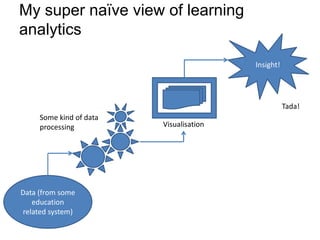
My super naïve view of learning
analytics

                                         Insight!


                                                    Tada!
     Some kind of data
     processing          Visualisation


Data (from some
   education
related system)
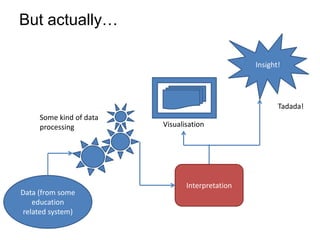
But actually…

                                                 Insight!


                                                        Tadada!
     Some kind of data
     processing          Visualisation


                                Interpretation
Data (from some
   education
related system)
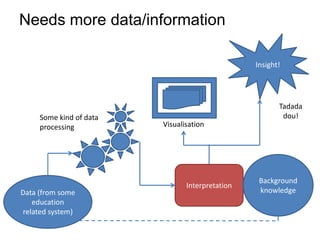
Needs more data/information

                                                 Insight!


                                                        Tadada
     Some kind of data                                   dou!
     processing          Visualisation


                                                  Background
                                Interpretation
Data (from some                                   knowledge
   education
related system)
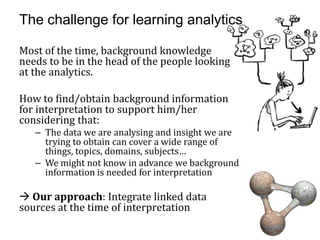
The challenge for learning analytics

Most of the time, background knowledge
needs to be in the head of the people looking
at the analytics.

How to find/obtain background information
for interpretation to support him/her
considering that:
   – The data we are analysing and insight we are
     trying to obtain can cover a wide range of
     things, topics, domains, subjects…
   – We might not know in advance we background
     information is needed for interpretation

 Our approach: Integrate linked data
sources at the time of interpretation
What’s linked data
See the “Using Linked Data in Learning
Analytics” tutorial yesterday
http://linkedu.eu/event/lak2013-linkeddata-
tutorial/
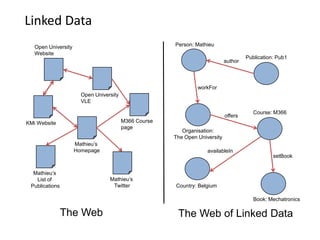
Linked Data
   Open University                                     Person: Mathieu
   Website
                                                                                      Publication: Pub1
                                                                             author


                                                                workFor
                       Open University
                       VLE

                                                                                         Course: M366
                                                                             offers
KMi Website                              M366 Course
                                         page
                                                          Organisation:
                                                       The Open University
                     Mathieu’s
                     Homepage                                       availableIn
                                                                                                 setBook


  Mathieu’s
   List of                        Mathieu’s
 Publications                      Twitter             Country: Belgium

                                                                                         Book: Mechatronics

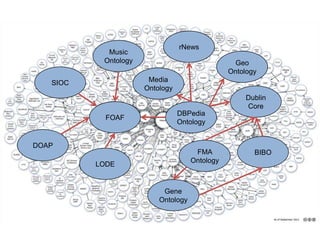
                The Web                                 The Web of Linked Data
rNews
            Music
           Ontology                               Geo
                                                Ontology
   SIOC                Media
                      Ontology
                                                    Dublin
                                                    Core
                                 DBPedia
            FOAF
                                 Ontology


DOAP
                                      FMA              BIBO
                                     Ontology
          LODE


                           Gene
                          Ontology
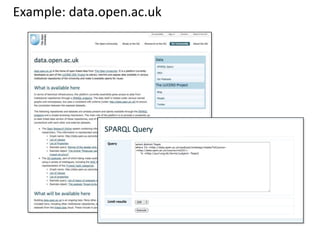
Example: data.open.ac.uk
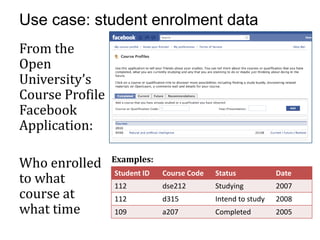
Use case: student enrolment data
From the
Open
University’s
Course Profile
Facebook
Application:

                 Examples:
Who enrolled
to what
                 Student ID   Course Code   Status            Date
                 112          dse212        Studying          2007
course at        112          d315          Intend to study   2008
what time        109          a207          Completed         2005
Sequence mining
We can represent each student’s trajectory by a
sequence of courses, e.g.

       (DD100)  (D203, S180)  (S283)

Applying sequence mining makes it possible to
find frequent patterns in these sequences, i.e.,
courses often taken together in a certain order.
The results
(and again, why they need background knowledge for
interpretation)
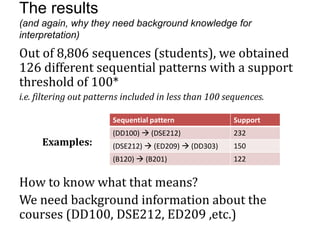
Out of 8,806 sequences (students), we obtained
126 different sequential patterns with a support
threshold of 100*
i.e. filtering out patterns included in less than 100 sequences.

                        Sequential pattern              Support
                        (DD100)  (DSE212)              232
      Examples:         (DSE212)  (ED209)  (DD303)    150
                        (B120)  (B201)                 122


How to know what that means?
We need background information about the
courses (DD100, DSE212, ED209 ,etc.)
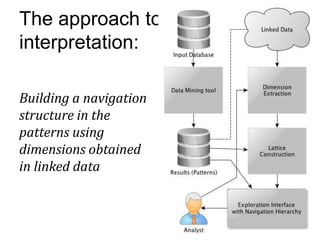
The approach to
interpretation:

Building a navigation
structure in the
patterns using
dimensions obtained
in linked data
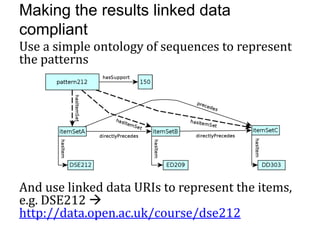
Making the results linked data
compliant
Use a simple ontology of sequences to represent
the patterns


And use linked data URIs to represent the items,
e.g. DSE212 
http://data.open.ac.uk/course/dse212
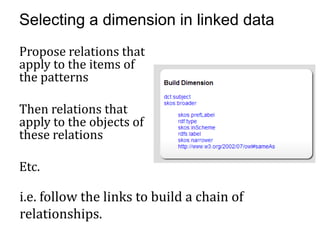
Selecting a dimension in linked data
Propose relations that
apply to the items of
the patterns

Then relations that
apply to the objects of
these relations

Etc.

i.e. follow the links to build a chain of
relationships.
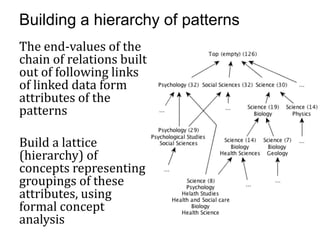
Building a hierarchy of patterns
The end-values of the
chain of relations built
out of following links
of linked data form
attributes of the
patterns

Build a lattice
(hierarchy) of
concepts representing
groupings of these
attributes, using
formal concept
analysis
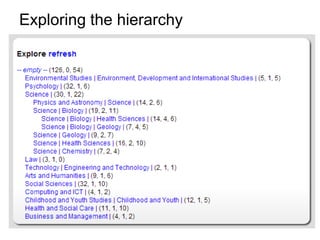
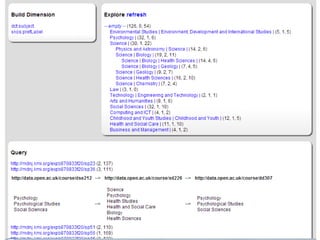
Exploring the hierarchy
Benefits
(see following examples)

Provides an overview of the patterns
obtained along a custom dimension

Helps identifying gaps and issues in
the original data/process

Helps identifying areas in need of
further exploration

Generic: can be straightforwardly
applied to other source data, other
linked data and other mining methods
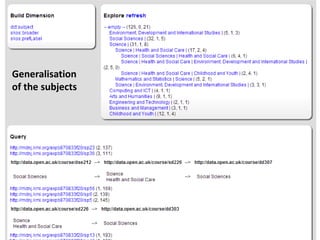
Generalisation
of the subjects
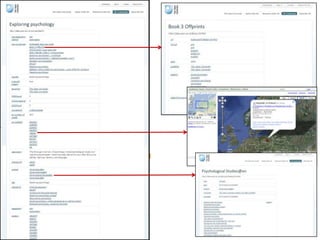
Examples
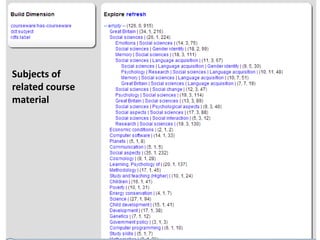
 • Subjects of books
Subjects of
related course
material
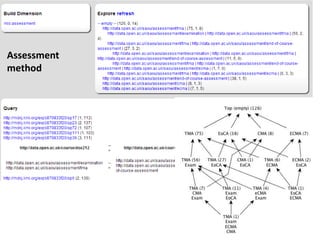
Examples

Assessment
method
Discussion
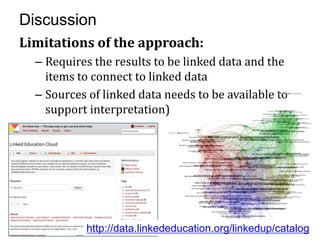
Limitations of the approach:
  – Requires the results to be linked data and the
    items to connect to linked data
  – Sources of linked data needs to be available to
    support interpretation)


           http://data.linkededucation.org/linkedup/catalog
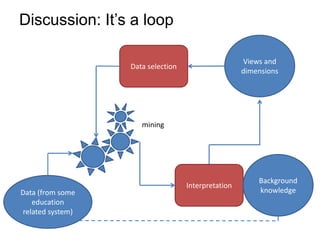
Discussion: It’s a loop

                                                    Views and
                  Data selection
                                                    dimensions


                     mining


                                                        Background
                                   Interpretation
Data (from some                                         knowledge
   education
related system)
Conclusion
Linked data can be used to enrich and
bring some meaningful structure to
the patterns from an analytics/mining
process

Introducing linked data not only in
input of the process, but also in
support of more analytical tasks

Promising, considering the growth of
education-related linked data

Should become part of an iterative
process, where patterns and data get
refined through interpretation and the
introduction of background
information from linked data
Thank you!
                 More info at:
       http://mdaquin.net @mdaquin
          http://linkedup-project.eu
        http://linkedup-challenge.org
http://linkedu.eu/event/lak2013-linkeddata-
                    tutorial/

Interpreting Data Mining Results with Linked Data for Learning Analytics

  • 1.
    Interpreting Data MiningResults with Linked Data for Learning Analytics: Motivation, Case Study and Directions Mathieu d’Aquin Knowledge Media Institute, The Open University mdaquin.net - @mdaquin mathieu.daquin@open.ac.uk Nicolas Jay Université de Lorraine, LORIA, nicolas.jay@loria.fr
  • 2.
    My super naïveview of learning analytics Insight! Tada! Some kind of data processing Visualisation Data (from some education related system)
  • 3.
    But actually… Insight! Tadada! Some kind of data processing Visualisation Interpretation Data (from some education related system)
  • 4.
    Needs more data/information Insight! Tadada Some kind of data dou! processing Visualisation Background Interpretation Data (from some knowledge education related system)
  • 5.
    The challenge forlearning analytics Most of the time, background knowledge needs to be in the head of the people looking at the analytics. How to find/obtain background information for interpretation to support him/her considering that: – The data we are analysing and insight we are trying to obtain can cover a wide range of things, topics, domains, subjects… – We might not know in advance we background information is needed for interpretation  Our approach: Integrate linked data sources at the time of interpretation
  • 6.
    What’s linked data Seethe “Using Linked Data in Learning Analytics” tutorial yesterday http://linkedu.eu/event/lak2013-linkeddata- tutorial/
  • 7.
    Linked Data Open University Person: Mathieu Website Publication: Pub1 author workFor Open University VLE Course: M366 offers KMi Website M366 Course page Organisation: The Open University Mathieu’s Homepage availableIn setBook Mathieu’s List of Mathieu’s Publications Twitter Country: Belgium Book: Mechatronics The Web The Web of Linked Data
  • 8.
    rNews Music Ontology Geo Ontology SIOC Media Ontology Dublin Core DBPedia FOAF Ontology DOAP FMA BIBO Ontology LODE Gene Ontology
  • 9.
  • 10.
    Use case: studentenrolment data From the Open University’s Course Profile Facebook Application: Examples: Who enrolled to what Student ID Course Code Status Date 112 dse212 Studying 2007 course at 112 d315 Intend to study 2008 what time 109 a207 Completed 2005
  • 11.
    Sequence mining We canrepresent each student’s trajectory by a sequence of courses, e.g. (DD100)  (D203, S180)  (S283) Applying sequence mining makes it possible to find frequent patterns in these sequences, i.e., courses often taken together in a certain order.
  • 12.
    The results (and again,why they need background knowledge for interpretation) Out of 8,806 sequences (students), we obtained 126 different sequential patterns with a support threshold of 100* i.e. filtering out patterns included in less than 100 sequences. Sequential pattern Support (DD100)  (DSE212) 232 Examples: (DSE212)  (ED209)  (DD303) 150 (B120)  (B201) 122 How to know what that means? We need background information about the courses (DD100, DSE212, ED209 ,etc.)
  • 13.
    The approach to interpretation: Buildinga navigation structure in the patterns using dimensions obtained in linked data
  • 14.
    Making the resultslinked data compliant Use a simple ontology of sequences to represent the patterns And use linked data URIs to represent the items, e.g. DSE212  http://data.open.ac.uk/course/dse212
  • 16.
    Selecting a dimensionin linked data Propose relations that apply to the items of the patterns Then relations that apply to the objects of these relations Etc. i.e. follow the links to build a chain of relationships.
  • 17.
    Building a hierarchyof patterns The end-values of the chain of relations built out of following links of linked data form attributes of the patterns Build a lattice (hierarchy) of concepts representing groupings of these attributes, using formal concept analysis
  • 18.
  • 20.
    Benefits (see following examples) Providesan overview of the patterns obtained along a custom dimension Helps identifying gaps and issues in the original data/process Helps identifying areas in need of further exploration Generic: can be straightforwardly applied to other source data, other linked data and other mining methods
  • 21.
  • 22.
    Examples • Subjectsof books Subjects of related course material
  • 23.
  • 24.
    Discussion Limitations of theapproach: – Requires the results to be linked data and the items to connect to linked data – Sources of linked data needs to be available to support interpretation) http://data.linkededucation.org/linkedup/catalog
  • 25.
    Discussion: It’s aloop Views and Data selection dimensions mining Background Interpretation Data (from some knowledge education related system)
  • 26.
    Conclusion Linked data canbe used to enrich and bring some meaningful structure to the patterns from an analytics/mining process Introducing linked data not only in input of the process, but also in support of more analytical tasks Promising, considering the growth of education-related linked data Should become part of an iterative process, where patterns and data get refined through interpretation and the introduction of background information from linked data
  • 27.
    Thank you! More info at: http://mdaquin.net @mdaquin http://linkedup-project.eu http://linkedup-challenge.org http://linkedu.eu/event/lak2013-linkeddata- tutorial/