Learning Analytics & Knowledge 2011, Banff, Canada


Theory-based Learning Analytics:
Notes & Examples from Learning & Sensemaking


Simon Buckingham Shum

Knowledge Media Institute
Open University UK

http://simon.buckinghamshum.net
http://open.edu
@sbskmi


            http://creativecommons.org/licenses/by-nc/2.0/uk   1
KMi: near future (3-5 years)
     infrastructure for Open U, and
    other knowledge-intensive orgs


http://kmi.open.ac.uk
Theory and Technology at the
                                     intersection of Hypertext and
                                               Discourse


     http://projects.kmi.open.ac.uk/hyperdiscourse
Projects span many disciplines, ranging from basic research to applications:


                                                                               3
theory ~ analytics

    examples


                     4
theory ~ analytics


                     5
?
―theory-based analytics‖


                    ?
                           6
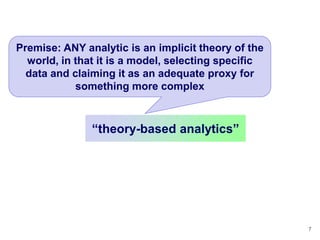
Premise: ANY analytic is an implicit theory of the
  world, in that it is a model, selecting specific
  data and claiming it as an adequate proxy for
            something more complex


               ―theory-based analytics‖


                                                     7
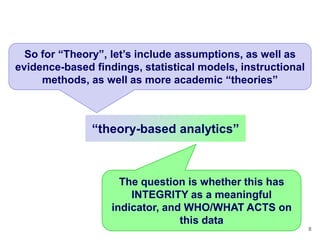
So for ―Theory‖, let‘s include assumptions, as well as
evidence-based findings, statistical models, instructional
     methods, as well as more academic ―theories‖


               ―theory-based analytics‖


                     The question is whether this has
                       INTEGRITY as a meaningful
                   indicator, and WHO/WHAT ACTS on
                                 this data
                                                             8
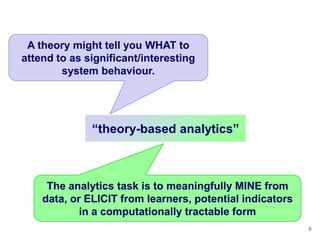
A theory might tell you WHAT to
attend to as significant/interesting
        system behaviour.


              ―theory-based analytics‖


     The analytics task is to meaningfully MINE from
    data, or ELICIT from learners, potential indicators
            in a computationally tractable form
                                                          9
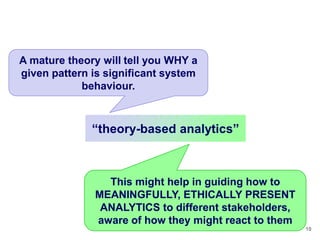
A mature theory will tell you WHY a
given pattern is significant system
            behaviour.


              ―theory-based analytics‖


                This might help in guiding how to
              MEANINGFULLY, ETHICALLY PRESENT
               ANALYTICS to different stakeholders,
              aware of how they might react to them
                                                      10
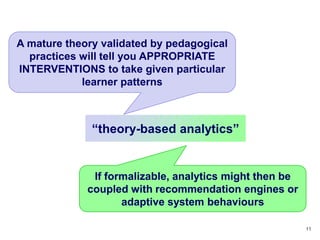
A mature theory validated by pedagogical
  practices will tell you APPROPRIATE
INTERVENTIONS to take given particular
            learner patterns


              ―theory-based analytics‖


              If formalizable, analytics might then be
             coupled with recommendation engines or
                    adaptive system behaviours

                                                         11
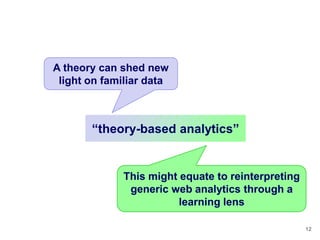
A theory can shed new
 light on familiar data


       ―theory-based analytics‖


              This might equate to reinterpreting
               generic web analytics through a
                         learning lens

                                                    12
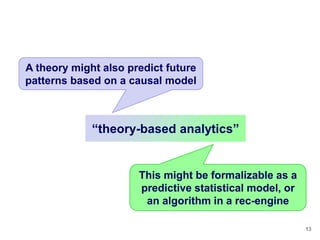
A theory might also predict future
patterns based on a causal model


             ―theory-based analytics‖


                      This might be formalizable as a
                      predictive statistical model, or
                       an algorithm in a rec-engine

                                                         13
Example

   RAISEonline: learning
analytics in English schools


                               14
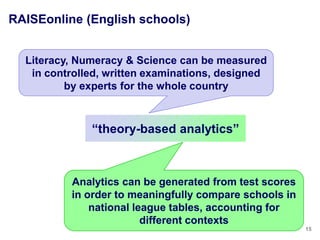
RAISEonline (English schools)


  Literacy, Numeracy & Science can be measured
   in controlled, written examinations, designed
          by experts for the whole country


              ―theory-based analytics‖


          Analytics can be generated from test scores
          in order to meaningfully compare schools in
              national league tables, accounting for
                         different contexts
                                                        15
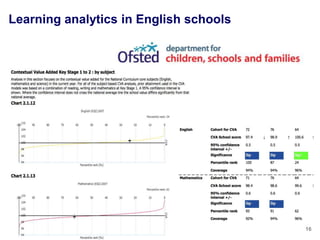
Learning analytics in English schools


                                        16
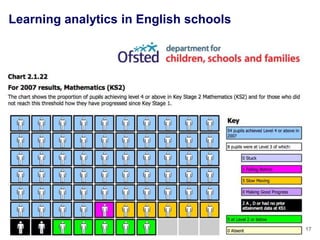
Learning analytics in English schools


                                        17
Example

Open U‘s analytics


                     18
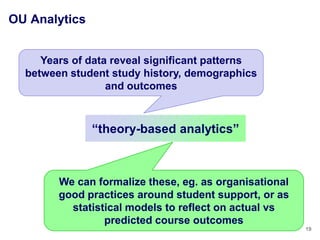
OU Analytics


     Years of data reveal significant patterns
  between student study history, demographics
                  and outcomes


               ―theory-based analytics‖


        We can formalize these, eg. as organisational
        good practices around student support, or as
          statistical models to reflect on actual vs
                 predicted course outcomes
                                                        19
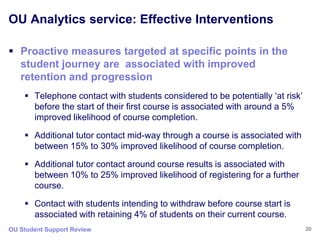
OU Analytics service: Effective Interventions

 Proactive measures targeted at specific points in the
  student journey are associated with improved
  retention and progression
     Telephone contact with students considered to be potentially „at risk‟
      before the start of their first course is associated with around a 5%
      improved likelihood of course completion.

     Additional tutor contact mid-way through a course is associated with
      between 15% to 30% improved likelihood of course completion.

     Additional tutor contact around course results is associated with
      between 10% to 25% improved likelihood of registering for a further
      course.

     Contact with students intending to withdraw before course start is
      associated with retaining 4% of students on their current course.
OU Student Support Review                                                      20
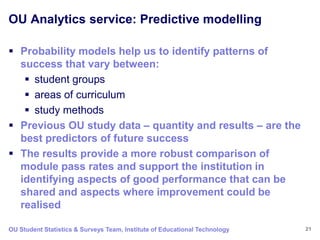
OU Analytics service: Predictive modelling

 Probability models help us to identify patterns of
  success that vary between:
    student groups
    areas of curriculum
    study methods
 Previous OU study data – quantity and results – are the
  best predictors of future success
 The results provide a more robust comparison of
  module pass rates and support the institution in
  identifying aspects of good performance that can be
  shared and aspects where improvement could be
  realised

OU Student Statistics & Surveys Team, Institute of Educational Technology   21
Example

sensemaking in complex
      problems


                         22
It‘s all about Sensemaking


 ―Sensemaking is about such things as
  placement of items into frameworks,
  comprehending, redressing surprise,
  constructing meaning, interacting in pursuit
  of mutual understanding, and patterning.‖


                            Karl Weick, 1995, p.6
                     Sensemaking in Organizations
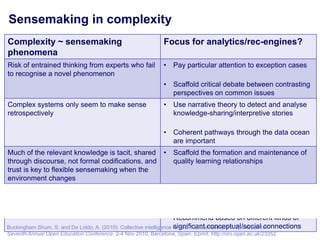
Sensemaking in complexity


 Individual and collective cognition has known
   limitations in dealing with complexity and
              information overload


               ―theory-based analytics‖


         Collective intelligence tools and analytics should
         be designed specifically to minimise breakdowns
                           in sensemaking

                                                          24
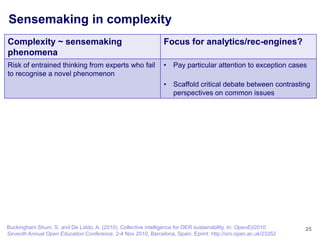
Sensemaking in complexity
Complexity ~ sensemaking                                       Focus for analytics/rec-engines?
phenomena
Risk of entrained thinking from experts who fail               •   Pay particular attention to exception cases
to recognise a novel phenomenon
                                                               •   Scaffold critical debate between contrasting
                                                                   perspectives on common issues
Complex systems only seem to make sense                        •   Use narrative theory to detect and analyse
retrospectively                                                    knowledge-sharing/interpretive stories

                                                               •   Coherent pathways through the data ocean
                                                                   are important
Much of the relevant knowledge is tacit, shared                •   Scaffold the formation and maintenance of
through discourse, not formal codifications                        quality learning relationships

Many small signals can build over time into a                  •   Highlight important events and connections
significant force/change                                            aggregation and emergent patterns


                                                               •   Recommend based on different kinds of
                                                                   significant conceptual/social connections

Buckingham Shum, S. and De Liddo, A. (2010). Collective intelligence for OER sustainability. In: OpenEd2010:    25
Seventh Annual Open Education Conference, 2-4 Nov 2010, Barcelona, Spain. Eprint: http://oro.open.ac.uk/23352
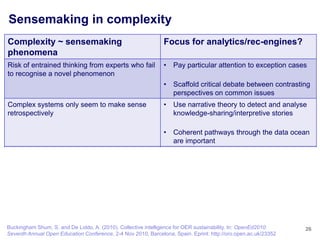
Sensemaking in complexity
Complexity ~ sensemaking                                       Focus for analytics/rec-engines?
phenomena
Risk of entrained thinking from experts who fail               •   Pay particular attention to exception cases
to recognise a novel phenomenon
                                                               •   Scaffold critical debate between contrasting
                                                                   perspectives on common issues
Complex systems only seem to make sense                        •   Use narrative theory to detect and analyse
retrospectively                                                    knowledge-sharing/interpretive stories

                                                               •   Coherent pathways through the data ocean
                                                                   are important
Much of the relevant knowledge is tacit, shared                •   Scaffold the formation and maintenance of
through discourse, not formal codifications                        quality learning relationships

Many small signals can build over time into a                  •   Highlight important events and connections
significant force/change                                            aggregation and emergent patterns


                                                               •   Recommend based on different kinds of
                                                                   significant conceptual/social connections

Buckingham Shum, S. and De Liddo, A. (2010). Collective intelligence for OER sustainability. In: OpenEd2010:    26
Seventh Annual Open Education Conference, 2-4 Nov 2010, Barcelona, Spain. Eprint: http://oro.open.ac.uk/23352
Sensemaking in complexity
Complexity ~ sensemaking                                       Focus for analytics/rec-engines?
phenomena
Risk of entrained thinking from experts who fail               •   Pay particular attention to exception cases
to recognise a novel phenomenon
                                                               •   Scaffold critical debate between contrasting
                                                                   perspectives on common issues
Complex systems only seem to make sense                        •   Use narrative theory to detect and analyse
retrospectively                                                    knowledge-sharing/interpretive stories

                                                               •   Coherent pathways through the data ocean
                                                                   are important
Much of the relevant knowledge is tacit, shared •                  Scaffold the formation and maintenance of
through discourse, not formal codifications, and                   quality learning relationships
trust is key to flexible sensemaking when the
environment changes
Many small signals can build over time into a                  •   Highlight important events and connections
significant force/change                                            aggregation and emergent patterns


                                                               •     Recommend based on different kinds of
                                                                     significant conceptual/social connections
Buckingham Shum, S. and De Liddo, A. (2010). Collective intelligence for OER sustainability. In: OpenEd2010:     27
Seventh Annual Open Education Conference, 2-4 Nov 2010, Barcelona, Spain. Eprint: http://oro.open.ac.uk/23352
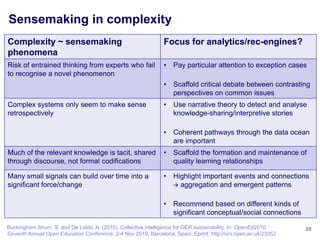
Sensemaking in complexity
Complexity ~ sensemaking                                       Focus for analytics/rec-engines?
phenomena
Risk of entrained thinking from experts who fail               •   Pay particular attention to exception cases
to recognise a novel phenomenon
                                                               •   Scaffold critical debate between contrasting
                                                                   perspectives on common issues
Complex systems only seem to make sense                        •   Use narrative theory to detect and analyse
retrospectively                                                    knowledge-sharing/interpretive stories

                                                               •   Coherent pathways through the data ocean
                                                                   are important
Much of the relevant knowledge is tacit, shared                •   Scaffold the formation and maintenance of
through discourse, not formal codifications                        quality learning relationships

Many small signals can build over time into a                  •   Highlight important events and connections
significant force/change                                            aggregation and emergent patterns


                                                               •   Recommend based on different kinds of
                                                                   significant conceptual/social connections

Buckingham Shum, S. and De Liddo, A. (2010). Collective intelligence for OER sustainability. In: OpenEd2010:    28
Seventh Annual Open Education Conference, 2-4 Nov 2010, Barcelona, Spain. Eprint: http://oro.open.ac.uk/23352
Example

learning-to-learn analytics


                              29
 ―We are preparing students for jobs that
  do not exist yet, that will use
  technologies that have not been invented
  yet, in order to solve problems that are
  not even problems yet.‖

                                    ―Shift Happens‖
                http://shifthappens.wikispaces.com


                                                      30
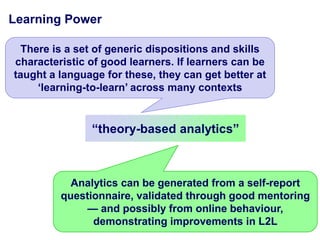
Learning Power

 There is a set of generic dispositions and skills
characteristic of good learners. If learners can be
taught a language for these, they can get better at
    ‗learning-to-learn‘ across many contexts


               ―theory-based analytics‖


           Analytics can be generated from a self-report
         questionnaire, validated through good mentoring
             — and possibly from online behaviour,
               demonstrating improvements in L2L
                                                       31
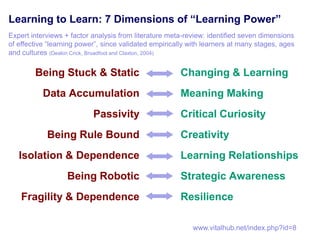
Learning to Learn: 7 Dimensions of ―Learning Power‖
Expert interviews + factor analysis from literature meta-review: identified seven dimensions
of effective “learning power”, since validated empirically with learners at many stages, ages
and cultures (Deakin Crick, Broadfoot and Claxton, 2004)

        Being Stuck & Static                           Changing & Learning
           Data Accumulation                           Meaning Making
                           Passivity                   Critical Curiosity
            Being Rule Bound                           Creativity
   Isolation & Dependence                              Learning Relationships
                   Being Robotic                       Strategic Awareness
    Fragility & Dependence                             Resilience

                                                           www.vitalhub.net/index.php?id=8
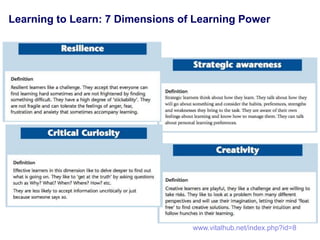
Learning to Learn: 7 Dimensions of Learning Power


                                  www.vitalhub.net/index.php?id=8
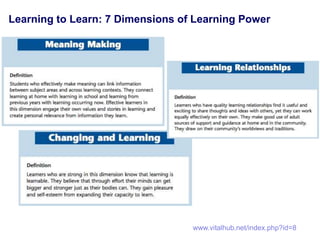
Learning to Learn: 7 Dimensions of Learning Power


                                  www.vitalhub.net/index.php?id=8
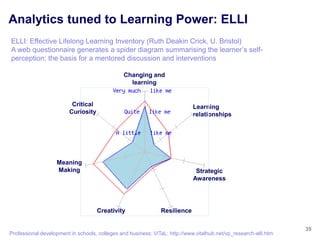
Analytics tuned to Learning Power: ELLI
ELLI: Effective Lifelong Learning Inventory (Ruth Deakin Crick, U. Bristol)
A web questionnaire generates a spider diagram summarising the learner‟s self-
perception: the basis for a mentored discussion and interventions

                                                Changing and
                                                  learning


                          Critical                                           Learning
                         Curiosity                                           relationships


                   Meaning
                   Making                                                     Strategic
                                                                             Awareness


                                     Creativity                Resilience

                                                                                                                  35
Professional development in schools, colleges and business: ViTaL: http://www.vitalhub.net/vp_research-elli.htm
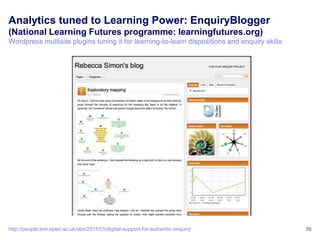
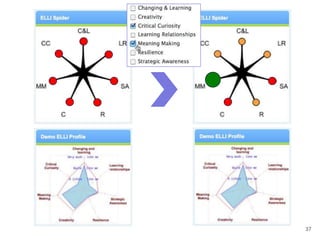
Analytics tuned to Learning Power: EnquiryBlogger
(National Learning Futures programme: learningfutures.org)
Wordpress multisite plugins tuning it for learning-to-learn dispositions and enquiry skills


http://people.kmi.open.ac.uk/sbs/2011/01/digital-support-for-authentic-enquiry                36
37
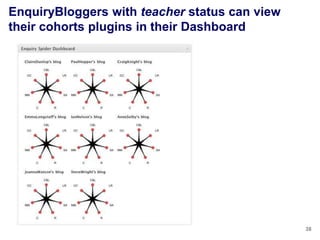
EnquiryBloggers with teacher status can view
their cohorts plugins in their Dashboard


                                               38
Example

discourse analytics


                      39
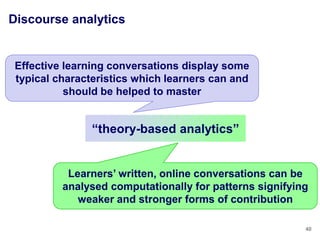
Discourse analytics


 Effective learning conversations display some
 typical characteristics which learners can and
           should be helped to master


                ―theory-based analytics‖


           Learners‘ written, online conversations can be
          analysed computationally for patterns signifying
             weaker and stronger forms of contribution

                                                         40
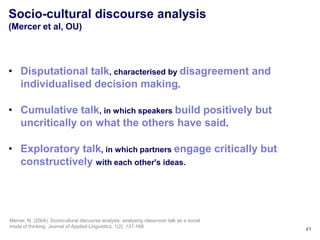
Socio-cultural discourse analysis
(Mercer et al, OU)


• Disputational talk, characterised by disagreement and
  individualised decision making.

• Cumulative talk, in which speakers build positively but
  uncritically on what the others have said.

• Exploratory talk, in which partners engage critically but
  constructively with each other's ideas.


Mercer, N. (2004). Sociocultural discourse analysis: analysing classroom talk as a social
mode of thinking. Journal of Applied Linguistics, 1(2), 137-168.
                                                                                            41
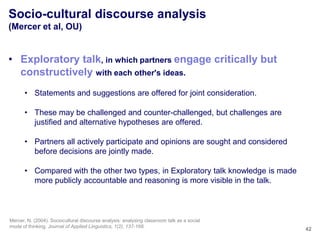
Socio-cultural discourse analysis
(Mercer et al, OU)


• Exploratory talk, in which partners engage critically but
  constructively with each other's ideas.
       • Statements and suggestions are offered for joint consideration.

       • These may be challenged and counter-challenged, but challenges are
         justified and alternative hypotheses are offered.

       • Partners all actively participate and opinions are sought and considered
         before decisions are jointly made.

       • Compared with the other two types, in Exploratory talk knowledge is made
         more publicly accountable and reasoning is more visible in the talk.


Mercer, N. (2004). Sociocultural discourse analysis: analysing classroom talk as a social
mode of thinking. Journal of Applied Linguistics, 1(2), 137-168.
                                                                                            42
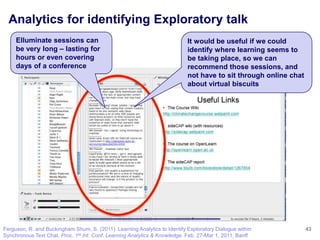
Analytics for identifying Exploratory talk
     Elluminate sessions can                                                It would be useful if we could
     be very long – lasting for                                             identify where learning seems to
     hours or even covering                                                 be taking place, so we can
     days of a conference                                                   recommend those sessions, and
                                                                            not have to sit through online chat
                                                                            about virtual biscuits


Ferguson, R. and Buckingham Shum, S. (2011). Learning Analytics to Identify Exploratory Dialogue within           43
Synchronous Text Chat. Proc. 1st Int. Conf. Learning Analytics & Knowledge. Feb. 27-Mar 1, 2011, Banff
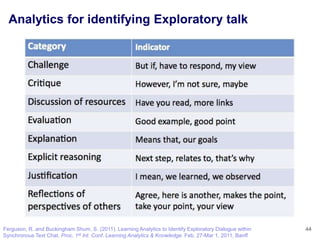
Analytics for identifying Exploratory talk


Ferguson, R. and Buckingham Shum, S. (2011). Learning Analytics to Identify Exploratory Dialogue within   44
Synchronous Text Chat. Proc. 1st Int. Conf. Learning Analytics & Knowledge. Feb. 27-Mar 1, 2011, Banff
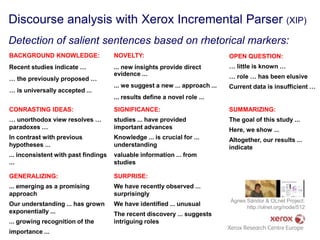
Discourse analysis with Xerox Incremental Parser (XIP)
Detection of salient sentences based on rhetorical markers:
BACKGROUND KNOWLEDGE:                 NOVELTY:                                OPEN QUESTION:
Recent studies indicate …             ... new insights provide direct         … little is known …
                                      evidence ...                            … role … has been elusive
… the previously proposed …
                                      ... we suggest a new ... approach ...   Current data is insufficient …
… is universally accepted ...
                                      ... results define a novel role ...
CONRASTING IDEAS:                     SIGNIFICANCE:                           SUMMARIZING:
… unorthodox view resolves …          studies ... have provided               The goal of this study ...
paradoxes …                           important advances                      Here, we show ...
In contrast with previous             Knowledge ... is crucial for ...        Altogether, our results ...
hypotheses ...                        understanding                           indicate
... inconsistent with past findings   valuable information ... from
...                                   studies

GENERALIZING:                         SURPRISE:
... emerging as a promising           We have recently observed ...
approach                              surprisingly
                                                                              Ágnes Sándor & OLnet Project:
Our understanding ... has grown       We have identified ... unusual                http://olnet.org/node/512
exponentially ...                     The recent discovery ... suggests
... growing recognition of the        intriguing roles
importance ...
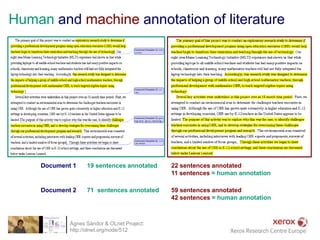
Human and machine annotation of literature


    Document 1    19 sentences annotated    22 sentences annotated
                                            11 sentences = human annotation

    Document 2    71 sentences annotated    59 sentences annotated
                                            42 sentences = human annotation


            Ágnes Sándor & OLnet Project:
            http://olnet.org/node/512
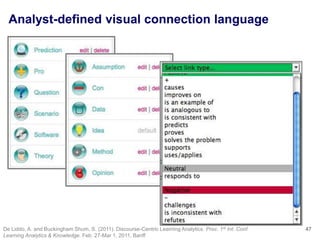
Analyst-defined visual connection language


De Liddo, A. and Buckingham Shum, S. (2011). Discourse-Centric Learning Analytics. Proc. 1st Int. Conf.   47
Learning Analytics & Knowledge. Feb. 27-Mar 1, 2011, Banff
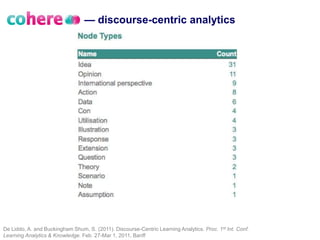
— discourse-centric analytics


De Liddo, A. and Buckingham Shum, S. (2011). Discourse-Centric Learning Analytics. Proc. 1st Int. Conf.
Learning Analytics & Knowledge. Feb. 27-Mar 1, 2011, Banff
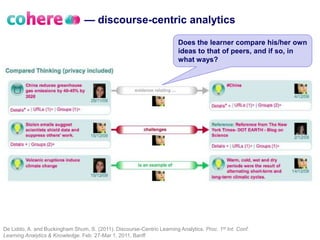
— discourse-centric analytics

                                                                         Does the learner compare his/her own
                                                                         ideas to that of peers, and if so, in
                                                                         what ways?


De Liddo, A. and Buckingham Shum, S. (2011). Discourse-Centric Learning Analytics. Proc. 1st Int. Conf.
Learning Analytics & Knowledge. Feb. 27-Mar 1, 2011, Banff
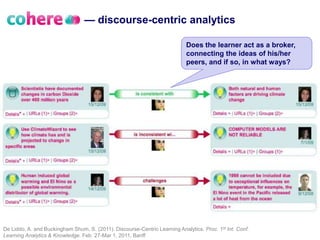
— discourse-centric analytics

                                                                            Does the learner act as a broker,
                                                                            connecting the ideas of his/her
                                                                            peers, and if so, in what ways?


De Liddo, A. and Buckingham Shum, S. (2011). Discourse-Centric Learning Analytics. Proc. 1st Int. Conf.
Learning Analytics & Knowledge. Feb. 27-Mar 1, 2011, Banff
LAK 2015?...

     New learning theories have emerged
     which are dependent on the enabling
   capabilities of online analytics to provide
             data on a huge scale…


                ―theory-based analytics‖


                    While in tandem, new categories of
                  learning analytic and rec-engine have
                   emerged in specific response to the
                   need to test emerging theories with
                   computational models and datasets      51
Discussion!


?
―theory-based analytics‖


                    ?
                           52