Understanding
personal privacy
in the age of big online data
Mathieu d'Aquin
@mdaquin - slideshare.net/mdaquin
Keerthi Thomas
Knowledge Media Institute, The Open University
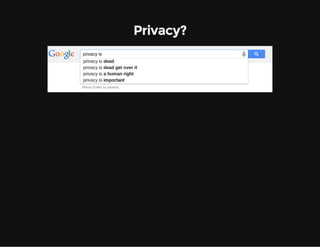
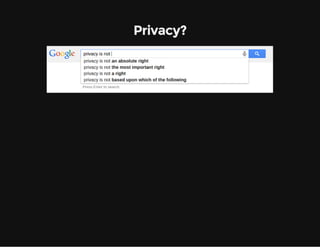
Privacy?
Privacy?
...
Privacy?
Privacy?
What the experts say?
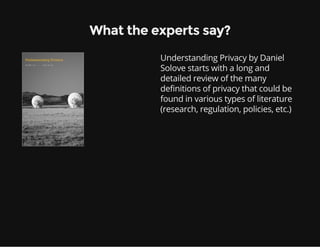
Understanding Privacy by Daniel
Solove starts with a long and
detailed review of the many
definitions of privacy that could be
found in various types of literature
(research, regulation, policies, etc.)
What the experts say?
Privacy is not simply an absence of information about us in
the minds of others, rather it is the control we have over
information about ourselves
-- Charles Fried - 1968
What the experts say?
Privacy is not simply an absence of information about us in
the minds of others, rather it is the controlwe have over
information about ourselves
-- Charles Fried - 1968
: The right to "private and
family life, his home and his correspondence"
What regulation says?
EU Directive 95/46/EC (Data Protection)
Transparency: Right to be informed of data collection and
processing. Processing should apply with consent, and only for
legitimate purposes.
Amounts: Personal data should be collected and processed only in
proportions adequate to the explicite purpose.
Transfer: Personal data can only be transfered to countries outside
the EU if these countries possess adequate levels of protection
: The right to "private and
family life, his home and his correspondence"
What regulation says?
EU Directive 95/46/EC (Data Protection)
Transparency: Right to be informedof data collection and
processing. Processing should apply with consent, and only for
legitimate purposes.
Amounts: Personal data should be collected and processed only in
proportions adequate to the explicite purpose.
Transfer: Personal data can only be transfered to countries outside
the EU if these countries possess adequate levels of protection
Informed Consent, Control,
Explicite Purpose...
Visibility, Awareness and
Accountability
The three principles of social transluscence
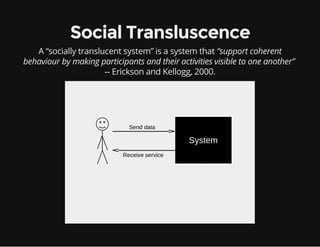
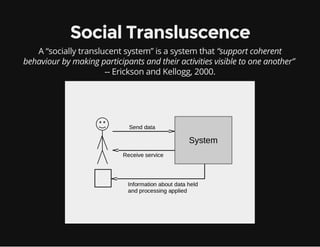
Social Transluscence
A “socially translucent system” is a system that “support coherent
behaviour by making participants and their activities visible to one another”
-- Erickson and Kellogg, 2000.
Social Transluscence
A “socially translucent system” is a system that “support coherent
behaviour by making participants and their activities visible to one another”
-- Erickson and Kellogg, 2000.
Some technical options and examples...
(Technological) Challenges:
Fragmentation and heterogeneity of location, format, ownership,
access, systems holding data
User identification across various, connected or not, systems
Data analysis and scale which large organisation barely cope with,
and are out of reach of web users
d'Aquin, Thomas @ PrivOn ISWC workshop 2013, Semantic Web Technologies for Social Translucence and Privacy Mirrors on the
Web
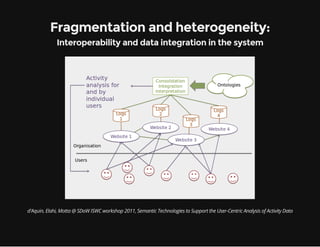
Fragmentation and heterogeneity:
Interoperability and data integration in the system
d'Aquin, Elahi, Motta @ SDoW ISWC workshop 2011, Semantic Technologies to Support the User-Centric Analysis of Activity Data
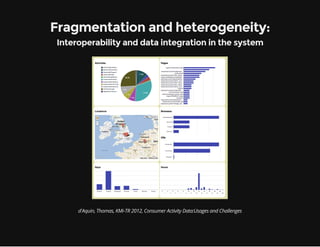
Fragmentation and heterogeneity:
Interoperability and data integration in the system
d'Aquin, Thomas, KMi-TR 2012, Consumer Activity Data:Usages and Challenges
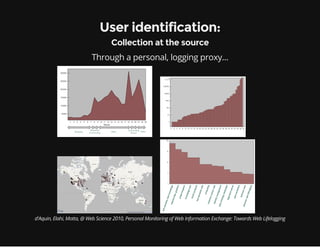
User identification:
Collection at the source
Through a personal, logging proxy...
d'Aquin, Elahi, Motta, @ Web Science 2010, Personal Monitoring of Web Information Exchange: Towards Web Lifelogging
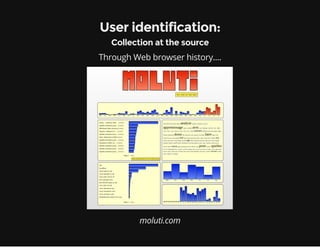
User identification:
Collection at the source
Through Web browser history....
moluti.com
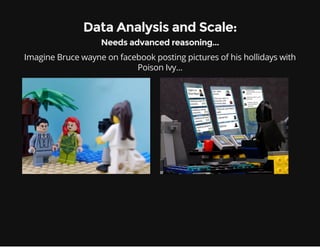
Imagine Bruce wayne on facebook posting pictures of his hollidays with
Poison Ivy...
Data Analysis and Scale:
Needs advanced reasoning...
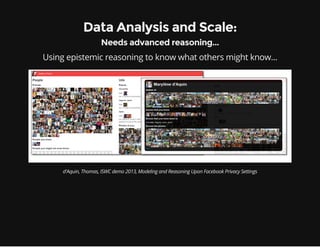
Data Analysis and Scale:
Needs advanced reasoning...
Using epistemic reasoning to know what others might know...
d'Aquin, Thomas, ISWC demo 2013, Modeling and Reasoning Upon Facebook Privacy Settings
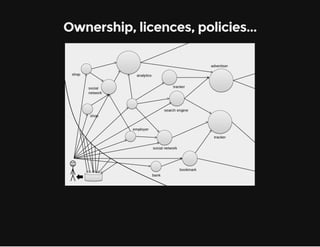
Ownership, licences, policies...
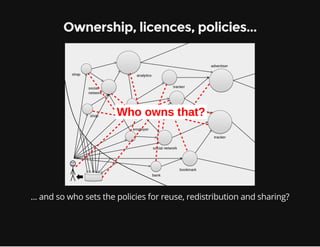
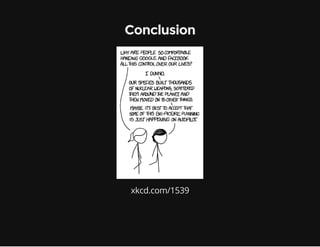
... and so who sets the policies for reuse, redistribution and sharing?
xkcd.com/1539
Conclusion
Thank you
mdaquin.net
@mdaquin
slideshare.net/mdaquin
mksmart.org/data/

Understanding personal privacy in the age of big online data

  • 1.
    Understanding personal privacy in theage of big online data Mathieu d'Aquin @mdaquin - slideshare.net/mdaquin Keerthi Thomas Knowledge Media Institute, The Open University
  • 2.
  • 3.
  • 4.
  • 5.
  • 6.
    What the expertssay? Understanding Privacy by Daniel Solove starts with a long and detailed review of the many definitions of privacy that could be found in various types of literature (research, regulation, policies, etc.)
  • 7.
    What the expertssay? Privacy is not simply an absence of information about us in the minds of others, rather it is the control we have over information about ourselves -- Charles Fried - 1968
  • 8.
    What the expertssay? Privacy is not simply an absence of information about us in the minds of others, rather it is the controlwe have over information about ourselves -- Charles Fried - 1968
  • 9.
    : The rightto "private and family life, his home and his correspondence" What regulation says? EU Directive 95/46/EC (Data Protection) Transparency: Right to be informed of data collection and processing. Processing should apply with consent, and only for legitimate purposes. Amounts: Personal data should be collected and processed only in proportions adequate to the explicite purpose. Transfer: Personal data can only be transfered to countries outside the EU if these countries possess adequate levels of protection
  • 10.
    : The rightto "private and family life, his home and his correspondence" What regulation says? EU Directive 95/46/EC (Data Protection) Transparency: Right to be informedof data collection and processing. Processing should apply with consent, and only for legitimate purposes. Amounts: Personal data should be collected and processed only in proportions adequate to the explicite purpose. Transfer: Personal data can only be transfered to countries outside the EU if these countries possess adequate levels of protection
  • 11.
    Informed Consent, Control, ExplicitePurpose... Visibility, Awareness and Accountability The three principles of social transluscence
  • 12.
    Social Transluscence A “sociallytranslucent system” is a system that “support coherent behaviour by making participants and their activities visible to one another” -- Erickson and Kellogg, 2000.
  • 13.
    Social Transluscence A “sociallytranslucent system” is a system that “support coherent behaviour by making participants and their activities visible to one another” -- Erickson and Kellogg, 2000.
  • 18.
    Some technical optionsand examples... (Technological) Challenges: Fragmentation and heterogeneity of location, format, ownership, access, systems holding data User identification across various, connected or not, systems Data analysis and scale which large organisation barely cope with, and are out of reach of web users d'Aquin, Thomas @ PrivOn ISWC workshop 2013, Semantic Web Technologies for Social Translucence and Privacy Mirrors on the Web
  • 19.
    Fragmentation and heterogeneity: Interoperabilityand data integration in the system d'Aquin, Elahi, Motta @ SDoW ISWC workshop 2011, Semantic Technologies to Support the User-Centric Analysis of Activity Data
  • 20.
    Fragmentation and heterogeneity: Interoperabilityand data integration in the system d'Aquin, Thomas, KMi-TR 2012, Consumer Activity Data:Usages and Challenges
  • 21.
    User identification: Collection atthe source Through a personal, logging proxy... d'Aquin, Elahi, Motta, @ Web Science 2010, Personal Monitoring of Web Information Exchange: Towards Web Lifelogging
  • 22.
    User identification: Collection atthe source Through Web browser history.... moluti.com
  • 23.
    Imagine Bruce wayneon facebook posting pictures of his hollidays with Poison Ivy... Data Analysis and Scale: Needs advanced reasoning...
  • 24.
    Data Analysis andScale: Needs advanced reasoning... Using epistemic reasoning to know what others might know... d'Aquin, Thomas, ISWC demo 2013, Modeling and Reasoning Upon Facebook Privacy Settings
  • 25.
  • 26.
    Ownership, licences, policies... ...and so who sets the policies for reuse, redistribution and sharing?
  • 27.
  • 28.