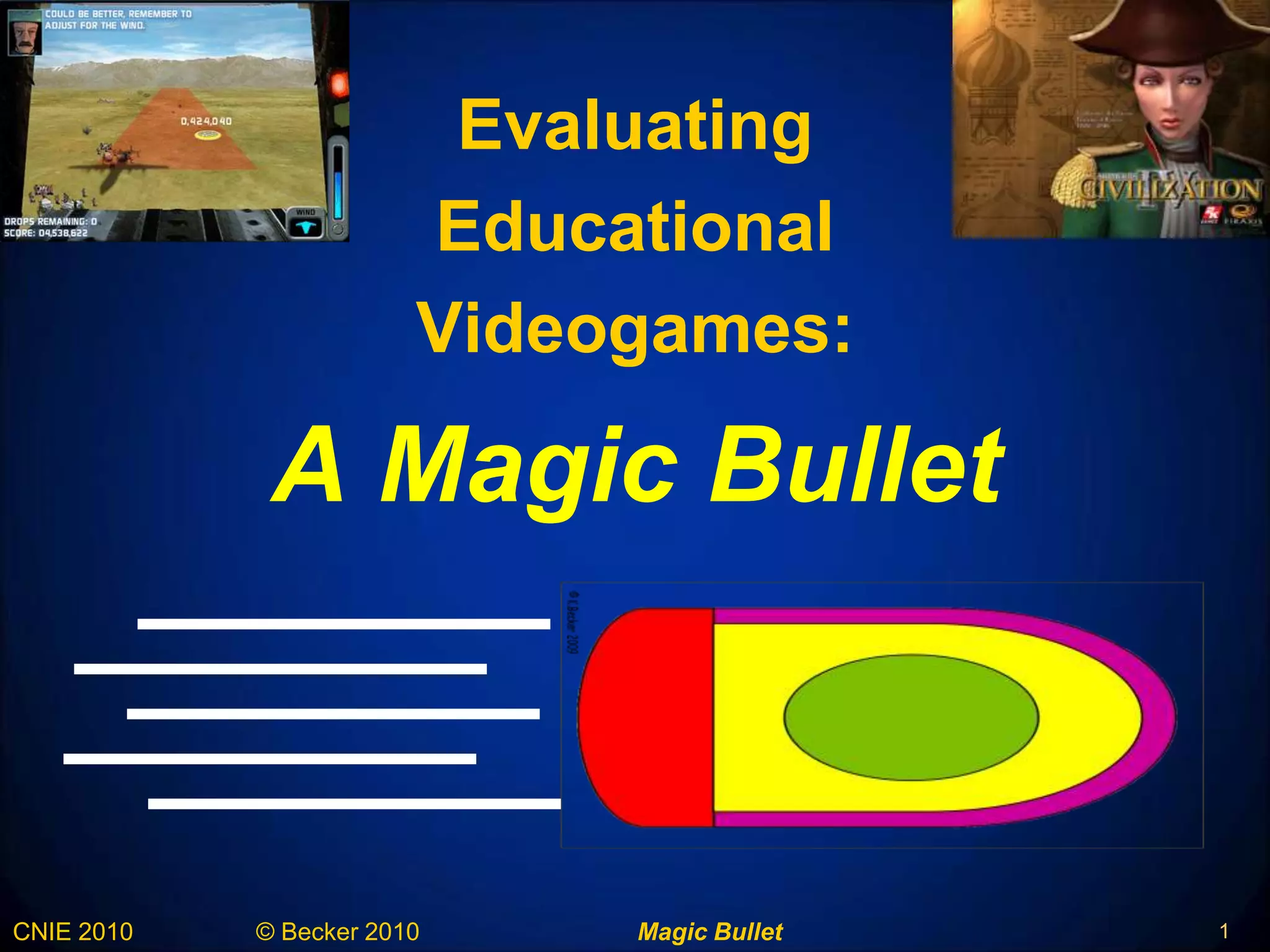
A Magic Bullet Evaluating Educational Videogames:
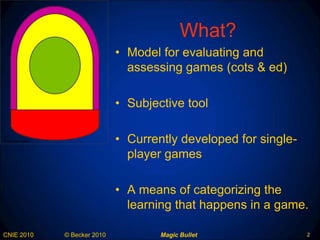
What? Model for evaluating and assessing games (cots & ed) Subjective tool Currently developed for single-player games A means of categorizing the learning that happens in a game.
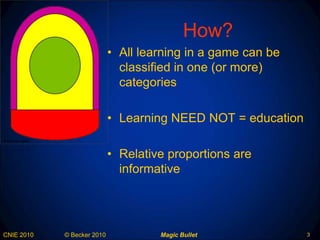
How? All learning in a game can be classified in one (or more) categories Learning NEED NOT = education Relative proportions are informative
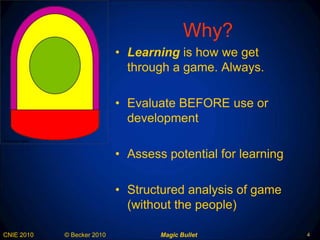
Why? Learning  is how we get through a game. Always. Evaluate BEFORE use or development Assess potential for learning Structured analysis of game (without the people)
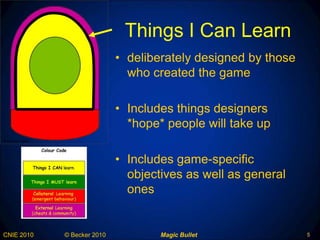
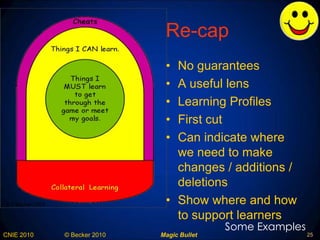
Things I Can Learn deliberately designed by those who created the game Includes things designers *hope* people will take up Includes game-specific objectives as well as general ones
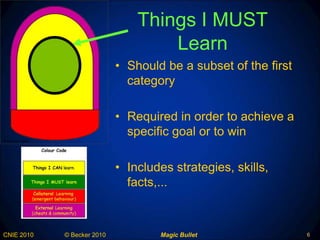
Things I MUST Learn Should be a subset of the first category Required in order to achieve a specific goal or to win Includes strategies, skills, facts,...
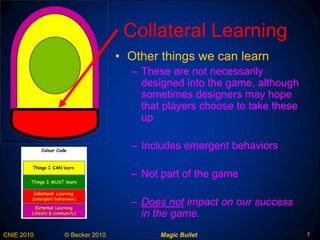
Collateral Learning Other things we can learn These are not necessarily designed into the game, although sometimes designers may hope that players choose to take these up Includes emergent behaviors Not part of the game Does not  impact on our success in the game .
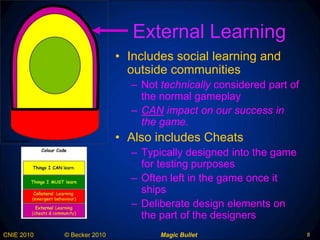
External Learning Includes social learning and outside communities  Not  technically  considered part of the normal gameplay CAN  impact on our success in the game . Also includes Cheats Typically designed into the game for testing purposes Often left in the game once it ships Deliberate design elements on the part of the designers
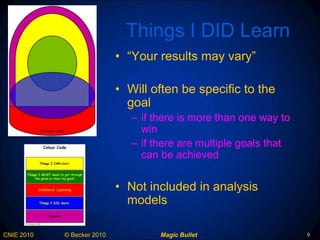
Things I DID Learn “ Your results may vary” Will often be specific to the goal  if there is more than one way to win if there are multiple goals that can be achieved Not included in analysis models
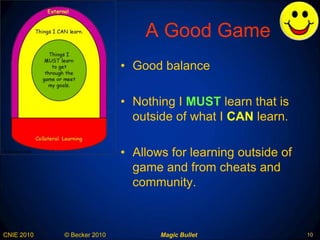
A Good Game Good balance Nothing I  MUST  learn that is outside of what I  CAN  learn. Allows for learning outside of game and from cheats and community.
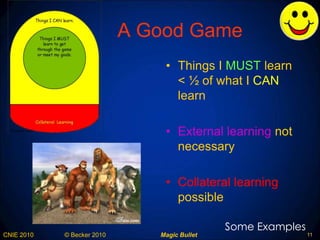
A Good Game Things I  MUST  learn < ½ of what I  CAN  learn External learning  not necessary Collateral learning  possible Some Examples
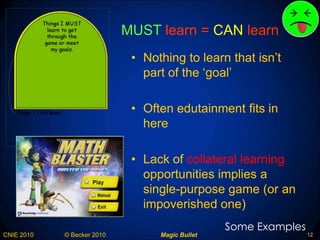
MUST  learn =  CAN  learn Nothing to learn that isn’t part of the ‘goal’ Often edutainment fits in here Lack of  collateral learning  opportunities implies a single-purpose game (or an impoverished one) Some Examples
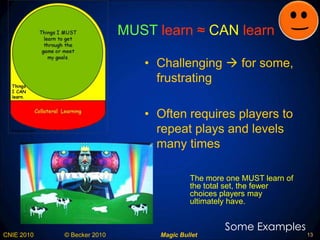
MUST  learn  ≈  CAN  learn Challenging    for some, frustrating Often requires players to repeat plays and levels many times Some Examples The more one MUST learn of the total set, the fewer choices players may ultimately have.
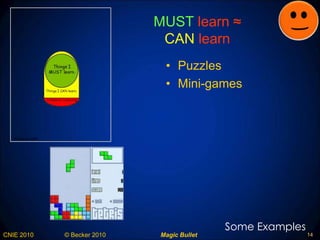
MUST  learn  ≈   CAN  learn Puzzles Mini-games Some Examples
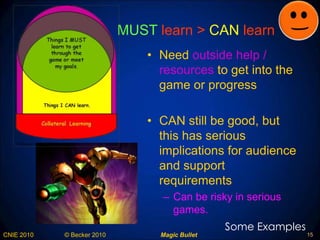
MUST  learn >  CAN  learn Need  outside help / resources  to get into the game or progress CAN still be good, but this has serious implications for audience and support requirements Can be risky in serious games. Some Examples
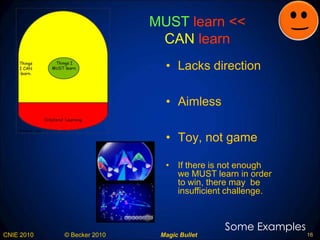
MUST  learn <<  CAN  learn Lacks direction Aimless Toy, not game Some Examples If there is not enough we MUST learn in order to win, there may  be insufficient challenge.
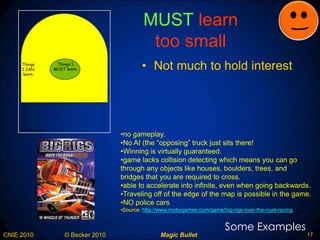
MUST  learn  too small Not much to hold interest Some Examples no gameplay.  No AI (the “opposing” truck just sits there!  Winning is virtually guaranteed. game lacks collision detecting which means you can go through any objects like houses, boulders, trees, and bridges that you are required to cross.  able to accelerate into infinite, even when going backwards.  Traveling off of the edge of the map is possible in the game.  NO police cars Source:  http://www.mobygames.com/game/big-rigs-over-the-road-racing
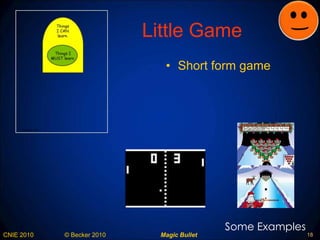
Little Game Short form game Some Examples
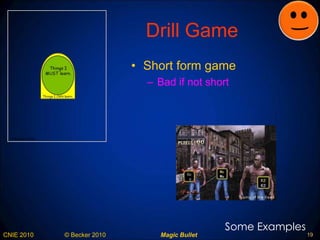
Drill Game Short form game Bad if not short Some Examples
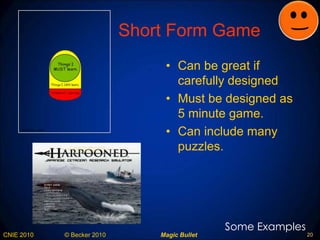
Short Form Game Can be great if carefully designed Must be designed as 5 minute game. Can include many puzzles. Some Examples
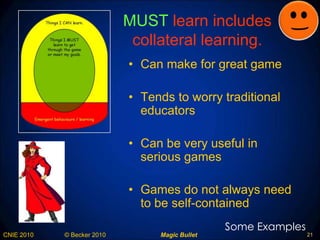
MUST   learn includes external learning. Can make for great game Tends to worry traditional educators Can be very useful in serious games Games do not always need to be self-contained Some Examples
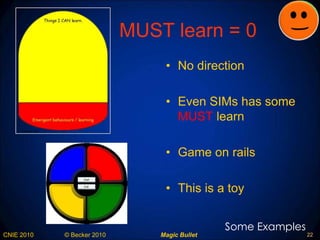
MUST learn = 0 No direction Even SIMs has some  MUST  learn Game on rails This is a toy Some Examples
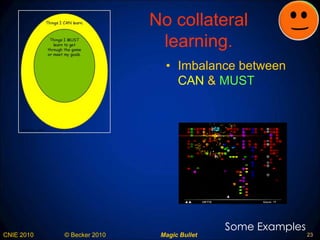
No collateral learning. Imbalance between  CAN  &  MUST Some Examples
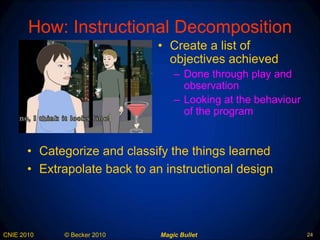
How: Instructional Decomposition Categorize and classify the things learned Extrapolate back to an instructional design Create a list of objectives achieved Done through play and observation Looking at the behaviour of the program
Re-cap No guarantees A useful lens Learning Profiles First cut Can indicate where we need to make changes / additions / deletions Show where and how to support learners Some Examples
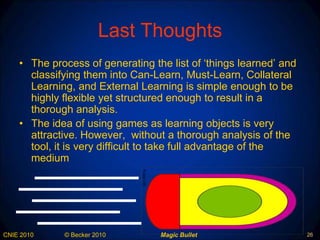
Last Thoughts The process of generating the list of ‘things learned’ and classifying them into Can-Learn, Must-Learn, Collateral Learning, and External Learning is simple enough to be highly flexible yet structured enough to result in a thorough analysis.  The idea of using games as learning objects is very attractive. However,  without a thorough analysis of the tool, it is very difficult to take full advantage of the medium
THANKS! Image & Game Credits Cover Slide:  Civilization ,  Food Force Black & White Mathblaster Katamary Damacy Tetris Metroid Prime Electroplancton Big Rigs Pong Elf Bowling Typing of the Dead Harpooned Carmen Sandiego Simon Space Invaders Façade

Evaluating Educational Games : A magic Bullet

  • 1.
    A Magic BulletEvaluating Educational Videogames:
  • 2.
    What? Model forevaluating and assessing games (cots & ed) Subjective tool Currently developed for single-player games A means of categorizing the learning that happens in a game.
  • 3.
    How? All learningin a game can be classified in one (or more) categories Learning NEED NOT = education Relative proportions are informative
  • 4.
    Why? Learning is how we get through a game. Always. Evaluate BEFORE use or development Assess potential for learning Structured analysis of game (without the people)
  • 5.
    Things I CanLearn deliberately designed by those who created the game Includes things designers *hope* people will take up Includes game-specific objectives as well as general ones
  • 6.
    Things I MUSTLearn Should be a subset of the first category Required in order to achieve a specific goal or to win Includes strategies, skills, facts,...
  • 7.
    Collateral Learning Otherthings we can learn These are not necessarily designed into the game, although sometimes designers may hope that players choose to take these up Includes emergent behaviors Not part of the game Does not impact on our success in the game .
  • 8.
    External Learning Includessocial learning and outside communities Not technically considered part of the normal gameplay CAN impact on our success in the game . Also includes Cheats Typically designed into the game for testing purposes Often left in the game once it ships Deliberate design elements on the part of the designers
  • 9.
    Things I DIDLearn “ Your results may vary” Will often be specific to the goal if there is more than one way to win if there are multiple goals that can be achieved Not included in analysis models
  • 10.
    A Good GameGood balance Nothing I MUST learn that is outside of what I CAN learn. Allows for learning outside of game and from cheats and community.
  • 11.
    A Good GameThings I MUST learn < ½ of what I CAN learn External learning not necessary Collateral learning possible Some Examples
  • 12.
    MUST learn= CAN learn Nothing to learn that isn’t part of the ‘goal’ Often edutainment fits in here Lack of collateral learning opportunities implies a single-purpose game (or an impoverished one) Some Examples
  • 13.
    MUST learn ≈ CAN learn Challenging  for some, frustrating Often requires players to repeat plays and levels many times Some Examples The more one MUST learn of the total set, the fewer choices players may ultimately have.
  • 14.
    MUST learn ≈ CAN learn Puzzles Mini-games Some Examples
  • 15.
    MUST learn> CAN learn Need outside help / resources to get into the game or progress CAN still be good, but this has serious implications for audience and support requirements Can be risky in serious games. Some Examples
  • 16.
    MUST learn<< CAN learn Lacks direction Aimless Toy, not game Some Examples If there is not enough we MUST learn in order to win, there may be insufficient challenge.
  • 17.
    MUST learn too small Not much to hold interest Some Examples no gameplay. No AI (the “opposing” truck just sits there! Winning is virtually guaranteed. game lacks collision detecting which means you can go through any objects like houses, boulders, trees, and bridges that you are required to cross. able to accelerate into infinite, even when going backwards. Traveling off of the edge of the map is possible in the game. NO police cars Source: http://www.mobygames.com/game/big-rigs-over-the-road-racing
  • 18.
    Little Game Shortform game Some Examples
  • 19.
    Drill Game Shortform game Bad if not short Some Examples
  • 20.
    Short Form GameCan be great if carefully designed Must be designed as 5 minute game. Can include many puzzles. Some Examples
  • 21.
    MUST learn includes external learning. Can make for great game Tends to worry traditional educators Can be very useful in serious games Games do not always need to be self-contained Some Examples
  • 22.
    MUST learn =0 No direction Even SIMs has some MUST learn Game on rails This is a toy Some Examples
  • 23.
    No collateral learning.Imbalance between CAN & MUST Some Examples
  • 24.
    How: Instructional DecompositionCategorize and classify the things learned Extrapolate back to an instructional design Create a list of objectives achieved Done through play and observation Looking at the behaviour of the program
  • 25.
    Re-cap No guaranteesA useful lens Learning Profiles First cut Can indicate where we need to make changes / additions / deletions Show where and how to support learners Some Examples
  • 26.
    Last Thoughts Theprocess of generating the list of ‘things learned’ and classifying them into Can-Learn, Must-Learn, Collateral Learning, and External Learning is simple enough to be highly flexible yet structured enough to result in a thorough analysis. The idea of using games as learning objects is very attractive. However, without a thorough analysis of the tool, it is very difficult to take full advantage of the medium
  • 27.
    THANKS! Image &Game Credits Cover Slide: Civilization , Food Force Black & White Mathblaster Katamary Damacy Tetris Metroid Prime Electroplancton Big Rigs Pong Elf Bowling Typing of the Dead Harpooned Carmen Sandiego Simon Space Invaders Façade