LAC OPERON
By
BIBISHA.B
Roll no: 18
1st year MBBS
SYNOPSIS
 Introduction
 Structure of lac operon
 CAP site
 Regulation of lac operon
 Gratuitous inducer
 Summary
INTRODUCTION
• Lac means lactose.
• Lac operon is a group of Genes that regulates the
Metabolism of lactose.
• The Operon concept is described by JACOB and MONAD
in E.coli.
• Lac Operon is a model for regulation of gene expression in
prokaryotes.
• It is a coordinated unit of genetic expression in bacteria.
STRUCTURE
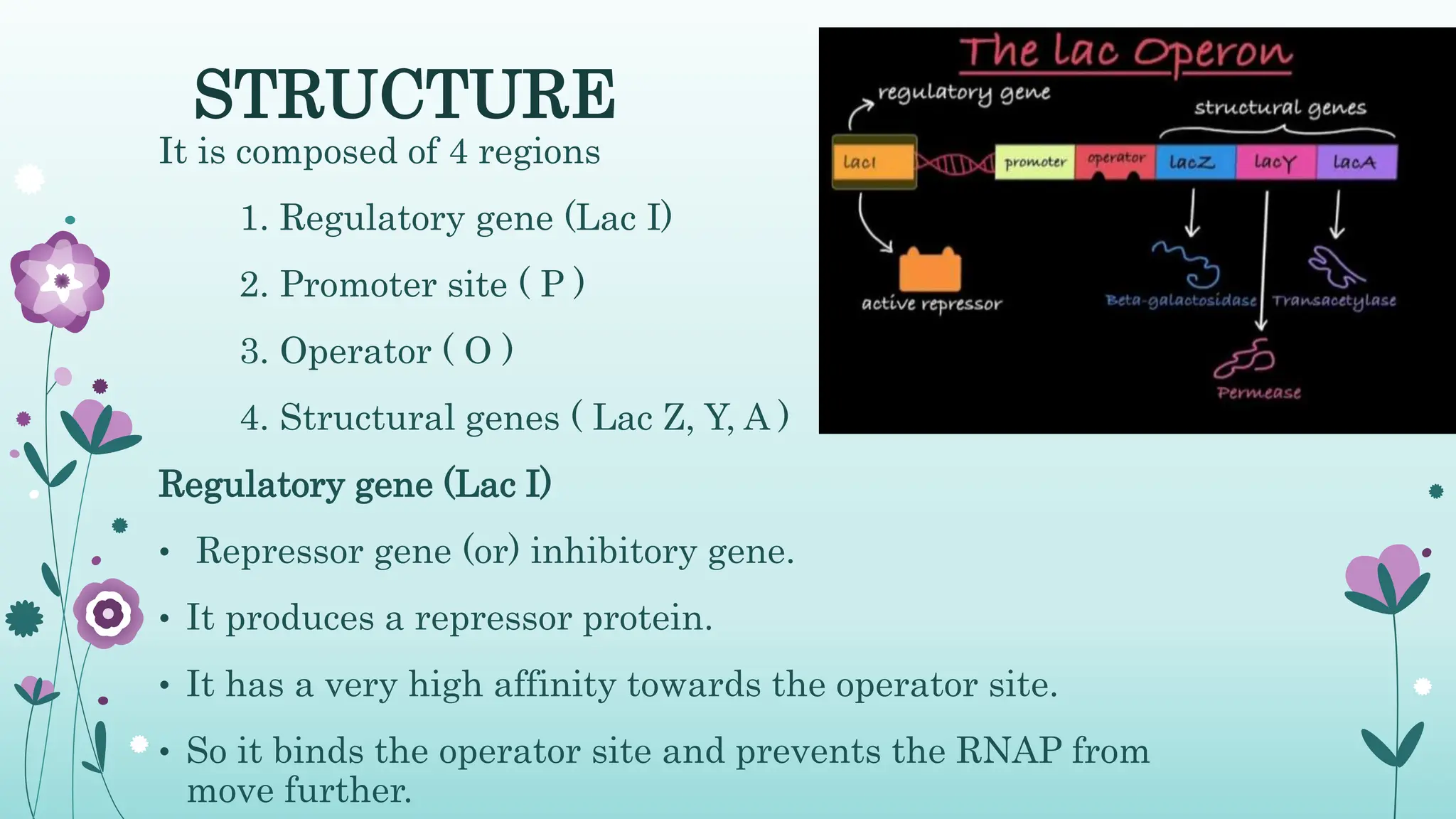
It is composed of 4 regions
1. Regulatory gene (Lac I)
2. Promoter site ( P )
3. Operator ( O )
4. Structural genes ( Lac Z, Y, A )
Regulatory gene (Lac I)
• Repressor gene (or) inhibitory gene.
• It produces a repressor protein.
• It has a very high affinity towards the operator site.
• So it binds the operator site and prevents the RNAP from
move further.
PROMOTER SITE
It contains two specific
regions.
1. Catabolite activator
protein binding site.
( CAP site)
2.RNA Polymerase
entry site, to which the
RNA Polymerase binds.
OPERATOR SITE
• A regulatory protein called
the lac repressor protein
binds to this site and blocks
the initiation of
transcription.
• This site is present
between the promoter site
and Lac Z gene.
STRUCTURAL GENES
Lac Z – codes for β – Galactosidase which hydrolyzes the lactose to
galactose and glucose.
Lac Y – codes for Permease which facilitates the movement of lactose
into the cell.
Lac A – codes for Thiogalactoside transacetylase which acetylates
lactose.
CAP site
• This site is present in the promoter region (upstream to
RNAP binding site) where the cAMP – CAP Complex binds
and enhances the initiation of transcription.
• When Glucose level decreases in the cell ,cAMP level
increases. Because Adenylyl cyclase is inactive in the
presence of glucose. This cAMP binds with Catabolite
Activator Protein. This complex binds to the CAP binding site
of promoter and the transcription occurs.
• When glucose level increases ,cAMP level decreases. In the
absence of cAMP ,CAP does not bind to the CAP binding site
and the transcription does not occur. This is called Catabolite
repression.
REGULATION OF LAC OPERON
• Lac Operon is an inducible operon. Lactose acts as a inducer
here .
• It is normally in off state.
Lac operon is regulated by 4 mechanisms.
1. Regulation in the absence of lactose and Presence of
glucose.
2. Regulation in the presence of Lactose and Absence of
glucose.
3. Regulation in the presence of both glucose and lactose.
4. Regulation in the absence of both glucose and lactose.
GLUCOSE (+) , LACTOSE (-)
• Usually E.coli depends on glucose as their source of energy.
LACTOSE (+), GLUCOSE (-)
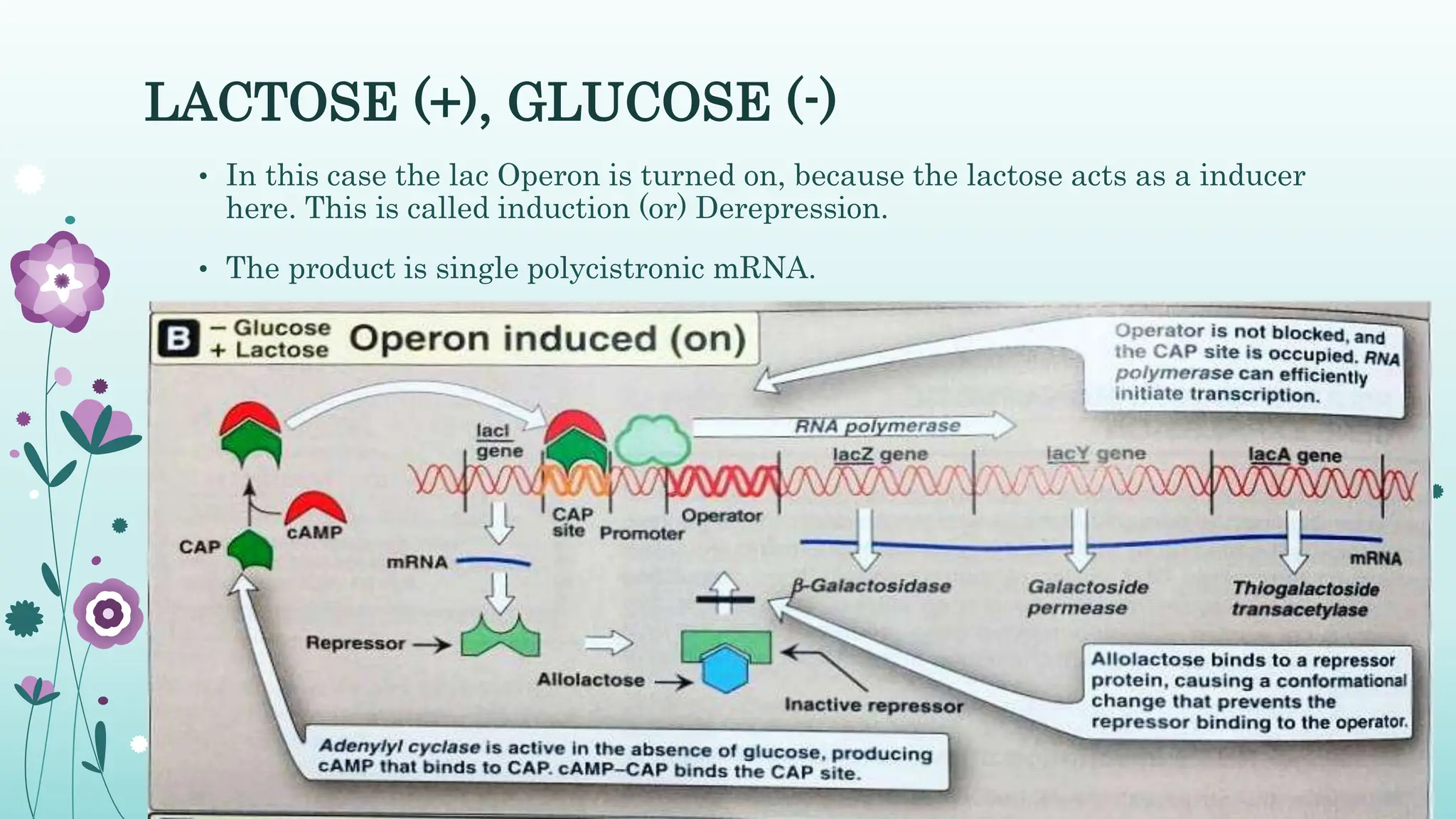
• In this case the lac Operon is turned on, because the lactose acts as a inducer
here. This is called induction (or) Derepression.
• The product is single polycistronic mRNA.
GLUCOSE (+) , LACTOSE (+)
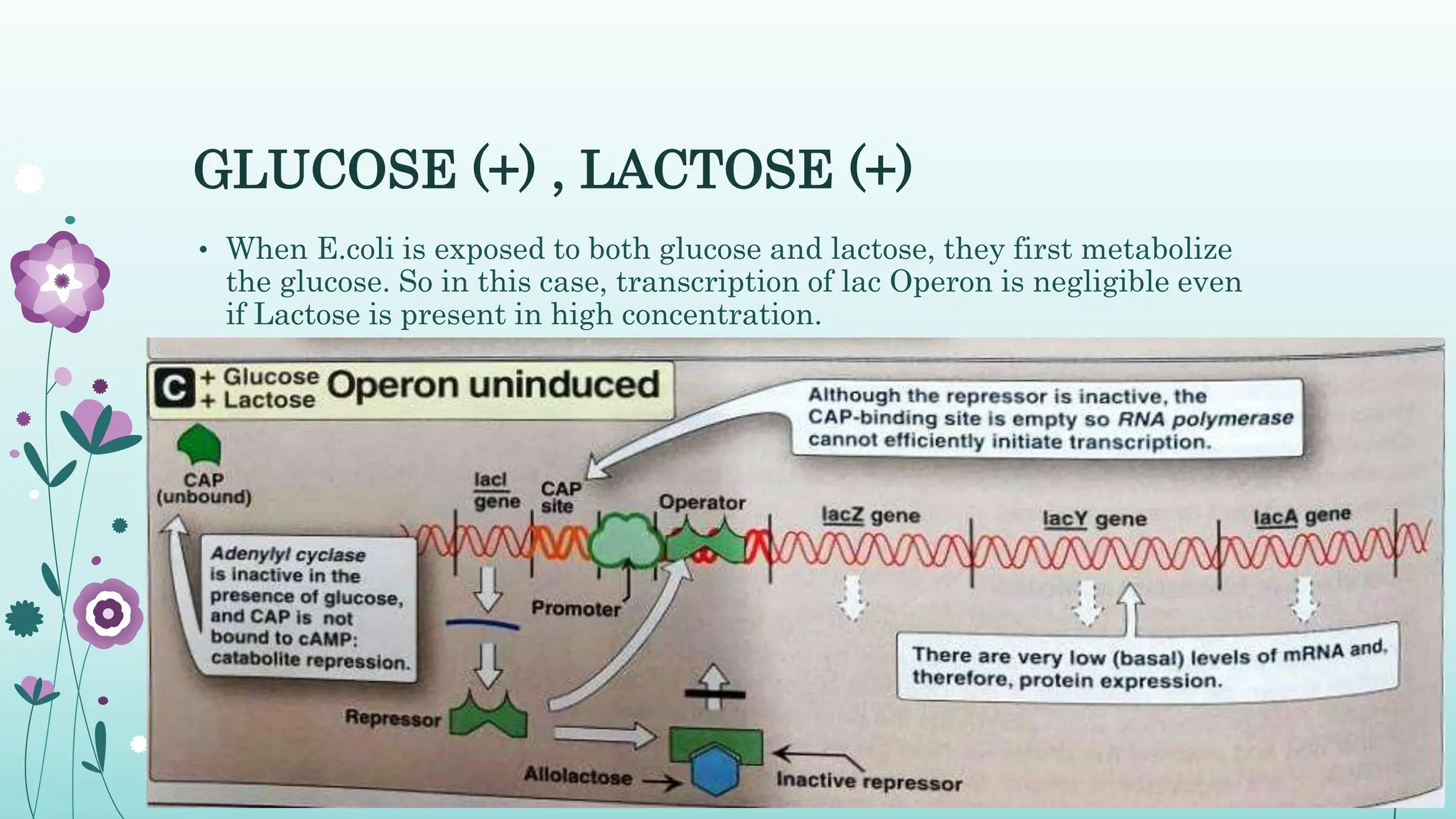
• When E.coli is exposed to both glucose and lactose, they first metabolize
the glucose. So in this case, transcription of lac Operon is negligible even
if Lactose is present in high concentration.
GLUCOSE (-) LACTOSE (-)
• cAMP – CAP Complex binds to Cap site and Enhances initiation of
transcription.
• But due to the absence of Lactose, repressor protein binds to the O site
and prevents transcription. So Operon is in off state.
GRATUITOUS INDUCER
• A Lactose analog that is capable of inducing the lac
operon while it is not serving as a substrate for Beta
Galactosidase is called GRATUITOUS INDUCER.
• Example: Isopropyl Thiogalactoside
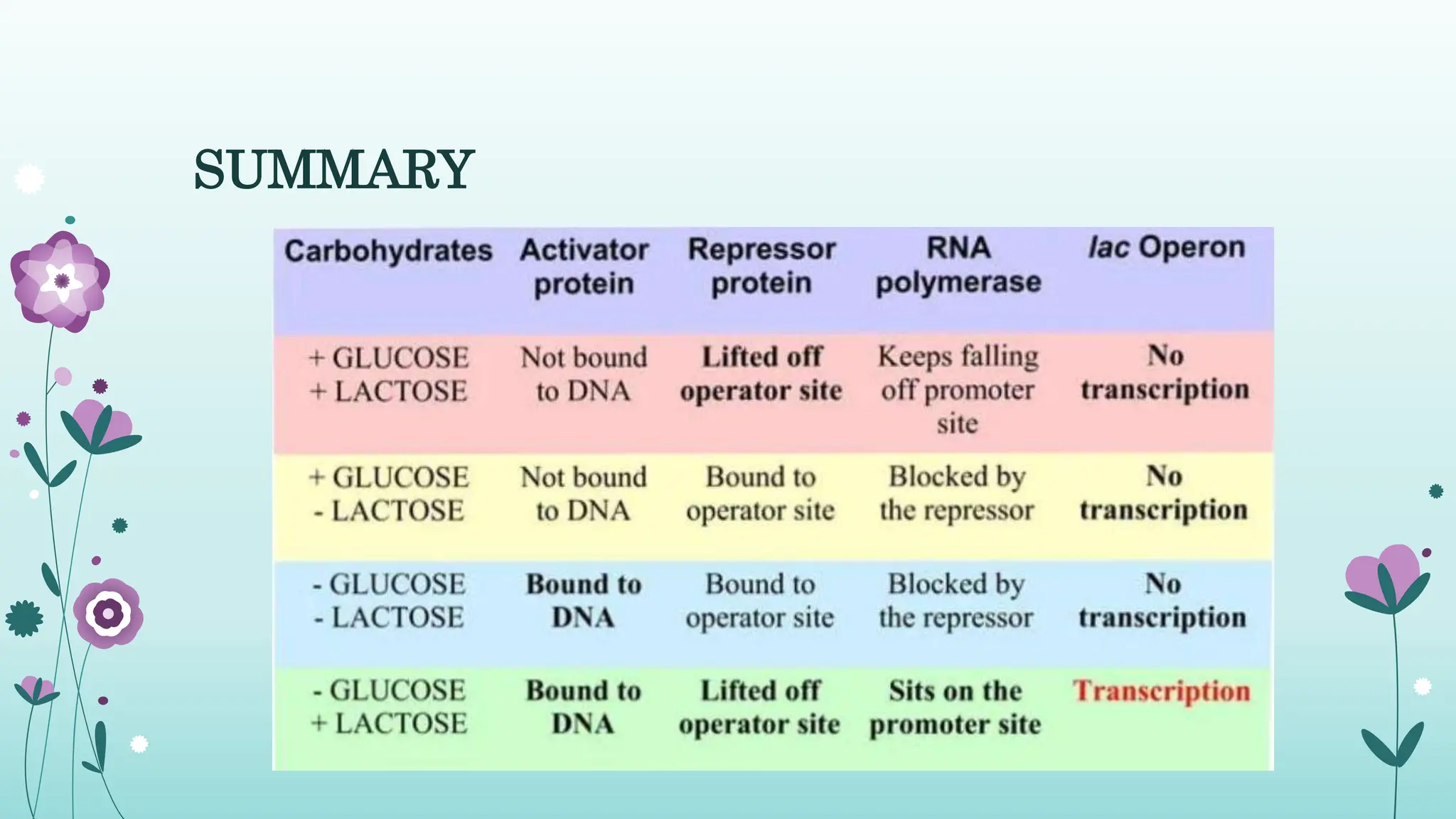
SUMMARY
REFERENCE
lac Operon.ppt-2.pptxThe classic example

lac Operon.ppt-2.pptxThe classic example

  • 1.
  • 2.
    SYNOPSIS  Introduction  Structureof lac operon  CAP site  Regulation of lac operon  Gratuitous inducer  Summary
  • 3.
    INTRODUCTION • Lac meanslactose. • Lac operon is a group of Genes that regulates the Metabolism of lactose. • The Operon concept is described by JACOB and MONAD in E.coli. • Lac Operon is a model for regulation of gene expression in prokaryotes. • It is a coordinated unit of genetic expression in bacteria.
  • 4.
    STRUCTURE It is composedof 4 regions 1. Regulatory gene (Lac I) 2. Promoter site ( P ) 3. Operator ( O ) 4. Structural genes ( Lac Z, Y, A ) Regulatory gene (Lac I) • Repressor gene (or) inhibitory gene. • It produces a repressor protein. • It has a very high affinity towards the operator site. • So it binds the operator site and prevents the RNAP from move further.
  • 5.
    PROMOTER SITE It containstwo specific regions. 1. Catabolite activator protein binding site. ( CAP site) 2.RNA Polymerase entry site, to which the RNA Polymerase binds. OPERATOR SITE • A regulatory protein called the lac repressor protein binds to this site and blocks the initiation of transcription. • This site is present between the promoter site and Lac Z gene.
  • 6.
    STRUCTURAL GENES Lac Z– codes for β – Galactosidase which hydrolyzes the lactose to galactose and glucose. Lac Y – codes for Permease which facilitates the movement of lactose into the cell. Lac A – codes for Thiogalactoside transacetylase which acetylates lactose.
  • 7.
    CAP site • Thissite is present in the promoter region (upstream to RNAP binding site) where the cAMP – CAP Complex binds and enhances the initiation of transcription. • When Glucose level decreases in the cell ,cAMP level increases. Because Adenylyl cyclase is inactive in the presence of glucose. This cAMP binds with Catabolite Activator Protein. This complex binds to the CAP binding site of promoter and the transcription occurs. • When glucose level increases ,cAMP level decreases. In the absence of cAMP ,CAP does not bind to the CAP binding site and the transcription does not occur. This is called Catabolite repression.
  • 8.
    REGULATION OF LACOPERON • Lac Operon is an inducible operon. Lactose acts as a inducer here . • It is normally in off state. Lac operon is regulated by 4 mechanisms. 1. Regulation in the absence of lactose and Presence of glucose. 2. Regulation in the presence of Lactose and Absence of glucose. 3. Regulation in the presence of both glucose and lactose. 4. Regulation in the absence of both glucose and lactose.
  • 9.
    GLUCOSE (+) ,LACTOSE (-) • Usually E.coli depends on glucose as their source of energy.
  • 10.
    LACTOSE (+), GLUCOSE(-) • In this case the lac Operon is turned on, because the lactose acts as a inducer here. This is called induction (or) Derepression. • The product is single polycistronic mRNA.
  • 11.
    GLUCOSE (+) ,LACTOSE (+) • When E.coli is exposed to both glucose and lactose, they first metabolize the glucose. So in this case, transcription of lac Operon is negligible even if Lactose is present in high concentration.
  • 12.
    GLUCOSE (-) LACTOSE(-) • cAMP – CAP Complex binds to Cap site and Enhances initiation of transcription. • But due to the absence of Lactose, repressor protein binds to the O site and prevents transcription. So Operon is in off state.
  • 13.
    GRATUITOUS INDUCER • ALactose analog that is capable of inducing the lac operon while it is not serving as a substrate for Beta Galactosidase is called GRATUITOUS INDUCER. • Example: Isopropyl Thiogalactoside
  • 14.
  • 15.