THE lac OPERON
The control of gene expression
• Each cell in the human contains all the genetic 
material for the growth and development of a 
human
• Some of these genes will be need to be expressed all 
the time
• These are the genes that are involved in of vital 
biochemical processes such as respiration
• Other genes are not expressed all the time
• They are switched on an off at need
Operons
• An operon is a group of 
genes that are 
transcribed at the 
same time. 
• They usually control an 
important biochemical 
process. 
• They are only found in 
prokaryotes.
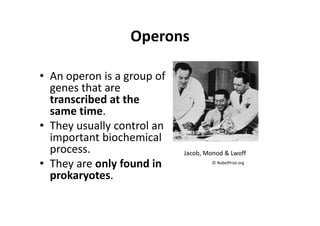
© NobelPrize.org
Jacob, Monod & Lwoff
The lac Operon
 The lac operon consists of three genes each 
involved in processing the sugar lactose
 One of them is the gene for the enzyme β‐
galactosidase
 This enzyme hydrolyses lactose into glucose 
and galactose
Adapting to the environment
• E. coli can use either glucose, which is a 
monosaccharide, or lactose, which is a 
disaccharide
• However, lactose needs to be hydrolysed 
(digested) first
• So the bacterium prefers to use glucose when 
it can
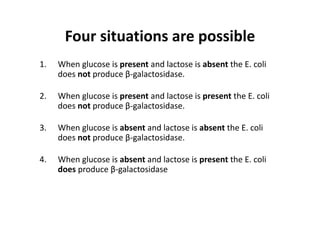
Four situations are possible
1. When glucose is present and lactose is absent the E. coli 
does not produce β‐galactosidase.
2. When glucose is present and lactose is present the E. coli 
does not produce β‐galactosidase.
3. When glucose is absent and lactose is absent the E. coli 
does not produce β‐galactosidase.
4. When glucose is absent and lactose is present the E. coli 
does produce β‐galactosidase
The control of the lac operon
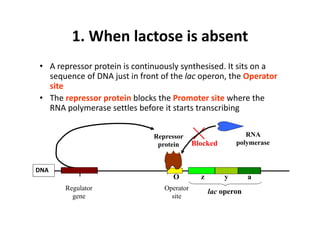
1. When lactose is absent
• A repressor protein is continuously synthesised. It sits on a 
sequence of DNA just in front of the lac operon, the Operator
site
• The repressor protein blocks the Promoter site where the 
RNA polymerase settles before it starts transcribing
Regulator
gene
lac operonOperator
site
z y a
DNA
I
O
Repressor
protein
RNA
polymeraseBlocked
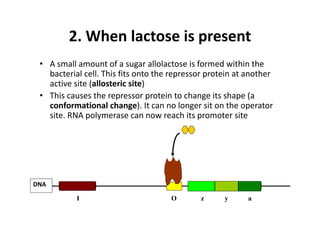
2. When lactose is present
• A small amount of a sugar allolactose is formed within the 
bacterial cell. This fits onto the repressor protein at another 
active site (allosteric site)
• This causes the repressor protein to change its shape (a
conformational change). It can no longer sit on the operator 
site. RNA polymerase can now reach its promoter site
z y a
DNA
I O
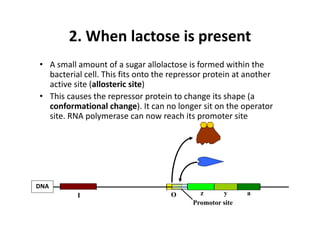
2. When lactose is present
• A small amount of a sugar allolactose is formed within the 
bacterial cell. This fits onto the repressor protein at another 
active site (allosteric site)
• This causes the repressor protein to change its shape (a
conformational change). It can no longer sit on the operator 
site. RNA polymerase can now reach its promoter site
Promotor site
z y a
DNA
I O
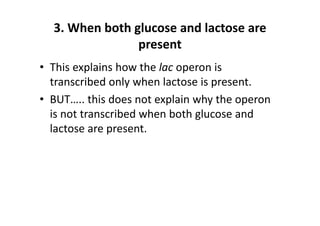
3. When both glucose and lactose are 
present
• This explains how the lac operon is 
transcribed only when lactose is present.
• BUT….. this does not explain why the operon 
is not transcribed when both glucose and 
lactose are present.
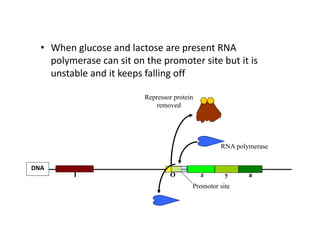
• When glucose and lactose are present RNA 
polymerase can sit on the promoter site but it is 
unstable and it keeps falling off
Promotor site
z y a
DNA
I O
Repressor protein
removed
RNA polymerase
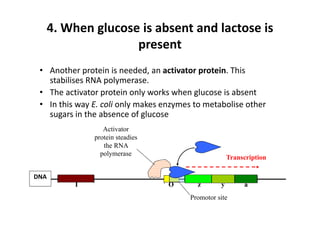
4. When glucose is absent and lactose is 
present
• Another protein is needed, an activator protein. This 
stabilises RNA polymerase.
• The activator protein only works when glucose is absent
• In this way E. coli only makes enzymes to metabolise other 
sugars in the absence of glucose
Promotor site
z y a
DNA
I O
Transcription
Activator
protein steadies
the RNA
polymerase

Lac operon