PROKARYOTIC GENE
REGULATION
Preeti Sharma
Ph.D. Scholar
2023BS11D
Department of Biochemistry,
COB&H, CCSHAU, Hisar
Operon
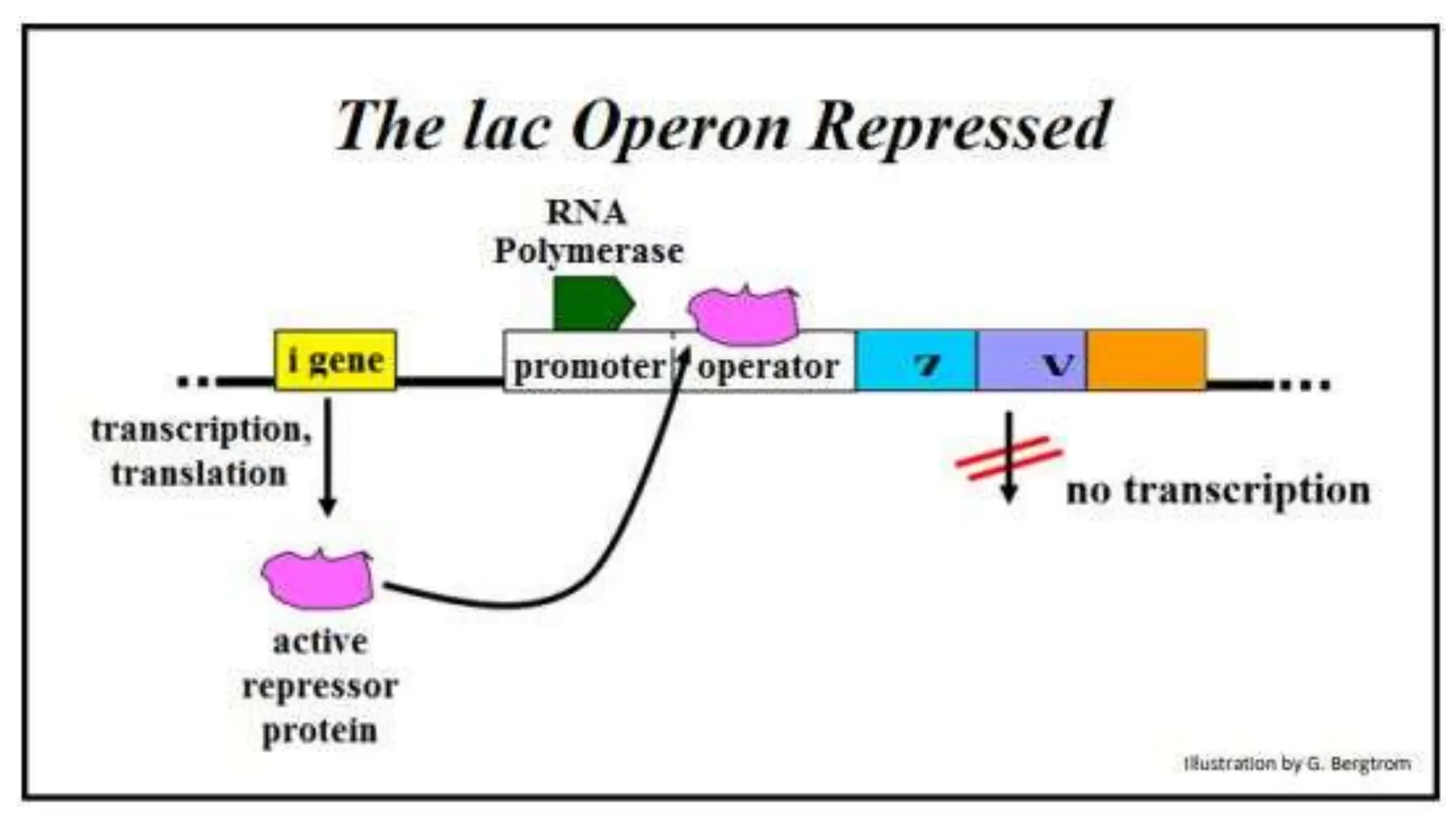
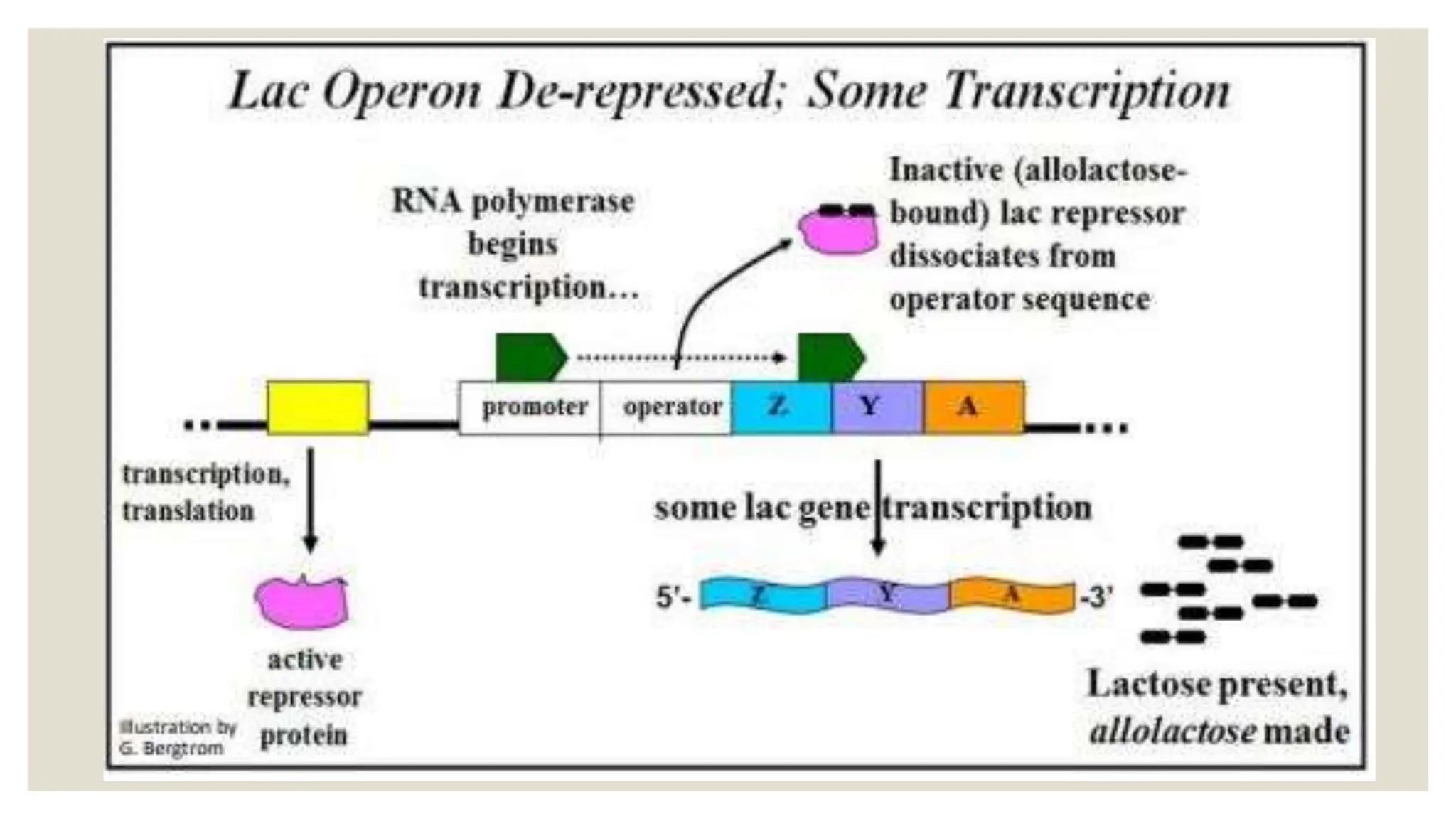
◦ An operon is a functional unit of prokaryotic gene expression and regulation. It consists of a cluster of genes that are
transcribed together into a single mRNA molecule from a single promoter. This shared mRNA is then translated into
individual proteins, each encoded by a separate gene within the operon. Operons are found in bacteria, archaea, and
some lower eukaryotes, but they are not present in higher eukaryotes like animals and plants.
◦ Regulating the activity of an operon (rather than multiple single genes encoding single proteins) allows better
coordination of the synthesis of several proteins at once. In E. coli, the regulated lac operon encodes three enzymes
involved in the metabolism of lactose (an alternative nutrient to glucose).
The mRNA transcribed from the lac operon is
simultaneously translated into three enzymes.
• The lacZ gene encodes an enzyme called β-
galactosidase- responsible for splitting lactose into
readily usable glucose and galactose
• The lacY gene encodes a membrane protein called
lactose permease- allows the cell to import lactose.
• The lacA gene encodes an enzyme known as a
transacetylase- attaches a particular chemical group
to target molecules.
Modes of Regulation
◦ Regulation of an operon can be by repression or by induction.
◦ When a small metabolite in a cell binds to a regulatory repressor or inducer protein, the
protein undergoes an allosteric change that allows it to bind to a regulatory DNA sequence, or
to un-bind from the DNA.
◦ Lac operon gene regulation is an example of gene repression as well as induction.
◦ Trp (tryptophan) operon regulation is by gene repression.
◦ In both the operons, changes in levels of intracellular metabolites reflect the metabolic status of
the cell and elicit appropriate changes in gene transcription.
• Bending the double helix
loosens H-bonds, it
becomes easier for RNA
polymerase to find and
bind the promoter on the
DNA strand to be
transcribed
Regulation of Lactose use by Inducer Exclusion
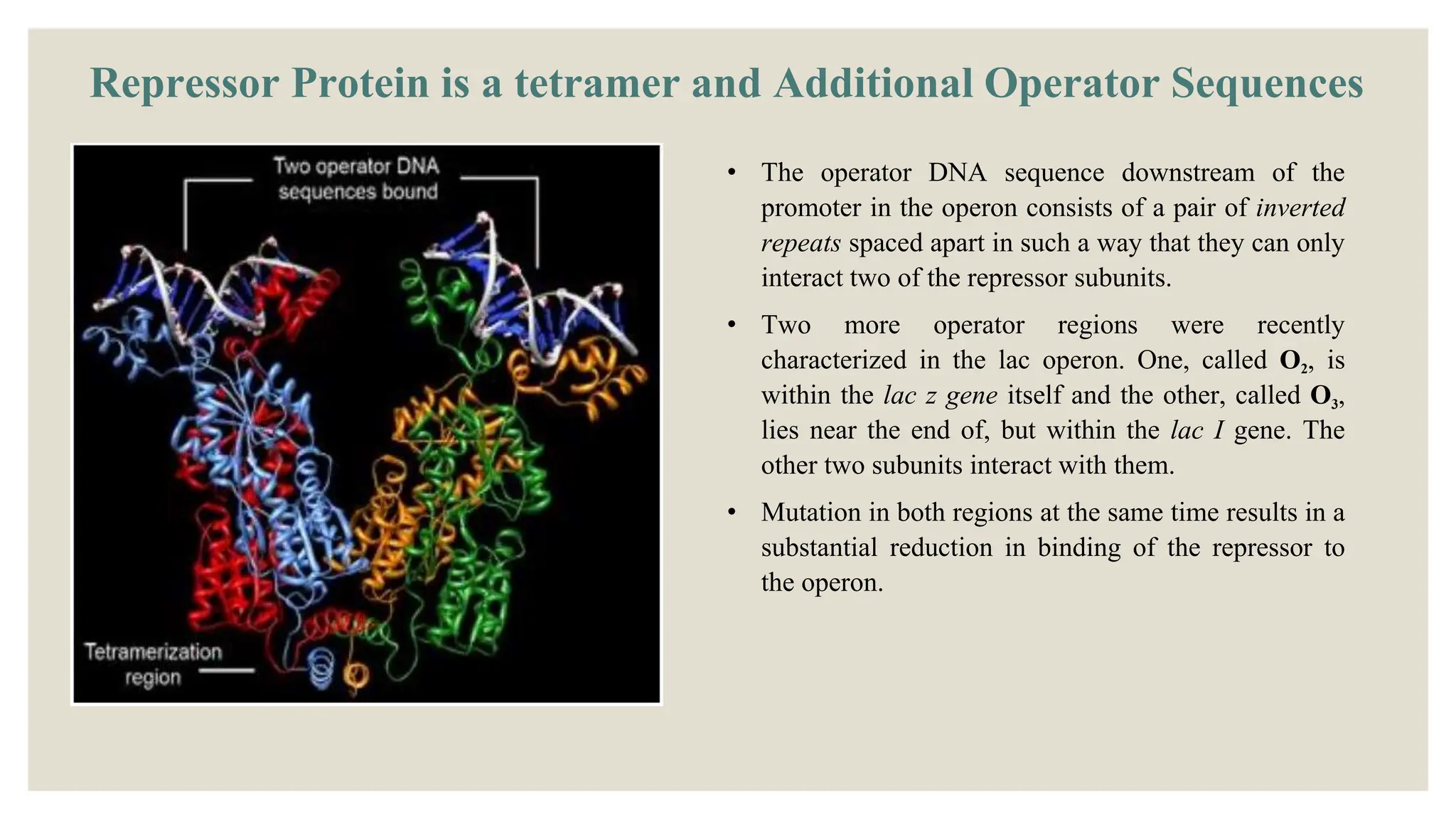
Repressor Protein is a tetramer and Additional Operator Sequences
• The operator DNA sequence downstream of the
promoter in the operon consists of a pair of inverted
repeats spaced apart in such a way that they can only
interact two of the repressor subunits.
• Two more operator regions were recently
characterized in the lac operon. One, called O2, is
within the lac z gene itself and the other, called O3,
lies near the end of, but within the lac I gene. The
other two subunits interact with them.
• Mutation in both regions at the same time results in a
substantial reduction in binding of the repressor to
the operon.
Activation and Repression of trp Operon
The leader sequence
• It contains a ribosome binding site and an AUG start codon necessary for the initiation of translation.
• The corresponding amino acid sequence coded for by the leader sequence contains several tryptophan residues.
• It contains several inverted repeat sequences such that the mRNA can adopt different alternative structures.
• One of these structures represents a rho-independent termination site.
Prokaryotic gene regulation (operon).pptx

Prokaryotic gene regulation (operon).pptx

  • 1.
    PROKARYOTIC GENE REGULATION Preeti Sharma Ph.D.Scholar 2023BS11D Department of Biochemistry, COB&H, CCSHAU, Hisar
  • 2.
    Operon ◦ An operonis a functional unit of prokaryotic gene expression and regulation. It consists of a cluster of genes that are transcribed together into a single mRNA molecule from a single promoter. This shared mRNA is then translated into individual proteins, each encoded by a separate gene within the operon. Operons are found in bacteria, archaea, and some lower eukaryotes, but they are not present in higher eukaryotes like animals and plants. ◦ Regulating the activity of an operon (rather than multiple single genes encoding single proteins) allows better coordination of the synthesis of several proteins at once. In E. coli, the regulated lac operon encodes three enzymes involved in the metabolism of lactose (an alternative nutrient to glucose). The mRNA transcribed from the lac operon is simultaneously translated into three enzymes. • The lacZ gene encodes an enzyme called β- galactosidase- responsible for splitting lactose into readily usable glucose and galactose • The lacY gene encodes a membrane protein called lactose permease- allows the cell to import lactose. • The lacA gene encodes an enzyme known as a transacetylase- attaches a particular chemical group to target molecules.
  • 3.
    Modes of Regulation ◦Regulation of an operon can be by repression or by induction. ◦ When a small metabolite in a cell binds to a regulatory repressor or inducer protein, the protein undergoes an allosteric change that allows it to bind to a regulatory DNA sequence, or to un-bind from the DNA. ◦ Lac operon gene regulation is an example of gene repression as well as induction. ◦ Trp (tryptophan) operon regulation is by gene repression. ◦ In both the operons, changes in levels of intracellular metabolites reflect the metabolic status of the cell and elicit appropriate changes in gene transcription.
  • 9.
    • Bending thedouble helix loosens H-bonds, it becomes easier for RNA polymerase to find and bind the promoter on the DNA strand to be transcribed
  • 10.
    Regulation of Lactoseuse by Inducer Exclusion
  • 11.
    Repressor Protein isa tetramer and Additional Operator Sequences • The operator DNA sequence downstream of the promoter in the operon consists of a pair of inverted repeats spaced apart in such a way that they can only interact two of the repressor subunits. • Two more operator regions were recently characterized in the lac operon. One, called O2, is within the lac z gene itself and the other, called O3, lies near the end of, but within the lac I gene. The other two subunits interact with them. • Mutation in both regions at the same time results in a substantial reduction in binding of the repressor to the operon.
  • 13.
  • 14.
    The leader sequence •It contains a ribosome binding site and an AUG start codon necessary for the initiation of translation. • The corresponding amino acid sequence coded for by the leader sequence contains several tryptophan residues. • It contains several inverted repeat sequences such that the mRNA can adopt different alternative structures. • One of these structures represents a rho-independent termination site.