DEPARTMENT OF HEALTH
RESEARCH INSTITUTE FOR TROPICAL
MEDICINE
LABORATORY BIOSAFETY IN
MOLECULAR DIAGNOSIS OF EMERGING
RESPIRATORY INFECTIOUS DISEASES
LEI LANNA M. DANCEL
Laboratory Manager
RITM – MOLECULAR BIOLOGY LABORATORY
Topics
2
The Changing Landscape of
Infectious Diseases
PCR-based Detection (MERS Co
Biosafety Considerations in PCR-based
Detection of Emerging Respiratory Viral
Infections (MERS-CoV)
Overview of Laboratory Biosafety
Principles of Biosafety
3RESEARCH INSTITUTE FOR TROPICAL MEDICINE
The Changing Landscape of Infectious
Diseases
3
2003
SARS
Coronavir
us
2009
Pandemic
Influenza
H1N1
2012
MERS
Coronavir
us
1975
Avian
Influenza
H7
1997
Avian
Influenza
H5
1999
Avian
Influenza
H9
Emerging and Re-Emerging Respiratory viruses
H7 H5 H9 SARS
CoV
PdmH10
9
MERS
CoV
4RESEARCH INSTITUTE FOR TROPICAL MEDICINE
Laboratory Response to Emerging
Respiratory Viral Infections
4
GLOBAL LAB
RESPONSE
NATIONAL LAB
RESPONSE
WHO Emerging and Dangerous
Pathogens Laboratory Network
 National Reference Lab at RITM
 DOH National-Subnational
Laboratory Network
5RESEARCH INSTITUTE FOR TROPICAL MEDICINE
Laboratory Biosafety
The safe handling of biological materials,
particularly infectious agents which are
classified on the basis of degree of risk to
humans
5
Safe
Handling
Contain
ment
6RESEARCH INSTITUTE FOR TROPICAL MEDICINE
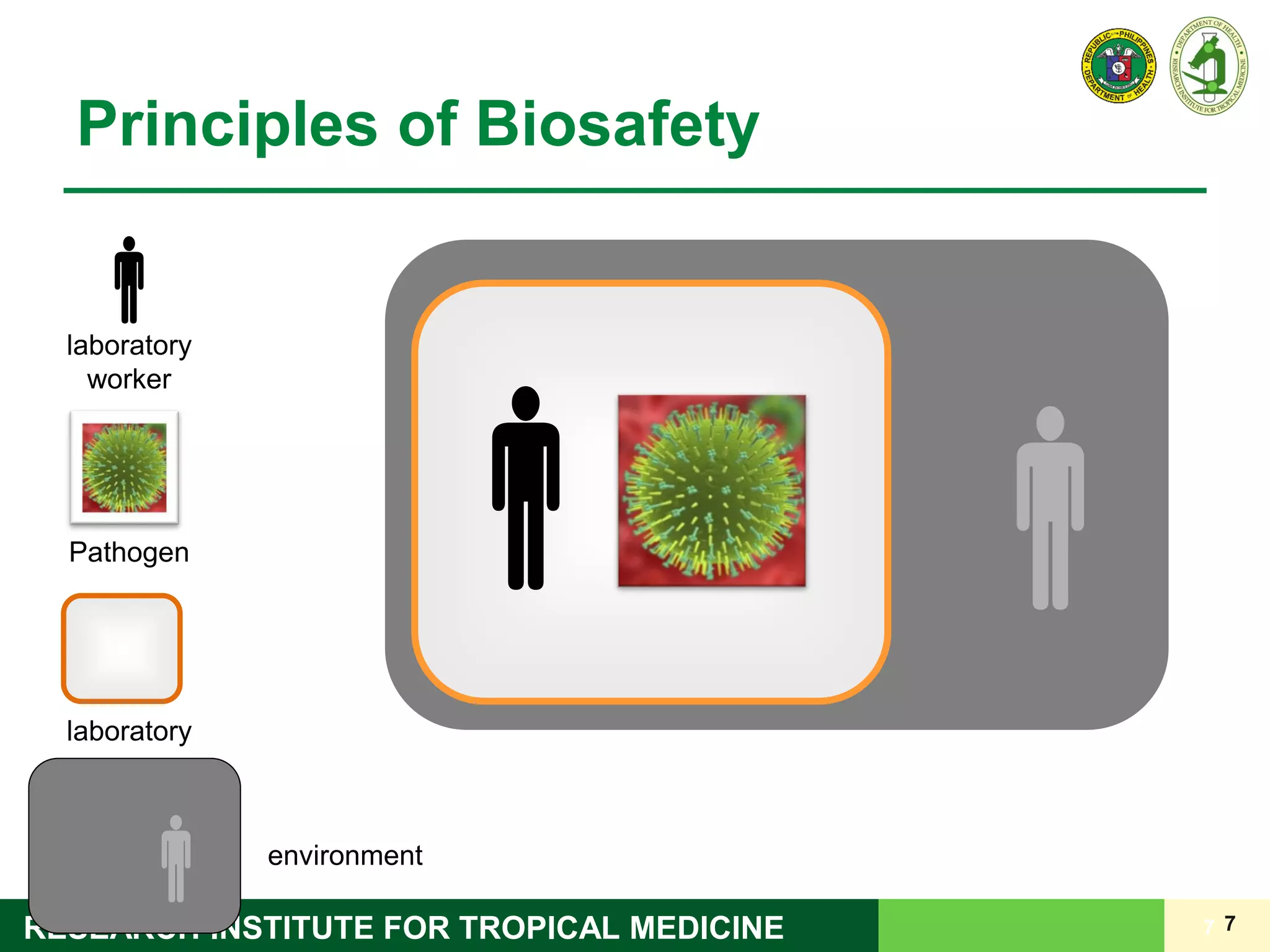
Principles of Biosafety
6
Safe Handling and
Containment aim to
protect the :
Laboratory
worker
Pathogen
(Specime
n
Integrity)
Laboratory
Environment
7RESEARCH INSTITUTE FOR TROPICAL MEDICINE
Principles of Biosafety
7

laboratory
worker
Pathogen


laboratory
environment
8RESEARCH INSTITUTE FOR TROPICAL MEDICINE
Principles of Biosafety
8

laboratory
worker
Pathogen


laboratory
environment
BIOSAFETY BREACH
9RESEARCH INSTITUTE FOR TROPICAL MEDICINE 9
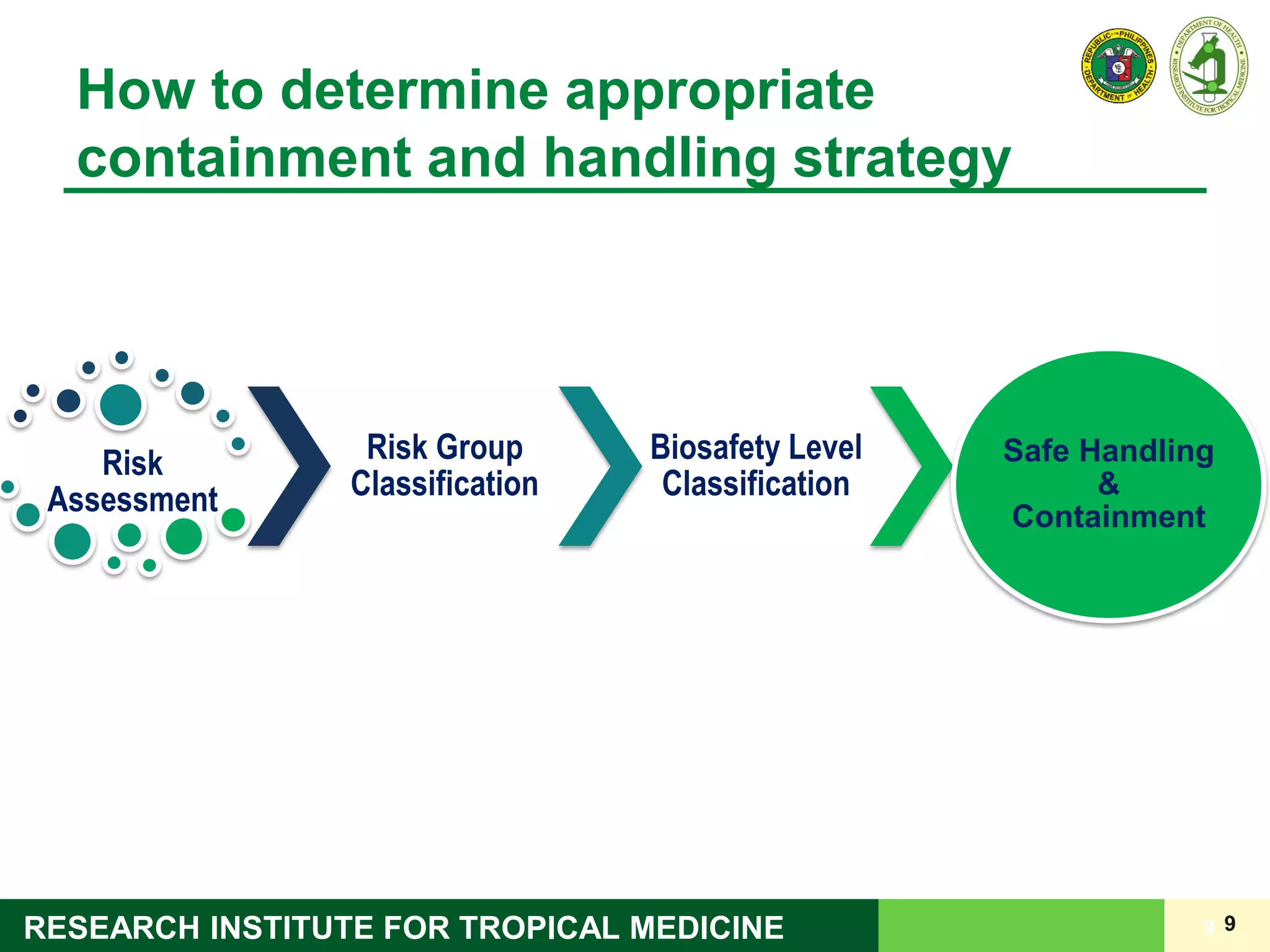
How to determine appropriate
containment and handling strategy
Risk
Assessment
Risk Group
Classification
Biosafety Level
Classification
Safe Handling
&
Containment
10RESEARCH INSTITUTE FOR TROPICAL MEDICINE
Risk Assessment
10
1 Identify key hazards and perform initial assessment
of the risk (capability to infect, severity of the
disease and availability of preventive measures and
effective treatment)
2 Identify the laboratory procedure hazards (aerosol
generation, use of sharps, use of experimental
animals)
3 Assign appropriate biosafety level and select
additional precautions
4 Evaluate the proficiencies of staff regarding safe
practices and integrity of safety equipment
11RESEARCH INSTITUTE FOR TROPICAL MEDICINE
Risk Group Classification (WHO)
11
 No or low individual and community risk
 Unlikely to cause human or animal disease
 Moderate individual risk, low community risk
 Can cause disease but unlikely to be a serious hazard
 Lab exposures may cause serious infection, but effective
treatment and preventive measures are available and risk of
spread of infection is limited
 High individual risk, low community risk
 Usually causes serious human or animal disease but
does not ordinarily spread. Effective treatment and
preventive measures are available.
 High individual and community risk
 Usually causes serious human or animal disease and
can be readily transmitted.
 Effective treatment and preventive measures are not
usually available
12RESEARCH INSTITUTE FOR TROPICAL MEDICINE
Biosafety Levels (WHO)
12
Suitable for work involving well-characterized agents not known
to cause disease in healthy adult humans and of minimal
potential hazard to laboratory personnel and the environment
Suitable for work involving agents of moderate potential
hazard to personnel and the environment
Suitable for work with infectious agents which may cause
serious or potentially lethal disease as a result of exposure
by the inhalation route
Suitable for work involving exotic infectious agents that
pose a high risk of life-threatening disease and can be
transmitted as an aerosol and for which there is no vaccine
or therapy
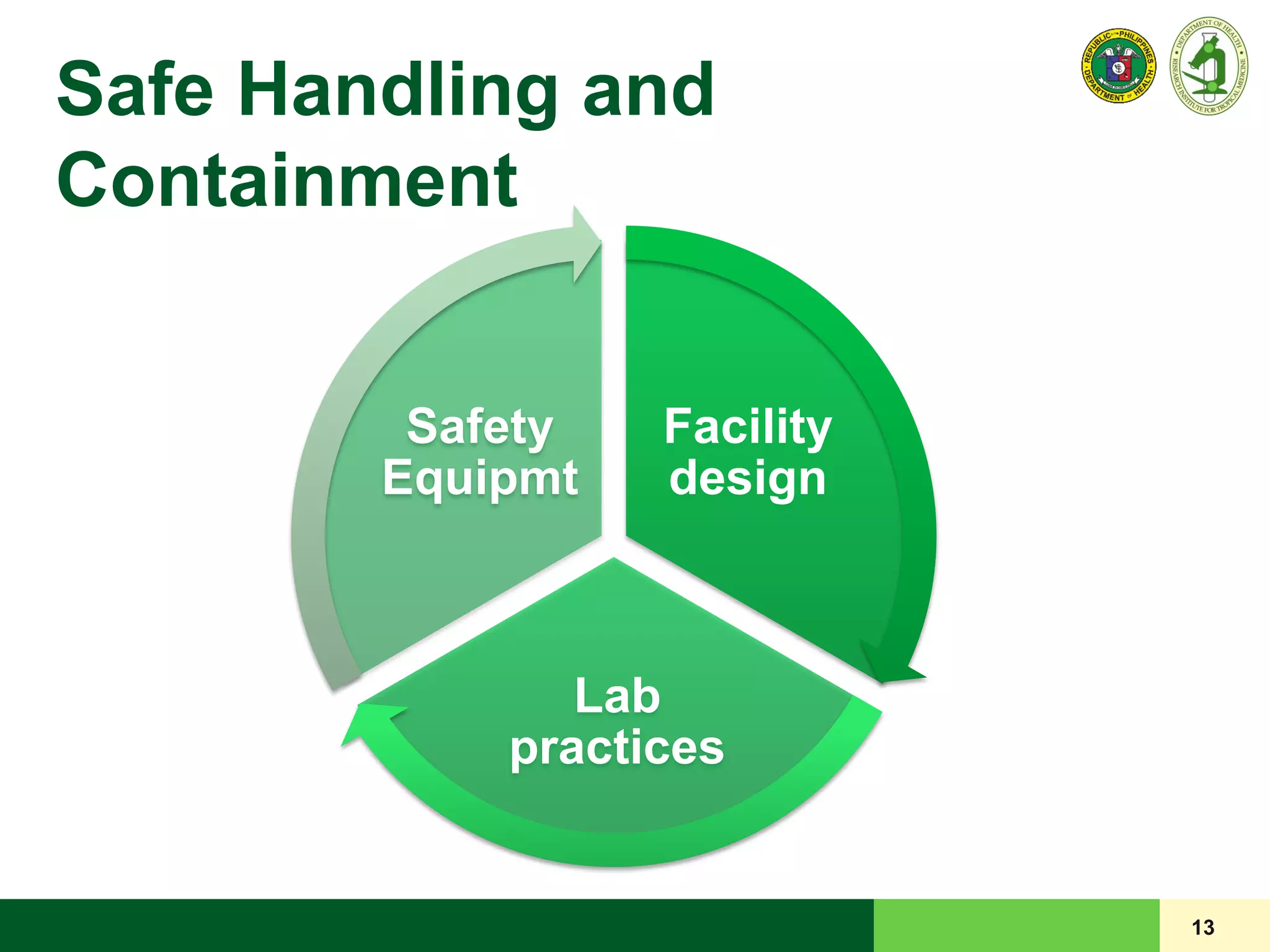
Safe Handling and
Containment
13
Facility
design
Lab
practices
Safety
Equipmt
14
Safe Lab Practices
Access Control
Use of appropriate
PPE
Waste Management
Practices
Decontamination/ Disinfection
Procedures
Good Personal Hygiene
15
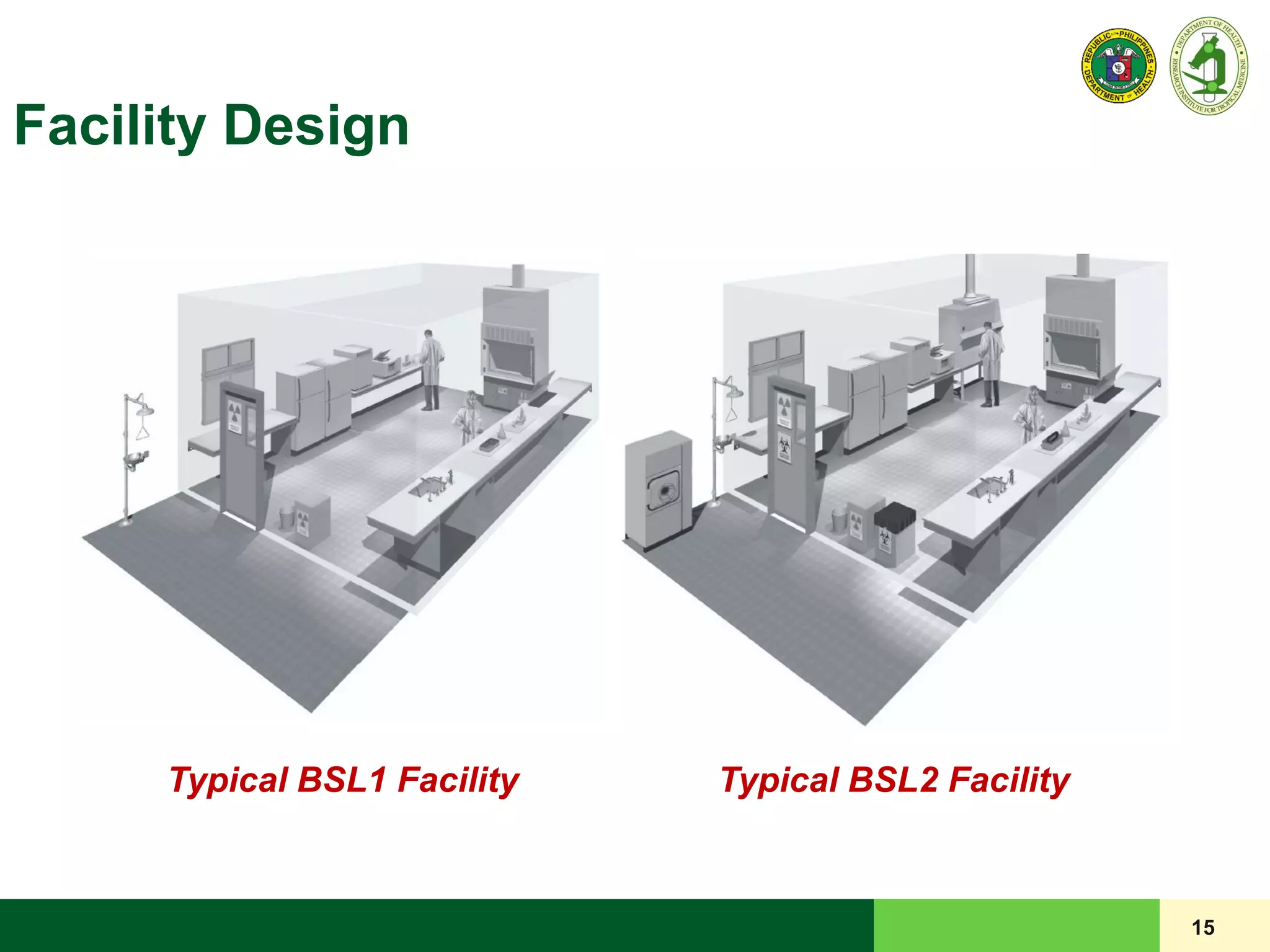
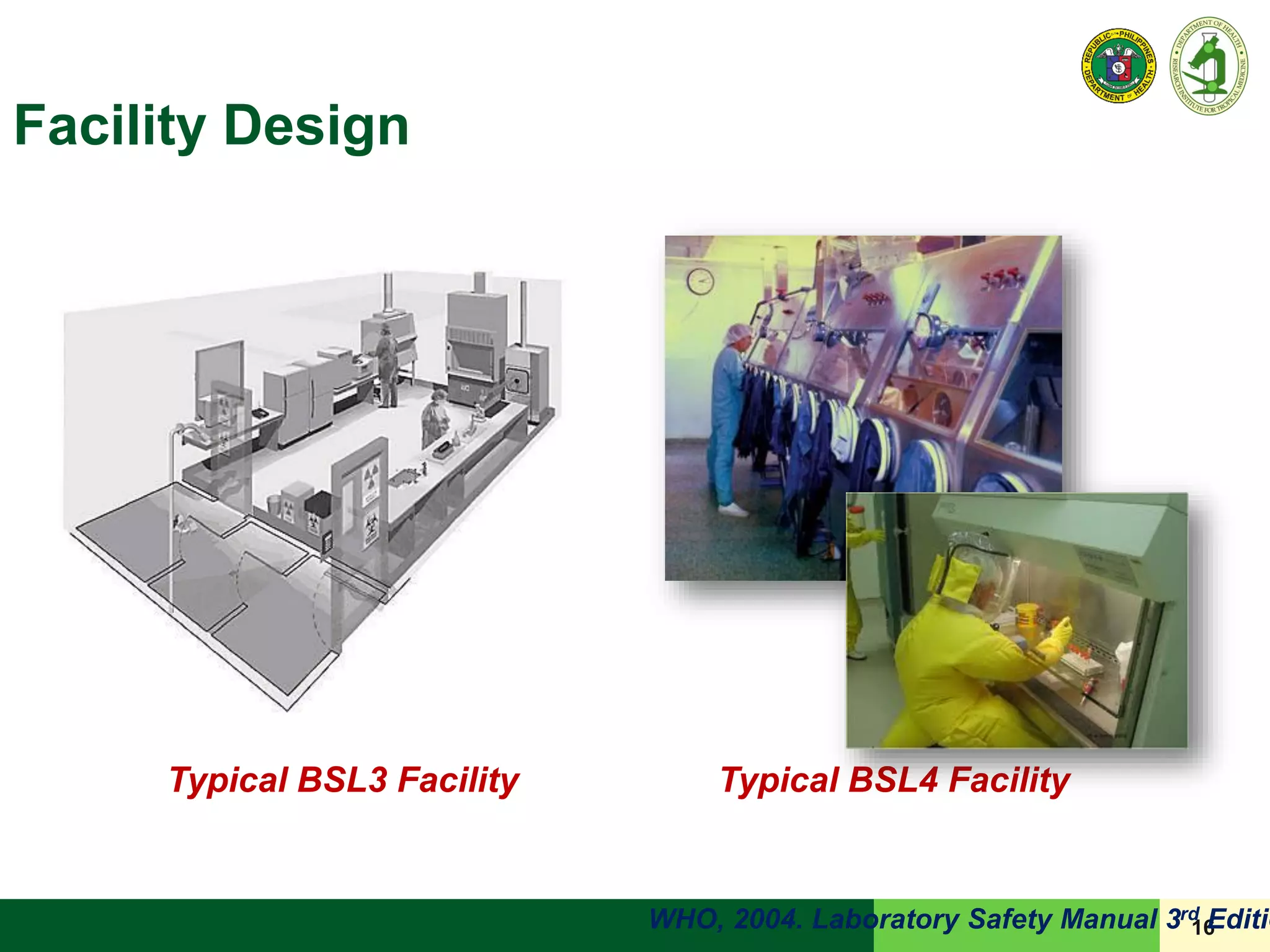
Facility Design
Typical BSL1 Facility Typical BSL2 Facility
16
Facility Design
WHO, 2004. Laboratory Safety Manual 3rd Editio
Typical BSL3 Facility Typical BSL4 Facility
Molecular Detection of Emerging
Respiratory Infectious Diseases
17
Molecular Dx
18
Checks for the
+/-of a molecular
ID
Each pathogen may be
identified by
unique/signature sections
of their genome
Polymerase
Chain Reaction
(PCR)
simple method for making
virtually unlimited copies of
the DNA sequence of a
pathogen
19
Genomes
Comprised of the entire
genetic/hereditary
information of the
organism/agent
20
PCR Based Detection
Target
pathogen
suspended in
clinical
specimen
Break
apart the
virus
Isolate the
genetic
material
Select the unique
sequence
(molecular ID)
Amplify selected
sequence
Detection of
the amplified
sequence
Result
Analysis
Reporting of
Result
MERS-CoV
Positive
PCR Detection of MERS
Coronavirus
22RESEARCH INSTITUTE FOR TROPICAL MEDICINE
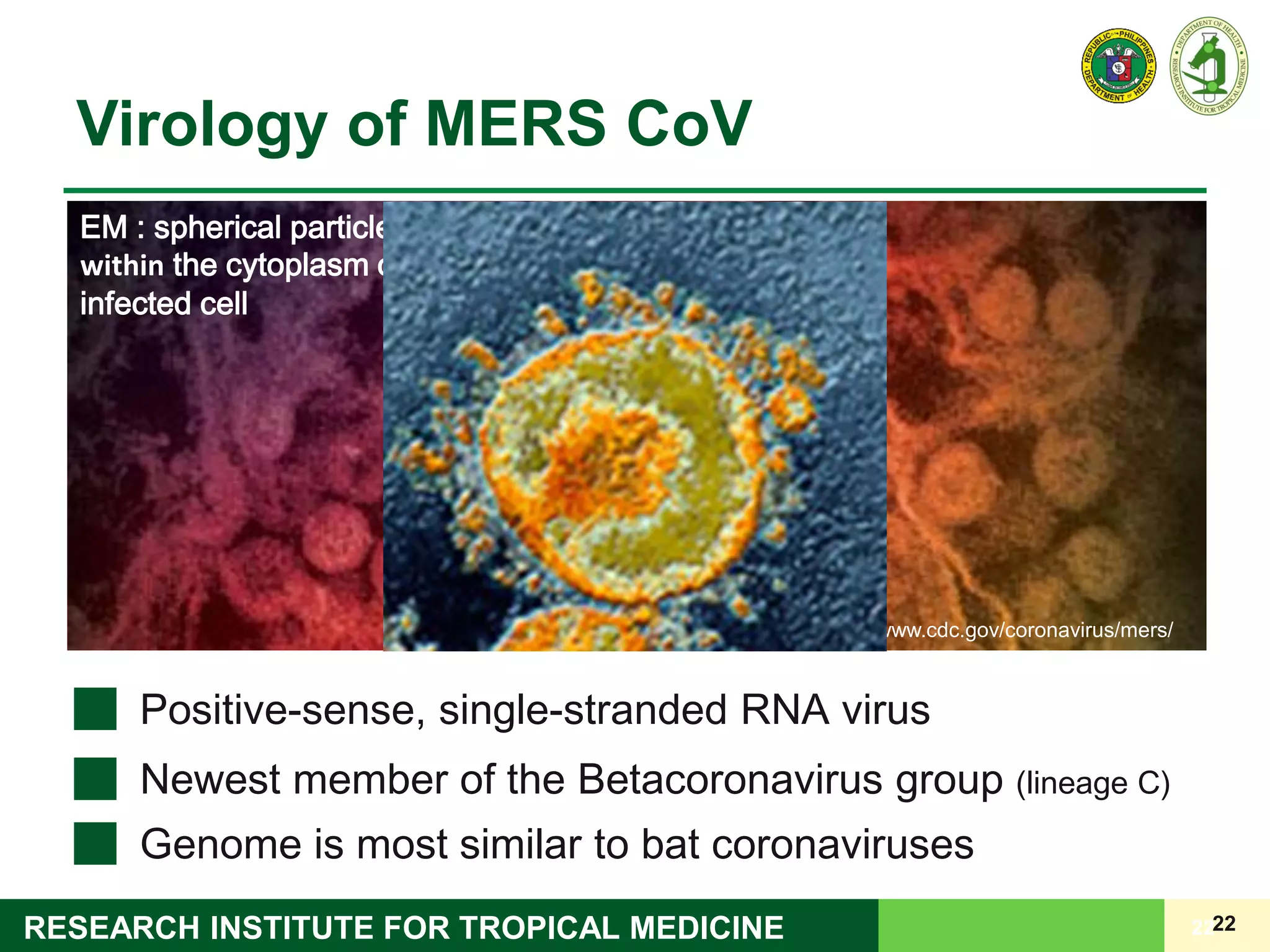
Virology of MERS CoV
22
http://www.cdc.gov/coronavirus/mers/
EM : spherical particles
within the cytoplasm of an
infected cell
Positive-sense, single-stranded RNA virus
Newest member of the Betacoronavirus group (lineage C)
Genome is most similar to bat coronaviruses
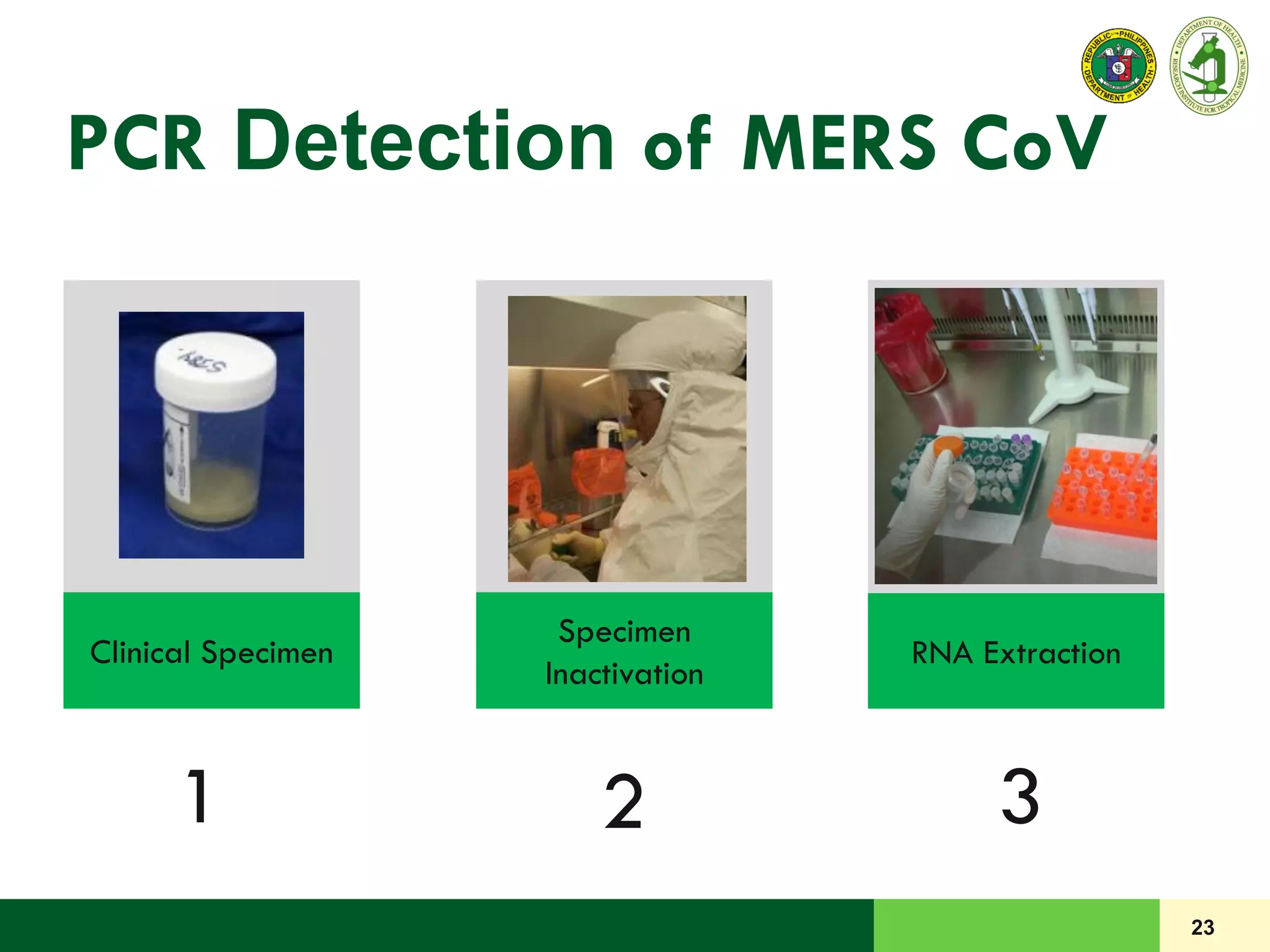
PCR Detection of MERS CoV
23
Clinical Specimen
Specimen
Inactivation
RNA Extraction
1 2 3
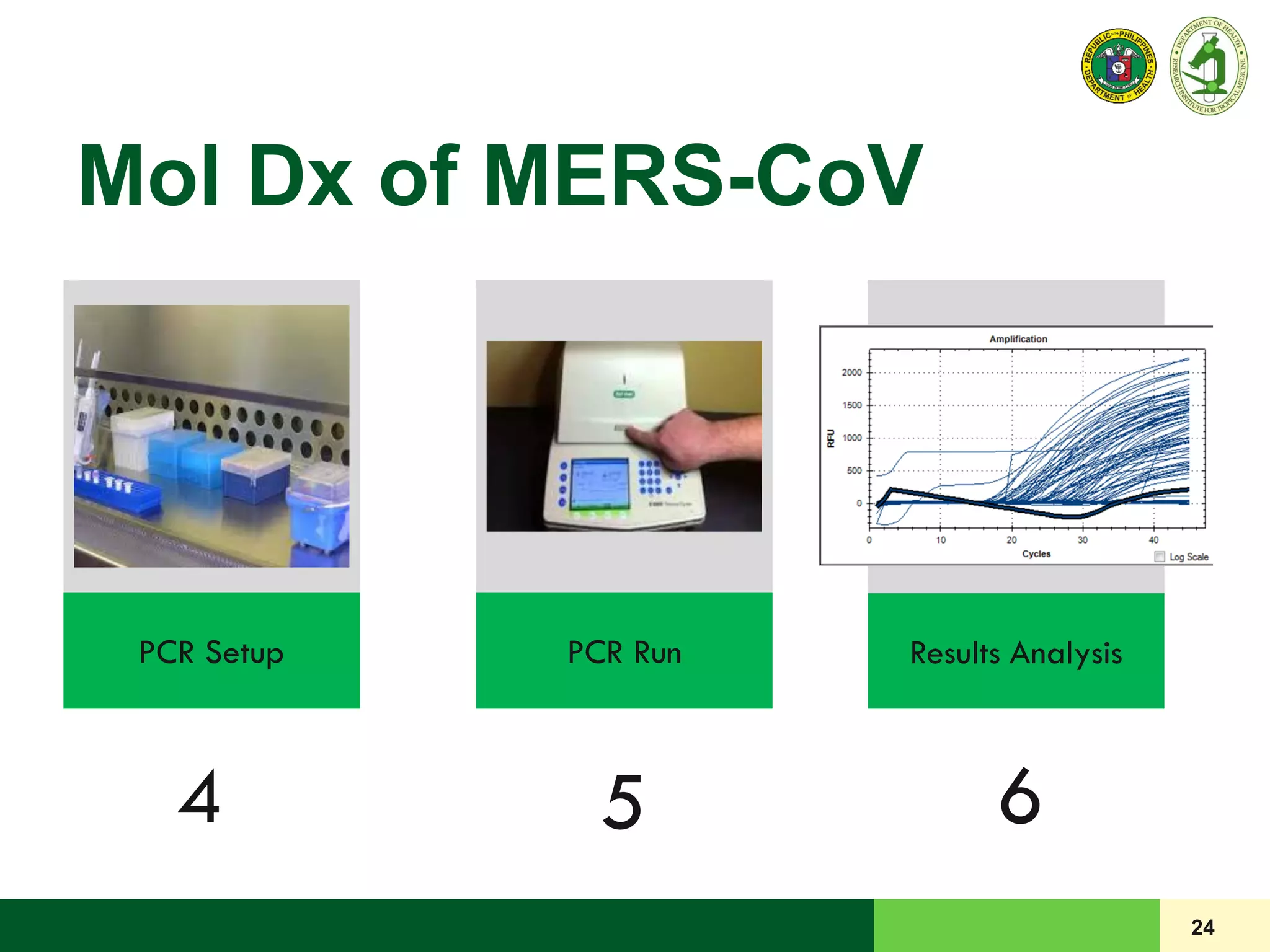
Mol Dx of MERS-CoV
24
PCR Setup PCR Run Results Analysis
4 5 6
Mol Dx of MERS-CoV
25
Results Validation Results Reporting
7 8
Sequence Analysis
(if applicable)
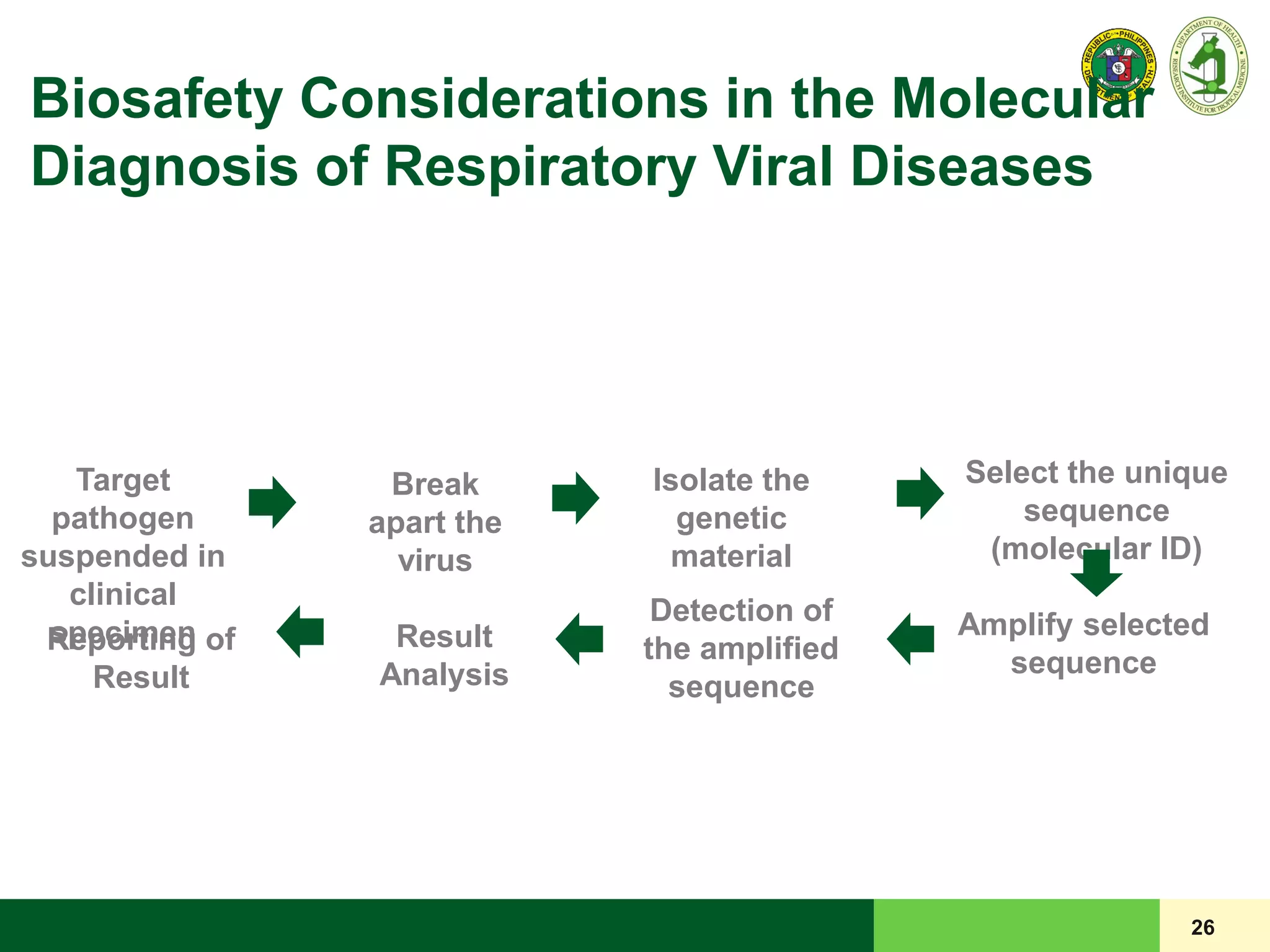
Biosafety Considerations in the Molecular
Diagnosis of Respiratory Viral Diseases
26
Target
pathogen
suspended in
clinical
specimen
Break
apart the
virus
Isolate the
genetic
material
Select the unique
sequence
(molecular ID)
Amplify selected
sequence
Detection of
the amplified
sequence
Result
Analysis
Reporting of
Result
27
Biosafety Considerations in the Molecular
Diagnosis of Respiratory Viral Diseases
MERS CoV Risk Group Classification : RG3
 High individual risk, low community risk
 Usually causes serious human or animal disease but
does not ordinarily spread. Effective treatment and
preventive measures are available.
28
Laboratory Activities involved in
MERS CoV detection (Canadian Biosafety
Standards)
Activity
BSL2
Facility
BSL3
Facility
Processing specimens for
packaging and distribution to
laboratories
Diagnostic Testing activities
(excluding culture)
Molecular diagnostic testing
Culture of specimens
Preparatory work for in vivo
activities
Processing positive cultures for
29RESEARCH INSTITUTE FOR TROPICAL MEDICINE 29
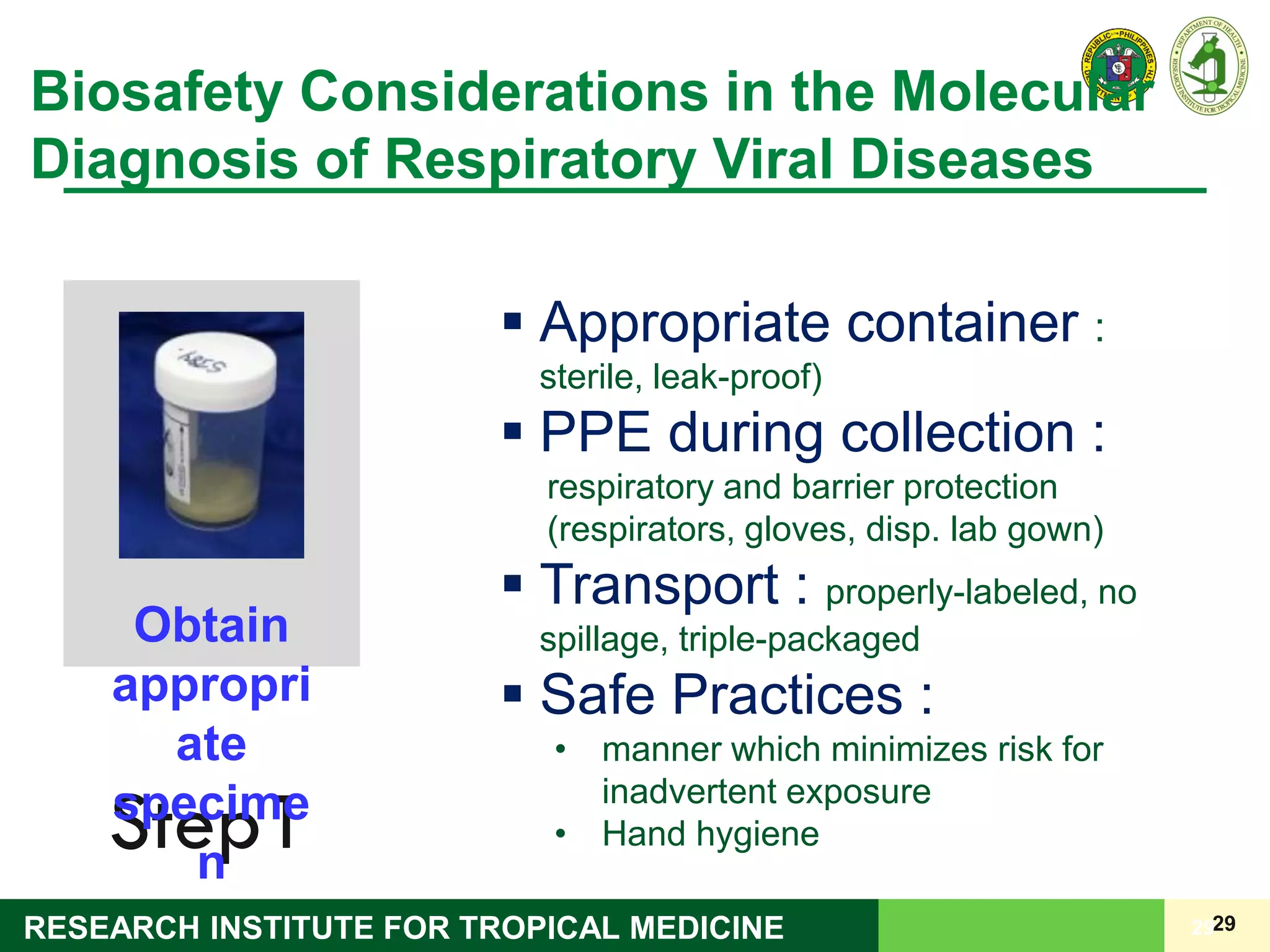
Biosafety Considerations in the Molecular
Diagnosis of Respiratory Viral Diseases
Step1
Obtain
appropri
ate
specime
n
 Appropriate container :
sterile, leak-proof)
 PPE during collection :
respiratory and barrier protection
(respirators, gloves, disp. lab gown)
 Transport : properly-labeled, no
spillage, triple-packaged
 Safe Practices :
• manner which minimizes risk for
inadvertent exposure
• Hand hygiene
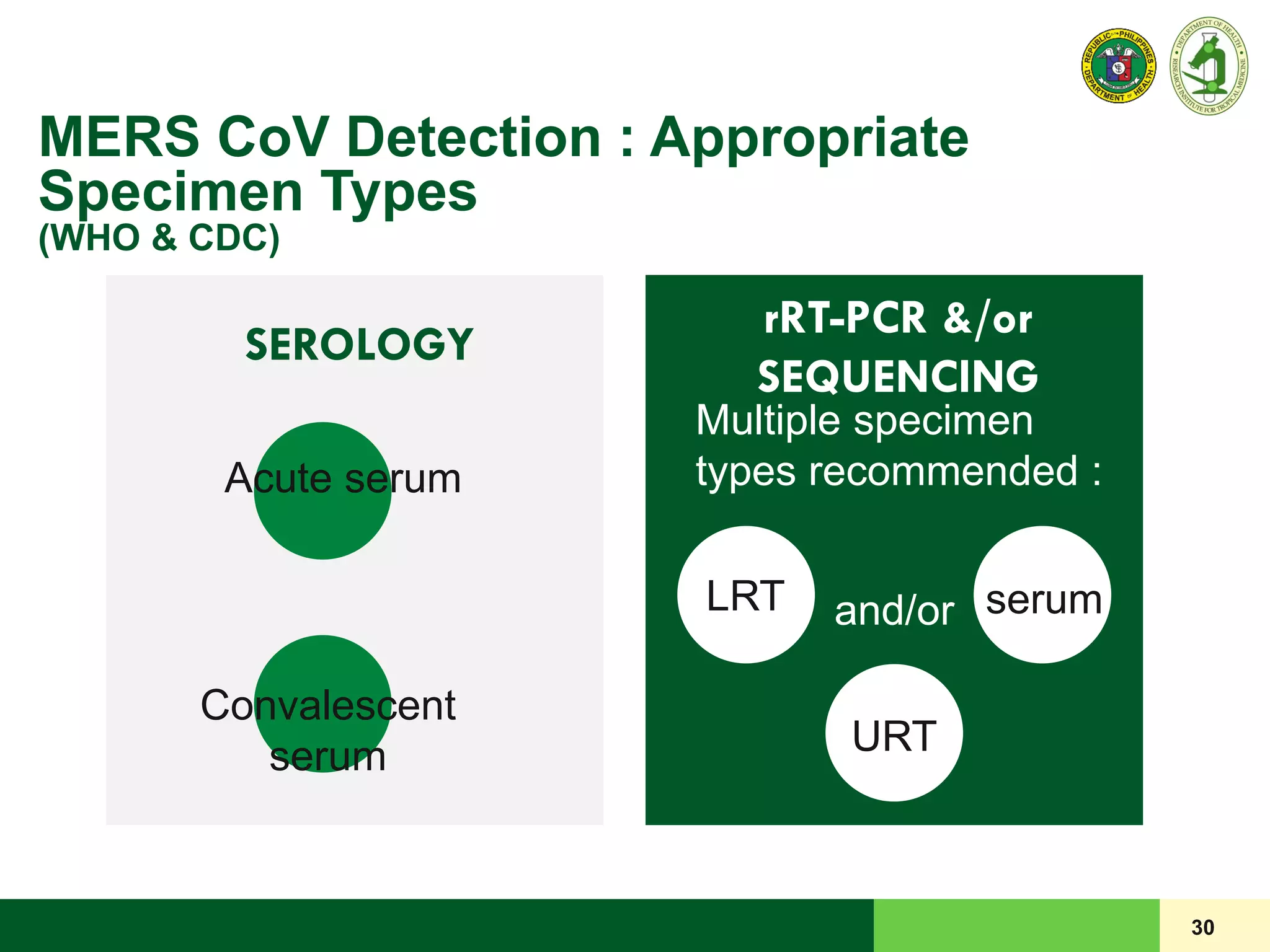
30
MERS CoV Detection : Appropriate
Specimen Types
(WHO & CDC)
SEROLOGY
Multiple specimen
types recommended :
and/or
Acute serum
Convalescent
serum
LRT
URT
serum
rRT-PCR &/or
SEQUENCING
31
 BAL
 Tracheal aspirate
 Pleural fluid
 sputum
LRT
Appropriate Specimen Types
(WHO & CDC)
Refrigerate specimen at 2-8°C up to 72 hours; if exceeding
72 hours, freeze at -70°C and ship on dry ice
32
 NPS and OPS in
VTM/UTM
 Nasopharyngeal
wash/aspirate
 Nasal aspirate
URT
Refrigerate specimen at 2-8°C up to 72 hours; if exceeding
72 hours, freeze at -70°C and ship on dry ice
Appropriate Specimen Types
(WHO & CDC)
33RESEARCH INSTITUTE FOR TROPICAL MEDICINE 33
Biosafety Considerations in the Molecular
Diagnosis of Respiratory Viral Diseases
Step1
Obtain
appropri
ate
specime
n
 Acceptable respiratory
protection devices for
MERS CoV specimen
collection :
 Properly-fit tested
 N95 or higher level
34RESEARCH INSTITUTE FOR TROPICAL MEDICINE 34
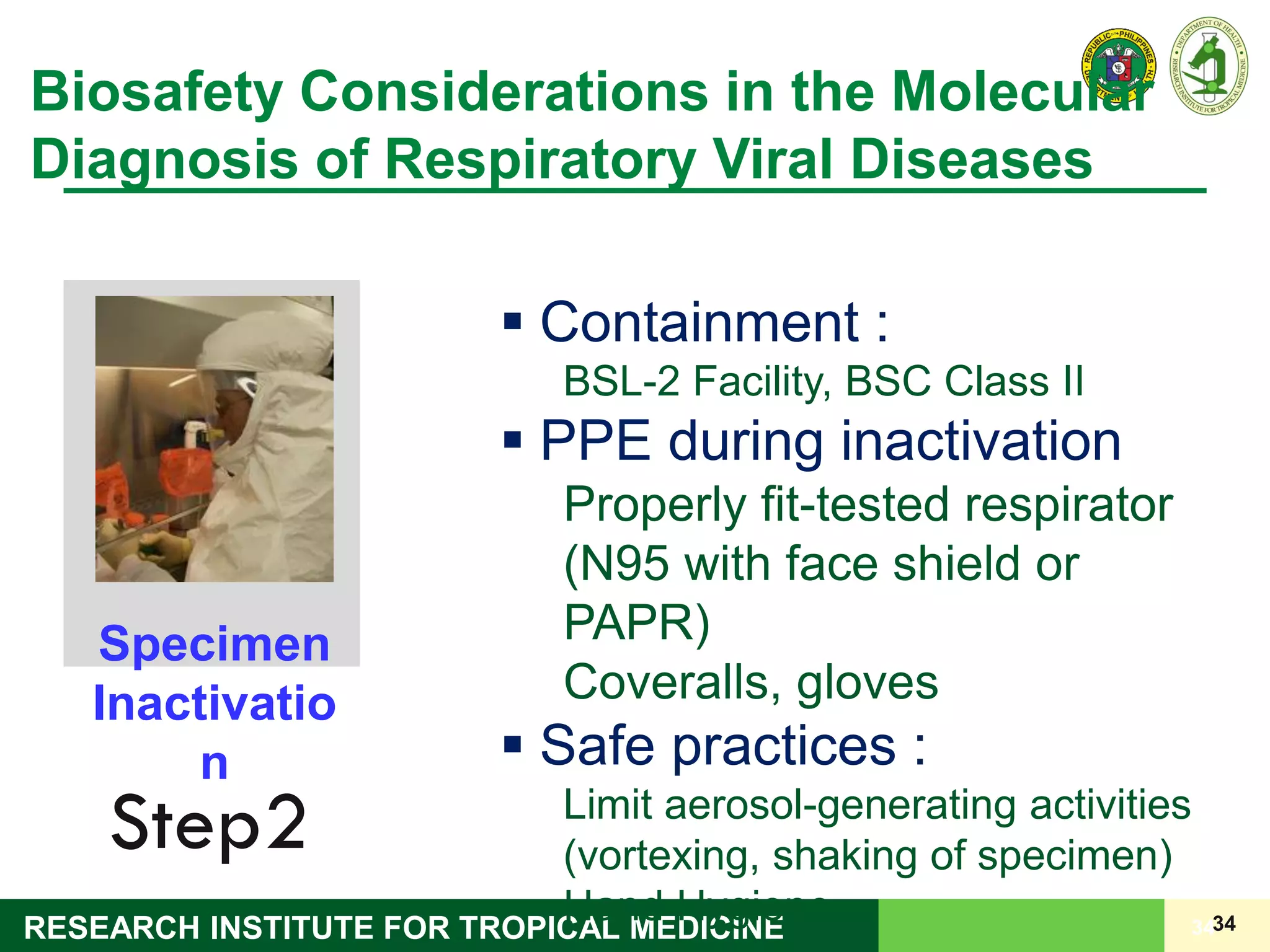
Biosafety Considerations in the Molecular
Diagnosis of Respiratory Viral Diseases
Step2
Specimen
Inactivatio
n
 Containment :
BSL-2 Facility, BSC Class II
 PPE during inactivation
Properly fit-tested respirator
(N95 with face shield or
PAPR)
Coveralls, gloves
 Safe practices :
Limit aerosol-generating activities
(vortexing, shaking of specimen)
Hand Hygiene
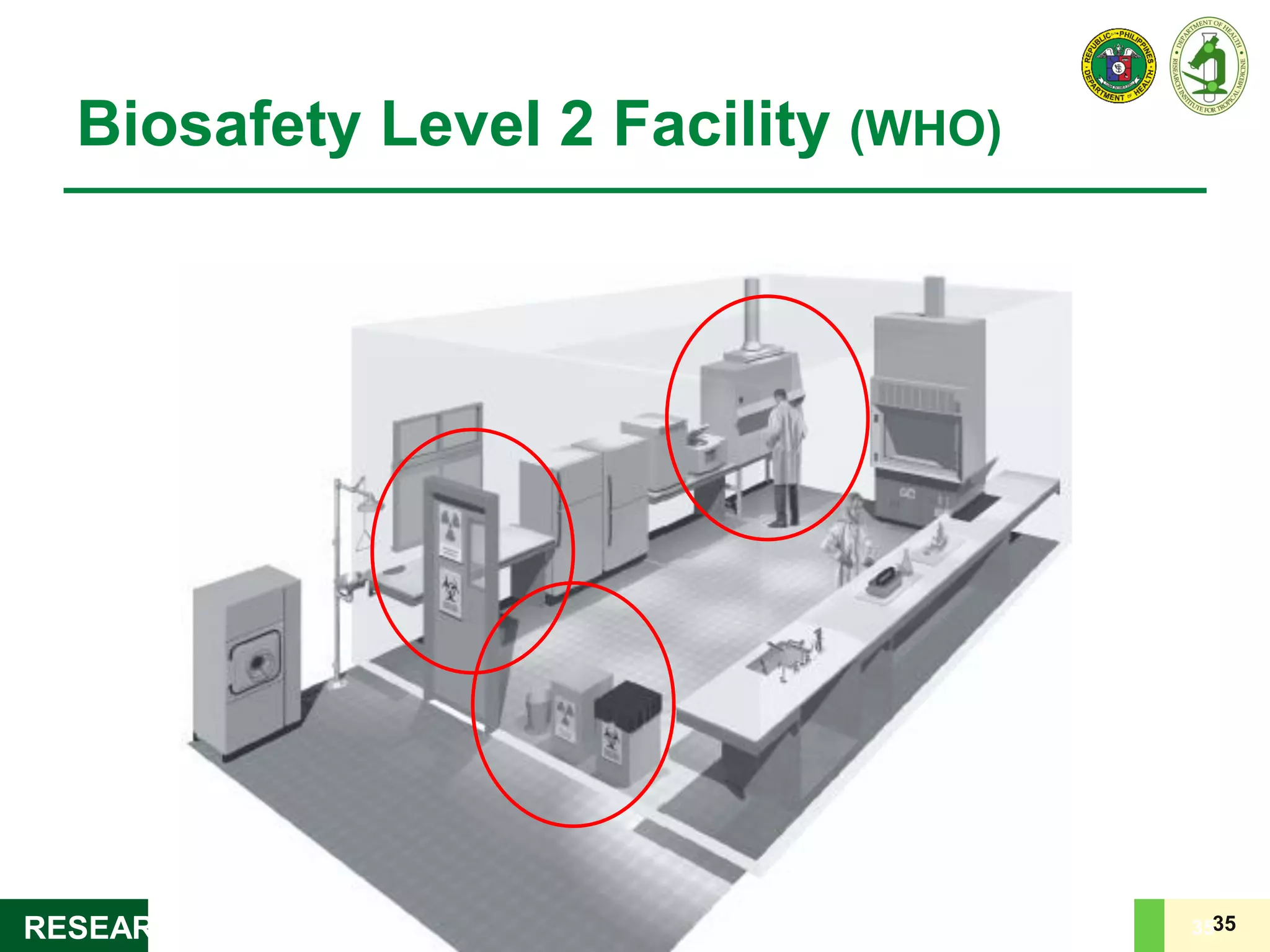
35RESEARCH INSTITUTE FOR TROPICAL MEDICINE
Biosafety Level 2 Facility (WHO)
35
Biosafety
Cabinet
Class II
36
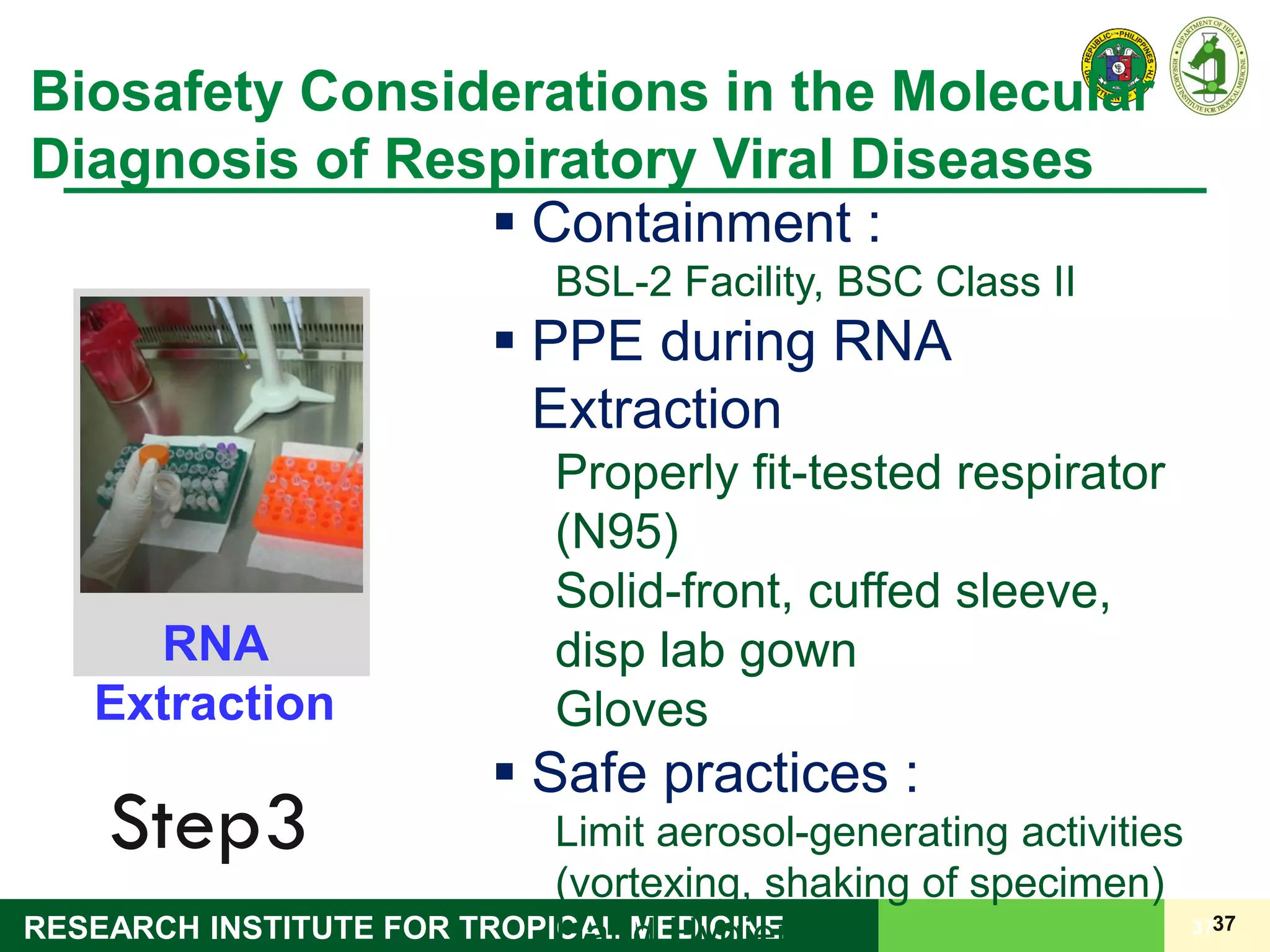
37RESEARCH INSTITUTE FOR TROPICAL MEDICINE 37
Biosafety Considerations in the Molecular
Diagnosis of Respiratory Viral Diseases
Step3
RNA
Extraction
 Containment :
BSL-2 Facility, BSC Class II
 PPE during RNA
Extraction
Properly fit-tested respirator
(N95)
Solid-front, cuffed sleeve,
disp lab gown
Gloves
 Safe practices :
Limit aerosol-generating activities
(vortexing, shaking of specimen)
Hand Hygiene
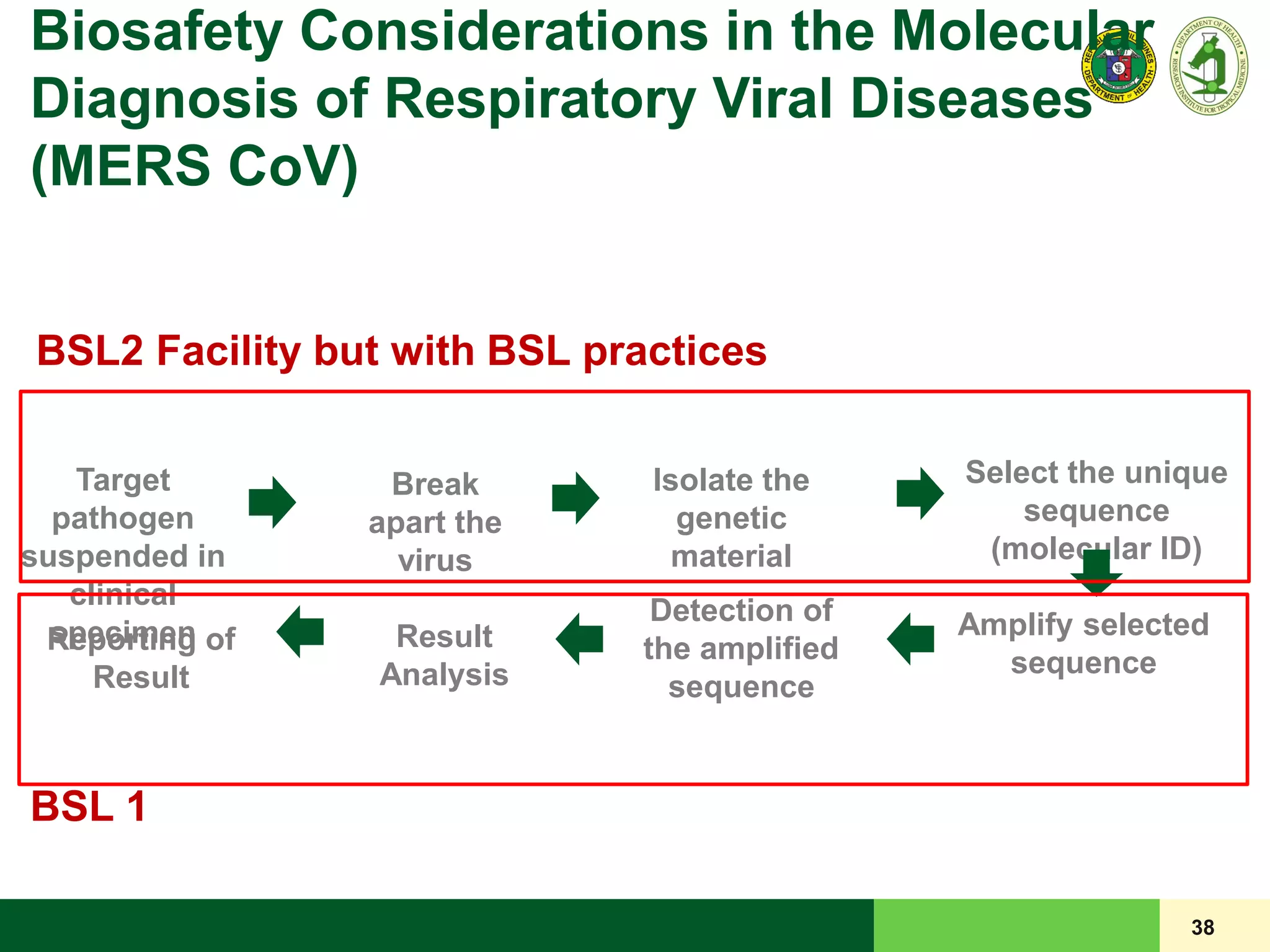
Biosafety Considerations in the Molecular
Diagnosis of Respiratory Viral Diseases
(MERS CoV)
38
Target
pathogen
suspended in
clinical
specimen
Break
apart the
virus
Isolate the
genetic
material
Select the unique
sequence
(molecular ID)
Amplify selected
sequence
Detection of
the amplified
sequence
Result
Analysis
Reporting of
Result
BSL2 Facility but with BSL practices
BSL 1
39RESEARCH INSTITUTE FOR TROPICAL MEDICINE 39
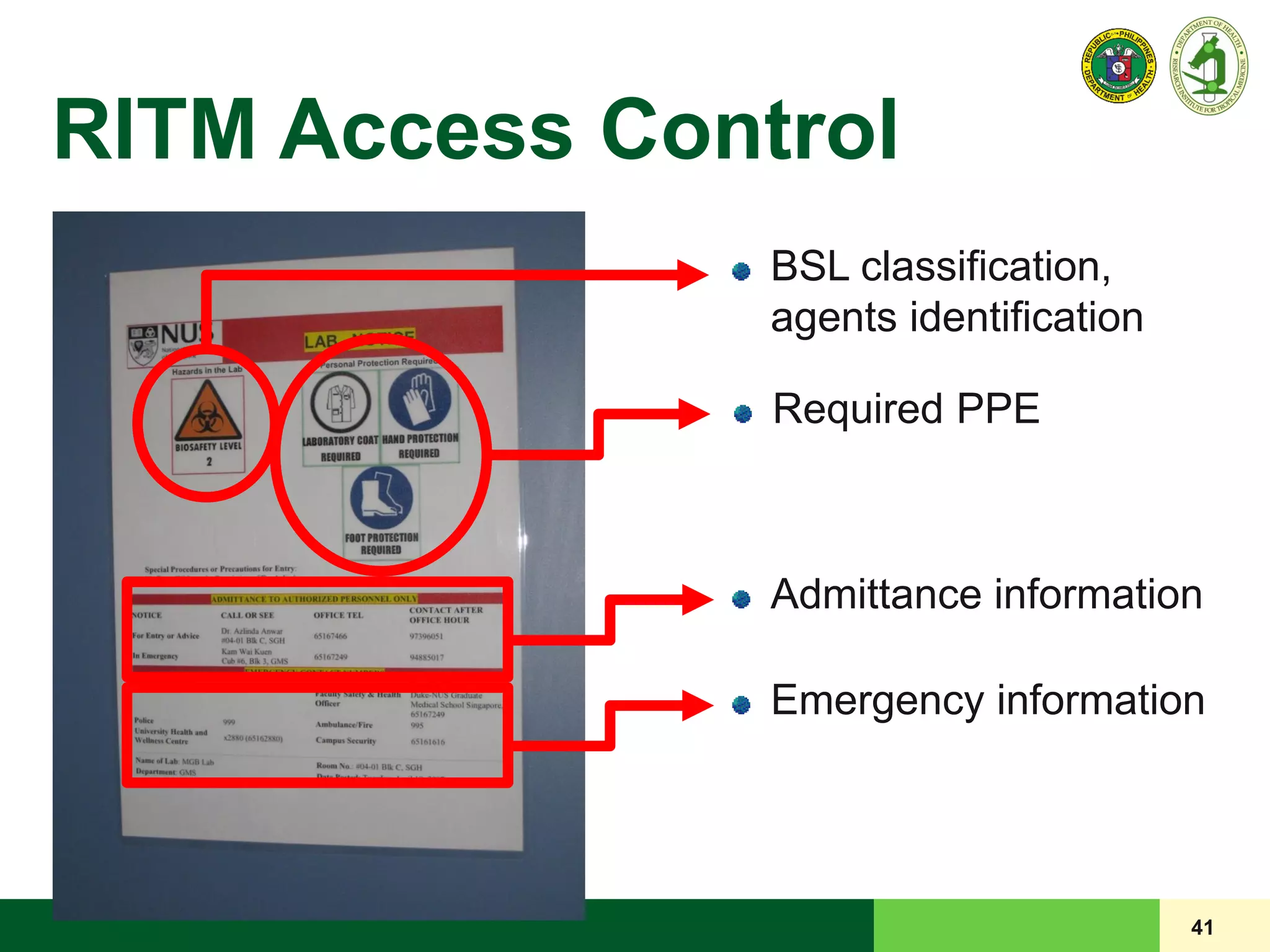
RITM Access Control
Limited or restricted access of laboratory
areas to staff, as required by activity
Laboratory personnel informed of routine
and emergency procedures
LRD POLICY
Laboratory “police-ing” on set institutional policies on
access control
Policies on access control for laboratory trainees and
observers
40
Door to the laboratory must be closed,
[preferably] with self-closing mechanism
Appropriate warning sign where infectious
microorganisms are handled
LRD POLICY
LRD Standard Access Control Information and
Biohazard Warning (if applicable) signage for each
laboratory
RITM Access Control
RITM Access Control
41
BSL classification,
agents identification
Required PPE
Admittance information
Emergency information
RITM Access Control
42
Employees must inform supervisor of changes
in health status or other medical issues
Supervisor must reevaluate access control
measures when risk potential changes
Certain conditions can result in altering
susceptibility to infection
Laboratory supervisor is responsible for ensuring
that employees are not at risk
Summary
43
 It is in the best interest of our country and its people to
invest in Biosafety
 To achieve a safe laboratory environment, Laboratory
Biosafety principles have to be ingrained in the
Institutional culture
 Each has a role in the successful implementation of
Biosafety
DEPARTMENT OF HEALTH
RESEARCH INSTITUTE FOR TROPICAL
MEDICINE
LABORATORY BIOSAFETY IN
MOLECULAR DIAGNOSIS OF EMERGING
RESPIRATORY INFECTIOUS DISEASES
LEI LANNA M. DANCEL
Laboratory Manager
RITM – MOLECULAR BIOLOGY LABORATORY

Laboratory Biosafety

  • 1.
    DEPARTMENT OF HEALTH RESEARCHINSTITUTE FOR TROPICAL MEDICINE LABORATORY BIOSAFETY IN MOLECULAR DIAGNOSIS OF EMERGING RESPIRATORY INFECTIOUS DISEASES LEI LANNA M. DANCEL Laboratory Manager RITM – MOLECULAR BIOLOGY LABORATORY
  • 2.
    Topics 2 The Changing Landscapeof Infectious Diseases PCR-based Detection (MERS Co Biosafety Considerations in PCR-based Detection of Emerging Respiratory Viral Infections (MERS-CoV) Overview of Laboratory Biosafety Principles of Biosafety
  • 3.
    3RESEARCH INSTITUTE FORTROPICAL MEDICINE The Changing Landscape of Infectious Diseases 3 2003 SARS Coronavir us 2009 Pandemic Influenza H1N1 2012 MERS Coronavir us 1975 Avian Influenza H7 1997 Avian Influenza H5 1999 Avian Influenza H9 Emerging and Re-Emerging Respiratory viruses H7 H5 H9 SARS CoV PdmH10 9 MERS CoV
  • 4.
    4RESEARCH INSTITUTE FORTROPICAL MEDICINE Laboratory Response to Emerging Respiratory Viral Infections 4 GLOBAL LAB RESPONSE NATIONAL LAB RESPONSE WHO Emerging and Dangerous Pathogens Laboratory Network  National Reference Lab at RITM  DOH National-Subnational Laboratory Network
  • 5.
    5RESEARCH INSTITUTE FORTROPICAL MEDICINE Laboratory Biosafety The safe handling of biological materials, particularly infectious agents which are classified on the basis of degree of risk to humans 5 Safe Handling Contain ment
  • 6.
    6RESEARCH INSTITUTE FORTROPICAL MEDICINE Principles of Biosafety 6 Safe Handling and Containment aim to protect the : Laboratory worker Pathogen (Specime n Integrity) Laboratory Environment
  • 7.
    7RESEARCH INSTITUTE FORTROPICAL MEDICINE Principles of Biosafety 7  laboratory worker Pathogen   laboratory environment
  • 8.
    8RESEARCH INSTITUTE FORTROPICAL MEDICINE Principles of Biosafety 8  laboratory worker Pathogen   laboratory environment BIOSAFETY BREACH
  • 9.
    9RESEARCH INSTITUTE FORTROPICAL MEDICINE 9 How to determine appropriate containment and handling strategy Risk Assessment Risk Group Classification Biosafety Level Classification Safe Handling & Containment
  • 10.
    10RESEARCH INSTITUTE FORTROPICAL MEDICINE Risk Assessment 10 1 Identify key hazards and perform initial assessment of the risk (capability to infect, severity of the disease and availability of preventive measures and effective treatment) 2 Identify the laboratory procedure hazards (aerosol generation, use of sharps, use of experimental animals) 3 Assign appropriate biosafety level and select additional precautions 4 Evaluate the proficiencies of staff regarding safe practices and integrity of safety equipment
  • 11.
    11RESEARCH INSTITUTE FORTROPICAL MEDICINE Risk Group Classification (WHO) 11  No or low individual and community risk  Unlikely to cause human or animal disease  Moderate individual risk, low community risk  Can cause disease but unlikely to be a serious hazard  Lab exposures may cause serious infection, but effective treatment and preventive measures are available and risk of spread of infection is limited  High individual risk, low community risk  Usually causes serious human or animal disease but does not ordinarily spread. Effective treatment and preventive measures are available.  High individual and community risk  Usually causes serious human or animal disease and can be readily transmitted.  Effective treatment and preventive measures are not usually available
  • 12.
    12RESEARCH INSTITUTE FORTROPICAL MEDICINE Biosafety Levels (WHO) 12 Suitable for work involving well-characterized agents not known to cause disease in healthy adult humans and of minimal potential hazard to laboratory personnel and the environment Suitable for work involving agents of moderate potential hazard to personnel and the environment Suitable for work with infectious agents which may cause serious or potentially lethal disease as a result of exposure by the inhalation route Suitable for work involving exotic infectious agents that pose a high risk of life-threatening disease and can be transmitted as an aerosol and for which there is no vaccine or therapy
  • 13.
  • 14.
    14 Safe Lab Practices AccessControl Use of appropriate PPE Waste Management Practices Decontamination/ Disinfection Procedures Good Personal Hygiene
  • 15.
    15 Facility Design Typical BSL1Facility Typical BSL2 Facility
  • 16.
    16 Facility Design WHO, 2004.Laboratory Safety Manual 3rd Editio Typical BSL3 Facility Typical BSL4 Facility
  • 17.
    Molecular Detection ofEmerging Respiratory Infectious Diseases 17
  • 18.
    Molecular Dx 18 Checks forthe +/-of a molecular ID Each pathogen may be identified by unique/signature sections of their genome Polymerase Chain Reaction (PCR) simple method for making virtually unlimited copies of the DNA sequence of a pathogen
  • 19.
    19 Genomes Comprised of theentire genetic/hereditary information of the organism/agent
  • 20.
    20 PCR Based Detection Target pathogen suspendedin clinical specimen Break apart the virus Isolate the genetic material Select the unique sequence (molecular ID) Amplify selected sequence Detection of the amplified sequence Result Analysis Reporting of Result MERS-CoV Positive
  • 21.
    PCR Detection ofMERS Coronavirus
  • 22.
    22RESEARCH INSTITUTE FORTROPICAL MEDICINE Virology of MERS CoV 22 http://www.cdc.gov/coronavirus/mers/ EM : spherical particles within the cytoplasm of an infected cell Positive-sense, single-stranded RNA virus Newest member of the Betacoronavirus group (lineage C) Genome is most similar to bat coronaviruses
  • 23.
    PCR Detection ofMERS CoV 23 Clinical Specimen Specimen Inactivation RNA Extraction 1 2 3
  • 24.
    Mol Dx ofMERS-CoV 24 PCR Setup PCR Run Results Analysis 4 5 6
  • 25.
    Mol Dx ofMERS-CoV 25 Results Validation Results Reporting 7 8 Sequence Analysis (if applicable)
  • 26.
    Biosafety Considerations inthe Molecular Diagnosis of Respiratory Viral Diseases 26 Target pathogen suspended in clinical specimen Break apart the virus Isolate the genetic material Select the unique sequence (molecular ID) Amplify selected sequence Detection of the amplified sequence Result Analysis Reporting of Result
  • 27.
    27 Biosafety Considerations inthe Molecular Diagnosis of Respiratory Viral Diseases MERS CoV Risk Group Classification : RG3  High individual risk, low community risk  Usually causes serious human or animal disease but does not ordinarily spread. Effective treatment and preventive measures are available.
  • 28.
    28 Laboratory Activities involvedin MERS CoV detection (Canadian Biosafety Standards) Activity BSL2 Facility BSL3 Facility Processing specimens for packaging and distribution to laboratories Diagnostic Testing activities (excluding culture) Molecular diagnostic testing Culture of specimens Preparatory work for in vivo activities Processing positive cultures for
  • 29.
    29RESEARCH INSTITUTE FORTROPICAL MEDICINE 29 Biosafety Considerations in the Molecular Diagnosis of Respiratory Viral Diseases Step1 Obtain appropri ate specime n  Appropriate container : sterile, leak-proof)  PPE during collection : respiratory and barrier protection (respirators, gloves, disp. lab gown)  Transport : properly-labeled, no spillage, triple-packaged  Safe Practices : • manner which minimizes risk for inadvertent exposure • Hand hygiene
  • 30.
    30 MERS CoV Detection: Appropriate Specimen Types (WHO & CDC) SEROLOGY Multiple specimen types recommended : and/or Acute serum Convalescent serum LRT URT serum rRT-PCR &/or SEQUENCING
  • 31.
    31  BAL  Trachealaspirate  Pleural fluid  sputum LRT Appropriate Specimen Types (WHO & CDC) Refrigerate specimen at 2-8°C up to 72 hours; if exceeding 72 hours, freeze at -70°C and ship on dry ice
  • 32.
    32  NPS andOPS in VTM/UTM  Nasopharyngeal wash/aspirate  Nasal aspirate URT Refrigerate specimen at 2-8°C up to 72 hours; if exceeding 72 hours, freeze at -70°C and ship on dry ice Appropriate Specimen Types (WHO & CDC)
  • 33.
    33RESEARCH INSTITUTE FORTROPICAL MEDICINE 33 Biosafety Considerations in the Molecular Diagnosis of Respiratory Viral Diseases Step1 Obtain appropri ate specime n  Acceptable respiratory protection devices for MERS CoV specimen collection :  Properly-fit tested  N95 or higher level
  • 34.
    34RESEARCH INSTITUTE FORTROPICAL MEDICINE 34 Biosafety Considerations in the Molecular Diagnosis of Respiratory Viral Diseases Step2 Specimen Inactivatio n  Containment : BSL-2 Facility, BSC Class II  PPE during inactivation Properly fit-tested respirator (N95 with face shield or PAPR) Coveralls, gloves  Safe practices : Limit aerosol-generating activities (vortexing, shaking of specimen) Hand Hygiene
  • 35.
    35RESEARCH INSTITUTE FORTROPICAL MEDICINE Biosafety Level 2 Facility (WHO) 35
  • 36.
  • 37.
    37RESEARCH INSTITUTE FORTROPICAL MEDICINE 37 Biosafety Considerations in the Molecular Diagnosis of Respiratory Viral Diseases Step3 RNA Extraction  Containment : BSL-2 Facility, BSC Class II  PPE during RNA Extraction Properly fit-tested respirator (N95) Solid-front, cuffed sleeve, disp lab gown Gloves  Safe practices : Limit aerosol-generating activities (vortexing, shaking of specimen) Hand Hygiene
  • 38.
    Biosafety Considerations inthe Molecular Diagnosis of Respiratory Viral Diseases (MERS CoV) 38 Target pathogen suspended in clinical specimen Break apart the virus Isolate the genetic material Select the unique sequence (molecular ID) Amplify selected sequence Detection of the amplified sequence Result Analysis Reporting of Result BSL2 Facility but with BSL practices BSL 1
  • 39.
    39RESEARCH INSTITUTE FORTROPICAL MEDICINE 39 RITM Access Control Limited or restricted access of laboratory areas to staff, as required by activity Laboratory personnel informed of routine and emergency procedures LRD POLICY Laboratory “police-ing” on set institutional policies on access control Policies on access control for laboratory trainees and observers
  • 40.
    40 Door to thelaboratory must be closed, [preferably] with self-closing mechanism Appropriate warning sign where infectious microorganisms are handled LRD POLICY LRD Standard Access Control Information and Biohazard Warning (if applicable) signage for each laboratory RITM Access Control
  • 41.
    RITM Access Control 41 BSLclassification, agents identification Required PPE Admittance information Emergency information
  • 42.
    RITM Access Control 42 Employeesmust inform supervisor of changes in health status or other medical issues Supervisor must reevaluate access control measures when risk potential changes Certain conditions can result in altering susceptibility to infection Laboratory supervisor is responsible for ensuring that employees are not at risk
  • 43.
    Summary 43  It isin the best interest of our country and its people to invest in Biosafety  To achieve a safe laboratory environment, Laboratory Biosafety principles have to be ingrained in the Institutional culture  Each has a role in the successful implementation of Biosafety
  • 44.
    DEPARTMENT OF HEALTH RESEARCHINSTITUTE FOR TROPICAL MEDICINE LABORATORY BIOSAFETY IN MOLECULAR DIAGNOSIS OF EMERGING RESPIRATORY INFECTIOUS DISEASES LEI LANNA M. DANCEL Laboratory Manager RITM – MOLECULAR BIOLOGY LABORATORY