PREVENTION OF 
EBOLAVIRUS INFECTION 
& THE ASSOCIATED 
CHALLENGES 
Dr.Chandan 
House surgeon, 
KIMS. 
Guide: 
Dr.Laxmikant Lokare 
Associate Professor, 
Dept. of Community Medicine, 
KIMS.
PEOPLE AT RISK 
Healthcare workers. 
Contacts of Ebola patients. 
People coming in contact with infected 
wildlife.
CASE DEFINITIONS 
SUSPECTED CASE: 
Any person, alive or dead, suffering or having suffered from a 
sudden onset of high fever and having 
had contact with: 
- a suspected, probable or confirmed case of Ebola 
- a dead or sick animal. 
OR: any person with inexplicable bleeding. 
OR: any sudden, inexplicable death. 
PROBABLE CASE: 
Any suspected case evaluated by a clinician.
Instructions when a suspected case has 
been identified: 
• Report the case to the surveillance team. 
• After obtaining express consent, collect a sample. 
• Fill in a case notification form. 
• Draw up a list of contacts of the suspected case.
LABORATORY TESTS 
Timeline of Infection Diagnostic tests available 
Within a few days after symptoms begin •Antigen-capture ELISA 
•Polymerase chain reaction (PCR) 
•Virus isolation 
•IgM ELISA 
Later in disease course or after recovery •IgM and IgG antibodies 
Retrospectively in deceased patients •Immunohistochemistry testing 
•PCR 
•Virus isolation
SCREENING DURING 
AIR TRAVEL 
The DGCA has issued the following directives to all airlines 
the operating on international routes in India- 
• In flight announcement for self-reporting. 
• Travellers on flights to be given the health-form. 
• To keep a record of all passengers or families who are 
returning to India after staying or visiting the West 
African countries. 
• The details of the passengers boarding from affected 
countries must be sent in advance.
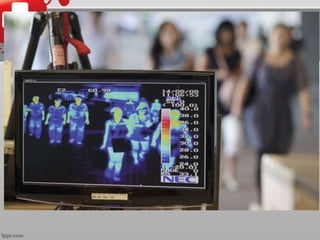
THERMAL SCANNERS 
• The union health minister on Tuesday said 
that 2 thermal scanners have been 
installed in every International airport in 
India. 
• They have started functioning in the 
country since yesterday.
ISOLATION & 
QUARANTINE 
• Isolation separates sick people with a 
contagious disease from people who are not 
sick. 
• Quarantine separates and restricts the 
movement of people who were exposed to a 
contagious disease to see if they become sick.
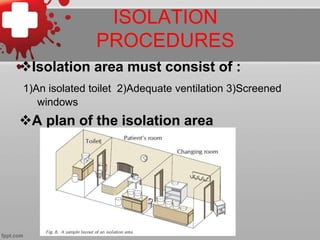
ISOLATION 
PROCEDURES 
Isolation area must consist of : 
1)An isolated toilet 2)Adequate ventilation 3)Screened 
windows 
A plan of the isolation area
Gather Recommended Supplies 
Bed and mattress, Plastic sheeting, thermometers, 
Covered container , Screens or other barriers 
Plan disinfection for contaminated items 
using 
1)Ordinary Household Bleach 2)Soap and Clean Water 
3)Sterilization 
Set Up Changing Rooms for patient-care staff 
Place Security Barrier Around Isolation Area
PRECAUTIONS DURING 
TREATMENT 
 Restrict all non essential staff. 
 Limit the number of visitors. 
 Ensure that all staff and visitors correctly use personal 
protective equipment (PPE). 
 Hand hygiene. 
 Limit the use of needles and other sharp objects. 
 Take the patients out of their rooms if they are free of 
virus, or for essential, life-saving tests ONLY. 
 Cleaning of the environment and patient care equipment.
CONTACT TRACING 
Contact tracing means finding everyone who 
comes in contact with an ebola patient. 
The CDC quotes contact tracing as an 
effective method in controlling the current 
outbreak.
CONTACT TRACING
PRECAUTIONS FOR 
HEALTHCARE WORKERS 
• Wear protective clothing, including masks, gloves, 
gowns, and eye protection. 
• Practice proper infection control and sterilization 
measures. 
• Hand hygiene. 
• Avoid direct contact with the bodies of Ebola victims. 
• Handling the bodies of ebola victims must be done by 
trained personnel only and with PPE.
WHO-RECOMMENDED 
HANDRUB FORMULATIONS 
FORMULATION 1 
Ethanol 80% (v/v) 
Glycerol 1.45% (v/v) 
Hydrogen peroxide 0.125% (v/v) 
FORMULATION 2: 
Isopropyl alcohol 75%(v/v) 
Glycerol 1.45% (v/v) 
Hydrogen peroxide 0.125% (v/v)
WASTE MANAGEMENT 
PROCEDURES 
• Waste segregation. 
• Sharp objects that has been in contact with blood or body 
fluids should be placed inside puncture resistant waste 
containers. These should be located as close as practical to 
the patient care area where the items are used. 
• Collect all solid, non-sharp, infectious waste using leak-proof 
waste bags and covered bins. Bins should never be carried 
against the body. 
• Waste should be placed in a designated pit of appropriate 
depth (e.g. 2 meters or about 7 feet) and filled . After each 
waste load, the waste should be covered with a layer of soil 
10 –15 cm deep.
• An incinerator may be used for short periods during an 
outbreak to destroy solid waste. However, it is essential to 
ensure that total incineration has taken place. 
• Placenta and anatomical samples should be buried in a 
separate pit. 
• The area designated for the final treatment and disposal of 
waste should have controlled access to prevent entry by 
animals, untrained personnel or children. 
• Waste, such as faeces, urine and vomit, and liquid waste from 
washing, can be disposed of in the sanitary sewer or pit 
latrine. No further treatment is necessary
VACCINES 
Recombinant vesicular stomatitis 
virus(rVSV-ZEBOV) encoding ebolavirus 
glycoproteins. 
Developed by the Public Health Agency of 
Canada in Winnipeg.
Another vaccine developed by 
GlaxoSmithKline in collaboration with the 
US National Institute of Allergy and 
Infectious Diseases is cAd3-ZEBOV. 
It uses a chimpanzee-derived adenovirus 
vector with an Ebola virus gene inserted.
POST EXPOSURE 
PROPHYLAXIS 
Post-exposures prophylaxis / treatment 
• Interferon alpha 
• ZMapp - “Secret Serum” 
Three monoclonal antibodies against parts of 
the glycoprotein 
Manufactured in tobacco plant. 
Suppresses viraemia and viral spread 
Effective in non-human primates – 3 doses 
starting on days 3 to 5
TKM – Ebola developed by Tekmira Pharmaceuticals Corp. 
• Small interfering RNAs 
• Zaire Ebola L polymerase, Zaire Ebola membrane-associated 
protein (VP24), and Zaire Ebola polymerase 
complex protein (VP35) 
• Inhibits the replication of the virus 
• Post-exposure prophylaxis in non-human primates given 
in multiple doses (30 minutes after infection and then 
either 
day 1, 3 and 5 or daily for 6 days) 
• Tekmira has commenced clinical trials in January 2014.
CHALLENGES IN THE 
PREVENTION 
• Health systems in the affected countries 
are not highly functional. 
• Lack of understanding about the disease 
and receptivity to control measures on the 
part of some of the affected populations. 
• A large number of international travellers. 
• Lack of cooperation between the countries 
and the various health organizations. 
• Poor economy of the countries.
• TECHNICAL CHALLENGES 
• The virus and disease are incompletely 
understood. 
• Difficulties in research activities due to 
high risk to those involved. 
• No specific treatment is made available. 
• No effective vaccine is made available.
REFERENCES 
• Park’s Textbook Of Preventive And Social 
Medicine e21 K.Park 
• The WHO website http://www.who.int 
• The CDC website http://www.cdc.gov 
• Wikipedia- http://www.wikipedia.org 
• The DGCA http://dgca.nic.in 
• The Hindustan Times
ebola-prevention and challenges

ebola-prevention and challenges

  • 1.
    PREVENTION OF EBOLAVIRUSINFECTION & THE ASSOCIATED CHALLENGES Dr.Chandan House surgeon, KIMS. Guide: Dr.Laxmikant Lokare Associate Professor, Dept. of Community Medicine, KIMS.
  • 2.
    PEOPLE AT RISK Healthcare workers. Contacts of Ebola patients. People coming in contact with infected wildlife.
  • 3.
    CASE DEFINITIONS SUSPECTEDCASE: Any person, alive or dead, suffering or having suffered from a sudden onset of high fever and having had contact with: - a suspected, probable or confirmed case of Ebola - a dead or sick animal. OR: any person with inexplicable bleeding. OR: any sudden, inexplicable death. PROBABLE CASE: Any suspected case evaluated by a clinician.
  • 4.
    Instructions when asuspected case has been identified: • Report the case to the surveillance team. • After obtaining express consent, collect a sample. • Fill in a case notification form. • Draw up a list of contacts of the suspected case.
  • 5.
    LABORATORY TESTS Timelineof Infection Diagnostic tests available Within a few days after symptoms begin •Antigen-capture ELISA •Polymerase chain reaction (PCR) •Virus isolation •IgM ELISA Later in disease course or after recovery •IgM and IgG antibodies Retrospectively in deceased patients •Immunohistochemistry testing •PCR •Virus isolation
  • 6.
    SCREENING DURING AIRTRAVEL The DGCA has issued the following directives to all airlines the operating on international routes in India- • In flight announcement for self-reporting. • Travellers on flights to be given the health-form. • To keep a record of all passengers or families who are returning to India after staying or visiting the West African countries. • The details of the passengers boarding from affected countries must be sent in advance.
  • 7.
    THERMAL SCANNERS •The union health minister on Tuesday said that 2 thermal scanners have been installed in every International airport in India. • They have started functioning in the country since yesterday.
  • 8.
    ISOLATION & QUARANTINE • Isolation separates sick people with a contagious disease from people who are not sick. • Quarantine separates and restricts the movement of people who were exposed to a contagious disease to see if they become sick.
  • 9.
    ISOLATION PROCEDURES Isolationarea must consist of : 1)An isolated toilet 2)Adequate ventilation 3)Screened windows A plan of the isolation area
  • 10.
    Gather Recommended Supplies Bed and mattress, Plastic sheeting, thermometers, Covered container , Screens or other barriers Plan disinfection for contaminated items using 1)Ordinary Household Bleach 2)Soap and Clean Water 3)Sterilization Set Up Changing Rooms for patient-care staff Place Security Barrier Around Isolation Area
  • 11.
    PRECAUTIONS DURING TREATMENT  Restrict all non essential staff.  Limit the number of visitors.  Ensure that all staff and visitors correctly use personal protective equipment (PPE).  Hand hygiene.  Limit the use of needles and other sharp objects.  Take the patients out of their rooms if they are free of virus, or for essential, life-saving tests ONLY.  Cleaning of the environment and patient care equipment.
  • 12.
    CONTACT TRACING Contacttracing means finding everyone who comes in contact with an ebola patient. The CDC quotes contact tracing as an effective method in controlling the current outbreak.
  • 13.
  • 14.
    PRECAUTIONS FOR HEALTHCAREWORKERS • Wear protective clothing, including masks, gloves, gowns, and eye protection. • Practice proper infection control and sterilization measures. • Hand hygiene. • Avoid direct contact with the bodies of Ebola victims. • Handling the bodies of ebola victims must be done by trained personnel only and with PPE.
  • 16.
    WHO-RECOMMENDED HANDRUB FORMULATIONS FORMULATION 1 Ethanol 80% (v/v) Glycerol 1.45% (v/v) Hydrogen peroxide 0.125% (v/v) FORMULATION 2: Isopropyl alcohol 75%(v/v) Glycerol 1.45% (v/v) Hydrogen peroxide 0.125% (v/v)
  • 17.
    WASTE MANAGEMENT PROCEDURES • Waste segregation. • Sharp objects that has been in contact with blood or body fluids should be placed inside puncture resistant waste containers. These should be located as close as practical to the patient care area where the items are used. • Collect all solid, non-sharp, infectious waste using leak-proof waste bags and covered bins. Bins should never be carried against the body. • Waste should be placed in a designated pit of appropriate depth (e.g. 2 meters or about 7 feet) and filled . After each waste load, the waste should be covered with a layer of soil 10 –15 cm deep.
  • 18.
    • An incineratormay be used for short periods during an outbreak to destroy solid waste. However, it is essential to ensure that total incineration has taken place. • Placenta and anatomical samples should be buried in a separate pit. • The area designated for the final treatment and disposal of waste should have controlled access to prevent entry by animals, untrained personnel or children. • Waste, such as faeces, urine and vomit, and liquid waste from washing, can be disposed of in the sanitary sewer or pit latrine. No further treatment is necessary
  • 19.
    VACCINES Recombinant vesicularstomatitis virus(rVSV-ZEBOV) encoding ebolavirus glycoproteins. Developed by the Public Health Agency of Canada in Winnipeg.
  • 20.
    Another vaccine developedby GlaxoSmithKline in collaboration with the US National Institute of Allergy and Infectious Diseases is cAd3-ZEBOV. It uses a chimpanzee-derived adenovirus vector with an Ebola virus gene inserted.
  • 21.
    POST EXPOSURE PROPHYLAXIS Post-exposures prophylaxis / treatment • Interferon alpha • ZMapp - “Secret Serum” Three monoclonal antibodies against parts of the glycoprotein Manufactured in tobacco plant. Suppresses viraemia and viral spread Effective in non-human primates – 3 doses starting on days 3 to 5
  • 22.
    TKM – Eboladeveloped by Tekmira Pharmaceuticals Corp. • Small interfering RNAs • Zaire Ebola L polymerase, Zaire Ebola membrane-associated protein (VP24), and Zaire Ebola polymerase complex protein (VP35) • Inhibits the replication of the virus • Post-exposure prophylaxis in non-human primates given in multiple doses (30 minutes after infection and then either day 1, 3 and 5 or daily for 6 days) • Tekmira has commenced clinical trials in January 2014.
  • 23.
    CHALLENGES IN THE PREVENTION • Health systems in the affected countries are not highly functional. • Lack of understanding about the disease and receptivity to control measures on the part of some of the affected populations. • A large number of international travellers. • Lack of cooperation between the countries and the various health organizations. • Poor economy of the countries.
  • 24.
    • TECHNICAL CHALLENGES • The virus and disease are incompletely understood. • Difficulties in research activities due to high risk to those involved. • No specific treatment is made available. • No effective vaccine is made available.
  • 25.
    REFERENCES • Park’sTextbook Of Preventive And Social Medicine e21 K.Park • The WHO website http://www.who.int • The CDC website http://www.cdc.gov • Wikipedia- http://www.wikipedia.org • The DGCA http://dgca.nic.in • The Hindustan Times