Labor: Part 1by La Lura White MDMaternal Fetal Medicine
Labor: Part 1Labor is a remarkable natural experience.A  sequence of timed events, correlate with biochemical  and hormonal messengers to develop synchronized contraction patterns. These contractions become stronger, more regulated and lead to the progressive dilation and effacement of the cervix , and ultimately  the delivery of a neonate.Understanding these interactions and recognizing their normal and abnormal manifestations are paramount in the appropriate management of the obstetrical patient.
Labor: Part 1The onset of labor occurs around 280 days, or 40 weeks, from the first day of a patient's last menstrual period (LMP), and serves the basis for the EDC or estimated date of confinement.Actually, only 5% of births occur on the assigned due date (EDC).  50% occur within a week. Almost 90%  within 2 weeks of an EDC.
Labor: Part 1According to Gabbe:Labor occurs in the term patient when she is between 37 0/7 (36 completed weeks) – 42 0/7 weeks (41 completed weeks).Pre-term or premature labor: occurs prior to 37 0/7 (36 completed weeks).Post-dates: gestation that continues past the assigned EDC.Post-term (prolonged): pregnancy progresses beyond 42 0/7. Obstetrics: Normal and Problem Pregnancies, Gabbe.
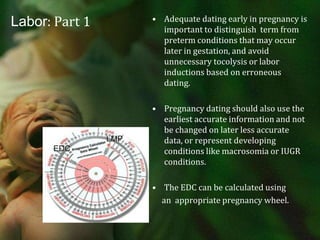
Labor: Part 1Adequate dating early in pregnancy is important to distinguish  term from preterm conditions that may occur later in gestation, and avoid unnecessary tocolysis or labor inductions based on erroneous dating.Pregnancy dating should also use the earliest accurate information and not be changed on later less accurate data, or represent developing conditions like macrosomia or IUGR conditions.The EDC can be calculated using      an  appropriate pregnancy wheel.                       orLMPEDC
Labor: Part 1Nagele’s rule = LMP-3 months + 7 days+1 yearEx: LMP = 8 May 20078 May 2007 (LMP) -3 months = 8 February 2007        Add 7 days = 15 February 2007Add 1 year = 15 February 2008EDC=15 February 2008
Labor: Part 1Using these dating methods assumes the patient has a regular menstrual cycle, a 28 day interval and an anticipated ovulation at day 14.The patient should have not recently discontinued oral contraceptives, which may affect ovulation time.If the cycles are irregular, they are adjusted based onvariations in the follicular or pre-ovulatory phase (first half of the cycle).For example, if a patient has a cycle that last 34 days (34-28=6), ovulation may have occurred 6 days later, and those 6 days may need to be added to the assigned EDC.
Labor: Part 1If using ultrasound data to determine a patients gestational age, use only the earliest ultrasound information, and change the EDC if and only if that early information falls outside the normal margin of error for ultrasound.The 1st trimester (conception to 13 weeks) scan should correlate within one week of EDC by LMP.The 2nd trimester(14-27 weeks) scan should correlate within two weeks of EDC by LMP.3rd trimester (28 weeks-delivery) should correlate within three weeks of EDC by LMP, but a single femur length may be a more accurate determination of gestational age in this late ultrasounds, if no earlier data available.PATIENTS SHOULD ONLY HAVE ONE EDC
Labor: Part 1Uterine Changes in PregnancyThe uterus is made primarily of smooth muscle.Increase in weight  4-70g (non-pregnant) to      1100-1200g (at term).Initial myometrial hyperplasia (increase in number cells) then hypertrophy (increase in cell size).Volume increases from 10ml to 5 L. 10 times increase in uterine blood flow, with 80-90% directed to the placenta.  
Labor: Part 1Uterine tonicity changes from the non-pregnant muscular uterus that has a normal but significant resting tone, to a functional uterine quiescence during pregnancy, secondary to negative inhibitory factors and finally towards the end of pregnancy to an activated, stimulated responsive uterus that is able to contract.These physiological changes are divided into four phases:Phase 0: (inhibitory)      Uterine maintains functional quiescence secondary to multiple agents that exert an inhibitory and includes: progesterone, prostacyclin, prostaglandin, relaxin, parathyroid hormone-related peptide, nitric oxide, calcitonin gene-related peptide, adrenomedullin and vasoactive intestinal peptide.
Labor: Part 1Before term, there is a release of this negative inhibitionPhase 1: (activation)Initiate  by uterotopins, like estrogen and possibly progesterone, prostaglandins and corticotrophin-releasing hormone.Increased expression of contraction associated proteins, including myometrial receptors for prostaglandin and oxytocin.Activation of certain ion channels.Increase in connexin-43 (key component for gap junctions).Increase in the number of gap junctions.This primed uterus can now be stimulated to contract.
Labor: Part 1Phase 2: (stimulation)Myometrium is stimulated by uterotropins like stimulatory prostaglandin (PGE2 and   PGF2 alpha) and oxytocin.Previously formed Gap junctions  facilitate the passage of electrical activity. Improved synchrony between myometrial contractions, leads to a progression in myometrial activity.
Labor: Part 1This  results in the development of initially  Braxton-Hicks contractures that are irregular, low frequency, disco-ordinate and painless) to  true labor contractions (regular, painful, high intensity, high frequency).Phase 3          Occurs after delivery.          Involution of uterus.          Mediated by oxytocin and possibly thrombin.
Labor: Part 1This uterine activity is coordinated with cervical changes: The cervix, composed some smooth muscle (greatest amount found at internal os) is mainly an extracellular connective tissue matrix.It’s major component are  type 1 and type 3 collagen, with a small amount of type 4 collagen at the basement membrane. In addition, this matrix includes  glycosaminoglycans and proteoglycans, predominantly dermatan sulfate, hyaluronic acid, and heparin sulfate. 
Labor: Part 1 Collagen fibers are  tightly wound into a tubular configuration that maintains a tight sphincter, protected by a mucus plug, that maintains the fetus in utero during pregnancy.Fibronectin and elastin are also found among these collagen fibers, with the highest ratio of elastin to collagen at the internal os.The actual amount of elastin and smooth muscle decrease progressively from the internal to the external os of the cervix.
Labor: Part 1In late pregnancy, the hyaluronic acid content in the cervix increases that leads to increased accumulation of water molecules that intersperse among the collagen fibers.Dermatan sulfate decreases, causing reduced bridging among the collagen fibers and a decrease in cervical firmness.The amount of collagen and collagen fibrils also decrease and disperse secondary to increased decorin, a proteoglycan that coats and separates collagen fibrils.
Labor: Part 1Leading to a rearrangement and realignment of the collagen molecules with diminished  collagen fiber and tensile strength.The cervix becomes thinner, softer, shorter and more pliable, leading to cervical ripening. Now if coordinated with regular uterine contractions, these changes allow easier progressive dilatation and effacement of the cervix, an  efficient  labor and a successful delivery.
Labor: Part 1 The “parturition cascade” thought to recruit the factors that moves uterine activity  from an irregular to a more regular contraction pattern involves activation of fetal-hypothalamic-pituitary-adrenal axis.Once activated, the fetal adrenal assist the placenta  in its production of steroid hormones, especially estrogens,  E1 ( estrone  ) E2 (estradiol  ) and E3 (estriol). However, the fetal adrenals and placenta are incomplete steridogenic organs and  dependent  on precursors from each other in order to complete their respective steroid synthesis.
Labor: Part 1 The fetal adrenals are functional early in pregnancy.Fetal pituitary basophilic cells at about 7 weeks begins to produce fetal ACTH to stimulate the fetal adrenal cortex.The placenta, because of its access to these steroid precursors, can now begins to dominate steroid production, a previous function  of the corpus luteum.This is also when estrogen first appears in the maternal circulation.
Labor: Part 1 In the first 20 weeks of gestation, placental hCG and progesterone, and possibly prolactin help maintain and regulate the fetal adrenal cortex that is later maintained by fetal ACTH.Between 32-36 weeks, there is a marked growth in the fetal adrenal cortex, in response to the increased steroid production required towards the end of gestation.So how does the placenta and the fetal adrenals interact to affect their respective steroidgenesis?
Labor: Part 1 The fetal adrenal cortex is deficient in 3-B hydroxysteroid dehydrogenate, the enzyme that converts pregnenolone and DHEA to progesterone and androstendioneTherefore, the fetus cannot make progesterone and androstendioneBut the placenta is abundant in in 3-B hydroxysteroid dehydrogenate
Labor: Part 1So the fetus takes LDL cholesterol from the fetal circulation and converts it to pregnenolone sulfate and DHEA-S.It then sends pregnenolone sulfate to the placenta via the umbilical artery.The placenta converts the pregnenolone to progesterone.The progesterone (that the fetus is unable to make), is sent back to the fetal adrenals where they can proceed to synthesize various mineralcorticoids and glucocorticids.
Labor: Part 1The placenta can also extract LDL cholesterol from the maternal circulation to produce progesterone, so although it uses the precussors produced in the fetal adrenal cortex, it is not dependent on them to synthesize progesterone.As a preservative measure, the placenta lacks 17-alpha hydroxylase, needed to metabolize progesterone.
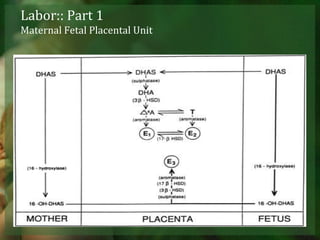
Labor: Part 1The placenta synthesizes estrogen, but needs external supply C-19 steroid precursor (DHEA: dehydroepiandrostenedione), DHEA is supplied from the fetal adrenal intermediate zoneRemember, DHEA-S, was the other byproduct, of the fetal adrenal cortex conversion of LDL cholesterol extracted from the fetal circulation, (LDL cholesterol= pregnenolone sulfate and DHEA-S)Also DHEA-S is the delivered to the fetal liver where it is converted into16-alpha hydroxydehydroepiandrosterone sulfate (16 alpha OHDHEAS)Placenta also uses 16 alpha OHDHEAS from the fetal liver , where it is first converted into 16 alpha-hydroxyandrostenedione  and further aromatized to estriol)
Labor:: Part 1Maternal Fetal Placental Unit
Labor: Part 1Once a contraction pattern  of Labor is established, it is divided into three stages.First Stage: onset of labor until full cervical dilation.Second Stage: full dilation of cervix until delivery of neonate.Third Stage: delivery of neonate to delivery of placenta.Fourth Stage: the hour immediately following delivery of placenta. (originally described by Friedman)
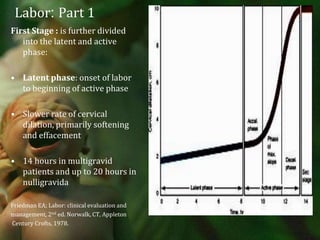
Labor: Part 1 First Stage : is further divided into the latent and active phase:Latent phase: onset of labor to beginning of active phaseSlower rate of cervical dilation, primarily softening and effacement14 hours in multigravid patients and up to 20 hours in nulligravidaFriedman EA; Labor: clinical evaluation and management, 2nd ed. Norwalk, CT, Appleton Century Crofts, 1978.
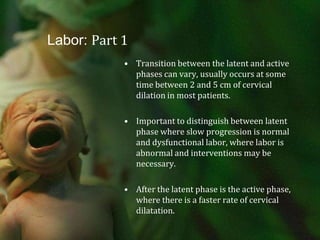
Labor: Part 1Transition between the latent and active phases can vary, usually occurs at some time between 2 and 5 cm of cervical dilation in most patients.Important to distinguish between latent phase where slow progression is normal and dysfunctional labor, where labor is abnormal and interventions may be necessary.After the latent phase is the active phase, where there is a faster rate of cervical dilatation.
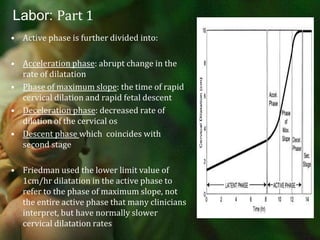
Labor: Part 1Active phase is further divided into:Acceleration phase: abrupt change in the rate of dilatationPhase of maximum slope: the time of rapid cervical dilation and rapid fetal descentDeceleration phase: decreased rate of dilation of the cervical os Descent phase which  coincides with second stageFriedman used the lower limit value of  1cm/hr dilatation in the active phase to refer to the phase of maximum slope, not the entire active phase that many clinicians interpret, but have normally slower cervical dilatation rates
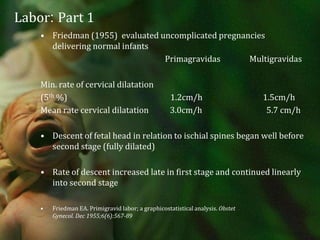
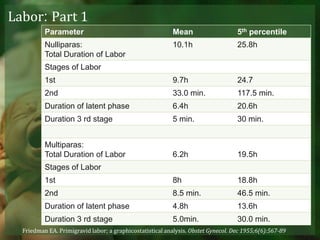
Labor: Part 1 Friedman (1955)  evaluated uncomplicated pregnancies delivering normal infants                                                                Primagravidas               MultigravidasMin. rate of cervical dilatation(5th %)                                                     1.2cm/h                               1.5cm/hMean rate cervical dilatation           3.0cm/h                                 5.7 cm/h Descent of fetal head in relation to ischial spines began well before second stage (fully dilated)Rate of descent increased late in first stage and continued linearly into second stageFriedman EA. Primigravid labor; a graphicostatistical analysis. Obstet Gynecol. Dec 1955;6(6):567-89
Labor: Part 1 Friedman EA. Primigravid labor; a graphicostatistical analysis. Obstet Gynecol. Dec 1955;6(6):567-89
Labor: Part 1Recent challenges to Friedman’s data on  patient’s labor patterns reflects changes over the past 50 years in the patients we see and how we practice. More aggressive medical management, higher induction rates, use of oxytocin, regional anesthesia and continuous fetal monitoring. Maternal characteristics have also changed, with greater body mass index [BMI] and an increase in fetal size.
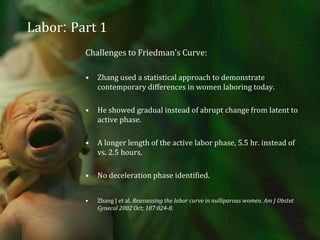
Labor: Part 1 Challenges to Friedman’s Curve:Zhang used a statistical approach to demonstrate contemporary differences in women laboring today.He showed gradual instead of abrupt change from latent to active phase.A longer length of the active labor phase, 5.5 hr. instead of  vs. 2.5 hours.No deceleration phase identified.Zhang J et al. Reassessing the labor curve in nulliparous women. Am J Obstet Gynecol 2002 Oct; 187:824-8.
Labor: Part 1Common for two hours to lapse in active phase without cervical change and especially before the patient was 7 cm. was not uncommon5th percentile for rate of cervical dilatation was determined less than 1 cm/hr.Head can take up to three hours to descend from   +0 station to +4 or present at the perineum, and an additional 30 minutes for delivery.Zhang J et al. Reassessing the labor curve in nulliparous women. Am J Obstet Gynecol 2002 Oct; 187:824-8.
Labor: Part 1 Rouse developed a protocol requiring a minimum of 12 hours of oxytocin after membrane rupture before failed labor induction could be diagnosed.Found many nulliparas who remained in the latent phase at up to 9 hours still had safe vaginal deliveriesSuggest  extending the minimum period of oxytocin augmentation for active phase labor arrest from 2 to at least 4 hours was found to be safe and effectiveRouse DJ Owen, Hauth JC: Criteria for failed labor induction: Prospective evaluation of a standardized protocol. Obstet Gynecol 96:671,2000.
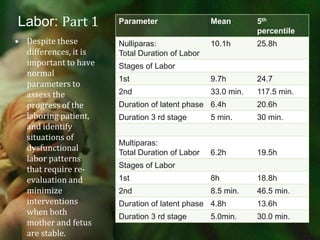
Labor: Part 1Despite these differences, it is important to have normal parameters to assess the progress of the laboring patient, and identify situations of dysfunctional labor patterns that require re-evaluation and minimize interventions when both mother and fetus are stable.
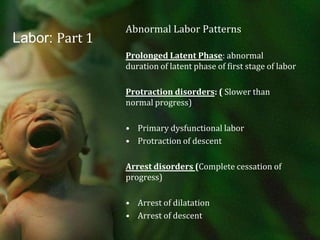
Labor: Part 1Abnormal Labor PatternsProlonged Latent Phase: abnormal duration of latent phase of first stage of laborProtraction disorders: ( Slower than normal progress)Primary dysfunctional laborProtraction of descentArrest disorders (Complete cessation of progress)Arrest of dilatationArrest of descent
Labor: Part 1Prolonged Latent Phase: Greater than 20 h in nulliparas (mean 8.6 hr.)  and 14 h in multiparas (mean 5.3 hr.).May be due to a delay in cervical ripening or change in the cervical tissue biochemistry.Not correlated with adverse outcome.Expectant management.Differentiate latent phase (normal slow progression) from Braxton-Hicks (irregular pre-labor contractions).
Labor: Part 1Augmentation of contractions in the latent phase is not beneficial and results in a 10X increase in Cesarean section rate and a 3X increase in low neonatal Apgar scores.Treatment: Reassurance: if no cervical change,  observation usually      2-3 hrs., contraction may cease.Analgesia: if contractions persistent with no cervical       change especially if painful.Therapeutic rest: Ex: morphine 10-15 mg or nubain
 15mg  with or without phenegram 25mg or vistiril
 25mg.Labor: Part 1Protracted Disorders:       There is a protraction of dilatation (active phase) and a protraction of descent (second stage)Primary dysfunctional labor: protraction of dilatation where the rate of active phase cervical dilatation less than 5th percentile, occurs after normal active phase dilatationLess than 1.2 cm/hr. in nulliparas and 1.5cm./hr. in multiparasProtraction of  Descent: : delayed descent of the fetal head less than 1.0 cm per hour in nulliparas and less than 2.0 cm per hour for multiparas
Labor: Part 1Careful assessment to fetal size and positionAugmentation and/or amniotomy if appropriate especially if poor contraction strengthMost common cause in nulliparas is inadequate uterine activity and in multiparas is CPD (cephaloelvic disproportion)
Labor: Part 1Arrest Disorders:Secondary arrest: cessation of previously normal active phase dilatation for 2 or more hours.Suggest dystocia in presence of adequate contractions. Requires vaginal exam to  verify dilatation, presentation, position and station.Evaluate with clinical pelvimetry to assess adequacy of pelvis.
Labor: Part 1Oxytocin with or without amniotomy if suboptimal contractions and candidate for artificial rupture.Greater risk for further labor abnormalities and operative delivery.Arrest 2-4 hours despite adequate contractions, preferably documented with an IUPC, may need to consider cesarean section.With a recently documented 31% cesarean section rate in the U.S., this decision should be made after a thorough evaluation, however it should not be inappropriately delayed.
Labor: Part 1Arrest of descent: No descent of fetal head with an epidural of  >3 hours in primips and	>2 hours in multips.If  no epidural >2 hours in primips and >1 hour in multip.s	Usually preceded by a normal pattern of dilatation and descent.Major risk factors nulliparity, fetal macrosomia, epidural analgesia, hydramnios, hypertensive disorders and gestational diabetes mellitus.Careful evaluation with the same caveat, make an appropriate, expedient and supportive decision for further management.
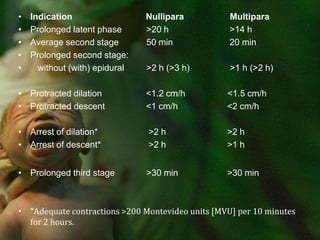
Indication	                          Nullipara	        Multipara	Prolonged latent phase	>20 h	                     >14 h	Average second stage	50 min	                     20 min	Prolonged second stage:   without (with) epidural	>2 h (>3 h)	        >1 h (>2 h)	Protracted dilation	             <1.2 cm/h	       <1.5 cm/h	Protracted descent	             <1 cm/h	                    <2 cm/h	Arrest of dilation*	              >2 h	                    >2 h	Arrest of descent*	              >2 h	                    >1 hProlonged third stage	>30 min	                    >30 min	*Adequate contractions >200 Montevideo units [MVU] per 10 minutes for 2 hours.
Labor: Part 1Prevent abnormalities of second stage: “ Aggressiveness may get you in trouble.”Descent and rotation often occurs before the cervix is fully dilated.No impact of duration of second stage if progressing slowly, if mother and fetus are stable.Delayed pushing after the patient is fully dilated, especially if the head is still high ,  “laboring down” may have better outcome
Labor: Part 1Muueller-Hillis maneuver: apply pressure to uterine fundus with one hand, and with 1-2fingers in the vagina, detect if there is descent of the fetal head.If fetal head descends 1 cm or more with pressure, prognosis for vaginal delivery is good.Once the fetus is delivered…….Remember, its not over!You still need to deliver the placenta
Labor: Part 1Although most placentas deliver within 5 minutes, you have up to 30 minutes Two maneuvers Brandt-Andrews: an abdominal hand is placed on the abdomen to secure the uterus while providing  downward traction on the umbilical cord;pt may assist with pushingCréde maneuver: the cord is fixed with the lower hand while the hand on the abdomen secures the uterine fundus and provides upward traction
Labor: Part 1The three classic signs of placental separation will be:Lengthening of the umbilical cordA gush of blood from the vagina signifying the separation of the placenta from the uterine wallA change in the shape of the uterine fundus from discoid to globular, with an elevation of fundal heightUterotonics given after delivery of the fetus (active management can hasten the delivery of the placenta, reduce blood loss and improve uterine contractilityBe Patient……………
Labor: Part 1You don’t want this…..Acute puerperal uterine inversion:  1/2000Rare but potentially life threatening conditionUterine fundus collapses within the endometrial cavity
Severe hemorrhage and shock can lead to maternal death
Immediate recognition with prompt attention and treatment
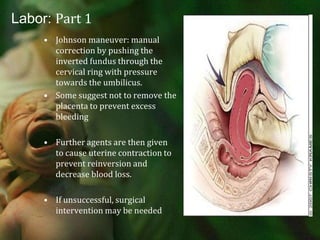
Discontinue all oxytocic agents until correction has been establishedLabor: Part 1Johnson maneuver: manual correction by pushing the inverted fundus through the cervical ring with pressure  towards the umbilicus. Some suggest not to remove the placenta to prevent excess bleedingFurther agents are then given to cause uterine contraction to prevent reinversion and  decrease blood loss. If unsuccessful, surgical intervention may be needed

Labor part one

  • 1.
    Labor: Part 1by La Lura White MDMaternal Fetal Medicine
  • 2.
    Labor: Part 1Laboris a remarkable natural experience.A sequence of timed events, correlate with biochemical and hormonal messengers to develop synchronized contraction patterns. These contractions become stronger, more regulated and lead to the progressive dilation and effacement of the cervix , and ultimately the delivery of a neonate.Understanding these interactions and recognizing their normal and abnormal manifestations are paramount in the appropriate management of the obstetrical patient.
  • 3.
    Labor: Part 1Theonset of labor occurs around 280 days, or 40 weeks, from the first day of a patient's last menstrual period (LMP), and serves the basis for the EDC or estimated date of confinement.Actually, only 5% of births occur on the assigned due date (EDC). 50% occur within a week. Almost 90% within 2 weeks of an EDC.
  • 4.
    Labor: Part 1Accordingto Gabbe:Labor occurs in the term patient when she is between 37 0/7 (36 completed weeks) – 42 0/7 weeks (41 completed weeks).Pre-term or premature labor: occurs prior to 37 0/7 (36 completed weeks).Post-dates: gestation that continues past the assigned EDC.Post-term (prolonged): pregnancy progresses beyond 42 0/7. Obstetrics: Normal and Problem Pregnancies, Gabbe.
  • 5.
    Labor: Part 1Adequatedating early in pregnancy is important to distinguish term from preterm conditions that may occur later in gestation, and avoid unnecessary tocolysis or labor inductions based on erroneous dating.Pregnancy dating should also use the earliest accurate information and not be changed on later less accurate data, or represent developing conditions like macrosomia or IUGR conditions.The EDC can be calculated using an appropriate pregnancy wheel. orLMPEDC
  • 6.
    Labor: Part 1Nagele’srule = LMP-3 months + 7 days+1 yearEx: LMP = 8 May 20078 May 2007 (LMP) -3 months = 8 February 2007 Add 7 days = 15 February 2007Add 1 year = 15 February 2008EDC=15 February 2008
  • 7.
    Labor: Part 1Usingthese dating methods assumes the patient has a regular menstrual cycle, a 28 day interval and an anticipated ovulation at day 14.The patient should have not recently discontinued oral contraceptives, which may affect ovulation time.If the cycles are irregular, they are adjusted based onvariations in the follicular or pre-ovulatory phase (first half of the cycle).For example, if a patient has a cycle that last 34 days (34-28=6), ovulation may have occurred 6 days later, and those 6 days may need to be added to the assigned EDC.
  • 8.
    Labor: Part 1Ifusing ultrasound data to determine a patients gestational age, use only the earliest ultrasound information, and change the EDC if and only if that early information falls outside the normal margin of error for ultrasound.The 1st trimester (conception to 13 weeks) scan should correlate within one week of EDC by LMP.The 2nd trimester(14-27 weeks) scan should correlate within two weeks of EDC by LMP.3rd trimester (28 weeks-delivery) should correlate within three weeks of EDC by LMP, but a single femur length may be a more accurate determination of gestational age in this late ultrasounds, if no earlier data available.PATIENTS SHOULD ONLY HAVE ONE EDC
  • 9.
    Labor: Part 1UterineChanges in PregnancyThe uterus is made primarily of smooth muscle.Increase in weight 4-70g (non-pregnant) to 1100-1200g (at term).Initial myometrial hyperplasia (increase in number cells) then hypertrophy (increase in cell size).Volume increases from 10ml to 5 L. 10 times increase in uterine blood flow, with 80-90% directed to the placenta.  
  • 10.
    Labor: Part 1Uterinetonicity changes from the non-pregnant muscular uterus that has a normal but significant resting tone, to a functional uterine quiescence during pregnancy, secondary to negative inhibitory factors and finally towards the end of pregnancy to an activated, stimulated responsive uterus that is able to contract.These physiological changes are divided into four phases:Phase 0: (inhibitory) Uterine maintains functional quiescence secondary to multiple agents that exert an inhibitory and includes: progesterone, prostacyclin, prostaglandin, relaxin, parathyroid hormone-related peptide, nitric oxide, calcitonin gene-related peptide, adrenomedullin and vasoactive intestinal peptide.
  • 11.
    Labor: Part 1Beforeterm, there is a release of this negative inhibitionPhase 1: (activation)Initiate by uterotopins, like estrogen and possibly progesterone, prostaglandins and corticotrophin-releasing hormone.Increased expression of contraction associated proteins, including myometrial receptors for prostaglandin and oxytocin.Activation of certain ion channels.Increase in connexin-43 (key component for gap junctions).Increase in the number of gap junctions.This primed uterus can now be stimulated to contract.
  • 12.
    Labor: Part 1Phase2: (stimulation)Myometrium is stimulated by uterotropins like stimulatory prostaglandin (PGE2 and PGF2 alpha) and oxytocin.Previously formed Gap junctions facilitate the passage of electrical activity. Improved synchrony between myometrial contractions, leads to a progression in myometrial activity.
  • 13.
    Labor: Part 1This results in the development of initially Braxton-Hicks contractures that are irregular, low frequency, disco-ordinate and painless) to true labor contractions (regular, painful, high intensity, high frequency).Phase 3 Occurs after delivery. Involution of uterus. Mediated by oxytocin and possibly thrombin.
  • 14.
    Labor: Part 1Thisuterine activity is coordinated with cervical changes: The cervix, composed some smooth muscle (greatest amount found at internal os) is mainly an extracellular connective tissue matrix.It’s major component are type 1 and type 3 collagen, with a small amount of type 4 collagen at the basement membrane. In addition, this matrix includes glycosaminoglycans and proteoglycans, predominantly dermatan sulfate, hyaluronic acid, and heparin sulfate. 
  • 15.
    Labor: Part 1Collagen fibers are tightly wound into a tubular configuration that maintains a tight sphincter, protected by a mucus plug, that maintains the fetus in utero during pregnancy.Fibronectin and elastin are also found among these collagen fibers, with the highest ratio of elastin to collagen at the internal os.The actual amount of elastin and smooth muscle decrease progressively from the internal to the external os of the cervix.
  • 16.
    Labor: Part 1Inlate pregnancy, the hyaluronic acid content in the cervix increases that leads to increased accumulation of water molecules that intersperse among the collagen fibers.Dermatan sulfate decreases, causing reduced bridging among the collagen fibers and a decrease in cervical firmness.The amount of collagen and collagen fibrils also decrease and disperse secondary to increased decorin, a proteoglycan that coats and separates collagen fibrils.
  • 17.
    Labor: Part 1Leadingto a rearrangement and realignment of the collagen molecules with diminished collagen fiber and tensile strength.The cervix becomes thinner, softer, shorter and more pliable, leading to cervical ripening. Now if coordinated with regular uterine contractions, these changes allow easier progressive dilatation and effacement of the cervix, an efficient labor and a successful delivery.
  • 18.
    Labor: Part 1The “parturition cascade” thought to recruit the factors that moves uterine activity from an irregular to a more regular contraction pattern involves activation of fetal-hypothalamic-pituitary-adrenal axis.Once activated, the fetal adrenal assist the placenta in its production of steroid hormones, especially estrogens, E1 ( estrone ) E2 (estradiol ) and E3 (estriol). However, the fetal adrenals and placenta are incomplete steridogenic organs and dependent on precursors from each other in order to complete their respective steroid synthesis.
  • 19.
    Labor: Part 1The fetal adrenals are functional early in pregnancy.Fetal pituitary basophilic cells at about 7 weeks begins to produce fetal ACTH to stimulate the fetal adrenal cortex.The placenta, because of its access to these steroid precursors, can now begins to dominate steroid production, a previous function of the corpus luteum.This is also when estrogen first appears in the maternal circulation.
  • 20.
    Labor: Part 1In the first 20 weeks of gestation, placental hCG and progesterone, and possibly prolactin help maintain and regulate the fetal adrenal cortex that is later maintained by fetal ACTH.Between 32-36 weeks, there is a marked growth in the fetal adrenal cortex, in response to the increased steroid production required towards the end of gestation.So how does the placenta and the fetal adrenals interact to affect their respective steroidgenesis?
  • 21.
    Labor: Part 1The fetal adrenal cortex is deficient in 3-B hydroxysteroid dehydrogenate, the enzyme that converts pregnenolone and DHEA to progesterone and androstendioneTherefore, the fetus cannot make progesterone and androstendioneBut the placenta is abundant in in 3-B hydroxysteroid dehydrogenate
  • 22.
    Labor: Part 1Sothe fetus takes LDL cholesterol from the fetal circulation and converts it to pregnenolone sulfate and DHEA-S.It then sends pregnenolone sulfate to the placenta via the umbilical artery.The placenta converts the pregnenolone to progesterone.The progesterone (that the fetus is unable to make), is sent back to the fetal adrenals where they can proceed to synthesize various mineralcorticoids and glucocorticids.
  • 23.
    Labor: Part 1Theplacenta can also extract LDL cholesterol from the maternal circulation to produce progesterone, so although it uses the precussors produced in the fetal adrenal cortex, it is not dependent on them to synthesize progesterone.As a preservative measure, the placenta lacks 17-alpha hydroxylase, needed to metabolize progesterone.
  • 24.
    Labor: Part 1Theplacenta synthesizes estrogen, but needs external supply C-19 steroid precursor (DHEA: dehydroepiandrostenedione), DHEA is supplied from the fetal adrenal intermediate zoneRemember, DHEA-S, was the other byproduct, of the fetal adrenal cortex conversion of LDL cholesterol extracted from the fetal circulation, (LDL cholesterol= pregnenolone sulfate and DHEA-S)Also DHEA-S is the delivered to the fetal liver where it is converted into16-alpha hydroxydehydroepiandrosterone sulfate (16 alpha OHDHEAS)Placenta also uses 16 alpha OHDHEAS from the fetal liver , where it is first converted into 16 alpha-hydroxyandrostenedione and further aromatized to estriol)
  • 25.
    Labor:: Part 1MaternalFetal Placental Unit
  • 26.
    Labor: Part 1Oncea contraction pattern of Labor is established, it is divided into three stages.First Stage: onset of labor until full cervical dilation.Second Stage: full dilation of cervix until delivery of neonate.Third Stage: delivery of neonate to delivery of placenta.Fourth Stage: the hour immediately following delivery of placenta. (originally described by Friedman)
  • 27.
    Labor: Part 1First Stage : is further divided into the latent and active phase:Latent phase: onset of labor to beginning of active phaseSlower rate of cervical dilation, primarily softening and effacement14 hours in multigravid patients and up to 20 hours in nulligravidaFriedman EA; Labor: clinical evaluation and management, 2nd ed. Norwalk, CT, Appleton Century Crofts, 1978.
  • 28.
    Labor: Part 1Transitionbetween the latent and active phases can vary, usually occurs at some time between 2 and 5 cm of cervical dilation in most patients.Important to distinguish between latent phase where slow progression is normal and dysfunctional labor, where labor is abnormal and interventions may be necessary.After the latent phase is the active phase, where there is a faster rate of cervical dilatation.
  • 29.
    Labor: Part 1Activephase is further divided into:Acceleration phase: abrupt change in the rate of dilatationPhase of maximum slope: the time of rapid cervical dilation and rapid fetal descentDeceleration phase: decreased rate of dilation of the cervical os Descent phase which coincides with second stageFriedman used the lower limit value of 1cm/hr dilatation in the active phase to refer to the phase of maximum slope, not the entire active phase that many clinicians interpret, but have normally slower cervical dilatation rates
  • 30.
    Labor: Part 1Friedman (1955) evaluated uncomplicated pregnancies delivering normal infants Primagravidas MultigravidasMin. rate of cervical dilatation(5th %) 1.2cm/h 1.5cm/hMean rate cervical dilatation 3.0cm/h 5.7 cm/h Descent of fetal head in relation to ischial spines began well before second stage (fully dilated)Rate of descent increased late in first stage and continued linearly into second stageFriedman EA. Primigravid labor; a graphicostatistical analysis. Obstet Gynecol. Dec 1955;6(6):567-89
  • 31.
    Labor: Part 1Friedman EA. Primigravid labor; a graphicostatistical analysis. Obstet Gynecol. Dec 1955;6(6):567-89
  • 32.
    Labor: Part 1Recentchallenges to Friedman’s data on patient’s labor patterns reflects changes over the past 50 years in the patients we see and how we practice. More aggressive medical management, higher induction rates, use of oxytocin, regional anesthesia and continuous fetal monitoring. Maternal characteristics have also changed, with greater body mass index [BMI] and an increase in fetal size.
  • 33.
    Labor: Part 1Challenges to Friedman’s Curve:Zhang used a statistical approach to demonstrate contemporary differences in women laboring today.He showed gradual instead of abrupt change from latent to active phase.A longer length of the active labor phase, 5.5 hr. instead of vs. 2.5 hours.No deceleration phase identified.Zhang J et al. Reassessing the labor curve in nulliparous women. Am J Obstet Gynecol 2002 Oct; 187:824-8.
  • 34.
    Labor: Part 1Commonfor two hours to lapse in active phase without cervical change and especially before the patient was 7 cm. was not uncommon5th percentile for rate of cervical dilatation was determined less than 1 cm/hr.Head can take up to three hours to descend from +0 station to +4 or present at the perineum, and an additional 30 minutes for delivery.Zhang J et al. Reassessing the labor curve in nulliparous women. Am J Obstet Gynecol 2002 Oct; 187:824-8.
  • 35.
    Labor: Part 1Rouse developed a protocol requiring a minimum of 12 hours of oxytocin after membrane rupture before failed labor induction could be diagnosed.Found many nulliparas who remained in the latent phase at up to 9 hours still had safe vaginal deliveriesSuggest extending the minimum period of oxytocin augmentation for active phase labor arrest from 2 to at least 4 hours was found to be safe and effectiveRouse DJ Owen, Hauth JC: Criteria for failed labor induction: Prospective evaluation of a standardized protocol. Obstet Gynecol 96:671,2000.
  • 36.
    Labor: Part 1Despitethese differences, it is important to have normal parameters to assess the progress of the laboring patient, and identify situations of dysfunctional labor patterns that require re-evaluation and minimize interventions when both mother and fetus are stable.
  • 37.
    Labor: Part 1AbnormalLabor PatternsProlonged Latent Phase: abnormal duration of latent phase of first stage of laborProtraction disorders: ( Slower than normal progress)Primary dysfunctional laborProtraction of descentArrest disorders (Complete cessation of progress)Arrest of dilatationArrest of descent
  • 38.
    Labor: Part 1ProlongedLatent Phase: Greater than 20 h in nulliparas (mean 8.6 hr.) and 14 h in multiparas (mean 5.3 hr.).May be due to a delay in cervical ripening or change in the cervical tissue biochemistry.Not correlated with adverse outcome.Expectant management.Differentiate latent phase (normal slow progression) from Braxton-Hicks (irregular pre-labor contractions).
  • 39.
    Labor: Part 1Augmentationof contractions in the latent phase is not beneficial and results in a 10X increase in Cesarean section rate and a 3X increase in low neonatal Apgar scores.Treatment: Reassurance: if no cervical change, observation usually 2-3 hrs., contraction may cease.Analgesia: if contractions persistent with no cervical change especially if painful.Therapeutic rest: Ex: morphine 10-15 mg or nubain
  • 40.
    15mg with or without phenegram 25mg or vistiril
  • 41.
    25mg.Labor: Part1Protracted Disorders: There is a protraction of dilatation (active phase) and a protraction of descent (second stage)Primary dysfunctional labor: protraction of dilatation where the rate of active phase cervical dilatation less than 5th percentile, occurs after normal active phase dilatationLess than 1.2 cm/hr. in nulliparas and 1.5cm./hr. in multiparasProtraction of Descent: : delayed descent of the fetal head less than 1.0 cm per hour in nulliparas and less than 2.0 cm per hour for multiparas
  • 42.
    Labor: Part 1Carefulassessment to fetal size and positionAugmentation and/or amniotomy if appropriate especially if poor contraction strengthMost common cause in nulliparas is inadequate uterine activity and in multiparas is CPD (cephaloelvic disproportion)
  • 43.
    Labor: Part 1ArrestDisorders:Secondary arrest: cessation of previously normal active phase dilatation for 2 or more hours.Suggest dystocia in presence of adequate contractions. Requires vaginal exam to verify dilatation, presentation, position and station.Evaluate with clinical pelvimetry to assess adequacy of pelvis.
  • 44.
    Labor: Part 1Oxytocinwith or without amniotomy if suboptimal contractions and candidate for artificial rupture.Greater risk for further labor abnormalities and operative delivery.Arrest 2-4 hours despite adequate contractions, preferably documented with an IUPC, may need to consider cesarean section.With a recently documented 31% cesarean section rate in the U.S., this decision should be made after a thorough evaluation, however it should not be inappropriately delayed.
  • 45.
    Labor: Part 1Arrestof descent: No descent of fetal head with an epidural of >3 hours in primips and >2 hours in multips.If no epidural >2 hours in primips and >1 hour in multip.s Usually preceded by a normal pattern of dilatation and descent.Major risk factors nulliparity, fetal macrosomia, epidural analgesia, hydramnios, hypertensive disorders and gestational diabetes mellitus.Careful evaluation with the same caveat, make an appropriate, expedient and supportive decision for further management.
  • 46.
    Indication Nullipara Multipara Prolonged latent phase >20 h >14 h Average second stage 50 min 20 min Prolonged second stage: without (with) epidural >2 h (>3 h) >1 h (>2 h) Protracted dilation <1.2 cm/h <1.5 cm/h Protracted descent <1 cm/h <2 cm/h Arrest of dilation* >2 h >2 h Arrest of descent* >2 h >1 hProlonged third stage >30 min >30 min *Adequate contractions >200 Montevideo units [MVU] per 10 minutes for 2 hours.
  • 47.
    Labor: Part 1Preventabnormalities of second stage: “ Aggressiveness may get you in trouble.”Descent and rotation often occurs before the cervix is fully dilated.No impact of duration of second stage if progressing slowly, if mother and fetus are stable.Delayed pushing after the patient is fully dilated, especially if the head is still high , “laboring down” may have better outcome
  • 48.
    Labor: Part 1Muueller-Hillismaneuver: apply pressure to uterine fundus with one hand, and with 1-2fingers in the vagina, detect if there is descent of the fetal head.If fetal head descends 1 cm or more with pressure, prognosis for vaginal delivery is good.Once the fetus is delivered…….Remember, its not over!You still need to deliver the placenta
  • 49.
    Labor: Part 1Althoughmost placentas deliver within 5 minutes, you have up to 30 minutes Two maneuvers Brandt-Andrews: an abdominal hand is placed on the abdomen to secure the uterus while providing downward traction on the umbilical cord;pt may assist with pushingCréde maneuver: the cord is fixed with the lower hand while the hand on the abdomen secures the uterine fundus and provides upward traction
  • 50.
    Labor: Part 1Thethree classic signs of placental separation will be:Lengthening of the umbilical cordA gush of blood from the vagina signifying the separation of the placenta from the uterine wallA change in the shape of the uterine fundus from discoid to globular, with an elevation of fundal heightUterotonics given after delivery of the fetus (active management can hasten the delivery of the placenta, reduce blood loss and improve uterine contractilityBe Patient……………
  • 51.
    Labor: Part 1Youdon’t want this…..Acute puerperal uterine inversion: 1/2000Rare but potentially life threatening conditionUterine fundus collapses within the endometrial cavity
  • 52.
    Severe hemorrhage andshock can lead to maternal death
  • 53.
    Immediate recognition withprompt attention and treatment
  • 54.
    Discontinue all oxytocicagents until correction has been establishedLabor: Part 1Johnson maneuver: manual correction by pushing the inverted fundus through the cervical ring with pressure towards the umbilicus. Some suggest not to remove the placenta to prevent excess bleedingFurther agents are then given to cause uterine contraction to prevent reinversion and decrease blood loss. If unsuccessful, surgical intervention may be needed