NON-HEME OXYGEN
CARRIER PROTEINS :
HEMOCYANIN AND
HEMERYTHRIN
Dr. Santarupa Thakurta
Assistant Professor in
Chemistry
Prabhu Jagatbandhu College,
West Bengal, India
Bio-inorganic Chemistry
Undergraduate Chemistry Honours
Course
Hemocyanin (Hc)
 The name ‘hemocyanin’ is a misnomer, as the protein contains
neither a porphyrin ring nor an iron atom, although it is blue as
reflected in ‘cyan’.
 The name simply means “Blue blood” (Hemo- comes from the
Greek haîma, meaning “blood)
 Oxygen carrying proteins/oxygen carriers that transport oxygen
throughout the bodies of some invertebrate animals such as
molluscs (eg. octopus, snails, squids) and arthropods (eg.
scorpions, crabs, lobsters).
 It is responsible for the bluish-green color of their blood.
 Unlike hemoglobin, they are not bound to blood cells
 Extracellular protein - suspended directly in the hemolymph.
 They are second only to hemoglobin in frequency of use as an
Copper containing
metalloprotein
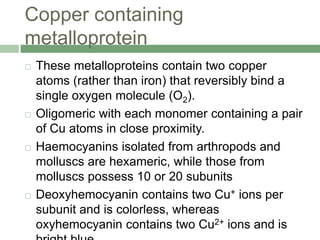
 These metalloproteins contain two copper
atoms (rather than iron) that reversibly bind a
single oxygen molecule (O2).
 Oligomeric with each monomer containing a pair
of Cu atoms in close proximity.
 Haemocyanins isolated from arthropods and
molluscs are hexameric, while those from
molluscs possess 10 or 20 subunits
 Deoxyhemocyanin contains two Cu+ ions per
subunit and is colorless, whereas
oxyhemocyanin contains two Cu2+ ions and is
Active site of deoxyhemocyanin
 Each monomer contains two cuprous ions
[Cu(I)] that reversibly bind one dioxygen.
 An empty cavity is present between the
two cuprous ions to accommodate the
dioxygen.
 The Cu(I)- Cu(I) bond distance is 460 pm
(no direct interaction between them).
 The coordination number of each Cu(I) is
three and is satisfied by three histidines
residues from the protein.
 This results in a distorted trigonal
pyramidal geometry.
 Two phenylalanine residues which are in
close proximity to the histidines residues
provide a hydrophobic environment at the
Binding of dioxygen to the active
site
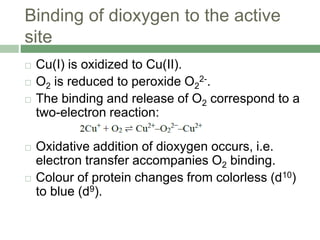
 Cu(I) is oxidized to Cu(II).
 O2 is reduced to peroxide O2
2-.
 The binding and release of O2 correspond to a
two-electron reaction:
 Oxidative addition of dioxygen occurs, i.e.
electron transfer accompanies O2 binding.
 Colour of protein changes from colorless (d10)
to blue (d9).
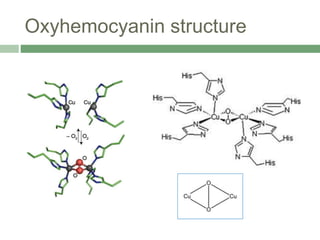
Active site structure of
oxyhemocyanin
 Coordination number of copper changes to five from three.
 Geometry of copper changes to square pyramidal from
trigonal pyramidal. The equatorial plane has two histidyl
imidazole nitrogens, the bound oxygens and the third histidyl
nitrogen is axially coordinated to copper.
 The Cu-Cu distance decreases to 360 pm.
 To accommodate the binding of O2, the protein adjusts its
conformation to bring the two Cu atoms closer together.
 The O2-binding site is formulated as Cu(II)-[O2]2--Cu(II)
 Coordination of O2 occurs between the two Cu atoms in a
bridging dihapto manner(μ-2-2)
Oxyhemocyanin structure
Experimental observation
 Evidence for the peroxo linkage comes from Raman
spectroscopy.
 The (O-O) stretching frequency is observed at 744 cm-1
confirming the presence of peroxo linkage
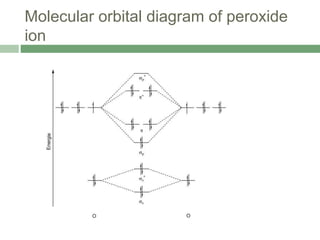
 Lowering of the bond order from 2 to 1.
 The O2 unit is bound in a bridging mode with an O-O
bond length of 140 pm, typical of that found in peroxide
complexes.
 Coordination of dioxygen to Cu(II) is symmetrical
 The Cu(II) centres are strongly antiferromagnetically
coupled, with the -[O2]2- ligand being involved in a
superexchange mechanism
Molecular orbital diagram of peroxide
ion
Real structure
 The structure of deoxyhaemocyanin from the
spiny lobster (Panulirus interruptus)
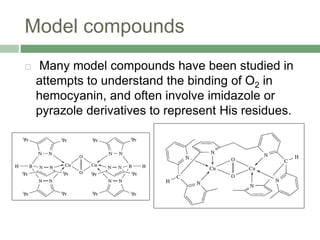
Model compounds
 Many model compounds have been studied in
attempts to understand the binding of O2 in
hemocyanin, and often involve imidazole or
pyrazole derivatives to represent His residues.
Mechanism
 It has been noted that species using hemocyanin for oxygen
transportation include crustaceans living in cold environments with low
oxygen pressure.
 Under these circumstances hemoglobin oxygen transportation is less
efficient than hemocyanin oxygen transportation.
 Nevertheless, there are also terrestrial arthropods using hemocyanin,
notably spiders and scorpions, that live in warm climates.
 Most hemocyanins bind with oxygen non-cooperatively and are
roughly one-fourth as efficient as hemoglobin at transporting oxygen
per amount of blood.
 In some hemocyanins of horseshoe crabs and some other species of
arthropods, cooperative binding is observed, with Hill coefficients of
1.6–3.0.
 In these cases of cooperative binding hemocyanin was arranged in
protein sub-complexes of 6 subunits (hexamer) each with one oxygen
Hemerythrin (Hr)
 Hemerythrin is a reversible oxygen binding
metalloprotein found in blood cells of a few marine
invertebrates.
 A non-hem Fe-containing protein.
 Intracelluar : Located within specialised immune cells
(hemerythrocytes) of invertebrate fluid
 It is an oligomeric protein generally found in an
octomeric form. The dimeric, trimeric and tetrameric
forms of hemerythrin are also known.
 Each subunit contains each with 113 amino acid
residues and a di-iron-active site
 It is colorless in the deoxy form and on oxygenation the
color changes to purple-red.
Active site structure of
deoxyhemerythrin
 Each monomeric unit contains an active site which has two
high spin ferrous ions [Fe(II)].
 The ferrous ions are bridged together by a hydroxyl group
and two carboxyl groups from an aspartate residue and a
glutamate residue of the protein chain.
 One of the ferrous is hexacoordinated with an octahedral
geometry and the other is pentacoordinated with a distorted
trigonal bipyramidal geometry.
 The remaining coordination sites of hexacoordinated ferrous
and pentacoordinated ferrous are satisfied by three and two
imidazole nitrogens respectively from histidine residues of the
protein chain
 The hydroxyl group serves as a bridging ligand but also
functions as a proton donor to the O2 substrate.
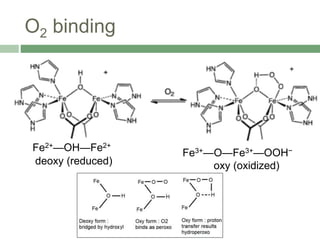
O2 binding
Fe2+—OH—Fe2+
deoxy (reduced)
Fe3+—O—Fe3+—OOH−
oxy (oxidized)
Active site structure of
oxyhemerythrin
 One monomeric unit of hemerythrin binds one dioxygen.
 The dioxygen adds only to the coordinatively unsaturated
ferrous.
 The dioxygen adds to hemerythrin in an oxidative manner
resulting in the formation of two Fe(III) centers and peroxide
(O2
2-).
 The oxidative addition is followed by the shifting of proton
from the bridged OH to the bound peroxide resulting in the
formation of hydroperoxo (HO2-) group.
 This proton-transfer result in the formation of a single oxygen
atom (μ-oxo) bridge in oxyhemerythrin.
 The hydroperoxo group is hydrogen bonded with the μ-oxo
group.
Experimental observation
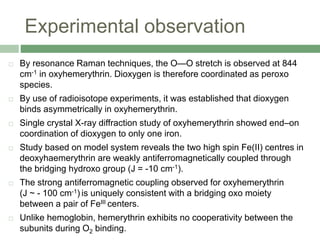
 By resonance Raman techniques, the O—O stretch is observed at 844
cm-1 in oxyhemerythrin. Dioxygen is therefore coordinated as peroxo
species.
 By use of radioisotope experiments, it was established that dioxygen
binds asymmetrically in oxyhemerythrin.
 Single crystal X-ray diffraction study of oxyhemerythrin showed end–on
coordination of dioxygen to only one iron.
 Study based on model system reveals the two high spin Fe(II) centres in
deoxyhaemerythrin are weakly antiferromagnetically coupled through
the bridging hydroxo group (J = -10 cm-1).
 The strong antiferromagnetic coupling observed for oxyhemerythrin
(J ~ - 100 cm-1) is uniquely consistent with a bridging oxo moiety
between a pair of FeIII centers.
 Unlike hemoglobin, hemerythrin exhibits no cooperativity between the
subunits during O2 binding.
Real structure
 Single Oxygenated Hemerythrin protein
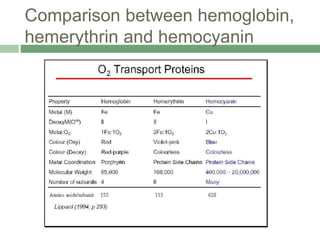
Comparison between hemoglobin,
hemerythrin and hemocyanin
Interesting fact
 Although hemocyanin and hemerythrin
perform the same basic function as
hemoglobin, these proteins are not
interchangeable.
 In fact, hemocyanin is so foreign to humans
that it is one of the major factors responsible
for the common allergies to shellfish.

Hemocyanin and Hemerythrin

  • 1.
    NON-HEME OXYGEN CARRIER PROTEINS: HEMOCYANIN AND HEMERYTHRIN Dr. Santarupa Thakurta Assistant Professor in Chemistry Prabhu Jagatbandhu College, West Bengal, India Bio-inorganic Chemistry Undergraduate Chemistry Honours Course
  • 2.
    Hemocyanin (Hc)  Thename ‘hemocyanin’ is a misnomer, as the protein contains neither a porphyrin ring nor an iron atom, although it is blue as reflected in ‘cyan’.  The name simply means “Blue blood” (Hemo- comes from the Greek haîma, meaning “blood)  Oxygen carrying proteins/oxygen carriers that transport oxygen throughout the bodies of some invertebrate animals such as molluscs (eg. octopus, snails, squids) and arthropods (eg. scorpions, crabs, lobsters).  It is responsible for the bluish-green color of their blood.  Unlike hemoglobin, they are not bound to blood cells  Extracellular protein - suspended directly in the hemolymph.  They are second only to hemoglobin in frequency of use as an
  • 3.
    Copper containing metalloprotein  Thesemetalloproteins contain two copper atoms (rather than iron) that reversibly bind a single oxygen molecule (O2).  Oligomeric with each monomer containing a pair of Cu atoms in close proximity.  Haemocyanins isolated from arthropods and molluscs are hexameric, while those from molluscs possess 10 or 20 subunits  Deoxyhemocyanin contains two Cu+ ions per subunit and is colorless, whereas oxyhemocyanin contains two Cu2+ ions and is
  • 4.
    Active site ofdeoxyhemocyanin  Each monomer contains two cuprous ions [Cu(I)] that reversibly bind one dioxygen.  An empty cavity is present between the two cuprous ions to accommodate the dioxygen.  The Cu(I)- Cu(I) bond distance is 460 pm (no direct interaction between them).  The coordination number of each Cu(I) is three and is satisfied by three histidines residues from the protein.  This results in a distorted trigonal pyramidal geometry.  Two phenylalanine residues which are in close proximity to the histidines residues provide a hydrophobic environment at the
  • 5.
    Binding of dioxygento the active site  Cu(I) is oxidized to Cu(II).  O2 is reduced to peroxide O2 2-.  The binding and release of O2 correspond to a two-electron reaction:  Oxidative addition of dioxygen occurs, i.e. electron transfer accompanies O2 binding.  Colour of protein changes from colorless (d10) to blue (d9).
  • 6.
    Active site structureof oxyhemocyanin  Coordination number of copper changes to five from three.  Geometry of copper changes to square pyramidal from trigonal pyramidal. The equatorial plane has two histidyl imidazole nitrogens, the bound oxygens and the third histidyl nitrogen is axially coordinated to copper.  The Cu-Cu distance decreases to 360 pm.  To accommodate the binding of O2, the protein adjusts its conformation to bring the two Cu atoms closer together.  The O2-binding site is formulated as Cu(II)-[O2]2--Cu(II)  Coordination of O2 occurs between the two Cu atoms in a bridging dihapto manner(μ-2-2)
  • 7.
  • 8.
    Experimental observation  Evidencefor the peroxo linkage comes from Raman spectroscopy.  The (O-O) stretching frequency is observed at 744 cm-1 confirming the presence of peroxo linkage  Lowering of the bond order from 2 to 1.  The O2 unit is bound in a bridging mode with an O-O bond length of 140 pm, typical of that found in peroxide complexes.  Coordination of dioxygen to Cu(II) is symmetrical  The Cu(II) centres are strongly antiferromagnetically coupled, with the -[O2]2- ligand being involved in a superexchange mechanism
  • 9.
  • 10.
    Real structure  Thestructure of deoxyhaemocyanin from the spiny lobster (Panulirus interruptus)
  • 11.
    Model compounds  Manymodel compounds have been studied in attempts to understand the binding of O2 in hemocyanin, and often involve imidazole or pyrazole derivatives to represent His residues.
  • 12.
    Mechanism  It hasbeen noted that species using hemocyanin for oxygen transportation include crustaceans living in cold environments with low oxygen pressure.  Under these circumstances hemoglobin oxygen transportation is less efficient than hemocyanin oxygen transportation.  Nevertheless, there are also terrestrial arthropods using hemocyanin, notably spiders and scorpions, that live in warm climates.  Most hemocyanins bind with oxygen non-cooperatively and are roughly one-fourth as efficient as hemoglobin at transporting oxygen per amount of blood.  In some hemocyanins of horseshoe crabs and some other species of arthropods, cooperative binding is observed, with Hill coefficients of 1.6–3.0.  In these cases of cooperative binding hemocyanin was arranged in protein sub-complexes of 6 subunits (hexamer) each with one oxygen
  • 13.
    Hemerythrin (Hr)  Hemerythrinis a reversible oxygen binding metalloprotein found in blood cells of a few marine invertebrates.  A non-hem Fe-containing protein.  Intracelluar : Located within specialised immune cells (hemerythrocytes) of invertebrate fluid  It is an oligomeric protein generally found in an octomeric form. The dimeric, trimeric and tetrameric forms of hemerythrin are also known.  Each subunit contains each with 113 amino acid residues and a di-iron-active site  It is colorless in the deoxy form and on oxygenation the color changes to purple-red.
  • 14.
    Active site structureof deoxyhemerythrin  Each monomeric unit contains an active site which has two high spin ferrous ions [Fe(II)].  The ferrous ions are bridged together by a hydroxyl group and two carboxyl groups from an aspartate residue and a glutamate residue of the protein chain.  One of the ferrous is hexacoordinated with an octahedral geometry and the other is pentacoordinated with a distorted trigonal bipyramidal geometry.  The remaining coordination sites of hexacoordinated ferrous and pentacoordinated ferrous are satisfied by three and two imidazole nitrogens respectively from histidine residues of the protein chain  The hydroxyl group serves as a bridging ligand but also functions as a proton donor to the O2 substrate.
  • 15.
  • 16.
    Active site structureof oxyhemerythrin  One monomeric unit of hemerythrin binds one dioxygen.  The dioxygen adds only to the coordinatively unsaturated ferrous.  The dioxygen adds to hemerythrin in an oxidative manner resulting in the formation of two Fe(III) centers and peroxide (O2 2-).  The oxidative addition is followed by the shifting of proton from the bridged OH to the bound peroxide resulting in the formation of hydroperoxo (HO2-) group.  This proton-transfer result in the formation of a single oxygen atom (μ-oxo) bridge in oxyhemerythrin.  The hydroperoxo group is hydrogen bonded with the μ-oxo group.
  • 17.
    Experimental observation  Byresonance Raman techniques, the O—O stretch is observed at 844 cm-1 in oxyhemerythrin. Dioxygen is therefore coordinated as peroxo species.  By use of radioisotope experiments, it was established that dioxygen binds asymmetrically in oxyhemerythrin.  Single crystal X-ray diffraction study of oxyhemerythrin showed end–on coordination of dioxygen to only one iron.  Study based on model system reveals the two high spin Fe(II) centres in deoxyhaemerythrin are weakly antiferromagnetically coupled through the bridging hydroxo group (J = -10 cm-1).  The strong antiferromagnetic coupling observed for oxyhemerythrin (J ~ - 100 cm-1) is uniquely consistent with a bridging oxo moiety between a pair of FeIII centers.  Unlike hemoglobin, hemerythrin exhibits no cooperativity between the subunits during O2 binding.
  • 18.
    Real structure  SingleOxygenated Hemerythrin protein
  • 19.
  • 20.
    Interesting fact  Althoughhemocyanin and hemerythrin perform the same basic function as hemoglobin, these proteins are not interchangeable.  In fact, hemocyanin is so foreign to humans that it is one of the major factors responsible for the common allergies to shellfish.