SECOND LANGUAGE
ACQUISITION

  Archibald, 2011
SLA: multidisciplinary field
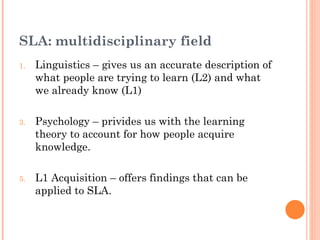
1.   Linguistics – gives us an accurate description of
     what people are trying to learn (L2) and what
     we already know (L1)

3.   Psychology – privides us with the learning
     theory to account for how people acquire
     knowledge.

5.   L1 Acquisition – offers findings that can be
     applied to SLA.
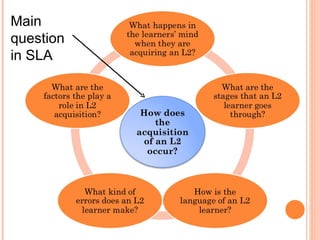
Main
question
in SLA
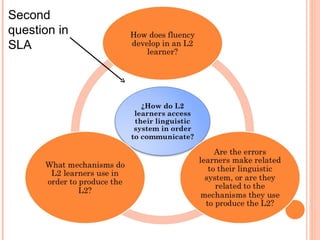
Second
question in
SLA
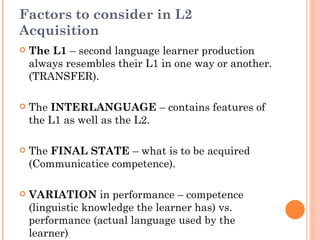
Factors to consider in L2
Acquisition
   The L1 – second language learner production
    always resembles their L1 in one way or another.
    (TRANSFER).

   The INTERLANGUAGE – contains features of
    the L1 as well as the L2.

   The FINAL STATE – what is to be acquired
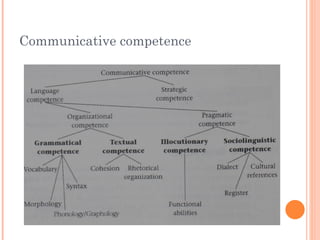
    (Communicatice competence).

   VARIATION in performance – competence
    (linguistic knowledge the learner has) vs.
    performance (actual language used by the
    learner)
Communicative competence
Variation: Example
I didn’t like that movie so I told her I no want to
go there.

QUESTIONS:

Why is there such variation?
Have these learners acquired the English negation
or not?
Variation: some explanations

   When learners are only focusing on the form of
    the L2 utterance, they may be able to produce it
    accurately.

HOWEVER,
 When there are other factors such as
  communicating a complex thought, errors may
  occur

A matter of PROCESSING?
 Need to shift processing from controlled to
  automatic (because of fixed processing capacity in
  humans).
Interlanguage Grammars

General question:
What is the structure of an interlanguage?


Investigate the mental representations of
interlanguage grammars within the different
domains of linguistic theory.
L2 phonology
   The L2 learner will have to learn to perceive and
    produce some new sounds when learning an L2.

   Segmental phonology

   Prosodic phonology
L2 Phonology: Question
 Why are some sounds easier to acquire than
  others in an L2?
 What is the role of the L1?


The role of
Markedness – The Markedness Differential
 Hypothesis.

   Investigates L2 acquisition by comparing the
    relative markedness in the L1 and the L2.
L2 Syntax
   Two facets of syntactic structure that L2 learners
    must acquire: the null subject parameter and
    verb movement.

THE NULL SUBJECT PARAMETER
 Languages with overt subjects vs. languages in
  which the subject can be omitted.
 Languages with null subjects also:
     Allow declarative sentences with flexible word order
     Speakers of null subject languages are more likely to
      permit that trace sequences).
L2 Syntax
VERB MOVEMENT

Some  languages do not allow verb movement,
while others do.

For example,
English does not allow it, but French does.
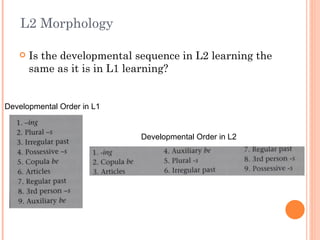
L2 Morphology

      Is the developmental sequence in L2 learning the
       same as it is in L1 learning?


Developmental Order in L1


                             Developmental Order in L2
Factors affecting SLA
   Does the onset age of L2 acquisition cause
    different levels of final proficiency?

   Is there an optimal time or a “critical period” to
    acquire an L2?

   Discussion focuses in the area of phonology
       Fairly certain predictions:
         People who start learning the L2 before the age of 7, will
          have native like L2 speech.
         People who start learning after the age of 14 or 15 will have

          non-native speech.


   It is much more difficult to predict knowledge or
    ability in the area of syntax, sociolinguistics, etc.
Individual differences

    Question asked: if learners have a particular
     quality “x”, does this make them better second
     language acquirers?

Three main points that need to be well explained:

5.   How doe we define “x”?
6.   What does it mean to be a “better” acquirer?
7.   What aspect of communicative competence are
     we referring to?
Affective factors: motivation

   Will a person that is more motivated be more
    successful at acquiring an L2?

   Two types of motivation:
     INSTRUMENTAL (having a specific goal or reason to
      learn the L2).
     INTEGRATIVE (wanting to learn more about a
      culture or to fit in better).

    Some findings:
    The degree of integrative motivation, correlates with
      the degree of success in learning a target language.
Cognitive factors
 The mechanics of how an individual learns
  something new.
 Contrast between field dependence and field
  independence.

Some SLA conclusions:
 field-independent learners do better on tests that
  focus on analytic tasks such as providing the
  correct grammatical form in a given sentence.
 Field-dependent learners do better in tasks that
  involve synthesizing their knowledge. (better
  communicative commpetence – more concerned
  with getting the message across than with the
  correctness)
The l2 classroom


Three relevant characteristics of
 a second language classroom:

  Modified  input (teacher talk)
  Modified interaction (recast)
  Focus on form (instructions
   about the language and
   explicit correction).
Bilingual education

   Minority language maintenance programs

   French immersion

L2 acquisition

  • 1.
  • 2.
    SLA: multidisciplinary field 1. Linguistics – gives us an accurate description of what people are trying to learn (L2) and what we already know (L1) 3. Psychology – privides us with the learning theory to account for how people acquire knowledge. 5. L1 Acquisition – offers findings that can be applied to SLA.
  • 3.
  • 4.
  • 5.
    Factors to considerin L2 Acquisition  The L1 – second language learner production always resembles their L1 in one way or another. (TRANSFER).  The INTERLANGUAGE – contains features of the L1 as well as the L2.  The FINAL STATE – what is to be acquired (Communicatice competence).  VARIATION in performance – competence (linguistic knowledge the learner has) vs. performance (actual language used by the learner)
  • 6.
  • 7.
    Variation: Example I didn’tlike that movie so I told her I no want to go there. QUESTIONS: Why is there such variation? Have these learners acquired the English negation or not?
  • 8.
    Variation: some explanations  When learners are only focusing on the form of the L2 utterance, they may be able to produce it accurately. HOWEVER,  When there are other factors such as communicating a complex thought, errors may occur A matter of PROCESSING?  Need to shift processing from controlled to automatic (because of fixed processing capacity in humans).
  • 9.
    Interlanguage Grammars General question: Whatis the structure of an interlanguage? Investigate the mental representations of interlanguage grammars within the different domains of linguistic theory.
  • 10.
    L2 phonology  The L2 learner will have to learn to perceive and produce some new sounds when learning an L2.  Segmental phonology  Prosodic phonology
  • 11.
    L2 Phonology: Question Why are some sounds easier to acquire than others in an L2?  What is the role of the L1? The role of Markedness – The Markedness Differential Hypothesis.  Investigates L2 acquisition by comparing the relative markedness in the L1 and the L2.
  • 12.
    L2 Syntax  Two facets of syntactic structure that L2 learners must acquire: the null subject parameter and verb movement. THE NULL SUBJECT PARAMETER  Languages with overt subjects vs. languages in which the subject can be omitted.  Languages with null subjects also:  Allow declarative sentences with flexible word order  Speakers of null subject languages are more likely to permit that trace sequences).
  • 13.
    L2 Syntax VERB MOVEMENT Some languages do not allow verb movement, while others do. For example, English does not allow it, but French does.
  • 14.
    L2 Morphology  Is the developmental sequence in L2 learning the same as it is in L1 learning? Developmental Order in L1 Developmental Order in L2
  • 15.
    Factors affecting SLA  Does the onset age of L2 acquisition cause different levels of final proficiency?  Is there an optimal time or a “critical period” to acquire an L2?  Discussion focuses in the area of phonology  Fairly certain predictions:  People who start learning the L2 before the age of 7, will have native like L2 speech.  People who start learning after the age of 14 or 15 will have non-native speech.  It is much more difficult to predict knowledge or ability in the area of syntax, sociolinguistics, etc.
  • 16.
    Individual differences  Question asked: if learners have a particular quality “x”, does this make them better second language acquirers? Three main points that need to be well explained: 5. How doe we define “x”? 6. What does it mean to be a “better” acquirer? 7. What aspect of communicative competence are we referring to?
  • 17.
    Affective factors: motivation  Will a person that is more motivated be more successful at acquiring an L2?  Two types of motivation:  INSTRUMENTAL (having a specific goal or reason to learn the L2).  INTEGRATIVE (wanting to learn more about a culture or to fit in better). Some findings: The degree of integrative motivation, correlates with the degree of success in learning a target language.
  • 18.
    Cognitive factors  Themechanics of how an individual learns something new.  Contrast between field dependence and field independence. Some SLA conclusions:  field-independent learners do better on tests that focus on analytic tasks such as providing the correct grammatical form in a given sentence.  Field-dependent learners do better in tasks that involve synthesizing their knowledge. (better communicative commpetence – more concerned with getting the message across than with the correctness)
  • 19.
    The l2 classroom Threerelevant characteristics of a second language classroom:  Modified input (teacher talk)  Modified interaction (recast)  Focus on form (instructions about the language and explicit correction).
  • 20.
    Bilingual education  Minority language maintenance programs  French immersion