These skills are really
important to
understand a message
 A simple listening task can help students to
become more skilful at listening. The most
important thing is to get the general overview
of the main message.
 The most useful tasks may be ones that
require students to listen in similar ways to
how they might hear such a conversation in
real life.
There are different tasks based on listening: A
simple listening task, a printed text with list task
and redesigning listening will help student to
improve this skill.
When we use listening in everyday life, we want:
 Get a general overview of the main story or message
of a conversation
 Catch specific details such us names, number,
addresses, etc.
Top-down:
We use background
knowledge to predict
structure and context of
the text, and getting a
general overall impression
of the message.
Bottom-up:
We build up the message
from individual small
pieces. We use that skill to
fill in missing gaps.
 Reading is a receptive skill and there are strategies to
make better readers like reading for details or
intensive reading that help them to improve that.
 The most notable difference on reading is the speed,
people read at different speeds and ways.
The author sets two variations to increase
reading speed:
 Scanning: it refers to move your eyes quickly over the
text to locate specific piece of information like name
and numbers.
 Skimming: it refers to read quickly to get the gist of a
passage like the main idea of the text.
 Reading for detail: reading texts closely and
carefully with the intention of gaining an
understanding of as much detail as possible.
 Extensive reading: the more someone reads, the
more they learn new vocabulary and grammar
without realising it and improving their skills.
 The main aim of readers is to provide
opportunities for extensive reading for pleasure.
Listening:
 Say to student “listen
to”
 Play recording several
times
 Ask them questions
 Give students a
purpose
 Help them to worry
less
 Task should be
realistic
Reading:
 Put illustration to
introduce the topic
 You read narrative text
 Student read silently
 Make them to put
paragraphs in the
correct order
 Act out the dialogue
 Discuss different
interpretations
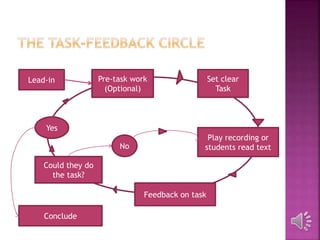
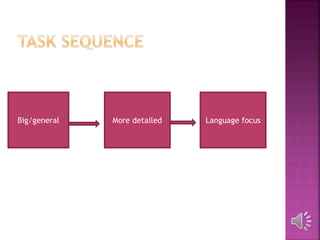
The task-feedback circle and the task sequence are:
Lead-in Pre-task work
(Optional)
Set clear
Task
Play recording or
students read text
Feedback on task
No
Yes
Could they do
the task?
Conclude
Big/general More detailed Language focus

Receptive skill

  • 1.
    These skills arereally important to understand a message
  • 2.
     A simplelistening task can help students to become more skilful at listening. The most important thing is to get the general overview of the main message.  The most useful tasks may be ones that require students to listen in similar ways to how they might hear such a conversation in real life.
  • 3.
    There are differenttasks based on listening: A simple listening task, a printed text with list task and redesigning listening will help student to improve this skill. When we use listening in everyday life, we want:  Get a general overview of the main story or message of a conversation  Catch specific details such us names, number, addresses, etc.
  • 4.
    Top-down: We use background knowledgeto predict structure and context of the text, and getting a general overall impression of the message. Bottom-up: We build up the message from individual small pieces. We use that skill to fill in missing gaps.
  • 5.
     Reading isa receptive skill and there are strategies to make better readers like reading for details or intensive reading that help them to improve that.  The most notable difference on reading is the speed, people read at different speeds and ways. The author sets two variations to increase reading speed:  Scanning: it refers to move your eyes quickly over the text to locate specific piece of information like name and numbers.  Skimming: it refers to read quickly to get the gist of a passage like the main idea of the text.
  • 6.
     Reading fordetail: reading texts closely and carefully with the intention of gaining an understanding of as much detail as possible.  Extensive reading: the more someone reads, the more they learn new vocabulary and grammar without realising it and improving their skills.  The main aim of readers is to provide opportunities for extensive reading for pleasure.
  • 7.
    Listening:  Say tostudent “listen to”  Play recording several times  Ask them questions  Give students a purpose  Help them to worry less  Task should be realistic Reading:  Put illustration to introduce the topic  You read narrative text  Student read silently  Make them to put paragraphs in the correct order  Act out the dialogue  Discuss different interpretations
  • 8.
    The task-feedback circleand the task sequence are:
  • 9.
    Lead-in Pre-task work (Optional) Setclear Task Play recording or students read text Feedback on task No Yes Could they do the task? Conclude
  • 10.