   Inflation is defined as a sustained increase in the
    general level of prices for goods and services.

   It is measured as an annual percentage increase.

   As inflation rises, every rupee you own buys a
    smaller percentage of a good or service
   Deflation is when the general level of prices is falling. This is
    the opposite of inflation.

   Hyperinflation is unusually rapid inflation. In extreme cases,
    this can lead to the breakdown of a nation's monetary
    system.

   Stagflation is the combination of high unemployment and
    economic stagnation with inflation
1) Demand-Pull Inflation - This theory can be summarized
  as "too much money chasing too few goods". In other
  words, if demand is growing faster than supply, prices
  will increase.

2) Cost-Push Inflation - When companies' costs go up,
  they need to increase prices to maintain their profit
  margins. Increased costs can include things such as
  wages, taxes, or increased costs of imports
 Anticipated inflation
 If the inflation rate corresponds to what the majority
 of people are expecting


 Unanticipatedinflation:
 Uncertainty about what will happen next makes
 corporations and consumers less likely to spend.
   A number of goods that are representative of
    the economy are put together into what is
    referred to as a "market basket.“

    The cost of this basket is then compared over
    time.

                 PRICE INDEX FORMULA
Inflation rate = PREVIOUS YEAR P.I – CURRENT YEAR P.I /
                    PREVIOUS YEAR P.I
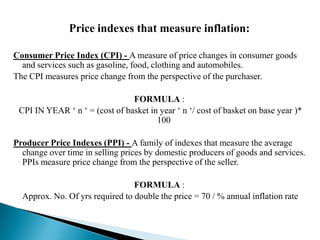
Price indexes that measure inflation:

Consumer Price Index (CPI) - A measure of price changes in consumer goods
  and services such as gasoline, food, clothing and automobiles.
The CPI measures price change from the perspective of the purchaser.

                                FORMULA :
 CPI IN YEAR ‘ n ‘ = (cost of basket in year ‘ n ‘/ cost of basket on base year )*
                                       100

Producer Price Indexes (PPI) - A family of indexes that measure the average
  change over time in selling prices by domestic producers of goods and services.
  PPIs measure price change from the perspective of the seller.

                                 FORMULA :
  Approx. No. Of yrs required to double the price = 70 / % annual inflation rate
   The budget that deals with how a Government raises its
    revenue and spends it
   The budget of the Government has two parts, revenue
    budget and capital budget.

MONETARY POLICY
 Adoption of suitable policy regarding interest rate and
  credit availability
 It is another source for reducing aggregate demand to
  control inflation
 The monetary theory emphasis that it is the changes in
  the credit availability rather than cost of credit that is a
  more effective instrument of regulating aggregate
  demand.
   To correct the excess demand relative to aggregate
    supply, the latter can also be raised by importing goods
    in short supply


   At times of inflationary expectations, there is a
    tendency on the part of businessmen to hoard goods.
   If productive capacity in the economy is not fully
    utilized, then excess demand can also be reduced by
    adopting measures for fully using the idle productive
    capacities in various industries of the economy.

   This would augment the aggregate supply of output and
    reduce the gap between the aggregate demand and
    output.
   Impact on Household Sector: Inflation directly reduces
    the purchasing power of the household sector.

   Impact on Business Sector: Firms benefit from rising
    prices. Soon, demand falls as consumers reduce
    consumption. Fall different for different commodities
    depending on the price elasticity of demand.

   Impact on Govt: expense goes up with increase in price
    level-austerity measures. Induction of more currency (to
    cut-deficit) may worsen inflatory pressures
     The Key roles of the RBI are:

I.      Regulator and supervisor of the financial system
II.     Manager of exchange control
III.    Issuer of currency
IV.     Banker to the Government
V.      Bank to banks: maintains banking accounts of all
        scheduled banks
   Liquidity Adjustment Facility
    Liquidity Adjustment Facility is a kind of policy that
    allows banks to borrow money through repurchase
    agreements.

   Cash Reverse Ratio

   CRR means Cash Reserve Ratio. Banks in India are
    required to hold a certain proportion of their deposits in the
    form of cash. However, actually Banks don’t hold these as
    cash with themselves, but deposit such case with Reserve
    Bank of India (RBI) / currency chests, which is considered
    as equivalent to holding cash with RBI.
Inflation

Inflation

  • 2.
    Inflation is defined as a sustained increase in the general level of prices for goods and services.  It is measured as an annual percentage increase.  As inflation rises, every rupee you own buys a smaller percentage of a good or service
  • 3.
    Deflation is when the general level of prices is falling. This is the opposite of inflation.  Hyperinflation is unusually rapid inflation. In extreme cases, this can lead to the breakdown of a nation's monetary system.  Stagflation is the combination of high unemployment and economic stagnation with inflation
  • 4.
    1) Demand-Pull Inflation- This theory can be summarized as "too much money chasing too few goods". In other words, if demand is growing faster than supply, prices will increase. 2) Cost-Push Inflation - When companies' costs go up, they need to increase prices to maintain their profit margins. Increased costs can include things such as wages, taxes, or increased costs of imports
  • 5.
     Anticipated inflation If the inflation rate corresponds to what the majority of people are expecting  Unanticipatedinflation: Uncertainty about what will happen next makes corporations and consumers less likely to spend.
  • 6.
    A number of goods that are representative of the economy are put together into what is referred to as a "market basket.“  The cost of this basket is then compared over time. PRICE INDEX FORMULA Inflation rate = PREVIOUS YEAR P.I – CURRENT YEAR P.I / PREVIOUS YEAR P.I
  • 7.
    Price indexes thatmeasure inflation: Consumer Price Index (CPI) - A measure of price changes in consumer goods and services such as gasoline, food, clothing and automobiles. The CPI measures price change from the perspective of the purchaser. FORMULA : CPI IN YEAR ‘ n ‘ = (cost of basket in year ‘ n ‘/ cost of basket on base year )* 100 Producer Price Indexes (PPI) - A family of indexes that measure the average change over time in selling prices by domestic producers of goods and services. PPIs measure price change from the perspective of the seller. FORMULA : Approx. No. Of yrs required to double the price = 70 / % annual inflation rate
  • 9.
    The budget that deals with how a Government raises its revenue and spends it  The budget of the Government has two parts, revenue budget and capital budget. MONETARY POLICY  Adoption of suitable policy regarding interest rate and credit availability  It is another source for reducing aggregate demand to control inflation  The monetary theory emphasis that it is the changes in the credit availability rather than cost of credit that is a more effective instrument of regulating aggregate demand.
  • 10.
    To correct the excess demand relative to aggregate supply, the latter can also be raised by importing goods in short supply  At times of inflationary expectations, there is a tendency on the part of businessmen to hoard goods.
  • 11.
    If productive capacity in the economy is not fully utilized, then excess demand can also be reduced by adopting measures for fully using the idle productive capacities in various industries of the economy.  This would augment the aggregate supply of output and reduce the gap between the aggregate demand and output.
  • 12.
    Impact on Household Sector: Inflation directly reduces the purchasing power of the household sector.  Impact on Business Sector: Firms benefit from rising prices. Soon, demand falls as consumers reduce consumption. Fall different for different commodities depending on the price elasticity of demand.  Impact on Govt: expense goes up with increase in price level-austerity measures. Induction of more currency (to cut-deficit) may worsen inflatory pressures
  • 13.
    The Key roles of the RBI are: I. Regulator and supervisor of the financial system II. Manager of exchange control III. Issuer of currency IV. Banker to the Government V. Bank to banks: maintains banking accounts of all scheduled banks
  • 14.
    Liquidity Adjustment Facility  Liquidity Adjustment Facility is a kind of policy that allows banks to borrow money through repurchase agreements.  Cash Reverse Ratio  CRR means Cash Reserve Ratio. Banks in India are required to hold a certain proportion of their deposits in the form of cash. However, actually Banks don’t hold these as cash with themselves, but deposit such case with Reserve Bank of India (RBI) / currency chests, which is considered as equivalent to holding cash with RBI.