Class Notes by Camila Roldán
Class 12th June, 2014
1) What are the different issues that differentiate one curriculum design from
another?
 Three curriculum approaches are described and compared. Each differs with
respect to when issues related to input (linguistic content), process (methodology
used), and outcomes (learners production), are addressed.
2) Summarize the forward, central and backward curriculum design presented by
Jack C Richards(2013).
 Forward design starts with syllabus planning, moves to methodology, and is
followed by assessment of learning outcomes. Resolving issues of syllabus content
and sequencing are essential starting points with forward design, which has been
the major tradition in language curriculum development.
 Central design begins with classroom processes and methodology. Issues of
syllabus and learning outcomes are not specified in detail in advance and are
addressed as the curriculum is implemented. Many of the ‘innovative methods’ of
the 1980s and 90s reflect central design.
 Backward design starts from a specification of learning outcomes and decisions on
methodology and syllabus are developed from the learning outcomes. The
Common European Framework of Reference is a recent example of backward
design.
3) Discuss the differences between curriculum and syllabus.
Who designs curriculum?
 Curriculum planners who are technicians and specialists and they work e.g. at
different ministries of Education. Also the authors of textbooks who are usually well-
known methodologists.
 Curriculum acts as a map or guidance for teachers, only as that. It's not just for
teaching, it also considers learners outcomes and assessment. Not only
assessment of teaching and learning but assessment of the educational system.
 Teachers, on the other hand, prepare the syllabus. In the syllabus there is a
selection of materials to be taught and there is a grading of those materials (from
the easier to the more complex tasks).
Class Notes by Camila Roldán
4) What is output?
 Output refers to learning outcomes, that is, what learners are able to do as the
result of a period of instruction.
www.professorjackrichards.com
Curriculum Approaches in Language Teaching: Forward, Central and Background
design.
Curriculum (overall plan)
Takes content (from external standards and local goals –NAPs-) and shapes it into a plan
for how to conduct effective teaching and learning. It is thus more than a list of topics and
lists of key facts and skills (the input). It is a map of how to achieve the "outputs" of desired
student performance, in which appropriate learning activities and assessments are
suggested to make it more likely that students achieve the desired results.
THREE DIMENSIONS OF A CURRICULUM
o Input = linguistic content of a course. (Syllabus)
o Process = how teaching is carried out (methodology)
Past= audiolingual method (listening and repeating)
Communicative Language teaching = students use the language to achieve a purpose ->
communication
Natural approach = students were not taught any grammar at all. They were given a lot of
input.
CLIL = Content Language Integrated Learning
TBL = Task Based Learning
Project Work
o Output = learning outcomes
 Curriculum development in language teaching can start from input, process or
output.
 Each starting point reflects different assumptions about both the means and ends of
teaching and learning.
Class Notes by Camila Roldán
More on the 3 approaches:
Forward design = developing a curriculum through moving from input, to process, and to
output (and then to assessment) (traditional one)
One starts with the field of knowledge that one is going to teach and then selects concepts
The teacher chooses a topic for a lesson (e.g. racial prejudice) subject. Objectives may
also be specified, but these usually have(…)
Central design = starting with process and deriving input and output from classroom
methodology (1st activities)
Backward design = starting from output and then dealing with issues relating to process
and input (European Framework of Reference).

Three Curriculum Approaches

  • 1.
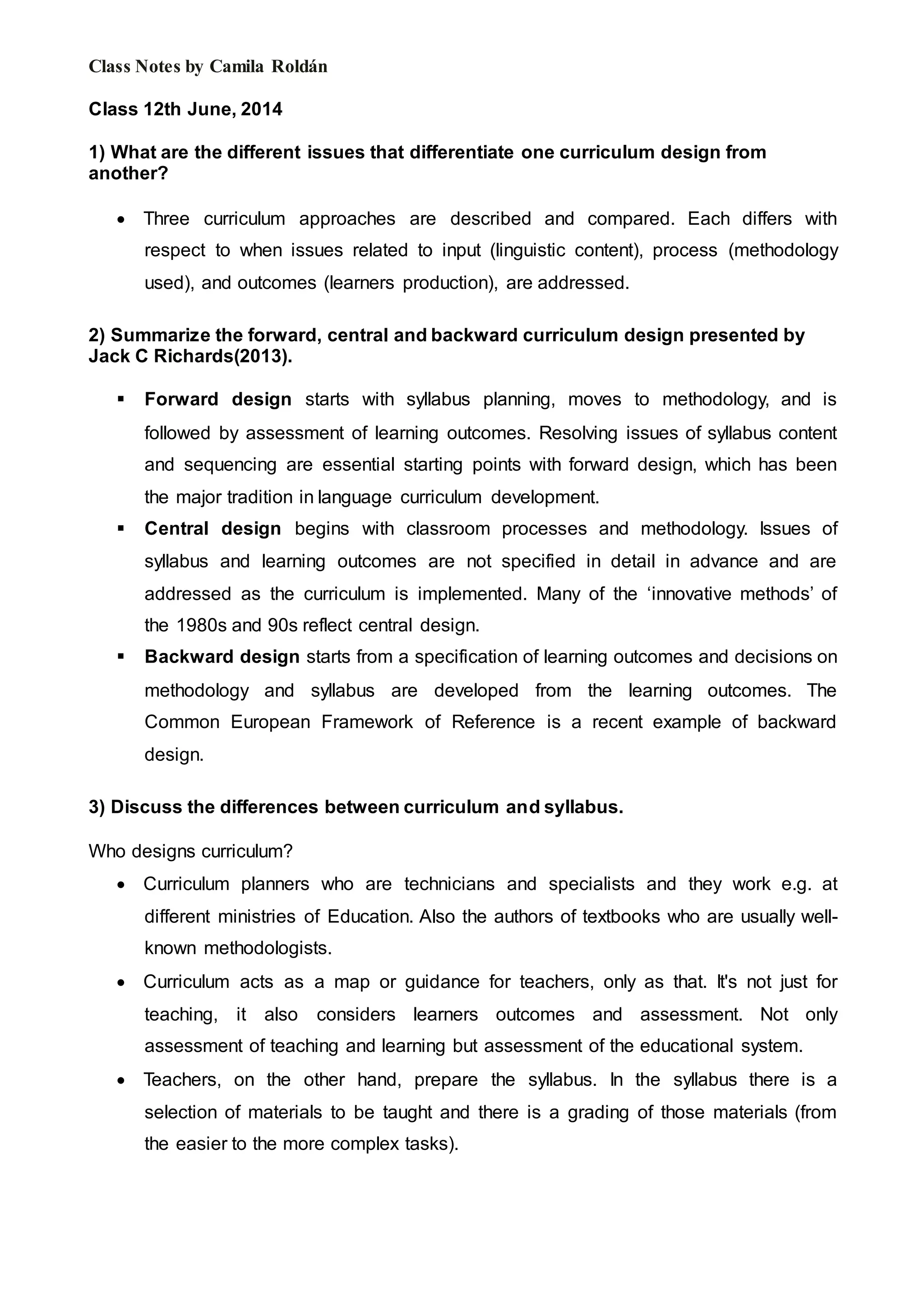
    Class Notes byCamila Roldán Class 12th June, 2014 1) What are the different issues that differentiate one curriculum design from another?  Three curriculum approaches are described and compared. Each differs with respect to when issues related to input (linguistic content), process (methodology used), and outcomes (learners production), are addressed. 2) Summarize the forward, central and backward curriculum design presented by Jack C Richards(2013).  Forward design starts with syllabus planning, moves to methodology, and is followed by assessment of learning outcomes. Resolving issues of syllabus content and sequencing are essential starting points with forward design, which has been the major tradition in language curriculum development.  Central design begins with classroom processes and methodology. Issues of syllabus and learning outcomes are not specified in detail in advance and are addressed as the curriculum is implemented. Many of the ‘innovative methods’ of the 1980s and 90s reflect central design.  Backward design starts from a specification of learning outcomes and decisions on methodology and syllabus are developed from the learning outcomes. The Common European Framework of Reference is a recent example of backward design. 3) Discuss the differences between curriculum and syllabus. Who designs curriculum?  Curriculum planners who are technicians and specialists and they work e.g. at different ministries of Education. Also the authors of textbooks who are usually well- known methodologists.  Curriculum acts as a map or guidance for teachers, only as that. It's not just for teaching, it also considers learners outcomes and assessment. Not only assessment of teaching and learning but assessment of the educational system.  Teachers, on the other hand, prepare the syllabus. In the syllabus there is a selection of materials to be taught and there is a grading of those materials (from the easier to the more complex tasks).
  • 2.
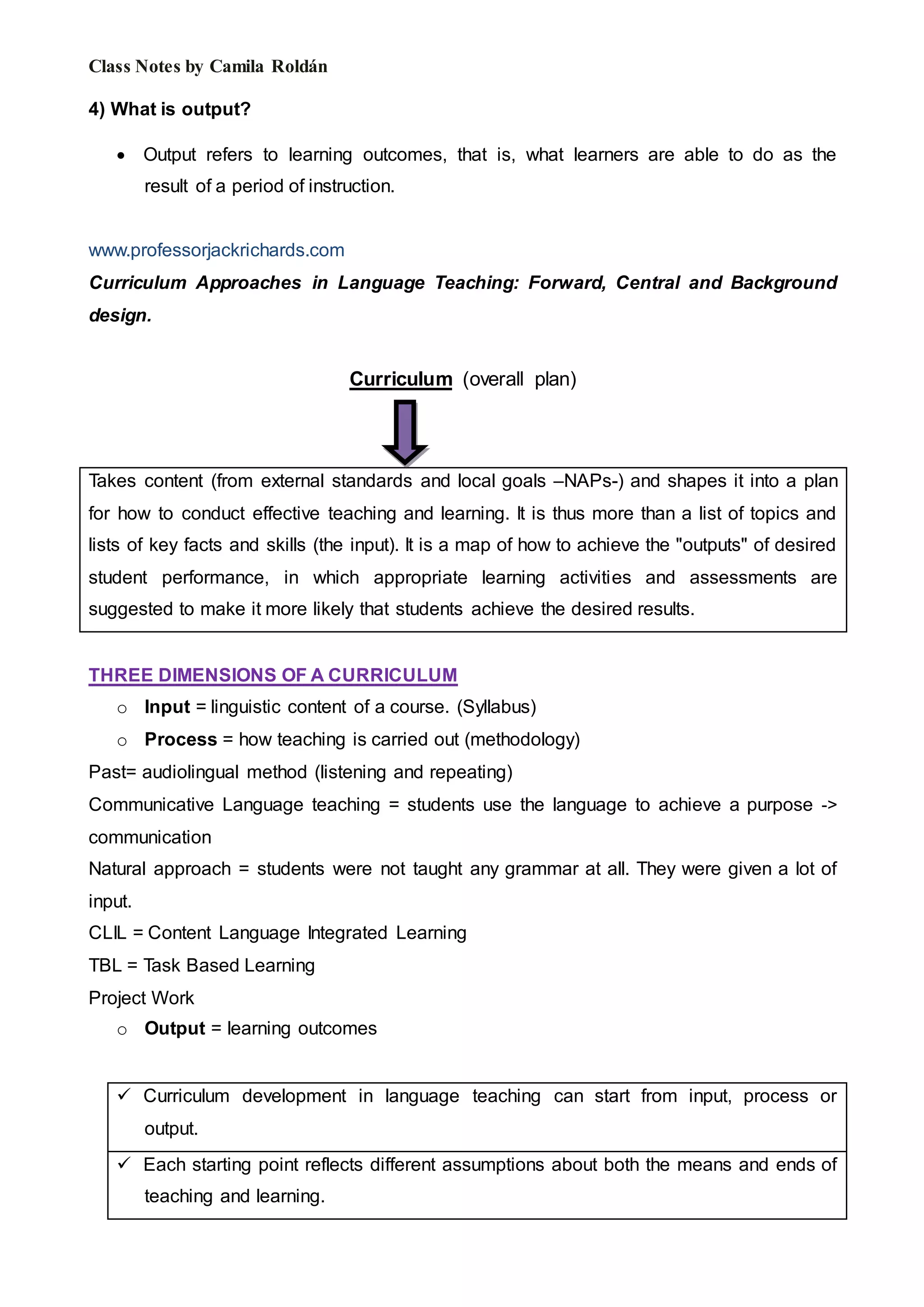
    Class Notes byCamila Roldán 4) What is output?  Output refers to learning outcomes, that is, what learners are able to do as the result of a period of instruction. www.professorjackrichards.com Curriculum Approaches in Language Teaching: Forward, Central and Background design. Curriculum (overall plan) Takes content (from external standards and local goals –NAPs-) and shapes it into a plan for how to conduct effective teaching and learning. It is thus more than a list of topics and lists of key facts and skills (the input). It is a map of how to achieve the "outputs" of desired student performance, in which appropriate learning activities and assessments are suggested to make it more likely that students achieve the desired results. THREE DIMENSIONS OF A CURRICULUM o Input = linguistic content of a course. (Syllabus) o Process = how teaching is carried out (methodology) Past= audiolingual method (listening and repeating) Communicative Language teaching = students use the language to achieve a purpose -> communication Natural approach = students were not taught any grammar at all. They were given a lot of input. CLIL = Content Language Integrated Learning TBL = Task Based Learning Project Work o Output = learning outcomes  Curriculum development in language teaching can start from input, process or output.  Each starting point reflects different assumptions about both the means and ends of teaching and learning.
  • 3.
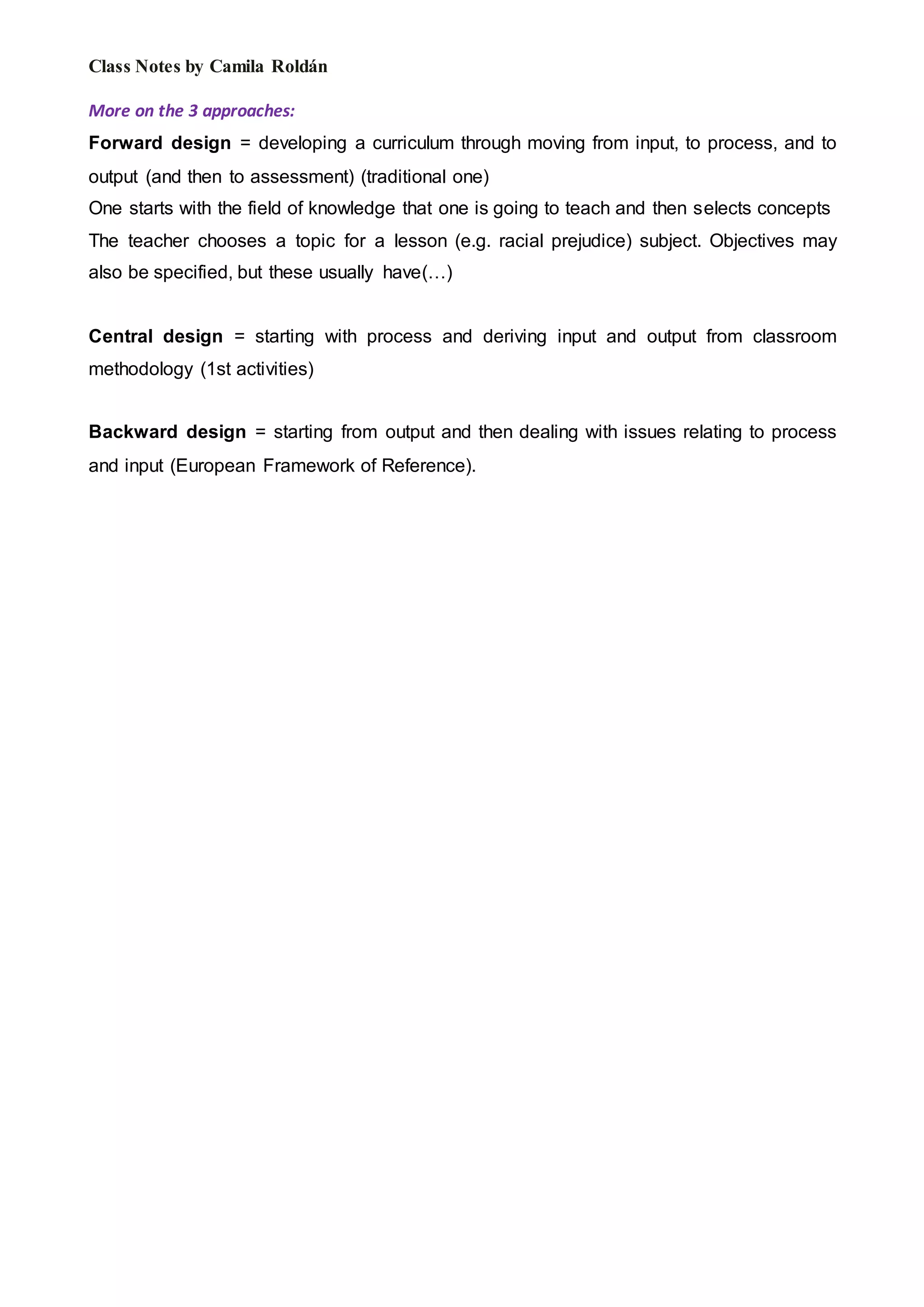
    Class Notes byCamila Roldán More on the 3 approaches: Forward design = developing a curriculum through moving from input, to process, and to output (and then to assessment) (traditional one) One starts with the field of knowledge that one is going to teach and then selects concepts The teacher chooses a topic for a lesson (e.g. racial prejudice) subject. Objectives may also be specified, but these usually have(…) Central design = starting with process and deriving input and output from classroom methodology (1st activities) Backward design = starting from output and then dealing with issues relating to process and input (European Framework of Reference).