The Landscape of 2021 A.D.
Gianna Salvo
Introduction to Communication Technologies
                 Final Project
             December 12, 2011
What will communication
technology look like in 2021
A.D.?
 Technology has done nothing but grown
  ever since the first computer or first
  telephone has come forth.
 Technology is going to continue to grow
  throughout the years.
What technologies are going to continue
to advance over the next 10 years?

   Cell phones are going to become even
    more advanced.
    -Internet is going to run faster
    -There will be signal EVERYWHERE!
       -No more dropped calls!
    -There will be better applications
       -Apps to start your car, find your keys, and
    MANY more!!
C.D.s will be non-existent
     -C.D.s are already beginning to be
     replaced with MP3s and iTunes. This is
     going to do nothing but continue to happen
     over the next 10 years.
     -IPods are much easier to carry around
     than a C.D. player.
     -IPods are also able to be hooked into your
     car so you no longer need C.D.s in your
     car either.
Televisions will become so much more high
tech than they already are.
    -Movies will all be 3D or 4D even when you are watching them
    at home.
    -The televisions will all double as a source to get on the
    internet.
    -People will be able to shop online through their television and
    some stores will become completely online.
    -Say goodbye to last minute Christmas shopping. Online
    shopping through your television will be the way to go.
    -Soon, when a commercial comes on the television, people
    will be able to select that commercial and they will be taken
    directly to their website to be able to do all of their shopping
    right from their home.
THEORIES IN TECHNOLOGY
The Umbrella Perspective
   The hardware is the most obvious aspect of
    communication technology is the hardware.
   New technologies come from the hardware in the
    Umbrella Perspective.
   The Umbrella Perspective starts with Social
    System being at the top.
     This is the political, economic serve functions.
    The next level on the Umbrella Perspective is
    Organizational Infrastructure.
     Production and Infrastructure
The next level of the Umbrella Perspective is the
hardware and software.

Under and in between that is the individual user.


(Grant & Meadows 3-6)
Roger’s Diffusion of Innovations
 Diffusion of Innovations tries to explain
  how innovations are taken in a
  population.
 An innovation is something that is a
  behavior, idea, or object that is
  considered new by people.
Diffusion of Innovation offers insight into social
change such as:

-What makes an innovation spread successfully.

-The importance of peer to peer conversations and peer
networks.

-Understanding the needs of different user segments.
Roger’s Diffusion of Innovations theory pertains
to all three things that I believe is going to
happen by 2021 comes around.

People are going to have to get used to the
changing technology and the ways to do that are
going to be teaching people that the technology
is not too advanced to understand.

Using Roger’s diffusion of innovations, people
will not become overwhelmed by the rapidly
changing technology.

(http://www.enablingchange.com.au/Summary_Diffusion_Theory.pd)
Uses and Gratification
Theory
 This theory is when people use media
  and technology for their own use and
  gratification.
 Needs people need for gratification:
     Cognitive needs
     Affective needs
     Personal Integrative needs
     Social Integrative needs
     Tension free needs
How will the new technology be
used for our gratification?
 Being able to shop on our television will
  save so much time and money. Already
  online shopping is cheaper, being able
  to do it on a television will be more
  convenient.
 Also saved gas and time will give us
  instant gratification.
(http://communicationtheory.org/uses-and-gratification-theory/)
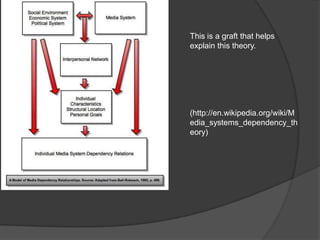
Media Systems Dependency
Theory
   A complex system when the
    media, individuals, their interpersonal
    environment, and the social environment
    have dependency relationships with
    each other.
This is a graft that helps
explain this theory.


(http://en.wikipedia.org/wiki/M
edia_systems_dependency_th
eory)
Social Learning Theory
 Focuses on learning in a social context.
 Learn by observing
 Learning can occur without a change in
  behavior
 People can learn through observing
  alone.
How does the Social Learning Theory
pertain to technology in 2012?

-Many times people will need to watch others
operate something before they know how to do
it on their own.
-Sometimes people will learn how certain
technology works and all of the possibilities of
that technology through a tutorial or someone
helping them and showing them the steps to
take.
(http://teachnet.edb.utexas.edu/~Lynda_abbot/Social.html)
Principle of Relative Constancy
 A complex idea with simple implications
 It is when something (Like an
  advertisement) seems very simple, but
  in reality it is something much more than
  that. And in the end, it turns into
  something that could redefine the
  industry.
Cell phones, televisions, and CDs all seem up to
date and high tech now. But in 10 years, just
imagine the upgrades and new technology that
will come out.

According to the principle of relative
constancy, these items seem like our everyday
electronics, but in reality, these electronics could
end up meaning more to us than they ever have
before.

(http://economicsofadvertising.com/?page_id=42)
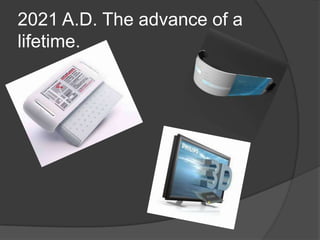
2021 A.D. The advance of a
lifetime.
References
   http://www.enablingchange.com.au/Summa
    ry_Diffusion_Theory.pd
   http://communicationtheory.org/uses-and-
    gratification-theory/
   http://en.wikipedia.org/wiki/Media_systems
    _dependency_theory
   http://teachnet.edb.utexas.edu/~Lynda_abb
    ot/Social.html
   http://economicsofadvertising.com/?page_i
    d=42

The future of technology final project

  • 1.
  • 2.
    Gianna Salvo Introduction toCommunication Technologies Final Project December 12, 2011
  • 3.
    What will communication technologylook like in 2021 A.D.?  Technology has done nothing but grown ever since the first computer or first telephone has come forth.  Technology is going to continue to grow throughout the years.
  • 4.
    What technologies aregoing to continue to advance over the next 10 years?  Cell phones are going to become even more advanced. -Internet is going to run faster -There will be signal EVERYWHERE! -No more dropped calls! -There will be better applications -Apps to start your car, find your keys, and MANY more!!
  • 5.
    C.D.s will benon-existent -C.D.s are already beginning to be replaced with MP3s and iTunes. This is going to do nothing but continue to happen over the next 10 years. -IPods are much easier to carry around than a C.D. player. -IPods are also able to be hooked into your car so you no longer need C.D.s in your car either.
  • 6.
    Televisions will becomeso much more high tech than they already are. -Movies will all be 3D or 4D even when you are watching them at home. -The televisions will all double as a source to get on the internet. -People will be able to shop online through their television and some stores will become completely online. -Say goodbye to last minute Christmas shopping. Online shopping through your television will be the way to go. -Soon, when a commercial comes on the television, people will be able to select that commercial and they will be taken directly to their website to be able to do all of their shopping right from their home.
  • 7.
  • 8.
    The Umbrella Perspective  The hardware is the most obvious aspect of communication technology is the hardware.  New technologies come from the hardware in the Umbrella Perspective.  The Umbrella Perspective starts with Social System being at the top.  This is the political, economic serve functions. The next level on the Umbrella Perspective is Organizational Infrastructure.  Production and Infrastructure
  • 9.
    The next levelof the Umbrella Perspective is the hardware and software. Under and in between that is the individual user. (Grant & Meadows 3-6)
  • 10.
    Roger’s Diffusion ofInnovations  Diffusion of Innovations tries to explain how innovations are taken in a population.  An innovation is something that is a behavior, idea, or object that is considered new by people.
  • 11.
    Diffusion of Innovationoffers insight into social change such as: -What makes an innovation spread successfully. -The importance of peer to peer conversations and peer networks. -Understanding the needs of different user segments.
  • 12.
    Roger’s Diffusion ofInnovations theory pertains to all three things that I believe is going to happen by 2021 comes around. People are going to have to get used to the changing technology and the ways to do that are going to be teaching people that the technology is not too advanced to understand. Using Roger’s diffusion of innovations, people will not become overwhelmed by the rapidly changing technology. (http://www.enablingchange.com.au/Summary_Diffusion_Theory.pd)
  • 13.
    Uses and Gratification Theory This theory is when people use media and technology for their own use and gratification.  Needs people need for gratification:  Cognitive needs  Affective needs  Personal Integrative needs  Social Integrative needs  Tension free needs
  • 14.
    How will thenew technology be used for our gratification?  Being able to shop on our television will save so much time and money. Already online shopping is cheaper, being able to do it on a television will be more convenient.  Also saved gas and time will give us instant gratification. (http://communicationtheory.org/uses-and-gratification-theory/)
  • 15.
    Media Systems Dependency Theory  A complex system when the media, individuals, their interpersonal environment, and the social environment have dependency relationships with each other.
  • 16.
    This is agraft that helps explain this theory. (http://en.wikipedia.org/wiki/M edia_systems_dependency_th eory)
  • 17.
    Social Learning Theory Focuses on learning in a social context.  Learn by observing  Learning can occur without a change in behavior  People can learn through observing alone.
  • 18.
    How does theSocial Learning Theory pertain to technology in 2012? -Many times people will need to watch others operate something before they know how to do it on their own. -Sometimes people will learn how certain technology works and all of the possibilities of that technology through a tutorial or someone helping them and showing them the steps to take. (http://teachnet.edb.utexas.edu/~Lynda_abbot/Social.html)
  • 19.
    Principle of RelativeConstancy  A complex idea with simple implications  It is when something (Like an advertisement) seems very simple, but in reality it is something much more than that. And in the end, it turns into something that could redefine the industry.
  • 20.
    Cell phones, televisions,and CDs all seem up to date and high tech now. But in 10 years, just imagine the upgrades and new technology that will come out. According to the principle of relative constancy, these items seem like our everyday electronics, but in reality, these electronics could end up meaning more to us than they ever have before. (http://economicsofadvertising.com/?page_id=42)
  • 21.
    2021 A.D. Theadvance of a lifetime.
  • 22.
    References  http://www.enablingchange.com.au/Summa ry_Diffusion_Theory.pd  http://communicationtheory.org/uses-and- gratification-theory/  http://en.wikipedia.org/wiki/Media_systems _dependency_theory  http://teachnet.edb.utexas.edu/~Lynda_abb ot/Social.html  http://economicsofadvertising.com/?page_i d=42