
Hashtag: #hunchgraphs
Malcolm Gladwell Title:
 What Chipotle, Glenn Beck and
Alien Abductions Teach Us About
      the Future of the Web
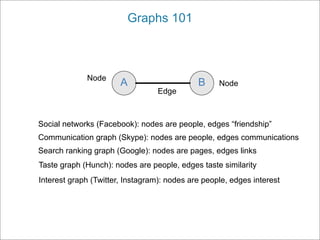
Graphs 101


             Node
                       A                     B     Node
                                  Edge


Social networks (Facebook): nodes are people, edges “friendship”
Communication graph (Skype): nodes are people, edges communications
Search ranking graph (Google): nodes are pages, edges links
Taste graph (Hunch): nodes are people, edges taste similarity
Interest graph (Twitter, Instagram): nodes are people, edges interest
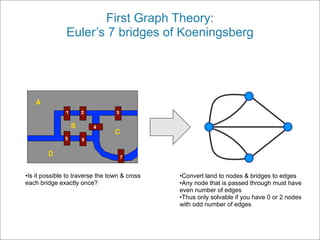
First Graph Theory:
               Euler’s 7 bridges of Koeningsberg


•Is it possible to traverse the town & cross   •Convert land to nodes & bridges to edges
each bridge exactly once?                      •Any node that is passed through must have
                                               even number of edges
                                               •Thus only solvable if you have 0 or 2 nodes
                                               with odd number of edges
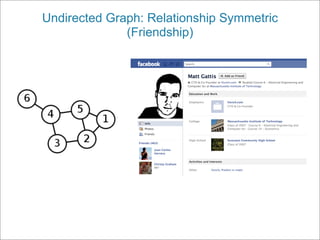
Undirected Graph: Relationship Symmetric
              (Friendship)
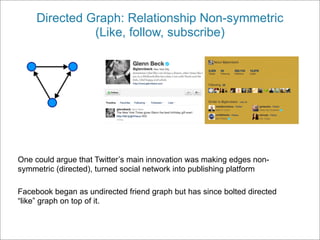
Directed Graph: Relationship Non-symmetric
               (Like, follow, subscribe)


One could argue that Twitter’s main innovation was making edges non-
symmetric (directed), turned social network into publishing platform

Facebook began as undirected friend graph but has since bolted directed
“like” graph on top of it.
Interlude: data fun
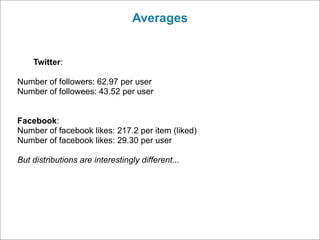
Averages


    Twitter:

Number of followers: 62.97 per user
Number of followees: 43.52 per user


Facebook:
Number of facebook likes: 217.2 per item (liked)
Number of facebook likes: 29.30 per user

But distributions are interestingly different...
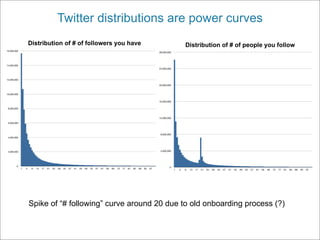
Twitter distributions are power curves
Distribution of # of followers you have     Distribution of # of people you follow


Spike of “# following” curve around 20 due to old onboarding process (?)
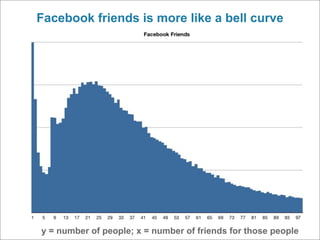
Facebook friends is more like a bell curve


y = number of people; x = number of friends for those people
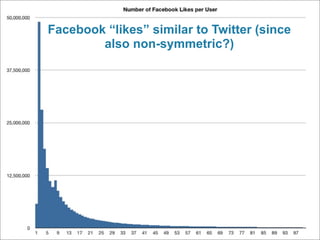
Facebook “likes” similar to Twitter (since
        also non-symmetric?)
Some real world applications
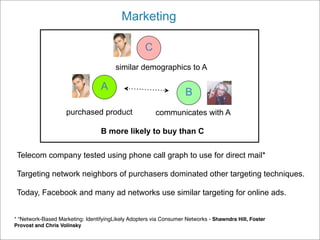
Marketing

                                                    C
                                        similar demographics to A

                                  A
                                                                    B
                    purchased product                   communicates with A

                                  B more likely to buy than C


 Telecom company tested using phone call graph to use for direct mail*

 Targeting network neighbors of purchasers dominated other targeting techniques.

 Today, Facebook and many ad networks use similar targeting for online ads.


* “Network-Based Marketing: IdentifyingLikely Adopters via Consumer Networks - Shawndra Hill, Foster
Provost and Chris Volinsky
Defense
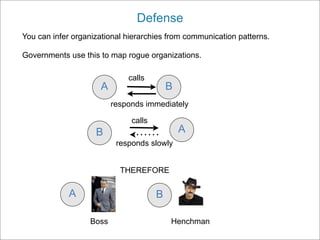
You can infer organizational hierarchies from communication patterns.

Governments use this to map rogue organizations.

                             calls
                     A                    B
                         responds immediately

                              calls
                    B                         A
                          responds slowly


                           THEREFORE

             A                        B

                  Boss                    Henchman
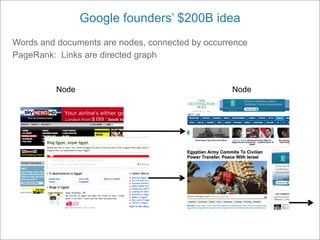
Google founders’ $200B idea
Words and documents are nodes, connected by occurrence
PageRank: Links are directed graph


          Node                                    Node
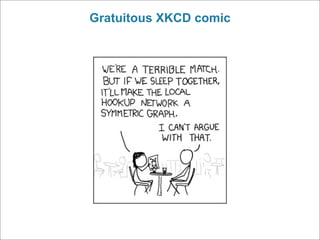
Gratuitous XKCD comic
Building graphs
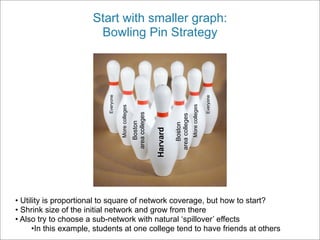
Start with smaller graph:
                       Bowling Pin Strategy


                           Everyone


                                                                                                                Everyone
                                                                                                More colleges
                                      More colleges


                                                      area colleges


                                                                                area colleges
                                                         Boston


                                                                                   Boston
                                                                      Harvard


• Utility is proportional to square of network coverage, but how to start?
• Shrink size of the initial network and grow from there
• Also try to choose a sub-network with natural ‘spillover’ effects
      •In this example, students at one college tend to have friends at others
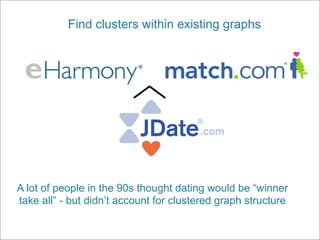
Find clusters within existing graphs


A lot of people in the 90s thought dating would be “winner
take all” - but didn’t account for clustered graph structure
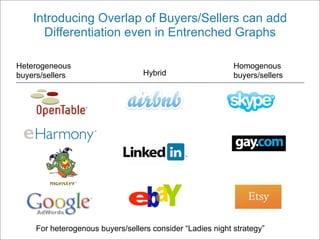
Introducing Overlap of Buyers/Sellers can add
      Differentiation even in Entrenched Graphs

Heterogeneous                                               Homogenous
buyers/sellers                    Hybrid                    buyers/sellers


     For heterogenous buyers/sellers consider “Ladies night strategy”
Graph wars
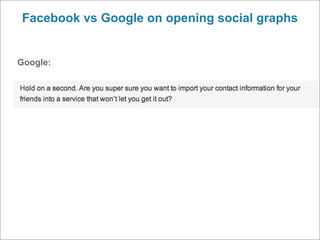
Facebook vs Google on opening social graphs


Google:
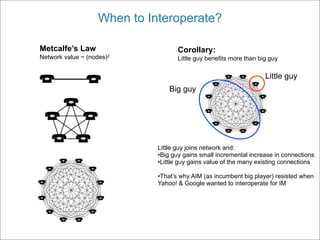
When to Interoperate?

Metcalfe’s Law                         Corollary:
Network value ~   (nodes)2             Little guy benefits more than big guy

                                                                       Little guy
                                    Big guy


                                Little guy joins network and:
                                •Big guy gains small incremental increase in connections
                                •Little guy gains value of the many existing connections

                                •That’s why AIM (as incumbent big player) resisted when
                                Yahoo! & Google wanted to interoperate for IM
On the other hand…

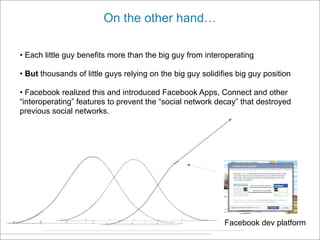
• Each little guy benefits more than the big guy from interoperating

• But thousands of little guys relying on the big guy solidifies big guy position

• Facebook realized this and introduced Facebook Apps, Connect and other
“interoperating” features to prevent the “social network decay” that destroyed
previous social networks.


                                                             Facebook dev platform
Shameless self-promotion: taste graphs
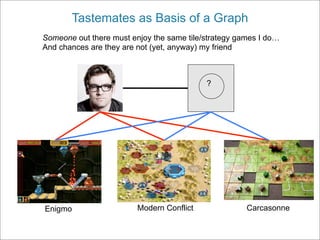
Tastemates as Basis of a Graph
Someone out there must enjoy the same tile/strategy games I do…
And chances are they are not (yet, anyway) my friend


                                           ?


Enigmo                   Modern Conflict              Carcasonne
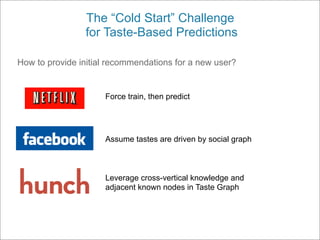
The “Cold Start” Challenge
                for Taste-Based Predictions

How to provide initial recommendations for a new user?


                     Force train, then predict


                     Assume tastes are driven by social graph


                     Leverage cross-vertical knowledge and
                     adjacent known nodes in Taste Graph
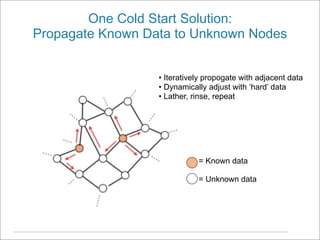
One Cold Start Solution:
Propagate Known Data to Unknown Nodes


                  • Iteratively propogate with adjacent data
                  • Dynamically adjust with ‘hard’ data
                  • Lather, rinse, repeat


                             = Known data

                             = Unknown data
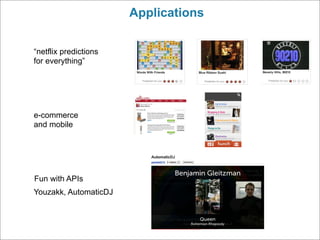
Applications


“netflix predictions
for everything”


e-commerce
and mobile


Fun with APIs
Youzakk, AutomaticDJ
Since we’re at Google, some more stuff about
                  Google
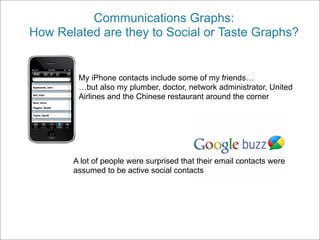
Communications Graphs:
How Related are they to Social or Taste Graphs?


        My iPhone contacts include some of my friends…
        …but also my plumber, doctor, network administrator, United
        Airlines and the Chinese restaurant around the corner


       A lot of people were surprised that their email contacts were
       assumed to be active social contacts
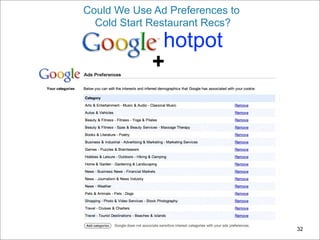
Could We Use Ad Preferences to
  Cold Start Restaurant Recs?
              hotpot
             +


                                 32
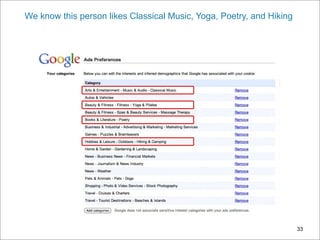
We know this person likes Classical Music, Yoga, Poetry, and Hiking


                                                                      33
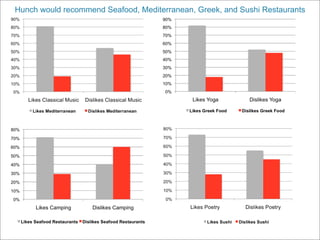
Hunch would recommend Seafood, Mediterranean, Greek, and Sushi Restaurants
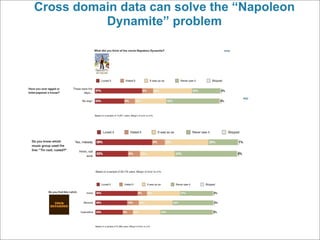
Cross domain data can solve the “Napoleon
          Dynamite” problem
Graphs - Chris Dixon & Matt Gattis

Graphs - Chris Dixon & Matt Gattis

  • 1.
  • 2.
    Malcolm Gladwell Title: What Chipotle, Glenn Beck and Alien Abductions Teach Us About the Future of the Web
  • 3.
    Graphs 101 Node A B Node Edge Social networks (Facebook): nodes are people, edges “friendship” Communication graph (Skype): nodes are people, edges communications Search ranking graph (Google): nodes are pages, edges links Taste graph (Hunch): nodes are people, edges taste similarity Interest graph (Twitter, Instagram): nodes are people, edges interest
  • 4.
    First Graph Theory: Euler’s 7 bridges of Koeningsberg •Is it possible to traverse the town & cross •Convert land to nodes & bridges to edges each bridge exactly once? •Any node that is passed through must have even number of edges •Thus only solvable if you have 0 or 2 nodes with odd number of edges
  • 5.
    Undirected Graph: RelationshipSymmetric (Friendship)
  • 6.
    Directed Graph: RelationshipNon-symmetric (Like, follow, subscribe) One could argue that Twitter’s main innovation was making edges non- symmetric (directed), turned social network into publishing platform Facebook began as undirected friend graph but has since bolted directed “like” graph on top of it.
  • 7.
  • 8.
    Averages Twitter: Number of followers: 62.97 per user Number of followees: 43.52 per user Facebook: Number of facebook likes: 217.2 per item (liked) Number of facebook likes: 29.30 per user But distributions are interestingly different...
  • 9.
    Twitter distributions arepower curves Distribution of # of followers you have Distribution of # of people you follow Spike of “# following” curve around 20 due to old onboarding process (?)
  • 10.
    Facebook friends ismore like a bell curve y = number of people; x = number of friends for those people
  • 11.
    Facebook “likes” similarto Twitter (since also non-symmetric?)
  • 12.
    Some real worldapplications
  • 13.
    Marketing C similar demographics to A A B purchased product communicates with A B more likely to buy than C Telecom company tested using phone call graph to use for direct mail* Targeting network neighbors of purchasers dominated other targeting techniques. Today, Facebook and many ad networks use similar targeting for online ads. * “Network-Based Marketing: IdentifyingLikely Adopters via Consumer Networks - Shawndra Hill, Foster Provost and Chris Volinsky
  • 14.
    Defense You can inferorganizational hierarchies from communication patterns. Governments use this to map rogue organizations. calls A B responds immediately calls B A responds slowly THEREFORE A B Boss Henchman
  • 15.
    Google founders’ $200Bidea Words and documents are nodes, connected by occurrence PageRank: Links are directed graph Node Node
  • 16.
  • 17.
  • 18.
    Start with smallergraph: Bowling Pin Strategy Everyone Everyone More colleges More colleges area colleges area colleges Boston Boston Harvard • Utility is proportional to square of network coverage, but how to start? • Shrink size of the initial network and grow from there • Also try to choose a sub-network with natural ‘spillover’ effects •In this example, students at one college tend to have friends at others
  • 19.
    Find clusters withinexisting graphs A lot of people in the 90s thought dating would be “winner take all” - but didn’t account for clustered graph structure
  • 20.
    Introducing Overlap ofBuyers/Sellers can add Differentiation even in Entrenched Graphs Heterogeneous Homogenous buyers/sellers Hybrid buyers/sellers For heterogenous buyers/sellers consider “Ladies night strategy”
  • 21.
  • 22.
    Facebook vs Googleon opening social graphs Google:
  • 23.
    When to Interoperate? Metcalfe’sLaw Corollary: Network value ~ (nodes)2 Little guy benefits more than big guy Little guy Big guy Little guy joins network and: •Big guy gains small incremental increase in connections •Little guy gains value of the many existing connections •That’s why AIM (as incumbent big player) resisted when Yahoo! & Google wanted to interoperate for IM
  • 24.
    On the otherhand… • Each little guy benefits more than the big guy from interoperating • But thousands of little guys relying on the big guy solidifies big guy position • Facebook realized this and introduced Facebook Apps, Connect and other “interoperating” features to prevent the “social network decay” that destroyed previous social networks. Facebook dev platform
  • 25.
  • 26.
    Tastemates as Basisof a Graph Someone out there must enjoy the same tile/strategy games I do… And chances are they are not (yet, anyway) my friend ? Enigmo Modern Conflict Carcasonne
  • 27.
    The “Cold Start”Challenge for Taste-Based Predictions How to provide initial recommendations for a new user? Force train, then predict Assume tastes are driven by social graph Leverage cross-vertical knowledge and adjacent known nodes in Taste Graph
  • 28.
    One Cold StartSolution: Propagate Known Data to Unknown Nodes • Iteratively propogate with adjacent data • Dynamically adjust with ‘hard’ data • Lather, rinse, repeat = Known data = Unknown data
  • 29.
  • 30.
    Since we’re atGoogle, some more stuff about Google
  • 31.
    Communications Graphs: How Relatedare they to Social or Taste Graphs? My iPhone contacts include some of my friends… …but also my plumber, doctor, network administrator, United Airlines and the Chinese restaurant around the corner A lot of people were surprised that their email contacts were assumed to be active social contacts
  • 32.
    Could We UseAd Preferences to Cold Start Restaurant Recs? hotpot + 32
  • 33.
    We know thisperson likes Classical Music, Yoga, Poetry, and Hiking 33
  • 34.
    Hunch would recommendSeafood, Mediterranean, Greek, and Sushi Restaurants
  • 35.
    Cross domain datacan solve the “Napoleon Dynamite” problem