IOSR Journal of Computer Engineering (IOSR-JCE)
e-ISSN: 2278-0661,p-ISSN: 2278-8727, Volume 18, Issue 1, Ver. IV (Jan – Feb. 2016), PP 73-77
www.iosrjournals.org
DOI: 10.9790/0661-18147377 www.iosrjournals.org 73 | Page
An Improved Genetic Algorithm Based on Adaptive Differential
Evolution
Feng Jiang1,3
, Yi Shen1,2,3,*
, Panpan Ge2
, Cheng Zhang1,3
, Mingxin Yuan1,2,3
1
(Suzhou Institute of Technology, Jiangsu University of Science and Technology, Zhangjiagang, China)
2
(School of Mechanical and Power Engineering, Jiangsu University of Science and Technology, Zhangjiagang,
China)
3
(Service Center of Zhangjiagang Camphor Tree Makerspace, Zhangjiagang, China)
Abstract: In order to solve the premature convergence and improve the optimization ability of simple genetic
algorithm (SGA) in the complex function optimization, an improved differential evolution based-genetic
algorithm (DGA) is proposed in this paper. On the basis of the selection and crossover operation of SGA, the
adaptive differential evolution operator is used as the main optimization method to realize the mutation
operation. Furthermore, the optimal reservation and worst elimination strategies are added in the SGA. All of
these improvements can significantly improve the optimization performance of SGA. Compared with the SGA,
the simulation results of function optimization show that the proposed DGA is characterized by strong global
optimization ability, quick convergence speed and good stability, which shows the validity of the improvements
to simple genetic algorithm.
Keywords: Self-adaption, Differential evolution, Genetic Algorithm, Function optimization
I. Introduction
Genetic algorithm is an adaptive global optimization probability search algorithm, which simulates the
biological genetic and evolution process in the natural environment [1]. A general framework for solving the
optimization problem of complex systems is provided, which does not depend on the specific areas of the
problems and has strong robustness to various types of problems. An improved genetic algorithm based on
arithmetic crossover operator and non-uniform mutation operator is proposed in [2], which can avoid the
premature convergence, but the search ability is slightly less. The crossover operator and the simulated
annealing algorithm are used to allow the parent generation to participate in the competition in [3], which can
improve the global search ability and help it quickly escape from the local minima, but its optimization
performance is sensitive to the initial temperature of the simulated annealing algorithm. Differential evolution is
a kind of heuristic random search algorithm based on group difference and the optimization is finished using
real encoding in continuous space. But it is incapable of “survival of the fittest” during the selection process.
The mutation operation in the algorithm only aims at the newly generated individual. Besides, all the individuals
in the new generation have no equal chance of mutation, so it is easy to trap into the local optimal solutions.
Compared with the genetic algorithm, the mutation operator of differential evolution algorithm is more
important, and its mutation probability is much higher than that of genetic algorithm. It is easy to see that the
differential evolution algorithm and the genetic algorithm have strong complementarity. Aiming at the problems,
such as premature convergence, weak search ability, in complex function optimization of genetic algorithm,
inspired by the basic principles of differential evolution and the evolution mechanism of genetic algorithm, an
improved genetic algorithm based on adaptive differential evolution is designed in this paper, and the
advantages of genetic algorithm and differential evolution algorithm are fully used to improve the optimization
ability of intelligent algorithm. The function optimization results also verify the validity of the proposed DGA.
II. Simple Genetic Algorithm
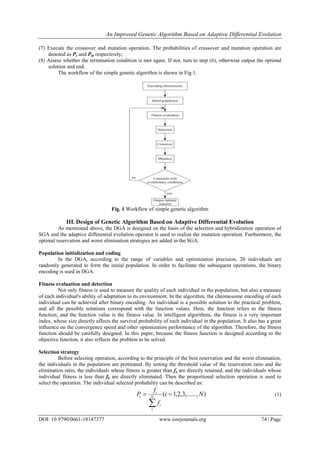
The simple genetic algorithm mainly includes encoding, initial population generation, fitness
evaluation, selection, crossover, mutation and other operations. The process can be described as follows:
(1) Code all possible solutions to the problem;
(2) find an objective fitness function for the problem optimization;
(3) Generate an initial population that satisfies all constraints;
(4) calculate the fitness of each chromosome in the population;
(5) Assess whether the termination condition is met. If not, proceed with the following process, otherwise output
the optimal solution and end;
(6) execute the selection operation, that is to generate a new population according to the fitness of each
chromosome;
* Corresponding author. E-mail: sheny456@hotmail.com
An Improved Genetic Algorithm Based on Adaptive Differential Evolution
DOI: 10.9790/0661-18147377 www.iosrjournals.org 74 | Page
(7) Execute the crossover and mutation operation. The probabilities of crossover and mutation operation are
denoted as Pc and Pm respectively;
(8) Assess whether the termination condition is met again. If not, turn to step (6), otherwise output the optimal
solution and end.
The workflow of the simple genetic algorithm is shown in Fig.1.
Fig. 1 Workflow of simple genetic algorithm
III. Design of Genetic Algorithm Based on Adaptive Differential Evolution
As mentioned above, the DGA is designed on the basis of the selection and hybridization operation of
SGA and the adaptive differential evolution operator is used to realize the mutation operation. Furthermore, the
optimal reservation and worst elimination strategies are added in the SGA.
Population initialization and coding
In the DGA, according to the range of variables and optimization precision, 20 individuals are
randomly generated to form the initial population. In order to facilitate the subsequent operations, the binary
encoding is used in DGA.
Fitness evaluation and detection
Not only fitness is used to measure the quality of each individual in the population, but also a measure
of each individual's ability of adaptation to its environment. In the algorithm, the chromosome encoding of each
individual can be achieved after binary encoding. An individual is a possible solution to the practical problem,
and all the possible solutions correspond with the function values. Here, the function refers to the fitness
function, and the function value is the fitness value. In intelligent algorithms, the fitness is a very important
index, whose size directly affects the survival probability of each individual in the population. It also has a great
influence on the convergence speed and other optimization performance of the algorithm. Therefore, the fitness
function should be carefully designed. In this paper, because the fitness function is designed according to the
objective function, it also reflects the problem to be solved.
Selection strategy
Before selecting operation, according to the principle of the best reservation and the worst elimination,
the individuals in the population are pretreated. By setting the threshold value of the reservation ratio and the
elimination ratio, the individuals whose fitness is greater than fa are directly retained, and the individuals whose
individual fitness is less than fb are directly eliminated. Then the proportional selection operation is used to
select the operation. The individual selected probability can be described as:
),......,3,2,1(
1
Ni
f
f
P N
i
i
i 

(1)
An Improved Genetic Algorithm Based on Adaptive Differential Evolution
DOI: 10.9790/0661-18147377 www.iosrjournals.org 75 | Page
where fi is the fitness value of individual i. N is the size of the population.
The probability that an individual is selected is proportional to its fitness. And the selection operation
can improve the average fitness of the population at the same time. New population is composed of direct
retention of individuals and selected individuals.
Crossover operator
The execution of crossover operator is: First, two individuals (namely Xi, Xj) are randomly selected to
make a pair, then whether the crossover operation of the two selected individuals is carried out depends on the
pre-set hybrid probability Ph. That is to say, if a uniform random number which is generated in (0, 1) is less than
Ph, the crossover operation is carried out, and two new individuals (namely Xi
’
, Xj
’
) are generated. The crossover
process can be described as follows:






),,2,1(),,1(
),,1(),,2,1(




jij
jii
XLXX
LXXX
(2)
Where μ is the crossover point, L is the total length of binary encoding.
Adaptive differential evolution operator
In difference strategy[5], three points from the current population are arbitrarily selected. One point is
taken as a base point and the other two points are taken as reference points, then a disturbance is generated. The
generation process of the disturbance can be described as:
))()(()()1( 321 mymymymV rrrn   n ≠ r1 ≠ r2 ≠ r3 (3)
where δ is a scaling factor and yn(m) represents the nth individual in the mth generation.
The scaling factor δ is dynamically adjusted along with the individual fitness and evolution generation.
When the individual fitness in the population tends to converge or converge to the local optimal solution, the δ
is increased. When the individual fitness in the population is relatively dispersed, the δ decreases. At the same
time, if the fitness is greater than the average fitness of the population, corresponding to the larger δ, the
individual is eliminated. In contrast, the individuals who are below average fitness and closer to the average
fitness of the population correspond to the smaller δ to ensure population diversity. Therefore, the adaptive
scaling factor is able to provide the best δ to each solution. The introduced adaptive difference operation
maintains the population diversity in the algorithm. At the same time, the convergence of the algorithm is also
guaranteed. The δ is on the basis of the following Eq.(4) to carry out adaptive adjustment:











avg
avg
bestavg
avg
ff
ff
ff
ff
'1
'
'
1
 (4)
Where f' is the fitness value of an individual. favg is the average fitness value of current population. fbest is the
maximum fitness value of the current population.
At the beginning of the optimization, because the gap between fbest and fbest is very large, there is no
possibility of local convergence. If the f' is smaller, the δ is smaller, then good genes can be preserved. With the
increase of the evolution generation, the difference of the gap between fbest and fbest becames smaller and δ tends
to decrease. That is to say that the speed of convergence of the optimal solution is gradually accelerated.
Because the convergence speed is gradually accelerated, the risk of local convergence is reduced, and the global
search ability is improved.
Algorithm flow
In order to further improve the optimization performance of the algorithm, based on SGA, the
crossover operator and the adaptive differential evolution operator are introduced. The algorithm flow of the
DGA is as follows:
Step1 Initialize algorithm parameters: population size N , reservation ratio threshold fa , elimination ratio
threshold fb, maximal evolution generation kmax, individual selected probability Pi, crossover probability
Ph, variable precision Vp, and variable range Vr.
Step2 Generated the initial population on the basis of variable precision and variable range.
Step3 Execute adaptive evaluation and detection and generate the population according to the principle of the
best reservation and the worst elimination. Calculate the individual selection probability by Eq.(1), and
execute the selection operation.
Step4 Execute crossover operation according to the probability Ph using Eq.(2).
An Improved Genetic Algorithm Based on Adaptive Differential Evolution
DOI: 10.9790/0661-18147377 www.iosrjournals.org 76 | Page
Step5 Execute adaptive differential evolution operation using Eq.(3) and new population is got. The scaling
factor δ is dynamically adjusted according to Eq.(4).
Step6 Judge whether the terminating condition is satisfied. If not, k←k+1, go to Step3, otherwise end.
IV. Function Optimization Test and Analysis
In order to verify the optimization performance of DGA, the following five different functions are
provided to test on a computer using Matlab[6]
. The test results are compared with those of the SGA. In DGA,
N=20, fa=0.5, fb=1.5, kmax=1000, Ph=0.25. In SGA, N=20, Pc=0.3, Pm=0.1, kmax=1000. Considering the
randomness of intelligent algorithms, each function was independently tested with 50 repetitions.
1. Schaffer’s Function
)))(001.01/(()5.0))((sin(5.0min 22
2
2
1
22
2
2
11 xxxxf  (5)
]10,10[, 21 xx , f*
=0.
2. Ackley's Path function
20)1exp()))2cos()2(cos(5.0exp())(5.02.0exp(20min 21
2
2
2
12  xxxxf  (6)
]12.5,12.5[, 21 xx , f*
=0.
3. Rastrigrin function
)2cos(10)2cos(1020min 2
2
21
2
13 xxxxf   (7)
]12.5,12.5[, 21 xx , f*
=0.
4. Michalewicz’s function
202
22
202
114 ))/2)(sin(sin())/)(sin(sin(min  xxxxf  (8)
],0[, 21 xx , f*
=-1.8013.
5. Camel function
2
2
2
221
2
1
4
1
2
15 )44(]3/1.24[min xxxxxxxf  (9)
]12.5,12.5-[, 21 xx , f*
=-1.031628.
Table 1 Comparison results among three algorithms
f  Nbest Nmax Nmean Nsd
SGA DGA SGA DGA SGA DGA SGA DGA
f1 10-13
49 50 706 564 355.98 286.54 145.25 86.66
f2 10-11
49 50 849 624 393.41 292.86 153.30 115.66
f3 10-6
48 50 557 398 311.35 221.14 103.78 77.55
f4 10-3
31 47 1000 773 434.97 291.98 256.54 216.14
f5 10-3
42 50 861 451 331.43 236.08 251.93 103.75
Table 1 is the comparison results among DGA and SGA. Nbest denotes the number of times an optimal
solution was found. Nmax,Nmean and Nsd denote the maximum, average convergence and standard deviation
generations needed to find the optimal solutions, respectively. From the comparison results, we can see that the
optimization results of DGA are better than those of SGA, which shows the strong optimization ability of the
DGA. DGA improved the global search capability of SGA by adaptive differential evolution operator. Under the
condition of ensuring population diversity, the algorithm performs adaptive differential evolution operator
according to the fitness value after the individual fitness is tested. So the whole population quality is improved
and the risk of local convergence is reduced. The global searching ability of DGA also is improved.
ƒ(x1,x2)
0 50 100 150 200 250
0
0.5
1
1.5
2
Generation
DGA
SGA
ƒ(x1,x2)
0 50 100 150 200 250
0
0.5
1
1.5
2
Generation
DGA
SGA
Fig. 2 Average evolutionary curves of optimal solution Fig. 3 Average evolutionary curves of whole
Of Rastrigrin function population of Rastrigrin function
An Improved Genetic Algorithm Based on Adaptive Differential Evolution
DOI: 10.9790/0661-18147377 www.iosrjournals.org 77 | Page
Fig.2 gives average evolutionary curves of optimal solution of Rastrigrin function. From the two
curves, it can also be seen that the convergence speed of the proposed DGA is faster than the speed of SGA,
which further verify the effectiveness of the DGA. Fig.3 gives Average evolutionary curves of whole population
of Rastrigrin function. From the two curves, it can also be seen that the population convergence performance of
the proposed DGA is better than that of SGA, and the search stability of DGA is higher than that of SGA.
V. Conclusions
In order to solve the problem of premature convergence and improve the optimization ability of the
simple genetic algorithms during the complex function optimization, an improved genetic algorithm based on
adaptive differential evolution is presented. Compared with the simple genetic algorithm, computer simulation
shows that the convergence speed of the proposed DGA algorithm is faster and the global search ability is
improved. Furthermore, the DGA can effectively reduce the dependence of the convergence on the initial
population.
Acknowledgements
This work is supported by the 2015 College Students Practice Innovation Training Program of Jiangsu
Province, 2015 Entry Project of Service Center of Zhangjiagang Camphor Tree Makerspace, and Modern
Educational Technology Project of Jiangsu Province (No. 2015-R-40701).
References
[1]. L.B. Booker, D.E. Goldberg, J.H. Holland, Classifier systems and genetic algorithms, Artificial Intelligence, 89,1989,235–282.
[2]. G. Gong, G.S. Hao, F. Yang, An improved algorithm for the suppression of premature convergence of genetic algorithms,
Computer and Digital Engineering, 5, 2009, 6-9, 16.
[3]. L. Ling, Y.J. Hu, Q.Q. Wang, J.J. Zhang. Optimization of hole group machining path based on improved genetic algorithm, Journal
of Huazhong University of Science and Technology (NATURAL SCIENCE EDITION), 8, 2009, 88-91.
[4]. R. Storn, K. Price, Differential evolution-a simple and efficient heuristic for global optimization over continuous space, Journal of
Global Optimization, 4, 1997, 341-359.
[5]. Y.L. Zhou, Y.H. Zhu, Discrete differential evolution with fitness uniform selection scheme, Journal of Chinese Computer Systems,
1, 2012, 151-154.
[6]. M.X. Yuan, H.F. Du, S.A. Wang, J. Zhuan, Chaos small-world optimal algorithm based on population entropy,Journal of Xi'an
Jiaotong University,9,2008,1137-1141.

L018147377

  • 1.
    IOSR Journal ofComputer Engineering (IOSR-JCE) e-ISSN: 2278-0661,p-ISSN: 2278-8727, Volume 18, Issue 1, Ver. IV (Jan – Feb. 2016), PP 73-77 www.iosrjournals.org DOI: 10.9790/0661-18147377 www.iosrjournals.org 73 | Page An Improved Genetic Algorithm Based on Adaptive Differential Evolution Feng Jiang1,3 , Yi Shen1,2,3,* , Panpan Ge2 , Cheng Zhang1,3 , Mingxin Yuan1,2,3 1 (Suzhou Institute of Technology, Jiangsu University of Science and Technology, Zhangjiagang, China) 2 (School of Mechanical and Power Engineering, Jiangsu University of Science and Technology, Zhangjiagang, China) 3 (Service Center of Zhangjiagang Camphor Tree Makerspace, Zhangjiagang, China) Abstract: In order to solve the premature convergence and improve the optimization ability of simple genetic algorithm (SGA) in the complex function optimization, an improved differential evolution based-genetic algorithm (DGA) is proposed in this paper. On the basis of the selection and crossover operation of SGA, the adaptive differential evolution operator is used as the main optimization method to realize the mutation operation. Furthermore, the optimal reservation and worst elimination strategies are added in the SGA. All of these improvements can significantly improve the optimization performance of SGA. Compared with the SGA, the simulation results of function optimization show that the proposed DGA is characterized by strong global optimization ability, quick convergence speed and good stability, which shows the validity of the improvements to simple genetic algorithm. Keywords: Self-adaption, Differential evolution, Genetic Algorithm, Function optimization I. Introduction Genetic algorithm is an adaptive global optimization probability search algorithm, which simulates the biological genetic and evolution process in the natural environment [1]. A general framework for solving the optimization problem of complex systems is provided, which does not depend on the specific areas of the problems and has strong robustness to various types of problems. An improved genetic algorithm based on arithmetic crossover operator and non-uniform mutation operator is proposed in [2], which can avoid the premature convergence, but the search ability is slightly less. The crossover operator and the simulated annealing algorithm are used to allow the parent generation to participate in the competition in [3], which can improve the global search ability and help it quickly escape from the local minima, but its optimization performance is sensitive to the initial temperature of the simulated annealing algorithm. Differential evolution is a kind of heuristic random search algorithm based on group difference and the optimization is finished using real encoding in continuous space. But it is incapable of “survival of the fittest” during the selection process. The mutation operation in the algorithm only aims at the newly generated individual. Besides, all the individuals in the new generation have no equal chance of mutation, so it is easy to trap into the local optimal solutions. Compared with the genetic algorithm, the mutation operator of differential evolution algorithm is more important, and its mutation probability is much higher than that of genetic algorithm. It is easy to see that the differential evolution algorithm and the genetic algorithm have strong complementarity. Aiming at the problems, such as premature convergence, weak search ability, in complex function optimization of genetic algorithm, inspired by the basic principles of differential evolution and the evolution mechanism of genetic algorithm, an improved genetic algorithm based on adaptive differential evolution is designed in this paper, and the advantages of genetic algorithm and differential evolution algorithm are fully used to improve the optimization ability of intelligent algorithm. The function optimization results also verify the validity of the proposed DGA. II. Simple Genetic Algorithm The simple genetic algorithm mainly includes encoding, initial population generation, fitness evaluation, selection, crossover, mutation and other operations. The process can be described as follows: (1) Code all possible solutions to the problem; (2) find an objective fitness function for the problem optimization; (3) Generate an initial population that satisfies all constraints; (4) calculate the fitness of each chromosome in the population; (5) Assess whether the termination condition is met. If not, proceed with the following process, otherwise output the optimal solution and end; (6) execute the selection operation, that is to generate a new population according to the fitness of each chromosome; * Corresponding author. E-mail: sheny456@hotmail.com
  • 2.
    An Improved GeneticAlgorithm Based on Adaptive Differential Evolution DOI: 10.9790/0661-18147377 www.iosrjournals.org 74 | Page (7) Execute the crossover and mutation operation. The probabilities of crossover and mutation operation are denoted as Pc and Pm respectively; (8) Assess whether the termination condition is met again. If not, turn to step (6), otherwise output the optimal solution and end. The workflow of the simple genetic algorithm is shown in Fig.1. Fig. 1 Workflow of simple genetic algorithm III. Design of Genetic Algorithm Based on Adaptive Differential Evolution As mentioned above, the DGA is designed on the basis of the selection and hybridization operation of SGA and the adaptive differential evolution operator is used to realize the mutation operation. Furthermore, the optimal reservation and worst elimination strategies are added in the SGA. Population initialization and coding In the DGA, according to the range of variables and optimization precision, 20 individuals are randomly generated to form the initial population. In order to facilitate the subsequent operations, the binary encoding is used in DGA. Fitness evaluation and detection Not only fitness is used to measure the quality of each individual in the population, but also a measure of each individual's ability of adaptation to its environment. In the algorithm, the chromosome encoding of each individual can be achieved after binary encoding. An individual is a possible solution to the practical problem, and all the possible solutions correspond with the function values. Here, the function refers to the fitness function, and the function value is the fitness value. In intelligent algorithms, the fitness is a very important index, whose size directly affects the survival probability of each individual in the population. It also has a great influence on the convergence speed and other optimization performance of the algorithm. Therefore, the fitness function should be carefully designed. In this paper, because the fitness function is designed according to the objective function, it also reflects the problem to be solved. Selection strategy Before selecting operation, according to the principle of the best reservation and the worst elimination, the individuals in the population are pretreated. By setting the threshold value of the reservation ratio and the elimination ratio, the individuals whose fitness is greater than fa are directly retained, and the individuals whose individual fitness is less than fb are directly eliminated. Then the proportional selection operation is used to select the operation. The individual selected probability can be described as: ),......,3,2,1( 1 Ni f f P N i i i   (1)
  • 3.
    An Improved GeneticAlgorithm Based on Adaptive Differential Evolution DOI: 10.9790/0661-18147377 www.iosrjournals.org 75 | Page where fi is the fitness value of individual i. N is the size of the population. The probability that an individual is selected is proportional to its fitness. And the selection operation can improve the average fitness of the population at the same time. New population is composed of direct retention of individuals and selected individuals. Crossover operator The execution of crossover operator is: First, two individuals (namely Xi, Xj) are randomly selected to make a pair, then whether the crossover operation of the two selected individuals is carried out depends on the pre-set hybrid probability Ph. That is to say, if a uniform random number which is generated in (0, 1) is less than Ph, the crossover operation is carried out, and two new individuals (namely Xi ’ , Xj ’ ) are generated. The crossover process can be described as follows:       ),,2,1(),,1( ),,1(),,2,1(     jij jii XLXX LXXX (2) Where μ is the crossover point, L is the total length of binary encoding. Adaptive differential evolution operator In difference strategy[5], three points from the current population are arbitrarily selected. One point is taken as a base point and the other two points are taken as reference points, then a disturbance is generated. The generation process of the disturbance can be described as: ))()(()()1( 321 mymymymV rrrn   n ≠ r1 ≠ r2 ≠ r3 (3) where δ is a scaling factor and yn(m) represents the nth individual in the mth generation. The scaling factor δ is dynamically adjusted along with the individual fitness and evolution generation. When the individual fitness in the population tends to converge or converge to the local optimal solution, the δ is increased. When the individual fitness in the population is relatively dispersed, the δ decreases. At the same time, if the fitness is greater than the average fitness of the population, corresponding to the larger δ, the individual is eliminated. In contrast, the individuals who are below average fitness and closer to the average fitness of the population correspond to the smaller δ to ensure population diversity. Therefore, the adaptive scaling factor is able to provide the best δ to each solution. The introduced adaptive difference operation maintains the population diversity in the algorithm. At the same time, the convergence of the algorithm is also guaranteed. The δ is on the basis of the following Eq.(4) to carry out adaptive adjustment:            avg avg bestavg avg ff ff ff ff '1 ' ' 1  (4) Where f' is the fitness value of an individual. favg is the average fitness value of current population. fbest is the maximum fitness value of the current population. At the beginning of the optimization, because the gap between fbest and fbest is very large, there is no possibility of local convergence. If the f' is smaller, the δ is smaller, then good genes can be preserved. With the increase of the evolution generation, the difference of the gap between fbest and fbest becames smaller and δ tends to decrease. That is to say that the speed of convergence of the optimal solution is gradually accelerated. Because the convergence speed is gradually accelerated, the risk of local convergence is reduced, and the global search ability is improved. Algorithm flow In order to further improve the optimization performance of the algorithm, based on SGA, the crossover operator and the adaptive differential evolution operator are introduced. The algorithm flow of the DGA is as follows: Step1 Initialize algorithm parameters: population size N , reservation ratio threshold fa , elimination ratio threshold fb, maximal evolution generation kmax, individual selected probability Pi, crossover probability Ph, variable precision Vp, and variable range Vr. Step2 Generated the initial population on the basis of variable precision and variable range. Step3 Execute adaptive evaluation and detection and generate the population according to the principle of the best reservation and the worst elimination. Calculate the individual selection probability by Eq.(1), and execute the selection operation. Step4 Execute crossover operation according to the probability Ph using Eq.(2).
  • 4.
    An Improved GeneticAlgorithm Based on Adaptive Differential Evolution DOI: 10.9790/0661-18147377 www.iosrjournals.org 76 | Page Step5 Execute adaptive differential evolution operation using Eq.(3) and new population is got. The scaling factor δ is dynamically adjusted according to Eq.(4). Step6 Judge whether the terminating condition is satisfied. If not, k←k+1, go to Step3, otherwise end. IV. Function Optimization Test and Analysis In order to verify the optimization performance of DGA, the following five different functions are provided to test on a computer using Matlab[6] . The test results are compared with those of the SGA. In DGA, N=20, fa=0.5, fb=1.5, kmax=1000, Ph=0.25. In SGA, N=20, Pc=0.3, Pm=0.1, kmax=1000. Considering the randomness of intelligent algorithms, each function was independently tested with 50 repetitions. 1. Schaffer’s Function )))(001.01/(()5.0))((sin(5.0min 22 2 2 1 22 2 2 11 xxxxf  (5) ]10,10[, 21 xx , f* =0. 2. Ackley's Path function 20)1exp()))2cos()2(cos(5.0exp())(5.02.0exp(20min 21 2 2 2 12  xxxxf  (6) ]12.5,12.5[, 21 xx , f* =0. 3. Rastrigrin function )2cos(10)2cos(1020min 2 2 21 2 13 xxxxf   (7) ]12.5,12.5[, 21 xx , f* =0. 4. Michalewicz’s function 202 22 202 114 ))/2)(sin(sin())/)(sin(sin(min  xxxxf  (8) ],0[, 21 xx , f* =-1.8013. 5. Camel function 2 2 2 221 2 1 4 1 2 15 )44(]3/1.24[min xxxxxxxf  (9) ]12.5,12.5-[, 21 xx , f* =-1.031628. Table 1 Comparison results among three algorithms f  Nbest Nmax Nmean Nsd SGA DGA SGA DGA SGA DGA SGA DGA f1 10-13 49 50 706 564 355.98 286.54 145.25 86.66 f2 10-11 49 50 849 624 393.41 292.86 153.30 115.66 f3 10-6 48 50 557 398 311.35 221.14 103.78 77.55 f4 10-3 31 47 1000 773 434.97 291.98 256.54 216.14 f5 10-3 42 50 861 451 331.43 236.08 251.93 103.75 Table 1 is the comparison results among DGA and SGA. Nbest denotes the number of times an optimal solution was found. Nmax,Nmean and Nsd denote the maximum, average convergence and standard deviation generations needed to find the optimal solutions, respectively. From the comparison results, we can see that the optimization results of DGA are better than those of SGA, which shows the strong optimization ability of the DGA. DGA improved the global search capability of SGA by adaptive differential evolution operator. Under the condition of ensuring population diversity, the algorithm performs adaptive differential evolution operator according to the fitness value after the individual fitness is tested. So the whole population quality is improved and the risk of local convergence is reduced. The global searching ability of DGA also is improved. ƒ(x1,x2) 0 50 100 150 200 250 0 0.5 1 1.5 2 Generation DGA SGA ƒ(x1,x2) 0 50 100 150 200 250 0 0.5 1 1.5 2 Generation DGA SGA Fig. 2 Average evolutionary curves of optimal solution Fig. 3 Average evolutionary curves of whole Of Rastrigrin function population of Rastrigrin function
  • 5.
    An Improved GeneticAlgorithm Based on Adaptive Differential Evolution DOI: 10.9790/0661-18147377 www.iosrjournals.org 77 | Page Fig.2 gives average evolutionary curves of optimal solution of Rastrigrin function. From the two curves, it can also be seen that the convergence speed of the proposed DGA is faster than the speed of SGA, which further verify the effectiveness of the DGA. Fig.3 gives Average evolutionary curves of whole population of Rastrigrin function. From the two curves, it can also be seen that the population convergence performance of the proposed DGA is better than that of SGA, and the search stability of DGA is higher than that of SGA. V. Conclusions In order to solve the problem of premature convergence and improve the optimization ability of the simple genetic algorithms during the complex function optimization, an improved genetic algorithm based on adaptive differential evolution is presented. Compared with the simple genetic algorithm, computer simulation shows that the convergence speed of the proposed DGA algorithm is faster and the global search ability is improved. Furthermore, the DGA can effectively reduce the dependence of the convergence on the initial population. Acknowledgements This work is supported by the 2015 College Students Practice Innovation Training Program of Jiangsu Province, 2015 Entry Project of Service Center of Zhangjiagang Camphor Tree Makerspace, and Modern Educational Technology Project of Jiangsu Province (No. 2015-R-40701). References [1]. L.B. Booker, D.E. Goldberg, J.H. Holland, Classifier systems and genetic algorithms, Artificial Intelligence, 89,1989,235–282. [2]. G. Gong, G.S. Hao, F. Yang, An improved algorithm for the suppression of premature convergence of genetic algorithms, Computer and Digital Engineering, 5, 2009, 6-9, 16. [3]. L. Ling, Y.J. Hu, Q.Q. Wang, J.J. Zhang. Optimization of hole group machining path based on improved genetic algorithm, Journal of Huazhong University of Science and Technology (NATURAL SCIENCE EDITION), 8, 2009, 88-91. [4]. R. Storn, K. Price, Differential evolution-a simple and efficient heuristic for global optimization over continuous space, Journal of Global Optimization, 4, 1997, 341-359. [5]. Y.L. Zhou, Y.H. Zhu, Discrete differential evolution with fitness uniform selection scheme, Journal of Chinese Computer Systems, 1, 2012, 151-154. [6]. M.X. Yuan, H.F. Du, S.A. Wang, J. Zhuan, Chaos small-world optimal algorithm based on population entropy,Journal of Xi'an Jiaotong University,9,2008,1137-1141.