ASSIGNMENT2
Question2
a. Explain Genetic Algorithms (GAs) by using a flowchart with annotations.
 ProposedbyJohnHollandin1975
 Imitating“Natural Selection”processof creatures
-> Geneticinformation(Gene)codedinthe cell of creaturescombines withothergene at
breedingandparents’characteristicsare transferredtothe offspring
 Geneticinformationischangedbyseveralfactors
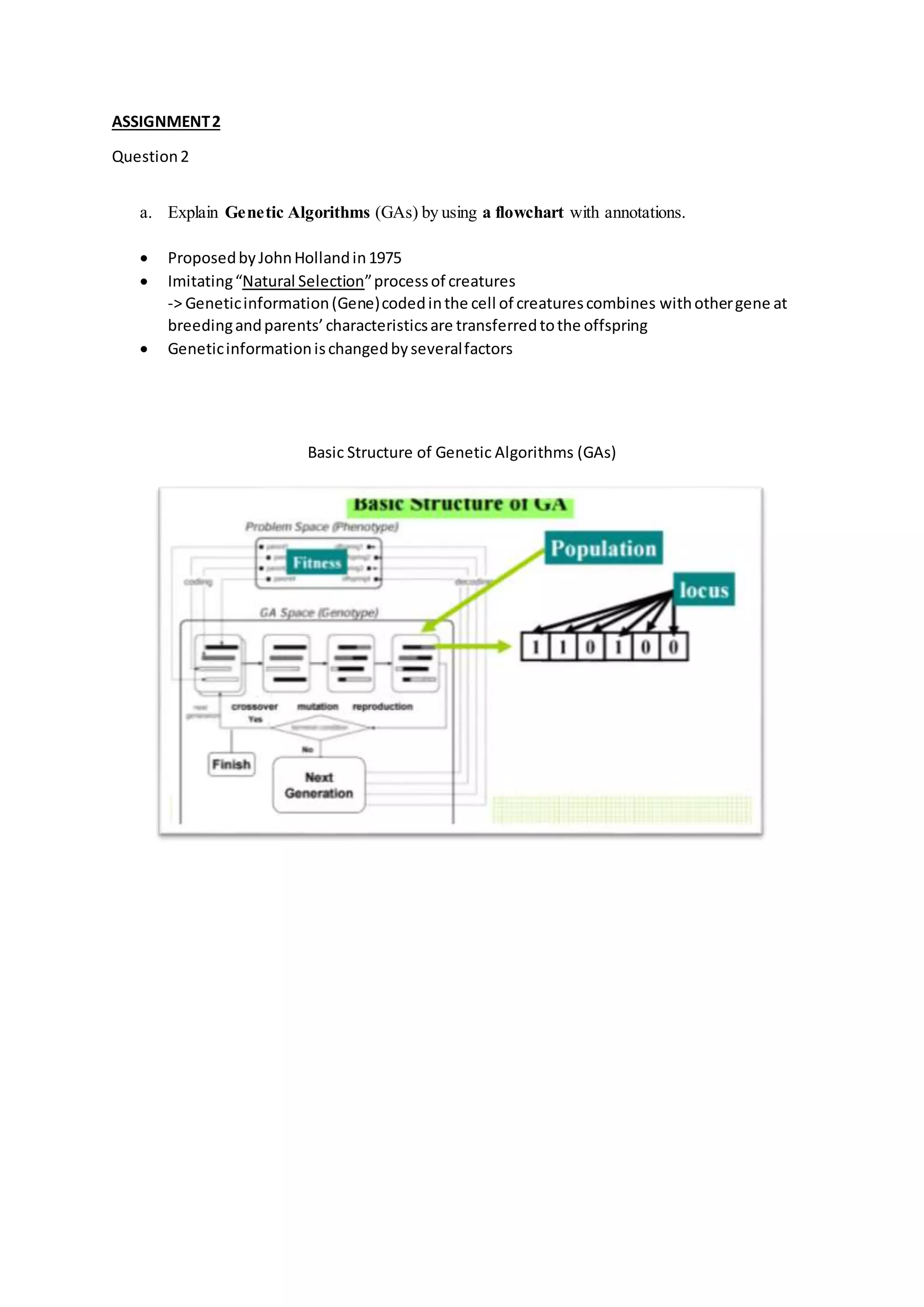
Basic Structure of Genetic Algorithms (GAs)
Genetic Operator of GA
 Genetic operator is the operator for generating new gene based on fitness of each
individual
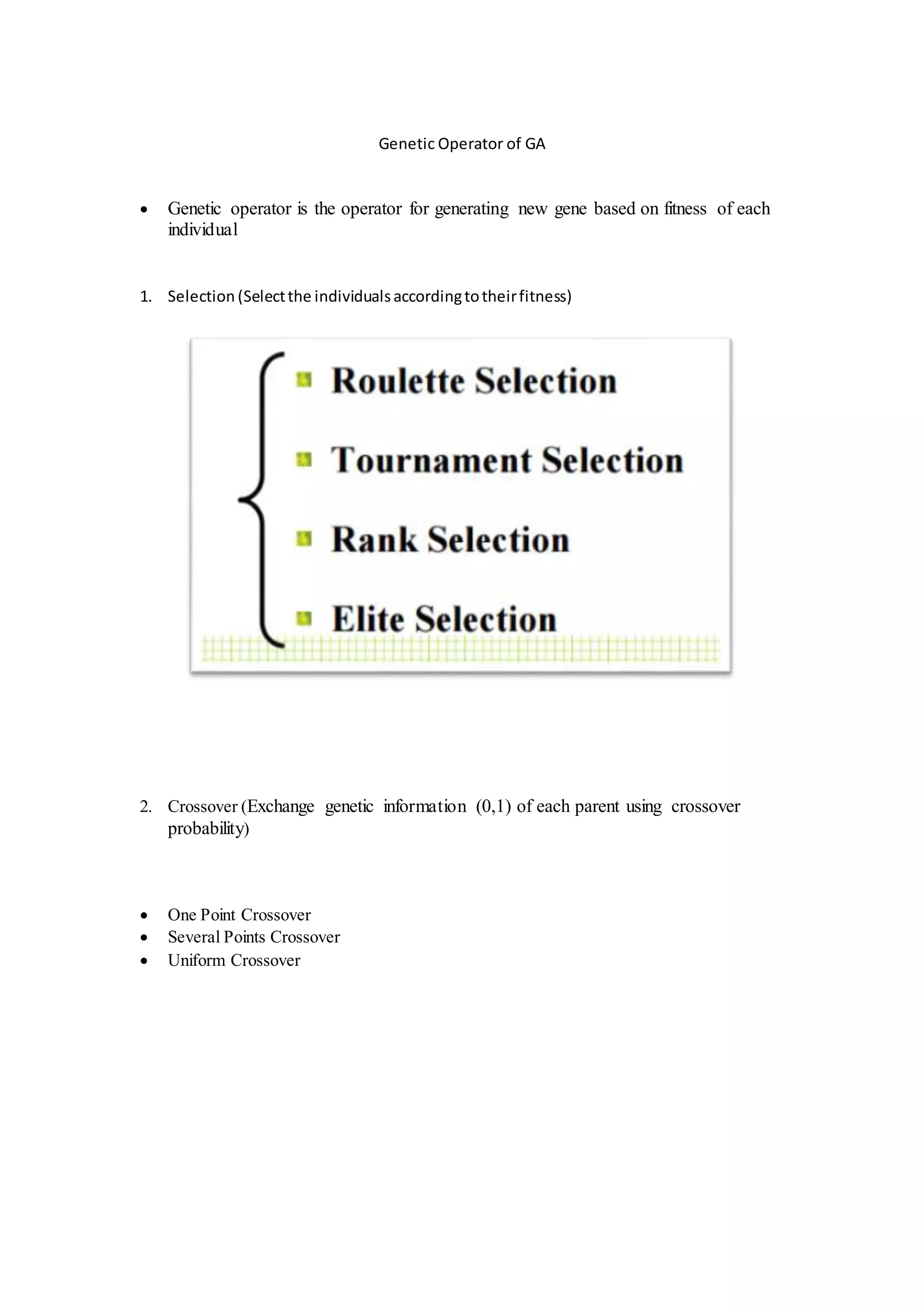
1. Selection (Selectthe individualsaccordingtotheirfitness)
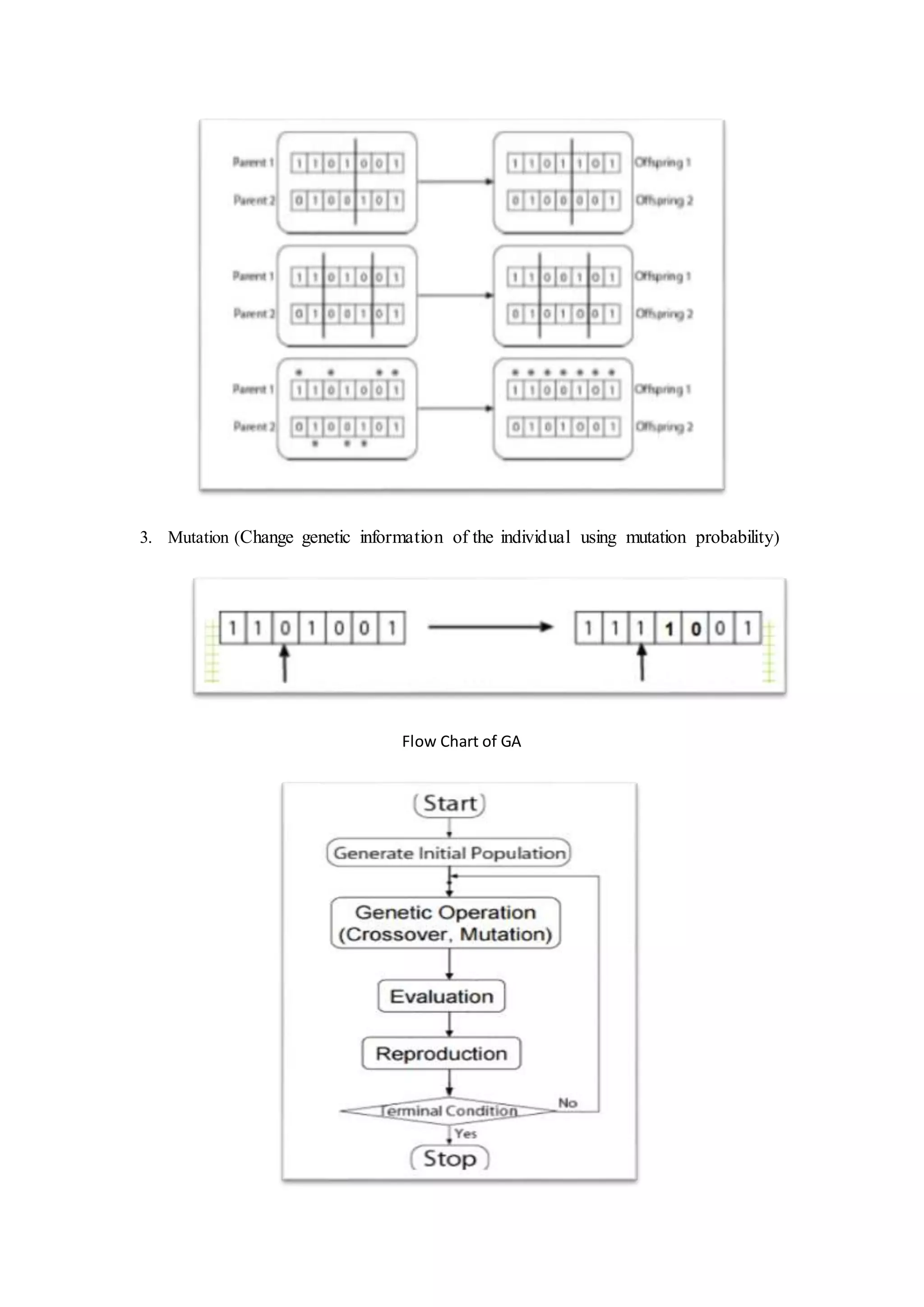
2. Crossover (Exchange genetic information (0,1) of each parent using crossover
probability)
 One Point Crossover
 Several Points Crossover
 Uniform Crossover
3. Mutation (Change genetic information of the individual using mutation probability)
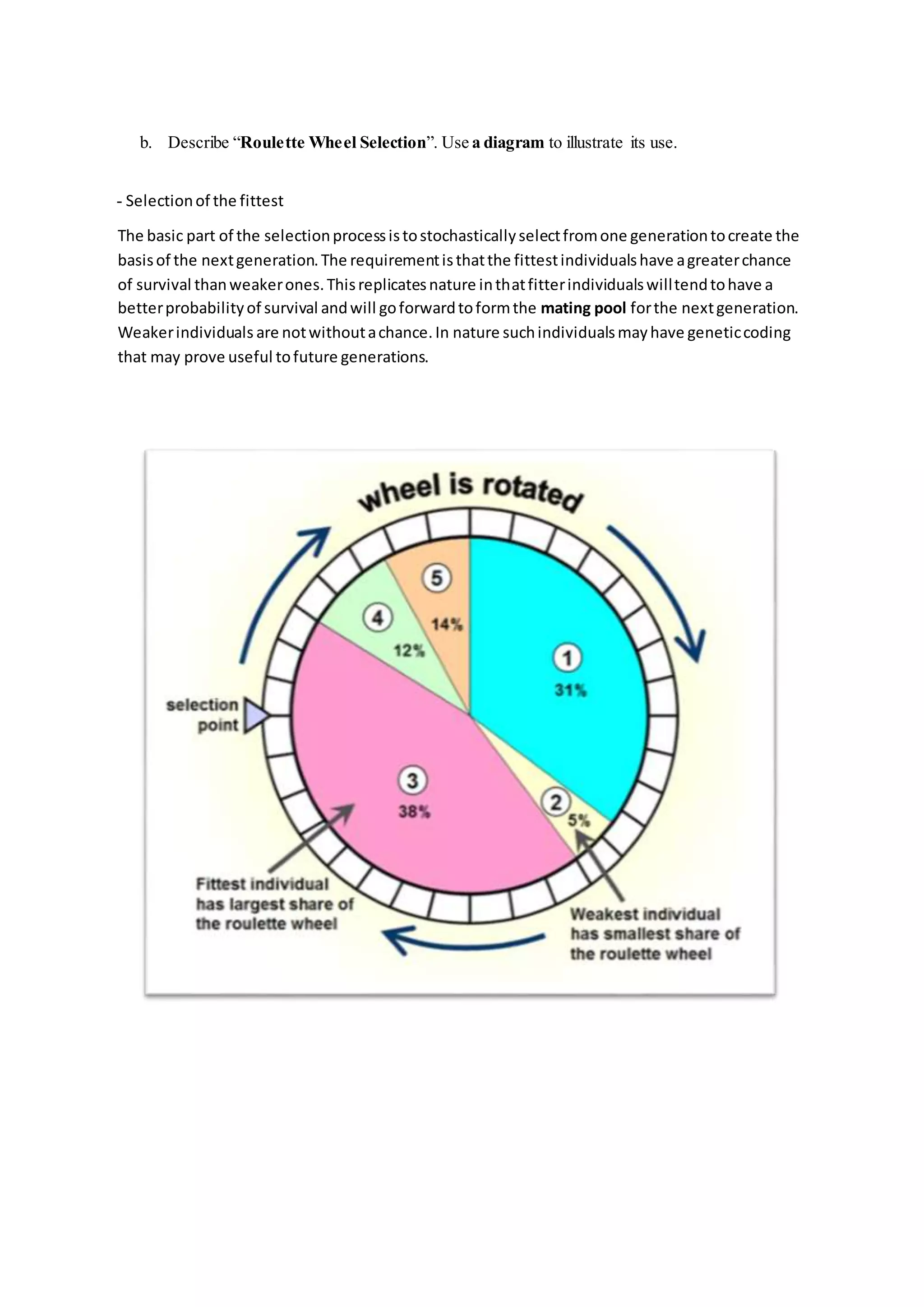
Flow Chart of GA
b. Describe “Roulette Wheel Selection”. Use a diagram to illustrate its use.
- Selectionof the fittest
The basic part of the selectionprocessistostochasticallyselectfromone generationtocreate the
basisof the nextgeneration.The requirementisthatthe fittestindividualshave agreaterchance
of survival thanweakerones.Thisreplicatesnature inthatfitterindividualswilltendtohave a
betterprobabilityof survival andwill goforwardtoformthe mating pool forthe nextgeneration.
Weakerindividuals are notwithoutachance.In nature suchindividualsmayhave geneticcoding
that may prove useful tofuture generations.
- Example
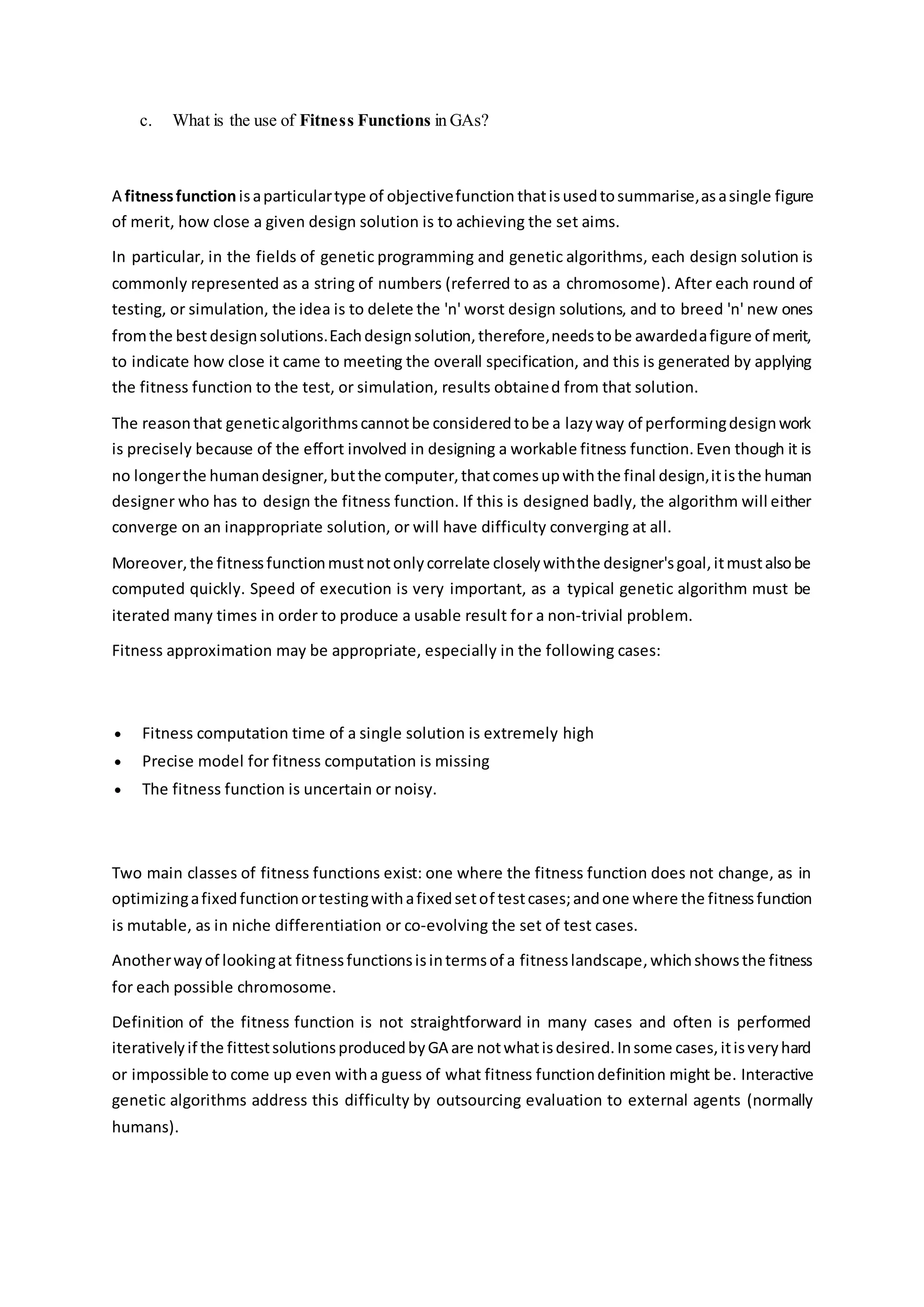
The normal methodusedisthe roulette wheel (asshowninFigure 2above).The followingtable
listsa sample populationof 5 individuals(atypical populationof 400 wouldbe difficultto
illustrate).
These individualsconsistof 10 bitchromosomesandare beingusedtooptimise asimple
mathematical function(wecanassume fromthisexample we are tryingtofind the maximum).If
the inputrange for x isbetween0and 10, thenwe can map the binarychromosomestobase 10
valuesandthento an inputvalue between0and10.
The fitnessvaluesare thentakenasthe functionof x. We can see fromthe table (column Fitness
f(x)) thatindividualNo.3is the fittestandNo.2 isthe weakest.Summingthesefitnessvalueswe
can apportiona percentage total of fitness.Thisgivesthe strongestindividualavalue of 38% and
the weakest5%.
These percentage fitnessvalues canthenbe usedtoconfigure the roulette wheel.Figure 2
highlightsthatindividual No.3has a segmentequal to38% of the area.
The numberof timesthe roulette wheelisspunisequal tosize of the population.Ascanbe seen
fromthe waythe wheel is nowdivided,eachtime the wheel stopsthisgivesthe fitterindividuals
the greatestchance of beingselectedforthe nextgenerationandsubsequent matingpool.
What ispossiblymore interestingfromthisexampleisthatas the generationsprogressandthe
populationgetsfitterthe gene patternforindividual No.3: 01000001012 will become more
prevalentinthe general populationbecause itisfitter,more apt tothe environmentwe have put
it in- inthiscase the functionwe are tryingto optimise.
c. What is the use of Fitness Functions in GAs?
A fitnessfunctionisaparticulartype of objectivefunction thatisusedtosummarise,asasingle figure
of merit, how close a given design solution is to achieving the set aims.
In particular, in the fields of genetic programming and genetic algorithms, each design solution is
commonly represented as a string of numbers (referred to as a chromosome). After each round of
testing, or simulation, the idea is to delete the 'n' worst design solutions, and to breed 'n' new ones
fromthe bestdesignsolutions.Eachdesignsolution,therefore,needstobe awardedafigure of merit,
to indicate how close it came to meeting the overall specification, and this is generated by applying
the fitness function to the test, or simulation, results obtained from that solution.
The reasonthat geneticalgorithmscannotbe consideredtobe a lazyway of performingdesignwork
is precisely because of the effort involved in designing a workable fitness function.Even though it is
no longerthe humandesigner,butthe computer,thatcomesupwiththe final design,itisthe human
designer who has to design the fitness function. If this is designed badly, the algorithm will either
converge on an inappropriate solution, or will have difficulty converging at all.
Moreover,the fitnessfunctionmustnotonlycorrelate closelywiththe designer'sgoal,itmustalsobe
computed quickly. Speed of execution is very important, as a typical genetic algorithm must be
iterated many times in order to produce a usable result for a non-trivial problem.
Fitness approximation may be appropriate, especially in the following cases:
 Fitness computation time of a single solution is extremely high
 Precise model for fitness computation is missing
 The fitness function is uncertain or noisy.
Two main classes of fitness functions exist: one where the fitness function does not change, as in
optimizingafixedfunctionortestingwithafixedsetof testcases;andone where the fitnessfunction
is mutable, as in niche differentiation or co-evolving the set of test cases.
Anotherwayof lookingat fitnessfunctionsisintermsof a fitnesslandscape,whichshowsthe fitness
for each possible chromosome.
Definition of the fitness function is not straightforward in many cases and often is performed
iterativelyif the fittestsolutionsproducedbyGA are notwhatisdesired.Insome cases,itisveryhard
or impossible to come up even witha guess of what fitness functiondefinition might be. Interactive
genetic algorithms address this difficulty by outsourcing evaluation to external agents (normally
humans).

Artificial Intelligence - 2

  • 1.
    ASSIGNMENT2 Question2 a. Explain GeneticAlgorithms (GAs) by using a flowchart with annotations.  ProposedbyJohnHollandin1975  Imitating“Natural Selection”processof creatures -> Geneticinformation(Gene)codedinthe cell of creaturescombines withothergene at breedingandparents’characteristicsare transferredtothe offspring  Geneticinformationischangedbyseveralfactors Basic Structure of Genetic Algorithms (GAs)
  • 2.
    Genetic Operator ofGA  Genetic operator is the operator for generating new gene based on fitness of each individual 1. Selection (Selectthe individualsaccordingtotheirfitness) 2. Crossover (Exchange genetic information (0,1) of each parent using crossover probability)  One Point Crossover  Several Points Crossover  Uniform Crossover
  • 3.
    3. Mutation (Changegenetic information of the individual using mutation probability) Flow Chart of GA
  • 4.
    b. Describe “RouletteWheel Selection”. Use a diagram to illustrate its use. - Selectionof the fittest The basic part of the selectionprocessistostochasticallyselectfromone generationtocreate the basisof the nextgeneration.The requirementisthatthe fittestindividualshave agreaterchance of survival thanweakerones.Thisreplicatesnature inthatfitterindividualswilltendtohave a betterprobabilityof survival andwill goforwardtoformthe mating pool forthe nextgeneration. Weakerindividuals are notwithoutachance.In nature suchindividualsmayhave geneticcoding that may prove useful tofuture generations.
  • 5.
    - Example The normalmethodusedisthe roulette wheel (asshowninFigure 2above).The followingtable listsa sample populationof 5 individuals(atypical populationof 400 wouldbe difficultto illustrate). These individualsconsistof 10 bitchromosomesandare beingusedtooptimise asimple mathematical function(wecanassume fromthisexample we are tryingtofind the maximum).If the inputrange for x isbetween0and 10, thenwe can map the binarychromosomestobase 10 valuesandthento an inputvalue between0and10. The fitnessvaluesare thentakenasthe functionof x. We can see fromthe table (column Fitness f(x)) thatindividualNo.3is the fittestandNo.2 isthe weakest.Summingthesefitnessvalueswe can apportiona percentage total of fitness.Thisgivesthe strongestindividualavalue of 38% and the weakest5%. These percentage fitnessvalues canthenbe usedtoconfigure the roulette wheel.Figure 2 highlightsthatindividual No.3has a segmentequal to38% of the area. The numberof timesthe roulette wheelisspunisequal tosize of the population.Ascanbe seen fromthe waythe wheel is nowdivided,eachtime the wheel stopsthisgivesthe fitterindividuals the greatestchance of beingselectedforthe nextgenerationandsubsequent matingpool. What ispossiblymore interestingfromthisexampleisthatas the generationsprogressandthe populationgetsfitterthe gene patternforindividual No.3: 01000001012 will become more prevalentinthe general populationbecause itisfitter,more apt tothe environmentwe have put it in- inthiscase the functionwe are tryingto optimise.
  • 6.
    c. What isthe use of Fitness Functions in GAs? A fitnessfunctionisaparticulartype of objectivefunction thatisusedtosummarise,asasingle figure of merit, how close a given design solution is to achieving the set aims. In particular, in the fields of genetic programming and genetic algorithms, each design solution is commonly represented as a string of numbers (referred to as a chromosome). After each round of testing, or simulation, the idea is to delete the 'n' worst design solutions, and to breed 'n' new ones fromthe bestdesignsolutions.Eachdesignsolution,therefore,needstobe awardedafigure of merit, to indicate how close it came to meeting the overall specification, and this is generated by applying the fitness function to the test, or simulation, results obtained from that solution. The reasonthat geneticalgorithmscannotbe consideredtobe a lazyway of performingdesignwork is precisely because of the effort involved in designing a workable fitness function.Even though it is no longerthe humandesigner,butthe computer,thatcomesupwiththe final design,itisthe human designer who has to design the fitness function. If this is designed badly, the algorithm will either converge on an inappropriate solution, or will have difficulty converging at all. Moreover,the fitnessfunctionmustnotonlycorrelate closelywiththe designer'sgoal,itmustalsobe computed quickly. Speed of execution is very important, as a typical genetic algorithm must be iterated many times in order to produce a usable result for a non-trivial problem. Fitness approximation may be appropriate, especially in the following cases:  Fitness computation time of a single solution is extremely high  Precise model for fitness computation is missing  The fitness function is uncertain or noisy. Two main classes of fitness functions exist: one where the fitness function does not change, as in optimizingafixedfunctionortestingwithafixedsetof testcases;andone where the fitnessfunction is mutable, as in niche differentiation or co-evolving the set of test cases. Anotherwayof lookingat fitnessfunctionsisintermsof a fitnesslandscape,whichshowsthe fitness for each possible chromosome. Definition of the fitness function is not straightforward in many cases and often is performed iterativelyif the fittestsolutionsproducedbyGA are notwhatisdesired.Insome cases,itisveryhard or impossible to come up even witha guess of what fitness functiondefinition might be. Interactive genetic algorithms address this difficulty by outsourcing evaluation to external agents (normally humans).