This document presents a new multi-robot formation control algorithm based on leader-follower optimized by an immune genetic algorithm (IGA). The algorithm uses a leader-follower approach for initial formation control, then optimizes the proportional coefficients in the leader-follower model using an IGA. Simulation results comparing the proposed algorithm to genetic algorithm, simple leader-follower, and behavior-based approaches show the IGA-optimized leader-follower approach achieves formation faster and with fewer steps, demonstrating its effectiveness.
![IOSR Journal of Computer Engineering (IOSR-JCE)
e-ISSN: 2278-0661,p-ISSN: 2278-8727, Volume 19, Issue 1, Ver. III (Jan.-Feb. 2017), PP 08-13
www.iosrjournals.org
DOI: 10.9790/0661-1901030813 www.iosrjournals.org 8 | Page
Multi-Robot Formation Control Based on Leader-Follower
Optimized by the IGA
Ting Huang1,2
, Mingxin Yuan1,2,*
, Donghan Lv1
, Yi Shen1
1
(School of Mechanical and Power Engineering, Jiangsu University of Science and Technology, Zhangjiagang,
China)
2
(Service Center of Zhangjiagang Camphor Tree Makerspace, Zhangjiagang, China)
Abstract: To improve the efficiency of multi-robot formation control, a new formation control algorithm based
on leader-follower optimized by the immune genetic algorithm (IGA) is put forward in this paper. Firstly, the
formation control is realized by leader-follower algorithm. Then, the proportion coefficients k1, k2 in leader-
follower is optimized by the immune genetic algorithm. Finally, the optimized proportion coefficients k1 and k2 is
used in the leader-follower algorithm to finish the multi-robot formation control. Compared with other three
formation control algorithms (i.e. GA, simple leader-follower algorithm, behavior algorithm), the experimental
results of multi-robot formation control in two environments show that the formation control performance at
time and step finishing formation of the proposed formation control algorithm is obviously improved, which
verifies the validity of this algorithm.
Keywords: Multiple robots, Formation control, Leader-follower, Immune genetic algorithm
I. Introduction
In recent years, the multi-robot system has attracted more and more attention. The formation control is
one of the key technologies in multi-robot systems. The existing formation control methods mainly include the
leader-follower algorithm [1], behavior-based control algorithm [2] and virtual structure algorithm [3]. Li et al.
[4] put forward a multi-robot formation control based on dynamic leader and enhance the ability of multi-robots
to deal with emergencies. However, the algorithm has poor adaptability in complex environments. Aiming at the
formation control of multi-robots, Zhang et al. [5] proposed a quick converging distributed algorithm for
generating arbitrary shape of multi-robots. However, the leader and followers are relatively independent of each
other, and it is difficult for the proposed algorithm to find feasible space when the obstacles are dense. He et al.
[6] proposed a distributed formation control approach to formation maneuvers. In the control approach, based on
virtual structures, formation feedback is incorporated in the formation control scheme to increase the robustness
of the formation. However, because the formation movement of multi-robots simulates a virtual structure, the
approach is limited in application range. In order to further improve the formation control efficiency of the
leader-follower algorithm, the immune genetic algorithm is introduced to optimize the proportion coefficients k1,
k2 of the leader-follower algorithm in this paper. The experimental results show that the formation control
efficiency of the proposed leader follower algorithm optimized by IGA is significantly improved.
II. Formation Control Based on Leader-Follower
The leader-follower method [7] is described as: In a multi-robot team, a leader is set. The rest of the
robots are designated followers, and follow the movement of the leader. Let le and φe be the expected straight-
line distance and expected included angle between the leader and a follower, respectively. The purpose of the
formation control is to make the actual detection distance l and included angle φ between the leader and a
follower equal to the le and φe.Let (x0, y0), θ0, v0 and ω0 be the position coordinate, direction angle, velocity and
angular velocity of the leader.Let (xi, yi) and θi be the position coordinate and direction angle of the ith follower.
The ith follower can finish its formation control by calculating its forward speed vi and angular velocity ωi.
The kinematics equation of the ith follower can be described:
0
0 0
cos cos sin
1
( sin sin cos )
i i i i i i i
i i i i i i i
i
i i
l v v d
v v d l
l
(1)
where, di is the distance between the leader point and the reference point of the ith follower. γi = φi +
θ0 + θi.
According to the closed loop characteristics of the leader-follower formation control, we can conclude:](https://image.slidesharecdn.com/b1901030813-170703064318/85/Multi-Robot-Formation-Control-Based-on-Leader-Follower-Optimized-by-the-IGA-1-320.jpg)
![IOSR Journal of Computer Engineering (IOSR-JCE)
e-ISSN: 2278-0661,p-ISSN: 2278-8727, Volume 19, Issue 1, Ver. III (Jan.-Feb. 2017), PP 08-13
www.iosrjournals.org
DOI: 10.9790/0661-1901030813 www.iosrjournals.org 8 | Page
Multi-Robot Formation Control Based on Leader-Follower
Optimized by the IGA
Ting Huang1,2
, Mingxin Yuan1,2,*
, Donghan Lv1
, Yi Shen1
1
(School of Mechanical and Power Engineering, Jiangsu University of Science and Technology, Zhangjiagang,
China)
2
(Service Center of Zhangjiagang Camphor Tree Makerspace, Zhangjiagang, China)
Abstract: To improve the efficiency of multi-robot formation control, a new formation control algorithm based
on leader-follower optimized by the immune genetic algorithm (IGA) is put forward in this paper. Firstly, the
formation control is realized by leader-follower algorithm. Then, the proportion coefficients k1, k2 in leader-
follower is optimized by the immune genetic algorithm. Finally, the optimized proportion coefficients k1 and k2 is
used in the leader-follower algorithm to finish the multi-robot formation control. Compared with other three
formation control algorithms (i.e. GA, simple leader-follower algorithm, behavior algorithm), the experimental
results of multi-robot formation control in two environments show that the formation control performance at
time and step finishing formation of the proposed formation control algorithm is obviously improved, which
verifies the validity of this algorithm.
Keywords: Multiple robots, Formation control, Leader-follower, Immune genetic algorithm
I. Introduction
In recent years, the multi-robot system has attracted more and more attention. The formation control is
one of the key technologies in multi-robot systems. The existing formation control methods mainly include the
leader-follower algorithm [1], behavior-based control algorithm [2] and virtual structure algorithm [3]. Li et al.
[4] put forward a multi-robot formation control based on dynamic leader and enhance the ability of multi-robots
to deal with emergencies. However, the algorithm has poor adaptability in complex environments. Aiming at the
formation control of multi-robots, Zhang et al. [5] proposed a quick converging distributed algorithm for
generating arbitrary shape of multi-robots. However, the leader and followers are relatively independent of each
other, and it is difficult for the proposed algorithm to find feasible space when the obstacles are dense. He et al.
[6] proposed a distributed formation control approach to formation maneuvers. In the control approach, based on
virtual structures, formation feedback is incorporated in the formation control scheme to increase the robustness
of the formation. However, because the formation movement of multi-robots simulates a virtual structure, the
approach is limited in application range. In order to further improve the formation control efficiency of the
leader-follower algorithm, the immune genetic algorithm is introduced to optimize the proportion coefficients k1,
k2 of the leader-follower algorithm in this paper. The experimental results show that the formation control
efficiency of the proposed leader follower algorithm optimized by IGA is significantly improved.
II. Formation Control Based on Leader-Follower
The leader-follower method [7] is described as: In a multi-robot team, a leader is set. The rest of the
robots are designated followers, and follow the movement of the leader. Let le and φe be the expected straight-
line distance and expected included angle between the leader and a follower, respectively. The purpose of the
formation control is to make the actual detection distance l and included angle φ between the leader and a
follower equal to the le and φe.Let (x0, y0), θ0, v0 and ω0 be the position coordinate, direction angle, velocity and
angular velocity of the leader.Let (xi, yi) and θi be the position coordinate and direction angle of the ith follower.
The ith follower can finish its formation control by calculating its forward speed vi and angular velocity ωi.
The kinematics equation of the ith follower can be described:
0
0 0
cos cos sin
1
( sin sin cos )
i i i i i i i
i i i i i i i
i
i i
l v v d
v v d l
l
(1)
where, di is the distance between the leader point and the reference point of the ith follower. γi = φi +
θ0 + θi.
According to the closed loop characteristics of the leader-follower formation control, we can conclude:](https://image.slidesharecdn.com/b1901030813-170703064318/75/Multi-Robot-Formation-Control-Based-on-Leader-Follower-Optimized-by-the-IGA-1-2048.jpg)
![Multi-Robot Formation Control Based on Leader-Follower Optimized by the IGA
DOI: 10.9790/0661-1901030813 www.iosrjournals.org 9 | Page
1
2
( )
( )
i e i
i e i
l k l l
k
(2)
where, k1 and k2 are the proportional control coefficients.
According to Eq.(1) and (2), the velocity vi and angular velocity ωi of the ith follower can be obtained.
2 0 0
cos
[ ( ) sin sin ]
tan
i
i i e i i i i
i
i i i i i
k l v l p
d
v p d
(3)
where, 0 1cos ( )
cos
i e i
i
i
v k l l
p
.
In the multi-robot formation system, the velocity and angular velocity of each follower robot can be achieved
according to Eq.(3). Then the multi-robot formation control can be completed.
III. Multi-Robot Formation Control Optimized by Immune Genetic Optimization
3.1 Immune genetic optimization algorithm
The genetic algorithm (GA) [8] is a kind of global random search algorithm, and is commonly used to
generate high-quality solutions to optimization and search problems by relying on bio-inspired operators such as
mutation, crossover and selection. The immune genetic algorithm (IGA) [9] is a novel optimization algorithm
based on artificial immune theory, and is designed on the basic framework of genetic algorithm by combing
with immune operators (such as antibody stimulation and suppression, vaccine extraction and inoculation, and
so on.), which can effectively enhance the search efficiency and search precision of genetic algorithm.
The flow of IGA is shown in Fig.1.
Fig. 1 Flow of immune genetic algorithm
3.2 Immune selection based on information entropy
In order to reflect the diversity of antibodies in the population, the information entropy is introduced in
this paper. The affinity between the antibody and the antigen, and the affinity between different antibodies are
calculated based on the information entropy.
The average information entropy of the entire population is defined as:](https://image.slidesharecdn.com/b1901030813-170703064318/85/Multi-Robot-Formation-Control-Based-on-Leader-Follower-Optimized-by-the-IGA-2-320.jpg)
![Multi-Robot Formation Control Based on Leader-Follower Optimized by the IGA
DOI: 10.9790/0661-1901030813 www.iosrjournals.org 10 | Page
M
j
j NH
M
NH
1
)(
1
)( (4)
1
0
)lg()(
i
ijijj ppNH (5)
Total number of symbol at th position of antibodies
ij
i j N
p
N
(6)
where, M is population size, Hj is entropy from jth position of N antibodies, and pij is probability whose symbol
is i from jth position of N antibodies.
Let Aij be the similarity between individuals si and sj.
1
1 (2)
ij
H
A (7)
where H(2) can be obtained through Equations (4), (5) and (6) when N = 2.
3.3 Calculation of the expected reproduction rate[10]
The concentration of antibody x is defined as
1 N
x ij
j i
D Q
N
(8)
Where
1
0
ij
ij
A
Q
otherwise
(9)
and γ is the preset threshold value of the similarity.
The affinity between antigen and antibody [8, 9]
is defined as:
( ) ( )xAf Fit Pra x x (10)
Where, Fit(x) is the fitness of antibody x. Pra(x) is the excitation value of an antibody which is next to the local
or global optimal points.
The expected reproduction rate (Err) of antibody x can be described as:
rr( ) x
x
Af
E
D
x (11)
3.4 Optimization flow of the proportional control coefficients of leader-follower algorithm
Step 1 Initialize algorithm parameters: antibody size M, selection probability, crossover probability, mutation
probability, threshold value γ, maximal evolutionary generation kmax, and so on. k ← 0.
Step 2 Generate initial operation population and memory population.
Step 3 Calculate the expected reproduction rates Errs of all antibodies in operation population.
Step 4 Execute selection operation.
Step 5 Execute crossover operation.
Step 6 Execute mutation operation.
Step 7 Calculate the expected reproduction rates Errs of all antibodies in new operation population and memory
population.
Step 8 Select better antibodies to update the operation population and memory population.
Step 9 Judge whether the terminating condition is satisfied. If not, k←k+1, go to Step 4, otherwise end.
The termination condition is stated as: The specified kmax is reached.
IV. Immune optimization test and result analysis
In order to verify the validity and superiority of the proposed multi-robot formation control based on
immune genetic optimization, the triangle formation control simulations in two environments are executed. The
simulation results are compared with those of the GA, leader-follower algorithm and behavior algorithm.The
proportional coefficients k1 and k2 in leader-follower algorithm are 0.22 and 0.20 respectively after optimization
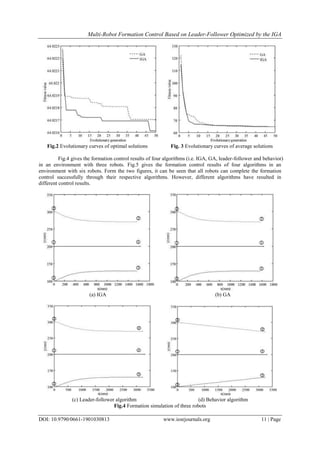
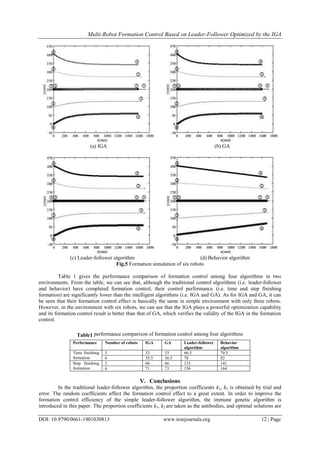
of IGA. The coefficients k1 and k2 optimized by GA are 0.20 and 0.20 respectively. The evolutionary curves of
optimal solutions of IGA and GA are shown in Fig. 2. The evolutionary curves of average solutions of IGA and
GA are shown in Fig. 3. From Fig.2 and Fig.3, it can be seen that the optimization ability of IGA is stronger
than that of IGA.](https://image.slidesharecdn.com/b1901030813-170703064318/85/Multi-Robot-Formation-Control-Based-on-Leader-Follower-Optimized-by-the-IGA-3-320.jpg)
![Multi-Robot Formation Control Based on Leader-Follower Optimized by the IGA
DOI: 10.9790/0661-1901030813 www.iosrjournals.org 13 | Page
obtained through the immune optimization. Finally the optimized proportion coefficients are used in the leader-
follower algorithm. The parameter optimization results show that the IGA not only can complete the global
optimization of k1 and k2, but also its optimization ability is stronger than that of the genetic algorithm.
Furthermore, the simulation results of formation control in two environments also show that the formation
control results of IGA are the best, which further verifies the validity of the IGA in the parameter optimization
of leader-follower algorithm.
Acknowledgements
This work is supported by the 2016 College Students Practice Innovation Training Program of Jiangsu
Province, 2016 Entry Project of Service Center of Zhangjiagang Camphor Tree Makerspace, and Special topic
of "Thirteenth Five - Year Plan" of Educational Science in Jiangsu Province (No.C-b/2016/01/06).
References
[1] C.J. Chen, Formation control based on leader-followers for multiple mobile robots, doctoral diss., Hangzhou Dianzi University,
Hangzhou, China, 2015
[2] Y. Pang, Research on behavior-based formation control of multi-robot, doctoral diss., Tianjin University, Tianjing, China,2012.
[3] F. Zhang, Z. Sun, M.J. Liu, Formation control based on the method of artificial potential and the leader-follower for multiple mobile
robots, Journal of Shenyang Jianzhu University (Natural Science), 26(4), 2010, 803-807.
[4] B. Li, X.F. Wang, Formation control based on dynamic leader multi-robots, Journal of Changchun University of Technology
(Natural Science Edition), 30(2), 2009, 210-214.
[5] L. Zhang, Y.Q. Qin, D.B. Sun, J. Xiao, Behavior-based control for arbitrary formation of multiple robots, Control Engineering of
China, 12(2),2005, 174-176.
[6] Z. He, Y.P. Lu, Y.B. Liu, Distributed control of formation maneuvers based on virtual structures, Journal of Applied Sciences,
25(4),2007, 387-391.
[7] M. Zhao, M.S. Lin, Y.Q. Huang, Leader-following formation control of multi-robots based on dynamic value of, Journal of
Southwest University of Science and Technology, 28(4), 2013, 57-61.
[8] N.N. Chai, Y. Shen, Y. Xu, F. Jiang, M.X. Yuan, Optimization design of manipulator based on the improved immune genetic
algorithm, Journal of Mechanical and Civil Engineering, 2015, 12(4):121-126.
[9] M.X. Yuan, Y.F. Jiang, Y. Shen, Z.L. Ye, Q. Wang, Task allocation of multi-robot systems based on a novel explosive immune
evolutionary algorithm, Applied Mechanics and Materials, 246, 2013, 331-335.
[10] Y. Shen, Y.F. Bu, M.X. Yuan, Study on weigh-in-motion system based on chaos immune algorithm and RBF network, Proc. 2008
IEEE Pacific-Asia Workshop on Computational Intelligence and Industrial Application, Wuhan, China, 2008, 502-506.](https://image.slidesharecdn.com/b1901030813-170703064318/85/Multi-Robot-Formation-Control-Based-on-Leader-Follower-Optimized-by-the-IGA-6-320.jpg)


