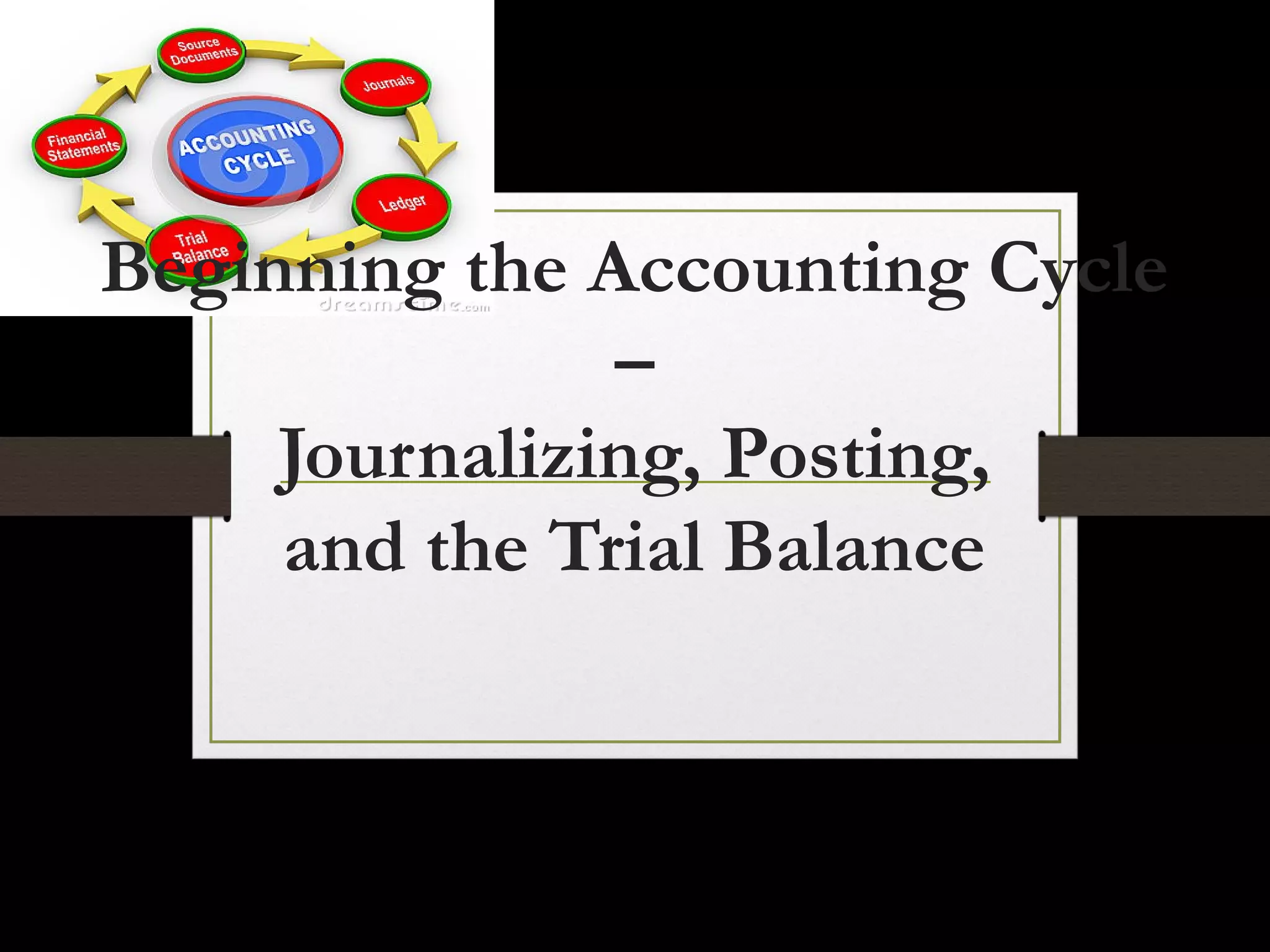
Beginning the Accounting Cycle 
– 
Journalizing, Posting, 
and the Trial Balance 
Nadia Danilova
Learning Objective 1 
Journalizing: analyzing and 
recording business 
transactions into a journal.
The Accounting Cycle 
• Accounting procedures are performed over a period of 
time. 
• Procedures are performed in a definite order in the 
accounting cycle. 
• The accounting period is a period of time covered by the 
income statement. 
• Usually this is a twelve month period. 
• The accounting cycle has sequential steps to be performed 
again each year.
The Accounting Cycle 
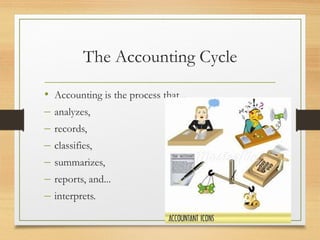
• Accounting is the process that... 
– analyzes, 
– records, 
– classifies, 
– summarizes, 
– reports, and... 
– interprets.
The Accounting Cycle 
A sole proprietorship: 
– has one owner 
– begins with a monthly accounting cycle 
– owner has a capital and withdrawals account
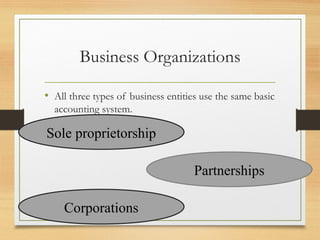
Business Organizations 
• All three types of business entities use the same basic 
accounting system. 
Sole proprietorship 
Partnerships 
Corporations
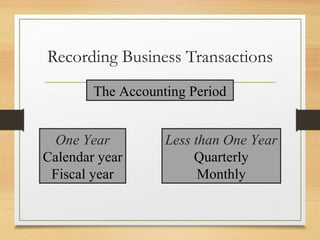
Recording Business Transactions 
The Accounting Period 
One Year 
Calendar year 
Fiscal year 
Less than One Year 
Quarterly 
Monthly
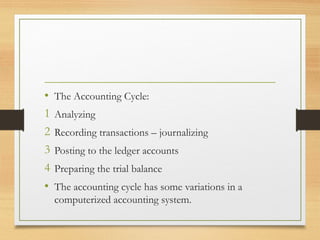
• The Accounting Cycle: 
1 Analyzing 
2 Recording transactions – journalizing 
3 Posting to the ledger accounts 
4 Preparing the trial balance 
• The accounting cycle has some variations in a 
computerized accounting system.
What is the general journal? 
• It is the book of original entry. 
• Transactions are written in a journal in chronological 
order. 
• The format of the journal is important. 
• Journalizing is the process of entering information as 
debits and credits to the correct accounts.
What is the general ledger? 
• It is the book of final entry. 
• The information from the journal is transferred to 
the ledger in the posting process. 
• Debits and credits in the journal remain exactly the 
same when posted to the accounts in the ledger.
What is the chart of accounts? 
• It is the list of accounts used by a business. 
• Each business entity has its unique chart of 
accounts. 
• Every chart of accounts has the same numbered 
account categories: 
– Assets, Liabilities, Owner’s Equity 
– Revenues, Expenses
Journalizing 
• Debits are always recorded first. 
• Indent, then record the credit below the debit. 
• A short explanation is included on the second line. 
• Leave a space between journal entries.
• Debits must always equal credits. 
• Amounts incurred for items that benefit future 
accounting periods are recorded as assets. 
• What are some examples? 
– prepaid rent 
– prepaid insurance
• Amounts for items used (expenses incurred) in the 
current accounting period are recorded as expenses. 
• What are some examples? 
– supplies used 
– rent for the month 
– expired insurance
• Amounts are recorded as revenue on the date in 
which they are earned. 
• When are revenues earned? 
• When services are performed, not necessarily when 
cash is paid.
Posting: transferring information 
from a journal to a ledger.
Posting 
• All transactions are recorded in the journal, then amounts 
are copied to the ledger accounts named on the journal 
line. 
• Once the amounts are entered into the accounts, a posting 
reference (PR) must be entered in the journal. 
• New balances are computed in the running ledger 
accounts.
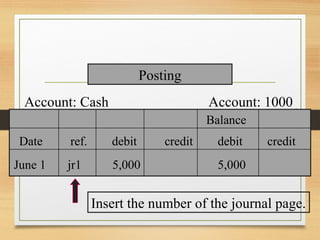
Posting 
Account: Cash Account: 1000 
Balance 
Date ref. debit credit debit credit 
June 1 jr1 5,000 5,000 
Insert the number of the journal page.
Preparing a trial balance.
Preparing the Trial Balance 
• The trial balance lists the accounts that have balances 
in the same order as they appear in the chart of 
accounts. 
• The trial balance will show if debits/credits have 
been interchanged, or if amounts have been 
transposed, or if a debit/credit was omitted or 
recorded twice.
• Some errors do not show, such as omissions or 
recording to the wrong account. 
• Corrections before posting are made in the journal. 
• An audit trail must be left. 
• Do not erase – cross out errors and enter 
corrections.
• What about corrections after posting? 
• This means that errors are also in the ledger 
accounts. 
• Cross out incorrect amounts, change to corrected 
amounts, and record balance changes.
Thank you

Данілова Н. Б 6 1

  • 1.
    Beginning the AccountingCycle – Journalizing, Posting, and the Trial Balance Nadia Danilova
  • 2.
    Learning Objective 1 Journalizing: analyzing and recording business transactions into a journal.
  • 3.
    The Accounting Cycle • Accounting procedures are performed over a period of time. • Procedures are performed in a definite order in the accounting cycle. • The accounting period is a period of time covered by the income statement. • Usually this is a twelve month period. • The accounting cycle has sequential steps to be performed again each year.
  • 4.
    The Accounting Cycle • Accounting is the process that... – analyzes, – records, – classifies, – summarizes, – reports, and... – interprets.
  • 5.
    The Accounting Cycle A sole proprietorship: – has one owner – begins with a monthly accounting cycle – owner has a capital and withdrawals account
  • 6.
    Business Organizations •All three types of business entities use the same basic accounting system. Sole proprietorship Partnerships Corporations
  • 7.
    Recording Business Transactions The Accounting Period One Year Calendar year Fiscal year Less than One Year Quarterly Monthly
  • 8.
    • The AccountingCycle: 1 Analyzing 2 Recording transactions – journalizing 3 Posting to the ledger accounts 4 Preparing the trial balance • The accounting cycle has some variations in a computerized accounting system.
  • 9.
    What is thegeneral journal? • It is the book of original entry. • Transactions are written in a journal in chronological order. • The format of the journal is important. • Journalizing is the process of entering information as debits and credits to the correct accounts.
  • 10.
    What is thegeneral ledger? • It is the book of final entry. • The information from the journal is transferred to the ledger in the posting process. • Debits and credits in the journal remain exactly the same when posted to the accounts in the ledger.
  • 11.
    What is thechart of accounts? • It is the list of accounts used by a business. • Each business entity has its unique chart of accounts. • Every chart of accounts has the same numbered account categories: – Assets, Liabilities, Owner’s Equity – Revenues, Expenses
  • 12.
    Journalizing • Debitsare always recorded first. • Indent, then record the credit below the debit. • A short explanation is included on the second line. • Leave a space between journal entries.
  • 13.
    • Debits mustalways equal credits. • Amounts incurred for items that benefit future accounting periods are recorded as assets. • What are some examples? – prepaid rent – prepaid insurance
  • 14.
    • Amounts foritems used (expenses incurred) in the current accounting period are recorded as expenses. • What are some examples? – supplies used – rent for the month – expired insurance
  • 15.
    • Amounts arerecorded as revenue on the date in which they are earned. • When are revenues earned? • When services are performed, not necessarily when cash is paid.
  • 16.
    Posting: transferring information from a journal to a ledger.
  • 17.
    Posting • Alltransactions are recorded in the journal, then amounts are copied to the ledger accounts named on the journal line. • Once the amounts are entered into the accounts, a posting reference (PR) must be entered in the journal. • New balances are computed in the running ledger accounts.
  • 18.
    Posting Account: CashAccount: 1000 Balance Date ref. debit credit debit credit June 1 jr1 5,000 5,000 Insert the number of the journal page.
  • 19.
  • 20.
    Preparing the TrialBalance • The trial balance lists the accounts that have balances in the same order as they appear in the chart of accounts. • The trial balance will show if debits/credits have been interchanged, or if amounts have been transposed, or if a debit/credit was omitted or recorded twice.
  • 21.
    • Some errorsdo not show, such as omissions or recording to the wrong account. • Corrections before posting are made in the journal. • An audit trail must be left. • Do not erase – cross out errors and enter corrections.
  • 22.
    • What aboutcorrections after posting? • This means that errors are also in the ledger accounts. • Cross out incorrect amounts, change to corrected amounts, and record balance changes.
  • 23.