ANABA FAROOQUI
SUBASH KUMAR
BAKHTAWAR NOOR
EBADULLAH KHAN
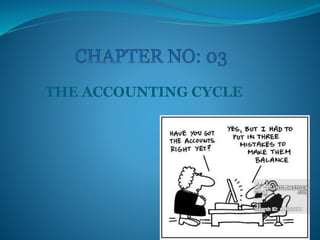
THE ACCOUNTING CYCLE
Accounting Cycle
● The sequence of accounting procedure used to
record classification and summarize accounting
information.
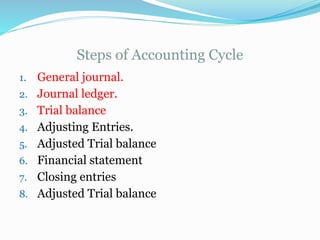
Steps of Accounting Cycle
1. General journal.
2. Journal ledger.
3. Trial balance
4. Adjusting Entries.
5. Adjusted Trial balance
6. Financial statement
7. Closing entries
8. Adjusted Trial balance
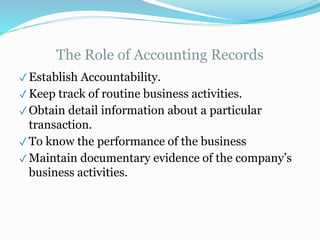
The Role of Accounting Records
✓ Establish Accountability.
✓ Keep track of routine business activities.
✓ Obtain detail information about a particular
transaction.
✓ To know the performance of the business
✓ Maintain documentary evidence of the company’s
business activities.
Debit Credit
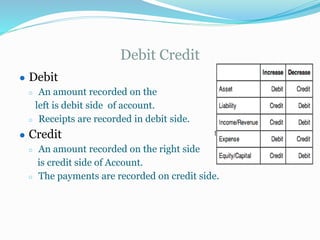
● Debit
○ An amount recorded on the
left is debit side of account.
○ Receipts are recorded in debit side.
● Credit
○ An amount recorded on the right side
is credit side of Account.
○ The payments are recorded on credit side.
Double-Entry Accounting
● Debit Credit
● Every transaction is recorded by equal dollar
amounts of debit credits.
● The reason for this lies in the relationship of the
debit and credit rules to accounting equation
○ Assets= liabilities + owner equity
● both side have equal effect.
Dividends
● Dividends is a distribution of assets by a
corporation to its share holders.
● Dividends reduce both asset and owner equity.
● Dividends are not expense and they are not
deducted from the revenue in the income
statement.
● Dividends are a distribution of profit among
shareholders.
General journal
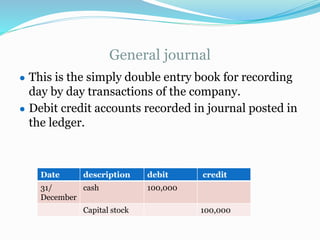
● This is the simply double entry book for recording
day by day transactions of the company.
● Debit credit accounts recorded in journal posted in
the ledger.
Date description debit credit
31/
December
cash 100,000
Capital stock 100,000
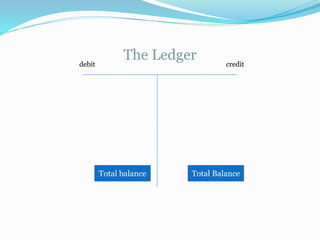
The Ledger
● An accounting system includes a separate record
for each item that appears in the financial
statements.
● The record used to keep track of the increase and
decrease in financial statement.
● Item is termed as a “ledger Account”.
The Ledger
Total BalanceTotal balance
debit credit
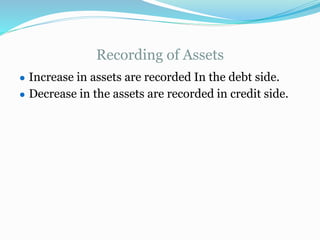
Recording of Assets
● Increase in assets are recorded In the debt side.
● Decrease in the assets are recorded in credit side.
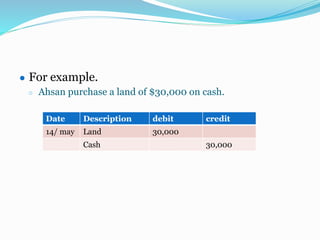
● For example.
○ Ahsan purchase a land of $30,000 on cash.
Date Description debit credit
14/ may Land 30,000
Cash 30,000
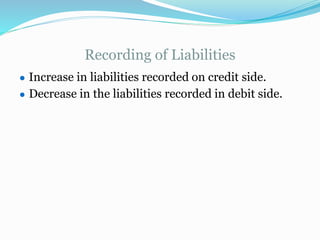
Recording of Liabilities
● Increase in liabilities recorded on credit side.
● Decrease in the liabilities recorded in debit side.
Examples increase in liabilities
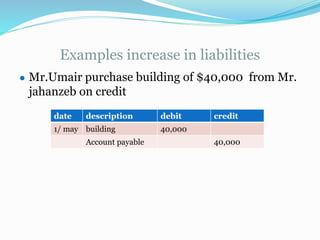
● Mr.Umair purchase building of $40,000 from Mr.
jahanzeb on credit
date description debit credit
1/ may building 40,000
Account payable 40,000
Example of decrease in liabilities
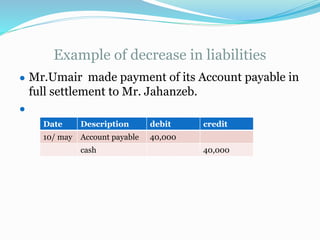
● Mr.Umair made payment of its Account payable in
full settlement to Mr. Jahanzeb.
●
Date Description debit credit
10/ may Account payable 40,000
cash 40,000
Recording of owner equity
● We record the owner equity same as liabilities.
● Increase in owner equity recorded on credit side.
● Decrease in the owner equity recorded in debit
side.
Example of journal and posting
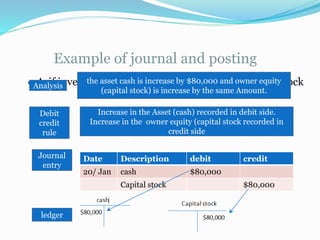
● Asif invested $80,000 cash in exchange for capital stockAnalysis
the asset cash is increase by $80,000 and owner equity
(capital stock) is increase by the same Amount.
Debit
credit
rule
Increase in the Asset (cash) recorded in debit side.
Increase in the owner equity (capital stock recorded in
credit side
Journal
entry
Date Description debit credit
20/ Jan cash $80,000
Capital stock $80,000
ledger
Net income and retained earnings
● Net income = Revenue – expenses
○ Net income is the total earning of the company
● Retained Earnings.
○ Retained Earnings represent the total net income of the
corporation over the entire lifetime of the business.
○ Retained earning= income – dividends.
Accounting period
● The period with reference to which Accounting
books of any entity are prepared.
● It is the period for which books are balanced and
financial statements are prepared.
● Generally, the Accounting period is consists of 12
months.
About revenue
● Revenue
○ Revenue is the price of goods sold and services rendered
during a given Accounting period.
○ Earning revenue increase owner equity.
● The realization principle: when revenue record:
○ Revenue should be record at the time of goods are sold or
services or rendered.
○ When action is performed.
About expenses
● Expenses:
○ Expenses are the cost of the goods and services used up in
the process of earning revenue.
● Matching principle: when to record expenses
○ the concept of offsetting expenses against revenue on a
basis of cause and effect in called matching principle.
Accrual basis of Accounting
● The policy of recognizing revenue in the accounting
records when it is earned and recognize expense
when related goods are services are used is called
accrual basis of accounting.
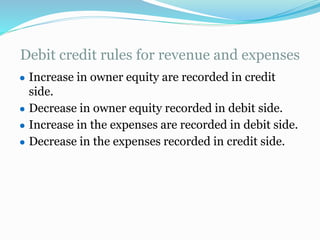
Debit credit rules for revenue and expenses
● Increase in owner equity are recorded in credit
side.
● Decrease in owner equity recorded in debit side.
● Increase in the expenses are recorded in debit side.
● Decrease in the expenses recorded in credit side.
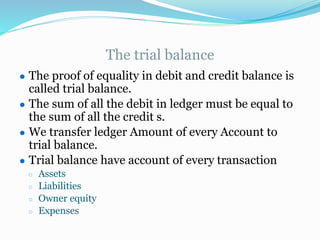
The trial balance
● The proof of equality in debit and credit balance is
called trial balance.
● The sum of all the debit in ledger must be equal to
the sum of all the credit s.
● We transfer ledger Amount of every Account to
trial balance.
● Trial balance have account of every transaction
○ Assets
○ Liabilities
○ Owner equity
○ Expenses
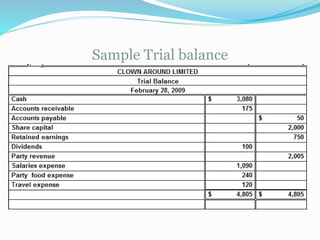
Sample Trial balance
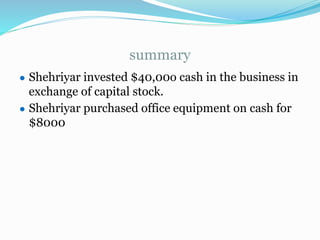
summary
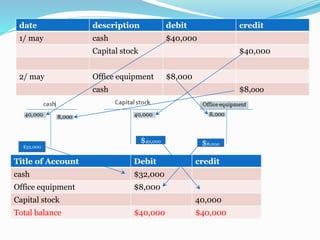
● Shehriyar invested $40,00o cash in the business in
exchange of capital stock.
● Shehriyar purchased office equipment on cash for
$8000
date description debit credit
1/ may cash $40,000
Capital stock $40,000
2/ may Office equipment $8,000
cash $8,ooo
$32,000
$40,000
$8,000
Title of Account Debit credit
cash $32,000
Office equipment $8,000
Capital stock 40,000
Total balance $40,000 $40,000
ONE BY ONE ASK QUESTIONS
TRY TO BE SPECIFIC AND RELEVANT
Chapter 3: Accounting Cycle (William Hawka)

Chapter 3: Accounting Cycle (William Hawka)

  • 2.
  • 3.
  • 4.
    Accounting Cycle ● Thesequence of accounting procedure used to record classification and summarize accounting information.
  • 5.
    Steps of AccountingCycle 1. General journal. 2. Journal ledger. 3. Trial balance 4. Adjusting Entries. 5. Adjusted Trial balance 6. Financial statement 7. Closing entries 8. Adjusted Trial balance
  • 6.
    The Role ofAccounting Records ✓ Establish Accountability. ✓ Keep track of routine business activities. ✓ Obtain detail information about a particular transaction. ✓ To know the performance of the business ✓ Maintain documentary evidence of the company’s business activities.
  • 7.
    Debit Credit ● Debit ○An amount recorded on the left is debit side of account. ○ Receipts are recorded in debit side. ● Credit ○ An amount recorded on the right side is credit side of Account. ○ The payments are recorded on credit side.
  • 8.
    Double-Entry Accounting ● DebitCredit ● Every transaction is recorded by equal dollar amounts of debit credits. ● The reason for this lies in the relationship of the debit and credit rules to accounting equation ○ Assets= liabilities + owner equity ● both side have equal effect.
  • 9.
    Dividends ● Dividends isa distribution of assets by a corporation to its share holders. ● Dividends reduce both asset and owner equity. ● Dividends are not expense and they are not deducted from the revenue in the income statement. ● Dividends are a distribution of profit among shareholders.
  • 10.
    General journal ● Thisis the simply double entry book for recording day by day transactions of the company. ● Debit credit accounts recorded in journal posted in the ledger. Date description debit credit 31/ December cash 100,000 Capital stock 100,000
  • 11.
    The Ledger ● Anaccounting system includes a separate record for each item that appears in the financial statements. ● The record used to keep track of the increase and decrease in financial statement. ● Item is termed as a “ledger Account”.
  • 12.
    The Ledger Total BalanceTotalbalance debit credit
  • 13.
    Recording of Assets ●Increase in assets are recorded In the debt side. ● Decrease in the assets are recorded in credit side.
  • 14.
    ● For example. ○Ahsan purchase a land of $30,000 on cash. Date Description debit credit 14/ may Land 30,000 Cash 30,000
  • 15.
    Recording of Liabilities ●Increase in liabilities recorded on credit side. ● Decrease in the liabilities recorded in debit side.
  • 16.
    Examples increase inliabilities ● Mr.Umair purchase building of $40,000 from Mr. jahanzeb on credit date description debit credit 1/ may building 40,000 Account payable 40,000
  • 17.
    Example of decreasein liabilities ● Mr.Umair made payment of its Account payable in full settlement to Mr. Jahanzeb. ● Date Description debit credit 10/ may Account payable 40,000 cash 40,000
  • 18.
    Recording of ownerequity ● We record the owner equity same as liabilities. ● Increase in owner equity recorded on credit side. ● Decrease in the owner equity recorded in debit side.
  • 19.
    Example of journaland posting ● Asif invested $80,000 cash in exchange for capital stockAnalysis the asset cash is increase by $80,000 and owner equity (capital stock) is increase by the same Amount. Debit credit rule Increase in the Asset (cash) recorded in debit side. Increase in the owner equity (capital stock recorded in credit side Journal entry Date Description debit credit 20/ Jan cash $80,000 Capital stock $80,000 ledger
  • 20.
    Net income andretained earnings ● Net income = Revenue – expenses ○ Net income is the total earning of the company ● Retained Earnings. ○ Retained Earnings represent the total net income of the corporation over the entire lifetime of the business. ○ Retained earning= income – dividends.
  • 21.
    Accounting period ● Theperiod with reference to which Accounting books of any entity are prepared. ● It is the period for which books are balanced and financial statements are prepared. ● Generally, the Accounting period is consists of 12 months.
  • 22.
    About revenue ● Revenue ○Revenue is the price of goods sold and services rendered during a given Accounting period. ○ Earning revenue increase owner equity. ● The realization principle: when revenue record: ○ Revenue should be record at the time of goods are sold or services or rendered. ○ When action is performed.
  • 23.
    About expenses ● Expenses: ○Expenses are the cost of the goods and services used up in the process of earning revenue. ● Matching principle: when to record expenses ○ the concept of offsetting expenses against revenue on a basis of cause and effect in called matching principle.
  • 24.
    Accrual basis ofAccounting ● The policy of recognizing revenue in the accounting records when it is earned and recognize expense when related goods are services are used is called accrual basis of accounting.
  • 25.
    Debit credit rulesfor revenue and expenses ● Increase in owner equity are recorded in credit side. ● Decrease in owner equity recorded in debit side. ● Increase in the expenses are recorded in debit side. ● Decrease in the expenses recorded in credit side.
  • 26.
    The trial balance ●The proof of equality in debit and credit balance is called trial balance. ● The sum of all the debit in ledger must be equal to the sum of all the credit s. ● We transfer ledger Amount of every Account to trial balance. ● Trial balance have account of every transaction ○ Assets ○ Liabilities ○ Owner equity ○ Expenses
  • 27.
  • 28.
    summary ● Shehriyar invested$40,00o cash in the business in exchange of capital stock. ● Shehriyar purchased office equipment on cash for $8000
  • 29.
    date description debitcredit 1/ may cash $40,000 Capital stock $40,000 2/ may Office equipment $8,000 cash $8,ooo $32,000 $40,000 $8,000 Title of Account Debit credit cash $32,000 Office equipment $8,000 Capital stock 40,000 Total balance $40,000 $40,000
  • 31.
    ONE BY ONEASK QUESTIONS TRY TO BE SPECIFIC AND RELEVANT