SHAHNEEL SIDDIQUI
SHAHNEEL KHAN
SHAHBAZ NAREJO
CHAPTER: 05
THE ACCOUNTING CYCLE
Reporting Financial Results
• Review of 2 Basic Financial Statements
Balance Sheet
Income Statement
• Statement of Retained Earnings
• Temporary and Permanent Accounts
• Closing Entries
• Closing Temporary Accounts
Closing Revenue accounts to Income Summary.
Closing Expense accounts to Income Summary.
Closing Income Summary account to Retained Earnings.
Closing Dividends to Retained Earnings
• Evaluating Business
Evaluating Liquidity
Evaluating Profitability
• Problems
Contents
• Balance Sheet
A financial statement that summarizes a company's assets, liabilities and shareholders' equity at a specific
point in time.
(𝐴𝑠𝑠𝑒𝑡𝑠 = 𝐿𝑖𝑎𝑏𝑖𝑙𝑖𝑡𝑖𝑒𝑠 + 𝑂𝑤𝑛𝑒𝑟𝑠 𝐸𝑞𝑢𝑖𝑡𝑦)
• Income Statement
It gives a summary of how the business incurs its revenues and expenses through both operating and non-
operating activities. It also shows the net profit or loss incurred over a specific accounting period.
(𝑁𝑒𝑡 𝐼𝑛𝑐𝑜𝑚𝑒 = 𝑅𝑒𝑣𝑒𝑛𝑢𝑒 – 𝐸𝑥𝑝𝑒𝑛𝑠𝑒𝑠)
Review of 2 Basic Financial Statements
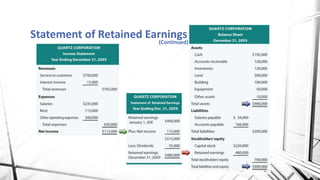
• Retained earnings is that portion of stockholders’ (owners’) equity created by
earning net income and retaining the related resources in the business.
• The statement of retained earnings summarizes the increases and decreases in
retained earnings resulting from business operations during the period.
• Increases in retained earnings result from earning net income; decreases result
from net losses and from the declaration of dividends
• The ending retained earnings appears at the bottom of the statement and also in
the company’s year-end balance sheet.
Statement of Retained Earnings
(Continued)
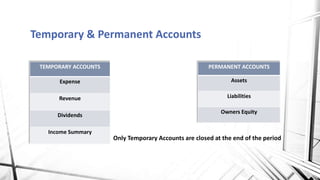
Temporary & Permanent Accounts
TEMPORARY ACCOUNTS
Expense
Revenue
Dividends
Income Summary
PERMANENT ACCOUNTS
Assets
Liabilities
Owners Equity
Only Temporary Accounts are closed at the end of the period
Closing Entries (Introduction)
• Closing entries are journal entries used to empty temporary accounts at the
end of a reporting period and transfer their balances into permanent accounts.
• The closing entries are recorded after the financial statements for the
accounting year are prepared.
• The reason for the closing entries is to ensure that each revenue and expense
account will begin the next accounting year with a zero balance.
• The objective is to get the account balance to be zero.
• There are four closing entries, which transfer all temporary account balances to
the owner's capital account.
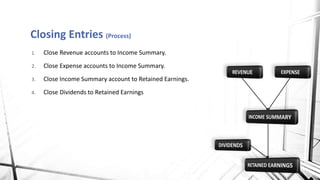
1. Close Revenue accounts to Income Summary.
2. Close Expense accounts to Income Summary.
3. Close Income Summary account to Retained Earnings.
4. Close Dividends to Retained Earnings
Closing Entries (Process)
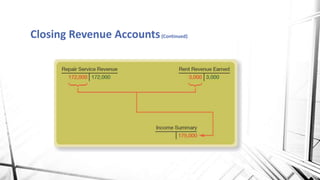
• Revenue accounts have credit balances.
• Closing a revenue account means transferring its credit balance to the Income
Summary account.
• This transfer is accomplished by a journal entry debiting the revenue account in
an amount equal to its credit balance, with an offsetting credit to the Income
Summary account.
• The debit portion of this closing entry returns the balance of the revenue
account to zero.
• the credit portion transfers the former balance of the revenue account into the
Income Summary account.
Closing Revenue Accounts
Closing Revenue Accounts(Continued)
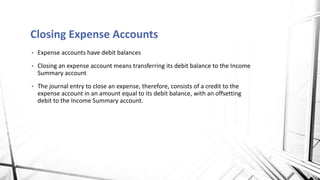
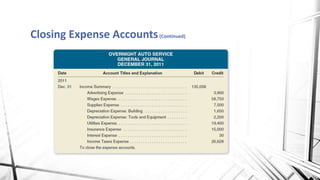
• Expense accounts have debit balances
• Closing an expense account means transferring its debit balance to the Income
Summary account
• The journal entry to close an expense, therefore, consists of a credit to the
expense account in an amount equal to its debit balance, with an offsetting
debit to the Income Summary account.
Closing Expense Accounts
Closing Expense Accounts(Continued)
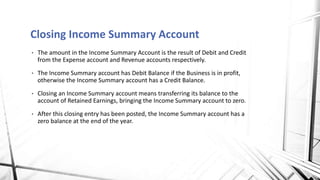
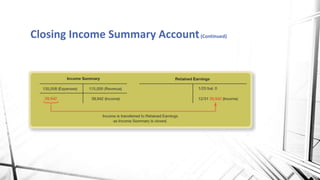
• The amount in the Income Summary Account is the result of Debit and Credit
from the Expense account and Revenue accounts respectively.
• The Income Summary account has Debit Balance if the Business is in profit,
otherwise the Income Summary account has a Credit Balance.
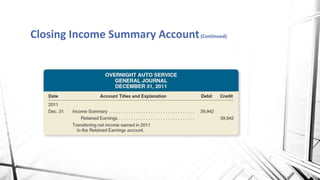
• Closing an Income Summary account means transferring its balance to the
account of Retained Earnings, bringing the Income Summary account to zero.
• After this closing entry has been posted, the Income Summary account has a
zero balance at the end of the year.
Closing Income Summary Account
Closing Income Summary Account(Continued)
• Dividends to stockholders are not considered an expense of the business;
therefore, they are not taken into account in determining net income for the
period.
• Since dividends are not an expense, the Dividends account is not closed to the
Income Summary account.
• Instead, it is closed directly to the Retained Earnings account.
• Since dividends have a natural debit balance, So they are credited from the
dividends account, and are debited to the account of Retained Earnings
Closing Dividends Account
Closing Dividends Account(Continued)
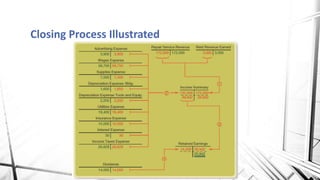
1. Closing the various revenue accounts and transferring their balances to the
Income Summary account.
2. Closing the various expense accounts and transferring their balances to the
Income Summary account.
3. Closing the Income Summary account and transferring its balance to the
Retained Earnings account.
4. Closing the Dividends account and transferring its balance to the Retained
Earnings account.
Summary of Closing Process
Closing Process Illustrated
Evaluating The
Business
• Liquidity ratios attempt to measure a company's ability to pay off its short-term
debt obligations.
• This is done by comparing a company's most liquid assets with its short-term
liabilities.
• The greater the coverage of liquid assets to short-term liabilities, the better a
company can pay its debts that are coming due in the near future.
• A company with a low coverage rate should raise a red flag for investors as it
may be a sign that the company will have difficulty meeting running its
operations, as well as meeting its obligations.
Evaluating Liquidity
𝐶𝑢𝑟𝑟𝑒𝑛𝑡 𝑅𝑎𝑡𝑖𝑜 = 𝐶𝑢𝑟𝑟𝑒𝑛𝑡 𝐴𝑠𝑠𝑒𝑡𝑠
𝐶𝑢𝑟𝑟𝑒𝑛𝑡 𝐿𝑖𝑎𝑏𝑖𝑙𝑖𝑡𝑒𝑠
Evaluating Liquidity(Continued)
𝑊𝑜𝑟𝑘𝑖𝑛𝑔 𝐶𝑎𝑝𝑖𝑡𝑎𝑙 = 𝐶𝑢𝑟𝑟𝑒𝑛𝑡 𝐴𝑠𝑠𝑒𝑡𝑠 − 𝐶𝑢𝑟𝑟𝑒𝑛𝑡 𝐿𝑖𝑎𝑏𝑖𝑙𝑖𝑡𝑖𝑒𝑠
• Profit is what is left over from income earned after you have deducted all costs
and expenses related to earning the income
• Profitability ratios compare income statement accounts and categories to show
a company's ability to generate profits from its operations
• Return on equity measures how much a company makes for each dollar that
investors put into it
• Net Income reveals the remaining profit after all costs of production,
administration, and financing have been deducted from sales, and income taxes
recognized
Evaluating Profitability
Evaluating Profitability (Continued)
𝑁𝑒𝑡 𝐼𝑛𝑐𝑜𝑚𝑒 % = 𝑁𝑒𝑡 𝐼𝑛𝑐𝑜𝑚𝑒
𝑇𝑜𝑡𝑎𝑙 𝑅𝑒𝑣𝑒𝑛𝑢𝑒
× 100
𝑅𝑒𝑡𝑢𝑟𝑛 𝑜𝑛 𝐸𝑞𝑢𝑖𝑡𝑦 = 𝑁𝑒𝑡 𝐼𝑛𝑐𝑜𝑚𝑒
𝐴𝑣𝑔. 𝑆ℎ𝑎𝑟𝑒ℎ𝑜𝑙𝑑𝑒𝑟𝑠 𝐸𝑞𝑢𝑖𝑡𝑦
× 100
Problems
Problem: 01
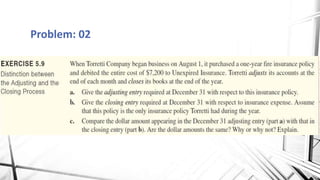
Problem: 02
Problem: 03
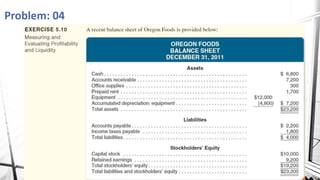
Problem: 04
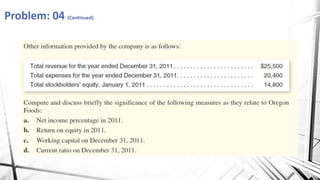
Problem: 04 (Continued)
END OF CHAPTER: 05
THANK YOU !
QUESTIONS ARE VERY MUCH
WELCOMED


The accounting cycle

  • 1.
    SHAHNEEL SIDDIQUI SHAHNEEL KHAN SHAHBAZNAREJO CHAPTER: 05 THE ACCOUNTING CYCLE Reporting Financial Results
  • 2.
    • Review of2 Basic Financial Statements Balance Sheet Income Statement • Statement of Retained Earnings • Temporary and Permanent Accounts • Closing Entries • Closing Temporary Accounts Closing Revenue accounts to Income Summary. Closing Expense accounts to Income Summary. Closing Income Summary account to Retained Earnings. Closing Dividends to Retained Earnings • Evaluating Business Evaluating Liquidity Evaluating Profitability • Problems Contents
  • 3.
    • Balance Sheet Afinancial statement that summarizes a company's assets, liabilities and shareholders' equity at a specific point in time. (𝐴𝑠𝑠𝑒𝑡𝑠 = 𝐿𝑖𝑎𝑏𝑖𝑙𝑖𝑡𝑖𝑒𝑠 + 𝑂𝑤𝑛𝑒𝑟𝑠 𝐸𝑞𝑢𝑖𝑡𝑦) • Income Statement It gives a summary of how the business incurs its revenues and expenses through both operating and non- operating activities. It also shows the net profit or loss incurred over a specific accounting period. (𝑁𝑒𝑡 𝐼𝑛𝑐𝑜𝑚𝑒 = 𝑅𝑒𝑣𝑒𝑛𝑢𝑒 – 𝐸𝑥𝑝𝑒𝑛𝑠𝑒𝑠) Review of 2 Basic Financial Statements
  • 4.
    • Retained earningsis that portion of stockholders’ (owners’) equity created by earning net income and retaining the related resources in the business. • The statement of retained earnings summarizes the increases and decreases in retained earnings resulting from business operations during the period. • Increases in retained earnings result from earning net income; decreases result from net losses and from the declaration of dividends • The ending retained earnings appears at the bottom of the statement and also in the company’s year-end balance sheet. Statement of Retained Earnings
  • 5.
    Statement of RetainedEarnings (Continued)
  • 6.
    Temporary & PermanentAccounts TEMPORARY ACCOUNTS Expense Revenue Dividends Income Summary PERMANENT ACCOUNTS Assets Liabilities Owners Equity Only Temporary Accounts are closed at the end of the period
  • 7.
    Closing Entries (Introduction) •Closing entries are journal entries used to empty temporary accounts at the end of a reporting period and transfer their balances into permanent accounts. • The closing entries are recorded after the financial statements for the accounting year are prepared. • The reason for the closing entries is to ensure that each revenue and expense account will begin the next accounting year with a zero balance. • The objective is to get the account balance to be zero. • There are four closing entries, which transfer all temporary account balances to the owner's capital account.
  • 8.
    1. Close Revenueaccounts to Income Summary. 2. Close Expense accounts to Income Summary. 3. Close Income Summary account to Retained Earnings. 4. Close Dividends to Retained Earnings Closing Entries (Process)
  • 9.
    • Revenue accountshave credit balances. • Closing a revenue account means transferring its credit balance to the Income Summary account. • This transfer is accomplished by a journal entry debiting the revenue account in an amount equal to its credit balance, with an offsetting credit to the Income Summary account. • The debit portion of this closing entry returns the balance of the revenue account to zero. • the credit portion transfers the former balance of the revenue account into the Income Summary account. Closing Revenue Accounts
  • 10.
  • 11.
  • 12.
    • Expense accountshave debit balances • Closing an expense account means transferring its debit balance to the Income Summary account • The journal entry to close an expense, therefore, consists of a credit to the expense account in an amount equal to its debit balance, with an offsetting debit to the Income Summary account. Closing Expense Accounts
  • 13.
  • 14.
  • 15.
    • The amountin the Income Summary Account is the result of Debit and Credit from the Expense account and Revenue accounts respectively. • The Income Summary account has Debit Balance if the Business is in profit, otherwise the Income Summary account has a Credit Balance. • Closing an Income Summary account means transferring its balance to the account of Retained Earnings, bringing the Income Summary account to zero. • After this closing entry has been posted, the Income Summary account has a zero balance at the end of the year. Closing Income Summary Account
  • 16.
    Closing Income SummaryAccount(Continued)
  • 17.
    Closing Income SummaryAccount(Continued)
  • 18.
    • Dividends tostockholders are not considered an expense of the business; therefore, they are not taken into account in determining net income for the period. • Since dividends are not an expense, the Dividends account is not closed to the Income Summary account. • Instead, it is closed directly to the Retained Earnings account. • Since dividends have a natural debit balance, So they are credited from the dividends account, and are debited to the account of Retained Earnings Closing Dividends Account
  • 19.
  • 20.
  • 21.
    1. Closing thevarious revenue accounts and transferring their balances to the Income Summary account. 2. Closing the various expense accounts and transferring their balances to the Income Summary account. 3. Closing the Income Summary account and transferring its balance to the Retained Earnings account. 4. Closing the Dividends account and transferring its balance to the Retained Earnings account. Summary of Closing Process
  • 22.
  • 23.
  • 24.
    • Liquidity ratiosattempt to measure a company's ability to pay off its short-term debt obligations. • This is done by comparing a company's most liquid assets with its short-term liabilities. • The greater the coverage of liquid assets to short-term liabilities, the better a company can pay its debts that are coming due in the near future. • A company with a low coverage rate should raise a red flag for investors as it may be a sign that the company will have difficulty meeting running its operations, as well as meeting its obligations. Evaluating Liquidity
  • 25.
    𝐶𝑢𝑟𝑟𝑒𝑛𝑡 𝑅𝑎𝑡𝑖𝑜 =𝐶𝑢𝑟𝑟𝑒𝑛𝑡 𝐴𝑠𝑠𝑒𝑡𝑠 𝐶𝑢𝑟𝑟𝑒𝑛𝑡 𝐿𝑖𝑎𝑏𝑖𝑙𝑖𝑡𝑒𝑠 Evaluating Liquidity(Continued) 𝑊𝑜𝑟𝑘𝑖𝑛𝑔 𝐶𝑎𝑝𝑖𝑡𝑎𝑙 = 𝐶𝑢𝑟𝑟𝑒𝑛𝑡 𝐴𝑠𝑠𝑒𝑡𝑠 − 𝐶𝑢𝑟𝑟𝑒𝑛𝑡 𝐿𝑖𝑎𝑏𝑖𝑙𝑖𝑡𝑖𝑒𝑠
  • 26.
    • Profit iswhat is left over from income earned after you have deducted all costs and expenses related to earning the income • Profitability ratios compare income statement accounts and categories to show a company's ability to generate profits from its operations • Return on equity measures how much a company makes for each dollar that investors put into it • Net Income reveals the remaining profit after all costs of production, administration, and financing have been deducted from sales, and income taxes recognized Evaluating Profitability
  • 27.
    Evaluating Profitability (Continued) 𝑁𝑒𝑡𝐼𝑛𝑐𝑜𝑚𝑒 % = 𝑁𝑒𝑡 𝐼𝑛𝑐𝑜𝑚𝑒 𝑇𝑜𝑡𝑎𝑙 𝑅𝑒𝑣𝑒𝑛𝑢𝑒 × 100 𝑅𝑒𝑡𝑢𝑟𝑛 𝑜𝑛 𝐸𝑞𝑢𝑖𝑡𝑦 = 𝑁𝑒𝑡 𝐼𝑛𝑐𝑜𝑚𝑒 𝐴𝑣𝑔. 𝑆ℎ𝑎𝑟𝑒ℎ𝑜𝑙𝑑𝑒𝑟𝑠 𝐸𝑞𝑢𝑖𝑡𝑦 × 100
  • 28.
  • 29.
  • 30.
  • 31.
  • 32.
  • 33.
  • 34.
    END OF CHAPTER:05 THANK YOU ! QUESTIONS ARE VERY MUCH WELCOMED 