Financial Statements
Introduction
• Basic knowledge of accounting and financial
  statements necessary for a chemical professional.
• This will help:
  – Analyze a firm’s operations.
  – Discover whether the firm is making a profit, and
  – Whether the firm will continue making a profit
• Financial reports are important sources of data.
• A general knowledge of accounting helps an
  engineer communicate with accountants,
  financial personnel and managers.
Journal and Legder
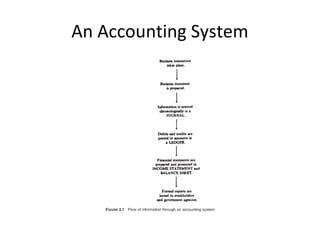
• Accounting systems have as inputs business
  transactions in the form of receipts and invoices.
• These events are entered chronologically in a
  journal.
• These are then classified and posted in an
  appropriate account in a ledger.
• Periodically – monthly or yearly – accounts are
  closed and a summary is issued as an income
  statement and a balance sheet.
An Accounting System
The Accounting Equation
•   Accounting methods in use today had their origin in 14 th century Italy.
•   A development was the double-entry bookkeeping system which states:
     – Assets = Equities
•   Assets: the economic resources a company owns and which are expected
    to benefit future operations.
• Tangible assets:
     – Equipment
     – Buildings
     – Furniture
• Intangible assets:
     – Franchises
     – Patents
     – Trademarks
The Accounting Equation
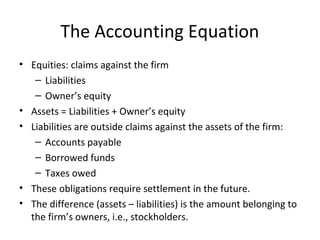
• Equities: claims against the firm
   – Liabilities
   – Owner’s equity
• Assets = Liabilities + Owner’s equity
• Liabilities are outside claims against the assets of the firm:
   – Accounts payable
   – Borrowed funds
   – Taxes owed
• These obligations require settlement in the future.
• The difference (assets – liabilities) is the amount belonging to
  the firm’s owners, i.e., stockholders.
The Accounting Equation
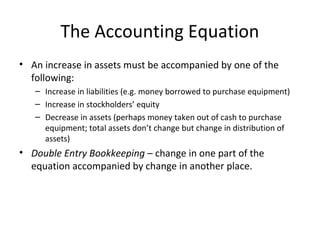
• An increase in assets must be accompanied by one of the
  following:
   – Increase in liabilities (e.g. money borrowed to purchase equipment)
   – Increase in stockholders’ equity
   – Decrease in assets (perhaps money taken out of cash to purchase
     equipment; total assets don’t change but change in distribution of
     assets)
• Double Entry Bookkeeping – change in one part of the
  equation accompanied by change in another place.
The Accounting Equation
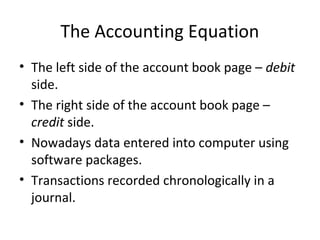
• The left side of the account book page – debit
  side.
• The right side of the account book page –
  credit side.
• Nowadays data entered into computer using
  software packages.
• Transactions recorded chronologically in a
  journal.
Debit and Credit
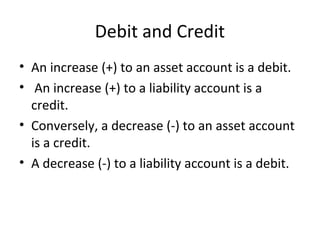
• An increase (+) to an asset account is a debit.
• An increase (+) to a liability account is a
  credit.
• Conversely, a decrease (-) to an asset account
  is a credit.
• A decrease (-) to a liability account is a debit.
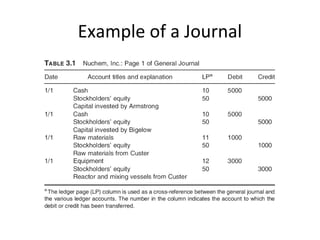
Example of a Journal
The Ledger
•   Journal entries are transferred to a ledger, via a process called posting.
•   Separate ledger accounts for each major type of transactions, e.g.,
     –   Asset account
     –   Liability account
     –   Revenue account
     –   Expense account
•   Each debit entry to a ledger account is matched by a credit entry to
    another account.
•   One-to-one correspondence between journal entries and ledger entries –
    hence the term double-entry bookkeeping.
•   The ledger page (LP) is the cross-reference.
The Ledger
• Periodically the ledger sheets are closed and
  balanced.
• Various reports made.
• A consolidated income statement can be
  prepared from the ledger revenue and
  expense account.
• From the asset and liability accounts, a
  company’s balance sheet is prepared.
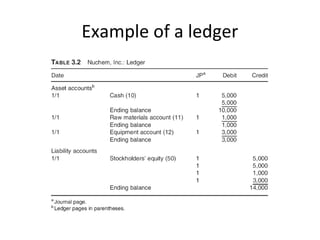
Example of a ledger
Journal and Ledger Example
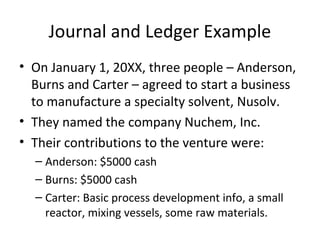
• On January 1, 20XX, three people – Anderson,
  Burns and Carter – agreed to start a business
  to manufacture a specialty solvent, Nusolv.
• They named the company Nuchem, Inc.
• Their contributions to the venture were:
  – Anderson: $5000 cash
  – Burns: $5000 cash
  – Carter: Basic process development info, a small
    reactor, mixing vessels, some raw materials.
Journal and Ledger Example
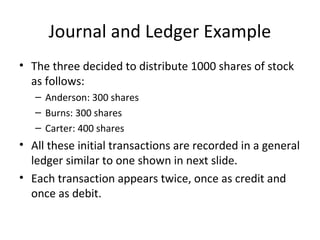
• The three decided to distribute 1000 shares of stock
  as follows:
   – Anderson: 300 shares
   – Burns: 300 shares
   – Carter: 400 shares
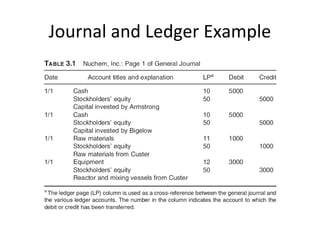
• All these initial transactions are recorded in a general
  ledger similar to one shown in next slide.
• Each transaction appears twice, once as credit and
  once as debit.
Journal and Ledger Example
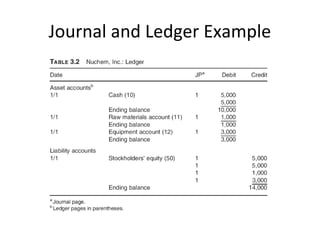
• A ledger set up to record the transactions of
  Jan 1, 20XX is shown in next slide.
• Note that initially Nuchem, Inc. required only
  asset and liability accounts.
• However, as the firm grows, more accounts
  are to be established to record business
  transactions.
Journal and Ledger Example
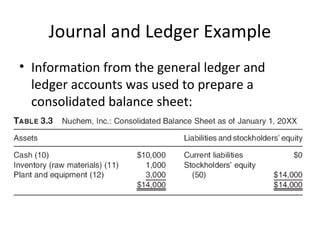
• Information from the general ledger and
  ledger accounts was used to prepare a
  consolidated balance sheet:
Journal and Ledger Example
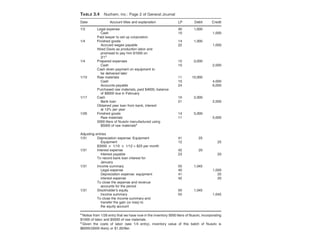
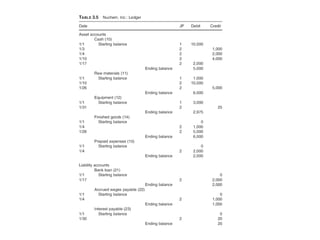
• During the month of January, manufacturing began.
• New asset and liability accounts were created to
  accommodate new types of transactions.
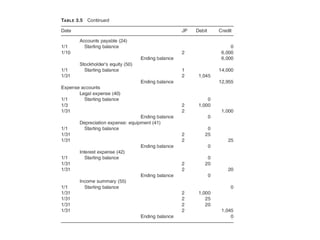
• Temporary revenue and expense accounts used to
  classify changes.
• Expense accounts: legal expense (40), depreciation
  expense (41), interest expense (42).
• Revenue account not needed in January because
  there was no income.
Journal and Ledger Example
• The balance of revenue and expense accounts
  is reduced to zero through an income
  summary account at the end of the month.
• The ledger for the month of January is shown
  in next slide.
Journal and Ledger Example
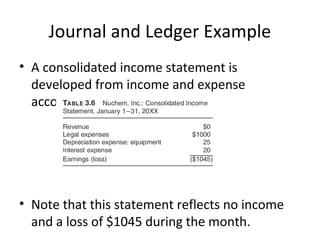
• A consolidated income statement is
  developed from income and expense
  accounts:


• Note that this statement reflects no income
  and a loss of $1045 during the month.
Journal and Ledger Example
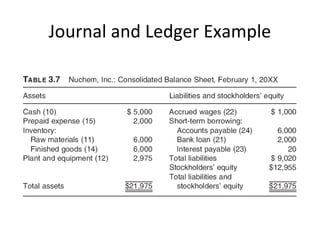
• The next slide shows the consolidated balance
  sheet as of February 1, 20XX.
• Comparing this with the January 1, 20XX
  balance sheet, we find that the stockholders’
  equity decreased on the February statement.
• This reflects the $1045 loss during January.
Journal and Ledger Example
• The same procedure can be followed month after
  month.
• Each transaction will be entered in the general
  journal and then posted to the appropriate ledger
  account.
• At the end of each month, an income statement and
  balance sheet may be prepared.
• In this manner, information for an annual report is
  assembled.
Additional Points
• Today, transactions are entered into a computer program.
• Manual ledgers are no longer kept in modern business firms.
• These are the “traditional” methods of cost/ managerial
  accounting.
• They help finance departments monitor operations and value
  inventory.
• But focus is more on direct costs.
• New tools have come which also look into indirect expenses
  of a production unit or of a service.
• This will give a better picture of the “real” expenses.

Winsem2012 13 cp1056-10-jan-2013_rm01_lecture-3---financial-statements

  • 1.
  • 2.
    Introduction • Basic knowledgeof accounting and financial statements necessary for a chemical professional. • This will help: – Analyze a firm’s operations. – Discover whether the firm is making a profit, and – Whether the firm will continue making a profit • Financial reports are important sources of data. • A general knowledge of accounting helps an engineer communicate with accountants, financial personnel and managers.
  • 3.
    Journal and Legder •Accounting systems have as inputs business transactions in the form of receipts and invoices. • These events are entered chronologically in a journal. • These are then classified and posted in an appropriate account in a ledger. • Periodically – monthly or yearly – accounts are closed and a summary is issued as an income statement and a balance sheet.
  • 4.
  • 5.
    The Accounting Equation • Accounting methods in use today had their origin in 14 th century Italy. • A development was the double-entry bookkeeping system which states: – Assets = Equities • Assets: the economic resources a company owns and which are expected to benefit future operations. • Tangible assets: – Equipment – Buildings – Furniture • Intangible assets: – Franchises – Patents – Trademarks
  • 6.
    The Accounting Equation •Equities: claims against the firm – Liabilities – Owner’s equity • Assets = Liabilities + Owner’s equity • Liabilities are outside claims against the assets of the firm: – Accounts payable – Borrowed funds – Taxes owed • These obligations require settlement in the future. • The difference (assets – liabilities) is the amount belonging to the firm’s owners, i.e., stockholders.
  • 7.
    The Accounting Equation •An increase in assets must be accompanied by one of the following: – Increase in liabilities (e.g. money borrowed to purchase equipment) – Increase in stockholders’ equity – Decrease in assets (perhaps money taken out of cash to purchase equipment; total assets don’t change but change in distribution of assets) • Double Entry Bookkeeping – change in one part of the equation accompanied by change in another place.
  • 8.
    The Accounting Equation •The left side of the account book page – debit side. • The right side of the account book page – credit side. • Nowadays data entered into computer using software packages. • Transactions recorded chronologically in a journal.
  • 9.
    Debit and Credit •An increase (+) to an asset account is a debit. • An increase (+) to a liability account is a credit. • Conversely, a decrease (-) to an asset account is a credit. • A decrease (-) to a liability account is a debit.
  • 10.
    Example of aJournal
  • 11.
    The Ledger • Journal entries are transferred to a ledger, via a process called posting. • Separate ledger accounts for each major type of transactions, e.g., – Asset account – Liability account – Revenue account – Expense account • Each debit entry to a ledger account is matched by a credit entry to another account. • One-to-one correspondence between journal entries and ledger entries – hence the term double-entry bookkeeping. • The ledger page (LP) is the cross-reference.
  • 12.
    The Ledger • Periodicallythe ledger sheets are closed and balanced. • Various reports made. • A consolidated income statement can be prepared from the ledger revenue and expense account. • From the asset and liability accounts, a company’s balance sheet is prepared.
  • 13.
  • 14.
    Journal and LedgerExample • On January 1, 20XX, three people – Anderson, Burns and Carter – agreed to start a business to manufacture a specialty solvent, Nusolv. • They named the company Nuchem, Inc. • Their contributions to the venture were: – Anderson: $5000 cash – Burns: $5000 cash – Carter: Basic process development info, a small reactor, mixing vessels, some raw materials.
  • 15.
    Journal and LedgerExample • The three decided to distribute 1000 shares of stock as follows: – Anderson: 300 shares – Burns: 300 shares – Carter: 400 shares • All these initial transactions are recorded in a general ledger similar to one shown in next slide. • Each transaction appears twice, once as credit and once as debit.
  • 16.
  • 17.
    Journal and LedgerExample • A ledger set up to record the transactions of Jan 1, 20XX is shown in next slide. • Note that initially Nuchem, Inc. required only asset and liability accounts. • However, as the firm grows, more accounts are to be established to record business transactions.
  • 18.
  • 19.
    Journal and LedgerExample • Information from the general ledger and ledger accounts was used to prepare a consolidated balance sheet:
  • 20.
    Journal and LedgerExample • During the month of January, manufacturing began. • New asset and liability accounts were created to accommodate new types of transactions. • Temporary revenue and expense accounts used to classify changes. • Expense accounts: legal expense (40), depreciation expense (41), interest expense (42). • Revenue account not needed in January because there was no income.
  • 22.
    Journal and LedgerExample • The balance of revenue and expense accounts is reduced to zero through an income summary account at the end of the month. • The ledger for the month of January is shown in next slide.
  • 25.
    Journal and LedgerExample • A consolidated income statement is developed from income and expense accounts: • Note that this statement reflects no income and a loss of $1045 during the month.
  • 26.
    Journal and LedgerExample • The next slide shows the consolidated balance sheet as of February 1, 20XX. • Comparing this with the January 1, 20XX balance sheet, we find that the stockholders’ equity decreased on the February statement. • This reflects the $1045 loss during January.
  • 27.
  • 28.
    Journal and LedgerExample • The same procedure can be followed month after month. • Each transaction will be entered in the general journal and then posted to the appropriate ledger account. • At the end of each month, an income statement and balance sheet may be prepared. • In this manner, information for an annual report is assembled.
  • 29.
    Additional Points • Today,transactions are entered into a computer program. • Manual ledgers are no longer kept in modern business firms. • These are the “traditional” methods of cost/ managerial accounting. • They help finance departments monitor operations and value inventory. • But focus is more on direct costs. • New tools have come which also look into indirect expenses of a production unit or of a service. • This will give a better picture of the “real” expenses.