The Accounting
Cycle
27 June 2013
Steps in the Accounting Cycle
โ€ข Analyzing business transactions through
source documents (business documents)
โ€ข Business Transactions? Personal
Transactions?
โ€ข Effect on the basic accounting equation?
Steps in the Accounting Cycle
๏‚› โ€บ Journalizing, or the recording of
transactions in a Journal or Book of
Original Entry
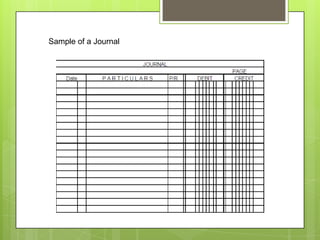
Sample of a Journal
Steps in the Accounting Cycle
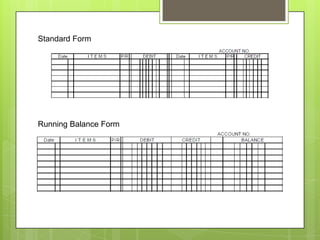
๏‚› Posting, or transferring of the account
from the Journal to the Ledger or the Book
of the Final Entry
Standard Form
Running Balance Form
Steps in the Accounting Cycle
๏‚› Balancing of the accounts and
preparation of the trial balance
๏‚› Trial Balance - a list of account balances
taken from the ledger
Steps in the Accounting Cycle
๏‚› Preparation of the 10-column worksheet
๏‚› Journalizing and posting adjusting entries
๏‚› Preparation of the financial statements
based on adjusted balances
๏‚› Recording and posting of closing entries
Steps in the Accounting Cycle
๏‚› Balancing and preparing a Post-Closing
Trial Balance from the list of open account
balances taken from the ledger
๏‚› Preparation of the reversing entries for
certain adjusted accounts to enable the
business to maintain the same method of
recording certain transactions from one
period to another. This is optional.
Bookkeeping
๏‚› Bookkeeping is the systematic and
chronological recording of transactions in
books of accounts following a series of
steps and procedures commonly referred
to as the accounting cycle.
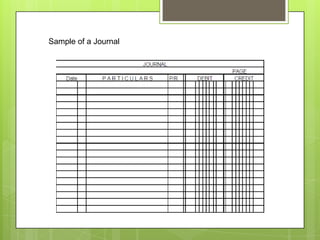
Sample of a Journal
Journal
๏‚› Date is used to show the day of the month
on which each transaction takes place.
๏‚› Particulars column or sometimes called
the Account Titles and Explanation
column, is used to show every account
title affected by each transaction and to
give some explanation or justification of
the debits and credits being made to the
accounts.
Journal
๏‚› P/R (Posting Reference) column is
important because it indicates the
numbers of the accounts in the ledger to
which the debits and credits recorded in
the journal have been transferred. In
manual systems, these account numbers
are inserted at the proper time in the P/R
column of the journal.
Journal
๏‚› Debit and credit columns indicate the
amounts to be debited or credited to the
account titles written in the particulars
column
The recording process
๏‚› Transactions are first analyzed, identifying
the transaction from business source
documents, e.g., official receipts, cash
vouchers, etc.
๏‚› Business documents are formal written
records that provide information to
everyone with an understanding of
accounting to measure the amount of the
transaction and to analyze it in the same
way.
The recording process
๏‚› The day on which the transaction took
place is written in the Date column.
๏‚› The account titles affected by the
transactions are put into the particulars
column. At the same time each account
title is written in the journal, the peso
amount is inserted in the appropriate
Debit or Credit column. For each journal
entry, the total debits must equal the total
credits.
The recording process
๏‚› A brief explanation is written immediately
below the last account title credited. The
explanations follow no rigid rules. The
accountant uses his own wording in every
explanation.
๏‚› It is advisable to leave a blank line
following the explanation to help
distinguish one journal entry from the next.

The accounting cycle 06272013

  • 1.
  • 2.
    Steps in theAccounting Cycle โ€ข Analyzing business transactions through source documents (business documents) โ€ข Business Transactions? Personal Transactions? โ€ข Effect on the basic accounting equation?
  • 3.
    Steps in theAccounting Cycle ๏‚› โ€บ Journalizing, or the recording of transactions in a Journal or Book of Original Entry
  • 4.
    Sample of aJournal
  • 5.
    Steps in theAccounting Cycle ๏‚› Posting, or transferring of the account from the Journal to the Ledger or the Book of the Final Entry
  • 6.
  • 7.
    Steps in theAccounting Cycle ๏‚› Balancing of the accounts and preparation of the trial balance ๏‚› Trial Balance - a list of account balances taken from the ledger
  • 8.
    Steps in theAccounting Cycle ๏‚› Preparation of the 10-column worksheet ๏‚› Journalizing and posting adjusting entries ๏‚› Preparation of the financial statements based on adjusted balances ๏‚› Recording and posting of closing entries
  • 9.
    Steps in theAccounting Cycle ๏‚› Balancing and preparing a Post-Closing Trial Balance from the list of open account balances taken from the ledger ๏‚› Preparation of the reversing entries for certain adjusted accounts to enable the business to maintain the same method of recording certain transactions from one period to another. This is optional.
  • 10.
    Bookkeeping ๏‚› Bookkeeping isthe systematic and chronological recording of transactions in books of accounts following a series of steps and procedures commonly referred to as the accounting cycle.
  • 11.
    Sample of aJournal
  • 12.
    Journal ๏‚› Date isused to show the day of the month on which each transaction takes place. ๏‚› Particulars column or sometimes called the Account Titles and Explanation column, is used to show every account title affected by each transaction and to give some explanation or justification of the debits and credits being made to the accounts.
  • 13.
    Journal ๏‚› P/R (PostingReference) column is important because it indicates the numbers of the accounts in the ledger to which the debits and credits recorded in the journal have been transferred. In manual systems, these account numbers are inserted at the proper time in the P/R column of the journal.
  • 14.
    Journal ๏‚› Debit andcredit columns indicate the amounts to be debited or credited to the account titles written in the particulars column
  • 15.
    The recording process ๏‚›Transactions are first analyzed, identifying the transaction from business source documents, e.g., official receipts, cash vouchers, etc. ๏‚› Business documents are formal written records that provide information to everyone with an understanding of accounting to measure the amount of the transaction and to analyze it in the same way.
  • 16.
    The recording process ๏‚›The day on which the transaction took place is written in the Date column. ๏‚› The account titles affected by the transactions are put into the particulars column. At the same time each account title is written in the journal, the peso amount is inserted in the appropriate Debit or Credit column. For each journal entry, the total debits must equal the total credits.
  • 17.
    The recording process ๏‚›A brief explanation is written immediately below the last account title credited. The explanations follow no rigid rules. The accountant uses his own wording in every explanation. ๏‚› It is advisable to leave a blank line following the explanation to help distinguish one journal entry from the next.