Environmental Modeling
Dissolved Oxygen Sag Curves in Streams
Quote
“[Mathematics] The handmaiden of the Sciences”
-Eric Temple Bell
Concepts
• Introduction
• Input sources
• Mathematical Model
• Sensitivity analysis
• Limitations
Case Study: Any Stream, Anywhere
• Every stream has inputs of
organic waste
– Spreads disease
– Consumes DO on
decomposition
• Ancient communities built
near flowing water
e.g. NY City, London,
W. Europe
Chemical process:
MO’s consume DO
Physical process:
Re-aeration by
atmosphere
Case Study: Any Stream, Anywhere
The Problem is D.O. < BOD
Sewage treatment begins
Meadows et al., 2004
Introduction
• Modeling the effects of release of oxidizable organic matter
into a
flowing body of water
– DO is the chemical measurement of dissolved oxygen (mg L-
1)
– BOD is the total DO needed to oxidize organic matter in a
water
sample = change from initial DO at saturation to amount after 5
days
• Standard of living ~ adequate water and wastewater treatment
Human Risks
• Challenge of preventing rapid spead of disease
e.g. typhoid fever (bacteria), hepatitis (viruses),
cryptosporidosis (protozoa)
• Removed by sand filtration and chlorination/ozonation
Aquatic Risks
• Aerobic organisms depend on DO
• 8-12 mg L-1
• Affected by temperature and salt
Wipple and Wipple (1911)
The Streeter-Phelps Equation
without trmt:
with trmt:
Organic matter is oxidized, stream re-aerates
End
• Review
Basic Input Sources
• Parameters for S-P equation:
– Wastewater: Flow rate, temperature, DO, BOD
• BOD measured in lab – DO measured after several days (flat
portion
of curve)
Basic Input Sources
Sewage Treatment Plants
• Remove turbidity, oxidizable organic matter, and pathogens
– Turbidity – settling tanks and filters
– Organic matter – trickling filters, activated sludge
– Pathogens – filtration, chloination, ozonation
ftp://ftp.wiley.com/public/sci_tech_med/pollutant_fate/
Basic Input Sources
Sewage Treatment Plants
• Prelininary - screening of large materials
• Primary - sedimentation - settling tanks
• Secondary - biological aeration – trickling
filters, activated sludge - metabolizes and
flocculates dissolved organics
• Tertiary – e.g. P removal
http://www.waterencyclopedia.com/Tw-Z/Wastewater-
Treatment-and-Management.html
http://www.waterencyclopedia.com/Tw-Z/Wastewater-
Treatment-and-Management.html
http://www.waterencyclopedia.com/Tw-Z/Wastewater-
Treatment-and-Management.html
http://www.waterencyclopedia.com/Tw-Z/Wastewater-
Treatment-and-Management.html
http://www.waterencyclopedia.com/Tw-Z/Wastewater-
Treatment-and-Management.html
http://www.waterencyclopedia.com/Tw-Z/Wastewater-
Treatment-and-Management.html
http://www.waterencyclopedia.com/Tw-Z/Wastewater-
Treatment-and-Management.html
http://www.waterencyclopedia.com/Tw-Z/Wastewater-
Treatment-and-Management.html
http://www.waterencyclopedia.com/Tw-Z/Wastewater-
Treatment-and-Management.html
http://www.waterencyclopedia.com/Tw-Z/Wastewater-
Treatment-and-Management.html
Basic Input Sources
• Wastewater Treatment Plant
Model
Mathematical Model
Take a river: What parameters and processes would be
important in
developing a model for the oxidation of organic waste?
our model river: draw in parameters
Ultimate BODLof mix
Stream DO deficit
Consumption DO by MO’s
Re-aeration by atmosphere
Amount DO consumed
The Streeter-Phelps Equation
D = k’BODL [exp(-k’(x/v) – exp(-k2’(x/v))] + D0exp(-
k2’(x/v))
k2’ – k’
where: D = DO concentration deficit (value below saturation)
(mg L-1),
k’2= the re-aeration constant (in d
-1),
BODL= the ultimate BOD (in mg L
-1),
k’= the BOD rate constant for oxidation (d-1),
x = distance downstream from the point source (km),
v = average water velocity (km d-1)
Do= initial oxygen deficit of mixed stream and wastewater (mg
L
-1)
Consumption by MO’s Re-aeration by atmos. O2
D is not the remaining DO content but the amount of original
DO
consumed…must be subtracted from original DO without BOD
waste
The Streeter-Phelps Equation
DO at a given distance below the input:
The Streeter-Phelps Equation
• k2’ = first-order rate constant for re-aeration
• Exact measurements are difficult, get from tables:
The Streeter-Phelps Equation
• BODL = ultimate BOD or maximum O2 required to oxize the
waste sample
• Determined from 5 day BOD test or using equation:
BODL = BOD5
1 – exp(-k’(x/v))
• Where k’ is obtained from a 20 day BOD experiment
• D0 = DO level in the stream upstream from input - initial DO
of
stream-waste mixture
The Streeter-Phelps Equation
Zone of Clean Water (Zone 1)
Zone of Degradation (Zone 2)
Zone of Active Decomposition (Zone 3)
Zone of Recovery (Zone 4)
Zone of Cleaner Water (Zone 5)
Algae, fungi, protozoa, worms,
larger planst die
Gray/black, H2S, CH4, NH3
productions,
Minimum D = critical
dissolved oxygen = Dc
The Streeter-Phelps Equation
tc = 1 ln k2’ 1 – D0(k2’-k’)
k2’ – k’ k’ k’ BODL
and xc = vtc
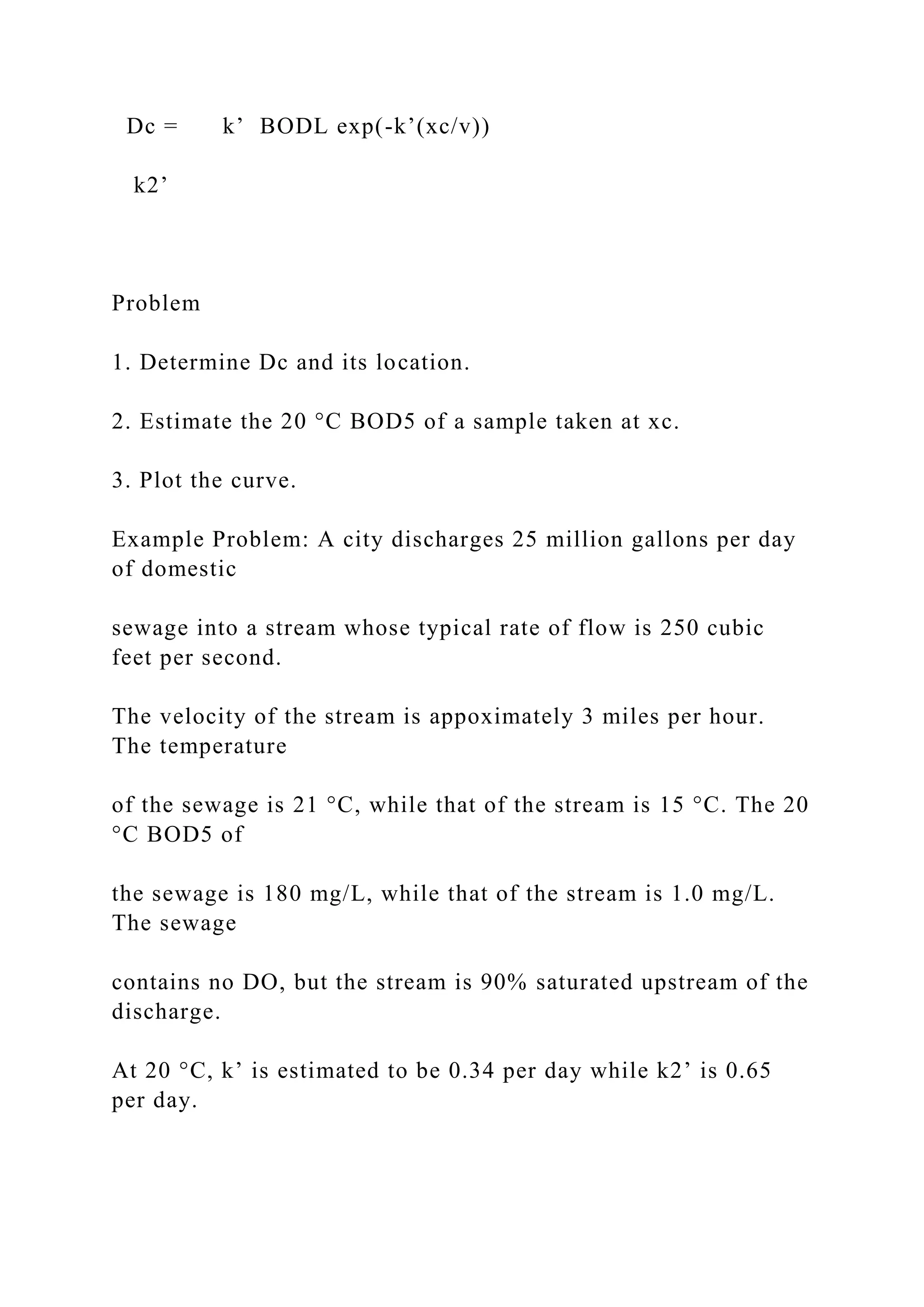
Critical DO concentration, Dc:
Dc = k’ BODL exp(-k’(xc/v))
k2’
Problem
1. Determine Dc and its location.
2. Estimate the 20 °C BOD5 of a sample taken at xc.
3. Plot the curve.
Example Problem: A city discharges 25 million gallons per day
of domestic
sewage into a stream whose typical rate of flow is 250 cubic
feet per second.
The velocity of the stream is appoximately 3 miles per hour.
The temperature
of the sewage is 21 °C, while that of the stream is 15 °C. The 20
°C BOD5 of
the sewage is 180 mg/L, while that of the stream is 1.0 mg/L.
The sewage
contains no DO, but the stream is 90% saturated upstream of the
discharge.
At 20 °C, k’ is estimated to be 0.34 per day while k2’ is 0.65
per day.
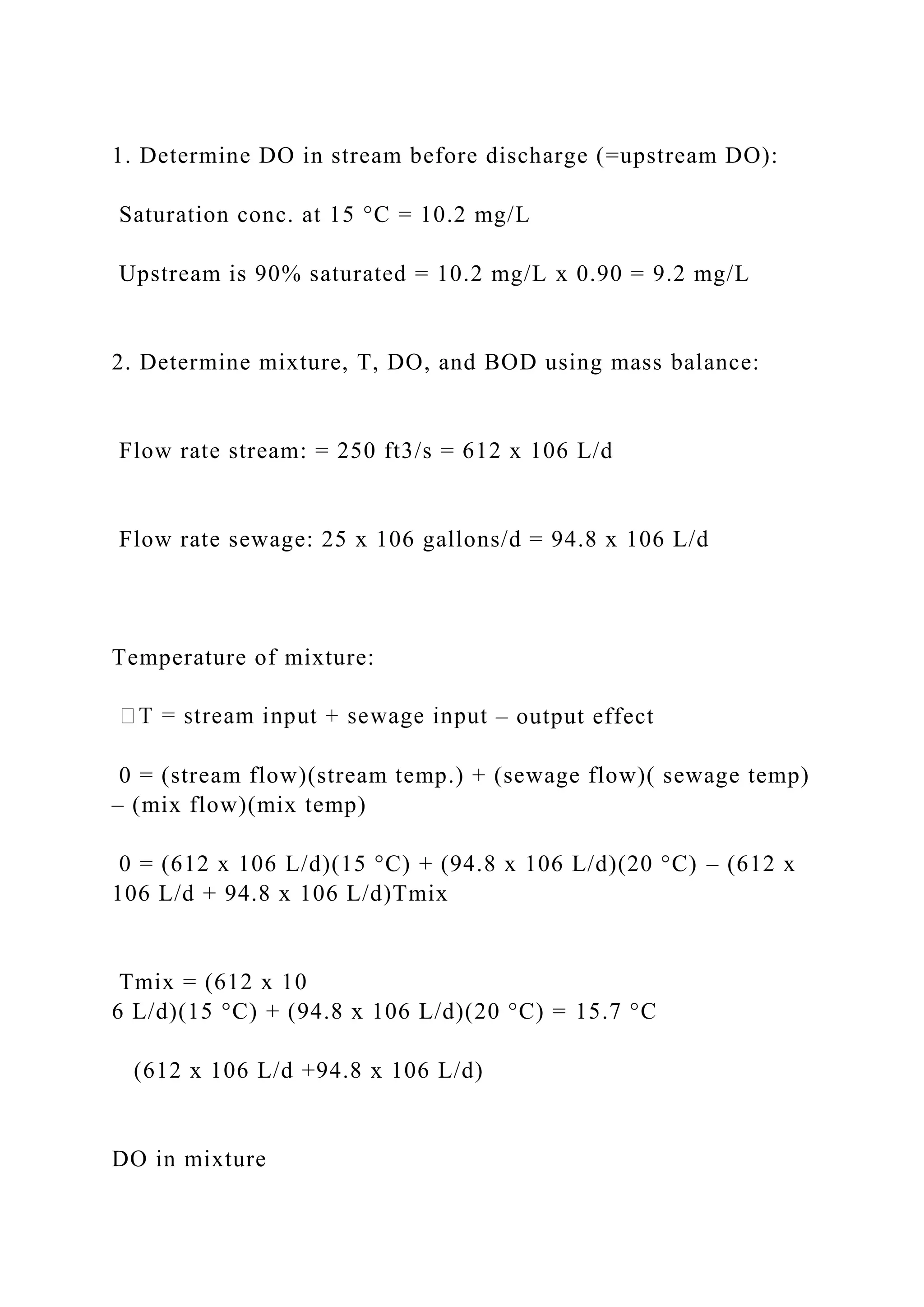
1. Determine DO in stream before discharge (=upstream DO):
Saturation conc. at 15 °C = 10.2 mg/L
Upstream is 90% saturated = 10.2 mg/L x 0.90 = 9.2 mg/L
2. Determine mixture, T, DO, and BOD using mass balance:
Flow rate stream: = 250 ft3/s = 612 x 106 L/d
Flow rate sewage: 25 x 106 gallons/d = 94.8 x 10⁶ L/d
Temperature of mixture:
– output effect
0 = (stream flow)(stream temp.) + (sewage flow)( sewage temp)
– (mix flow)(mix temp)
0 = (612 x 106 L/d)(15 °C) + (94.8 x 10⁶ L/d)(20 °C) – (612 x
106 L/d + 94.8 x 10⁶ L/d)Tmix
Tmix = (612 x 10
6 L/d)(15 °C) + (94.8 x 10⁶ L/d)(20 °C) = 15.7 °C
(612 x 106 L/d +94.8 x 10⁶ L/d)
DO in mixture
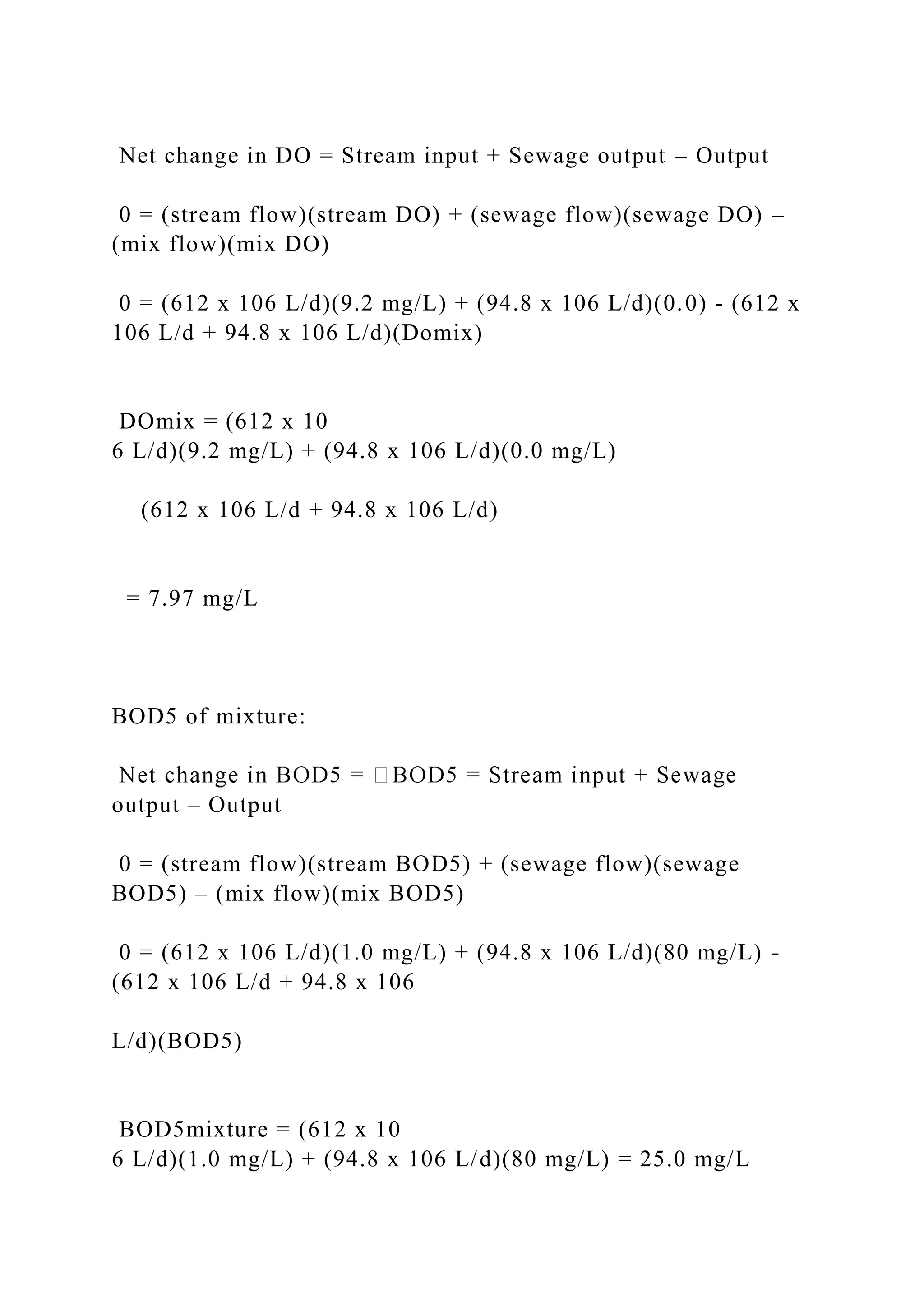
Net change in DO = Stream input + Sewage output – Output
0 = (stream flow)(stream DO) + (sewage flow)(sewage DO) –
(mix flow)(mix DO)
0 = (612 x 106 L/d)(9.2 mg/L) + (94.8 x 10⁶ L/d)(0.0) - (612 x
106 L/d + 94.8 x 10⁶ L/d)(Domix)
DOmix = (612 x 10
6 L/d)(9.2 mg/L) + (94.8 x 10⁶ L/d)(0.0 mg/L)
(612 x 106 L/d + 94.8 x 10⁶ L/d)
= 7.97 mg/L
BOD5 of mixture:
output – Output
0 = (stream flow)(stream BOD5) + (sewage flow)(sewage
BOD5) – (mix flow)(mix BOD5)
0 = (612 x 106 L/d)(1.0 mg/L) + (94.8 x 10⁶ L/d)(80 mg/L) -
(612 x 106 L/d + 94.8 x 10⁶
L/d)(BOD5)
BOD5mixture = (612 x 10
6 L/d)(1.0 mg/L) + (94.8 x 10⁶ L/d)(80 mg/L) = 25.0 mg/L
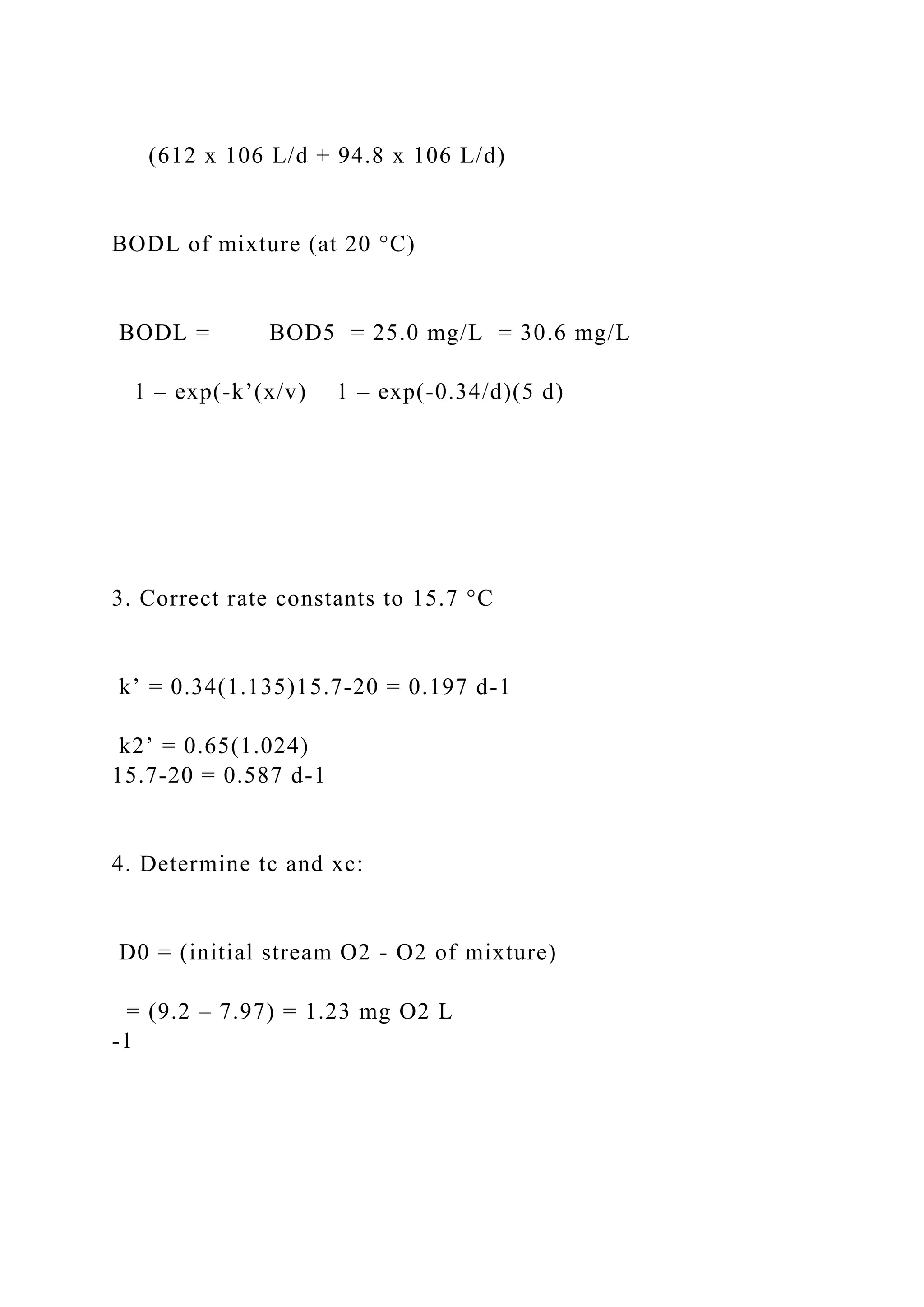
(612 x 106 L/d + 94.8 x 10⁶ L/d)
BODL of mixture (at 20 °C)
BODL = BOD5 = 25.0 mg/L = 30.6 mg/L
1 – exp(-k’(x/v) 1 – exp(-0.34/d)(5 d)
3. Correct rate constants to 15.7 °C
k’ = 0.34(1.135)15.7-20 = 0.197 d-1
k2’ = 0.65(1.024)
15.7-20 = 0.587 d-1
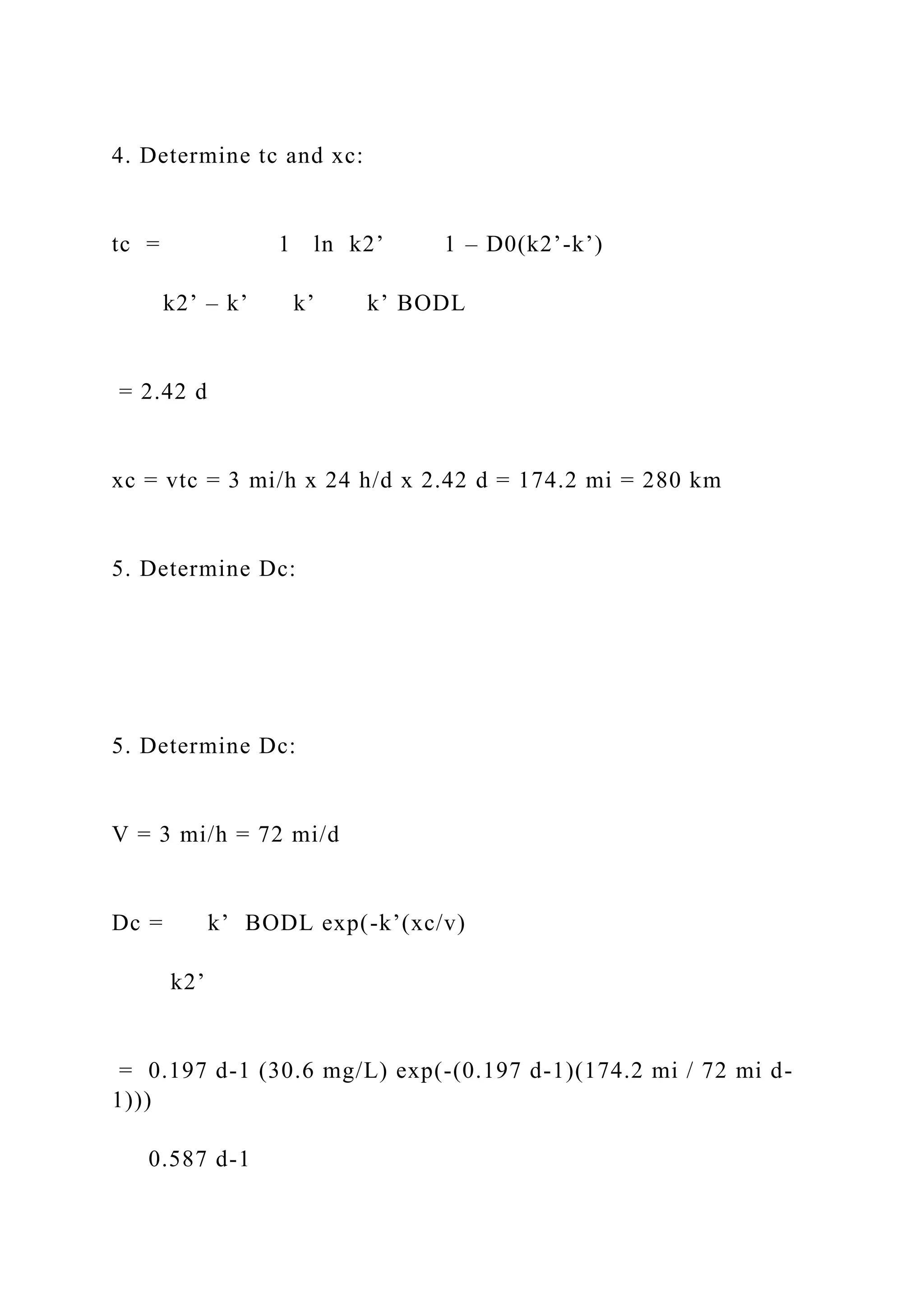
4. Determine tc and xc:
D0 = (initial stream O2 - O2 of mixture)
= (9.2 – 7.97) = 1.23 mg O2 L
-1
4. Determine tc and xc:
tc = 1 ln k2’ 1 – D0(k2’-k’)
k2’ – k’ k’ k’ BODL
= 2.42 d
xc = vtc = 3 mi/h x 24 h/d x 2.42 d = 174.2 mi = 280 km
5. Determine Dc:
5. Determine Dc:
V = 3 mi/h = 72 mi/d
Dc = k’ BODL exp(-k’(xc/v)
k2’
= 0.197 d-1 (30.6 mg/L) exp(-(0.197 d-1)(174.2 mi / 72 mi d-
1)))
0.587 d-1
= 6.37 mg L-1
The DO will be depressed 6.37 mg L-1 from saturation.
Minimum DO = 9.2 mg L-1 - 6.37 mg L-1 = 2.83 mg L-1
6. Determine BOD5 at critical point, xc:
BOD5 = BODL exp(-k’(x/v))
= (30.6 mg L-1) exp(-0.197 d-1)(174.2 mi)/(72 mi d-1) = 19.0
mg L-1
20 °C BOD5 = BOD5 [1 – exp(-k’)(5)]
= 19.0 mg L-1 [1 – exp(-0.34 d-1)(5 d)] = 15.5 mg L-1
Easier method
Sensitivity Analysis
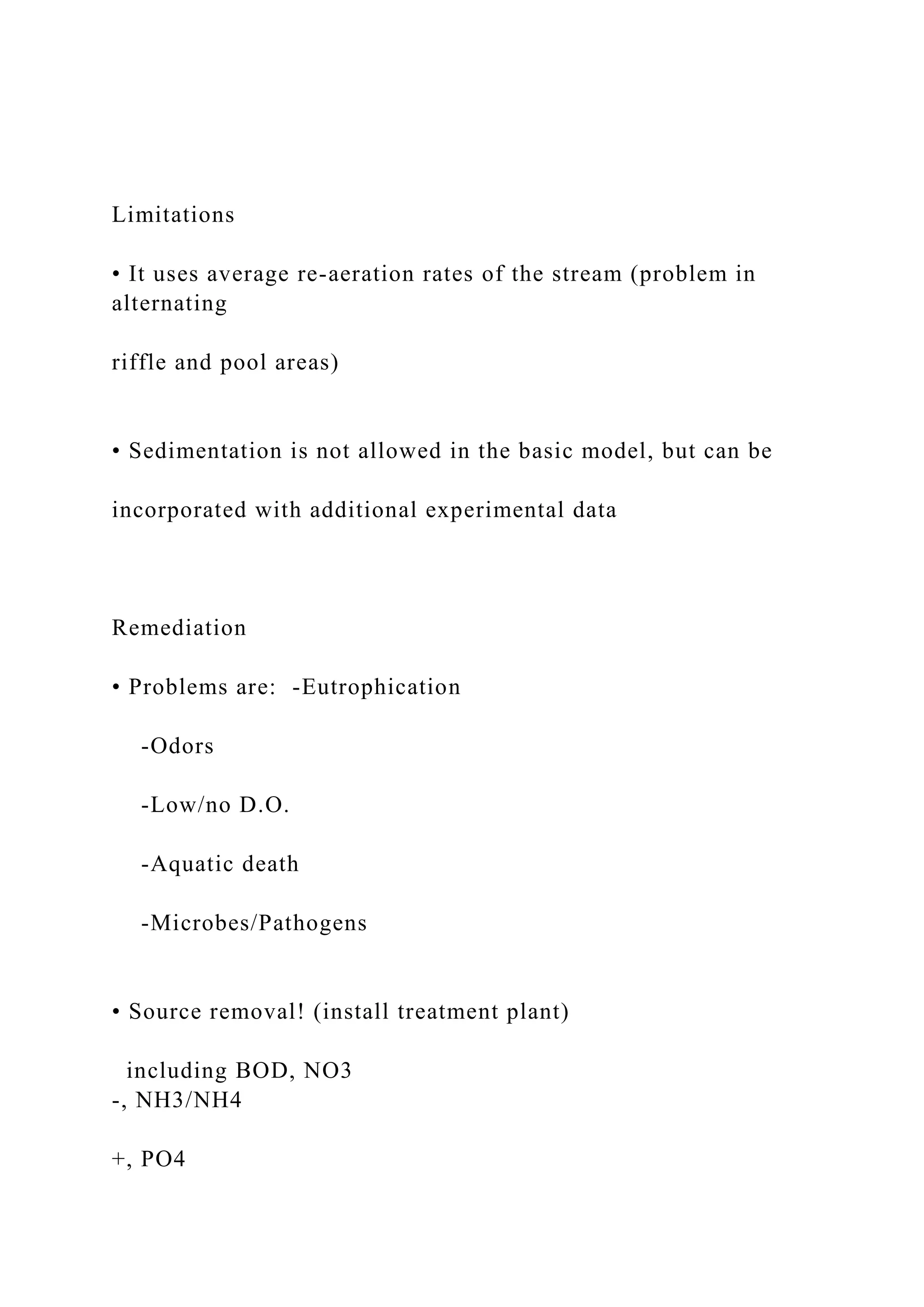
Limitations
• It uses average re-aeration rates of the stream (problem in
alternating
riffle and pool areas)
• Sedimentation is not allowed in the basic model, but can be
incorporated with additional experimental data
Remediation
• Problems are: -Eutrophication
-Odors
-Low/no D.O.
-Aquatic death
-Microbes/Pathogens
• Source removal! (install treatment plant)
including BOD, NO3
-, NH3/NH4
+, PO4
3-
removal, but you still will have organic rich
sediments for some time
• Time (flowing aquatic systems can be very resilient)
• Notice the difference between the recovery of a biodegradable
pollutant
versus nonbiodegradable!
End
• Review
Further Reading
Journals and Reports
• Wipple, G.C. and Wipple, M.C. (1911) Solubility of oxygen in
sea
water. Journal of the American Chemical Society, Vol. 3 pp
362.
Books
• Craun, G. (1986) Waterborne Diseases in the United States.
CRC Press, Boca Raton, FL.
• Meadows, D., Randers, J., and Meadows, D. (2004) Limits to
Growth: The 30-Year Update.
Chelsea Gren Publishing Compnay, White River Junction, VT.
• Metcalf and Eddy Inc. (1991) Wastewater Engineering, 3rd
Ed. McGraw-Hill, New York.
• Sawyer, C.N. and McCarty, P.L. (1978) Chemistry for
Environmental Engineering. McGraw-
Hill, New York.
• Snoeyink, V.L. and Jenkins, D. (1980) Water Chemistry. John
Wiley & Sons, New York.
• Standard Methods for the Examination of Water and
Wastewater, 20th Ed. (1998) American
Waterworks Association, Washington D.C.
• Streeter, H.W. and Phelps, E.B. (1925) A Study of the
Pollution and natural Purification of
the Ohio River. United States Public Health Service, U.S.
Department of Health, Education
and Welfare.
• Tchobanoglous, G. and Burton, F.L. (1991) Wastewater
Engineering: Treatment, Disposal,
and Reuse. McGraw-Hill, New York.

Environmental Modeling Dissolved Oxygen Sag Curves in Stre.docx

  • 1.
    Environmental Modeling Dissolved OxygenSag Curves in Streams Quote “[Mathematics] The handmaiden of the Sciences” -Eric Temple Bell Concepts • Introduction • Input sources • Mathematical Model • Sensitivity analysis • Limitations Case Study: Any Stream, Anywhere
  • 2.
    • Every streamhas inputs of organic waste – Spreads disease – Consumes DO on decomposition • Ancient communities built near flowing water e.g. NY City, London, W. Europe Chemical process: MO’s consume DO Physical process: Re-aeration by atmosphere Case Study: Any Stream, Anywhere The Problem is D.O. < BOD
  • 3.
    Sewage treatment begins Meadowset al., 2004 Introduction • Modeling the effects of release of oxidizable organic matter into a flowing body of water – DO is the chemical measurement of dissolved oxygen (mg L- 1) – BOD is the total DO needed to oxidize organic matter in a water sample = change from initial DO at saturation to amount after 5 days • Standard of living ~ adequate water and wastewater treatment Human Risks • Challenge of preventing rapid spead of disease e.g. typhoid fever (bacteria), hepatitis (viruses), cryptosporidosis (protozoa) • Removed by sand filtration and chlorination/ozonation
  • 4.
    Aquatic Risks • Aerobicorganisms depend on DO • 8-12 mg L-1 • Affected by temperature and salt Wipple and Wipple (1911) The Streeter-Phelps Equation without trmt: with trmt: Organic matter is oxidized, stream re-aerates End • Review Basic Input Sources • Parameters for S-P equation: – Wastewater: Flow rate, temperature, DO, BOD
  • 5.
    • BOD measuredin lab – DO measured after several days (flat portion of curve) Basic Input Sources Sewage Treatment Plants • Remove turbidity, oxidizable organic matter, and pathogens – Turbidity – settling tanks and filters – Organic matter – trickling filters, activated sludge – Pathogens – filtration, chloination, ozonation ftp://ftp.wiley.com/public/sci_tech_med/pollutant_fate/ Basic Input Sources Sewage Treatment Plants • Prelininary - screening of large materials • Primary - sedimentation - settling tanks • Secondary - biological aeration – trickling filters, activated sludge - metabolizes and
  • 6.
    flocculates dissolved organics •Tertiary – e.g. P removal http://www.waterencyclopedia.com/Tw-Z/Wastewater- Treatment-and-Management.html http://www.waterencyclopedia.com/Tw-Z/Wastewater- Treatment-and-Management.html http://www.waterencyclopedia.com/Tw-Z/Wastewater- Treatment-and-Management.html http://www.waterencyclopedia.com/Tw-Z/Wastewater- Treatment-and-Management.html http://www.waterencyclopedia.com/Tw-Z/Wastewater- Treatment-and-Management.html http://www.waterencyclopedia.com/Tw-Z/Wastewater- Treatment-and-Management.html http://www.waterencyclopedia.com/Tw-Z/Wastewater- Treatment-and-Management.html http://www.waterencyclopedia.com/Tw-Z/Wastewater- Treatment-and-Management.html http://www.waterencyclopedia.com/Tw-Z/Wastewater- Treatment-and-Management.html http://www.waterencyclopedia.com/Tw-Z/Wastewater- Treatment-and-Management.html Basic Input Sources • Wastewater Treatment Plant Model
  • 7.
    Mathematical Model Take ariver: What parameters and processes would be important in developing a model for the oxidation of organic waste? our model river: draw in parameters Ultimate BODLof mix Stream DO deficit Consumption DO by MO’s Re-aeration by atmosphere Amount DO consumed The Streeter-Phelps Equation D = k’BODL [exp(-k’(x/v) – exp(-k2’(x/v))] + D0exp(- k2’(x/v)) k2’ – k’ where: D = DO concentration deficit (value below saturation) (mg L-1), k’2= the re-aeration constant (in d
  • 8.
    -1), BODL= the ultimateBOD (in mg L -1), k’= the BOD rate constant for oxidation (d-1), x = distance downstream from the point source (km), v = average water velocity (km d-1) Do= initial oxygen deficit of mixed stream and wastewater (mg L -1) Consumption by MO’s Re-aeration by atmos. O2 D is not the remaining DO content but the amount of original DO consumed…must be subtracted from original DO without BOD waste The Streeter-Phelps Equation DO at a given distance below the input: The Streeter-Phelps Equation • k2’ = first-order rate constant for re-aeration
  • 9.
    • Exact measurementsare difficult, get from tables: The Streeter-Phelps Equation • BODL = ultimate BOD or maximum O2 required to oxize the waste sample • Determined from 5 day BOD test or using equation: BODL = BOD5 1 – exp(-k’(x/v)) • Where k’ is obtained from a 20 day BOD experiment • D0 = DO level in the stream upstream from input - initial DO of stream-waste mixture The Streeter-Phelps Equation Zone of Clean Water (Zone 1) Zone of Degradation (Zone 2)
  • 10.
    Zone of ActiveDecomposition (Zone 3) Zone of Recovery (Zone 4) Zone of Cleaner Water (Zone 5) Algae, fungi, protozoa, worms, larger planst die Gray/black, H2S, CH4, NH3 productions, Minimum D = critical dissolved oxygen = Dc The Streeter-Phelps Equation tc = 1 ln k2’ 1 – D0(k2’-k’) k2’ – k’ k’ k’ BODL and xc = vtc Critical DO concentration, Dc:
  • 11.
    Dc = k’BODL exp(-k’(xc/v)) k2’ Problem 1. Determine Dc and its location. 2. Estimate the 20 °C BOD5 of a sample taken at xc. 3. Plot the curve. Example Problem: A city discharges 25 million gallons per day of domestic sewage into a stream whose typical rate of flow is 250 cubic feet per second. The velocity of the stream is appoximately 3 miles per hour. The temperature of the sewage is 21 °C, while that of the stream is 15 °C. The 20 °C BOD5 of the sewage is 180 mg/L, while that of the stream is 1.0 mg/L. The sewage contains no DO, but the stream is 90% saturated upstream of the discharge. At 20 °C, k’ is estimated to be 0.34 per day while k2’ is 0.65 per day.
  • 12.
    1. Determine DOin stream before discharge (=upstream DO): Saturation conc. at 15 °C = 10.2 mg/L Upstream is 90% saturated = 10.2 mg/L x 0.90 = 9.2 mg/L 2. Determine mixture, T, DO, and BOD using mass balance: Flow rate stream: = 250 ft3/s = 612 x 106 L/d Flow rate sewage: 25 x 106 gallons/d = 94.8 x 10⁶ L/d Temperature of mixture: – output effect 0 = (stream flow)(stream temp.) + (sewage flow)( sewage temp) – (mix flow)(mix temp) 0 = (612 x 106 L/d)(15 °C) + (94.8 x 10⁶ L/d)(20 °C) – (612 x 106 L/d + 94.8 x 10⁶ L/d)Tmix Tmix = (612 x 10 6 L/d)(15 °C) + (94.8 x 10⁶ L/d)(20 °C) = 15.7 °C (612 x 106 L/d +94.8 x 10⁶ L/d) DO in mixture
  • 13.
    Net change inDO = Stream input + Sewage output – Output 0 = (stream flow)(stream DO) + (sewage flow)(sewage DO) – (mix flow)(mix DO) 0 = (612 x 106 L/d)(9.2 mg/L) + (94.8 x 10⁶ L/d)(0.0) - (612 x 106 L/d + 94.8 x 10⁶ L/d)(Domix) DOmix = (612 x 10 6 L/d)(9.2 mg/L) + (94.8 x 10⁶ L/d)(0.0 mg/L) (612 x 106 L/d + 94.8 x 10⁶ L/d) = 7.97 mg/L BOD5 of mixture: output – Output 0 = (stream flow)(stream BOD5) + (sewage flow)(sewage BOD5) – (mix flow)(mix BOD5) 0 = (612 x 106 L/d)(1.0 mg/L) + (94.8 x 10⁶ L/d)(80 mg/L) - (612 x 106 L/d + 94.8 x 10⁶ L/d)(BOD5) BOD5mixture = (612 x 10 6 L/d)(1.0 mg/L) + (94.8 x 10⁶ L/d)(80 mg/L) = 25.0 mg/L
  • 14.
    (612 x 106L/d + 94.8 x 10⁶ L/d) BODL of mixture (at 20 °C) BODL = BOD5 = 25.0 mg/L = 30.6 mg/L 1 – exp(-k’(x/v) 1 – exp(-0.34/d)(5 d) 3. Correct rate constants to 15.7 °C k’ = 0.34(1.135)15.7-20 = 0.197 d-1 k2’ = 0.65(1.024) 15.7-20 = 0.587 d-1 4. Determine tc and xc: D0 = (initial stream O2 - O2 of mixture) = (9.2 – 7.97) = 1.23 mg O2 L -1
  • 15.
    4. Determine tcand xc: tc = 1 ln k2’ 1 – D0(k2’-k’) k2’ – k’ k’ k’ BODL = 2.42 d xc = vtc = 3 mi/h x 24 h/d x 2.42 d = 174.2 mi = 280 km 5. Determine Dc: 5. Determine Dc: V = 3 mi/h = 72 mi/d Dc = k’ BODL exp(-k’(xc/v) k2’ = 0.197 d-1 (30.6 mg/L) exp(-(0.197 d-1)(174.2 mi / 72 mi d- 1))) 0.587 d-1
  • 16.
    = 6.37 mgL-1 The DO will be depressed 6.37 mg L-1 from saturation. Minimum DO = 9.2 mg L-1 - 6.37 mg L-1 = 2.83 mg L-1 6. Determine BOD5 at critical point, xc: BOD5 = BODL exp(-k’(x/v)) = (30.6 mg L-1) exp(-0.197 d-1)(174.2 mi)/(72 mi d-1) = 19.0 mg L-1 20 °C BOD5 = BOD5 [1 – exp(-k’)(5)] = 19.0 mg L-1 [1 – exp(-0.34 d-1)(5 d)] = 15.5 mg L-1 Easier method Sensitivity Analysis
  • 17.
    Limitations • It usesaverage re-aeration rates of the stream (problem in alternating riffle and pool areas) • Sedimentation is not allowed in the basic model, but can be incorporated with additional experimental data Remediation • Problems are: -Eutrophication -Odors -Low/no D.O. -Aquatic death -Microbes/Pathogens • Source removal! (install treatment plant) including BOD, NO3 -, NH3/NH4 +, PO4
  • 18.
    3- removal, but youstill will have organic rich sediments for some time • Time (flowing aquatic systems can be very resilient) • Notice the difference between the recovery of a biodegradable pollutant versus nonbiodegradable! End • Review Further Reading Journals and Reports • Wipple, G.C. and Wipple, M.C. (1911) Solubility of oxygen in sea water. Journal of the American Chemical Society, Vol. 3 pp 362.
  • 19.
    Books • Craun, G.(1986) Waterborne Diseases in the United States. CRC Press, Boca Raton, FL. • Meadows, D., Randers, J., and Meadows, D. (2004) Limits to Growth: The 30-Year Update. Chelsea Gren Publishing Compnay, White River Junction, VT. • Metcalf and Eddy Inc. (1991) Wastewater Engineering, 3rd Ed. McGraw-Hill, New York. • Sawyer, C.N. and McCarty, P.L. (1978) Chemistry for Environmental Engineering. McGraw- Hill, New York. • Snoeyink, V.L. and Jenkins, D. (1980) Water Chemistry. John Wiley & Sons, New York. • Standard Methods for the Examination of Water and Wastewater, 20th Ed. (1998) American Waterworks Association, Washington D.C. • Streeter, H.W. and Phelps, E.B. (1925) A Study of the Pollution and natural Purification of the Ohio River. United States Public Health Service, U.S. Department of Health, Education and Welfare.
  • 20.
    • Tchobanoglous, G.and Burton, F.L. (1991) Wastewater Engineering: Treatment, Disposal, and Reuse. McGraw-Hill, New York.