HOW THE HISTORY OF
SHAKA HAS BEEN
WRITTENWRITTEN
Grade: 10
Term: 3
Topic: 4 – TRANSFORMATIONS IN SOUTHERN AFRICA
AFTER 1750
Sub-Topic: - HOW THE HISTORY OF SHAKA HAS BEEN
WRITTEN
1M.N.SPIES
2M.N.SPIES
Shaka, King of the Zulu: Shaka’s
legacy
• Shaka, King of the Zulu, is probably the most famous pre-
colonial southern African ruler.
• He is sometimes portrayed as the creator of the most
feared, militarised and powerful states in southern Africa in
the early 1820’s.
• Shaka has been portrayed in many different ways.• Shaka has been portrayed in many different ways.
• He has achieved iconic status.
• This means he is a well-known person with qualities that
represent something of great significance.
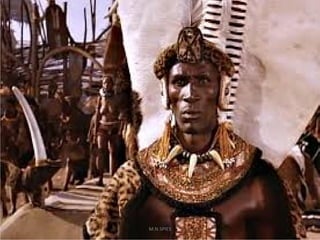
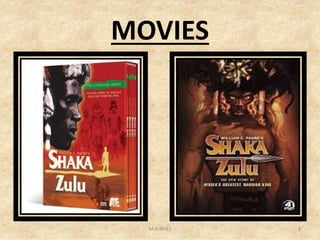
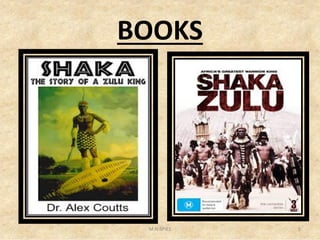
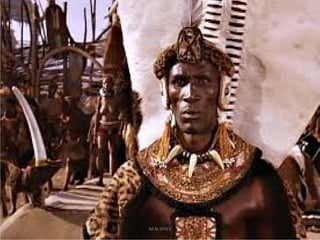
• Shaka is a fascinating figure who has been portrayed in
movies, books, art, legends, poetry, plays and popular
songs.
• He is usually seen as both ruthless and heroic.
3M.N.SPIES
MOVIES
M.N.SPIES 4
BOOKS
M.N.SPIES 5
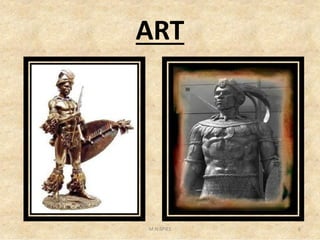
ART
M.N.SPIES 6
What kind of leader was Shaka?
• Shaka certainly is a well-known historical figure.
• But what was he really like? As young historians,
we should not just accept what we are told. We
should ask questions and look for answers.
Look at this statue of King Shaka and the• Look at this statue of King Shaka and the
questions around it. He clearly represents
different things to different people. When you
have finished this section, you can judge for
yourself as long as you can provide evidence for
your answer.
7M.N.SPIES
M.N.SPIES 8
Who was Shaka?
• An iconic leader who provides inspiration to others?
• A symbol of African pride and achievement?
• A military genius, a hero of great strength and
courage who is celebrated for his success in warfare?courage who is celebrated for his success in warfare?
• A nation builder, who created, organised and
developed a nation?
• A savage, cruel, ruthless and bloodthirsty tyrant?
• A legendary figure about whom we know very little?
9M.N.SPIES
Portrayals of Shaka in the past
• Historians used to think that the ‘time of
troubles’ was caused by the growth of the
Zulu kingdom under Shaka, which set off a
chain reaction of warfare and migration.
• They called this period ‘the Zulu wars’ or ‘the• They called this period ‘the Zulu wars’ or ‘the
wars of Shaka’.
• Shaka and the Zulu were once regarded by
historians as being the major cause of the
conflict during this period.
10M.N.SPIES
Notice the changes in historical interpretations
about Shaka, the Zulu kingdom and the time of
troubles:
• In 1928
• The historian E.A. Walker published the first university textbook on South African
history called A History of South Africa. He first used the word Mfecane. Shaka and
the Zulu kingdom were seen as the initiators of a period of disaster, of violent and
widespread disruption and destruction.
• In 1966
• The historian John Omer-Cooper used the term Mfecane in a widely read book• The historian John Omer-Cooper used the term Mfecane in a widely read book
called The Zulu Aftermath.
• After 1970
• The Mfecane interpretation of the transformation in southern Africa was accepted
in universities, teacher training colleges, schools, newspapers, television and
movies.
• Late 1980’s and 1990’s
• Historians began to question the Mfecane interpretation. After studying the
evidence carefully, historians have moved away from the idea that the wars of
Shaka were central to the changes that took place in southern African history in the
19th century. Wars and disruptions took place, but most of them were not caused
by Shaka and the Zulu. 11M.N.SPIES
Sources of evidence for our histories
of Shaka
1. Early British traveller accounts about Shaka
• European traders and settlers had an interest in describing
the wars of Shaka as bloodthirstily as possible.
• They believed that black people were savages and that
Europeans had come to Africa on a ‘civilising mission’.Europeans had come to Africa on a ‘civilising mission’.
• They had to justify their presence as intruders, and later
as masters. Henry Francis Fynn and Nathaniel Isaacs are
two of the most well-known early British travellers who
wrote about Shaka.
• Both men learned to speak isiZulu fluently.
• Modern historians have questioned the accuracy of their
writings.
12M.N.SPIES
Sources of evidence for our histories
of Shaka
2. Visual sources of Shaka
• Visual sources are useful sources because they provide
us with an image of what things looked like in the past.
• However, like all other sources, historical pictures have
been created from a particular perspective and may
contain inaccuracies or exaggerations.
been created from a particular perspective and may
contain inaccuracies or exaggerations.
• Two artists depicting the same thing can produce two
totally different pictures.
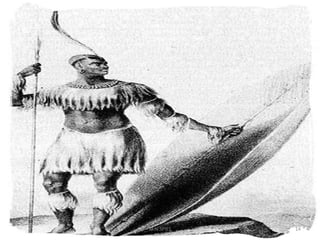
• No one is sure what Shaka looked like.
• Here is a drawing of him with a long assegai and a
heavy shield. A European artist who had never seen
him drew it in 1824. He drew it from his imagination.
13M.N.SPIES
M.N.SPIES 14
Representations of Shaka in the
present
1. Shaka in popular culture
• The image of Shaka is often used in popular culture.
• Popular culture contains ideas and images that are
influenced by the mass media - we absorb ideas likeinfluenced by the mass media - we absorb ideas like
these in our everyday lives.
• These ideas are usually superficial and are not
historically accurate.
• As young historians, we need to be critical of
popular culture and the way it creates false ideas of
historical figures. 15M.N.SPIES
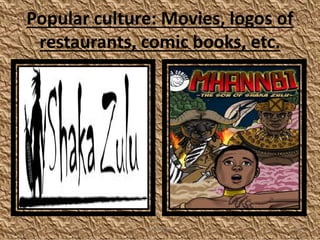
Popular culture: Movies, logos of
restaurants, comic books, etc.
M.N.SPIES 16
Representations of Shaka in the
present
2. Shaka and South African heritage
• Heritage is about the ways in which people
remember the past: at heritage sites, in museums,
through the construction of monuments and
memorials, and in families and communities.memorials, and in families and communities.
• People in the past are also part of our heritage.
• Shaka, the king of the Zulu kingdom, is
remembered differently by different people.
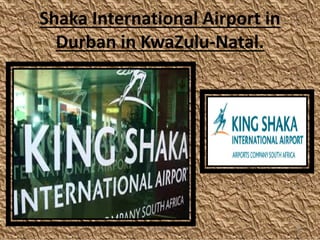
• His statue was recently erected at the Shaka
International Airport in Durban in KwaZulu-Natal.
M.N.SPIES 17
Shaka International Airport in
Durban in KwaZulu-Natal.
M.N.SPIES 18

Shaka

  • 1.
    HOW THE HISTORYOF SHAKA HAS BEEN WRITTENWRITTEN Grade: 10 Term: 3 Topic: 4 – TRANSFORMATIONS IN SOUTHERN AFRICA AFTER 1750 Sub-Topic: - HOW THE HISTORY OF SHAKA HAS BEEN WRITTEN 1M.N.SPIES
  • 2.
  • 3.
    Shaka, King ofthe Zulu: Shaka’s legacy • Shaka, King of the Zulu, is probably the most famous pre- colonial southern African ruler. • He is sometimes portrayed as the creator of the most feared, militarised and powerful states in southern Africa in the early 1820’s. • Shaka has been portrayed in many different ways.• Shaka has been portrayed in many different ways. • He has achieved iconic status. • This means he is a well-known person with qualities that represent something of great significance. • Shaka is a fascinating figure who has been portrayed in movies, books, art, legends, poetry, plays and popular songs. • He is usually seen as both ruthless and heroic. 3M.N.SPIES
  • 4.
  • 5.
  • 6.
  • 7.
    What kind ofleader was Shaka? • Shaka certainly is a well-known historical figure. • But what was he really like? As young historians, we should not just accept what we are told. We should ask questions and look for answers. Look at this statue of King Shaka and the• Look at this statue of King Shaka and the questions around it. He clearly represents different things to different people. When you have finished this section, you can judge for yourself as long as you can provide evidence for your answer. 7M.N.SPIES
  • 8.
  • 9.
    Who was Shaka? •An iconic leader who provides inspiration to others? • A symbol of African pride and achievement? • A military genius, a hero of great strength and courage who is celebrated for his success in warfare?courage who is celebrated for his success in warfare? • A nation builder, who created, organised and developed a nation? • A savage, cruel, ruthless and bloodthirsty tyrant? • A legendary figure about whom we know very little? 9M.N.SPIES
  • 10.
    Portrayals of Shakain the past • Historians used to think that the ‘time of troubles’ was caused by the growth of the Zulu kingdom under Shaka, which set off a chain reaction of warfare and migration. • They called this period ‘the Zulu wars’ or ‘the• They called this period ‘the Zulu wars’ or ‘the wars of Shaka’. • Shaka and the Zulu were once regarded by historians as being the major cause of the conflict during this period. 10M.N.SPIES
  • 11.
    Notice the changesin historical interpretations about Shaka, the Zulu kingdom and the time of troubles: • In 1928 • The historian E.A. Walker published the first university textbook on South African history called A History of South Africa. He first used the word Mfecane. Shaka and the Zulu kingdom were seen as the initiators of a period of disaster, of violent and widespread disruption and destruction. • In 1966 • The historian John Omer-Cooper used the term Mfecane in a widely read book• The historian John Omer-Cooper used the term Mfecane in a widely read book called The Zulu Aftermath. • After 1970 • The Mfecane interpretation of the transformation in southern Africa was accepted in universities, teacher training colleges, schools, newspapers, television and movies. • Late 1980’s and 1990’s • Historians began to question the Mfecane interpretation. After studying the evidence carefully, historians have moved away from the idea that the wars of Shaka were central to the changes that took place in southern African history in the 19th century. Wars and disruptions took place, but most of them were not caused by Shaka and the Zulu. 11M.N.SPIES
  • 12.
    Sources of evidencefor our histories of Shaka 1. Early British traveller accounts about Shaka • European traders and settlers had an interest in describing the wars of Shaka as bloodthirstily as possible. • They believed that black people were savages and that Europeans had come to Africa on a ‘civilising mission’.Europeans had come to Africa on a ‘civilising mission’. • They had to justify their presence as intruders, and later as masters. Henry Francis Fynn and Nathaniel Isaacs are two of the most well-known early British travellers who wrote about Shaka. • Both men learned to speak isiZulu fluently. • Modern historians have questioned the accuracy of their writings. 12M.N.SPIES
  • 13.
    Sources of evidencefor our histories of Shaka 2. Visual sources of Shaka • Visual sources are useful sources because they provide us with an image of what things looked like in the past. • However, like all other sources, historical pictures have been created from a particular perspective and may contain inaccuracies or exaggerations. been created from a particular perspective and may contain inaccuracies or exaggerations. • Two artists depicting the same thing can produce two totally different pictures. • No one is sure what Shaka looked like. • Here is a drawing of him with a long assegai and a heavy shield. A European artist who had never seen him drew it in 1824. He drew it from his imagination. 13M.N.SPIES
  • 14.
  • 15.
    Representations of Shakain the present 1. Shaka in popular culture • The image of Shaka is often used in popular culture. • Popular culture contains ideas and images that are influenced by the mass media - we absorb ideas likeinfluenced by the mass media - we absorb ideas like these in our everyday lives. • These ideas are usually superficial and are not historically accurate. • As young historians, we need to be critical of popular culture and the way it creates false ideas of historical figures. 15M.N.SPIES
  • 16.
    Popular culture: Movies,logos of restaurants, comic books, etc. M.N.SPIES 16
  • 17.
    Representations of Shakain the present 2. Shaka and South African heritage • Heritage is about the ways in which people remember the past: at heritage sites, in museums, through the construction of monuments and memorials, and in families and communities.memorials, and in families and communities. • People in the past are also part of our heritage. • Shaka, the king of the Zulu kingdom, is remembered differently by different people. • His statue was recently erected at the Shaka International Airport in Durban in KwaZulu-Natal. M.N.SPIES 17
  • 18.
    Shaka International Airportin Durban in KwaZulu-Natal. M.N.SPIES 18