DEMOCRACY : WAVES
OF DEMOCRATISATION
PSCI 2210 SEM 1,
2015/2016 SECTION 1
& 2
WHAT IS IT ?
 A group of transitions from non-democratic regime
to democratic regimes that occur within a period
of time and that significantly outnumber transitions
in the opposite directions.
 Note : Not every transitions of democracy occur at
the same time
 Each wave is followed by a reverse wave.
 What is reverse wave ?
 When democratic transitions is reversed, whole or
part – democratic become less democratic
(illiberal democracy) or authoritarian
FIRST WAVE : 1828-1926
 Note : First reverse wave : 1922-1942
 First wave, democratisation : 33 countries
adopted universal suffrage by secret ballot
 The start : United States of America, roughly
about 1828.
 What is the indicator of the first wave ?
Universal suffrage.
…..
 1828 : Abolition of property qualifications
boosted over 50% of proportion of white males
in voting in 1828 presidential election.
 1919 – suffrage is extended to all white males
and women
 Constitution of the USA : Divides power
between three organs of government to
prevent the abuse of power [ prevent the
majority from ruling with an iron fist] through
CHECK and BALANCES.
…
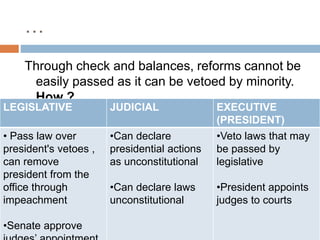
Through check and balances, reforms cannot be
easily passed as it can be vetoed by minority.
How ?
LEGISLATIVE JUDICIAL EXECUTIVE
(PRESIDENT)
• Pass law over
president's vetoes ,
can remove
president from the
office through
impeachment
•Senate approve
•Can declare
presidential actions
as unconstitutional
•Can declare laws
unconstitutional
•Veto laws that may
be passed by
legislative
•President appoints
judges to courts
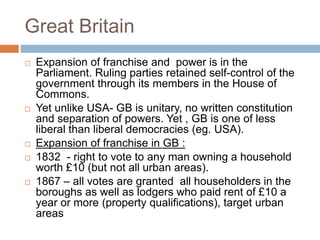
Great Britain
 Expansion of franchise and power is in the
Parliament. Ruling parties retained self-control of the
government through its members in the House of
Commons.
 Yet unlike USA- GB is unitary, no written constitution
and separation of powers. Yet , GB is one of less
liberal than liberal democracies (eg. USA).
 Expansion of franchise in GB :
 1832 - right to vote to any man owning a household
worth £10 (but not all urban areas).
 1867 – all votes are granted all householders in the
boroughs as well as lodgers who paid rent of £10 a
year or more (property qualifications), target urban
areas
…
 1884 : uniform franchise throughout the
country, target rural areas (but with lodgers
who paid rent of £10 a year)
 1918 : Women, over 30, [men over 21]
 1928 : Equal franchise. Women were given
franchise as the same terms of men in
[Women voters : 21 yrs old]
Reversed Wave (1) [1922 –
1942]
 Occurred in countries that adopted democratic
forms before WW 1, where democracy and
nations were new
 First reverse in Italy, 1922 : Mussolini marched
into Rome and took advantage of Italy’s fragile
democracy. Faction-fighting, failed government
(instability); Fascist leader convinced the King
to appoint him as the Prime Minister “
Monarchy and Fascism could work together” .
…
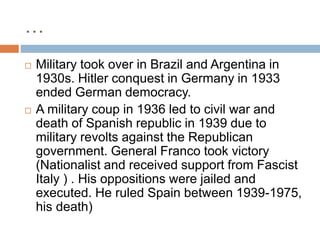
 Military took over in Brazil and Argentina in
1930s. Hitler conquest in Germany in 1933
ended German democracy.
 A military coup in 1936 led to civil war and
death of Spanish republic in 1939 due to
military revolts against the Republican
government. General Franco took victory
(Nationalist and received support from Fascist
Italy ) . His oppositions were jailed and
executed. He ruled Spain between 1939-1975,
his death)
SECOND WAVE [1943-1962]
Reverse [1958 -1972]
 After ww2, imposition of democracy in West
Germany, Japan and Austria
 Democracy also blossomed in Latin America,
post-colonial countries in Africa and Asia
such as Nigeria, Malaysia, Pakistan, India,
Phililippines.
 In Venuezela: overthrew of military ruler in
1958. Agreements and pacts were made
between elites to consolidate democracy –
eg) respect elections whatever the
outcomes, support democracy.
….
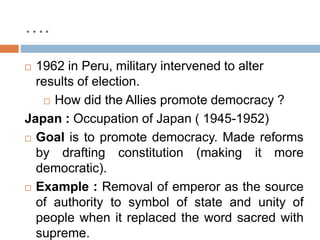
 1962 in Peru, military intervened to alter
results of election.
 How did the Allies promote democracy ?
Japan : Occupation of Japan ( 1945-1952)
 Goal is to promote democracy. Made reforms
by drafting constitution (making it more
democratic).
 Example : Removal of emperor as the source
of authority to symbol of state and unity of
people when it replaced the word sacred with
supreme.
….
 New constitution also turned down the clause
that would retain traditional values such as
children obligations to their parents.
 Also called for general election with women as
voters. 1946 general election – women were
allowed to vote.
…
 But democratic experience, were never took
hold in these countries. For example,
Malaysia’s democracy in interrupted between
1969-1971 (emergency rule).
 Pakistan, democracy is abrogated in 1958.
Martial law was declared. What is martial law?
Suspension of ordinary law, governed by
military government.
….
 Led to new form of government “ bureaucratic
authoritarianism” – decision-making is
technocratic accompanied with repression
against labour movement of parties connected
with labour movements. Brazil, Chile and
Uruguay
 Liberal traditions weaker when parties took
central role in democratic instruments.
What is consolidation of
democracy ?
 Huntington : The presence of two turnover tests.
When two main sides has given up power to the
other through election. Democracy is consolidated
.
 Przeworski : A particular system of institutions
become the only game in time and when one can
imagine acting outside the democratic institutions.
A system in which parties also lose elections (not
only opposition parties). If in election result when
president hand over the power to those who
defeated them.
THIRD WAVE [1974 -
 Third wave transformed the global political
scale : We see the liberalisation and
promotions of democracy.
 However , we also see a few of setbacks such
as in the case of China 1989 – Tiananmen
Square -Thousands of students and people
march through the capital to Tiananmen
Square, calling for a more democratic
government, against Communist rulers (drew
1.2 million pple) (popular uprising).
…
 Among the events : The ending of right-wing
dictatorship in Southern Europe (Portugal, Greece
and Spain).
 In Spain : Franco died in 1975. Succeeded by the
King (Gen. Franco appointed him in 1969, hoping
that he would carry his autocratic rule). In 1978 -
New constitution confirms Spain as a
parliamentary monarchy. It was approved also
approved by the citizens (Spanish) in referendum.
New constitution- Head of State plays the
symbolic role but PM is the key figure in politics.
 First parliamentary election in 1979
…
 The retreat of generals in Latin America in
1970s
 Collapse of Soviet Union and Eastern Europe
in 1980s.
 Final phase of European colonization :
Carnation revolution - overthrew of right-wing
dictatorship and end of Portuguese empire in
Africa. In 1999, it gave its last overseas
territory, Macau to China.
 1978 – South Africa began slow process to
reduce apartheid policy and expanded political
participation to non-white majorities.
…
 In 1990 – de Clerk resumed negotiations with
African National Congress by lifting the ban
against ANC ; and Nelson Mandela was
released (after 27 years in prison) – the
decision allowed active opposition in the
political system.
 1994 – ANC won the first non-racial elections
and Nelson Mandela was elected as the
President.
…
 But in general we can see
 Southern Europe : consolidation of democracy
 Latin America and Africa : Not yet consolidated,
bring about the category of illiberal democracy
(inclusive of Asia).
 Now, the notion of a "transition paradigm," in
which countries move from authoritarian rule
toward democracy is not strong as many countries
have been seen to settle into a "gray zone" of
diverse forms of government where autocratic and
democratic features are combined.
...
 WHY ?
 We have competitive elections, but democratic
qualities are hardly present. Example :
enforcing legal restraints on states’ power (rule
of law), protect civil rights, non-corrupt
bureaucracies and impose control on military.
Table 1 : Democratization in the
modern world [ADAPTED :
Huntington]
YEAR PERCENTAGE OF
DEMOCRACTIC
STATES
1922 45.3
1942 19.7
1962 32.4
1973 24.6
1990 45.4
WHAT EXPLAIN THE CAUSES
?
 In general, many countries have no tradition of
individual rights or formal restraint on rulers
even before the emergence of communist and
military dictatorships. Those are :
 1. Culture
 Not democratic. Leaders do not uphold rule of
law. How? No tolerance of other ethnic groups,
religions and not willing to co-operate with
them.
 Confucian values : maintenance of order and
respect for hierarchy.
…
 East Asian dominant party system , in
Singapore. The leader’s comments;
 “ A stable system is where there is a
mainstream political party representing broad
range of population. Then you can have other
parties at the periphery”
…
 2. Middle class
 Favourable to democracy. Why ? Members
would seek to establish their economic
security on the basis of private enterprise , rule
of law and accountable government.
 The rich : use their control of economy to
dominate the poor, while the poor will be
interested to expropriating the rich.
 Both are willing to impose authoritarianism.
…
 3. Economic
 Transform is possible with countries with
middle-income .
 The development of private enterprise will
“kick in” democracy. How ? When people work
in this area, they want to have a say in how
government treats them eg.) property laws,
rights, business regulations and taxes –
stimulates the growth of Middle class – does
not depend on states for livelihood.

C3 - Waves of Democratisation

  • 1.
    DEMOCRACY : WAVES OFDEMOCRATISATION PSCI 2210 SEM 1, 2015/2016 SECTION 1 & 2
  • 2.
    WHAT IS IT?  A group of transitions from non-democratic regime to democratic regimes that occur within a period of time and that significantly outnumber transitions in the opposite directions.  Note : Not every transitions of democracy occur at the same time  Each wave is followed by a reverse wave.  What is reverse wave ?  When democratic transitions is reversed, whole or part – democratic become less democratic (illiberal democracy) or authoritarian
  • 3.
    FIRST WAVE :1828-1926  Note : First reverse wave : 1922-1942  First wave, democratisation : 33 countries adopted universal suffrage by secret ballot  The start : United States of America, roughly about 1828.  What is the indicator of the first wave ? Universal suffrage.
  • 4.
    …..  1828 :Abolition of property qualifications boosted over 50% of proportion of white males in voting in 1828 presidential election.  1919 – suffrage is extended to all white males and women  Constitution of the USA : Divides power between three organs of government to prevent the abuse of power [ prevent the majority from ruling with an iron fist] through CHECK and BALANCES.
  • 5.
    … Through check andbalances, reforms cannot be easily passed as it can be vetoed by minority. How ? LEGISLATIVE JUDICIAL EXECUTIVE (PRESIDENT) • Pass law over president's vetoes , can remove president from the office through impeachment •Senate approve •Can declare presidential actions as unconstitutional •Can declare laws unconstitutional •Veto laws that may be passed by legislative •President appoints judges to courts
  • 6.
    Great Britain  Expansionof franchise and power is in the Parliament. Ruling parties retained self-control of the government through its members in the House of Commons.  Yet unlike USA- GB is unitary, no written constitution and separation of powers. Yet , GB is one of less liberal than liberal democracies (eg. USA).  Expansion of franchise in GB :  1832 - right to vote to any man owning a household worth £10 (but not all urban areas).  1867 – all votes are granted all householders in the boroughs as well as lodgers who paid rent of £10 a year or more (property qualifications), target urban areas
  • 7.
    …  1884 :uniform franchise throughout the country, target rural areas (but with lodgers who paid rent of £10 a year)  1918 : Women, over 30, [men over 21]  1928 : Equal franchise. Women were given franchise as the same terms of men in [Women voters : 21 yrs old]
  • 8.
    Reversed Wave (1)[1922 – 1942]  Occurred in countries that adopted democratic forms before WW 1, where democracy and nations were new  First reverse in Italy, 1922 : Mussolini marched into Rome and took advantage of Italy’s fragile democracy. Faction-fighting, failed government (instability); Fascist leader convinced the King to appoint him as the Prime Minister “ Monarchy and Fascism could work together” .
  • 9.
    …  Military tookover in Brazil and Argentina in 1930s. Hitler conquest in Germany in 1933 ended German democracy.  A military coup in 1936 led to civil war and death of Spanish republic in 1939 due to military revolts against the Republican government. General Franco took victory (Nationalist and received support from Fascist Italy ) . His oppositions were jailed and executed. He ruled Spain between 1939-1975, his death)
  • 10.
    SECOND WAVE [1943-1962] Reverse[1958 -1972]  After ww2, imposition of democracy in West Germany, Japan and Austria  Democracy also blossomed in Latin America, post-colonial countries in Africa and Asia such as Nigeria, Malaysia, Pakistan, India, Phililippines.  In Venuezela: overthrew of military ruler in 1958. Agreements and pacts were made between elites to consolidate democracy – eg) respect elections whatever the outcomes, support democracy.
  • 11.
    ….  1962 inPeru, military intervened to alter results of election.  How did the Allies promote democracy ? Japan : Occupation of Japan ( 1945-1952)  Goal is to promote democracy. Made reforms by drafting constitution (making it more democratic).  Example : Removal of emperor as the source of authority to symbol of state and unity of people when it replaced the word sacred with supreme.
  • 12.
    ….  New constitutionalso turned down the clause that would retain traditional values such as children obligations to their parents.  Also called for general election with women as voters. 1946 general election – women were allowed to vote.
  • 13.
    …  But democraticexperience, were never took hold in these countries. For example, Malaysia’s democracy in interrupted between 1969-1971 (emergency rule).  Pakistan, democracy is abrogated in 1958. Martial law was declared. What is martial law? Suspension of ordinary law, governed by military government.
  • 14.
    ….  Led tonew form of government “ bureaucratic authoritarianism” – decision-making is technocratic accompanied with repression against labour movement of parties connected with labour movements. Brazil, Chile and Uruguay  Liberal traditions weaker when parties took central role in democratic instruments.
  • 15.
    What is consolidationof democracy ?  Huntington : The presence of two turnover tests. When two main sides has given up power to the other through election. Democracy is consolidated .  Przeworski : A particular system of institutions become the only game in time and when one can imagine acting outside the democratic institutions. A system in which parties also lose elections (not only opposition parties). If in election result when president hand over the power to those who defeated them.
  • 16.
    THIRD WAVE [1974-  Third wave transformed the global political scale : We see the liberalisation and promotions of democracy.  However , we also see a few of setbacks such as in the case of China 1989 – Tiananmen Square -Thousands of students and people march through the capital to Tiananmen Square, calling for a more democratic government, against Communist rulers (drew 1.2 million pple) (popular uprising).
  • 17.
    …  Among theevents : The ending of right-wing dictatorship in Southern Europe (Portugal, Greece and Spain).  In Spain : Franco died in 1975. Succeeded by the King (Gen. Franco appointed him in 1969, hoping that he would carry his autocratic rule). In 1978 - New constitution confirms Spain as a parliamentary monarchy. It was approved also approved by the citizens (Spanish) in referendum. New constitution- Head of State plays the symbolic role but PM is the key figure in politics.  First parliamentary election in 1979
  • 18.
    …  The retreatof generals in Latin America in 1970s  Collapse of Soviet Union and Eastern Europe in 1980s.  Final phase of European colonization : Carnation revolution - overthrew of right-wing dictatorship and end of Portuguese empire in Africa. In 1999, it gave its last overseas territory, Macau to China.  1978 – South Africa began slow process to reduce apartheid policy and expanded political participation to non-white majorities.
  • 19.
    …  In 1990– de Clerk resumed negotiations with African National Congress by lifting the ban against ANC ; and Nelson Mandela was released (after 27 years in prison) – the decision allowed active opposition in the political system.  1994 – ANC won the first non-racial elections and Nelson Mandela was elected as the President.
  • 20.
    …  But ingeneral we can see  Southern Europe : consolidation of democracy  Latin America and Africa : Not yet consolidated, bring about the category of illiberal democracy (inclusive of Asia).  Now, the notion of a "transition paradigm," in which countries move from authoritarian rule toward democracy is not strong as many countries have been seen to settle into a "gray zone" of diverse forms of government where autocratic and democratic features are combined.
  • 21.
    ...  WHY ? We have competitive elections, but democratic qualities are hardly present. Example : enforcing legal restraints on states’ power (rule of law), protect civil rights, non-corrupt bureaucracies and impose control on military.
  • 22.
    Table 1 :Democratization in the modern world [ADAPTED : Huntington] YEAR PERCENTAGE OF DEMOCRACTIC STATES 1922 45.3 1942 19.7 1962 32.4 1973 24.6 1990 45.4
  • 23.
    WHAT EXPLAIN THECAUSES ?  In general, many countries have no tradition of individual rights or formal restraint on rulers even before the emergence of communist and military dictatorships. Those are :  1. Culture  Not democratic. Leaders do not uphold rule of law. How? No tolerance of other ethnic groups, religions and not willing to co-operate with them.  Confucian values : maintenance of order and respect for hierarchy.
  • 24.
    …  East Asiandominant party system , in Singapore. The leader’s comments;  “ A stable system is where there is a mainstream political party representing broad range of population. Then you can have other parties at the periphery”
  • 25.
    …  2. Middleclass  Favourable to democracy. Why ? Members would seek to establish their economic security on the basis of private enterprise , rule of law and accountable government.  The rich : use their control of economy to dominate the poor, while the poor will be interested to expropriating the rich.  Both are willing to impose authoritarianism.
  • 26.
    …  3. Economic Transform is possible with countries with middle-income .  The development of private enterprise will “kick in” democracy. How ? When people work in this area, they want to have a say in how government treats them eg.) property laws, rights, business regulations and taxes – stimulates the growth of Middle class – does not depend on states for livelihood.