The Role of Marketing 
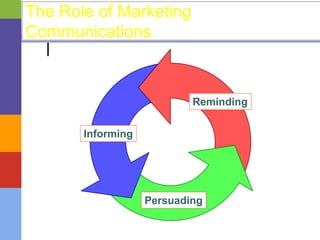
Communications 
Informing 
Reminding 
Persuading
The Marketing Communications Mix
Integrated Marketing Communications 
 Integrated Marketing 
Communications (IMC): 
 The strategic integration of 
multiple means of 
communicating with target 
markets to form a 
comprehensive, consistent 
message.
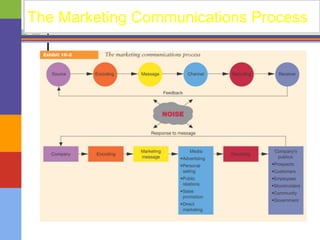
The Marketing Communications Process
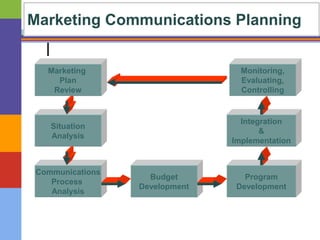
Marketing Communications Planning 
Situation 
Analysis 
Communications 
Process 
Analysis 
Budget 
Development 
Monitoring, 
Evaluating, 
Controlling 
Integration 
& 
Implementation 
Program 
Development 
Marketing 
Plan 
Review
Situation Analysis 
The 
Competitive 
Environment 
The 
Economic 
Environment 
Marketing 
Mix 
Considerations 
The 
Social 
Environment
Communications Process Analysis 
 Set Marketing Communications 
Objectives 
 Apply the Basic Communication Model.
Budget Development 
 Influences on Budgeting: 
 Size of the company 
 Its financial resources 
 The type of business 
 The market dispersion 
 The industry growth rate 
 The firm’s position in the 
marketplace
Budgeting Methods 
 Percentage of Sales 
 Competitive Parity 
 All-You-Can-Afford 
 Objective-Task
Marketing Communications 
Program Development 
 Explicit Communications: 
 Convey a distinct, clearly stated message through personal 
selling, advertising, public relations, sales promotion, direct 
marketing, or some combination of these methods. 
 Implicit Communications: 
 What the message connotes about the product itself, its price, or 
the places it is sold.
Push, Pull, and Combination 
Strategies 
 Push Strategy: 
 Involves convincing intermediary channel members to “push” 
the product through the cannel to the ultimate consumer. 
 Pull Strategy: 
 Attempts to get consumers to “pull” the product from the 
manufacturing company through the marketing channel.
Push, Pull, and Combination 
Strategies 
 Combination Strategy: 
 Aiming marketing communications 
at both resellers and ultimate 
consumers.
Integration and Implementation 
 Implementation: 
 Setting the marketing communications 
plan into action. 
The key aspect of implementation 
is coordination !!!
Monitoring, Evaluating, and 
Controlling 
 Monitor sales promotion by the number of 
coupons redeemed. 
 Measure the effectiveness of a new personal 
selling strategy by looking at the number of new 
accounts opened. 
 A firm might run tests to see it consumers 
noticed the ad. 
 Review sales results and attribute fluctuations in 
sales volume to MC.
Ethical and Legal Considerations 
M C Element Legal / Ethical Concerns 
Advertising Deceptive advertising 
Unfavorable stereotypes 
Public Relations Lack of sincerity 
Using economic power unfairly 
Sales Promotion Misleading consumer promotions 
Paying slotting allowances for shelf space 
Personal Selling High-pressure selling 
Misrepresenting product benefits 
Direct Marketing Telemarketing privacy invasion 
Misuse of consumer database information
Legal -- but Ethical? 
 Some marketing communications may be 
technically legal but raise significant ethical 
questions: 
 Liquor industry now advertises on cable and local 
television stations. 
 Extensive promotion of higher-cost drugs when 
health care costs are spiraling out of control. 
 Heavy promotional allowances to pharmacies for 
agreement to push proprietary instead of generic 
drugs. 
 Promotion of legalized gambling.

IMC Planning Process

  • 1.
    The Role ofMarketing Communications Informing Reminding Persuading
  • 2.
  • 3.
    Integrated Marketing Communications  Integrated Marketing Communications (IMC):  The strategic integration of multiple means of communicating with target markets to form a comprehensive, consistent message.
  • 4.
  • 5.
    Marketing Communications Planning Situation Analysis Communications Process Analysis Budget Development Monitoring, Evaluating, Controlling Integration & Implementation Program Development Marketing Plan Review
  • 6.
    Situation Analysis The Competitive Environment The Economic Environment Marketing Mix Considerations The Social Environment
  • 7.
    Communications Process Analysis  Set Marketing Communications Objectives  Apply the Basic Communication Model.
  • 8.
    Budget Development Influences on Budgeting:  Size of the company  Its financial resources  The type of business  The market dispersion  The industry growth rate  The firm’s position in the marketplace
  • 9.
    Budgeting Methods Percentage of Sales  Competitive Parity  All-You-Can-Afford  Objective-Task
  • 10.
    Marketing Communications ProgramDevelopment  Explicit Communications:  Convey a distinct, clearly stated message through personal selling, advertising, public relations, sales promotion, direct marketing, or some combination of these methods.  Implicit Communications:  What the message connotes about the product itself, its price, or the places it is sold.
  • 11.
    Push, Pull, andCombination Strategies  Push Strategy:  Involves convincing intermediary channel members to “push” the product through the cannel to the ultimate consumer.  Pull Strategy:  Attempts to get consumers to “pull” the product from the manufacturing company through the marketing channel.
  • 12.
    Push, Pull, andCombination Strategies  Combination Strategy:  Aiming marketing communications at both resellers and ultimate consumers.
  • 13.
    Integration and Implementation  Implementation:  Setting the marketing communications plan into action. The key aspect of implementation is coordination !!!
  • 14.
    Monitoring, Evaluating, and Controlling  Monitor sales promotion by the number of coupons redeemed.  Measure the effectiveness of a new personal selling strategy by looking at the number of new accounts opened.  A firm might run tests to see it consumers noticed the ad.  Review sales results and attribute fluctuations in sales volume to MC.
  • 15.
    Ethical and LegalConsiderations M C Element Legal / Ethical Concerns Advertising Deceptive advertising Unfavorable stereotypes Public Relations Lack of sincerity Using economic power unfairly Sales Promotion Misleading consumer promotions Paying slotting allowances for shelf space Personal Selling High-pressure selling Misrepresenting product benefits Direct Marketing Telemarketing privacy invasion Misuse of consumer database information
  • 16.
    Legal -- butEthical?  Some marketing communications may be technically legal but raise significant ethical questions:  Liquor industry now advertises on cable and local television stations.  Extensive promotion of higher-cost drugs when health care costs are spiraling out of control.  Heavy promotional allowances to pharmacies for agreement to push proprietary instead of generic drugs.  Promotion of legalized gambling.