Company and Marketing Strategy: Partnering to Build Customer Relationships
Strategic Planning Strategic Planning   is the Process of Developing and Maintaining a Strategic Fit Between the Organization’s Goals and Capabilities and Its Changing Marketing Opportunities.
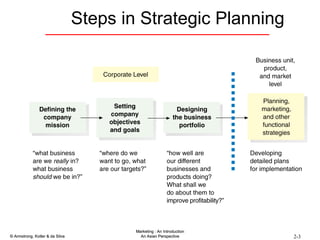
Steps in Strategic Planning
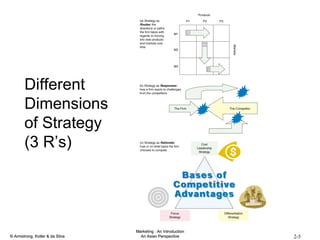
The 3 R’s of Strategy Routes: The  directions  the firm will choose to pursue in terms of markets and products Responses: How the firm  reacts  to competitors marketing strategies Rationale: The  basis  upon which the firm chooses to compete such as lower costs, differentiation or niching
Different Dimensions of Strategy (3 R’s)
Outcomes of effective marketing strategies: Achieve clear competitive advantages over the firm’s rivals Create positive responses among its target customers Turn in positive contributions to its bottom-line
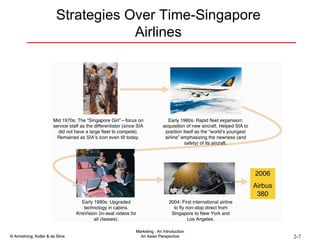
Strategies Over Time-Singapore Airlines
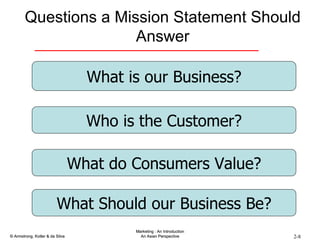
Questions a Mission Statement Should Answer What is our Business? Who is the Customer? What do Consumers Value? What Should our Business Be?
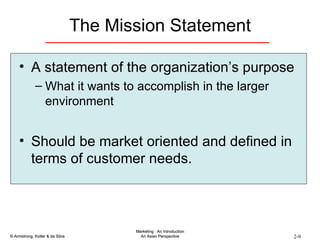
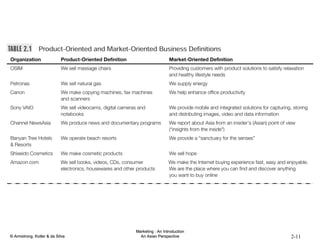
The Mission Statement A statement of the organization’s purpose What it wants to accomplish in the larger environment Should be market oriented and defined in terms of customer needs.
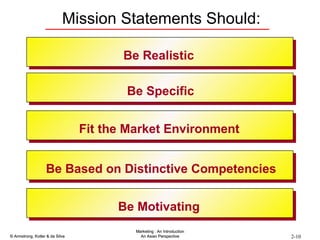
Mission Statements Should: Be Realistic  Be Specific Fit the Market Environment  Be Based on Distinctive Competencies Be Motivating
 
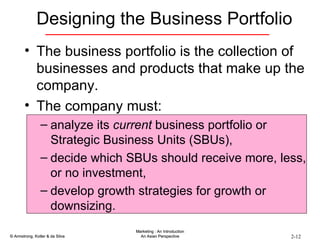
Designing the Business Portfolio The business portfolio is the collection of businesses and products that make up the company. The company must: analyze its  current  business portfolio or Strategic Business Units (SBUs), decide which SBUs should receive more, less, or no investment, develop growth strategies for growth or downsizing.
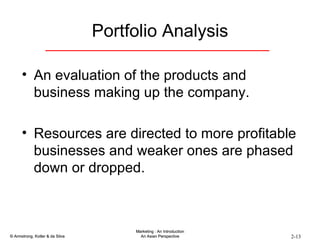
Portfolio Analysis An evaluation of the products and business making up the company. Resources are directed to more profitable businesses and weaker ones are phased down or dropped.
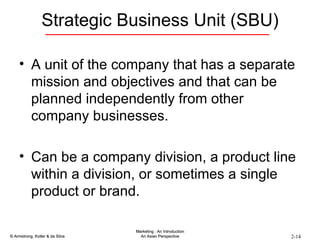
Strategic Business Unit (SBU) A unit of the company that has a separate mission and objectives and that can be planned independently from other company businesses. Can be a company division, a product line within a division, or sometimes a single product or brand.
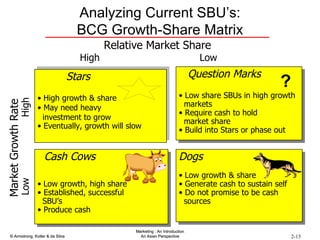
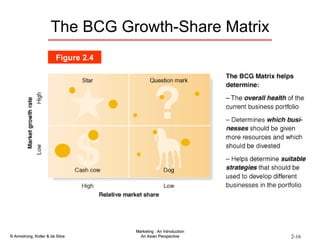
Analyzing Current SBU’s: BCG Growth-Share Matrix Question Marks Low share SBUs in high growth markets Require cash to hold  market share Build into Stars or phase out   Stars High growth & share May need heavy  investment to grow Eventually, growth will slow Relative Market Share   High  Low Market Growth Rate Low  High ? Cash Cows Low growth, high share Established, successful SBU’s Produce cash Dogs Low growth & share  Generate cash to sustain self Do not promise to be cash  sources
The BCG Growth-Share Matrix Figure 2.4
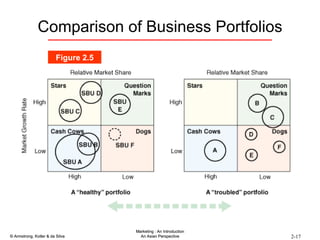
Comparison of Business Portfolios Figure 2.5
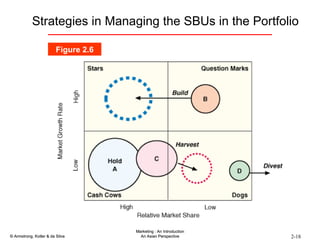
Figure 2.6 Strategies in Managing the SBUs in the Portfolio
Problems With Matrix Approaches Can be Difficult, Time Consuming, Costly to Implement Difficult to Define SBUs & Measure Market Share/Growth Focus on Current Businesses, Not Future Planning Can Place too Much Emphasis on Growth Can Lead to Poorly Planned Diversification
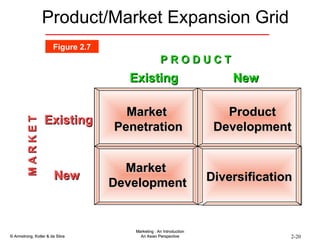
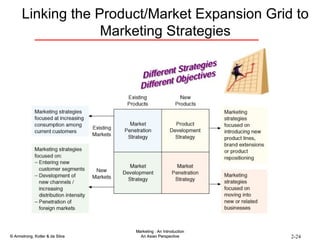
Product/Market Expansion Grid Market  Penetration Product Development Market  Development Existing New P R O D U C T New M A R K E T Diversification Existing Figure 2.7
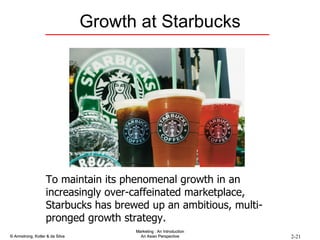
Growth at Starbucks To maintain its phenomenal growth in an increasingly over-caffeinated marketplace, Starbucks has brewed up an ambitious, multi-pronged growth strategy.
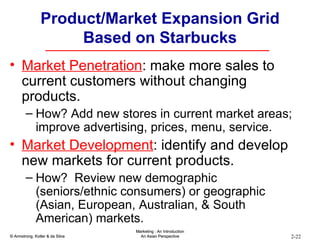
Product/Market Expansion Grid Based on Starbucks Market Penetration : make more sales to current customers without changing products.  How? Add new stores in current market areas; improve advertising, prices, menu, service. Market Development : identify and develop new markets for current products.  How?  Review new demographic (seniors/ethnic consumers) or geographic (Asian, European, Australian, & South American) markets.
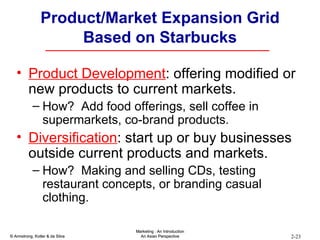
Product/Market Expansion Grid   Based on Starbucks Product Development : offering modified or new products to current markets.  How?  Add food offerings, sell coffee in supermarkets, co-brand products. Diversification : start up or buy businesses outside current products and markets. How?  Making and selling CDs, testing restaurant concepts, or branding casual clothing.
Linking the Product/Market Expansion Grid to Marketing Strategies
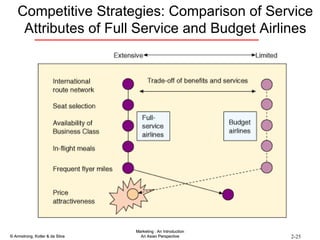
Competitive Strategies: Comparison of Service Attributes of Full Service and Budget Airlines
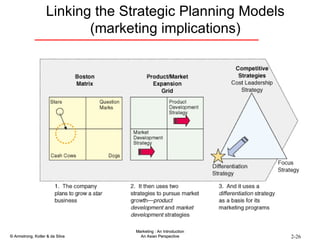
Linking the Strategic Planning Models (marketing implications)
 
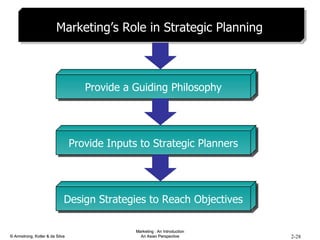
Marketing’s Role in Strategic Planning Provide a Guiding Philosophy Provide Inputs to Strategic Planners Design Strategies to Reach Objectives
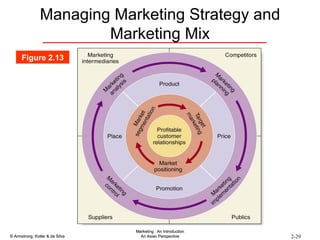
Managing Marketing Strategy and Marketing Mix Figure 2.13
Market Segmentation The process of dividing a market into distinct groups of buyers with different needs, characteristics, or behavior who might require separate products of marketing programs. A market segment consists of consumers who respond in a similar way to a given set of marketing efforts.
Target Marketing Involves evaluating each market segment’s attractiveness and selecting one or more segments to enter. Target segments that can sustain profitability.
Market Positioning Arranging for a product to occupy a clear, distinctive, and desirable place relative to competing products in the minds of target consumers (e.g. “in a perfect world everyone would drive a Mercedes Benz”) Process begins with differentiating the company’s marketing offer so it gives consumers more value.
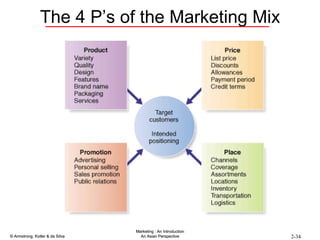
The Marketing Mix The set of controllable, tactical marketing tools that the firm blends to produce the response it wants in the target market. Consists of the 4 P’s Product Price Place Promotion
The 4 P’s of the Marketing Mix
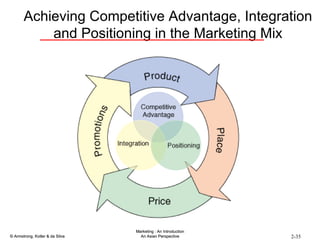
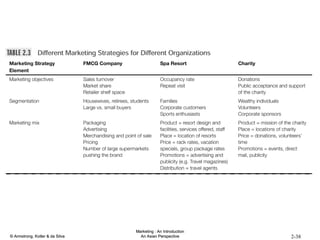
Achieving Competitive Advantage, Integration and Positioning in the Marketing Mix
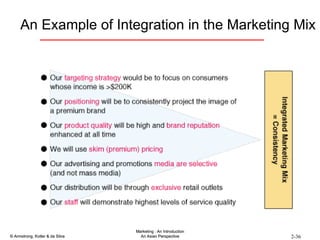
An Example of Integration in the Marketing Mix
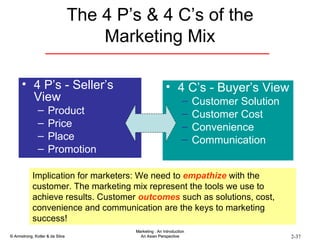
The 4 P’s & 4 C’s of the Marketing Mix 4 P’s - Seller’s View Product Price Place Promotion 4 C’s - Buyer’s View Customer Solution Customer Cost Convenience Communication Implication for marketers: We need to  empathize  with the customer. The marketing mix represent the tools we use to achieve results. Customer  outcomes  such as solutions, cost, convenience and communication are the keys to marketing success!
 
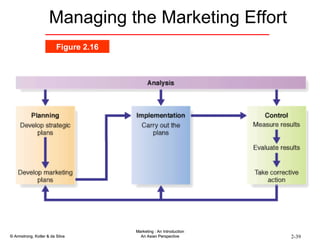
Managing the Marketing Effort Figure 2.16
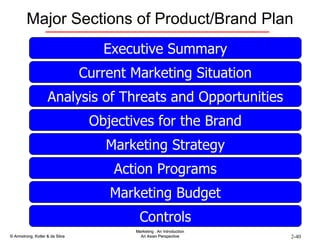
Major Sections of Product/Brand Plan Executive Summary Current Marketing Situation Analysis of Threats and Opportunities Objectives for the Brand Marketing Strategy Action Programs Marketing Budget Controls
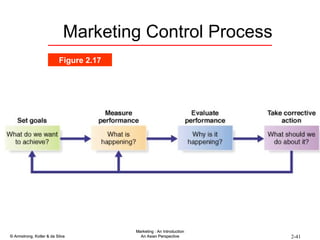
Marketing Control Process Figure 2.17

MARKETING-CH2

  • 1.
    Company and MarketingStrategy: Partnering to Build Customer Relationships
  • 2.
    Strategic Planning StrategicPlanning is the Process of Developing and Maintaining a Strategic Fit Between the Organization’s Goals and Capabilities and Its Changing Marketing Opportunities.
  • 3.
  • 4.
    The 3 R’sof Strategy Routes: The directions the firm will choose to pursue in terms of markets and products Responses: How the firm reacts to competitors marketing strategies Rationale: The basis upon which the firm chooses to compete such as lower costs, differentiation or niching
  • 5.
    Different Dimensions ofStrategy (3 R’s)
  • 6.
    Outcomes of effectivemarketing strategies: Achieve clear competitive advantages over the firm’s rivals Create positive responses among its target customers Turn in positive contributions to its bottom-line
  • 7.
  • 8.
    Questions a MissionStatement Should Answer What is our Business? Who is the Customer? What do Consumers Value? What Should our Business Be?
  • 9.
    The Mission StatementA statement of the organization’s purpose What it wants to accomplish in the larger environment Should be market oriented and defined in terms of customer needs.
  • 10.
    Mission Statements Should:Be Realistic Be Specific Fit the Market Environment Be Based on Distinctive Competencies Be Motivating
  • 11.
  • 12.
    Designing the BusinessPortfolio The business portfolio is the collection of businesses and products that make up the company. The company must: analyze its current business portfolio or Strategic Business Units (SBUs), decide which SBUs should receive more, less, or no investment, develop growth strategies for growth or downsizing.
  • 13.
    Portfolio Analysis Anevaluation of the products and business making up the company. Resources are directed to more profitable businesses and weaker ones are phased down or dropped.
  • 14.
    Strategic Business Unit(SBU) A unit of the company that has a separate mission and objectives and that can be planned independently from other company businesses. Can be a company division, a product line within a division, or sometimes a single product or brand.
  • 15.
    Analyzing Current SBU’s:BCG Growth-Share Matrix Question Marks Low share SBUs in high growth markets Require cash to hold market share Build into Stars or phase out Stars High growth & share May need heavy investment to grow Eventually, growth will slow Relative Market Share High Low Market Growth Rate Low High ? Cash Cows Low growth, high share Established, successful SBU’s Produce cash Dogs Low growth & share Generate cash to sustain self Do not promise to be cash sources
  • 16.
    The BCG Growth-ShareMatrix Figure 2.4
  • 17.
    Comparison of BusinessPortfolios Figure 2.5
  • 18.
    Figure 2.6 Strategiesin Managing the SBUs in the Portfolio
  • 19.
    Problems With MatrixApproaches Can be Difficult, Time Consuming, Costly to Implement Difficult to Define SBUs & Measure Market Share/Growth Focus on Current Businesses, Not Future Planning Can Place too Much Emphasis on Growth Can Lead to Poorly Planned Diversification
  • 20.
    Product/Market Expansion GridMarket Penetration Product Development Market Development Existing New P R O D U C T New M A R K E T Diversification Existing Figure 2.7
  • 21.
    Growth at StarbucksTo maintain its phenomenal growth in an increasingly over-caffeinated marketplace, Starbucks has brewed up an ambitious, multi-pronged growth strategy.
  • 22.
    Product/Market Expansion GridBased on Starbucks Market Penetration : make more sales to current customers without changing products. How? Add new stores in current market areas; improve advertising, prices, menu, service. Market Development : identify and develop new markets for current products. How? Review new demographic (seniors/ethnic consumers) or geographic (Asian, European, Australian, & South American) markets.
  • 23.
    Product/Market Expansion Grid Based on Starbucks Product Development : offering modified or new products to current markets. How? Add food offerings, sell coffee in supermarkets, co-brand products. Diversification : start up or buy businesses outside current products and markets. How? Making and selling CDs, testing restaurant concepts, or branding casual clothing.
  • 24.
    Linking the Product/MarketExpansion Grid to Marketing Strategies
  • 25.
    Competitive Strategies: Comparisonof Service Attributes of Full Service and Budget Airlines
  • 26.
    Linking the StrategicPlanning Models (marketing implications)
  • 27.
  • 28.
    Marketing’s Role inStrategic Planning Provide a Guiding Philosophy Provide Inputs to Strategic Planners Design Strategies to Reach Objectives
  • 29.
    Managing Marketing Strategyand Marketing Mix Figure 2.13
  • 30.
    Market Segmentation Theprocess of dividing a market into distinct groups of buyers with different needs, characteristics, or behavior who might require separate products of marketing programs. A market segment consists of consumers who respond in a similar way to a given set of marketing efforts.
  • 31.
    Target Marketing Involvesevaluating each market segment’s attractiveness and selecting one or more segments to enter. Target segments that can sustain profitability.
  • 32.
    Market Positioning Arrangingfor a product to occupy a clear, distinctive, and desirable place relative to competing products in the minds of target consumers (e.g. “in a perfect world everyone would drive a Mercedes Benz”) Process begins with differentiating the company’s marketing offer so it gives consumers more value.
  • 33.
    The Marketing MixThe set of controllable, tactical marketing tools that the firm blends to produce the response it wants in the target market. Consists of the 4 P’s Product Price Place Promotion
  • 34.
    The 4 P’sof the Marketing Mix
  • 35.
    Achieving Competitive Advantage,Integration and Positioning in the Marketing Mix
  • 36.
    An Example ofIntegration in the Marketing Mix
  • 37.
    The 4 P’s& 4 C’s of the Marketing Mix 4 P’s - Seller’s View Product Price Place Promotion 4 C’s - Buyer’s View Customer Solution Customer Cost Convenience Communication Implication for marketers: We need to empathize with the customer. The marketing mix represent the tools we use to achieve results. Customer outcomes such as solutions, cost, convenience and communication are the keys to marketing success!
  • 38.
  • 39.
    Managing the MarketingEffort Figure 2.16
  • 40.
    Major Sections ofProduct/Brand Plan Executive Summary Current Marketing Situation Analysis of Threats and Opportunities Objectives for the Brand Marketing Strategy Action Programs Marketing Budget Controls
  • 41.