Marketing: Managing
Profitable Customer
Relationships
11
Principles of Marketing
Learning Objectives
After studying this chapter, you should be able to:
1. Define marketing and outline the steps in the marketing
process
2. Explain the importance of understanding customers and the
marketplace, and identify the five core marketplace concepts
3. Identify the key elements of a customer-driven marketing
strategy and discuss the marketing management orientations
that guide marketing strategy
4. Discuss customer relationship management, and identify
strategies for creating value for customers and capturing value
from customers in return
5. Describe the major trends and forces that are changing the
marketing landscape in this age of relationships
1-2
Chapter Concepts
1. What Is Marketing?
2. Understanding the Marketplace and Customer Needs
3. Designing a Customer-Driven Marketing Strategy
4. Preparing an Integrated Marketing Plan and Program
5. Building Customer Relationships
6. Capturing Value from Customers
7. The New Marketing Landscape
8. So, What Is Marketing? Pulling It All Together
1-3
What Is Marketing?
Marketing Defined
Marketing is the process by which companies
create value for customers and build strong
customer relationships to capture value from
customers in return
1-4
What Is Marketing?
The Marketing Process
1. Understand the marketplace and customer wants
and needs
2. Design a customer-driven marketing strategy
3. Construct a marketing plan that delivers superior
value
4. Build profitable relationships and create customer
satisfaction
5. Capture value from customers to create profit and
customer equity
1-5
Understanding the Marketplace
and Customer Needs
Customer Needs, Wants, and Demands
• Needs are states of deprivation
• Physical—food, clothing, warmth, safety
• Social—belonging and affection
• Individual—knowledge and self-
expression
1-6
Understanding the Marketplace
and Customer Needs
Customer Needs, Wants, and Demands
Wants are the form that needs take as they
are shaped by culture and individual
personality
Demands are wants backed by buying power
1-7
Understanding the Marketplace
and Customer Needs
Market Offerings—Products, Services, and
Experiences
Market offerings are some combination of
products, services, information, or
experiences offered to a market to satisfy a
need or want
1-8
Understanding the Marketplace
and Customer Needs
Market Offerings—Products, Services, and
Experiences
Marketing myopia is focusing only on
existing wants and losing sight of underlying
consumer needs
Exchange is the act of obtaining a desired
object from someone by offering something
in return
1-9
Understanding the Marketplace
and Customer Needs
Customer Value and Satisfaction
• Expectations
• Customers
• Value and satisfaction
• Marketers
• Set the right level of expectations
• Not too high or too low
1-10
Understanding the Marketplace
and Customer Needs
Exchanges and Relationships
Exchange is the act of obtaining a
desired object from someone by
offering something in return
Relationships consist of actions to build
and maintain desirable relationships
1-11
Understanding the Marketplace
and Customer Needs
Markets are the set of actual and potential buyers
of a product
Marketing system consists of all of the actors
(suppliers, company, competitors,
intermediaries, and end users) in the system
who are affected by major environmental forces
• Demographic
• Economic
• Physical
• Technological
• Political–legal
• Socio-cultural
1-12
Designing a Customer-Driven
Marketing Strategy
Marketing Management
Marketing management is the art and
science of choosing target markets and
building profitable relationships with them
• What customers will we serve?
• How can we best serve these customers?
1-13
Designing a Customer-Driven
Marketing Strategy
Selecting Customers to Serve
Market segmentation: Dividing the markets
into segments of customers
Target marketing: Which segments to go
after
1-14
Designing a Customer-Driven
Marketing Strategy
Selecting Customers to Serve
De-marketing: Marketing to reduce demand
temporarily or permanently; the aim is not to
destroy demand but to reduce or shift it.
1-15
Designing a Customer-Driven
Marketing Strategy
Selecting Customers to Serve
Marketing management is:
• Customer management
• Demand management
1-16
Designing a Customer-Driven
Marketing Strategy
Choosing a Value Proposition
The value proposition is the set of
benefits or values a company
promises to deliver to customers
to satisfy their needs
1-17
Designing a Customer-Driven
Marketing Strategy
Marketing Management Orientations
• Production concept
• Product concept
• Selling concept
• Marketing concept
• Societal concept
1-18
Designing a Customer-Driven
Marketing Strategy
Marketing Management Orientations
Production concept is the idea that
consumers will favor products that are
available or highly affordable
1-19
Designing a Customer-Driven
Marketing Strategy
Marketing Management Orientations
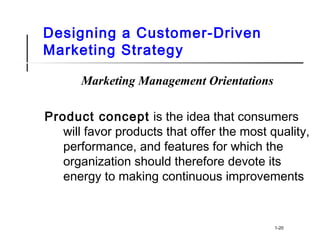
Product concept is the idea that consumers
will favor products that offer the most quality,
performance, and features for which the
organization should therefore devote its
energy to making continuous improvements
1-20
Designing a Customer-Driven
Marketing Strategy
Marketing Management Orientations
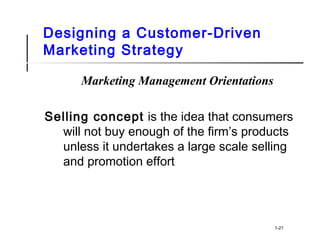
Selling concept is the idea that consumers
will not buy enough of the firm’s products
unless it undertakes a large scale selling
and promotion effort
1-21
Designing a Customer-Driven
Marketing Strategy
Marketing Management Orientations
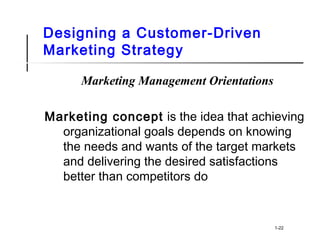
Marketing concept is the idea that achieving
organizational goals depends on knowing
the needs and wants of the target markets
and delivering the desired satisfactions
better than competitors do
1-22
Designing a Customer-Driven
Marketing Strategy
Marketing Management Orientations
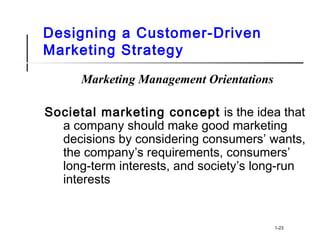
Societal marketing concept is the idea that
a company should make good marketing
decisions by considering consumers’ wants,
the company’s requirements, consumers’
long-term interests, and society’s long-run
interests
1-23
Preparing an Integrated
Marketing Plan and Program
Marketing Mix
The marketing mix is the set of tools (four
Ps) the firm uses to implement its marketing
strategy
• Product
• Price
• Promotion
• Place
1-24
Preparing an Integrated
Marketing Plan and Program
Integrated Marketing Program
Integrated marketing program is a
comprehensive plan that communicates and
delivers the intended value to chosen
customers
1-25
Building Customer Relationships
Customer Relationship Management
(CRM)
Customer relationship management is the
overall process of building and maintaining
profitable customer relationships by
delivering superior value and satisfaction
1-26
Building Customer Relationships
Customer Relationship Management
(CRM)
Customer perceived value is the difference
between total customer value and total customer
cost
Customer satisfaction is the extent to which a
product’s perceived performance matches a buyer’s
expectations
1-27
Building Customer Relationships
Customer Relationship Management
(CRM)
Customer Relationship Levels and Tools
• Basic relationship
• Full relationships
• Frequency marketing programs
• Club marketing programs
1-28
Building Customer Relationships
Partner Relationship Management
Partners inside the company is every function area
interacting with customers
• Electronically
• Cross-functional teams
Partners outside the company is how marketers
connect with their suppliers, channel partners, and
competitors by developing partnerships
1-31
Building Customer Relationships
Partner Relationship Management
Supply chain is a channel that stretches from
raw materials to components to final
products to final buyers
• Supply management
• Strategic partners
• Strategic alliances
1-32
Capturing Value from Customers
Creating Customer Loyalty and Retention
Customer lifetime value is the value of
the entire stream of purchases that the
customer would make over a lifetime of
patronage
1-33
Capturing Value from Customers
Growing Share of Customer
Share of customer is the portion of the
customer’s purchasing that a company gets
in its product categories
1-34
Capturing Value from Customers
Building Customer Equity
Customer equity is the total combined
customer lifetime values of all of the
company’s customers
1-35
Capturing Value from Customers
Building Customer Equity
Building the right relationships with the
right customers involves treating
customers as assets that need to be
managed and maximized
• Different types of customers require different
relationship management strategies
• Build the right relationship with the right
customers
1-36
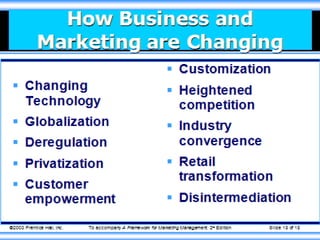
The New Marketing Landscape
Major Developments
• Digital age
• Globalization
• Ethics and social responsibility
• Not-for-profit marketing
1-37
The New Marketing Landscape
The Call for More Ethics and Social Responsibility
Social marketing campaigns encourage
energy conservation and concern for the
environment or discourage smoking,
excessive drinking, and drug use
1-42
The New Marketing Landscape
The Growth for Not-for-Profit Marketing
• Colleges
• Hospitals
• Museums
• Zoos
• Orchestras
• Religious groups
1-43

1 managing

  • 1.
  • 2.
    Learning Objectives After studyingthis chapter, you should be able to: 1. Define marketing and outline the steps in the marketing process 2. Explain the importance of understanding customers and the marketplace, and identify the five core marketplace concepts 3. Identify the key elements of a customer-driven marketing strategy and discuss the marketing management orientations that guide marketing strategy 4. Discuss customer relationship management, and identify strategies for creating value for customers and capturing value from customers in return 5. Describe the major trends and forces that are changing the marketing landscape in this age of relationships 1-2
  • 3.
    Chapter Concepts 1. WhatIs Marketing? 2. Understanding the Marketplace and Customer Needs 3. Designing a Customer-Driven Marketing Strategy 4. Preparing an Integrated Marketing Plan and Program 5. Building Customer Relationships 6. Capturing Value from Customers 7. The New Marketing Landscape 8. So, What Is Marketing? Pulling It All Together 1-3
  • 4.
    What Is Marketing? MarketingDefined Marketing is the process by which companies create value for customers and build strong customer relationships to capture value from customers in return 1-4
  • 5.
    What Is Marketing? TheMarketing Process 1. Understand the marketplace and customer wants and needs 2. Design a customer-driven marketing strategy 3. Construct a marketing plan that delivers superior value 4. Build profitable relationships and create customer satisfaction 5. Capture value from customers to create profit and customer equity 1-5
  • 6.
    Understanding the Marketplace andCustomer Needs Customer Needs, Wants, and Demands • Needs are states of deprivation • Physical—food, clothing, warmth, safety • Social—belonging and affection • Individual—knowledge and self- expression 1-6
  • 7.
    Understanding the Marketplace andCustomer Needs Customer Needs, Wants, and Demands Wants are the form that needs take as they are shaped by culture and individual personality Demands are wants backed by buying power 1-7
  • 8.
    Understanding the Marketplace andCustomer Needs Market Offerings—Products, Services, and Experiences Market offerings are some combination of products, services, information, or experiences offered to a market to satisfy a need or want 1-8
  • 9.
    Understanding the Marketplace andCustomer Needs Market Offerings—Products, Services, and Experiences Marketing myopia is focusing only on existing wants and losing sight of underlying consumer needs Exchange is the act of obtaining a desired object from someone by offering something in return 1-9
  • 10.
    Understanding the Marketplace andCustomer Needs Customer Value and Satisfaction • Expectations • Customers • Value and satisfaction • Marketers • Set the right level of expectations • Not too high or too low 1-10
  • 11.
    Understanding the Marketplace andCustomer Needs Exchanges and Relationships Exchange is the act of obtaining a desired object from someone by offering something in return Relationships consist of actions to build and maintain desirable relationships 1-11
  • 12.
    Understanding the Marketplace andCustomer Needs Markets are the set of actual and potential buyers of a product Marketing system consists of all of the actors (suppliers, company, competitors, intermediaries, and end users) in the system who are affected by major environmental forces • Demographic • Economic • Physical • Technological • Political–legal • Socio-cultural 1-12
  • 13.
    Designing a Customer-Driven MarketingStrategy Marketing Management Marketing management is the art and science of choosing target markets and building profitable relationships with them • What customers will we serve? • How can we best serve these customers? 1-13
  • 14.
    Designing a Customer-Driven MarketingStrategy Selecting Customers to Serve Market segmentation: Dividing the markets into segments of customers Target marketing: Which segments to go after 1-14
  • 15.
    Designing a Customer-Driven MarketingStrategy Selecting Customers to Serve De-marketing: Marketing to reduce demand temporarily or permanently; the aim is not to destroy demand but to reduce or shift it. 1-15
  • 16.
    Designing a Customer-Driven MarketingStrategy Selecting Customers to Serve Marketing management is: • Customer management • Demand management 1-16
  • 17.
    Designing a Customer-Driven MarketingStrategy Choosing a Value Proposition The value proposition is the set of benefits or values a company promises to deliver to customers to satisfy their needs 1-17
  • 18.
    Designing a Customer-Driven MarketingStrategy Marketing Management Orientations • Production concept • Product concept • Selling concept • Marketing concept • Societal concept 1-18
  • 19.
    Designing a Customer-Driven MarketingStrategy Marketing Management Orientations Production concept is the idea that consumers will favor products that are available or highly affordable 1-19
  • 20.
    Designing a Customer-Driven MarketingStrategy Marketing Management Orientations Product concept is the idea that consumers will favor products that offer the most quality, performance, and features for which the organization should therefore devote its energy to making continuous improvements 1-20
  • 21.
    Designing a Customer-Driven MarketingStrategy Marketing Management Orientations Selling concept is the idea that consumers will not buy enough of the firm’s products unless it undertakes a large scale selling and promotion effort 1-21
  • 22.
    Designing a Customer-Driven MarketingStrategy Marketing Management Orientations Marketing concept is the idea that achieving organizational goals depends on knowing the needs and wants of the target markets and delivering the desired satisfactions better than competitors do 1-22
  • 23.
    Designing a Customer-Driven MarketingStrategy Marketing Management Orientations Societal marketing concept is the idea that a company should make good marketing decisions by considering consumers’ wants, the company’s requirements, consumers’ long-term interests, and society’s long-run interests 1-23
  • 24.
    Preparing an Integrated MarketingPlan and Program Marketing Mix The marketing mix is the set of tools (four Ps) the firm uses to implement its marketing strategy • Product • Price • Promotion • Place 1-24
  • 25.
    Preparing an Integrated MarketingPlan and Program Integrated Marketing Program Integrated marketing program is a comprehensive plan that communicates and delivers the intended value to chosen customers 1-25
  • 26.
    Building Customer Relationships CustomerRelationship Management (CRM) Customer relationship management is the overall process of building and maintaining profitable customer relationships by delivering superior value and satisfaction 1-26
  • 27.
    Building Customer Relationships CustomerRelationship Management (CRM) Customer perceived value is the difference between total customer value and total customer cost Customer satisfaction is the extent to which a product’s perceived performance matches a buyer’s expectations 1-27
  • 28.
    Building Customer Relationships CustomerRelationship Management (CRM) Customer Relationship Levels and Tools • Basic relationship • Full relationships • Frequency marketing programs • Club marketing programs 1-28
  • 29.
    Building Customer Relationships PartnerRelationship Management Partners inside the company is every function area interacting with customers • Electronically • Cross-functional teams Partners outside the company is how marketers connect with their suppliers, channel partners, and competitors by developing partnerships 1-31
  • 30.
    Building Customer Relationships PartnerRelationship Management Supply chain is a channel that stretches from raw materials to components to final products to final buyers • Supply management • Strategic partners • Strategic alliances 1-32
  • 31.
    Capturing Value fromCustomers Creating Customer Loyalty and Retention Customer lifetime value is the value of the entire stream of purchases that the customer would make over a lifetime of patronage 1-33
  • 32.
    Capturing Value fromCustomers Growing Share of Customer Share of customer is the portion of the customer’s purchasing that a company gets in its product categories 1-34
  • 33.
    Capturing Value fromCustomers Building Customer Equity Customer equity is the total combined customer lifetime values of all of the company’s customers 1-35
  • 34.
    Capturing Value fromCustomers Building Customer Equity Building the right relationships with the right customers involves treating customers as assets that need to be managed and maximized • Different types of customers require different relationship management strategies • Build the right relationship with the right customers 1-36
  • 35.
    The New MarketingLandscape Major Developments • Digital age • Globalization • Ethics and social responsibility • Not-for-profit marketing 1-37
  • 36.
    The New MarketingLandscape The Call for More Ethics and Social Responsibility Social marketing campaigns encourage energy conservation and concern for the environment or discourage smoking, excessive drinking, and drug use 1-42
  • 37.
    The New MarketingLandscape The Growth for Not-for-Profit Marketing • Colleges • Hospitals • Museums • Zoos • Orchestras • Religious groups 1-43