McKinsey’s 7-S
Model
Presented By,
Jerrin Mary John
HISTORY
• First mentioned in “The Art of Japanese Management”
by Richard Pascale & Antony Athos (1981)
• Appeared in “In search of Excellence” by Robert J.
Waterman & Tom Peters (1982)
• Consultants at McKinsey & Company
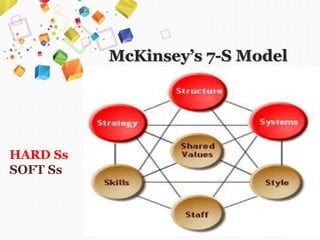
McKinsey’s 7-S Model
HARD Ss
SOFT Ss
BASIS OF MODEL
• Deals organizational change
• Interconnected
• No Implied hierarchy
• Equally important
• Change according to organization
PURPOSE
• To show inter-relationship between
elements
• Bring together
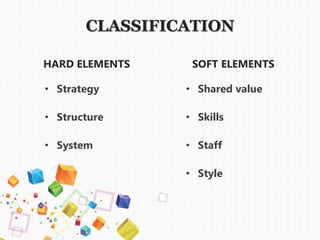
CLASSIFICATION
HARD ELEMENTS
• Strategy
• Structure
• System
SOFT ELEMENTS
• Shared value
• Skills
• Staff
• Style
STRATEGY
• Long term direction
• Plan or course of action in allocating resource to
achieve identified goals over time
• Plan of action an organization prepares in response
to, or anticipation of, change in external
environment
STRUCTURE
• Represents how organizations are organized
• How organizational units are relate to each other:
centralized, decentralized, matrix, network
• Formal relationships
SYSTEM
• Activities and procedures that staff members
engage in to get the job done
• Formal or Informal ; complements the
organizational structure
• Eg:- Cost and Accounting procedure,
Performance Evaluation System
SHARED VALUE
• Super – Ordinate Goals
• Goals of higher order
• Represents the core values and aspirations of the
organization
• Eg: IBM, HP
SKILLS
• Distinctive Capabilities
• Eg: HL - marketing
TELCO - engineering
IBM - customer service
SON Y - new product development
STAFF
• Company’s people resources and how they are
developed , trained and motivated
• 3 aspects: Select, Develop, Motivate
• Key issues: Selection, Reward, Recognition,
Motivation
STYLE
• Employees shared and common way of thinking
and behaving
• Leadership style
• Good fit between Culture and Strategy
Slide Title
MERITS OF 7-S FRAMEWORK
• Highlights organizational interconnections and
their role in affecting change
• Brings all 7-S s in Harmony
• If in good alignment, organization is energized to
execute strategy to the best of its ability
• Provides a convenient checklist for judging
whether an organization is ready for implementing
strategy
• Helps strategists in evaluating organizational
strengths and weaknesses
LIMITATIONS OF 7-S FRAMEWORK
• Shows that relationships exists and it provides
some limited clues as to what constitutes more
effective strategy implementation
• Not precise
• External environment is not mentioned
• Does not highlight areas: Innovation, Knowledge,
Quality, Customer - driven service
USES OF 7-S FRAMEWORK
• To understand how the organizational elements
are inter-related
• To identify what needs to be realigned so as to
improve performance
• To identify the gaps and inconsistencies between
the current position and future position of the
company
CONCLUSION
• The McKinsey 7-S model can be applied to
elements of a team or project as well
• Inconsistency between some of the elements can
be identified out by this classic model
Mc kinsey’s 7 s model

Mc kinsey’s 7 s model

  • 1.
  • 2.
    HISTORY • First mentionedin “The Art of Japanese Management” by Richard Pascale & Antony Athos (1981) • Appeared in “In search of Excellence” by Robert J. Waterman & Tom Peters (1982) • Consultants at McKinsey & Company
  • 3.
  • 4.
    BASIS OF MODEL •Deals organizational change • Interconnected • No Implied hierarchy • Equally important • Change according to organization
  • 5.
    PURPOSE • To showinter-relationship between elements • Bring together
  • 6.
    CLASSIFICATION HARD ELEMENTS • Strategy •Structure • System SOFT ELEMENTS • Shared value • Skills • Staff • Style
  • 7.
    STRATEGY • Long termdirection • Plan or course of action in allocating resource to achieve identified goals over time • Plan of action an organization prepares in response to, or anticipation of, change in external environment
  • 8.
    STRUCTURE • Represents howorganizations are organized • How organizational units are relate to each other: centralized, decentralized, matrix, network • Formal relationships
  • 9.
    SYSTEM • Activities andprocedures that staff members engage in to get the job done • Formal or Informal ; complements the organizational structure • Eg:- Cost and Accounting procedure, Performance Evaluation System
  • 10.
    SHARED VALUE • Super– Ordinate Goals • Goals of higher order • Represents the core values and aspirations of the organization • Eg: IBM, HP
  • 11.
    SKILLS • Distinctive Capabilities •Eg: HL - marketing TELCO - engineering IBM - customer service SON Y - new product development
  • 12.
    STAFF • Company’s peopleresources and how they are developed , trained and motivated • 3 aspects: Select, Develop, Motivate • Key issues: Selection, Reward, Recognition, Motivation
  • 13.
    STYLE • Employees sharedand common way of thinking and behaving • Leadership style • Good fit between Culture and Strategy
  • 14.
  • 15.
    MERITS OF 7-SFRAMEWORK • Highlights organizational interconnections and their role in affecting change • Brings all 7-S s in Harmony • If in good alignment, organization is energized to execute strategy to the best of its ability • Provides a convenient checklist for judging whether an organization is ready for implementing strategy • Helps strategists in evaluating organizational strengths and weaknesses
  • 16.
    LIMITATIONS OF 7-SFRAMEWORK • Shows that relationships exists and it provides some limited clues as to what constitutes more effective strategy implementation • Not precise • External environment is not mentioned • Does not highlight areas: Innovation, Knowledge, Quality, Customer - driven service
  • 17.
    USES OF 7-SFRAMEWORK • To understand how the organizational elements are inter-related • To identify what needs to be realigned so as to improve performance • To identify the gaps and inconsistencies between the current position and future position of the company
  • 18.
    CONCLUSION • The McKinsey7-S model can be applied to elements of a team or project as well • Inconsistency between some of the elements can be identified out by this classic model