KNOWLEDGE
MANAGEMENT
PRESENTED BY:
PRIYANKA KHANNA
SAKSHI NAGPAL
ABSTRACT STUDY
• What is knowledge?
• What are the different types of knowledge?
• Where does knowledge reside?
• What is knowledge management?
• What is the purpose of knowledge management?
• What is a knowledge culture?
• Is knowledge management unique?
• How is knowledge management different from other fields?
• Why is knowledge management important?
• What are the benefits of knowledge management?
• How is knowledge management evolving in the market?
• What are the key elements of a knowledge process?
• What is included in knowledge management planning?
• How do we create knowledge?
• What are the components of a knowledge management strategy?
• How is knowledge managed effectively?
• How do you prevent knowledge loss in the business?
• What is the future of knowledge management within the business environment?
KNOWLEDGE
• Knowledge is a level higher than information
• It is a mix of contextual structured and unstructured raw material that is transferred
into valuable facts and figures as an assets
• It can be:
 renewed
 grown
 acted upon
“It is not only personal, it is also an evolutionary mental process – we formulate and
structure what we know”
TYPES OF KNOWLEDGE
• Explicit knowledge:
Knowledge which is expressed in words and numbers and shared in the form of;
Data,
scientific formulae,
product specifications,
Manuals,
universal principles, etc
This knowledge type can be readily transmitted across individuals formally and systematically.
• Tacit knowledge:
Knowledge which is something not easily visible and expressible
WHERE THE KNOWLEDGE
RESIDES?
• Structured Information
• Unstructured Information
• Expertise
KNOWLEDGE MANAGEMENT
• It is a collaborative work environment in which all untapped
and unconnected knowledge is systemically collected,
structured, and distributed enterprise-wide to support effective
decision making and improvement of competitive advantage
Components…
• Generating new knowledge
• Accessing valuable knowledge from external sources
• Using accessible knowledge in decision-making
• Embedding knowledge in processes, products and services
• Representing knowledge in documents, databases, and software
• Facilitating knowledge growth through culture and incentives
• Transferring existing knowledge into other parts of the organization
• Measuring the value of mission-critical knowledge assets.
purpose…
• to deliver value to an organization
• to harness knowledge resources and knowledge capabilities
• to learn and adapt to its changing environment
• Process: acquisition, creation, packaging, and application or reuse of
knowledge.
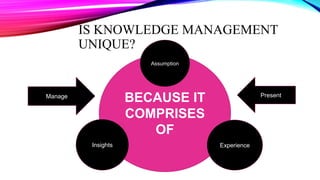
IS KNOWLEDGE MANAGEMENT
UNIQUE?
BECAUSE IT
COMPRISES
OF
Manage
Insights
Assumption
Experience
Present
Importance…
Accelerated pace of change
Growth in organization scope – geographic dispersion associated with
globalization of markets
Global integration
Increase in networked organizations
Growing knowledge-intensity of goods and services
Revolution in enabling technology
components of a knowledge
management strategy…
Appoint a Chief Knowledge Officer – CKO
Develop the Knowledge Management Strategy
Strengthen management’s commitment
Integrate Knowledge Management into core work processes
Create a discipline
Deploy technologies for enabling knowledge
Establish methods for measuring the benefits of knowledge
management
WHAT IS THE FUTURE OF
KNOWLEDGE MANAGEMENT WITHIN
THE BUSINESS ENVIRONMENT
• It leads to long-term program strategic commitment
• It involves a correct understanding
• It helps in know- how in the business
• It also helps in strategic resource planning {productivity}
• It act as stability factor in an unstable and dynamic competitive environment
• It also overcome obstacles and barriers
• It builds the long term building of relationships
• It leads to exchange of ideas and information
Ism resrch ppr

Ism resrch ppr

  • 1.
  • 2.
    ABSTRACT STUDY • Whatis knowledge? • What are the different types of knowledge? • Where does knowledge reside? • What is knowledge management? • What is the purpose of knowledge management? • What is a knowledge culture? • Is knowledge management unique? • How is knowledge management different from other fields? • Why is knowledge management important? • What are the benefits of knowledge management? • How is knowledge management evolving in the market? • What are the key elements of a knowledge process? • What is included in knowledge management planning? • How do we create knowledge? • What are the components of a knowledge management strategy? • How is knowledge managed effectively? • How do you prevent knowledge loss in the business? • What is the future of knowledge management within the business environment?
  • 3.
    KNOWLEDGE • Knowledge isa level higher than information • It is a mix of contextual structured and unstructured raw material that is transferred into valuable facts and figures as an assets • It can be:  renewed  grown  acted upon “It is not only personal, it is also an evolutionary mental process – we formulate and structure what we know”
  • 4.
    TYPES OF KNOWLEDGE •Explicit knowledge: Knowledge which is expressed in words and numbers and shared in the form of; Data, scientific formulae, product specifications, Manuals, universal principles, etc This knowledge type can be readily transmitted across individuals formally and systematically. • Tacit knowledge: Knowledge which is something not easily visible and expressible
  • 5.
    WHERE THE KNOWLEDGE RESIDES? •Structured Information • Unstructured Information • Expertise
  • 6.
    KNOWLEDGE MANAGEMENT • Itis a collaborative work environment in which all untapped and unconnected knowledge is systemically collected, structured, and distributed enterprise-wide to support effective decision making and improvement of competitive advantage
  • 7.
    Components… • Generating newknowledge • Accessing valuable knowledge from external sources • Using accessible knowledge in decision-making • Embedding knowledge in processes, products and services • Representing knowledge in documents, databases, and software • Facilitating knowledge growth through culture and incentives • Transferring existing knowledge into other parts of the organization • Measuring the value of mission-critical knowledge assets.
  • 8.
    purpose… • to delivervalue to an organization • to harness knowledge resources and knowledge capabilities • to learn and adapt to its changing environment • Process: acquisition, creation, packaging, and application or reuse of knowledge.
  • 9.
    IS KNOWLEDGE MANAGEMENT UNIQUE? BECAUSEIT COMPRISES OF Manage Insights Assumption Experience Present
  • 10.
    Importance… Accelerated pace ofchange Growth in organization scope – geographic dispersion associated with globalization of markets Global integration Increase in networked organizations Growing knowledge-intensity of goods and services Revolution in enabling technology
  • 11.
    components of aknowledge management strategy… Appoint a Chief Knowledge Officer – CKO Develop the Knowledge Management Strategy Strengthen management’s commitment Integrate Knowledge Management into core work processes Create a discipline Deploy technologies for enabling knowledge Establish methods for measuring the benefits of knowledge management
  • 12.
    WHAT IS THEFUTURE OF KNOWLEDGE MANAGEMENT WITHIN THE BUSINESS ENVIRONMENT • It leads to long-term program strategic commitment • It involves a correct understanding • It helps in know- how in the business • It also helps in strategic resource planning {productivity} • It act as stability factor in an unstable and dynamic competitive environment • It also overcome obstacles and barriers • It builds the long term building of relationships • It leads to exchange of ideas and information